Prioritize…
After reading this section, you should be able to:
- define what the thermohaline circulation is and what “thermo-” and “haline-” mean in the context of ocean dynamics.
- qualitatively describe the motions of the thermohaline circulation and how it moves warm and cold water (and therefore energy) in the climate system.
Read…
In the last lesson, we mentioned there were two components to ocean circulation. We spoke extensively about the surface gyres, Ekman pumping, and upwelling. All of these are driven by wind “pushing” and “pulling” on the ocean surface. So what is the second component of the circulation?
An important additional mode of ocean circulation is the thermohaline circulation, which is sometimes referred to as the meridional overturning circulation or MOC for short. The term “thermohaline” combines two key components: “thermo” refers to temperature (how warm or cold the water is), and “haline” refers to salinity (how salty or fresh the water is). Therefore, “thermohaline” describes ocean currents and processes that are driven by differences in water temperature and salinity. The circulation pattern is shown below:
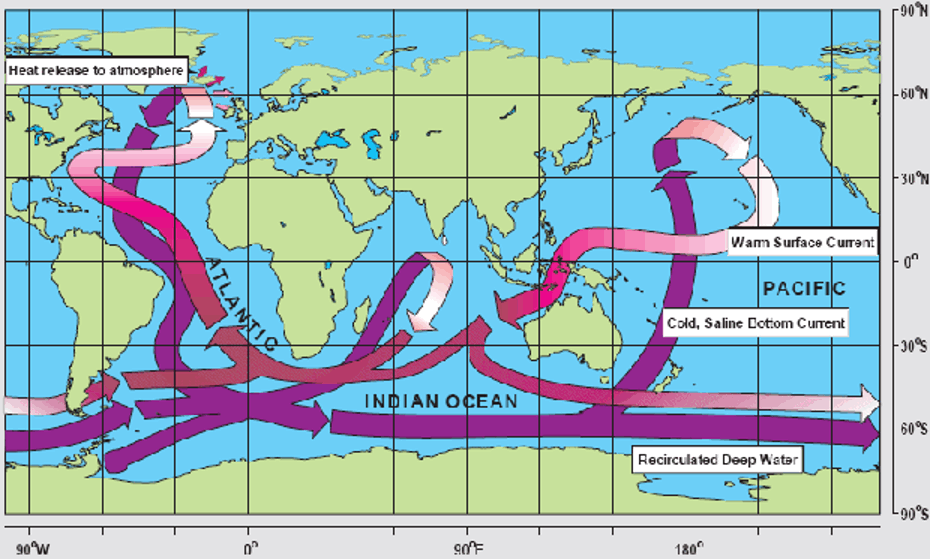
The therrmohaline circulation functions differently from the surface wind-driven currents we just learned about. Instead of horizontal movements across the ocean’s surface, thermohaline circulation involves a vertical flow pattern that spans the ocean’s depths.
Much like the Hadley circulation in the atmosphere, the thermohaline circulation can be thought of as a giant conveyor belt moving water up and down throughout the ocean. In the North Atlantic, near the pole, water becomes very cold and salty, making it denser and causing it to sink deep into the ocean. This sinking action creates a sort of vacuum, pulling water from other regions to replace it. To balance the water being pulled down, more water must flow in from elsewhere—otherwise, we’d end up with a giant divot in the center of the Atlantic!
In contrast, in warmer tropical and subtropical regions, like the Indian and Pacific Oceans, water tends to be warmer and less salty. This lighter, less dense water rises to the surface to fill the gaps left by the sinking cold water in the North Atlantic.
The main driving forces behind this circulation are differences in water density, primarily due to variations in temperature and salinity. Similar to the atmosphere, warmer water is less dense and tends to rise, while colder, saltier water is denser and sinks.
This balance of rising and sinking water plays a crucial role in regulating Earth’s climate by redistributing heat. It acts like a massive heat pump, moving warmth from the tropics toward the poles, helping to moderate temperatures in different regions.
Take a look at the schematic above. It’s worth mentioning that this is a somewhat simplified view of the actual vertical circulation patterns in the ocean—they are, in reality, much more complex. Still, you get the idea of how this circulation resembles a conveyor belt.
You might also notice, “Hey, I see the Gulf Stream in both sections!” You know, that current that is moving towards the north off of the eastern half of the United States. But hold on—that’s not quite right. The Gulf Stream is primarily driven by winds, not by the temperature or salinity of the water. When we talk about the thermohaline circulation, the northward extension in the North Atlantic is better known as the North Atlantic Drift. Like the Gulf Stream, this current also involves the net transport of warm surface waters to higher latitudes in the North Atlantic. Ultimately, the goal is to transfer that extra energy from the tropics to the poles!
Quiz Yourself…
Thermohaline shutdown?
Hopefully, I’ve convinced you by now that ocean currents, including the thermohaline circulation, play a crucial role in redistributing heat across the globe.
Within the thermohaline circulation, there are various components, much like the different currents we discussed in the context of wind-driven circulation. One of the most important of these is the Atlantic Meridional Overturning Circulation (AMOC). As we saw earlier, the North Atlantic Drift—a key part of AMOC—carries warm surface waters from the tropics to the North Atlantic, where they cool and sink, forming a deep ocean current that flows southward. This movement helps redistribute heat globally, influencing weather patterns and climate conditions, especially in regions like northern Europe.
Recent research suggests that AMOC may be approaching a “tipping point” where its behavior could change dramatically. Previous studies indicate that AMOC has two stable modes: a “strong” mode, which efficiently transports warm water into the North Atlantic, moderating the climate of northern and Western Europe, and a “weak” mode, where this transport is significantly reduced. Some scientists believe that current conditions may be pushing AMOC towards a transition from its strong state to a weaker one, leading to numerous—sometimes sensational—news articles warning of a potential climate crisis.
This possible shift to a weaker AMOC state is largely driven by the influx of cold, fresh water from the melting Greenland ice sheet (we’ll delve deeper into this topic in a few lectures). This freshwater disrupts the thermohaline circulation by reducing the salinity and density of the ocean water, which in turn weakens the sinking motion in the North Atlantic. If AMOC slows down, less heat will be transported to the North Atlantic, reducing its moderating effect on the climate of northern and Western Europe. As a result, these areas could experience colder conditions that are more typical of regions at similar latitudes, like Canada and Russia. Additionally, decreased heat transfer to the North Atlantic could lead to further warming in the southern Atlantic and surrounding areas. While the most significant impacts are expected in regions directly influenced by AMOC, broader changes in global temperature and precipitation patterns are also anticipated.
One thing worth noting is that it is best to think of these potential changes as a “tipping point” rather than a true collapse. For example, in the 2004 movie “The Day After Tomorrow,” the AMOC circulation plays a key role!
Clip from Day After Tomorrow
Newscast announcer: What you're seeing is what's left of downtown Los Angeles.
Speaker 1: Hey, man, I just got off the phone from my mom.
Speaker 2: Um, Excuse me, you guys. I'm really sorry, but we need to change the channel.
Newscast announcer: The FAA has grounded all air traffic in the United States. Unfortunately, the order came too late for two planes that were brought down by severe turbulence in the Midwest. The first flight-So much for one in a billion.
Tom: All right, all right, listen up, everybody. Listen up, please. We've got a lot of work to do, and we don't have much time, so let's get started, please. Vorsteen.
Vorsteen: All our grid models are worthless.
Booker: I don't think grid models are going to be a lot of help here. The Canadians are reporting tremendous circulation moving down from the Arctic. In Siberia, there's a low pressure system unlike anything we've seen, and Australia just saw the strongest typhoon ever recorded.
Lanson: Hang on, are you saying that these things are interconnected?
Booker: We have to consider the possibility.
Lanson: The only force strong enough to affect global weather is the sun.
Tom: What's NASA have to say?
Janet: We've already checked. Solar output is normal.
Jack Hall: What about the North Atlantic current?
Speaker: What about it?
Jack: I got a call last night from Professor Rapson at the Headland Center. He thinks the current has changed.
Booker: Come on, Jack. How could that be?
Jack: The current depends upon a delicate balance of salt and fresh water.
Tom: We all know that.
Jack: Yes, but no one has taken it into account how much fresh water has been dumped into the ocean because of melting polar ice. I think we've hit a critical desalination point.
Janet: It would explain what's driving this extreme weather.
Jack: Headland had some pretty convincing data. They've asked me to feed it into my paleo-climate model to track the next set of events.
Tom: Hold on, Jack. Are you suggesting these weather anomalies are going to continue?
Jack: Not just continue. Get worse. I think we're on the verge of a major climate shift.
Jack: Tom, what are you going to tell the administration?
Tom: What do you expect me to tell?
Jack: The government has to start making long-term preparations now.
Tom: Jack, all you have is a theory.
Jack: Well, then give me the mainframe and let me prove it.
Tom: No……You have 48 hours.
Janet: Professor Hall. Yes. I think your theory may be correct. Go off with me. Just a few weeks ago, I monitored the strongest hurricane on record. The hail, the tornado, it all fits. Can the model you're working on factor in storm scenarios?
Jason: We haven't had the time.
Janet: Maybe I can help.
Jack:
Welcome aboard.
Janet: Thanks.
Jason: Hi, I'm Jason.
Wow, the collapse of this circulation resulted in incredible and immediate shifts in day-to-day weather! Hail in Tokyo, tornados in Los Angeles, planes and helicopters “flash freezing” and falling out of the sky. Do not worry; this is highly sensationalized! Even relatively “abrupt” changes in AMOC do not happen overnight; they take years to decades to become apparent due to the ocean's size and the timescales at play. There is also no evidence that a slowdown of the AMOC (like that in the movie) would lead to global anomalous weather events that cause immediate and severe harm around the world.
However, this does not mean changes in AMOC would not result in societal impacts. In reality, the effects of such changes would be more gradual and localized, potentially altering weather patterns and marine ecosystems in specific regions rather than triggering instant, catastrophic consequences on a global scale. Despite the concerns raised by recent research, uncertainties remain regarding the specifics of AMOC transitions and the exact timing of potential collapses. There remain ongoing debates within the scientific community and the need for further research to better understand the implications of AMOC changes.