Prioritize…
After reading this section, you should be able to:
- describe how friction from winds in the atmosphere drives circulation patterns in the ocean.
- define what a gyre is and explain why the western side of the North Atlantic and North Pacific Ocean basins are warm while the eastern sides are cool.
- define the Ekman spiral and how wind blowing across the ocean surface can pump cool, nutrient-rich water upward in specific parts of the ocean.
Read…
While we have focused primarily on the atmosphere thus far, the oceans, too, play a key role in addressing the radiation imbalance by transporting heat from lower to higher latitudes. The oceans also play a key role in both climate variability and climate change, as we will see. In fact, oceans transport as much as a third of the planet's excess heat from the equator towards the poles, playing a massive role in regulating global temperatures! We will discuss ocean circulation currents, which refer to the continuous movement of seawater in the oceans, driven by various factors including wind, temperature, density differences, and the Earth's rotation. There are two primary components of the ocean circulation. Let's focus on the first one -- the wind-driven circulation.
Wind-Driven Circulation
The first component is the horizontal circulation, characterized by wind-driven ocean gyres. A gyre is a large system – typically circular or spiral-shaped -- of circulating ocean currents, typically spanning an entire ocean basin. These gyres are formed – well, exactly how they sound. Imagine these gyres like planetary-sized whirlpools, with water slowly circulating around an ocean basin like a giant, slow-moving pinwheel. Wind in the atmosphere pushes on water and moves it around. This is not unlike if you take your hand and drag it across a lake – as you do, you induce a current on the surface. This is the frictional force we talked about earlier at work.

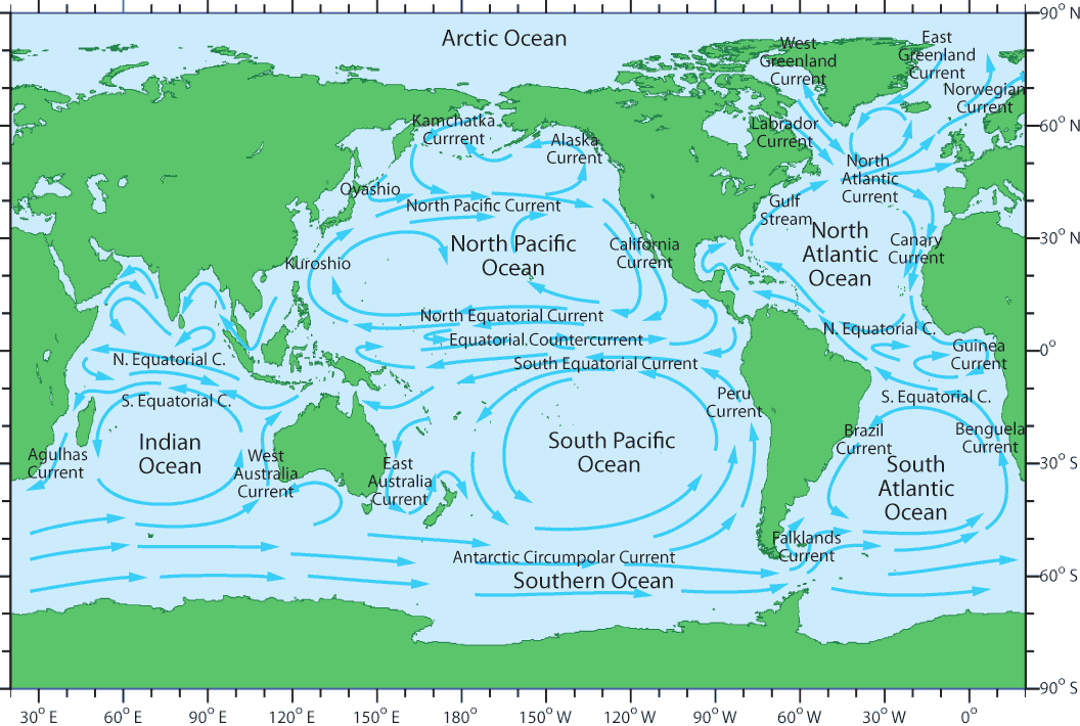
The major surface currents you may have heard of are associated with the ocean gyres. These include the warm poleward western boundary currents such as the Gulf Stream, which is associated with the North Atlantic Gyre, and the Kuroshio Current associated with the North Pacific Gyre. These currents bring warm water from regions closer to the equator and move them poleward. It’s the main reason why it’s relatively pleasant to swim off the Outer Banks in North Carolina, even if the air temperature is relatively chilly.
Check out the map of sea surface temperatures below – that stripe of red, orange, and yellow (warmer waters) moving along the coast and out into the Atlantic Ocean is the Gulf Stream, which is the Atlantic’s western boundary current.

These gyres also contain corresponding cold equatorward (i.e., from higher latitudes to lower latitudes) eastern boundary currents such as the Canary Current in the eastern North Atlantic and the California Current in the eastern North Pacific. These are the opposite of what we just discussed, as they are currents that take cool water towards tropical regions. If you’ve visited Los Angeles, California and gone swimming in the Pacific Ocean, you may have been surprised at how cold the water felt even if it was 85 degrees outside. That is largely due to the eastern boundary current moving southward along the United States’ west coast. So warm water on the east coast, cool water on the west coast -- now you can impress your friends by telling them it's all due to ocean gyres!
Similar current systems are found in the Southern Hemisphere, where the horizontal patterns of ocean circulation mirror those in the Northern Hemisphere. This symmetry is driven by the alternating patterns of wind as a function of latitude, which are part of the broader atmospheric circulation we discussed quite recently! The trade winds blow predominantly from the east in the tropics, while the westerlies prevail in the mid-latitudes. These wind patterns exert a significant influence on ocean currents, pushing surface waters in predictable directions. Check out the below map of global surface currents – in general, water moves from east to west close the equator (pushed by the trade winds) and west to east in the mid-latitudes (pushed by the prevailing westerlies). To close the loops, water must move north or south in the regions we discussed above!
Quiz Yourself…
Ekman Pumping and Upwelling
Before moving on, let’s touch on an important phenomenon in ocean circulation closely tied to the wind-driven circulation.
We just talked about how the wind “drags” ocean water along with it. Now, you’d probably just expect that the water just starts moving along with the wind, right? But it doesn't happen exactly like that because the Earth is rotating. This rotation makes things on the Earth's surface, like ocean currents, move to the right in the Northern Hemisphere and to the left in the Southern Hemisphere. Aha, the Coriolis force is back!
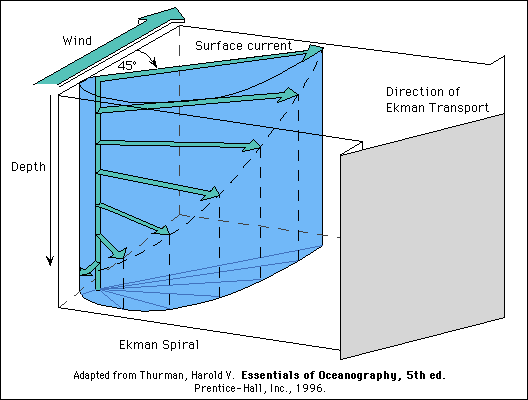
Now, this is where it gets a bit twisty … literally! The wind starts pushing the water, but due to the Earth’s rotation, the water doesn't just move in the direction of the wind; it moves at an angle to it. And each layer of water below the surface moves at a slightly different angle than the one above, creating a kind of spiral staircase of water movement under the sea. This pattern is what we see in the image as the “Ekman spiral.” Take a look at the image below – the little green arrows represent the spiraling ocean direction with depth.
Because of this spiraling effect, the water on the surface doesn't just go in the direction the wind is blowing. Instead, there's what we call the “Ekman transport,” which is the average movement of all these spiraling layers of water. In the end, this means that the water at the surface tends to move at a 90-degree angle to the direction of the wind. If the wind is blowing from north to south, the water on the surface will end up moving to the west in the Northern Hemisphere and to the east in the Southern Hemisphere.
As surface water is pushed away by the wind-induced Ekman transport, a void is created. Nature abhors a vacuum, so deeper water from below rises to fill this void. This upward movement of deeper water to replace the surface water that has been transported away is known as Ekman pumping.
Ekman pumping is a bit like the ocean taking a breath, since it brings water from deeper down to the surface. It plays a role in distributing heat throughout the ocean, which helps to moderate the global climate. The upwelling water is typically cooler and can lower sea surface temperatures. Done over large enough areas and for a long enough time, it can influence atmospheric conditions and alter weather patterns over vast areas. Beyond its climatic impact, Ekman pumping serves as an underwater nutrient source. As it uplifts water from the abyss, it carries with it various nutrients that have been locked away in the dark. Upon reaching the sunlit upper layers, they fertilize the water, providing a bounty for phytoplankton, the tiny but mighty organisms that support the marine ecosystem. This process not only fuels phytoplankton, but it’s the reason coastal areas like California are teeming with marine life—from fish to dolphins to the flocks of seabirds you see diving for a meal.
Coastal Upwelling
Relatedly, coastal upwelling is a phenomenon that occurs along coastlines where winds blow parallel to the shore, driving surface water away from the coast. This offshore movement of surface water creates a void along the coastline, which is swiftly filled by deeper water welling up from below, a process known as upwelling.

The primary driving force behind coastal upwelling is wind stress exerted on the ocean surface. Along many coastlines, particularly those with strong, persistent winds such as the west coasts of continents, prevailing winds blow parallel to the shore, known as alongshore winds. These winds generate a phenomenon known as Ekman transport, where surface water is pushed offshore due to the Coriolis effect.
As surface water moves away from the coast, it is replaced by deeper, colder, and nutrient-rich water that wells up from below. This upwelled water originates from deeper layers of the ocean, where nutrient concentrations are typically higher due to biological processes and the accumulation of organic matter.
Coastal upwelling and Ekman pumping, though related, are distinct processes in ocean circulation. Ekman pumping primarily results from wind-induced Ekman transport, where friction between wind and the ocean's surface causes surface water to diverge, allowing deeper water to rise and replace it. This process occurs not only along coastlines but also in open ocean regions where wind-driven surface currents diverge. In contrast, coastal upwelling specifically occurs along coastlines where persistent winds blow parallel to the shore, driving surface water offshore and allowing deeper, nutrient-rich water to upwell. While both processes involve the upward movement of nutrient-rich water to the surface, coastal upwelling is more localized and directly linked to coastal wind patterns, whereas Ekman pumping operates on a broader scale.

In regions where coastal upwelling and Ekman pumping coincide, the combination of nutrient inputs from deep water upwelling and surface water divergence leads to exceptionally high levels of biological productivity. Phytoplankton thrive in these nutrient-rich waters, supporting abundant fisheries and diverse marine ecosystems.. Nutrient inputs from upwelling fuel the growth of phytoplankton, which form the base of the marine food web. This abundance of primary producers supports thriving populations of zooplankton, fish, seabirds, and marine mammals. In the end, these ocean currents don’t just move water!