Prioritize...
After reading this section, you should be able to:
- describe the three main cells in the atmosphere and explain why we don’t just have one single atmospheric cell like we hypothesized.
- state where each cell is located and whether the cells are thermally-direct or thermally-indirect and how their rising and sinking motions can lead to broad latitudes of wet or dry climates.
Read...
However, what we observe in the atmosphere is a bit more complicated. There really isn’t just a single cell in the atmosphere like we hypothesized a little while ago. In fact, what we observe looks more like this below.
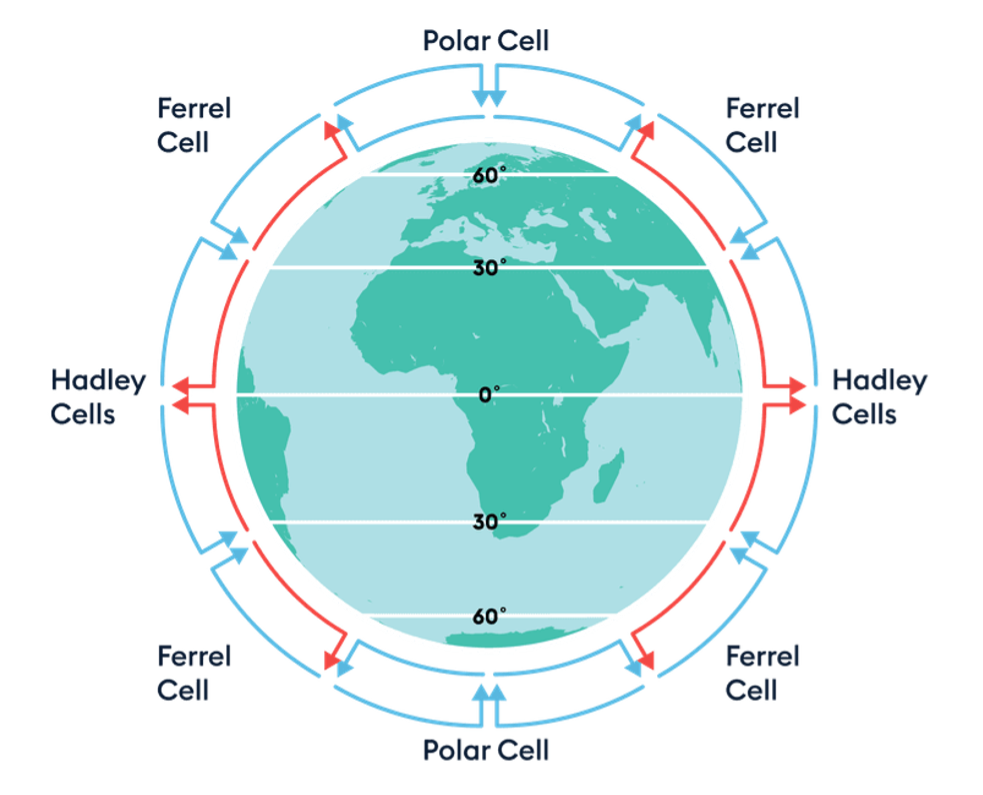
This is because the Earth is rotating. Without this rotation, things would be simple, just like we thought in the previous section! But unfortunately, Earth's rotation complicates matters…
To understand how this rotation impacts global circulation, let’s focus on the Northern Hemisphere for simplicity (the same general process happens in the Southern Hemisphere, but remember—the Coriolis force acts in the opposite direction there).
Recall that we mentioned the Coriolis force causes air to move to the right in the Northern Hemisphere. So, in our non-rotating Earth example, air rises at the equator and then moves directly toward the poles. However, since the Earth rotates, this air can’t travel in a straight line. Instead, it bends to the right as it moves from south to north. This bending starts turning the wind—first toward the northeast, and eventually toward the east. In short, this deflection prevents the Hadley cell from spanning the entire hemisphere; it only reaches about 30 degrees latitude. At this point, the air that rose in the tropics begins descending in a belt known as the "subtropics."
Within the subtropics, the descending air diverges, with some moving poleward and some equatorward. The air that flows back toward the equator near the surface also experiences the Coriolis force, bending to the right. This contributes to the formation of the surface trade winds, also called the easterlies.
Meanwhile, some of the air that descends in the subtropics moves north once it reaches the surface. From there, it forms another important circulation pattern known as the Ferrel cell, which operates between roughly 30 and 60 degrees latitude in both hemispheres. In the upper atmosphere of the Ferrel cell, air moving toward the equator is deflected westward by the Coriolis force. Air in the lower branch moving northwards is deflected to the east, producing the Westerlies. As a result, just as the easterly Trade Winds occur below the Hadley cell, the surface Westerlies are found beneath the upper branch of the Ferrel cell.
The Ferrel cell is relatively weak because it lacks both a strong heat source and a strong sink. This makes the airflow and temperatures within it more variable, which is why the latitudes it spans are sometimes referred to as the "zone of mixing.” The easterly Trade Winds in the Hadley circulation face few obstacles, as the Hadley cell is strong and undisturbed by large terrain features or high-pressure zones. In contrast, the weaker Westerlies of the Ferrel cell can be easily disrupted. For example, the passage of a cold front can change wind direction in a matter of minutes. While surface winds in the Ferrel cell are more variable, winds higher up, away from terrain disruptions, remain predominantly westerly. A low-pressure zone at 60° latitude moving toward the equator, or a high-pressure zone at 30° latitude moving poleward, can accelerate the Westerlies. A strong high moving poleward may bring westerly winds for several days.
Further poleward, closer to the poles, we find the Polar cell, which operates between approximately 60 and 90 degrees latitude in both hemispheres. In the Polar cell, cold air descends and moves toward lower latitudes. As it moves toward the equator, it’s deflected by the Coriolis force, creating polar easterlies.

The Polar cell is a simpler system driven by strong convection. Though colder and drier than equatorial air, the air masses at 60 degrees latitude are still warm and moist enough to drive convection and create a thermal loop. Here, air rises to the tropopause (about 8 km at this latitude) and moves poleward. As it does, the upper-level air is deflected eastward by the Coriolis force. When the air reaches the polar regions, it has cooled through radiation to space and becomes denser than the underlying air, causing it to descend and create a cold, dry high-pressure area. At the polar surface, the air moves away from the pole, replacing the air that rose earlier, completing the polar circulation cell. As this surface air flows toward the equator, it is deflected westward again by the Coriolis force, creating the polar easterlies. These winds flow from northeast to southwest in the Northern Hemisphere and from southeast to northwest in the Southern Hemisphere.
Quiz Yourself…
As we learned recently, Hadley and Polar cells are termed thermally direct because their circulation patterns are primarily driven by temperature differences. In the case of the Hadley cell, warm moist air rises at the equator due to intense solar heating, creating a low-pressure zone, while cooler drier air descends at higher latitudes, particularly around 30 degrees latitude, creating a high-pressure zone. This temperature contrast sets up a direct circulation pattern where air moves from regions of high pressure to low pressure (equator to subtropics). Similarly, in the Polar cell, cold, dry dense air descends at the poles due to lower temperatures, creating a high-pressure zone, while warmer, moist buoyant air rises at lower latitudes, creating a low-pressure zone. This temperature contrast also establishes a direct circulation pattern from high to low pressure (poles to mid-latitudes).
On the other hand, the Ferrell cell is termed thermally indirect because its circulation is not primarily driven by temperature differences. Instead, it exists because of the interactions between the Hadley and Polar cells. The Ferrell cell is located between these two larger cells, around 30 to 60 degrees latitude in both hemispheres. The descending air in the subtropics from the Hadley cell and the rising air in the mid-latitudes from the Polar cell set up a pattern where warmer air is sinking and cooler air is rising – the opposite of what you’d expect based on what we discussed earlier – making it thermally indirect.
The Hadley cell and the Polar cell exhibit similarities in their thermal directness, meaning they are both primarily driven by temperature differentials. Their thermal characteristics dictate the weather patterns within their respective regions. The Hadley circulation transports energy poleward from the equator out to about 30 degrees of latitude. Out to 15 degrees of latitude, it is the dominant mode of poleward energy transport, and from 15 degrees to 30 degrees other (transient) weather processes come to dominate it. Similarly, the thermally direct Polar cell also constantly works to transport energy poleward, though as a percentage of the total energy transport it is swamped by (transient) weather events.
The perpetual succession of highs and lows, a common occurrence in the daily lives of those residing in mid-latitudes under the influence of the Ferrel cell, is virtually absent beyond the 60th and below the 30th parallels. There are noteworthy exceptions to this general pattern; for instance, over Europe, unstable weather patterns extend as far north as the 70th parallel.

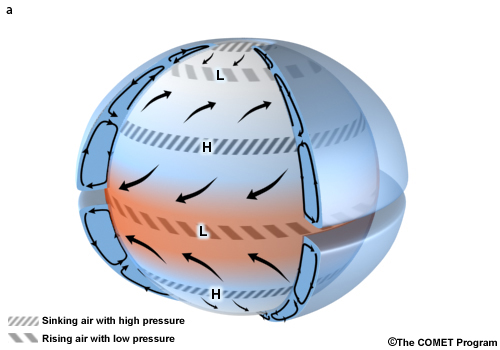
But it’s worth noting that these cells go far beyond just distributing heat -- they play a pivotal role in shaping the global climate by establishing semi-permanent high and low-pressure systems.
In the region of the Hadley cells where air rises, such as the equatorial rainforests, low-pressure zones are prevalent. The rising air cools and condenses, resulting in abundant rainfall characteristic of these areas.
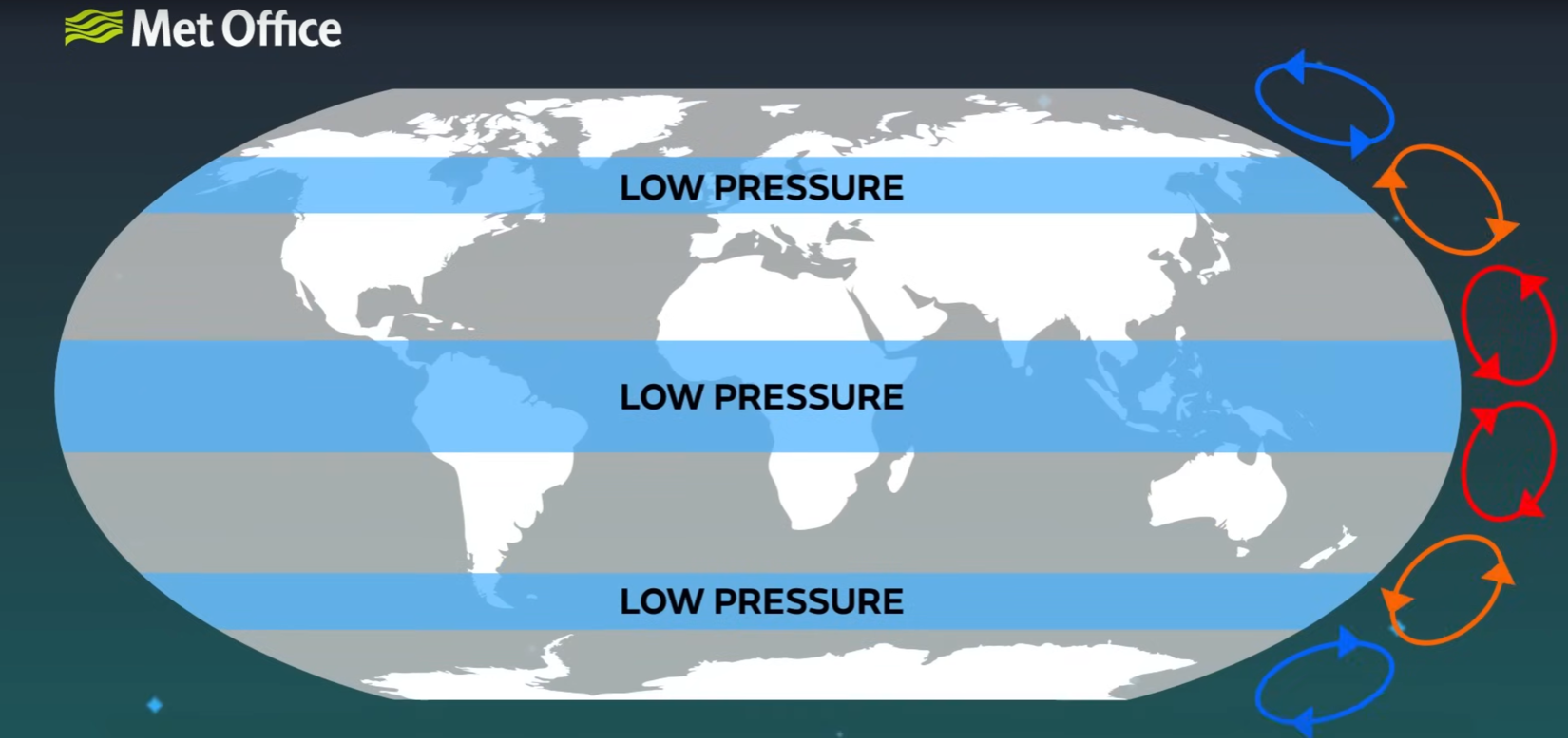
Conversely, areas at the surface under the branches of the Hadley cells where air descends experience high-pressure conditions – this leads to drier climates akin to desert regions.

Watch this video, which synthesizes everything we just talked about! (3:35 minutes)
Narrator: The last video showed that different parts of the Earth heat up differently, with the equator receiving more rates of heat from the Sun than the poles, and the purpose of global circulation is to redistribute this heat. If the Earth did not rotate and was a simple landmass with no oceans, we would have a single circulatory cell in each hemisphere, where hotter air would rise at the equator and flow toward the poles. The air would sink as it cools and then return towards the equator. But the unequal distribution of land and ocean, and the speed of the Earth's rotation, complicates this circulation system, giving us a 3-cell pattern which exists in both the northern and southern hemispheres.
The largest cells are the Hadley cells; at the equator, the warmer, less dense air rises. It rises to a height of about 18 kilometers and spreads out underneath the tropopause. The tropopause acts as a lid to the lowest part of our atmosphere, which contains all of our weather. The warm air spreads out towards the poles, gradually cooling and sinking as it moves before descending to the surface and flowing back to the equator. The smallest cells are the polar cells; cold, dense air descending in the polar regions flows at low levels to about 60 to 70 degrees north or south. As the air leaves the polar regions, it starts to warm and rise, returning to the poles at high levels.
Between the Hadley and polar cells are the Ferrel cells. Unlike the other cells, the Ferrel cells are not driven by temperature. These cells flow in the opposite direction to the Hadley and polar cells, acting like a gear. These circulating cells not only transport heat from the equator to the poles but also result in semi-permanent areas of high and low pressure due to the rising and descending parts of the circulation cells, giving us our climatic zones. Where air is rising, an area of low pressure is created, so these areas see much more rainfall. This is why the largest areas of rainforests are found near the equator, and why the United Kingdom has a relatively wet climate. Where air is descending, an area of high-pressure forms, giving largely clear skies and little rainfall, which leads to the desert regions.
But not all deserts are hot. Antarctica sits under the descending branch of the polar cell and is also classed as a desert. With more precipitation falling in the Sahara, Antarctica is the largest and driest desert. Overall, take a look at our video on atmospheric pressure for more on how pressure leads to weather. Our next video shows how the rotation of the Earth gives us jet streams and prevailing winds.
One fascinating aspect of this phenomenon is the diversity of deserts worldwide. While deserts are often associated with scorching temperatures, the designation extends beyond heat alone. Antarctica, for instance, stands as a stark testament to this notion. Despite its frigid temperatures, Antarctica qualifies as a desert due to its exceptionally low precipitation levels associated with the descending air in the polar cell. This anomaly underscores the nuanced interplay between atmospheric circulation and climatic conditions.