Prioritize…
After completing this section, you should be able to:
- describe how friction from the surface is influenced by the speed of the wind and how rough the surface is.
- describe what aspects of the atmosphere that gravity affects
Read…
Frictionextract
Friction, a concept widely recognized in our daily experiences, refers to the resistance encountered by an object or medium when it interacts with another object or medium during motion. While you may associate friction with solid objects, such as the challenge of trying to drag your furniture around your apartment when redecorating, it also plays a crucial role in fluid dynamics, which means it’s ever present in both atmospheric and oceanic circulations.
Within these realms, we encounter two distinct types of friction: molecular and eddy viscosity. Molecular viscosity is the result of the random movements of molecules that compose a liquid or gas, contributing to the frictional resistance experienced during fluid flow.
However, of greater significance to us in climate science is eddy viscosity, which arises from the much larger and irregular motions known as eddies within fluid substances. An example of the impact of eddy viscosity can be observed in swiftly flowing streams. In such streams, the presence of rocks in the streambed disrupts the smooth flow of water, leading to the formation of turbulent eddies immediately downstream of these obstacles. These eddies, manifest as swirling water patterns, extract kinetic energy from the stream and cause it to slow down. Similarly, on the Earth's surface, obstacles such as trees and buildings create eddies of various sizes to the lee (downwind) of each obstacle, thereby reducing the speed of near-surface winds.
Imagine trying to push a massive box with some new apartment furniture across two surfaces, one smooth (say, a surface-wetted sheet of ice) and one rough (say, a parking lot). Which is easier? Obviously, the smooth surface is because the surface provides less frictional resistance, meaning you don’t have to push as hard to get the box to move.
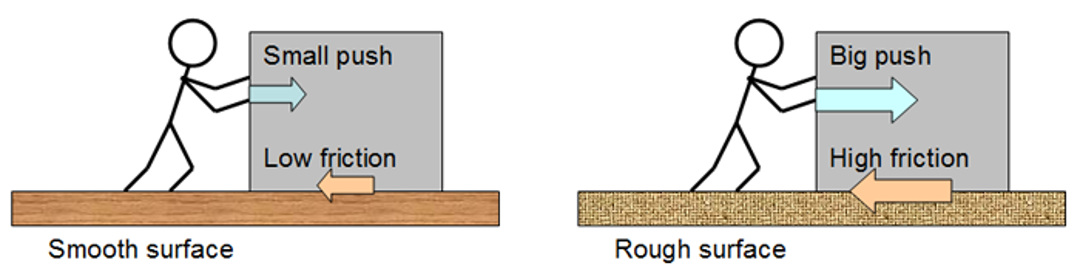
Instead of pushing a box, now think of wind blowing over that surface. Like with the box, the wind encounters less resistance over smooth surfaces and more resistance over rough ones. Friction is always going to slow down our air parcel, thereby always acting exactly opposite to the direction the wind is blowing. The degree of eddy viscosity in the atmosphere depends on the roughness of the surface below. On a particularly windy day, think – are you struggling to hold on to your hat if you are in a wide-open field or under a dense forest canopy? You feel the wind far more in open, flat areas because the relatively smooth surface that lacks irregularities does little to impede the flow of air. However, you are more sheltered under a canopy of trees since they present greater frictional resistance to the wind due to the increased turbulence caused by the objects in the wind’s way.

You can readily see this effect in weather maps, too. For example, above is the output from a model simulation depicting Hurricane Irma's landfall. I don't need to actually show the outlines of the state of Florida; you can figure it out just by looking at where the wind speed changes due to air moving from flowing over the nice, smooth ocean to the much higher friction land. The smooth ocean surface offers little in the way of friction, but the land (with its associated vegetation, buildings, etc.) exerts far more friction on the winds.
As we move above the Earth's surface, away from the primary sources of frictional resistance caused by obstacles on the ground (or the ground itself), this eddy viscosity diminishes rapidly, leading to an increase in horizontal wind speed with altitude. This transition becomes particularly noticeable at an average altitude of approximately 1000 meters (3300 feet) above the surface – above this, friction's influence is essentially negligible. The region in the atmosphere where frictional resistance is most pronounced is referred to as the atmospheric boundary layer.
Gravity
You probably remember countless physics assignments in high school where you had to draw forces on an object (remember a block on an incline?) and instinctually just drew a downward-facing arrow representing the gravitational force. Well, just like any other object with mass, air parcels are subject to the force of gravity, which is the attractive force between Earth and any object near it. Even though it is far less dense than the solids we interact with on a day-to-day basis, the fact that air is also subjected to gravity is a saving grace – without this effect, our atmosphere will escape to space, leaving us to struggle for survival in a vacuum.
Gravity causes objects to accelerate towards Earth's surface at an average rate of 9.8 m/s² (32.2 ft./sec.²). This is considered to be a “universal” constant, although it's important to note that this average assumes a perfectly spherical Earth with uniform mass distribution – this is actually not true. For example, the Earth slightly bulges out near the equator. It’s technically an oblate spheroid, slightly bulging at the equator due to its rotation. This bulge results in slightly lower surface gravity at the equator compared to the poles because the equator is farther from Earth's center of mass. If you stand in Costa Rica, you actually experience less gravity than if you were standing at the North Pole (although it’s imperceptibly small!)

Gravity always acts vertically downward on Earth and does not significantly impact horizontal winds, unlike the Coriolis force and friction. Gravity primarily influences vertical air motion, playing a fundamental role in creating buoyant forces. These forces drive the ascent and descent of air, seen in phenomena like updrafts and downdrafts in convection currents (e.g., thunderstorms) and the downhill drainage of cold, dense air.
In summary, four main forces are important for understanding motion in the climate system:
- The horizontal pressure gradient force, responsible for initiating air motion, continually tries to move air from high-pressure areas toward low-pressure regions.
- The Coriolis force arises from Earth's rotation, deflecting large-scale winds to the right in the Northern Hemisphere and to the left in the Southern Hemisphere. Its magnitude increases with latitude, reaching a maximum at the poles.
- Friction always opposes motion, acting in the opposite direction of the wind and increasing with surface roughness. It primarily affects winds close to the surface.
- Gravity exerts a vertical downward force on air and is critical for impacting upward or downward motions and the vertical structure of the atmosphere.