Prioritize...
After reading this section you should be able to:
- Define what a "feedback" is.
- Differentiate between positive and negative feedback, and explain what each means for the climate system.
- List three feedback mechanisms in the climate system and briefly describe how they generally operate.
Read...
As we've seen, the concept of radiative forcing – whether natural or caused by humans -- is a crucial component in the study of Earth's climate, acting as the initial 'nudge' that can either warm or cool our planet. However, the climate system doesn't always respond in a straightforward manner to these forcings. It's here that I need to introduce the concept of 'feedbacks' — processes that can either magnify or mitigate the effects of the original forcing. These feedbacks are essential in understanding the full scope of climate change, as they often determine the magnitude and rate of a climate response.
OK, consider the climate system as a live concert sound system. The 'forcings' are like the original sound from the instruments and vocals — they start the process of producing music. Now, feedbacks are akin to the soundboard's adjustment knobs that the audio engineer uses to fine-tune the music that the audience hears.
When the engineer turns up a knob (positive feedback), it's like boosting the volume or bass to enhance the sound — this can make the existing music fuller and louder, much like positive feedback mechanisms in the climate can amplify warming. For example, a slight increase in temperature from greenhouse gases can cause more water vapor to enter the atmosphere, which in turn traps even more heat and further warms the planet.
Conversely, if the engineer dials down a knob (negative feedback), it can soften a piercing high note during the concert, maintaining a pleasant listening experience. This is similar to how negative feedback mechanisms in the climate system can counteract warming, like how increased cloud cover might reflect more sunlight away from the Earth's surface, helping to cool the planet.
In this way, just as the audio engineer uses the soundboard to balance the music, Earth's climate system is constantly adjusting through feedback mechanisms to balance the planet's energy budget.
Let’s think about this more concretely. If our planet gets a nudge (like more sunlight or more greenhouse gases), these feedback mechanisms can make the Earth's response stronger or weaker. Where this can be problematic for us is when a positive feedback actually makes things warmer than they would be just from that nudge alone. Check out this schematic below. The center box is the amount of warming, let’s say that arises due to additional CO2 emissions into the atmosphere since the industrial revolution. A positive feedback adds more warming on top of that warming, making the CO2 punch above its weight!
Key Definition:
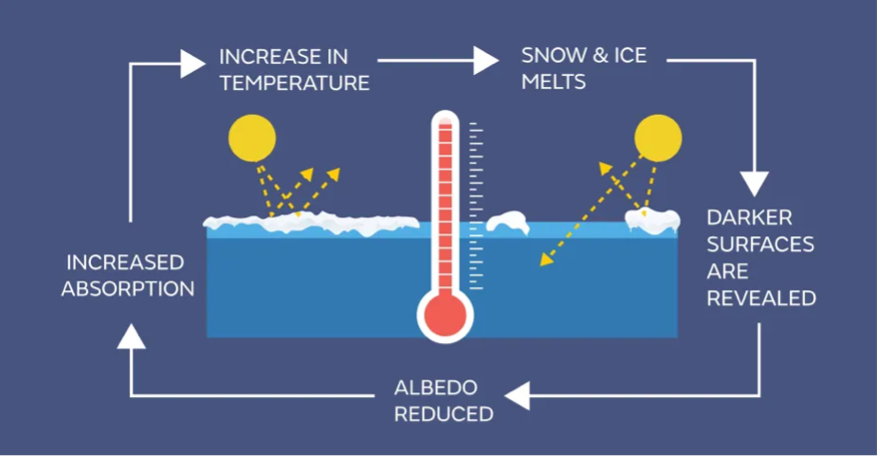
A feedback in the context of climate refers to a process that can either amplify or reduce the impact of an initial change in the Earth's energy budget. For example, a positive feedback might enhance warming, like ice melting, which lowers albedo and leads to more heat absorption. A negative feedback would counteract the change, such as increased cloud cover reflecting more sunlight and cooling the surface.

Let's talk about a few key feedback mechanisms related to climate change:
- Water Vapor Feedback
As we discussed in earlier lessons, as the atmosphere warms, it holds more water vapor. We also know that water vapor is a greenhouse gas, leading to further warming. Luckily, while this is a positive feedback (and amplifies warming) it isn’t a runaway feedback since a warmer, moister atmosphere eventually removes water through precipitation. - Cloud Radiative Feedbacks
How clouds in the atmosphere respond to global warming is incredibly complex and influenced by changes in cloud distribution and type. For example, we know that clouds can both warm the surface by absorbing and mitting infrared radiation or cool it by reflecting sunlight. The overall effect varies with cloud characteristics like type and altitude. This feedback is very complicated, still actively researched, and one of the largest uncertainties in predicting the exact state of future climates. - Ice-Albedo Feedback
As Earth warms up, ice and snow (very bright, reflective surfaces) start to melt, revealing land or water beneath. Both the land and water have lower albedos than the ice, meaning they absorb more solar radiation. Therefore, the removal of ice in a particular region and the pooling of liquid water on top of ice in another region lead to warming in that region via this increased absorption. This warming makes even more ice in the area likely to melt, further accelerating this spiral. This feedback is a classic example of a positive feedback and is relatively easy to visualize. See the below figure!
When we examine all these feedback loops together, they generally amplify the initial warming triggered by any change in our climate. For instance, let's consider a scenario where the CO2 levels in our atmosphere double compared to the pre-industrial era, due to extensive fossil fuel combustion. This would take us from about 280 parts per million CO2 to 560 parts per million (for context, we are currently around 420 ppm). This alone (in the absence of other gases and feedbacks) would lead to a temperature increase of about 1.25°C. However, when we factor in the additional warming from feedback processes, such as the extra heat trapped by increased water vapor or the reduced reflection of solar radiation due to melting ice, the temperature could actually climb by about 2.5°C to 3°C, as suggested by some climate models – which we will learn about in a few lectures.
Quiz Yourself...