Prioritize...
After reading this section, you should be able to:
- Explain what the “Keeling” curve is and place today’s carbon dioxide concentrations in context with those from the past few hundred thousand years.
Read...
So how much has carbon dioxide grown over the past century or so? Before the Industrial Revolution, the atmospheric concentration of carbon dioxide was around 280 parts per million. "Parts per million" (commonly abbreviated ppm) asks the question... given a million molecules in a random parcel of atmosphere, how many of them are carbon dioxide? However, through the burning of fossil fuels like coal, oil, and natural gas, humans have added carbon dioxide to the atmosphere. The concentration of carbon dioxide in the atmosphere now exceeds 420 parts per million, and you can see the upward trend in atmospheric carbon dioxide concentration since the late 1950s in the data from the Mauna Loa Observatory in Hawaii below. We've already observed a 50% increase in the amount of CO2 in the atmosphere over the span of a few human generations.
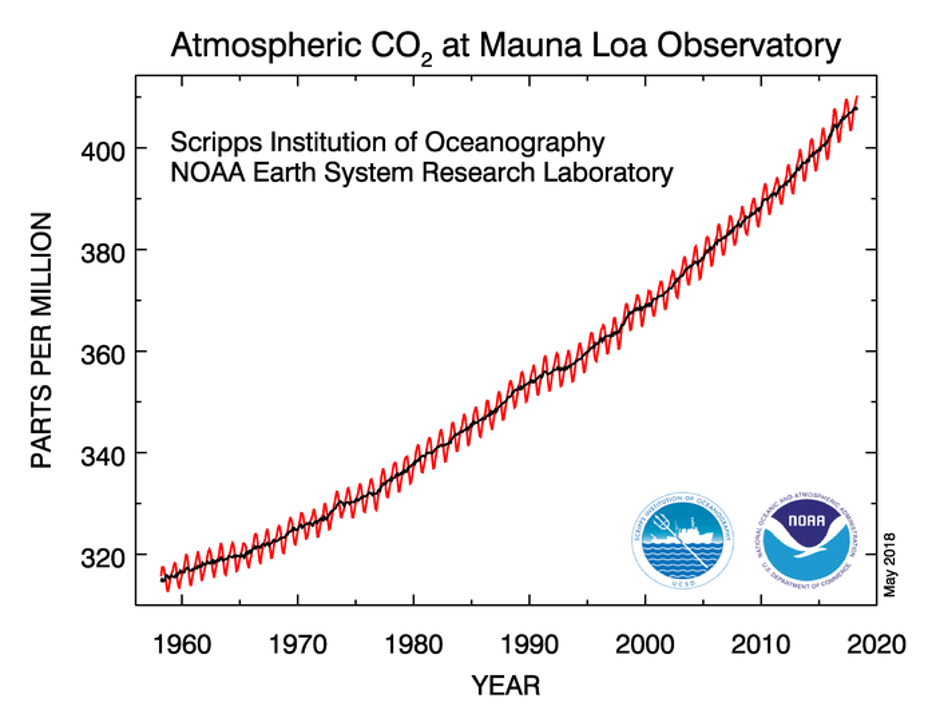
This graph of carbon dioxide (CO₂) over time is iconic. Known as the “Keeling Curve”, it was named after Charles David Keeling, who began consistently measuring atmospheric CO₂ in 1958. The red line reflects the seasonal fluctuations in CO₂ levels—CO₂ decreases during the Northern Hemisphere summer, when widespread plant photosynthesis draws carbon from the atmosphere. However, the black line, representing the long-term average, reveals a steady, unmistakable upward trend over time.
Remember, carbon dioxide is the second most important greenhouse gas after water vapor. Increasing CO₂ concentrations in the atmosphere amplify the greenhouse effect, absorbing more upward directed infrared radiation from the surface, thereby leading to an increase in atmospheric temperature, hence more downward directed infrared radiation as a result of both increasing CO2 concentrations and increased atmospheric temperature. This intensification of energy in the Earth system leads to global warming, which is at the heart of our concerns about climate change.
While the topic of global warming only began to dominate headlines in the late 1980s and 1990s, the idea has been around for much longer. As early as 1903, Swedish scientist Svante Arrhenius, a Nobel Prize-winning chemist, predicted that burning carbon-rich fossil fuels (like coal) would increase CO₂ concentrations and warm the planet. His ideas were largely ignored at the time, not because other scientists doubted the greenhouse effect. Indeed, knowledge of the greenhouse can be traced back to Eunice Foote's research in 1856 and John Tyndall's work in 1859. Rather, incomplete knowledge of Earth's carbon cycle at the time, which we'll study more in depth shortly, did not compel other scientists to fully appreciate the ramifications of such an increase.
Naturally, CO₂ levels have varied throughout Earth's history, but studies of ice cores, which trap air bubbles from the distant past, reveal that the CO₂ concentrations we see today are unprecedented in at least the past hundreds of thousands of years. As the graph below shows, CO₂ levels historically fluctuated between about 180 parts per million (ppm) and 300 ppm for millennia, until the mid-20th century. Since then, however, CO₂ concentrations have skyrocketed, now exceeding 400 ppm, largely due to the burning of fossil fuels.
