Prioritize…
At the completion of this section, you should be able to:
- define radiation, wavelength, and micron.
- discuss the organization of radiation in the electromagnetic spectrum by wavelength, including knowing which types of radiation have longer wavelengths and which have shorter wavelengths, for example).
Read…
So, we’ve now discussed that of the forms of energy, radiant energy (i.e., radiation) plays a central role. If you think of “radiation” and immediately conjure up images from science fiction movies or cautionary stories about nuclear energy, I can understand why! From a scientific perspective, radiation refers to the emission, transfer, and absorption of energy in the form of electromagnetic waves through space or a medium. It serves as a fundamental mechanism for transporting and exchanging energy within Earth's climate system. This encompasses solar radiation, which provides the energy that drives weather patterns and climate, as well as terrestrial radiation emitted by the Earth and its atmosphere.
Origins of Electromagnetic Spectrum of Radiation
During your science classes, you probably explored the electromagnetic spectrum of radiation. However, have you ever wondered about its origins? First, it's essential to recognize that all matter consists of atoms (the fundamental building blocks) and molecules (combinations of atoms). Within these already small structures exist even tinier particles with positive and negative charges, protons and electrons. Molecules tend to rotate andsibrate, and the electrons within them can move from lower energy orbitals to higher ones and vice versa. These movements of and within molecules lead to accelerations of the protons and electrons. Without delving into intricate details, physics teaches us that accelerated charges are the source of electromagnetic waves. It is amazing to think that all of the rotating water molecules around me (and most of the water molecules are indeed rotating!) are producing radiation, much of which strikes and is absorbed by my skin.
Another way to think about this is to imagine your hand as a vibrating molecule and a pond as the surrounding medium through which a wave propagates. Imagine moving your hand rapidly back and forth in the water – this generates waves that ripple out away from your hand and across the surface of the pond. Similarly, oscillating protons and electrons emit energy ripples known as electromagnetic "waves," and these waves propagate in every direction away from the accelerated charges whatever the surrounding medium might be, including the vacuum of space. These waves exhibit both electric and magnetic characteristics, hence the term “electromagnetic wave, or electromagnetic radiation, to describe them." The word “electromagnetic” is commonly abbreviated as “EM.”
Wavelengths
So, what gives rise to the different types of EM waves that form the complete spectrum? First, let's discuss the various categories of EM radiation based on wavelength. The wavelength of any wave is the distance from one identical point on the wave to the next, such as from crest to crest. Let's revisit our earlier analogy with the pond. When you move your hand through the water slowly, you generate a few waves with long wavelengths. Conversely, if you move your hand rapidly, you produce numerous waves with much shorter wavelengths. This same principle applies to an oscillating charge. When the oscillation is exceptionally fast (referred to as high frequency), the resulting EM radiation will have a short wavelength. Conversely, if the oscillation occurs at a slower rate (entailing a lower frequency), the electromagnetic waves will consist of longer wavelengths.

Now, the frequencies at which of charges in molecules can oscillate is primarily determined by the type and arrangement of atoms that compose the molecules.The temperature of the medium in which the molecules are situated subsequently determines how many molecules are oscillating at each frequency. As the temperature of the medium goes up, higher frequency oscillations within the molecules occur Why? The temperature of any piece of matter is determined by the kinetic energy of the atoms or molecules that compose the material. Remember, kinetic energy is a measure of the energy of a substance due to translation through space – we usually think about it in terms of throwing a ball or a moving train, but atoms and moleculesare tiny forms of matter and they too, can be moving through space! The higher the temperature, the faster these particles are moving. When faster moving atoms and molecules bang into each other, they are able to transfer more kinetic energy into the rotations, vibrations, and orbital excitations within the colliding particles, which correspond to higher frequency oscillations. Higher frequency oscillations, in turn, correspond to smaller wavelengths of the EM waves they generate. Conversely, as the temperature of a collection of atoms and moleculesdecreases, the frequencies induced by colliding particles decreases, and the wavelengths emanating from the collection of particles increase.
Explore Further…
Take a few minutes to explore how to measure and compare wavelengths by completing the Describing a Wave activity.
A Caveat
Extremely high-frequency EM radiation emissions (e.g., gamma rays) necessitate an additional mechanism to produce them, which goes beyond the scope of what's necessary for this course as these emissions are not important for understanding weather and climate.
Complete Spectrum of Electromagnetic Radiation
Now that we've addressed that caveat, let's examine the complete spectrum of electromagnetic radiation depicted below. Firstly, it's important to recognize the vast range of wavelengths that different types of electromagnetic radiation encompass — from hundreds of meters down to the dimensions of an atom's nucleus. Additionally, it's worth acknowledging that visible light falls within the category of electromagnetic radiation, albeit occupying just a minuscule portion of the entire spectrum. This fact underscores that our eyes are effectively blind to nearly all forms of electromagnetic radiation.
Video: What it Light? Maxwell and the Electromagnetic Spectrum (3:55)
Video: Science at NASA: An Introduction to the Electromagnetic Spectrum (5:19)
Starting from the far end of the spectrum characterized by its longest wavelengths, often referred to as the “long-wave” segment, we encounter radio waves and microwaves, boasting wavelengths ranging from hundreds of meters to just a few millimeters (one-thousandth of a meter, or 10^-3 meters). As we delve into shorter wavelengths, we find measurements often expressed in micrometers, more commonly termed microns (one-millionth of a meter, or 10^-6 meters). Within this range, when wavelengths decrease to the scale of tens of microns, comparable in size to a bacterium or a virus, we classify these emissions as infrared, visible, and ultraviolet light. In the final stretch of the spectrum, characterized by exceedingly short wavelengths comparable in size to individual molecules or atoms, we encounter X-rays and gamma rays.
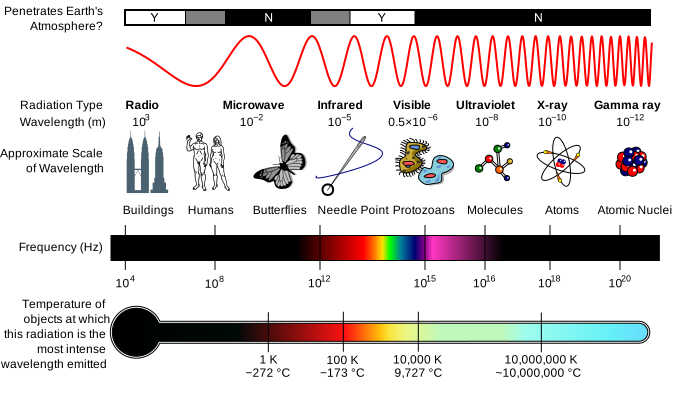
A detailed visual representation of various types of electromagnetic radiation, their wavelengths, frequencies, and the temperature at which they are most intensely emitted. It includes a horizontal illustration of the electromagnetic spectrum, starting from radio waves on the left to gamma rays on the right.
Penetration of Earth's Atmosphere: A horizontal bar at the top illustrates whether each type of radiation penetrates Earth's atmosphere. It is divided into sections marked “Y” (Yes) and “N” (No), indicating if the radiation type can reach Earth.
Radiation Types and Wavelengths: A red waveform visually depicts the wavelength of each radiation type, starting with long wavelengths for radio waves and shortening progressively to gamma rays. Below, several categories of radiation types are listed with their respective wavelengths in meters: Radio (10³), Microwave (10⁻²), Infrared (10⁻⁵), Visible (0.5×10⁻⁶), Ultraviolet (10⁻⁸), X-ray (10⁻¹⁰), and Gamma ray (10⁻¹²).
Approximate Scale of Wavelengths: Various objects are depicted to represent the approximate scale of each radiation type's wavelength: buildings (radio), humans (microwave), butterflies (infrared), needle points (visible), protozoans (ultraviolet), molecules (X-ray), atoms (gamma ray), and atomic nuclei (gamma ray).
Frequency: A horizontal bar denotes the frequency range (Hz) corresponding to each type of radiation, starting from 10⁴ Hz (radio waves) to 10²⁰ Hz (gamma rays).
Temperature of Most Intense Emission: A colored horizontal scale at the bottom represents the temperature (in Kelvin and Celsius) at which each type of radiation is most intensely emitted. It ranges from 1K (-272°C) for radio waves to 10,000,000K (~10,000,000°C) for gamma rays.
In the context of this course, our primary focus will be on infrared, visible, and ultraviolet radiation, as these are relevant for climate scientists studying how energy is transferred into, within, and out of the Earth system. Additionally, we'll delve further into the infrared spectrum in this lesson, which extends “beyond red.” Notably, a significant portion of the infrared spectrum, spanning approximately 3 to 100 microns, is called “terrestrial” or “longwave” radiation — radiation originating from Earth. This is because at the temperatures commonly observed on our planet, including those within Earth's atmosphere, the molecules that compose the Earth system emit EM waves mostly with these wavelengths.
Now that you are familiar with the terminology used to describe the various segments of the electromagnetic spectrum, it's imperative to explore the characteristics governing the emission of radiation. These properties are organized into what we can think of as the “four laws of radiation.” Let's delve into these further.