Prioritize...
After completing this section, you should be able to:
- Define adaptation and mitigation in the context of climate change.
- Explain why serious climate solutions should include some combination of both adaptation and mitigation strategies.
Read...
We've spent all semester talking about the science of climate, the history of climate, and why we have observed (and expect) the climate to change. So, what do we do now? Throw up our hands and say "good game!"?
When it comes to addressing the challenges of climate change, the conversation often revolves around two main strategies: adaptation and mitigation. These represent the broad paths humanity can take to confront the impacts of a warming planet.

Mitigation focuses on reducing the extent of climate change itself. An analogy would be trying to avoid injuring yourself while playing in a basketball game—perhaps you wear a knee brace proactively. This can be achieved through two main approaches:
- Emissions reductions, which address the problem at its source by curbing greenhouse gas emissions.
- Geoengineering, which involves large-scale technological interventions designed to offset the effects of those emissions (a controversial topic we’ll explore in a future lesson).
Adaptation, on the other hand, emphasizes efforts to limit our vulnerability to the impacts of climate change. This typically involves measures to protect human communities—like building seawalls, managing water resources, or altering agricultural practices—without necessarily addressing the root cause of the problem. Essentially, we are trying to harden ourselves against expected future challenges. Using our example above, if you hurt your knee, you now try to do things that allow you to function as well as possible given a hurt knee—perhaps you use crutches or do activities that don't require standing or walking.
It’s worth noting that adaptation often focuses on safeguarding human systems, not natural ecosystems. For instance, coral reefs are unlikely to adapt to the combined pressures of warming oceans and acidification. Unfortunately, humans do not control that. As ecosystems collapse, the essential services they provide—like coastal protection or fisheries—could be lost, with severe consequences for human civilization.
See the flowchart below. Start in the top left box—humans are changing the climate. This leads to all the impacts and vulnerabilities in the purple box. We now have two strategies (mainly driven by policy, which we'll talk about soon): mitigation and adaptation.
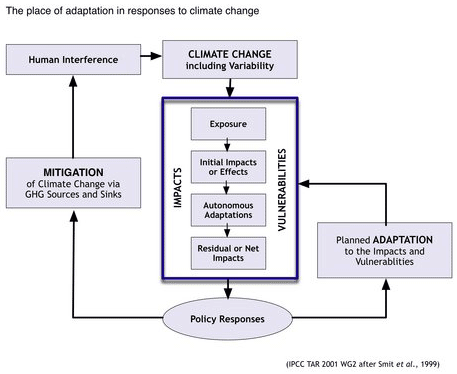
Text description of the climate change adaptation image.
The image presents a flowchart illustrating the place of adaptation in responses to climate change. At the top, it includes a box labeled "Human Interference," which connects to another box labeled "CLIMATE CHANGE including Variability." Below this, there is a central box titled "IMPACTS," which outlines three subcategories: "Exposure," "Initial Impacts or Effects," and "Autonomous Adaptations." Adjacent to this are two boxes labeled "Residual or Net Impacts" and "Vulnerabilities." A curved arrow leads from "IMPACTS" to "Policy Responses," depicted as an oval at the bottom. The entire chart is framed by a purple box, emphasizing the context of adaptation, while the flow of information is represented through arrows guiding from one section to another, highlighting relationships and dependencies. The background is white, allowing the gray and purple elements to stand out clearly.
Sometimes, you might hear people say, "Why worry about trying to stop climate change? We should just focus on adapting to it." Others might argue, "Planning for adaptation means you’ve already given up on stopping it!" So, what do we do?
The reality is that framing this as an either-or question is misleading—we’re going to need both adaptation and mitigation to tackle climate change effectively. The greenhouse gases we’ve already put into the atmosphere have committed us to at least 1°C of additional warming, a concept known as committed climate change. This warming is already "baked in," and no amount of mitigation can undo it. That’s where adaptation comes in—we have to prepare for the changes we can’t avoid. At the same time, adaptation alone isn’t enough. Without mitigating future emissions, the problems will only escalate. For instance, you can build a seawall today, but if emissions continue unchecked, rising seas could overtop it in just a few decades, forcing ever-larger fixes. That would be a vicious cycle, for sure.
To understand the interplay between these two strategies, consider a few scenarios:
- No response measures (so we do nothing, no adaptation nor mitigation): This leads to widespread and severe vulnerabilities across the globe. Obviously, very bad.
- Adaptation alone: Without mitigation, adaptive measures may slow local impacts but cannot prevent the worsening of global climate conditions. Our "spiral" we talked about above.
- Mitigation alone: While limiting our emissions and resulting greenhouse gas concentrations might reduce the magnitude of climate change, vulnerable regions, especially in the tropics, would still face severe impacts. We've already seen there is far more CO2 in the atmosphere now than in recorded human history: "the cake is (somewhat) baked."
- Adaptation and mitigation combined: Together, these approaches can significantly reduce vulnerability, offering a more sustainable path forward for most regions. This seems like our best option!
Hopefully, your convinced that only a combination of adaptation and mitigation can minimize risks to both human and natural systems.
One helpful way to think about climate vulnerability is by comparing different scenarios: no response at all (no adaptation or mitigation), adaptation on its own, mitigation on its own, and a combination of both strategies. Play with the slider in the interactive tool below to explore these scenarios. As you move the slider to the right—representing an increase in both adaptation and mitigation efforts—you’ll notice the map’s colors shift from dark red, nearly black (indicating high vulnerability), to much lighter shades across the globe. This visual demonstrates the powerful impact of combining adaptation and mitigation to reduce climate risks worldwide.

As is apparent from the above comparisons, much of the world would likely suffer extreme vulnerability to climate change in the absence of any mitigation efforts at all, regardless of what adaptive measures are taken. Yet, mitigation alone, for example limiting CO2 concentrations to 550 ppm, would, in the absence of any adaptive measures, still result in great vulnerability, particularly in tropical and subtropical regions. However, a combination of adaptation and mitigation could reduce vulnerability to modest levels for most of the world.
While mitigation strategies will be covered in-depth in later sections, early in this lesson the spotlight is turned on adaptation. We’ll explore specific examples of adaptive measures in areas such as:
- Coastal protection (e.g., barriers against rising sea levels),
- Water resource management (e.g., systems for drought resilience), and
- Agriculture and food security (e.g., crop diversification and irrigation technologies).
However, adaptation comes with limits. It is inherently reactive and localized, often unable to address the cascading effects of environmental degradation. For instance, when ecosystems like coral reefs collapse, the ripple effects extend beyond biodiversity loss to include economic and social challenges for human communities.
Ultimately, adaptation and mitigation are complementary, not competing, strategies. Each plays a critical role in addressing climate change, but neither can succeed in isolation. As we delve into adaptation strategies, let us remain mindful of the larger context in which they operate—and the urgent need for a balanced, dual-pronged approach to climate solutions.