Learning Objectives Self-Check
Read through the following statements/questions. You should be able to answer all of these after reading through the content on this page. After going through the content, check the boxes next to the questions/statements that you feel at least somewhat confident answering. I suggest writing or typing out your answers, but if nothing else, say them out loud to yourself. This is to help you reflect on important content, and will help you prepare for this week's quiz. It will also help lay the foundation for future course content.
What is the difference between renewable and non-renewable energy?
Knowing whether a source of energy is renewable or non-renewable is important when considering energy and/or sustainability. Renewable energy is defined by the U.S. Environmental Protection Agency thus: “Renewable energy includes resources that rely on fuel sources that restore themselves over short periods of time and do not diminish” (Source: U.S. EPA). Non-renewable energy is energy that cannot restore itself over a short period of time and does diminish. It is usually easy to distinguish between renewable and non-renewable, but there are some exceptions (more on that in a minute).
To Read Now
Once again, we will go to the US EIA for a description of renewable energy sources. Please read through the following links (quickly, if nothing else). You are welcome to read the sub-headings for each source, but that is not necessary. The key points are summarized below.
Optional Readings/Videos
Please note that these readings only scratch the surface of the world of renewable energy sources! The DOE's Energy 101 YouTube channel has a bunch of good, short videos about different energy sources, note that there are a lot more energy-related links on the EIA websites that you read just now. You could spend your whole career learning about them (as some people do), and still have more to learn. I encourage you to learn as much as you can about these and other sources. It may sound like hyperbole, but you can never know too much about energy. It figuratively and literally makes the world go 'round.
Renewable Energy
It should be clear how most of these sources fit the definition of renewable energy ("resources that rely on fuel sources that restore themselves over short periods of time and do not diminish") and have various benefits and drawbacks. Please note that this does not provide a comprehensive list of pros and cons, but will give you a solid idea of many of them:
- Solar energy comes directly from the sun, which comes every day in most locations and does not diminish appreciably over time. Yes, the intensity does ebb and flow on short and long timescales, but it is hopefully not going away anytime soon. If the sun burns out and stops shining, we have bigger problems than solar panels not working!
- Pros: A few benefits of solar energy are that it is relatively predictable and reliable, it is effectively limitless, and that it does not create any emissions/pollution when generating energy. It is also now generally cheaper than almost all other energy sources.
- Cons: The main drawback is that it is intermittent, both in terms of the sun only being in the sky 50% of the time, and that weather can impact it significantly. Solar is also very diffuse, meaning that it is not very concentrated, and so, usually a large area is required to provide a lot of useful energy. Solar PV used to be very expensive but is now cost-competitive. Battery storage has become much more affordable in recent years, which can help eliminate the intermittency problem.
- The wind gets its energy from the sun - it is caused mostly by differential heating across the surface of the earth - so cannot be "used up" either.
- Pros: More good news is that the wind will never disappear as long as the sun shines and the earth is spherical, and like solar, wind does not generate emissions. Well-sited onshore wind is actually the least expensive form of electricity.
- Cons: However, the wind is also variable - more in some locations than others - and is less predictable than solar energy in most locations. Again, battery storage has all but eliminated this problem.
- Hydropower is the power in moving water and gets its energy from the sun as well and is even more consistent in most locations than the wind.
- I want you to think for a moment how the energy in moving water started out as solar energy. (This is a good thought experiment in energy conversion.) Answer: Remember that water flows downhill, and so the motion energy in flowing water started out as gravitational potential energy. How does water get this potential energy, i.e., how does it get uphill? Mostly from evaporation caused by the sun!
- Pros: In terms of other benefits, like solar and wind, hydropower does not generate emissions, and is very consistent and reliable in most locations, which makes it a good source of baseload power. Though it should be noted that some methane emissions result when organic material behind dams decomposes. Hydropower can also be ramped up or down relatively easily, which makes it useful for variable load demands.
- Cons: There are some drawbacks associated with large hydropower installations (see the EIA's Hydropower and the Environment website for some examples), and in some cases, very big environmental and social drawbacks (e.g., in the Three Gorges Dam in China). All of these factors are important to keep in mind. Hydroelectricity is the single biggest source of renewable electricity in the world.
- One additional drawback of all of the above sources is that they are each location-specific. In other words, some locations may have a lot of sun, wind, and/or hydro, while others may have very little. (This will be addressed in more detail in a future lesson.) This problem can be at least partially solved by transporting electricity, but that is not always easy, and often expensive.


All of these sources renew themselves over short periods of time and do not diminish. And though intermittent, none of these sources are going to disappear in the foreseeable future. They are textbook renewable energy sources.
Good to Know: Agrivoltaics
Agrivoltaics are a burgeoning systems-thinking application. Agrivotaics combines - you guessed it - agriculture and photovoltaics. Ground-mounted solar arrays are a great application of solar PV technology, but they do take up a lot of space relative to their energy output. So why not find a way to use all of this space? Enter agrivoltaics! With some careful design considerations (e.g. knowing which plants are shade-tolerant or even prefer some shade), crops can not only be successful but in some cases more successful in terms of production than when planted in an open field. This is particularly helpful in hot, dry climates, such as the eastern part of Colorado, which is pictured below. But it can be successful in more humid and cooler climates as well.
Agrivoltaics are becoming increasingly recognized and researched throughout the U.S. and internationally. Feel free to browse through the National Renewable Energy Laboratory's (NREL) article about agrivoltaics for more information.

Video: NREL’s Agrivoltaics Research: Combining Solar Energy With Agriculture
Combining Solar Energy With Agriculture
NARRATOR: Everyone likes growing things. Everyone likes to see a garden. I've been blown away by how much interest there's been by staff and researchers across the entire lab. Here we're exploring agrivoltaics, which is combining solar energy with agriculture. And agriculture can be vegetable production, it can be pollinator habitat, it can also be pasture grasses that can support animal grazing. We are able to look at eight different types of crops as well as two different types of pollinator mixes and two different types of pasture grasses. And what we're trying to do is compare how different types of vegetation perform under the open sun and open air as well as how they perform under the partial shade of the solar panels.
So we have fruiting plants like tomatoes and peppers. We also have root crops like carrots. And then we have leafy greens as well as herbs like basil. In many cases, solar projects are built on agricultural lands, and you could have a lot of push back from landowners or their surrounding communities who don't want to see prime agricultural land getting taken out of production. Agrivoltaics really offers us the opportunity to continue agriculture production while also producing clean electricity.
There's so much capability that the lab has and can contribute to this. And so being able to showcase this on campus, really, I think, will improve the science and improve the output that we can have. Some of the produce will be going into the NREL Cafeteria, especially the leafy greens like the kale and the chard. Much of the other produce will be donated throughout the communities for areas that lack adequate food access in the Denver Metro area.
Okay, so what about biomass and biofuels? They are both derived from living or recently living things (trees, corn, algae, sugarcane, etc.) They also get their energy from the sun (anyone sensing a pattern here?), and plants are usually pretty good at regenerating themselves. But I want you to take a minute to try to think about examples of biomass and/or biofuels that might not be "renewable," in the sense of the definition above. Can you think of any examples of non-renewable biomass?
Nearly all forms of biomass and biofuels are renewable. Corn-based ethanol is the most-used source of bio-based energy in the U.S. Corn can be grown in the same field year after year, so it is renewable. Whether or not it is sustainable is another question, which will be addressed later. The primary source of bioenergy in Brazil is sugarcane. Nearly all of Brazil's vehicles are able to use 100% sugarcane ethanol for fuel. (Contrast this with the U.S., where most automobile engines are only required to be able to handle up to 10% ethanol.) Sugarcane grows year-round in Brazil, so is definitely renewable.
There are many other biomass sources that fit our definition of renewable, including animal dung, algae (for biodiesel), jatropha nut, soybean, switchgrass, and more. Wood is used around the world as a source of heat, particularly for cooking. Most trees and shrubs regrow relatively quickly, so they are generally considered renewable. But even a fast-growing tree like an oak (up to two feet per year, according to the National Arbor Day Foundation) has limits. Though most biomass sources are considered renewable, keep this in mind: if you harvest a renewable resource faster than it regenerates, it will not be able to renew itself over time. We will revisit this point in a later lesson, but it is important to remember.
Not all Renewables Are Created Equal
Most renewable energy sources are carbon-free. This means that they do not emit any carbon dioxide when they generate energy. Solar, wind, and hydroelectric are carbon-free. Nuclear, though not renewable, is also considered a carbon-free energy source, because unlike coal and natural gas, it does not burn. As noted in a previous reading, nuclear energy generates heat through fission, not combustion. Biomass and biofuels are often considered carbon-neutral because they emit carbon dioxide when they are burned. So, why are they carbon neutral?

Good to Know
An excellent place to look for reliable energy data - as well as everything from greenhouse gas emissions to population to life expectancy to childhood mortality and much, much more - is Our World in Data. The chart below shows the energy use by type worldwide from 1800 (!) to 2024, expressed as a percentage. This site is very well-sourced, and they provide the source(s) for each chart. You can also download the image and the original data, and even export it into Google Sheets. I also inserted a chart that I built using the same data, but broken down into 25-year increments. You can see the original data here, if you are so interested. (This is available for download from the Our World in Data site.)
FYI, another good, reliable source of global energy data is the Energy Instute's annual "Statistical Review of World Energy" (formerly BP's Statistical Review of World Energy) and the International Energy Agency's website in general (especially its data portal), but also their annual World Energy Outlook. They are worth browsing if you are interested! (While I'm at it, Gapminder is a great website for visualizing all kinds of data, including many related to the UN Sustainable Development Goals.)

There are a few interesting things to point out from the chart above.
- First of all, Total Primary Energy Supply (TPES) refers to all original or primary energy consumed. For example, if your electricity is supplied by a power plant, the energy your electronic device is using right now is not primary energy because the electricity was converted from an original source (e.g., coal, oil, natural gas, nuclear). Given that electricity generation is always less than 100% efficient (sometimes much less, per the previous section), the primary energy used by your device is greater than what shows up on your electric bill. Incidentally, the "energy sources" on the left-hand side of the sankey diagram that you looked at earlier this lesson are primary energy.
- Another interesting thing to point out is that "waste" (burning trash to generate electricity) is generally considered as renewable energy. In many parts of the world, including many states in the U.S., if you burn garbage to produce heat and/or electricity, it is considered a biofuel, and thus renewable. I'll leave it to you to think about whether or not that is reasonable. But note that biofuels (and biomass) constitute the majority of that "slice" of the global energy pie.
- Hydro is at only 5.83%. But where are wind and solar? We hear about them all the time in the U.S., and in other parts of the world. Wind and solar's contribution, while increasing many-fold in the past 25 years, contributes only about 3.3% and 2.8%, respectively. They have both been growing at an all-time high rate, but there is still a long way to go before wind and solar make a major dent in the global energy regime.


Non-Renewable Energy
Non-renewable energy sources diminish over time and are not able to replenish themselves. In other words, they are finite, and once they are used, they are effectively gone because they take so long to reform.
You have already read about the four non-renewable energy sources: coal, oil, natural gas, and nuclear. Let's start with coal, oil, and natural gas, which (as you read earlier) are referred to as fossil fuels. Fossil fuels were created from the remains of dead plants and animals. The source material is renewable (it's biomass!), but since they take millions of years to form, they are not replenished over a "short" period of time, so are non-renewable. Fossil fuels are forming somewhere under your feet right now, but don't hold your breath waiting for them to finish.
The nuclear energy we use comes from an isotope of uranium called U-235. Unlike fossil fuels, U-235 has cosmic origins: it was formed by one or more supernovae around 6 billion years ago, about 1.5 billion years before the Earth was formed (a supernova is a collapsing star, "supernovae" is the plural form of supernova) (source: World Nuclear Association). Again, this is not renewable on a human timescale.
All fossil fuels emit carbon dioxide (CO2) and other emissions when they are used to generate energy. Recall that they are made mostly of hydrogen and carbon, and the carbon mostly ends up as CO2. Nuclear is considered carbon-free, because it is not burned, and it is not made of carbon. Remember that energy is extracted through fission or splitting of atoms. This generates heat, but no emissions. (It is important to note that it does result in very dangerous and long-lasting radioactive waste, but that will be addressed in a future lesson.)
To summarize:
Non-renewables
- Coal, oil, and natural gas are fossil fuels. Even though they all get their energy from the sun, none of them are renewable. They all emit CO2 and other emissions when burned.
- Nuclear is also non-renewable, but not a fossil fuel. It is carbon-free but causes radioactive waste.
- Most importantly, for all intents and purposes, whatever coal, oil, natural gas, and nuclear exists today is all that we will ever have.
Renewables
- Solar, wind, and hydro are renewable and carbon-free, and effectively inexhaustible.
- Bioenergy is renewable and carbon-neutral. It emits CO2, but no more CO2 than was originally pulled from the atmosphere. Even though it is considered renewable, it is possible to use bioenergy unsustainably by harvesting it more quickly than it can be replenished.
Check Your Understanding
All of the carbon dioxide emitted from coal, oil, and natural gas was originally pulled from the atmosphere to make the plants from which is was derived grow. In other words, the amount of carbon dioxide emitted is no more than the amount of carbon dioxide it originally removed from the air. Why are they not carbon-neutral energy sources?
Good to Know
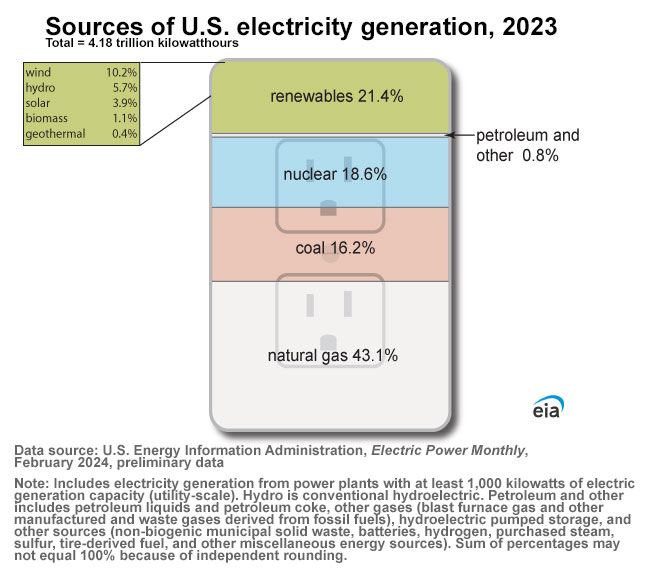
We hear a lot about renewables and natural gas in the U.S., as their use has been growing rapidly for some time now. But as you can see in this chart from the EIA, coal and nuclear still constitute over 40% of all electricity generation in the U.S. Wind is an encouraging 10.2%. Solar, despite its massive growth and growth potential, is only 3.9%! We have a long way to go, people!
Optional (But Strongly Suggested)
Now that you have completed the content, I suggest going through the Learning Objectives Self-Check list at the top of the page.