Module 3: Earth's Climate System
Module 3: Earth's Climate SystemVideo: Module 3 Introduction (1:14)
Module 3 Introduction
TIM BRALOWER: Hi, students. Welcome to module 3 on climate models. I grew up in London back in the 1960s, and weather forecasts were always wrong. They would predict a storm--it would be perfectly sunny. They would predict sunny weather, and there would be a storm. They were always wrong. Now we're at a time when weather prediction is really good, and that is because the computer side of the models is very strong and very advanced, and we're getting much better at predicting climate in the future as well.
So in this module, you'll learn about how CO2 levels and forecasted levels of CO2 drives climate models. The amount of CO2 in the atmosphere will definitely be related to the temperature in the future, as well as the global rainfall in the future, storm tracks, and storm intensity in the future, fire forecasts in the future, and sea level rise. And what we're going to learn about in this module is how different levels of CO2 that are controlled by human activity in the future will definitely be used to predict temperature, rainfall, hurricane intensity, as well as sea level rise. I think you're going to learn a lot about this module, how it's important for your future, and I hope you enjoy it.
Introduction
This course is all about the Earth’s climate. Thus, it is essential that you have a solid understanding of how the climate system works. This module is all about the climate system. It is by far the most technical module in the course, and our philosophy is to lay out the science in a comprehensive way, equations and all, so that you can see that Earth's climate is in part fairly simple, governed by physical relationships that describe how heat from the Sun is exchanged on the surface of the Earth and in its atmosphere. Then, there are some very complex aspects of the Earth's climate that we will not devote much time to.
Here is an example of why this module is important. The Polar Vortex has become a household name in the US in recent years. In Texas in the winter of 2021, the cold air from the vortex caused unusually cold temperatures and this crippled the power system that was not built to withstand such temperatures. The power cuts caused chaos, up to 5 million people were without power often for many days, 12 million people lost water service due to freezing pipes, and 151 people died as a result of hypothermia and carbon monoxide poisoning.
Video: Deep freeze in Texas: Millions without power, 21 dead in historic snowstorms (2:54)
Deep Freeze in Texas
[Music throughout video]
TEXT ON SCREEN: Deep freeze in Texas. Homes and roads blanked in deep snow and temperatures colder than Alaska…
[Icicles on house]
[Several scenes of snow covered streets and roads]
TEXT ON SCREEN: Historic and deadly winter storms have sent the souther US state of Texas into a deep freeze with temperatures plummeting to as low as -18C in some places. In a state more used to heat and sunshine and ill-equipped for Arctic conditions.
[Scenes of ice covered landscapes]
BURKE NIXON, HOUSTON RESIDENT: We have no water. We woke up this morning, our pipes are all frozen, and we have no water in the house. Our neighbor just got us some propane to try to thaw our pipes because they are frozen. We’re not used to this in Texas.
[Scene of a truck going down a snow-covered road]
TEXT ON SCREEN: For many, the conditions have been made tougher by being left without power. With the storm knocking out about a third of the state’s energy production capacity.
[A man filling up a generator with gasoline in front of his garage. Then starts generator.]
TEXT ON SCREEN: As of late Tuesday, more than 4 million cross the state were still without electricity.
BIRGIT KAMPS, HOUSTON RESIDENT: We were getting ready to cook dinner and all of a sudden, lights went off, power went off, everything went off. And I was like, “Wow, now what do I do?” And, I grabbed a bunch of blankets. So we cuddled up with our three dogs, one cat, my daughter and, you know, made it through the night.
[Scenes from, Louisville, Kentucky: Snowy UPS facility with planes]
TEXT ON SCREEN: Winter storms have hit vast swathes of central and southern US since the weekend.
[Scenes from, Telluride, Colorado: vehicles driving down a snow-covered street in blizzard conditions and Icicles hanging from a house]
[Scenes from, Ciudad Juarez, Mexico: a grown up and child playing in the snow]
TEXT ON SCREEN: and even seen rare snowfall and caused power outages in northern Mexico.
[Snow-covered cars on a wet road and a traffic cop with warm clothes on]
[Scenes from, Chicago, Illinois: Man shoveling snow from around a vehicle along the street]
TEXT ON SCREEN: At least 21 people have been killed across four US states,
[View from inside a vehicle while driving down a snow-covered highway]
TEXT ON SCREEN: including in falls and traffic accidents.
[Scenes from, Brunswick County, North Carolina: Arial view of homes destroyed by tornadoes]
TEXT ON SCREEN: The extreme conditions have also triggered at least four tornadoes, including one in coastal North Carolina that killed at least three people.
[Person running in a snow-covered road]
TEXT ON SCREEN: The freezing weather is expected to continue to grip much of the United States until the weekend.
[Person shoveling their pathway]
Fast forward to late January 2026 and those of us on the east coast of the US and Canada, experienced extreme cold as a result of the expansion of the polar vortex. Record low temperatures were set all the way from upstate New York where it reached -34oF to Minnesota where it reached -42oF. Snow fell as far south as Texas and Florida. In Canada it reached -44oF in Ontario and it remained below freezing for 16 straight days in Toronto. The vortex even caused seasonally cold temperatures as far south as Mexico, Belize and Cuba where it froze for the first time in recorded history. This cold was a result of the southward expansion of the polar vortex, a whirlwind of cold dense air that is normally restricted to the area around the poles. Understanding the polar vortex, and how it became unstable and swept across the Midwest and eastern parts of Canada and US, is key to interpreting the significance of the extreme cold in early 2026. Without this understanding, you might think that the expansion of cold air is a sign of cooling climate. However, it is likely that the opposite is the case; the recent cold snap is actually a result of warming. This is how it works. As you will learn in this module, the northern high latitudes are warming more rapidly than the rest of the globe as a result of melting sea ice. You will also learn that such warming leads to diminished wind velocities, including the polar vortex. As the vortex weakens, it becomes less stable and begins to wobble and stray from the region around the North Pole. It turns out that the recent cold snap was just one of these wobble events, and the projections are for polar vortices to become more common over North America in the future, just as other extreme events like extratropical hurricanes such as Sandy, heat waves and droughts become more frequent.

Now, right off the bat, we need to make it clear that the "simple" relationships are often portrayed in the module in terms of equations. You do not need to be a Math major to understand these equations, nor do we want you to memorize them. The point of showing the equations is not to cause great anxiety, but to provide an understanding of the relationship between two variables. For example, you should be looking to distinguish relationships that are linear (such as a=b*x [where * is multiplied by]) from those that are quadratic (such as a=bx2). This is the level at which we expect you to understand equations. One last word, the lab for this module is designed to strengthen the fundamentals you learn in the reading. By experimenting with climate in the lab, you should come away with a really solid understanding of the climate system.
Goals and Learning Outcomes
Goals and Learning OutcomesGoals
On completing this module, students are expected to be able to:
- describe how energy is absorbed, stored, and moved around in Earth's climate system;
- distinguish how the amount of energy stored determines the temperature;
- interpret the importance of feedback mechanisms that make our climate system sensitive to forcings, but also provide a stabilizing influence;
- infer how temperature responds to changes in solar input, albedo, and greenhouse gas concentrations;
- evaluate how simple (i.e., STELLA) models can be used to make projections of climate variables.
Learning Outcomes
After completing this module, students should be able to answer the following questions:
- What are heat and thermal energy?
- What are the different types of electromagnetic radiation?
- What is blackbody radiation and what is the significance of the Stefan-Boltzmann law?
- What is emissivity and what is its significance?
- What is albedo and what are albedo values for different materials?
- What is the solar constant and how is it measured?
- What is insolation and what are its geographic and annual distributions?
- What does sunspot history look like and how is it related to solar intensity?
- What are the relative heat capacities of different materials?
- What is the greenhouse effect and what are the different greenhouse gasses?
- What are the basic energy flows in the atmosphere?
- What is positive and negative feedback and what are examples of each?
- What are the energy budgets of different latitudes?
- How is heat transferred in the atmosphere?
- How is heat transferred in the oceans?
- What is the Global Conveyor Belt and what is its significance?
Assignments Roadmap
Assignments RoadmapBelow is an overview of your assignments for this module. The list is intended to prepare you for the module and help you to plan your time.
Assignments
- Lab 3: Climate Modeling
- Submit Module 3 Lab 3 (Graded).
- Take Module 3 Quiz.
- Yellowdig Entry and Reply
Global Climate
Global ClimateWe begin with a quick glimpse of the global climate — and then we’ll try to understand why it looks this way. But first, what does climate mean? In the simplest sense, it is the average weather of a region — the average temperature, rainfall, air pressure, humidity, cloud cover, wind direction, and wind speed. This means that climate is not the same as weather; weather implies a very short-term description of the atmospheric conditions, and it tends to change in a complex manner over short time scales, making it notoriously difficult to predict. In contrast, the climate is less variable — it smoothens out the variability of the short-term weather. This course is about climate, how it is changing, and what that means for our future; as we move through this class, you should remind yourself periodically that we are not talking about the weather — our time frame is much longer.
So, let’s have a look at the climate as expressed by temperature:

The average near-surface air temperature (sea surface temperature over the oceans) of the Earth for the period from 1961-1990.
This image is a world map showing the annual mean temperature across the globe, measured in both degrees Fahrenheit and Celsius. The map uses a color gradient to represent temperature variations, with colder regions in blue and warmer regions in red.
- Map Type: World map
- Measurement: Annual mean temperature
- Color Scale (bottom of the map):
- Range: -40°F (-40°C) to 80°F (30°C)
- Colors: Dark blue (-40°F/-40°C) to dark red (80°F/30°C), with purple, green, yellow, and orange in between
- Regions with Notable Temperatures:
- Coldest (dark blue, -40°F/-40°C to 0°F/-18°C):
- Polar regions (Arctic and Antarctic)
- Northern Canada, Greenland, and Siberia
- Cool (green to light blue, 0°F/-18°C to 40°F/4°C):
- Northern Europe, parts of Russia, and the northern U.S.
- Moderate (yellow to orange, 40°F/4°C to 60°F/15°C):
- Southern Europe, the central U.S., and parts of China
- Warm (red, 60°F/15°C to 80°F/30°C):
- Most of Africa, South America, India, Southeast Asia, and Australia
- Parts of the Middle East and Central America
- Coldest (dark blue, -40°F/-40°C to 0°F/-18°C):
The map illustrates the global distribution of annual mean temperatures, with the coldest temperatures in polar regions and the warmest in equatorial and tropical areas.
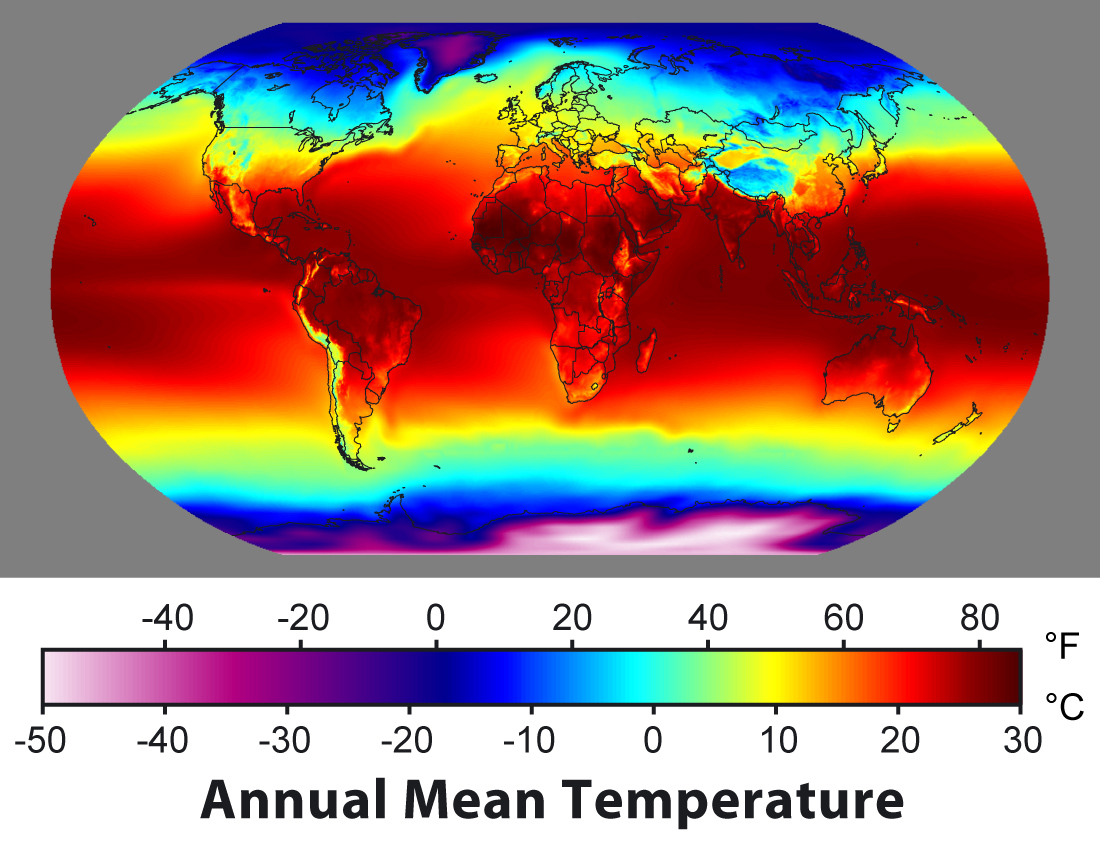

As you can see, the equatorial regions are the warmest, and the poles are the coldest, with Antarctica being noticeably colder than the Arctic. The temperature varies more within the continents than the oceans, and there is a pronounced northward extension of warm water in the North Atlantic.
The global climate system is like a big machine receiving, moving, storing, transferring, and releasing heat or thermal energy. The machine consists of the oceans, the atmosphere, the land surface, and the biota on land and in the oceans; in short, it consists of everything at the Earth’s surface. The average state of this system — the global climate — is represented most simply by the pattern of temperatures and precipitation at the surface.
In order to really understand this complex machine, we will have to understand something about its parts, but we also need to begin with some fundamental ideas about energy, heat, and temperature, including the source of the energy for the climate system — the sun.
Useful Terms and Definitions Related to the Energy of the Climate System
Energy
In the broadest terms, energy is a quantity that has the ability to produce change in a physical system; it includes all kinds of kinetic energy (energy of motion) and potential energy (energy based on the body's position) and is measured in joules. One joule represents the amount of energy needed to exert a force of one Newton over a meter; so 1 Joule = 1Nm.
Power
Energy expended over a period of time is a measure of power, and in the context of climate, power is expressed in terms of Watts (1 Watt = 1 joule per second). This is also called a heat flux — the rate of energy flow.
Heat
This is simply the thermal energy of a body, measured in joules. Think of this as the average kinetic energy (vibrations) of the atoms of a material.
Heat Flux Density
This is a measure of how concentrated the energy flow is and is given in units of Watts per square meter.
Temperature
This is obviously closely related to heat, but it is the average kinetic energy within some body. Materials can be the same temperature, but they may have different amounts of thermal energy — for instance, a volume of water has much more thermal energy than a similar volume of air at the same temperature. Remember that there are 3 temperature scales: Fahrenheit, Celsius, and Kelvin. We’ll use Celsius and Kelvin, which have the same scale, just offset so that 0°C = 273°K.
Simple Climate Model
Simple Climate ModelWe begin with a very simple analog model for our planet’s climate (figure below) in which solar energy enters the system, is absorbed (some will have been reflected), stored (some will have been transformed or put to work), and then released back into outer space. The amount of energy stored determines the temperature of the planet. The balance between the incoming energy and the outgoing energy determines whether the planet becomes cooler, warmer, or stays the same. Notice the little arrow connecting the box to the Energy Out flow — this means that the amount of energy released by the planet depends on how hot it is; when it is hotter, it releases, or emits, more energy and when it is cooler, it emits less energy. What this does is to drive this system to a state where the energy out matches the energy in — then, the temperature (energy stored) is constant. This energy balance, sometimes called radiative equilibrium, is at the heart of all climate models.

Global Climate System
Global Climate SystemNow, let’s consider the connection between this idea of an energy flow system to the actual Earth. As shown in the figure below, this system includes the atmosphere, the oceans, volcanoes, plants, ice, mountains, and even people — it is intimately connected to the whole planet. We will get to some of these other components of the climate system later, but to begin with, we will focus on just the energy flows — the yellow and red arrows shown below.

Global Climate System
The image is a labeled diagram titled "The Global Climate System," illustrating various processes and components that influence Earth's climate. It depicts interactions between the atmosphere, land, ocean, and Earth's interior, with numbered annotations and a key explaining the symbols used.
- Overall Structure:
- The diagram is a cross-sectional view of Earth, showing the atmosphere, ocean, land (continental and oceanic crust), and the underlying lithospheric mantle and asthenosphere.
- The asthenosphere is depicted in red at the bottom, indicating its semi-fluid nature.
- Atmospheric Components:
- 1: Short-wavelength (SW) solar radiation (yellow wavy arrows) enters the atmosphere from the top.
- 2: Some solar radiation is reflected back into space (yellow wavy arrows pointing upward).
- 3: Long-wavelength (LW) radiation (red wavy arrows) is emitted from the Earth's surface upward.
- 4: Clouds reflect solar radiation back into space (yellow arrows) and trap long-wavelength radiation (red arrows).
- 5: Some solar radiation is absorbed by the atmosphere (yellow arrows curving within the atmosphere).
- 7: Clouds release precipitation (blue arrows pointing downward), contributing to the water cycle.
- 8: Evaporation from the ocean surface (blue arrows pointing upward) adds water vapor to the atmosphere.
- 9: Evaporation from land surfaces (blue arrows pointing upward) also contributes to atmospheric moisture.
- Land and Ocean Components:
- 6: Ice on land reflects solar radiation (yellow arrows bouncing off ice).
- 10: Ocean currents (black arrows) show the movement of water within the ocean.
- 11: Transfer of CO₂ between the ocean and atmosphere (green arrows) indicates carbon exchange.
- 15: Ice melts, contributing to the water cycle (blue arrows from ice to ocean).
- 16: Runoff from land to ocean (blue arrows) shows the movement of water.
- 17: Human activities, depicted as factories and vehicles on land, release CO₂ into the atmosphere (green arrows).
- Geological Components:
- 12: A volcano on the continental crust releases CO₂ (green arrows) and ash (gray cloud) into the atmosphere.
- 13: Volcanic eruptions emit particles and gases (gray cloud) that can influence climate.
- 14: Weathering of rocks on the continental crust (green arrows) removes CO₂ from the atmosphere.
- Earth's Interior:
- The diagram shows the continental crust and oceanic crust as part of tectonic plates.
- The lithospheric mantle (part of the plate) is labeled beneath both the continental and oceanic crust.
- Black arrows indicate the movement of plates, with a divergent boundary at the oceanic crust where new crust is formed (red area).
- The asthenosphere beneath the lithospheric mantle is shown in red, indicating its role in plate movement.
- Key (Bottom of Diagram):
- Long-wavelength (LW) radiation: Red wavy arrows.
- Short-wavelength (SW) solar radiation: Yellow wavy arrows.
- Transfer of CO₂: Green arrows.
- Movement of water: Blue arrows.
- Movement of plates: Black arrows.
The diagram visually represents the complex interactions within the global climate system, highlighting the roles of solar radiation, the carbon cycle, the water cycle, geological processes, and human activities in shaping Earth's climate.
Numbers in the figure refer to the following key:
- Incoming short-wavelength solar radiation
- Reflected short-wavelength solar radiation
- Emission of long-wavelength radiation (heat) from surface
- Absorption of heat by greenhouse gases and emission of heat from the atmosphere back to the surface (the greenhouse effect)
- Emission of surface heat not absorbed by the atmosphere
- Evaporation cools the surface, adds water to the atmosphere
- Condensation of water vapor releases heat to the atmosphere, precipitation returns water to the surface
- Evapotranspiration by plants cools the surface
- Chemical weathering of rocks consumes atmospheric CO2
- Oceans store and transfer thermal energy
- Sedimentation of organic material and limestone (CaCO3) transfers carbon to sediment on the ocean floor
- Melting and metamorphism of sediments sends carbon back to surface
- Emission of CO2 from volcanoes
- Emission of CO2 from burning fossil fuels
- Cold oceans absorb atmospheric CO2
- Warm oceans release CO2 to the atmosphere
- Photosynthesis and respiration of plants and soil exchange CO2 between the atmosphere and biosphere
The figure above includes some new words and concepts, including short-wavelength and long-wavelength radiation, that will make sense if we devote a bit of time to a review of some topics related to energy.
Electromagnetic Spectrum
Electromagnetic SpectrumBrief Review of Electromagnetic Radiation
The energy we are concerned with here comes in the form of electromagnetic radiation, so it will help us to review some aspects of this form of energy. Electromagnetic (EM) radiation comes in a spectrum of waves, each consisting of an electrical and a magnetic oscillation of particles called photons; this spectrum is shown in the figure below:

The image is a diagram titled "The Electromagnetic Spectrum," illustrating the range of electromagnetic radiation types, their wavelengths, and their relationship to the temperature of objects emitting them. The diagram is structured vertically, with various segments representing different types of radiation, their wavelengths, and associated temperatures.
- Title: "The Electromagnetic Spectrum" is written at the top.
- Main Structure: The diagram is a vertical bar divided into segments, each representing a type of electromagnetic radiation, with wavelengths and temperatures labeled on the sides.
- Wavelength Scale (Right Side):
- Wavelengths are shown in a logarithmic scale, ranging from 0.01 nm (nanometers) at the top to 1000 m (meters) at the bottom.
- Specific wavelength ranges are marked:
- 0.01 nm (10-11 m) for gamma rays
- 1 nm (10-9 m) for X-rays
- 10 nm for ultraviolet (UV)
- 100 nm to 1000 nm (10-6 m) for visible light (400 nm to 700 nm highlighted in a color gradient from purple to red)
- 10 μm (micrometers, 10-5 m) for infrared (IR)
- 100 μm for thermal IR
- 1000 μm (10-3 m) for far IR
- 1 cm (10-2 m) for microwaves
- 10 cm for radar
- 1 m for FM radio and TV
- 10 m to 1000 m (103 m) for AM radio
- Types of Radiation (Center):
- From top to bottom, the types of electromagnetic radiation are labeled:
- Gamma rays
- X-rays
- Ultraviolet (UV)
- Visible light (with a color gradient from purple at 400 nm to red at 700 nm)
- Near IR (infrared)
- Thermal IR
- Far IR
- Microwaves
- Radar
- FM radio, TV
- AM radio
- From top to bottom, the types of electromagnetic radiation are labeled:
- Temperature Scale (Left Side):
- The left side shows the temperature of objects whose energy peaks at specific wavelengths, based on blackbody radiation principles.
- Temperatures are marked with corresponding radiation types:
- 29,000°K (Kelvin) for objects emitting gamma rays
- 290°K for objects emitting in the solar spectrum (visible light)
- 29°K for objects emitting in the Earth's thermal IR spectrum
- 2.9°K for objects emitting in the microwave spectrum
- Spectral Curves:
- Two curves are overlaid on the diagram, showing the blackbody radiation spectra:
- A yellow curve labeled "Solar" peaks around the visible light range (290°K), indicating the Sun's emission spectrum.
- A blue curve labeled "Earth's" peaks in the thermal IR range (29°K), indicating Earth's emission spectrum.
- Two curves are overlaid on the diagram, showing the blackbody radiation spectra:
- Visible Light Section:
- The visible light portion (400 nm to 700 nm) is highlighted with a color gradient, transitioning from purple (400 nm) to blue, green, yellow, orange, and red (700 nm).
The diagram effectively illustrates the relationship between wavelength, type of electromagnetic radiation, and the temperature of objects emitting that radiation, emphasizing the Sun's peak in visible light and Earth's peak in thermal infrared.
Blackbody Radiation
Blackbody RadiationIn the realm of physics, a blackbody is an idealized material that absorbs perfectly all EM radiation that it receives (nothing is reflected), and it also releases or emits EM radiation according to its temperature. Hotter objects emit more EM energy, and the energy is concentrated at shorter wavelengths. The relationship between temperature and the wavelength of the peak of the energy emitted is given by Wien’s Law, which states that the wavelength, lambda, is:
(λ is in m, T in kelvins)
But the energy emitted covers a fairly broad range, as described by Planck’s Law, as shown below:

The image is a graph titled "Blackbody Emission from Objects of Different Temperatures," illustrating the energy emitted by blackbodies at various temperatures as a function of wavelength, based on Planck's law of blackbody radiation. The graph also references Wien's Law to highlight the wavelength at which the energy emission peaks for each temperature.
- Title: "Blackbody Emission from Objects of Different Temperatures" is written at the top.
- Axes:
- X-Axis (Wavelength): Labeled "Wavelength (μm)" and ranges from 0 to 30 micrometers (μm), with major ticks at intervals of 5 μm (0, 5, 10, 15, 20, 25, 30).
- Y-Axis (Energy): Labeled "Energy Emitted" with arbitrary units, ranging from 0 to 6, with major ticks at intervals of 1 (0, 1, 2, 3, 4, 5, 6).
- Data Representation:
- Three curves are plotted, each representing the energy emitted by a blackbody at a specific temperature:
- 300°K (Kelvin): Plotted in blue.
- 400°K: Plotted in green.
- 500°K: Plotted in red.
- Each curve shows the energy emitted across the wavelength range, with a distinct peak indicating the wavelength at which the maximum energy is emitted.
- Three curves are plotted, each representing the energy emitted by a blackbody at a specific temperature:
- Curve Characteristics:
- 300°K (Blue Curve): Peaks around 10 μm, with a maximum energy of about 1 unit, then gradually decreases toward longer wavelengths.
- 400°K (Green Curve): Peaks around 7.5 μm, with a maximum energy of about 2 units, showing a higher and sharper peak compared to the 300°K curve.
- 500°K (Red Curve): Peaks around 5.5 μm, with a maximum energy of about 5 units, exhibiting the highest and sharpest peak among the three curves.
- Annotation:
- A label near the 500°K curve states: "energy peaks at a wavelength of 0.0029/T (Wien's Law)," explaining that the peak wavelength is inversely proportional to the temperature (T) of the blackbody, as per Wien's Displacement Law. The constant 0.0029 is in meter-Kelvin units (m·K), so when divided by temperature in Kelvin, it gives the peak wavelength in meters (which is then converted to μm in the graph).
- Overall Trend:
- As the temperature increases from 300°K to 500°K, the peak of the emission curve shifts to shorter wavelengths (from ~10 μm to ~5.5 μm), and the total energy emitted (the area under the curve) increases significantly, consistent with the Stefan-Boltzmann Law and Wien's Law.
The graph visually demonstrates how blackbody radiation varies with temperature, showing that hotter objects emit more energy and at shorter wavelengths, which is a fundamental concept in understanding thermal radiation and its role in climate science (e.g., Earth's and the Sun's emission spectra).
The total amount of energy radiated from an object is also a function of its temperature, in a relationship known as the Stefan-Boltzmann law, which looks like this:
where σ is the Stefan-Boltzmann constant, which is 5.67e-8 Wm-2K-4 (this is another way of writing 5.67 x 10⁻⁸; so 100 is 1e2, 1000 is 1e3, one million is 1e6, etc.), T is temperature of the object in °K, and so F has units of W/m2. If you multiply this by the surface area of an object, you get the total rate of energy given off by an object (remember that Watts are a measure of energy, Joules, per second). As you can see, the amount of energy emitted is very sensitive to the temperature, and that can be seen in the figure above if you think about the area beneath the curves of different color. This sensitivity to temperature is very important in establishing the radiative equilibrium or balance of something like our planet — if you add more energy, that warms the planet, and then it emits more energy, which tends to oppose the warming effect of more energy added. Conversely, if you decrease the energy added, the planet cools and emits far less energy, which tends to minimize the cooling. This is a very important example of a negative feedback mechanism, one that works in opposition to some imposed change. The thermostat in your house is another good example of a negative feedback — it works to stabilize the temperature in your house, bringing it into radiative equilibrium.
The version of the Stefan-Boltzmann law described above applies for an ideal blackbody object, but it can easily be adapted to describe all other objects by including something called the emissivity, as follows:
Here, epsilon is the emissivity, which is a unitless value that is a measure of how good an object is at emitting (giving off) energy via electromagnetic radiation. A blackbody has epsilon=1, but most objects have lower emissivities. A very shiny object has an emissivity close to 0, and human skin is between 0.6 to 0.8.
Check Your Understanding
Albedo
AlbedoAs mentioned earlier, an ideal blackbody will absorb all incident light, but in the real world, things absorb only part of the incident light. The fraction of light that is reflected by an object is called the albedo, which means whiteness in Latin. Black objects have an albedo close to 0, while white objects have an albedo of close to 1.0. The table below lists some representative albedos for Earth surface materials. Most of these albedos are sensitive to the angle at which the sunlight hits the surface; this is especially true for water. When the Sun is at angles of 40° and higher relative to the horizon, the albedo of the water is fairly constant, but as the angle decreases from 40°, the albedo increases dramatically so that it is about 0.5 at a Sun angle of 10° and 1.0 at a sun angle of 0°. You are aware of this in the form of glare coming off the water in the early morning or in the evening before sunset.
| Substance | Albedo (% reflectance) |
|---|---|
| Whole Planet | 0.31 |
| Cumulonimbus Clouds | 0.9 |
| Stratocumulus Clouds | 0.6 |
| Cirrus Clouds | 0.5 |
| Water | 0.06 - 0.1 |
| Ice & Snow | 0.7 - 0.9 |
| Sand | 0.35 |
| Grass lands | 0.18 - 0.25 |
| Deciduous forest | 0.15 - 0.18 |
| Coniferous forest | 0.09 - 0.15 |
| Rain forest | 0.07 - 0.15 |
Most people have an intuitive sense for the effects of albedo on reflectance and solar energy absorption. This is why people wear white clothes in hot sunny climates and dark clothes in cold sunny climates. What should you wear if it is cloudy and cold?
In the above table, we see that the Earth’s average albedo is 0.31, but there is considerable variation in this value over the surface of the Earth and over time as well — this spatial and temporal variation in albedo of the Earth is shown in the figure below.

Check Your Understanding
Radiative Equilibrium
Radiative EquilibriumRadiative equilibrium determines Earth's core temperature: it says energy coming to the Earth from the Sun is balanced by the energy leaving Earth transmitted back to space. If incoming and outgoing energy are balanced, Earth's average temperature remains stable.
The Sun provides shortwave radiation (mostly visible light). Some of this is absorbed by Earth which warms. Earth then emits energy back to space as long-wave infrared radiation which cools Earth. If Earth had no atmosphere, its equilibrium temperature would be about -18 deg C (hint, remember this number for the Module 3 lab!) which would make life on Earth almost impossible. The key thing is that Earth’s atmosphere contains gases: carbon dioxide, methane and water vapor. These gases absorb some of the infrared radiation emitted by Earth's surface, re-radiate some of this energy back toward the Earth’s surface, and reduce the rate at which heat escapes back space.
These gases in the atmosphere prevent Earth from emitting as much energy as it should back to space. This in a nutshell is the greenhouse effect — the key that makes our planet a nice place to live. You will learn more about that soon.
Check Your Understanding
Insolation
InsolationInsolation — Incoming Solar Radiation
It all starts with the Sun, where the fusion of hydrogen creates an immense amount of energy, heating the surface to around 6000°K; the Sun then radiates energy outwards in the form of ultraviolet and visible light, with a bit in the near-infrared part of the spectrum. By the time this energy gets out to the Earth, its intensity has dropped to a value of about 1370 W/m2 —as we just saw this is often called the solar constant (even though it is not truly constant — it changes on several timescales):

Sun's energy shining onto Earth
Since the Earth spins, the insolation is spread out over an area 4 times greater than the disk shown in the figure above, so the solar constant translates into a value of 343 W/m2. This is a bit less than six 60 Watt light bulbs shining on every square meter of the surface, which adds up to a lot of light bulbs since the total surface area of Earth is 5.1e14 m2. How much energy do we get from the Sun in a year? Take 1370 W/m2, multiply by the area of the disk (pi x r2 where r=radius of Earth, 6.37e6 m), and this gives us an answer in Watts, which has units of joules per second, so if we then multiply by the number of seconds in a year, then we get the total energy in joules per year. The number is staggering — 5.56e24 Joules of energy — and is 10,000 times greater than all of the energy generated and consumed by humans each year.

Earth's Orbit, Axial Tilt, and Seasons
The Earth orbits around the Sun with its spin axis (the line connecting the North and South Poles) tilted at 23.4° from a line perpendicular to the orbital plane. This tilt, or obliquity, gives rise to the variation in seasons, and the larger the tilt angle, the greater the contrast in seasons (this tilt changes on a timescale of about 40,000 years). If the tilt were 0°, there would be no real difference between winter and summer; the difference in distance between perihelion (the closest point of the orbit) and aphelion (the farthest point) is very small at present, but this, too, changes. The degree of ellipticity is called the orbital eccentricity; it changes on timescales of 95,000, 125,000, and 405,000 years. A very nice animated version of Earth’s orbit can be found here.
- Central Elements:
- The Sun is depicted in the center as an orange circle.
- Earth's elliptical orbit around the Sun is shown as a black oval path, with Earth positioned at four points corresponding to the seasons.
- Earth’s Positions and Seasons:
- Summer (Northern Hemisphere):
- Earth is shown on the left side of the orbit, tilted with the Northern Hemisphere facing the Sun.
- Labeled "Summer Northern Hemisphere."
- An annotation reads: "the South Pole receives no sunlight during this part of the orbit."
- The position is marked as "Aphelion – Jul. 4, 1.01671 AU," indicating Earth is farthest from the Sun (1.01671 Astronomical Units).
- Spring (Northern Hemisphere):
- Earth is shown at the top of the orbit, with its axis tilted at an angle.
- Labeled "Spring Northern Hemisphere."
- Winter (Northern Hemisphere):
- Earth is shown on the right side of the orbit, tilted with the Northern Hemisphere facing away from the Sun.
- Labeled "Winter Northern Hemisphere."
- An annotation reads: "the North Pole receives no sunlight during this part of the orbit."
- The position is marked as "Perihelion – Jan. 4, 0.98329 AU," indicating Earth is closest to the Sun (0.98329 Astronomical Units).
- Fall (Northern Hemisphere):
- Earth is shown at the bottom of the orbit, with its axis tilted at an angle.
- Labeled "Fall Northern Hemisphere."
- Summer (Northern Hemisphere):
- Axial Tilt Annotation:
- A label on the right side of the diagram reads: "Earth’s spin axis is tilted relative to the orbital plane," explaining the cause of seasonal variations.
- The tilt angle is marked as 23.5° on the Earth diagrams.
- Visual Details:
- Each Earth is depicted as a globe with visible continents, primarily showing North and South America.
- The tilt of Earth’s axis is indicated by a dashed line running through the center of each Earth, with the North Pole (marked with a small symbol) tilted toward or away from the Sun depending on the season.
- Arrows on the orbital path indicate the direction of Earth’s movement around the Sun (counterclockwise).
The insolation is not constant over the surface of the Earth — it is concentrated near the equator (first figure on the page) because of the curvature of the Earth. But, the situation is complicated by the fact that the Earth’s spin axis is tilted by 23.4° relative to a line perpendicular to the Earth’s orbital plane (see the second figure on the page), so that as Earth orbits around the Sun, the insolation is concentrated in the Northern Hemisphere (the Northern Hemisphere summer) and then the Southern Hemisphere (winter in the Northern Hemisphere). This tilt of the spin axis, also called the obliquity, is the main reason we have seasons.

Insolation with latitude graph
The image is a graph titled "Insolation v. Latitude," showing the variation in average daily insolation (solar energy received per unit area) across different latitudes on Earth. The graph includes three curves representing insolation at different times of the year, with a note indicating Earth's tilt angle as 23.45°.
- Axes:
- X-Axis (Latitude): Labeled "Latitude," ranging from -80° (Southern Hemisphere) to 80° (Northern Hemisphere), with major ticks at intervals of 20° (-80, -60, -40, -20, 0, 20, 40, 60, 80). The equator is at 0°.
- Y-Axis (Insolation): Labeled "Average Daily Insolation W/m²," ranging from 0 to 600 watts per square meter (W/m²), with major ticks at intervals of 100 W/m² (0, 100, 200, 300, 400, 500, 600).
- Data Representation:
- Three curves are plotted, each representing the average daily insolation at different times:
- Winter Solstice (Dec. 21): Plotted in blue, labeled "winter Dec. 21 solstice."
- Summer Solstice (June 21): Plotted in red, labeled "summer solstice."
- Annual Average: Plotted in green, labeled "Annual avg."
- Three curves are plotted, each representing the average daily insolation at different times:
- Curve Characteristics:
- Winter Solstice (Dec. 21, Blue Curve):
- Shows high insolation in the Southern Hemisphere, peaking at around 500 W/m² near -20° latitude.
- Insolation decreases sharply toward the Northern Hemisphere, dropping to nearly 0 W/m² at 80° latitude (North Pole), reflecting minimal sunlight during the Northern Hemisphere's winter.
- Summer Solstice (June 21, Red Curve):
- Shows high insolation in the Northern Hemisphere, peaking at around 500 W/m² near 20° latitude.
- Insolation decreases sharply toward the Southern Hemisphere, dropping to nearly 0 W/m² at -80° latitude (South Pole), reflecting minimal sunlight during the Southern Hemisphere's winter.
- Annual Average (Green Curve):
- Shows a more balanced distribution, peaking at around 400 W/m² near the equator (0° latitude).
- Insolation gradually decreases toward both poles, reaching around 150 W/m² at ±80° latitude, reflecting the yearly average sunlight received.
- Winter Solstice (Dec. 21, Blue Curve):
- Overall Trend:
- The graph illustrates how Earth's axial tilt causes significant seasonal variations in insolation, with the Northern Hemisphere receiving more sunlight during the summer solstice (June 21) and the Southern Hemisphere receiving more during the winter solstice (Dec. 21).
- The annual average curve shows that the equator receives the most consistent and highest insolation year-round, while the poles experience the greatest seasonal extremes.
The graph effectively demonstrates the relationship between latitude, Earth's tilt, and the distribution of solar energy, which drives seasonal climate patterns
The tilt of the spin axis also means that day length changes, and these changes are most dramatic at the poles, which experience 24 hours of daylight during their summers and no daylight during their winters. The varying day length, along with the angle of incidence of the Sun’s rays, combine to control the average daily insolation variation (see figure above). On a yearly average, the equatorial region receives the most insolation, so we expect it to be the warmest, and indeed it is.
Earlier, we mentioned the Solar Constant — a measure of the amount of solar energy reaching Earth. In reality, this value is not a constant because the Sun is a dynamic star with lots of interesting changes occurring. One of the best known of these changes is the solar cycle, related to sunspots. Sunspots are dark regions on the surface of the Sun related to intense magnetic activity, and measurements have shown that the greater the number of sunspots, the greater the energy output of the Sun. Early observations of these sunspots revealed a pronounced cyclical pattern to them, varying on an 11-year cycle, as shown below.

The image is a graph showing two overlapping time series, likely representing climate-related data such as temperature anomalies or another paleoclimate proxy, over a period of time. The graph lacks specific labels for the axes and title, but the y-axis appears to represent a measurement scale, and the x-axis likely represents time, with specific years marked on the right side.
- Axes:
- Y-Axis: The vertical axis ranges from -50 to 200, with major ticks at intervals of 50 (-50, 0, 50, 100, 150, 200). The units are not specified but could represent temperature anomalies (e.g., in °C or a proxy like δ¹⁸O in ‰).
- X-Axis: The horizontal axis is not explicitly labeled with a time scale, but specific years are marked on the right side, suggesting a time series. The years are not shown on the x-axis itself but are inferred from the right-side labels.
- Data Representation:
- Two curves are plotted:
- A blue line representing one dataset.
- A pink line representing another dataset.
- Both lines show similar patterns, indicating they might be measuring related variables or the same variable from different sources.
- Two curves are plotted:
- Curve Characteristics:
- Both the blue and pink lines exhibit significant variability, with frequent peaks and troughs.
- The values generally fluctuate between -50 and 150, with occasional peaks reaching close to 200.
- The two lines closely follow each other, suggesting a strong correlation between the datasets, though there are slight differences in amplitude and timing of peaks.
- Year Markers (Right Side):
- Specific years are marked on the right side of the graph, corresponding to certain points on the curves:
- 1967 at the top (around 150 on the y-axis).
- 1964.5 (around 100 on the y-axis).
- 1964 (around 50 on the y-axis).
- 1963.5 (around 0 on the y-axis).
- 1963 (around -50 on the y-axis).
- These years suggest the data spans at least from 1963 to 1967, though the full time range of the graph is not clear without x-axis labels.
- Specific years are marked on the right side of the graph, corresponding to certain points on the curves:
- Overall Trend:
- The graph shows cyclical fluctuations with no clear long-term trend over the visible period.
- The data appears to oscillate around a mean value (possibly around 50 on the y-axis), with periodic increases and decreases.
- The close alignment of the blue and pink lines indicates consistency between the two datasets, possibly representing different measurements of the same phenomenon or related climate variables.
The graph likely represents a paleoclimate or climate variability record, showing short-term fluctuations over a few years in the 1960s, but without specific labels, the exact nature of the data (e.g., temperature, isotopic ratios, or another proxy) remains unclear.
Here, in blue, we see the annual number of sunspots and in red we see the reconstructed solar intensity or Solar Constant. The reconstruction is made by studying the relationship between sunspot number and solar intensity in the last few decades, where we have good direct measurements of the solar intensity — this provides a relationship that is fairly simple and directly proportional. Higher sunspot numbers correspond to higher solar intensity. Both records are characterized by a strong 11-year cycle, often called the sunspot cycle.
The magnitude of variation in the Solar Constant, however, is quite small, and we shall see in our lab activity for this module that this amounts to a very small change in the temperature of the Earth.
Check Your Understanding
Heat Capacity and Energy Storage
Heat Capacity and Energy StorageWhen our planet absorbs and emits energy, the temperature changes, and the relationship between energy change and temperature change of a material is wrapped up in the concept of heat capacity, sometimes called specific heat. Simply put, the heat capacity expresses how much energy you need to change the temperature of a given mass. Let’s say we have a chunk of rock that weighs one kilogram, and the rock has a heat capacity of 2000 Joules per kilogram per °C — this means that we would have to add 2000 Joules of energy to increase the temperature of the rock by 1 °C. If our rock had a mass of 10 kg, we’d need 20,000 Joules to get the same temperature increase. In contrast, water has a heat capacity of 4184 Joules per kg per °K, so you’d need twice as much energy to change its temperature by the same amount as the rock.

Cooling history of air and water
This image is a line graph showing the cooling of air temperature over time in comparison to a constant water temperature. The graph plots temperature in Kelvin against time in hours, illustrating the cooling process of air.
- Graph Type: Line graph
- Y-Axis: Temperature (K)
- Range: 17 K to 293 K
- X-Axis: Hours
- Range: 0 to 200 hours
- Data Representation:
- Water Temperature (T_water): Red line
- Constant at 293 K (labeled as 2) throughout the 200 hours
- Air Temperature (T_air): Blue line
- Starts at 155 K (labeled as 1) at 0 hours
- Decreases rapidly within the first 50 hours, approaching 17 K
- Levels off near 17 K after 100 hours, remaining stable through 200 hours
- Water Temperature (T_water): Red line
- Trend:
- Air temperature cools significantly from 155 K to near 17 K within the first 100 hours
- Water temperature remains unchanged at 293 K
The graph demonstrates the rapid cooling of air over time while the water temperature remains constant, highlighting the difference in thermal behavior between air and water over a 200-hour period.
The heat capacity of a material, along with its total mass and its temperature, tell us how much thermal energy is stored in a material. For instance, if we have a square tub full of water one meter deep and one meter on the sides, then we have one cubic meter of water. Since the density of water is 1000 kg/m3, this tub has a mass of 1000 kg. If the temperature of the water is 20 °C (293 °K), then we multiply the mass (1000) times the heat capacity (4184) times the temperature (293) in °K to find that our cubic meter of water has 1.22e9 (1.2 billion) Joules of energy. Consider for a moment two side-by-side cubic meters of material — one cube is water, the other air. Air has a heat capacity of about 1000 Joules per kg per °K and a density of just 1.2 kg/m3, so its initial energy would be 1000 x 1 x 1.2 x 293 = 351,600 Joules — a tiny fraction of the thermal energy stored in the water. If the two cubes are at the same temperature, they will radiate the same amount of energy from their surfaces, according to the Stefan-Boltzmann law described above. If the energy lost in an interval of time is the same, the temperature of the cube of air will decrease much more than the water, and so in the next interval of time, the water will radiate more energy than the air, yet the air will have cooled even more, so it will radiate less energy. The result is that the temperature of the water cube is much more stable than the air — the water changes much more slowly; it holds onto its temperature longer. The figure above shows the results of a computer model that tracks the temperature of these two cubes.
One way to summarize this is to say that the higher the heat capacity, the greater the thermal inertia, which means that it is harder to get the temperature to change. This concept is an important one since Earth is composed of materials with very different heat capacities — water, air, and rock; they respond to heating and cooling quite differently.
The heat capacities for some common materials are given in the table below.
| Substance | Heat Capacity (Jkg-1K-1) |
|---|---|
| Water | 4184 |
| Ice | 2008 |
| Average Rock | 2000 |
| Wet Sand (20% water) | 1500 |
| Snow | 878 |
| Dry Sand | 840 |
| Vegetated Land | 830 |
| Air | 1000 |
Check Your Understanding
The Greenhouse Effect and the Global Energy Budget
The Greenhouse Effect and the Global Energy BudgetEarlier, we noticed that if you do the energy balance calculation to figure out the temperature of our planet, it suggests that Earth should be -19 °C, which is 34 °C colder than the observed average global temperature of 15 °C. Why is Earth warmer than it should be? The answer lies in the greenhouse effect — gases in our atmosphere (including CO2, CH4 (methane) and H2O water vapor) trap much of the emitted heat and then re-radiate it back to Earth’s surface. This means that the energy leaving our planet from the top of the atmosphere is less than one would expect given the known temperature of our planet. As mentioned earlier, this effect can be represented in the simple energy balance equation as a term called the emissivity.
The fact of this greenhouse effect comes out of the very simple calculation we did above, but it can also be observed in great detail from satellite measurements of the infrared energy leaving Earth’s atmosphere.
As we discussed on the topic of black body radiation, the temperature of a body (a planet, for instance) gives us a sense of what the spectrum of energy should look like — that is, a range of wavelengths and intensity of radiation at those wavelengths. For the Earth, this spectrum, as seen from satellites looking down on the surface, is very different from the expected. The figure below shows the difference between the expected and the observed.

CO2 H20 CH4 O3 absorb energy differences
The image consists of two related diagrams illustrating the spectrum of energy emitted by Earth and the absorption of this energy by greenhouse gases across different wavelengths. The diagrams highlight the role of greenhouse gases in trapping Earth's emitted energy, contributing to the greenhouse effect. The image is credited to Robert Rhode and includes a source link.
- Top Diagram (Energy Emission Spectrum):
- Axes:
- X-Axis (Wavelength): Labeled "Wavelength," ranging from 1 μm (micrometer) to 70 μm, with major ticks at 1, 5, 10, and 70 μm.
- Y-Axis (Energy Emitted): Labeled "Energy Emitted," with no specific units provided, but the scale is relative, showing the intensity of emitted energy.
- Data Representation:
- Yellow Curve: Represents the theoretical blackbody emission spectrum for a planet at Earth's temperature (~288 K) without greenhouse gases, peaking around 10 μm.
- Red Curve: Represents the actual spectrum of energy emitted by Earth, showing significant reductions at certain wavelengths due to absorption by greenhouse gases.
- The area between the yellow and red curves is shaded red, indicating the energy absorbed by the atmosphere.
- Trend: The yellow curve follows a smooth blackbody radiation curve, while the red curve shows dips at specific wavelengths where greenhouse gases absorb energy, reducing the amount of energy escaping to space.
- Axes:
- Bottom Diagram (Absorption by Greenhouse Gases):
- Title and Label: The bottom diagram shows the "% Absorption From All Greenhouse Gases" and breaks down the absorption contributions from individual gases.
- Axes:
- X-Axis (Wavelength): Matches the top diagram, ranging from 1 μm to 70 μm, with major ticks at 1, 5, 10, and 70 μm.
- Y-Axis (Absorption): For the topmost graph, labeled "% Absorption From All Greenhouse Gases," ranging from 0 to 100%, with major ticks at 0, 50, and 100%.
- Data Representation:
- Topmost Graph (Yellow with Blue Shading): Shows the percentage of Earth’s emitted energy absorbed by all greenhouse gases combined (blue shading) at each wavelength, with the red curve from the top diagram overlaid to show the emitted energy that escapes.
- Individual Gas Absorption Graphs: Below the combined absorption graph, separate graphs show the absorption spectra for specific greenhouse gases:
- Water Vapor (Blue): Strong absorption around 5–7 μm and beyond 20 μm.
- Carbon Dioxide (Green): Significant absorption around 4 μm and 15 μm.
- Oxygen and Ozone (Gray): Absorption primarily around 9–10 μm.
- Methane (Brown): Absorption around 3.5 μm and 7–8 μm.
- Nitrous Oxide (Dark Brown): Minor absorption around 4.5 μm and 8 μm.
- A label on the right side reads: "these absorption spectra add up to the total absorption spectrum for green-house gases," indicating that the combined absorption (topmost graph) is the sum of the individual contributions.
- Trend: The absorption graphs show that different gases absorb energy at specific wavelengths, with water vapor and carbon dioxide being the most significant contributors to the overall absorption.
The diagrams together illustrate how greenhouse gases absorb Earth’s outgoing infrared radiation, reducing the energy that escapes to space and contributing to the greenhouse effect. The absorption spectra of individual gases highlight their specific roles in this process.
In fact, the same thing happens to the energy the Earth receives from the Sun — various gases in the atmosphere absorb that energy, so the amount we receive on the surface is less than what arrives at the top of the atmosphere.

Spectrum of Solar Radiation
The image is a graph titled "Spectrum of Solar Radiation," showing the energy intensity of solar radiation across different wavelengths, comparing the radiation above the atmosphere to that at sea level. It highlights the effects of atmospheric absorption by various gases.
- Title: The title at the top reads: "Spectrum of Solar Radiation."
- Axes:
- X-Axis (Wavelength): Labeled "Wavelength (nm)," ranging from 250 to 2500 nanometers (nm), with major ticks at intervals of 250 nm (250, 500, 750, 1000, 1250, 1500, 1750, 2000, 2250, 2500).
- Y-Axis (Energy Intensity): Labeled "Energy Intensity (W/m2/nm)," ranging from 0 to 2.5 watts per square meter per nanometer (W/m2/nm), with major ticks at intervals of 0.5 (0, 0.5, 1.0, 1.5, 2.0, 2.5).
- Data Representation:
- Two curves are plotted:
- Radiation Above the Atmosphere: Represented by a smooth yellow curve labeled "Radiation Above the Atmosphere," also referred to as "Black Body at 5250°C." This curve approximates the Sun's emission as a blackbody at 5250°C (approximately 5523 K, close to the Sun's surface temperature of ~5773 K).
- Radiation at Sea Level: Represented by a red curve labeled "Radiation at sea level," showing the solar radiation after passing through the atmosphere.
- The area between the yellow and red curves is shaded red, indicating the energy absorbed by the atmosphere.
- Two curves are plotted:
- Spectral Regions:
- The graph is divided into three regions along the x-axis:
- UV (Ultraviolet): From 250 nm to ~400 nm.
- Visible: From ~400 nm to ~700 nm.
- Infrared: From ~700 nm to 2500 nm.
- These regions are marked with vertical dashed lines separating UV, visible, and infrared.
- The graph is divided into three regions along the x-axis:
- Absorption Bands:
- Specific absorption bands are labeled along the red curve, indicating where atmospheric gases absorb solar radiation:
- O₃ (Ozone): Absorbs strongly in the UV range (around 250–350 nm).
- O₂ (Oxygen): Absorbs around 750 nm.
- H₂O (Water Vapor): Absorbs at multiple wavelengths, notably around 900 nm, 1100 nm, 1400 nm, and 1900 nm.
- CO₂ (Carbon Dioxide): Absorbs around 2000 nm.
- These absorption bands cause dips in the red curve, showing reduced energy intensity at sea level compared to above the atmosphere.
- Specific absorption bands are labeled along the red curve, indicating where atmospheric gases absorb solar radiation:
- Curve Characteristics:
- Yellow Curve (Above Atmosphere): Peaks around 500 nm in the visible range at an intensity of about 2.0 W/m2/nm, then gradually decreases toward longer wavelengths, reaching near 0 W/m2/nm by 2500 nm.
- Red Curve (At Sea Level): Follows the yellow curve but with significant reductions at specific wavelengths due to absorption. It peaks slightly below 2.0 W/m2/nm around 500 nm and shows pronounced dips corresponding to the absorption bands of O3, O2, H2O, and CO2.
- Overall Trend:
- The graph illustrates that while solar radiation above the atmosphere follows a smooth blackbody curve, the radiation reaching sea level is significantly altered by atmospheric absorption.
- The visible range (400–700 nm) experiences relatively less absorption, allowing most of the sunlight in this range to reach the surface, while UV and infrared regions are more heavily absorbed by atmospheric gases.
The graph effectively demonstrates the impact of Earth's atmosphere on incoming solar radiation, highlighting the role of specific gases in absorbing energy at different wavelengths.
How do gases absorb this energy? It is basically a matter of vibrations of gas molecules being in sync with some of the frequencies of energy associated with insolation or infrared energy given off by Earth. You can think of the bonds between atoms in an H2O molecule like springs that stretch, twist, and bend at specific frequencies (nice animation of H2O movement), and if energy hits those molecules at just the right frequency, the bonds of the molecule absorb that energy and oscillate and stretch and twist more strongly.
There are numerous ways to demonstrate this heat-trapping ability of some gases — here is a nice laboratory demonstration of heat-trapping — but you can also think of the difference between the cold nighttime temperatures when the air is dry (little water vapor) compared to the warmer nighttime temperatures when the air is humid. The fact of the greenhouse effect is one of the most important things to understand about our climate system. This greenhouse effect, which is probably better described as warming produced by heat-trapping gases, is incredibly powerful — it returns more energy to the surface than we absorb from the Sun, and its strength is closely tied to the global carbon cycle, and thus the oceans, and all the biota on Earth.
Let’s try to put a lot of this together now and have a glance at the energy budget for Earth’s climate. The figure below attempts to illustrate where all the energy goes in the climate system. We start with 100 units of energy, which represents the total amount of energy Earth receives from the Sun in a year.

Energy Flows in the Climate System
The image is a diagram titled "Energy Flows in the Climate System," illustrating the flow of solar energy through Earth's climate system, including the atmosphere and surface reservoirs. It quantifies the energy in units (relative to 100 units of incoming solar radiation) and highlights processes like reflection, absorption, heat transfer, and the greenhouse effect. The diagram is attributed to Kiehl and Trenberth (1997).
- Overall Structure:
- The diagram is divided into three main sections: incoming solar radiation (left), the atmosphere (center), and the surface reservoir (bottom). Arrows and numerical values indicate the flow and distribution of energy.
- Incoming Solar Radiation (Left Side):
- 100 units: Represented as a yellow arrow labeled "Incoming Solar Radiation," entering from the top left.
- 9 units: Reflected off the land surface, labeled "Insolation Reflected off Land Surface" (yellow arrow pointing back upward).
- 23 units: Reflected by clouds and aerosols, labeled "Insolation Reflected by Clouds & Aerosols" (yellow arrow pointing upward).
- Total Reflected: 9 + 23 = 32 units of the incoming 100 units are reflected back to space.
- Atmosphere (Center Section):
- 19 units: Absorbed by the atmosphere, labeled "Absorbed by Atmosphere" (yellow arrow curving into the atmosphere).
- 16.5 units: Labeled "Atmosphere Reservoir," indicating the energy stored in the atmosphere.
- 11 units: Lost to space as heat, labeled "Heat Lost to Space" (purple arrow pointing upward).
- 133 units: Transferred from the surface to the atmosphere, labeled "Heat Transfer to Atmosphere" (red arrow pointing upward).
- 57 units: Radiated into space from the top of the atmosphere, labeled "Heat Radiated into Space from top Atmosphere" (purple arrow pointing upward).
- 95 units: Returned to the surface via the greenhouse effect, labeled "Heat Returned to Surface (Greenhouse Effect)" (green arrow pointing downward).
- A section labeled "Energy Recycles" indicates the cycling of energy between the surface and atmosphere.
- Surface Reservoir (Bottom Section):
- 49 units: Absorbed by the surface, labeled "Insolation Absorbed by Surface" (yellow arrow pointing downward).
- 271.2 units: Labeled "Surface Reservoir (30% land; 70% water)," indicating the total energy at the surface.
- A note within the surface reservoir states: "(boxed values indicate thermal energy stored in a reservoir)," referring to the 271.2 units.
- Another note states: "(circled values indicate energy flows)," referring to the other numerical values in the diagram.
- Energy Balance Note (Bottom Left):
- A note at the bottom left reads: "Here, 100 energy units = ~5.56E24 Joules/yr; the total annual solar energy received (averages ~342 W/m² over the surface of the Earth)," providing the scale for the energy units used in the diagram.
- Visual Elements:
- The diagram uses color-coded arrows to represent different energy flows:
- Yellow for incoming and reflected solar radiation.
- Red for heat transfer from the surface to the atmosphere.
- Purple for heat lost to space.
- Green for heat returned to the surface via the greenhouse effect.
- Clouds are depicted in the atmosphere, and the surface is divided into land (30%) and water (70%).
- The diagram uses color-coded arrows to represent different energy flows:
The diagram effectively illustrates the energy balance of Earth's climate system, showing how incoming solar radiation is distributed, reflected, absorbed, and re-radiated, with a significant portion recycled through the greenhouse effect, as quantified by Kiehl and Trenberth in 1997.
When the insolation strikes the atmosphere, 23 units are reflected back to space from clouds and aerosols, which are tiny particles suspended in the atmosphere. Another 19 units are absorbed by the atmosphere, as described in the figure above, thus adding thermal energy to the atmosphere. The remaining 58 units of energy reach the Earth’s surface, where 9 units are reflected back into space, and the remaining 49 units are absorbed by the surface, warming the planet. The Earth’s surface is mostly water, and by virtue of its temperature and heat capacity, it has a lot more thermal energy than the atmosphere (271.2 vs 16.5). Energy flows up from the surface to the atmosphere in a variety of ways — mainly by emission of infrared radiation, heat transfer by evaporation, and then condensation of water. When water evaporates, it “steals” energy from the surface; this energy is needed to make the phase change from liquid to vapor, and the same energy is then released when water vapor condenses to form liquid water droplets. As you can see from the diagram, the combined flow of energy from the surface is greater than the amount we get from the sun! Of this energy given off by the surface, a little bit (7 units) escapes the atmosphere because there are no gases that absorb infrared energy at wavelengths between 10 to 15 microns; the rest is absorbed by the atmosphere, which then emits infrared energy from its top to outer space and from its bottom back to the surface; this atmospheric absorption of infrared energy and its return to the surface is called the greenhouse effect. Since the bottom of the atmosphere is much warmer than the top, much more energy is returned to the Earth’s surface than is emitted to outer space.
The remarkable thing to observe and remember here is that the surface receives almost twice as much energy from the greenhouse effect than it does directly from the Sun! But, if you look at the diagram a bit, you can see that the energy sent to the surface from the atmosphere is essentially recycled energy, whose origin is the Sun.
Check Your Understanding
Feedback Mechanisms
Feedback MechanismsEnergy Flows in the Climate System
The image is a diagram titled "Energy Flows in the Climate System," illustrating the flow of solar energy through Earth's climate system, including the atmosphere and surface reservoirs. It quantifies the energy in units (relative to 100 units of incoming solar radiation) and highlights processes like reflection, absorption, heat transfer, and the greenhouse effect. The diagram is attributed to Kiehl and Trenberth (1997).
- Overall Structure:
- The diagram is divided into three main sections: incoming solar radiation (left), the atmosphere (center), and the surface reservoir (bottom). Arrows and numerical values indicate the flow and distribution of energy.
- Incoming Solar Radiation (Left Side):
- 100 units: Represented as a yellow arrow labeled "Incoming Solar Radiation," entering from the top left.
- 9 units: Reflected off the land surface, labeled "Insolation Reflected off Land Surface" (yellow arrow pointing back upward).
- 23 units: Reflected by clouds and aerosols, labeled "Insolation Reflected by Clouds & Aerosols" (yellow arrow pointing upward).
- Total Reflected: 9 + 23 = 32 units of the incoming 100 units are reflected back to space.
- Atmosphere (Center Section):
- 19 units: Absorbed by the atmosphere, labeled "Absorbed by Atmosphere" (yellow arrow curving into the atmosphere).
- 16.5 units: Labeled "Atmosphere Reservoir," indicating the energy stored in the atmosphere.
- 11 units: Lost to space as heat, labeled "Heat Lost to Space" (purple arrow pointing upward).
- 133 units: Transferred from the surface to the atmosphere, labeled "Heat Transfer to Atmosphere" (red arrow pointing upward).
- 57 units: Radiated into space from the top of the atmosphere, labeled "Heat Radiated into Space from top Atmosphere" (purple arrow pointing upward).
- 95 units: Returned to the surface via the greenhouse effect, labeled "Heat Returned to Surface (Greenhouse Effect)" (green arrow pointing downward).
- A section labeled "Energy Recycles" indicates the cycling of energy between the surface and atmosphere.
- Surface Reservoir (Bottom Section):
- 49 units: Absorbed by the surface, labeled "Insolation Absorbed by Surface" (yellow arrow pointing downward).
- 271.2 units: Labeled "Surface Reservoir (30% land; 70% water)," indicating the total energy at the surface.
- A note within the surface reservoir states: "(boxed values indicate thermal energy stored in a reservoir)," referring to the 271.2 units.
- Another note states: "(circled values indicate energy flows)," referring to the other numerical values in the diagram.
- Energy Balance Note (Bottom Left):
- A note at the bottom left reads: "Here, 100 energy units = ~5.56E24 Joules/yr; the total annual solar energy received (averages ~342 W/m² over the surface of the Earth)," providing the scale for the energy units used in the diagram.
- Visual Elements:
- The diagram uses color-coded arrows to represent different energy flows:
- Yellow for incoming and reflected solar radiation.
- Red for heat transfer from the surface to the atmosphere.
- Purple for heat lost to space.
- Green for heat returned to the surface via the greenhouse effect.
- Clouds are depicted in the atmosphere, and the surface is divided into land (30%) and water (70%).
- The diagram uses color-coded arrows to represent different energy flows:
The diagram effectively illustrates the energy balance of Earth's climate system, showing how incoming solar radiation is distributed, reflected, absorbed, and re-radiated, with a significant portion recycled through the greenhouse effect, as quantified by Kiehl and Trenberth in 1997.
The view of the climate system depicted in the adjacent figure is one of stability — energy flows in and out, in perfect balance, so the temperature of the earth should stay the same. But if we can learn anything from studying Earth’s history, we learn that change is the rule and stability the exception. When change occurs, it almost always brings feedback mechanisms into play — they can accentuate and dampen change, and they are incredibly important to our climate system. There are many good examples of feedback mechanisms, but here are a few to illustrate the idea.
Ice — Albedo Feedback
Ice reflects sunlight better than almost any other material on Earth, and in reflecting sunlight, it lowers the amount of insolation absorbed by Earth, which makes it colder. If the Earth becomes colder, more ice may grow, covering more area and thus reflecting even more insolation, which in turn cools the Earth further. Thus cooling instigates ice expansion, which promotes additional cooling, and so on — this is clearly a cycle that feeds back on itself to encourage the initial change. Since this chain of events furthers the initial change that triggered the whole thing, it is called a positive feedback (but note that the change may not be good from our perspective). Positive feedback mechanisms tend to lead to runaway change — some small initial change is thus accentuated into a major change.
Weathering Feedback
Rocks exposed at the surface interact with water and the atmosphere and undergo a set of chemical and physical changes we call weathering. The chemical part of weathering often involves the consumption of carbonic acid (formed from water and carbon dioxide) in dissolving minerals in rocks. This process of weathering is thus a sink for atmospheric carbon dioxide, which is an important greenhouse gas. If you remove carbon dioxide from the atmosphere, you weaken the greenhouse effect and this leads to cooling of the Earth. Like many chemical reactions, this chemical weathering occurs more rapidly in hotter climates, which are associated with higher levels of carbon dioxide. So consider a scenario in which some warming occurs; this will encourage faster weathering, which will consume carbon dioxide, which will lead to cooling. In this case, the initial change triggered a set of processes that countered the initial change — this is called a negative feedback (even though it may have beneficial results) because it works in opposition to the change that triggered it.
Cloud Feedback
Another important negative feedback mechanism involves the formation of clouds. On the whole, clouds in today's climate have a slight net cooling effect — this is the balance of the increased albedo due to low clouds and the increased greenhouse effect caused by high cirrus clouds. As a general rule, as the atmosphere gets warmer, it can hold more water vapor, and with more water vapor, we expect more clouds, and the increased clouds will then tend to limit the warming that initiated the increased clouds — thus we have another negative feedback mechanism.
Positive and Negative Feedbacks — Yin and Yang
In Asian philosophy, yin and yang can be thought of as interacting, interconnected forces that are essential components of a dynamic system. In the Earth system, positive and negative feedbacks are a bit like yin and yang — they are essential components of the whole system that ultimately play an important role in maintaining a more or less stable state. Positive feedback mechanisms enhance or amplify some initial change, while negative feedback mechanisms stabilize a system and prevent it from getting into extreme states. In many respects, the history of Earth’s climate system can be seen as a bit of a battle between these two types of feedback, but in the end, the negative feedbacks win out and our climate is generally stable with a limited range of change (excepting, of course, a few extremes such as the Snowball Earth events back around 750 Myr ago).

Positive and Negative Feedback Mechanisms
The image consists of two sets of diagrams illustrating feedback mechanisms in the climate system, specifically focusing on positive and negative feedback loops. The diagrams use arrows and labels to show the relationships between different climate variables.
- Top Section: Positive Feedback Mechanism
- Left Diagram (Cooling Cycle):
- Components and Flow:
- "Cooling" (in blue) leads to "Ice Growth" (with a "+" sign indicating a positive relationship).
- "Ice Growth" leads to "Increase Albedo" (more ice reflects more sunlight).
- "Increase Albedo" leads to "Less Insolation Absorbed" (less solar energy absorbed due to higher reflectivity).
- "Less Insolation Absorbed" loops back to "Cooling," completing the cycle.
- Description: This cycle shows that cooling promotes ice growth, which increases albedo (reflectivity), reducing the absorption of solar energy and further enhancing cooling—a self-reinforcing loop.
- Components and Flow:
- Right Diagram (Warming Cycle):
- Components and Flow:
- "Warming" (in red) leads to "Ice Melting" (with a "+" sign indicating a positive relationship).
- "Ice Melting" leads to "Decrease Albedo" (less ice means less reflectivity).
- "Decrease Albedo" leads to "More Insolation Absorbed" (more solar energy absorbed due to lower reflectivity).
- "More Insolation Absorbed" loops back to "Warming," completing the cycle.
- Description: This cycle shows that warming causes ice to melt, decreasing albedo, which increases the absorption of solar energy and further enhances warming—another self-reinforcing loop.
- Components and Flow:
- Left Diagram (Cooling Cycle):
- Bottom Section: Negative Feedback Mechanism
- Title: "Negative Feedback Mechanism" is written below the positive feedback section.
- Left Diagram (Warming to Cooling):
- Components and Flow:
- "Warming" (in red) leads to "Increased Weathering" (with a "−" sign indicating a negative relationship).
- "Increased Weathering" leads to "Weaker Greenhouse" (weathering removes CO2 from the atmosphere, reducing the greenhouse effect).
- "Weaker Greenhouse" leads to "Cooling" (in blue).
- "Cooling" loops back to "Warming," completing the cycle.
- Description: This cycle shows that warming increases weathering, which weakens the greenhouse effect by removing CO2, leading to cooling—a self-regulating loop that counteracts the initial warming.
- Components and Flow:
- Right Diagram (Cooling to Warming):
- Components and Flow:
- "Cooling" (in blue) leads to "Decreased Weathering" (with a "−" sign indicating a negative relationship).
- "Decreased Weathering" leads to "Stronger Greenhouse" (less CO2 removal allows the greenhouse effect to strengthen).
- "Stronger Greenhouse" leads to "Warming" (in red).
- "Warming" loops back to "Cooling," completing the cycle.
- Description: This cycle shows that cooling reduces weathering, allowing CO2 to accumulate and strengthen the greenhouse effect, leading to warming—a self-regulating loop that counteracts the initial cooling.
- Components and Flow:
- Visual Elements:
- Arrows indicate the direction of influence between variables.
- "+" signs in the positive feedback diagrams indicate that the variables reinforce each other.
- "−" signs in the negative feedback diagrams indicate that the variables counteract each other.
- "Cooling" is written in blue, and "Warming" is written in red to differentiate the temperature changes.
The diagrams effectively illustrate how positive feedback mechanisms (like the ice-albedo feedback) amplify climate changes, while negative feedback mechanisms (like the weathering-greenhouse feedback) act to stabilize the climate system by counteracting changes.
Check Your Understanding
Tipping Points
Tipping PointsEarth’s climate systems are characterized by thresholds, levels that once crossed herald a new climate state. For example, we often talk about the 1.5 or 2oC thresholds across which the impacts of climate change become dangerous, for example including long heatwaves, devastating droughts and more common extreme weather events. Thresholds can become tipping points if, once crossed, there is no going back from the new climate state, at least temporarily. One of the best examples of a tipping point is the cessation in Atlantic meridional overturning circulation (AMOC) which we will learn about in Module 6 and which is a key driver of heat transport around the globe. This circulation drives the formation of ocean deep waters which in return feeds the Gulf Stream which warms northern latitudes including Western Europe, making them more habitable. It also fuels monsoon rains in places like India. In the past, AMOC has turned off, driving Northern Europe into an ice age. The system is highly complex and difficult to predict, but there have been warning signs that it has been edging closer to that potentially devastating tipping point in recent decades. The system becomes more variable as a tipping point is reached, and that variability is currently showing signs of increasing. Tipping points may involve positive feedbacks. For example, melting and disintegration of the West Antarctic Ice sheet will lower planetary albedo resulting in further melting, and at some stage the feedback will make the system irreversible, at least temporarily. Another example is the melting of permafrost in the Arctic region. Tipping points can lead to cascading changes if they impact one another, for example, significant melting of Antarctic ice can cause enough warming to exacerbate permafrost melting. More examples of tipping points are showing in the figure below.

The image is a world map highlighting various regions with potential climate tipping points, where small changes in climate conditions could lead to significant, often irreversible shifts in the Earth system. The map uses color-coded regions and labels to indicate specific tipping elements and their potential impacts.
- Map Overview:
- The map is a global projection centered on the Atlantic Ocean, showing continents in gray with specific regions highlighted in colors (red, green, blue, orange) to indicate climate tipping points.
- Labels are placed over the highlighted regions to describe the tipping elements and their potential changes.
- Highlighted Regions and Tipping Points:
- Arctic and Northern Regions:
- Melt of Greenland Ice-Sheet: Highlighted in orange over Greenland, indicating potential ice loss due to warming.
- Climatic Change-Induced Ozone Hole?: Highlighted in orange over the Arctic, suggesting possible changes in atmospheric chemistry.
- Boreal Forest Dieback: Highlighted in green over northern North America (Canada and Alaska) and northern Eurasia (Siberia), indicating potential forest loss due to climate stress.
- Permafrost and Tundra Loss?: Highlighted in blue over northern Siberia, suggesting potential thawing of permafrost and loss of tundra ecosystems.
- Atlantic Ocean:
- Atlantic Deep Water Formation: Highlighted in orange in the North Atlantic, indicating potential disruption of ocean circulation patterns like the Atlantic Meridional Overturning Circulation (AMOC).
- South America:
- Dieback of Amazonas Rainforest: Highlighted in green over the Amazon Basin, indicating potential forest loss due to drying and deforestation.
- Africa:
- Sahel Greening: Highlighted in green over the Sahel region (south of the Sahara Desert), suggesting potential vegetation growth due to changing rainfall patterns.
- West African Monsoon Shift: Highlighted in green over West Africa, indicating potential changes in monsoon patterns.
- Indian Subcontinent:
- Indian Monsoon Chaotic Multistability: Highlighted in red over India, suggesting potential unpredictable shifts in monsoon behavior.
- Antarctica:
- Instability of West Antarctic Ice Sheet: Highlighted in blue over West Antarctica, indicating potential ice sheet collapse and sea level rise.
- Changes in Antarctic Bottom Water Formation?: Highlighted in blue around Antarctica, suggesting potential disruption of deep ocean water formation.
- Global Ocean:
- Change in ENSO Amplitude or Frequency: Highlighted in red over the equatorial Pacific Ocean, indicating potential changes in the El Niño-Southern Oscillation (ENSO) patterns.
- Arctic and Northern Regions:
- Color Coding:
- Red: Used for regions with potential changes in ENSO and the Indian Monsoon, indicating high-impact, dynamic shifts.
- Green: Used for regions like the Amazon, Sahel, West Africa, and boreal forests, indicating potential ecosystem changes (dieback or greening).
- Blue: Used for polar regions (Siberia, Antarctica), indicating ice and permafrost-related tipping points.
- Orange: Used for the Arctic, Greenland, and North Atlantic, indicating ice melt and ocean circulation changes.
- Visual Elements:
- The map uses a gray background for continents not highlighted, with colored overlays for the tipping point regions.
- Labels are written in black, with question marks in some cases (e.g., "Climatic Change-Induced Ozone Hole?" and "Permafrost and Tundra Loss?") indicating uncertainty or ongoing research.
The map effectively illustrates the global distribution of climate tipping points, highlighting regions where the climate system may undergo significant and potentially irreversible changes due to global warming and other climate stressors.

Tipping points represent one of the most dire threats of climate change due to their irreversible nature. Because of this, they are very much a key driver of the warming thresholds and emissions targets. In fact, there are signs that some we are approaching, or in some cases have even crossed, some of these tipping points, including slowdown of meridional circulation, dieback of Amazon Rainforest, and Stability of Antarctic Icesheet.
A Satellite's View of the Climate Energy Budget
A Satellite's View of the Climate Energy BudgetEnergy Flows in the Climate System
The image is a diagram titled "Energy Flows in the Climate System," illustrating the flow of solar energy through Earth's climate system, including the atmosphere and surface reservoirs. It quantifies the energy in units (relative to 100 units of incoming solar radiation) and highlights processes like reflection, absorption, heat transfer, and the greenhouse effect. The diagram is attributed to Kiehl and Trenberth (1997).
- Overall Structure:
- The diagram is divided into three main sections: incoming solar radiation (left), the atmosphere (center), and the surface reservoir (bottom). Arrows and numerical values indicate the flow and distribution of energy.
- Incoming Solar Radiation (Left Side):
- 100 units: Represented as a yellow arrow labeled "Incoming Solar Radiation," entering from the top left.
- 9 units: Reflected off the land surface, labeled "Insolation Reflected off Land Surface" (yellow arrow pointing back upward).
- 23 units: Reflected by clouds and aerosols, labeled "Insolation Reflected by Clouds & Aerosols" (yellow arrow pointing upward).
- Total Reflected: 9 + 23 = 32 units of the incoming 100 units are reflected back to space.
- Atmosphere (Center Section):
- 19 units: Absorbed by the atmosphere, labeled "Absorbed by Atmosphere" (yellow arrow curving into the atmosphere).
- 16.5 units: Labeled "Atmosphere Reservoir," indicating the energy stored in the atmosphere.
- 11 units: Lost to space as heat, labeled "Heat Lost to Space" (purple arrow pointing upward).
- 133 units: Transferred from the surface to the atmosphere, labeled "Heat Transfer to Atmosphere" (red arrow pointing upward).
- 57 units: Radiated into space from the top of the atmosphere, labeled "Heat Radiated into Space from top Atmosphere" (purple arrow pointing upward).
- 95 units: Returned to the surface via the greenhouse effect, labeled "Heat Returned to Surface (Greenhouse Effect)" (green arrow pointing downward).
- A section labeled "Energy Recycles" indicates the cycling of energy between the surface and atmosphere.
- Surface Reservoir (Bottom Section):
- 49 units: Absorbed by the surface, labeled "Insolation Absorbed by Surface" (yellow arrow pointing downward).
- 271.2 units: Labeled "Surface Reservoir (30% land; 70% water)," indicating the total energy at the surface.
- A note within the surface reservoir states: "(boxed values indicate thermal energy stored in a reservoir)," referring to the 271.2 units.
- Another note states: "(circled values indicate energy flows)," referring to the other numerical values in the diagram.
- Energy Balance Note (Bottom Left):
- A note at the bottom left reads: "Here, 100 energy units = ~5.56E24 Joules/yr; the total annual solar energy received (averages ~342 W/m2 over the surface of the Earth)," providing the scale for the energy units used in the diagram.
- Visual Elements:
- The diagram uses color-coded arrows to represent different energy flows:
- Yellow for incoming and reflected solar radiation.
- Red for heat transfer from the surface to the atmosphere.
- Purple for heat lost to space.
- Green for heat returned to the surface via the greenhouse effect.
- Clouds are depicted in the atmosphere, and the surface is divided into land (30%) and water (70%).
- The diagram uses color-coded arrows to represent different energy flows:
The diagram effectively illustrates the energy balance of Earth's climate system, showing how incoming solar radiation is distributed, reflected, absorbed, and re-radiated, with a significant portion recycled through the greenhouse effect, as quantified by Kiehl and Trenberth in 1997.
Here 100 energy units = 5.56e24J/year, the total annual solar energy received averages 342 W/m^@ over the surface of the Earth
Incoming solar radiation: 100
Insolation Reflected by Clouds and Aerosols: 23
Insolation Reflected off Land Surface: 9
Insolation Absorbed by Surface: 49
Atmosphere Reservoir: 16.5
Surface Reservoir (30% Land, 70% Water): 271.2
Heat Transfer to Atmosphere: 133
Heat Lost to Space: 11
Heat returned to Surface (Greenhouse Effect): 95
Heat Radiated into Space from top of Atmosphere: 57
The diagram we have just been considering (repeated above), presents a good overview of how energy flows through the Earth’s climate system, but it does not give us a sense of how that energy is distributed across the surface of the globe and there are some important things to be learned from looking at this spatial pattern. For many years now, satellites have been monitoring these energy flows using spectrometers that measure the intensity of energy at different wavelengths flowing to the Earth and from the Earth. So, let’s see what can be learned from a quick study of these satellite views. First, we consider the insolation at the top of the atmosphere averaged for the month of March.

Of course, not all of this insolation strikes the surface — remember that just 49% of it reaches the ground. If we then look at the insolation reaching the ground, we see the following:

Notice that the highest flux is about 190 W/m2; far less than the maximum of almost 440 W/m2 that reaches the top of the atmosphere. The difference is due to reflection from clouds, reflection from the surface, and absorption by atmospheric gases.
Now, let’s look at what comes back from the Earth, in the form of long wavelength energy, for the same time period.

At the simplest level, we see that the tropics emit much more energy than the poles. This makes sense since we know they are warmer, and the Stefan-Boltzmann law tells us that the amount of energy emitted varies as the fourth power of temperature, and the tropics are warmer because they receive much more insolation (see figures above). Looking closely at the nearest above image, we see some interesting variations near the tropics — look at South America, Central Africa, and Indonesia, where the emitted energy is far less than we see elsewhere at these same latitudes. Why is this? Is it colder there? No, it is not colder there, which leads to another question — is the atmosphere above these regions absorbing more of the infrared energy emitted by the surface? Recall that one of the main heat-absorbing gases is water, and where you have a lot of water, you have a lot of clouds. So, let’s have a look at the typical average cloud cover for this time of year.

So, it is indeed the case that the amount of energy leaving the Earth varies according not only to the temperature but also to the concentration of heat-absorbing gases such as water.
Recall that we are focused on the energy budget here and whenever you do a budget, at the end, you look at the balance between what is coming in and what is going out. So, let’s do that now with the energy as measured by the satellites.

As can be seen in the figure above, the tropics receive more energy than they emit, while the poles emit more than they receive. This picture can also be seen in a somewhat simpler diagram in which we average the net energy flow at each latitude.

The image is a graph titled "Net Energy: Insolation - LW Emission, March, 1960," showing the net energy balance (incoming solar radiation minus outgoing longwave radiation) across different latitudes on Earth for the month of March 1960. The graph highlights regions of energy surplus and deficit.
- Axes:
- X-Axis (Latitude): Labeled "Latitude," ranging from -90° (South Pole) to 90° (North Pole), with major ticks at intervals of 30° (-90, -60, -30, 0, 30, 60, 90). The equator is at 0°.
- Y-Axis (Net Radiation): Labeled "Net Radiation (W/m2)," ranging from -160.0 to 160.0 watts per square meter (W/m²), with major ticks at intervals of 32.0 W/m² (-160.0, -96.0, -32.0, 32.0, 96.0, 160.0). The zero line represents a balance between incoming and outgoing radiation.
- Data Representation:
- The graph is a single curve plotted in red, representing the net energy (insolation minus longwave emission) at each latitude.
- The area above the zero line (positive values) is shaded gray and labeled "Energy Surplus," indicating where incoming solar radiation exceeds outgoing longwave radiation.
- The areas below the zero line (negative values) are shaded with a crosshatch pattern and labeled "Energy Deficit," indicating where outgoing longwave radiation exceeds incoming solar radiation.
- Curve Characteristics:
- Energy Surplus: The curve peaks around the equator (0° latitude), reaching a maximum of approximately 96 W/m², indicating a significant energy surplus in the tropics. The surplus extends from about -30° to 30° latitude.
- Energy Deficit: The curve dips below the zero line at higher latitudes, showing an energy deficit. It reaches a minimum of around -160 W/m2 at the poles (-90° and 90° latitude), indicating a significant energy deficit in polar regions.
- The curve crosses the zero line (net energy balance) at approximately -30° and 30° latitude, marking the transition between energy surplus and deficit zones.
- Overall Trend:
- The graph shows a clear latitudinal pattern: the tropics (near the equator) experience an energy surplus due to high insolation and relatively lower longwave emission, while the polar regions experience an energy deficit due to low insolation (especially in March, during the polar night in the Southern Hemisphere) and high longwave emission.
- The energy surplus in the tropics drives global atmospheric and oceanic circulation, as excess energy is transported toward the poles to balance the energy deficit.
The graph effectively illustrates the latitudinal variation in Earth's energy balance for March 1960, highlighting the role of solar insolation and longwave emission in creating energy surpluses and deficits that influence global climate patterns.
Check Your Understanding
Process of Heat Transfer
Process of Heat TransferThe atmosphere and oceans are constantly flowing, and this motion is critical to the climate system. What makes them flow? In general, the movement is due to pressure differences — things flow from regions of high pressure to low pressure and the resulting surface winds distribute heat at the Earth's surface.

The pressure changes are themselves due to density and height differences — higher density in the air or the oceans leads to higher pressures. The density differences are due to changes in composition and temperature; this works slightly differently for air and water. In air, the important compositional variable is water vapor content — more water means lower density air. When we say more water, we mean that for a given number of molecules in a volume of air, a greater percentage of them are water, and water, as shown below, is lighter than a nitrogen molecule, which is the most abundant molecule in our atmosphere.
Density of Air
Inverse relationship with Temperature:
Higher temp = lower density → rising air
Weight of H2O= 18
Lower temp = higher density → sinking air
Weight of N2 = 28
Inverse relationship with water content:
More water = lower density → rising air
Less water = higher density → sinking air
As indicated above, density differences can cause either rising or sinking of air masses. Because Earth’s gravity decreases as you move away from the surface, there is a kind of equilibrium profile of density with height above the surface, as shown by the green curve below:

The image is a simple graph labeled "Equilibrium profile of density," depicting the relationship between density and an unspecified variable, likely altitude or depth, in a fluid medium such as the atmosphere or ocean. The graph consists of a single curve on a black background with minimal labeling.
- Curve:
- The curve is plotted in cyan and shows a smooth, exponential-like decay.
- It starts at a higher value on the left side and decreases as it moves to the right, approaching a lower value asymptotically.
- The curve suggests that density decreases with increasing altitude (if the x-axis represents height in the atmosphere) or increases with depth (if the x-axis represents depth in the ocean).
- Axes:
- The graph lacks explicit axes labels or numerical scales.
- The x-axis likely represents the variable with which density changes (e.g., altitude, depth, or another parameter), increasing from left to right.
- The y-axis likely represents density, decreasing from left to right as the curve slopes downward.
- Trend:
- The curve indicates an equilibrium state where density decreases exponentially with increasing altitude (or increases with depth), which is typical in atmospheric or oceanic profiles due to gravitational effects and pressure gradients.
The graph visually represents a fundamental concept in atmospheric or oceanic science, showing how density varies in a stable, equilibrium state, likely influenced by factors such as gravity, temperature, and pressure. The lack of specific axes labels makes the exact context (e.g., atmosphere vs. ocean) ambiguous, but the shape of the curve is characteristic of such profiles.
If we lower the density of air at the surface from A to B, then the air rises from B to C. Then, if we increase the density of air at point C, moving it to D, it will sink back down to point A near the surface.
We start with the movement of the atmosphere, which we will try to make as simple as possible by first concentrating on the flow as seen in a vertical slice from pole to pole. The story begins at the equator, where air is warmed and lots of evaporation adds water to the air, giving it a low density:

The image is a simple graph depicting a temperature profile in the atmosphere, likely illustrating the concept of the lapse rate or temperature variation with altitude. The graph consists of a single curve on a black background with minimal labeling.
- Curve:
- The curve is plotted in blue with a dashed line style.
- It forms a smooth, parabolic shape, starting at a higher value on the left, reaching a peak at the center, and then decreasing symmetrically to a lower value on the right.
- The curve likely represents temperature as a function of altitude, with the peak indicating a temperature maximum (possibly at the tropopause or another atmospheric layer) and the decrease on either side representing cooling with increasing altitude.
- Axes:
- The graph lacks explicit axes labels or numerical scales.
- The x-axis likely represents altitude, increasing from left to right.
- The y-axis likely represents temperature, with the peak at the center indicating the highest temperature in the profile.
- Additional Element:
- At the bottom center of the graph, there is a small rectangular box with the symbol "L" inside it, possibly indicating the lapse rate (the rate of temperature decrease with altitude) or another related parameter.
- Trend:
- The curve suggests a temperature profile where temperature increases with altitude up to a certain point (the peak) and then decreases, which is characteristic of the troposphere-stratosphere transition in the atmosphere.
The graph visually represents a fundamental concept in atmospheric science, showing how temperature varies with altitude in a simplified manner, likely focusing on the lapse rate or a specific atmospheric layer.
This air rises until it gets to the top of the tropopause, which is a bit like a lid on the lower atmosphere. It then diverges, with some of the air flowing north and some flowing south. As it rises and moves away from the equator, the air gets colder, water vapor condenses and rains out and the air grows drier — the cooling and drying both make the air grow denser and by the time it reaches about 30°N and 30°S latitude, it begins to sink down to the surface.

- Diagram Overview:
- A simple diagram illustrating a low-pressure system in the atmosphere.
- Features a blue dashed parabolic curve on a black background.
- Curve Details:
- The blue dashed curve dips to a minimum at the center.
- Represents a pressure profile with altitude or horizontal distance.
- Indicates the lowest pressure at the center of the curve.
- Labeling:
- A light blue box labeled "Low pressure" is placed at the center below the curve.
- Marks the point of lowest pressure in the system.
- Surrounding Elements:
- Two red upward-curving shapes on either side of the "Low pressure" label.
- Indicate higher pressure regions surrounding the low-pressure center.
- Interpretation:
- Suggests the structure of a low-pressure system where air rises at the center.
- Often associated with weather phenomena like storms due to the pressure gradient.
The sinking air is dense and dry, creating zones of high pressure in each hemisphere that are associated with very few clouds and rainfall — these are the desert latitudes. The sinking air hits the ground and then diverges. Some flows south and some flows north; the parts of this divergent flow that return towards the equator complete a loop or a convection cell, a Hadley Cell, named after Hadley, a famous meteorologist. Now, let’s turn our attention to the air that flows away from the equator. Moving along the surface, it warms and picks up water vapor, and so, its density decreases, and it eventually rises up when it gets to somewhere between 45° and 60° latitude in each hemisphere.

- Diagram Overview:
- A simple diagram illustrating a high-pressure system in the atmosphere.
- Features a blue dashed parabolic curve on a black background.
- Curve Details:
- The blue dashed curve peaks at the center, forming a convex shape.
- Represents a pressure profile with altitude or horizontal distance.
- Indicates the highest pressure at the center of the curve.
- Pressure Elements:
- Two red upward-curving shapes on either side of the center, indicating low-pressure regions.
- Three light blue boxes with a "J" symbol, placed at the far left, center, and far right below the curve, representing high-pressure points.
- Interpretation:
- Suggests the structure of a high-pressure system where air sinks at the center.
- Often associated with clear, stable weather due to the sinking air in the high-pressure region.
Once again, the rising air runs into the tropopause (which is lower at these higher latitudes) and diverges, with some of it returning toward the equator, thus completing another convection cell called the Ferrel Cell. The air that flows pole-ward sinks down at the poles, creating yet another convection cell known as the Polar Hadley Cell. These convection cells create bands of low and high pressure that roughly follow lines of latitude that exert a big influence on the climate at different latitudes. The air flowing within these convection cells does not simply move north and south as depicted above — the Coriolis effect alters the flow directions, giving us a surface pattern that is dominated by winds flowing east and west.

- Diagram Overview:
- A diagram titled "Simplified View of Global Circulation in the Atmosphere."
- Depicts a cross-section of Earth's atmosphere, showing circulation patterns from the equator to the poles.
- Atmospheric Layers and Latitudes:
- The troposphere is shown at the top, with the tropopause as a wavy line.
- Latitudes are marked: 0° (equator), 30°, 60°, and 90° (poles) on both hemispheres.
- Circulation Cells:
- Hadley Cells: Near the equator (0° to 30°), with rising air at the equator (low pressure) and sinking air at 30° (high pressure).
- Ferrel Cells: Between 30° and 60°, with rising air at 60° (low pressure) and sinking air at 30° (high pressure).
- Polar Hadley Cells: Between 60° and 90°, with rising air at 60° (low pressure) and sinking air at the poles (low pressure).
- Pressure and Flow Patterns:
- Red arrows indicate rising air (low pressure, labeled "LOW P") at 0° and 60°, and sinking air (high pressure) at 30° and the poles.
- Blue arrows show the direction of air movement within the cells, looping between high and low pressure zones.
- Polar fronts are marked at 60° latitude in both hemispheres, where air masses converge.
- Weather Patterns:
- Green labels indicate dominant weather patterns:
- "Precipitation Dominates" at 0° and 60° (rising air leads to rain).
- "Evaporation Dominates" at 30° (sinking air leads to dry conditions).
- Green labels indicate dominant weather patterns:
- Interpretation:
- Illustrates the three-cell model of atmospheric circulation (Hadley, Ferrel, Polar Hadley).
- Shows how pressure differences drive global wind patterns and weather, with precipitation and evaporation varying by latitude.
Note that the boundary between the Polar Hadley Cell and the Ferrel Cell (often called the Polar Front, and associated with the mid-latitude jet stream) is highly variable, with big loops in it. These loops, or waves, change over time to a much greater extent than the boundaries between the other convection cells.
The Coriolis Effect
The Coriolis EffectThe Coriolis Effect arises because our planet is spinning, which means that objects near the equator are moving at much faster velocities than objects at higher latitudes. If you were standing on the equator, you would be traveling at about 1600 km/hr; if you were standing at the North Pole, you would be traveling at 0 km/hr. This means that a parcel of air moving across the surface moves into regions where the whole planet is traveling either slower or faster. The physics of this phenomenon are well-understood, and without getting into the mathematics behind it, we can summarize it with 4 simple statements:
- objects moving in the Northern Hemisphere get deflected to the right as you look in the direction of motion;
- objects moving in the Southern Hemisphere get deflected to the left as you look in the direction of motion;
- the strength of this effect, this deflection, is greater as you approach the poles; and
- the strength of the effect is more important at higher velocities (e.g., a glacier does not respond to Coriolis).

Let’s think for a minute about what this general circulation of the atmosphere does. Among other things, it mixes the atmosphere quite thoroughly, and this means that the concentrations of things like greenhouse gases get homogenized. It also means that heat gets transferred. Polar air finds its way toward lower latitudes, where it cools the surface and in so doing warms itself, and warmer air finds its way to higher latitudes, where it gives up its heat to the surroundings and thus cools.
But this general circulation does more — it drives the circulation of the surface waters in the ocean.
Ocean Circulation
Ocean CirculationThe oceans swirl and twirl under the influence of the winds, Coriolis, salinity differences, the edges of the continents, and the shape of the deep ocean floor. We will discuss ocean circulation in detail in Module 6, but since ocean currents are critical agents of heat transport, we must include them here as well. In general, the surface currents of the oceans are driven by winds, Coriolis, and the edges of continents, and the deep currents that mix the oceans are driven by density changes related to temperature and salinity as well as the shape of the deep ocean floor.
The pattern of circulation is shown in the figure below, which represents the average paths of flow; on a shorter term, the flow is dominated by eddies that spin around.

- Map Overview:
- A world map titled "Ocean Surface Currents," showing major ocean currents and gyres.
- Continents are in beige, oceans in white, with currents depicted as arrows.
- Ocean Gyres:
- North Pacific Gyre: Labeled in green, with currents like the Kuroshio and California currents (blue arrows).
- North Atlantic Gyre: Labeled in green, includes the Gulf Stream and North Atlantic Drift (red arrows).
- South Pacific Gyre: Labeled in green, with the Peru Current (blue arrows).
- South Atlantic Gyre: Labeled in green, includes the Brazil Current (red arrows).
- South Indian Gyre: Labeled in green, with the Agulhas Current (red arrows).
- Equatorial Currents:
- North Equatorial Currents: Labeled in both Pacific and Atlantic (blue arrows).
- South Equatorial Currents: Labeled in Pacific, Atlantic, and Indian Oceans (blue arrows).
- Equatorial Counter Currents: Labeled between North and South Equatorial Currents (red arrows).
- Circum-Antarctic Currents:
- Labeled in green around Antarctica, with blue arrows indicating the Antarctic Circumpolar Current.
- Antarctic Subpolar: Labeled in green, with blue arrows showing subpolar flow.
- Other Currents:
- Oyashio Current: In the North Pacific (blue arrows).
- West Australian Current: In the Indian Ocean (blue arrows).
- Benguela Current: In the South Atlantic (blue arrows).
- Flow Patterns:
- Red arrows indicate warm currents (e.g., Gulf Stream, Brazil Current).
- Blue arrows indicate cold currents (e.g., Peru Current, Oyashio Current).
- Arrows show the direction of flow, forming large gyres in each ocean basin.
- Interpretation:
- Illustrates the global pattern of ocean surface currents driven by wind and the Coriolis effect.
- Highlights the role of gyres in redistributing heat and influencing climate.
In this map, the different colors correspond to the warm currents (red), cold currents (blue), and currents that move mostly along lines of latitude and thus do not transport waters across a temperature gradient (black). These latter currents may involve warm or cold water, but they do not move that water to warmer or colder places. As mentioned earlier, these arrows depict average flow paths, but on a shorter timescale, the water is involved in eddies that move along the directions indicated by these arrows. These ubiquitous eddies are important since they mix up the surface of the oceans, just as swirling a spoon in a coffee cup mixes the coffee. There are several ways of forming eddies, including intermittent winds combining with the Coriolis effect, opposing currents interacting with each other, and currents interacting with coastlines. As this pattern of currents indicates, surface ocean circulation moves a lot of warm water to colder portions of the Earth; it also moves cold water back down to warmer regions — the net effect is to exchange heat and bring the tropics and the poles a little closer to each other in terms of temperature. Or, in other words, this (along with the winds) moves surplus energy from the tropics to the regions of energy deficit near the poles.
It is important to realize that these currents, by themselves, would eventually homogenize the temperature on the surface, were it not for the huge difference in solar energy between the tropics and the poles. In addition, the strength of these air and ocean currents is sensitive to the temperature difference between the poles and the equator — the greater the temperature difference, the stronger the currents.
The surface currents described above are generally confined to the upper hundred meters or so of the oceans, and considering that the average depth of the oceans is about 4000 meters, the surface currents represent a very small part of the ocean system. The rest of the oceans are also in motion, moving much more slowly under the influence of density differences caused by temperature and salinity changes. Cold, salty water is dense, while warm, fresh water is light, and the resulting density differences drive a system of flows sometimes referred to as the thermohaline circulation. In today’s world, there are two principal places where deep waters form — the North Atlantic and Antarctica, as shown below:

- Map Overview:
- A world map titled "Thermohaline Circulation," showing global ocean circulation patterns.
- Continents are in beige, oceans in white, with currents depicted as colored arrows.
- Circulation Patterns:
- Surface Flow (Red Arrows): Warm surface currents flow from the equator toward the poles, e.g., in the Atlantic from the Gulf of Mexico to the North Atlantic.
- Deep Flow (Blue Arrows): Cold deep currents flow from the poles toward the equator, e.g., from the North Atlantic southward.
- Deepest Flow (Purple Arrows): The deepest currents, primarily in the Southern Ocean, connecting the Atlantic, Indian, and Pacific Oceans.
- Key Features:
- Yellow dots mark areas of deep water formation, mainly in the North Atlantic (near Greenland) and the Southern Ocean (near Antarctica).
- Arrows show a continuous loop, indicating the global conveyor belt of ocean circulation.
- Annotations:
- A note in the bottom right reads: "about 1 kyr to make a loop," indicating the circulation takes about 1,000 years to complete.
- The map is credited to "Rahmstorf, 2002" in the bottom left.
- Color Coding:
- Red arrows for surface flow (warm water).
- Blue arrows for deep flow (cold water).
- Purple arrows for the deepest flow.
- Interpretation:
- Illustrates the thermohaline circulation, driven by temperature and salinity differences.
- Shows how surface and deep currents connect globally, redistributing heat and influencing climate.
In the North Atlantic, warm, salty water from the Gulf Stream comes into contact with cold Arctic air, and as the water cools it becomes very dense and sinks to the bottom of the ocean — this is called the North Atlantic Deep Water (NADW). When NADW forms, a tremendous amount of heat is transferred from the water to the air; this heat is equivalent to about 30% of the thermal energy received by the whole polar region, so it can influence the Arctic climate in a major way. In the Antarctic, as sea ice forms at the edge of the ice sheet, pure water is removed from seawater, thus increasing the salinity of the remaining water; the resulting density increase makes this the densest water in oceans, and it sinks to the bottom — this water mass is called the Antarctic Bottom Water (ABW). Of these two deep water flows, the NADW is much greater, and it flows in a complex path, hugging the bottom of the ocean as it moves through the Atlantic and into the Indian and Pacific Oceans, by which point it has warmed and mixed with the surrounding water to rise back up into the surface, where it starts its return path back into the North Atlantic, completing the loop in something like a thousand years. This flow is sometimes called the Global Conveyor Belt (we will talk a lot more about this in Module 6), and it represents an important means of mixing the global oceans.
These deep currents are very important to the global climate system in a couple of ways. One of these ways, described above, is the way that NADW formation influences the Arctic climate; this, in turn, can influence the formation or melting of ice in the polar region, which can trigger the ice-albedo feedback mechanism (see below). Another way these deep currents influence the global climate is by transporting CO2 to the deep waters of the oceans. The CO2 is dissolved into the seawater at the surface, so when deep waters form, they bring that CO2 with them, thus removing it from the atmosphere. What this does is to effectively increase the volume of ocean water that can hold CO2, which increases the total mass of carbon the oceans can hold. Indeed, these deep currents are already transporting anthropogenic CO2 and other gases such as CFCs into the deep ocean (we will talk a lot more about this in Modules 5 and 7).
Check Your Understanding
Lab 3: Climate Modeling (Introduction)
Lab 3: Climate Modeling (Introduction)In this activity, we’ll explore some relatively simple aspects of Earth’s climate system, through the use of several STELLA models. STELLA models are simple computer models that are perfect for learning about the dynamics of systems — how systems change over time. The question of how Earth’s climate system changes over time is of huge importance to all of us, and we’ll make progress towards understanding the dynamics of this system through experimentation with these models. In a sense, you could say that we are playing with these models, and watching how they react to changes; these observations will form the basis of a growing understanding of system dynamics that will then help us understand the dynamics of Earth’s real climate system.
What is a STELLA model?
What is a STELLA model?It is a computer program containing numbers, equations, and rules that together form a description of how we think a system works — it is a kind of simplified mathematical representation of a part of the real world. Systems, in the world of STELLA, are composed of a few basic parts that can be seen in the diagram below:

- Diagram Overview:
- A STELLA model diagram titled "STELLA Model Diagram," representing a system dynamics model for energy flow.
- Illustrates the flow of energy through a thermal energy reservoir.
- Components:
- Reservoir: A gray box labeled "Thermal Energy," representing stored energy.
- Flows: Two flows connected to the reservoir:
- "Energy Added" (left, with a cloud and valve symbol), flowing into the reservoir.
- "Energy Lost" (right, with a valve and cloud symbol), flowing out of the reservoir.
- Converter: A circle labeled "Temperature," connected to the reservoir.
- Connector: A pink arrow labeled "Connector," linking the reservoir to the temperature converter.
- Flow Directions:
- Blue arrows indicate the direction of energy flow:
- From "Energy Added" into the "Thermal Energy" reservoir.
- From the "Thermal Energy" reservoir to "Energy Lost."
- A blue arrow from the reservoir to the temperature converter shows the influence of thermal energy on temperature.
- A pink arrow from the temperature converter back to the reservoir indicates feedback.
- Blue arrows indicate the direction of energy flow:
- Interpretation:
- Models the dynamics of thermal energy in a system, where energy is added, stored, and lost.
- Temperature is influenced by the thermal energy and provides feedback to the system, affecting energy loss.
A Reservoir is a model component that stores some quantity — thermal energy in this case.
A Flow adds to or subtracts from a Reservoir — it can be thought of as a pipe with a valve attached to it that controls how much material is added or removed in a given period of time. The cloud symbols at the ends of the flows signify that the material or quantity has a limitless source, or sink.
A Connector is an arrow that establishes a link between different model components — it shows how different parts of the model influence each other. The labeled connector, for instance, tells us that the Energy Lost Flow is dependent on the Temperature of the planet.
A Converter is something that does a conversion or adds information to some other part of the model. In this case, Temperature takes the thermal energy stored in the Reservoir and converts it into temperature.
To construct a STELLA model, you first draw the model components and then link them together. Equations and starting conditions are then added (these are hidden from view in the model) and then the timing is set — telling the computer how long to run the model and how frequently to do the calculations needed to figure out the flow and accumulation of quantities the model is keeping track of. When the system is fully constructed, you can essentially press the ‘on’ button, sit back, and watch what happens.
Introduction to a Simple Planetary Climate Model
Introduction to a Simple Planetary Climate ModelOur first model is slightly more complicated than the diagram shown above because there are quite a few other parameters that determine how much energy is received and emitted and how the temperature of the Earth relates to the amount of thermal energy stored. The complete model is shown below, with three different sectors of the model highlighted in color:

- Diagram Overview:
- A STELLA diagram titled "STELLA Diagram for the Planetary Climate Model."
- Models the energy balance and climate dynamics of Earth.
- Components:
- Reservoir: A gray box labeled "Earth Heat," representing stored thermal energy.
- Flows:
- "Insolation" (left, with a cloud symbol), flowing into the reservoir, labeled "ENERGY IN."
- "Heat emitted" (right, with a cloud symbol), flowing out of the reservoir, labeled "ENERGY OUT."
- Converters (Circles):
- Energy In (Yellow Section): Includes "Solar Constant," "Albedo," and "Surf Area," influencing "Insolation."
- Energy Out (Blue Section): Includes "LW int," "LW slope," and "Surf Area," influencing "Heat emitted."
- Temperature (Pink Section): Includes "Temperature," "heat capacity," "Ocean Depth," and "Water Density," influencing the system.
- "Initial Temp" (top left) sets the starting temperature.
- Connections:
- Pink arrows connect converters to flows and the reservoir:
- "Solar Constant," "Albedo," and "Surf Area" to "Insolation."
- "Temperature," "LW int," "LW slope," and "Surf Area" to "Heat emitted."
- "Temperature" to "Earth Heat," with feedback from "heat capacity," "Ocean Depth," and "Water Density."
- Pink arrows connect converters to flows and the reservoir:
- Interpretation:
- Models Earth's climate by balancing incoming energy (insolation) and outgoing energy (heat emitted).
- Temperature is influenced by Earth’s heat, ocean properties, and surface area, with feedback loops affecting the energy balance.
The Energy In sector (yellow above - albedo, solar constant, surf area, and insolation) controls the amount of insolation absorbed by the planet. The Solar Constant converter is a constant, as the name suggests — 1370 Watts/m2. This is then multiplied by the cross-sectional area of the Earth — this is the area that faces the Sun — giving a result in Watts (which you should recall is a measure of energy flow and is equal to Joules per second). This is then multiplied by (1 – albedo) to give the total amount of energy absorbed by our planet. In the form of an equation, this is:
S is the Solar Constant (1370 W/m2), Ax is the cross-sectional area, and a is the albedo (0.3 for Earth as a whole).
The Energy Out sector (blue above - surf area, LW int, LW slope) of the model controls the amount of energy emitted by the Earth in the form of infrared radiation. This is simply described by the Stefan-Boltzmann Law as being the surface area times the emissivity times the Stefan-Boltzmann constant times the temperature raised to the fourth power:
A is the whole surface area of the Earth, e is the emissivity, s is the Stefan-Boltzmann constant, and T is the temperature of the Earth.
The Temperature sector (brown above - water density, ocean depth, heat capacity, temp) of the model establishes the temperature of the Earth’s surface based on the amount of thermal energy stored in the Earth’s surface. In order to figure out the temperature of something given the amount of thermal energy contained in that object, we have to divide that thermal energy by the product of the mass of the object times the heat capacity of the object. Here is how it looks in the form of an equation (with units added):
Here, E is the thermal energy stored in Earth’s surface [Joules], A is the area of the planet [m2], d is the depth of the oceans involved in short-term climate change [m], ρ is the density of sea water [kg/m3] and Cp is the heat capacity of water [Joules/kg°K]. We assume water to be the main material absorbing, storing, and giving off energy in the climate system since most of Earth’s surface is covered by the oceans. The terms in the denominator of the above fraction will all remain constant during the model’s run through time — they are set at the beginning of the model and can be altered from one run to the next. This means that the only reason the temperature changes is because the energy stored changes.
The model has a few other parts to it, including the initial temperature of the Earth, which determines how much thermal energy is stored in the Earth at the beginning of the model run. There are also some converters that divide the energy received and the energy emitted by the surface area of the Earth to give a measure of the intensity of energy flow, of the flux, in terms of Watts/m2, which is a common form for expressing energy flows in climate science.
One unit of time in this model is equal to a year, but the program will actually calculate the energy flows and the temperature every 0.01 years.
Now that you have seen how the model is constructed, let’s explore it by doing some experiments. Here is the link to the model.
The First Run
What will happen to the temperature of the Earth if we run the model for 30 years with the following initial conditions:
Initial Temp = 0°C
Albedo = 0.3 (this will not change over time)
Emissivity = 1.0 (this will not change over time)
Ocean Depth = 100 m (this will not change over time)
Solar Constant = 1370 W/m2
These are the values you see when you first launch the model.
Video: Climate Model Introduction (3:22)
Climate Model Introduction
NARRATOR: Click on the model link. You should see a screen that looks like this, that has a graph here in the middle, that's got different pages you can toggle back and forth between. There's page 1. And then some controls for our model, including the albedo up here, the ocean depth, the emissivity, the initial temperature, and we can change the solar constant here if we want to. So, first, I'm going to run the model and just talk about what we see. So, you click the run button, here, and wait for it to execute. And then, when it's done, it'll display the results of this model run, which is going to go for 30 years here in this case. And here, it's showing us two parameters, one in magenta is the temperature, and it starts off at 0 degrees because we told it to start at zero.
Then, you can see that that temperature drops, and it continues to drop as you move along here and ends up kind of flattening off at a temperature of just about minus 18 degrees Celsius. And that's at about 30 years. Notice that when I put the cursor over one of these curves and then click on the mouse button, it'll tell me the value of that parameter. So, there I can see the temperature at any time the model run. So here, I start off at a temperature of zero, and it cooled very quickly to a temperature of minus eighteen. And that's in part because we have the emissivity here set at one and that means that this model planet has no greenhouse whatsoever. So, this is the presumed temperature of our planet if we had no greenhouse.
In this first set of experiments, we're going to have you do a couple of things. One is to change the initial temperature and see to what extent that affects the model's outcome, and then change the albedo up here, and then also change the emissivity. You can change these parameters by doing a couple of things. So, I'm just going to change the initial temperature here to, let's see, 20 degrees, like that. So, I can change it by moving that slider, or I can just click here in this box and type in whatever number I want. So, now I'm going to change it to 10. So, if I do that and then run the model, you can see what happens. It's going to start off at 10 degrees, and then it will evolve after that starting condition. So, here you can see it starts at 10, and it drops off as well.
You can restore it to the initial value here by clicking that little “U” and it does undo that change. And then, you can change the emissivity and run it, or change the albedo and run it. After you've made these changes to albedo or emissivity, you want to always click that “U” so you kind of return that value to its starting position. What we're going to do here is to kind of investigate the effects of changing initial temperature, emissivity, and albedo on the performance of this climate model, and we want to look at these things one at a time. Okay, so that's it.
Video: Sample Problem (2:38)
Sample Problem
NARRATOR: When we ran this initial model, we saw that the temperature of our planet cooled. Here, we see it starting at 10 because that was the last initial temperature that I'd used, and it dropped from 10 to a temperature of about minus 18. Now the question is, why? Why did that happen? Let's consider a couple of things here. We clicked to page two here, we see a couple of other parameters graphed here. One is the energy flux in, so that's just the energy added to our planet in blue. And here's the energy out, the energy flux out, that's the energy leaving the Earth in the form of infrared radiation. And so, look what happens initially. Let's take the energy in to begin with, that starts off with a value of about 240 roughly, 239.
Okay, and that doesn't change at all throughout this model run. That has the same value of about 240. And the energy out instead, it starts quite high, 358 watts per meter squared. So, at the beginning of time, the planet is losing a lot more energy than it's gaining here at this blue line. And that continues until eventually, watch that energy flux out, it eventually gets down to be about 240. So, at this point in time, those two have exactly the same value, the energy in and energy out. When the energy in and the energy out have the same value, then our model is in what we call a steady state and the temperature won't change.
One thing just to note here is that each of these curves, the red, and the blue, are plotted with their own different scales on the vertical axis. And that's why out in this region here the two curves appear to be offset, but they actually have the same value here, right? So, it's just a little trick in the vertical axis that's misleading us a little bit there. So, the answer to the question of why did the planet cool is simply that, initially given its initial temperature, the energy leaving the planet was much higher than the energy coming into the planet, so the temperature has to drop.
Lab 3: Climate Modeling
Lab 3: Climate ModelingLab 3: Climate Modeling Instructions
Once you are done answering the questions below, enter your answers into the Module 3 Lab Submission (Practice) to check your answers. If you didn’t do as well as you'd hoped, review the course materials, including the instructional videos, or post questions to the Yammer group to ask for clarification of a particular topic or concept. After that, open the Module 3 Lab Submission (Graded) and complete the graded version of the lab. The graded lab mostly includes questions similar to the practice lab, but has some additional questions.
Download this lab as a Word document: Lab 3: Climate Modeling (Please download required files below.)
Use this Model for Questions 1 - 4. Please Note: The model in the videos below may look slightly different than the model linked here. Both models, however, function the same.
Video: The Simplest Climate Model (Questions 1-3) Part 1 (3:21)
The Simplest Climate Model (Questions 1-3) Part 1
NARRATOR: Click on the model link. You should see a screen that looks like this, that has a graph here in the middle, that's got different pages you can toggle back and forth between. There's page 1. And then some controls for our model, including the albedo up here, the ocean depth, the emissivity, the initial temperature, and we can change the solar constant here if we want to. So, first I'm going to run the model and just talk about what we see. So, you click the Run button here and wait for it to execute. And then when it's done, it'll display the results of this model run, which is going to go for 30 years here in this case. And here it's showing us two parameters, one in magenta is the temperature and it starts off at 0 degrees because we told it to start at zero. Then you can see that that temperature drops, and it continues to drop as you move along here, and ends up kind of flattening off at a temperature of just about minus 18 degrees Celsius. And that's at about 30 years.
Notice that when I put the cursor over one of these curves and then click on the on the mouse button, it'll tell me the value of that parameters. There I can see the temperature at any time in the model run. So, here I start off at a temperature of zero and it cooled very quickly to a temperature of minus eighteen. And that's in part because we have the emissivity here set at one. And that means that the planet, this model planet, has no greenhouse whatsoever. So this is the presumed temperature of our planet if we had no greenhouse. In this first set of experiments, we're going to have you do a couple of things. One is to change the initial temperature and see to what extent that affects the model's outcome. And then change the albedo up here, and then also change the image emissivity. You can change these parameters by doing a couple of things. So, I'm just going to change the initial temperature here, to let's see 20 degrees, like that. So, I can change it by moving that slider or I can just click here in this box and type in whatever number I want.
So, now I'm going to change it to 10. So, if I do that, and then run the model, you can see what happens. It's going to start off at 10 degrees and then it will evolve after that starting condition. So, here you can see it starts at 10 and it drops off as well/ You can restore it to the initial value here by clicking that little "u", it just undoes that change. And then you can change the emissivity and run it or change the albedo and run it. After you've made these changes to albedo or emissivity, you want to always click that "u" so you kind of return that value to its starting position. What we're going to do here is to kind of investigate the effects of changing initial temperature, emissivity, and albedo on the performance of this climate model. We want to look at these things one at a time. Okay. So, that's it.
Video: The Simplest Climate Model (Questions 1-3) Part 2 (2:38)
The Simplest Climate Model (Questions 1-3) Part 2
NARRATOR: When we ran this initial model, we saw that the temperature of our planet cooled. Here we see it starting at 10 because that was the last initial temperature that I'd used. And it dropped from 10 to a temperature of minus 18. Now the question is, why? Why did that happen? Let's consider a couple of things here. We clicked to page two here. We see a couple of other parameters graphed here. One is the energy flux in. So that's just the energy added to our planet in blue. And here's the energy out, the energy flux out, that's the energy leaving the earth in the form of infrared radiation. And so look what happens initially. Let's take the energy in to begin with. That starts off with a value of about 240 roughly, 239.
Okay. And that doesn't change at all - all throughout this model run. That has the same value of about 240. And the energy out, instead, it starts quite high 358 watts per meter squared. So, at the beginning of time, the planet is losing a lot more energy than it's gaining here at this blue line. And that continues until eventually watch that energy flux out. It eventually gets down to be about 240. So, at this point in time, those two have exactly the same value. The energy in and energy out. When the energy in and the energy out have the same value, then our model is in what we call a steady state and the temperature won't change. One thing, just a note here, is that each of these curves, the red in the blue, are plotted with their own different scales on the vertical axis.
And that's why, out in this region here, the two curves appear to be offset, but they actually have the same value here, right. So it's just a little trick in the vertical axis that's misleading us a little bit there. So the answer to the question of why did the planet cool, is simply that initially, given its initial temperature, the energy leaving the planet was much higher than the energy coming into the planet. So the temperature has to drop.
Changing Initial Temperature
How will changing the initial temperature affect the model? We saw that when we started with an initial temperature (remember that this is the global average temp.) of 0°, the model ended up with a temperature of about -18°C. What will happen if we start with a different initial temperature? Change the initial temperature to 1, then run the model and take note of the ending temperature by placing your cursor over the curve at the right-hand side (where the time is 30 years) and then click and you should see the little box that tells you the position of your cursor. You should round this temperature to the nearest whole number. Select your answer from the following:
- 10°
- -8°C
- -18°C
- -33°C
Click on the Restore all Devices button when you are done, before going on to the next question.
Changing the Albedo
What will happen to our climate model if we change the albedo? Recall that a low albedo represents a dark-colored planet that absorbs lots of solar energy, while a higher albedo (it can only go up to 1.0) represents a light-colored planet that reflects lots of solar energy. Change the albedo to 0.5, then run the model and find the ending temperature, and select your answer from the following:
- about -38(plus or minus 1)
- about 2 (plus or minus 1)
- about -1 (plus or minus 1)
- about -16 (plus or minus 1)
Click on the Restore all Devices button when you are done, before going on to the next question.
Changing the Emissivity
Next, we will see what happens when we change the emissivity. Recall that if the emissivity is 1.0, the planet has no greenhouse effect and as the emissivity gets smaller, it represents a stronger greenhouse effect — so, how will this change our climate model? Change the emissivity to 0.3, then run the model and find the ending temperature, and select your answer from the following:
- about -18 (plus or minus 1)
- about 47 (plus or minus 1)
- about 16 (plus or minus 1)
- about 71 (plus or minus 1)
Click on the Restore all Devices button when you are done, before going on to the next question.
Changing the Solar Constant
Video: The Simplest Climate Model (Question 4) (3:24)
Click here for a transcript of The Simplest Climate Model video.NARRATOR: For problem number four, we're gonna see what happens to the climate model in response to a brief change in the solar constant. We’re gonna increase the solar constant for a little bit and see how the model reacts. But before doing that, we're going to try to set the model up, to begin with, in such a way that it represents something like our earth. So, we're going to change the emissivity first to .61, that's an emissivity value that kind of represents the strength of our greenhouse. We're going to change the initial temperature of our planet to 15, and we'll leave the other things the same. Then we're going to go to the solar constant here and click on that. And right here in the middle of this graph, I'm going to position the cursor right here and click one little tick mark up.
There, so I've made a graph now of the solar constant so that it's steady at 1370, then it bumps up to 1372 here for a little bit, and then it drops back down like that to 1370 for the rest of the time. You hit okay, and now we're ready to run the model to see what happens. So, it's evaluating it, and we're about to see the results here. So, we see in magenta now the temperature of our climate model is staying constant at 15, up until the point where the solar constant starts to increase. And then, as it increases, the planetary temperature increases to 15.05, it peaks there. And notice that that peak occurs at 16.6 years, 16.7 years, something like. That's about 1.7 years after the peak in the solar constant value. So, that's what we call a lag time, a difference in time between the peak of some kind of forcing (like the solar constant) and the response, which is the planetary temperature.
So, it peaks at about 1.7, 1.8 years later. And then it drops back down. It doesn't quite get back down to 15 after we have restored the solar constant to 1370 because the system takes a while to sort of settle down again, and that's a function of the kind of thermal mass of the climate system, which is related to the ocean temperature. And so, what we're going to do in this question, is to change the ocean depth from its default value of 100 to different values, by simply typing in a different value here. So, there's 200, and then running the model and comparing the response of the model to this kind of control version here that we're looking at in this little video. So you might want to, in fact, you should, take note of the maximum temperature rise of the model, following this spike in the solar constant, and the timing of that as well.
Credit: Dutton Institute. Earth103Mod4SA4. YouTube. January 30, 2018.The solar constant is not really constant for any length of time. For instance, it was only 70% as bright early in Earth’s history, and it undergoes smaller, more rapid fluctuations (and much smaller) in association with the 11-year sunspot cycle. Let’s see how the temperature of the planet reacts to changes in the solar constant. First, we need to run a “control” version of our model, as is shown in the video above. Set the model up with the following parameters:
Initial Temp = 15°C
Albedo = 0.3
Emissivity = 0.6147 (enter the value manually in the box)
Ocean Depth = 100 m
Solar Constant — alter graph as shown in the video. Note the lines in the Solar Constant graph do not line up exactly with numbers. To get the exact number (1372) click on the Solar Constant Plot, then on Graph and enter the value at X=15 Y-1372.
Record the peak temperature (should be 15.04 deg C) and the time lag (should be 1.7 years).
What we are going to look at now is how the ocean depth affects the way the model responds to this spike in the solar constant. In our control, the ocean depth is 100 m — this means that only the upper 100 m of the oceans are involved in exchanging heat with the atmosphere on a timescale of a few decades. If the oceans were mixing faster, this depth would be greater, and if they were mixing more slowly, the depth would be less. Change the ocean depth to 50 m. Then run the model and note the peak value of the temperature and estimate the lag time, for comparison with the control version. Select your answer from the following:
- Peak temp > control; lag time > control
- Peak temp < control; lag time > control
- Peak temp > control; lag time < control
- Peak temp < control; lag time < control
Adding a Feedback
Use this Model for Question 5. Please Note: The model in the videos below may look slightly different than the model linked here. Both models, however, function the same.
Now, we’re ready to try something more challenging and more realistic. In the real world, the surface temperature has a big impact on the albedo — when it gets very cold, snow and ice will form and increase the albedo. So, there is a feedback in the system — a temperature change will cause an albedo change, which will cause a temperature change, and so forth. To explore this feedback, we need to work with an altered version of the model, where we have defined the relationship between albedo and temperature as follows:
 Relationship between albedo and temperature in the revised modelCredit: David Bice © Penn State University is licensed under CC BY-NC-SA 4.0
This graph implies that there is a kind of threshold temperature of about -10 to -15°C, at which point the whole planet becomes frozen. The suggestion is that even with a very cold global temperature of 0 °C, the equatorial region might be relatively ice-free and would thus have a low albedo, but as the temperature gets colder, even the tropics become covered by snow and ice. Once that happens, the planetary albedo changes only slightly. Likewise, at higher temperatures, the albedo decreases only slightly since there is so little snow and ice to remove.
This important to understand what this model includes — a link between planetary temperature and planetary albedo. As the temperature changes, so the albedo changes, and as the albedo changes, so the insolation changes, and as the insolation changes, so the temperature changes — this is a feedback mechanism. Feedback mechanisms are very important components of many systems, and our climate system is full of them.
Video: Simple Planetary Climate Model (Question 5) (4:20)
Click here for the Simple Planetary Climate Model (Question 5) video.NARRATOR: For problem number five, we have a slightly different model of the climate system that's got a few new features to it. We see the initial temperature and albedo and ocean depth from before. The solar multiplier here is just something that, if it's one, it's not going to change the solar input at all. If I make that greater, like 2 or 1.5 or 3, or something, that's going to increase, it's going to multiply solar constant by 1.3 in this case. I'm going to do that here. It also has something called a CO2 multiplier, and it does the same thing to the CO2 concentration. So, here it is set at 1 initially. I could make that 2 and then in that case instead of having 380 parts per million CO2, we'd have 760.
So, we would double it. And if I made this be 0.5, then we would cut our CO2 concentration in half, and in doing that, we're changing the greenhouse effect of the climate model. We could change the history of atmospheric CO2 using this graph here, but we're not going to work with that in number five. It also has a couple of switches down here, one for a solar cycle and one for the albedo switch. And this albedo switch is the most important thing for this problem. When it's in this position, it's off. And then, we have just a constant albedo that's assigned up here in this box. But if we turn that thing on by going “click”, like that, it's suddenly now is going to make the albedo be a function of temperature, and that creates a feedback mechanism that does some interesting things. You'll kind of explore that in this problem. Let me just show you a few things here. So, if we restore everything to the way it was when you first opened the model, and you just run it. You see that in page 1 of this graph pad, everything is just constant all the way across here. CO2, solar input, and temperature are staying the same. I'm going to switch to page 3 of this and this shows the temperature for the first run here. Now, if I switch the albedo switch on, I'm activating that feedback mechanism. But if I run it, it doesn't change anything at all.
Okay, now watch this. I'm going to turn that back off. I'm going to decrease the CO2 multiplier. I'm going to make it be point something very small, point one, let’s say. Let's change that to point one, and now I'm going to run the model and see what happens. So, it gets quite a bit colder because we've taken a lot of CO2 out of that atmosphere here. It gets down to 8.3 at the end of eighty years. Now, if I turn the albedo switch on, see what happens now. Now, the temperature really drops. It drops to -5.6. So, the difference between -5.6 and this 8.3, that's the impact of the feedback mechanism. It has an effect, a cooling effect, from 8.3 to -5.6, so something more than 13 degrees of a negative shift in temperature for that feedback mechanism. So, in this problem, you're going to be assigned a CO2 multiplier value and you'll type that in here. It'll be something like 0.25 or 0.5 or 2 or 4 or something along those lines. You enter that number in there. Let's say you've got 4, and then you run the model with the albedo switch off and then you run it again with the albedo switch on, and you look at the temperature difference between those two runs of the model to get a sense of how big the albedo feedback effect is in our climate system.
Credit: Dutton Institute. Earth103Mod3SA5A. YouTube. January 31, 2018.By definition, feedback mechanisms are triggered by a change in a system — if it is in steady state, the feedbacks may not do much. In the above graph, you may notice that at a temperature of 15°C (our steady state temperature), the albedo is 0.3, which is the albedo of our steady state model. So, if we run the model with an initial temperature of 15 °C, and an unchanging solar constant of 1370, our system will be in a steady state and we will not see the consequences of this feedback. But, if we impose a change on the system, things will happen.
The change we will impose involves the greenhouse effect. The model includes something called the CO2 Multiplier. When this has a value of 1, it gives us a CO2 concentration of 380 ppm, which is the default value that gives us a temperature of 15°C. If we change it to 2, we then have 760 ppm and a stronger greenhouse, which leads to warming. If we change it to 0.5, we then have 190 ppm and a weaker greenhouse, thus cooling.
You will be given a value for the CO2 Multiplier; enter that into the model and run it with the Albedo Switch in the off position (see the video) and note the ending temperature. Then turn the Albedo Switch on, which activates the feedback mechanism, and run the model again, noting the ending temperature. The difference between these two temperatures is what you need for your answer. For example, if you set the CO2 Multiplier to 3 and run the model with the Albedo Switch turned off, you see an ending temperature of 18.17°C, and then with the switch turned on, the ending temperature is 24.86°C, so the temperature difference due to the albedo feedback is +6.69°C — this is the answer you would select.
Set the CO2 Multiplier to 6.0
What is the temperature difference due to the albedo feedback? Choose the answer that most closely matches your result. Be sure to study page 3 of the graph pad to get your results.
- about -5°C
- about +11°C
- about +18°C
- about -20°C
Causes of Climate Change
Use this Model for Questions 6-7. Please Note: The model in the videos below may look slightly different than the model linked here. Both models, however, function the same.
Things that can cause the climate to change are sometimes called climate forcings. It is generally agreed upon that on relatively short time scales like the last 1000 years, there are 4 main forcings — solar variability, volcanic eruptions (whose erupted particles and gases block sunlight), aerosols (tiny particles suspended in the air) from pollution, and greenhouse gases (CO2 is the main one). Solar variability and volcanic eruptions are obviously natural climate forcings, while aerosols and greenhouse gases are anthropogenic, meaning they are related to human activities. The history of these forcings is shown in the figure below.
 The reconstructed record of important climate forcings over the past 1000 years (data from Crowley, 2000). Positive values lead to warming, while negative values lead to cooling. Note that although volcanoes have very strong cooling effects, these effects are very short-lived.Credit: David Bice © Penn State University is licensed under CC BY-NC-SA 4.0
Volcanoes, by spewing ash and sulfate gases into the atmosphere block sunlight and thus have a cooling effect. This history is based on the human records of eruptions in recent times and ash deposits preserved in ice cores (which we can date because they have annual layers — we count backward from the present) and sediment cores for older times. Note that although the volcanoes have a strong cooling effect, the history consists of very brief events. The solar variability comes from actual measurements in recent times and further back in time, on the abundance of an isotope of Beryllium, whose production in the atmosphere is a function of solar intensity — this isotope falls to the ground and is preserved in ice cores. The greenhouse gas forcing record is based on actual measurements in recent times and ice core records further in the past (the ice contains tiny bubbles that trap samples of the atmosphere from the time the snow fell). The aerosol record is based entirely on historical observations and is 0 earlier in times before we began to burn wood and coal on a large scale.
In this experiment, we will add the history of these forcings over the last 1000 years and see how our climate system responds, comparing the model temperature with the best estimates for what the temperature actually was over that time period. Solar variability, volcanic eruptions, and aerosols all change the Ein or Insolation part of the model, while the greenhouse gas forcing change the Eout part of the model. We can turn the forcings on and off by flicking some switches, and thus get a clear sense of what each of them does and which of them is the most important at various points in time.
We can compare the model temperature history with the reconstructed (also referred to in the model as “observed”) temperature history for this time period, which comes from a combination of thermometer measurements in recent times and temperature proxy data for the earlier part of the history (these are data from tree rings, corals, stalactites, and ice cores, all of which provide an indirect measure of temperature). This observed temperature record, shown in graph #1 on the model, is often referred to as the “hockey stick” because it resembles (to some) a hockey stick with the upward-pointing blade on the right side of the graph.
First, open the model with the forcings built-in, and study the Model Diagram to get a sense of how the forcings are applied to the model. If you run the model with all of the switches in the off position, you will see our familiar steady state model temperature of 15°C over the whole length of time. The model time goes from the year 1000 to 1998 because the forcings are from a paper published in 2000.
Graph #1 plots the model temperature and the observed temperature in °C, graph #2 plots the 4 forcings in terms of W/m2, graph #5 plots the cumulative temperature difference between the model and the observed temperature (it takes the absolute value of the temperature difference at each time step and then adds them up — the lower this number at the end of time, the closer the match between the model and the observed temperatures), and graph #6 shows the same thing, but it begins keeping track of these differences in 1850, so it focuses on the more recent part of the history. Graph #1 gives you a visual comparison of the model and the observed temperatures, while graphs #5 and 6 give you a more quantitative sense of how the model compares with reality.
Video: A Simple Climate Model with 1000 years of Forcings (Questions 6-7) (3:33)
Click here for a transcript of the Simple Climate Model with 1000 years of Forcings (Questions 6-7).NARRATOR: The model that you're going to use for problems six and seven is this one here. It's the same climate model that we've worked at before, in essence, but here we're running it for a much longer time, from the year 1000 up until 1998. And over that time, we're applying to the model, the best estimates of four different climate forcings, things that can change the climate. One is greenhouse gas concentrations, another is aerosols, these are fine particulates, essentially pollution in the atmosphere. Then there are volcanic forcings, so whenever there is an eruption, all the particles thrown up into the atmosphere tend to block sunlight and cause cooling. And then there's a solar variability, that's another forcing, and that changes over the course of time as the Sun gets brighter or dimmer.
So, each of these forcings has a switch associated with it. You can turn them. They’re in the on position now. You can turn them off here, and we'll just run the model really quickly here, and you'll see two things on this graph. One is in red, the model temperature, so our climate model temperature, about 15 degrees steady through time. And then, in blue, is the observed temperature. This is the reconstructed temperature over this time period based on all sorts of studies of different climate proxies. And so, the idea is that if we have a relatively good climate model and we apply these four principal forcings to it, we should be able to kind of closely match this observed temperature curve here in blue. So, we can turn these things on and see what they do. There's the greenhouse gas concentration, here's the aerosol concentration combined with greenhouse gases. And I'm going to combine the volcanic forcing, and finally, the solar forcing. So, we see all four kinds of principal climate forcings added in here.
One variable here is the ocean depth, the depth of the ocean water that's involved in relatively short-term climate change. Watch what happens if I increase that. I’ll just increase it to four hundred and something. I'll run it again and watch what happens to these abrupt little cooling spikes that are associated with volcanic eruptions. You see they get diminished greatly if the ocean depth is greater, and that's just because these volcanic eruptions are such short-lived forcings, that if the ocean that's involved in climate is very deep, it doesn't change much, it doesn't have time to change much because these volcanic events are so short. So, that really dampens the cooling effect there, and you get a much closer match to the curve here. So, in these questions, you'll be asked to try out various combinations of these forcings and evaluate the match between the model temperature and the observed temperature here, and there are two questions to answer with respect to this model.
Credit: Dutton Institute. Earth103 Mod3 SA6. YouTube. January 26, 2018- Before running the model set the ocean depth to 50 m. Run the model 4 times with each of the forcing switches turned on separately (i.e., only one forcing switch turned on for each model run) and evaluate which of the forcings does the best job of matching the shape of the observed temperature curve from 1800 to 1998. Which one provides the best match?
- GHG
- Aerosols
- Volcanoes
- Solar
- Before running the model, set the ocean depth to 150 m. Run the model 3 times — once with only the natural forcing switches turned, once with only the anthropogenic forcings turned on, and once with all of them turned on. Which combination does the best job of matching the shape of the observed temperature curve from 1800 to 1998?
- natural forcings
- anthropogenic forcings
- all forcings
- natural and anthropogenic forcings are about the same.
Module Summary and Final Tasks
Module Summary and Final TasksEnd of Module Recap: Please go down this list carefully and make sure you understand all of the points below.
- Earth's climate system is essentially an energy balance system, where the energy in (from sunlight or insolation) is balanced by the energy emitted (energy out) (via heat or infrared radiation).
- The energy in varies with latitude and season (and also orbital cycles like precession, axial tilt, and eccentricity mentioned in Module 1 regarding the Ice Ages). The energy in also varies as a function of the albedo (fraction of sunlight reflected); ice and snow have high albedo, water has low albedo, and the land surface is in between, varying according to the type and density of vegetation.
- The energy out depends on temperature and the greenhouse effect, or emissivity, as described by the Stefan-Boltzmann Law.
- The rate at which different parts of the Earth warm and cool is a function of the heat capacity; a larger heat capacity means that things warm and cool more slowly, and they also store much more heat.
- The greenhouse effect is not a theory — it is directly measured by satellites and represents a kind of energy recycling mechanism wherein particular gases in the atmosphere absorb heat emitted from the surface and then re-radiate some of that heat back to the surface.
- Without the greenhouse effect, our planet would be about 33 °C colder!
- Water, carbon dioxide, and methane are the main greenhouse gases. Water contributes the greatest amount of warming, but the atmosphere is saturated with water, and it cycles through the atmosphere very fast, so it cannot drive climate change (even though it is a very important part of the climate system). Carbon dioxide, on the other hand, is not close to saturation, and it cycles through the atmosphere more slowly, so it can drive climate change. Methane is far less abundant in the atmosphere and is quickly converted to carbon dioxide, so it is less important as a greenhouse gas.
- Our climate system is filled with feedback mechanisms. Positive feedback mechanisms like the ice-albedo feedback are triggered by a small climate change and then enhance the strength of that climate change. Negative feedbacks like the weathering feedback are triggered by a small climate change and then act to counter that change — these tend to stabilize the climate.
- If we look at the Earth as a whole, we see that the tropics get more heat than they emit back to space, and the polar regions emit more heat back to space than they get — the balance on a global scale comes about from the transport of heat through the winds and ocean currents.
- Winds and ocean currents are initiated by density differences that create pressure differences (or gradients). Pressure gradients (change in pressure over a certain distance) drive these flows, but the flows are modified by the Coriolis effect caused by the spinning of the Earth.
- Finally, we looked at the effects of historical variations in the four major drivers of the Earth’s climate system — the amount of sunlight, volcanoes, greenhouse gases, and pollutants (aerosols) — on a simple climate model. We saw that combined, they make our climate model warm and cool in a pattern that is pretty close to the reconstructed temperature history, and that among these, the greenhouse gas effect is by far the most important factor in the climate change of the last 100 years or so.
Assignments
You should have read the contents of this module carefully, completed and submitted any labs, the Yellowdig Entry and Reply, and taken the Module Quiz. If you have not done so already, please do so before moving on to the next module. Incomplete assignments will negatively impact your final grade.
Lab
- Lab 3: Climate Modeling.