Prioritize...
By the time you are finished reading this page:
- You should be able to identify the three tools scientists use to study climate and give a strength of each.
Read...
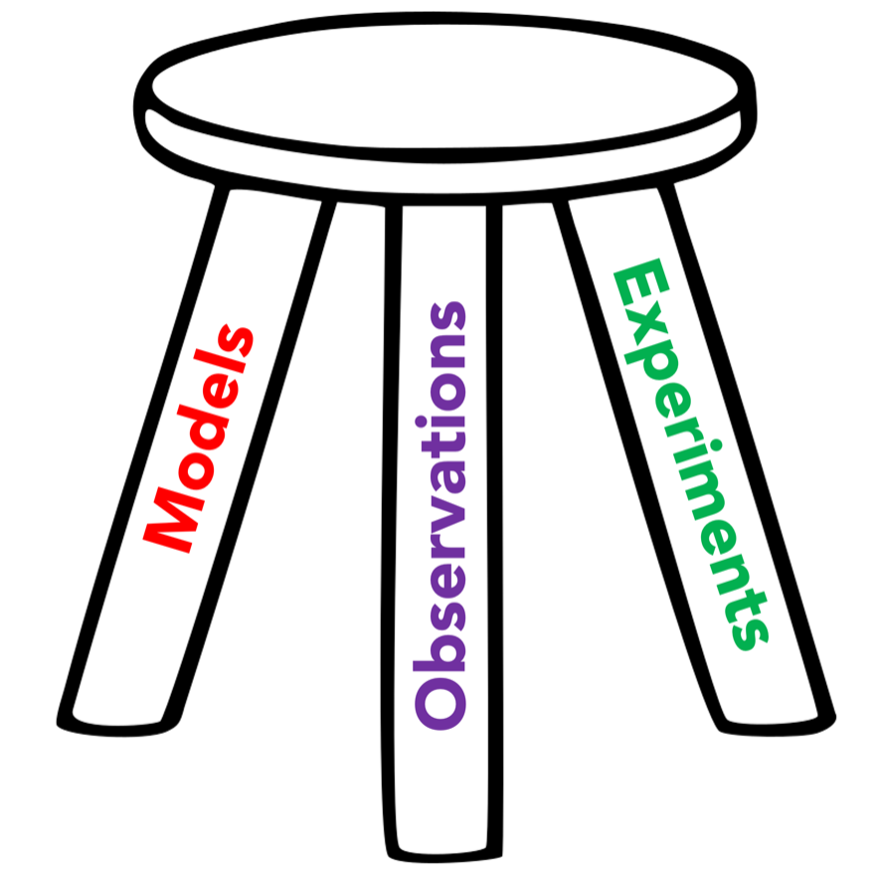
You may have heard of the three-legged stool analogy. It is often used to describe a concept or situation where three essential components or factors are critical. If one of the legs is missing, you are no longer sitting on a stool, but rather toppled over on the floor!
Three-legged Stool Example
Scientists understand climate by using three tools at their disposal. These three legs are:
Observations
“Observations” refer to the empirical data collected about the Earth's climate system through various methods. We’ll talk about these soon, but they can include satellites, weather stations, ocean buoys, and ice cores, among many others. These measurements can be straightforward, like temperature readings from a thermometer in your backyard, or incredibly complex, requiring highly specialized instruments to gauge parameters such as aerosol concentrations in the atmosphere or salinity levels in the ocean. Observations provide the essential raw data that feed into analyses, studies, and models, giving us the foundational "truth" about the evolution of the climate system. They offer a snapshot of real-world conditions, allowing scientists to validate hypotheses, calibrate models, and assess the current state of the climate system.
Models
“Models” are mathematical representations of the climate system built using the fundamental laws of physics, including conservation of mass, conservation of energy, and more. They can range from very simple “back-of-the-envelope” calculations you can do on a bar napkin to vast multi-million-line programs run on massive supercomputing systems that cost millions, if not billions, of dollars. Models serve as a virtual laboratory for experimenting on Earth, allowing scientists to simulate and analyze various scenarios to understand potential climate outcomes. These simulations are vital for predicting future climate conditions, assessing potential impacts, and developing strategies for mitigation and adaptation.
Experiments
“Experiments” in climate science involve controlled, often highly specialized, tests designed to isolate and study specific components or interactions within the Earth's climate system. These can range from lab-based studies that quantify fluxes from atmosphere-ocean interactions to field experiments that measure emissions from agricultural sources or the effect of land-use changes on emissions. Some experiments utilize advanced technologies like radiative forcing chambers to understand the response of atmospheric gases to various forms of radiation. Other experiments might employ techniques like stable isotope analysis to trace the origins and fates of specific elements within climatic cycles. The aim is to establish causality, validate or refute theories, and gather data that can be incorporated into climate models for more accurate predictions. Experiments are critical for advancing our understanding of complex climate processes, enabling scientists to tease apart the myriad factors contributing to climate change, and ultimately helping us make informed decisions for a sustainable future.
All of the legs complement one another, and focusing too much on one leads us to lack a large-scale overview of the Earth’s climate.