Why Humidity Matters
Humidity is one of the main reasons hot weather can feel uncomfortable. Sometimes it is not just the air temperature that makes us feel hot, but also the amount of water vapor in the air.
Our bodies cool themselves by sweating. When sweat evaporates from the skin, it removes heat from the body. However, when the air already contains a lot of moisture, sweat does not evaporate as easily. This makes it harder for the body to cool down, so we feel warmer and more uncomfortable.
Humidity also matters in buildings because it affects both comfort and energy use. If indoor air is too humid, people may lower the thermostat to feel cooler, which increases energy use. Managing humidity can therefore help improve comfort while also reducing cooling costs.
Air Composition and Pressure
Air is a mixture of several gases, including nitrogen, oxygen, and water vapor.
- The total air pressure exerted by a volume of air in a given container on that container is the sum of the individual (partial) pressures of these gases.
- The vapor pressure is the individual or partial pressure of the water vapor.
Warm air can hold more water vapor than cool air. This is why humidity changes with temperature. As air warms up, its moisture-holding capacity increases. As air cools down, it can hold less water vapor, and some of that moisture may condense into liquid water.
The Psychrometric Chart
A psychrometric chart is a tool used to show the properties of air at different temperatures and moisture levels. It helps us understand how temperature and humidity work together.
The chart shows that as air temperature increases, the amount of moisture the air can hold also increases. This is an important idea in heating, ventilation, and air conditioning (HVAC), because comfort depends on both temperature and moisture content.
A psychrometric chart (shown below) graphically represents the moisture content of air at various temperatures. The chart demonstrates that as air temperature increases, the amount of moisture that dry air can hold also increases.
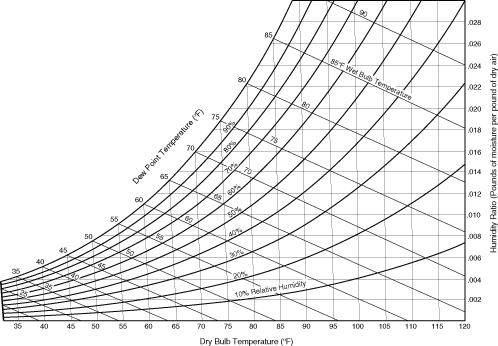
Text description of the Psychometric Chart image.
The image is a psychrometric chart, which is a graphical representation of the physical and thermal properties of moist air. The chart is structured with a grid of curved and straight lines.
- The horizontal axis represents Dry Bulb Temperature in degrees Fahrenheit, ranging from approximately 30°F to 120°F.
- The left vertical axis is labeled Humidity Ratio, measured in pounds of water vapor per pound of dry air, with values ranging from about 0.002 to 0.028.
- Curved lines represent constant Relative Humidity (RH) percentages, labeled at intervals like 10%, 20%, up to 100%.
- Several sets of diagonal lines run across the chart:
- Lines of constant Wet Bulb Temperature appear, measured in degrees Fahrenheit.
- Lines of constant Dew Point Temperature, also in degrees Fahrenheit, angle slightly less steep than the Wet Bulb lines.
Measuring Moisture in Air
Absolute Humidity is the actual amount of moisture that is contained in air. It is represented in the formula below:
Relative humidity (RH), is the ratio of the amount of moisture in the air to the maximum amount of moisture the air can hold at a given temperature, expressed as a percentage It is represented in the formula below:

Text description of the Relative Humidity image.
The image depicts a black chalkboard with a mathematical equation for calculating relative humidity written in white chalk. The equation reads: "Relative Humidity = (Amount of Water Vapor (lb)) / (Max. Amount of Water Vapor Air can hold) x 100." The terms "at a given temperature" and "at that temp." are indicated in smaller font beneath the numerator and denominator respectively. The color and texture suggest a vintage blackboard surface.
Example 1
Calculate the relative humidity of air when the air contains 0.002 lb of moisture per pound of dry air, while the maximum moisture air can hold at that temperature is 0.005 lb per lb of dry air.
Key Temperature Concepts
- Dry bulb temperature: The dry-bulb temperature is the regular air temperature measured by a thermometer. It is called “dry-bulb” because the thermometer bulb is dry. This is the temperature we usually see in weather reports.
Dew point Temperature: The dew point is the temperature at which air becomes fully saturated with water vapor. If air cools to its dew point, water vapor begins to condense into liquid water. This is how dew forms on grass or how moisture can form on a cold surface. A higher dew point means there is more moisture in the air. When the dew point is high, the air often feels muggy and uncomfortable.
Water vapor can store and transfer heat energy differently than dry air. Because of this, moist air often feels warmer and heavier than dry air at the same temperature. High humidity can make summer weather feel much hotter, while lower humidity usually feels more comfortable.
Saturation and Condensation
Saturation occurs when air contains the maximum amount of water vapor possible at a given temperature and pressure. At saturation:
- Relative humidity = 100%
- Air cannot hold additional moisture in vapor form
Condensation occurs when:
- Relative humidity reaches 100%, or
- Air is cooled below its dew point temperature, or
- Moist air contacts a surface cooler than the dew point temperature
Important: The coldest surface in a room is typically where condensation will occur first (called the "first condensing surface"). For air at a given absolute humidity, the colder the surface, the higher the relative humidity at that surface.
Temperature and Moisture Relationships
- As air warms: Water molecules move faster and remain in the gas phase; air can hold more moisture
- As air cools: Water molecules slow down and are more likely to condense onto surfaces
- At dew point: Air is saturated (100% RH); any further cooling causes condensation
Relative Humidity Isn't What You Think it Is (3:25)
Transcript: Relative Humidity Isn't What You Think it Is (3:25)
This episode is brought to you by the Music for Scientists album, now available on all streaming services. Click the link in the description to start listening.
[♪ INTRO]
If you’ve ever paid close attention to the humidity levels on your phone’s weather app, you might have noticed that they seem to make no sense. Like, in the summer, your app can say there’s 75% humidity, and you’ll be sticky and sweaty. But during winter, 75% might mean that your skin is super dry. So, what’s going on here?
Well, it turns out that the most common definition of humidity is… kind of inconvenient. But there is a better way to think about it. It all comes down to the fact that your phone, and most weather channels, specifically report relative humidity.
This number is measured in percentages, and it’s the amount of moisture in the air compared to how much water the air can hold. And the key is, how much water the air can hold depends a lot on temperature. See, for water vapor to come out of the air, it has to go from a gas to a liquid — usually, by condensing onto something like dust, or your window glass. And for something to go from a gas to a liquid, it has to lose energy. In other words, the molecules have to physically slow down.
Well, when the air is warm, the water molecules in it contain a lot of energy. They’re moving more than water molecules in cooler air. That means they’re less likely to condense out of the atmosphere — and they end up hanging out in the air and making things feel all sticky.
Humidity and temperature. So, temperature plays a big role in relative humidity. And it’s why this stat usually isn’t that useful in planning your day. If it’s -10 degrees Celsius, the air can’t hold onto as much moisture — so 75% humidity isn’t actually that humid. But if it’s 20 degrees, 75% humidity suddenly means there’s a lot more water in the air to make things feel all muggy.
If you want a number for humidity that isn’t quite so relative… try the dew point temperature. This is the temperature at which water droplets or dew form on things like grass. In other words, it’s the temperature at which the air is completely saturated with moisture. And the closer the dew point temperature is to the temperature outside, the stickier and more unpleasant it will be.
For reference, people react differently to dew points, but most folks are comfortable with a dew point of 10 degrees Celsius. And things get pretty humid and unpleasant around 15 or 21 degrees. So, it’s still a new scale to learn… but it’s also consistent no matter how cold it is outside.
Science inspiration. Now, the big question is, if the dew point temperature is a great way to tell you how the outside world feels, why don’t weather apps and weather channels use it? It’s mostly a matter of history. Instruments that measure relative humidity predate the ones that measure dew points. Like, one of the first mechanical hygrometers, a device that measures humidity, appeared in 1783. And since these devices were widely available to the public and gave reliable measurements of relative humidity, the term, unfortunately, stuck around.
...you know what else is available to the public and gives reliable science inspiration? Music for Scientists, a tribute album to science inspired by the beauty of science. It was written and recorded by Patrick Olsen, and if you want to check it out, I’d recommend starting off with the song “Aristarchus in the Rain” — which isn’t about humidity, but is about a scientist trying to make sense of this messy and cloudy world. If you want to check it out, look for “Music for Scientists” on all major music streaming services, or click the link below.
[♪ OUTRO]
 Saturation is the maximum amount of water vapor in the air at an existing temperature and pressure. Air is said to be saturated at 100 percent relative humidity when it contains the maximum amount of moisture possible at that specific temperature.
Dew point is the temperature when air reaches 100% relative humidity.