Unit 1: Energy and Environment
Unit 1: Energy and EnvironmentUnit 1 Introduction: How and Why We Use Energy
Welcome to Unit 1. In this first unit, we will present content in text and video showing the immense value we get from energy, where we get most of our energy, why the energy system must change eventually, and why a faster change would help us.
Each module of the course includes links to topic-related video clips taken directly from Earth: The Operators' Manual, a three-hour miniseries funded by the US National Science Foundation and viewed by millions of people nationwide on PBS. The conceptual foundations of this course were built on the principles and materials created for ETOM.
In addition, the course includes integrated video-enhanced graphics—clicking on many of the images and tables will open a short narrated video from Dr. Alley, explaining the key points. We hope that these will greatly enhance your level of understanding of key concepts presented.
- Why Energy Matters (Module 1)
- What is Energy? (Module 2)
- Oil, Coal & Natural Gas | Drilling, Fracking & Reserves (Module 3)
- The Physics of Global Warming (Module 4)
- The History of Global Warming (Module 5)
To get started, please watch the video below. This particular video will give you a glimpse into what the world's energy usage currently is and what it might be in the future.
 Earth: The Operators' Manual
Video: Humans & Energy (4:32)
Humans & Energy
RICHARD ALLEY: Humans need energy. We always have, and always will. But how we use energy is now critical for our survival. It all began with fire...Today, it's mostly fossil fuels. Now we're closing in on seven billion of us and the planet's population is headed toward 10 billion. Our cities and our civilization depend on vast amounts of energy. Fossil fuels-- coal, oil and natural gas--provide almost 80% of the energy used worldwide. Nuclear is a little less than 5%. Hydro-power a little under 6.
And the other renewables--solar, wind and geothermal about 1% but growing fast. Wood and dung make up the rest. Using energy is helping many of us live better than ever before. Yet well over a billion and a half are lagging behind, without access to electricity or clean fuels.
In recent years, Brazil has brought electricity to ten million, but in rural Ceará, some still live off the grid. No electricity, no running water, and no refrigerators to keep food safe. Life's essentials come from their own hard labor. Education is compulsory, but studying's a challenge when evening arrives. The only light is from kerosene lamps. They're smoky, dim and dangerous. Someday, this mother prays, the electric grid will reach her home. (translator) The first thing I'll do when the electricity arrives in my house will be to say a rosary and give praise to God. (Richard Alley) More than half of China's 1.3 billion citizens live in the countryside. Many rural residents still use wood or coal for cooking and heating, although most of China is already on the grid. China has used energy to fuel the development that has brought more than half a billion out of poverty.
In village homes, there are flat screen TVs and air conditioners. By 2030, it's projected that 350 million Chinese, more than the population of the entire United States, will move from the countryside to cities... a trend that's echoed worldwide. Development in Asia, Africa, and South America will mean three billion people will start using more and more energy as they escape from poverty. Suppose we make the familiar if old-fashioned 100 watt light bulb our unit for comparing energy use. If you're off the grid, your share of your nation's energy will be just a few hundred watts, a few light bulbs. South Americans average about 13 bulbs. For fast-developing China, it's more like 22 bulbs. Europe and Russia, 5,000 watts, 50 bulbs. And North Americans, over ten thousand watts, more than 100 bulbs.
Now let's replace those light bulbs with the actual numbers. Population, shown across the bottom and energy use, displayed vertically, off the grid to the left, North America to the right. If everyone, everywhere, started using energy at the rate North Americans do, the world's energy consumption would more than quadruple, and using fossil fuels, that's clearly unsustainable. No doubt about it, coal, gas, and oil have brought huge benefits. But we're burning through 'em approximately a million times faster than nature saved them for us, and they will run out. What's even worse, the carbon dioxide from our energy system threatens to change the planet in ways that'll make our lives much harder. So why are fossil fuels such a powerful, but ultimately problematic, source of energy?
Credit: Earth: The Operators' Manual. "Humans & Energy". YouTube. April 9, 2012.
Unit Goals
Upon completion of Unit 1, students will be able to:
- Recognize the natural and human-driven systems and processes that produce energy and affect the environment
- Explain scientific concepts in language non-scientists can understand
- Find reliable sources of information on the internet
- Use numerical tools and publicly available scientific data to demonstrate important concepts about the Earth, its climate, and resources
Unit Objectives
In order to reach these goals, the instructors have established the following objectives for student learning. In working through the modules within Unit 1, students will:
- Recognize that even really smart people have failed when climate changed
- Explain how machines and trade have helped other people avoid catastrophe
- Describe how we have burned through energy sources in the past
- Show that people can make money and save the world at the same time
- Recall that using energy doesn’t make it go away, it is just converted into a less useful form
- Recognize the many units of energy and power
- Show that the amount of energy used by people around the world is much larger than the 100 watts inside most people converted from food
- Recall that around 85% of the energy we use is derived from fossil fuels
- Analyze energy use and production in a country other than the United States
- Recall that oil, coal and natural gas are produced naturally by well-understood processes
- Evaluate the effects of technology, economics, and population growth on fossil fuel production using computer models
- Demonstrate that our current consumption of fossil fuels is not sustainable by exploring future scenarios with computer models
- Recall that carbon dioxide has a well-understood and physically unavoidable warming influence on Earth’s climate
- Recognize that positive feedbacks amplify changes, and negative feedbacks reduce them
- Recall that multiple independent records from different places using different methods all show that both CO2 and temperature are rising
- Explain that patterns of global warming in the past century can only be reproduced by considering both natural and human influences on climate
- Use a model to show that global climate always finds a steady state, but certain factors may influence how long it takes to get there
- Demonstrate that greenhouse gases are the most significant factor controlling surface temperature
- Summarize how the Earth’s history confirms the warming influence of carbon dioxide
- Recognize that past climate changes have greatly affected plants and animals, usually in unpleasant ways
- Recall that future rise in CO2, and therefore surface temperature is likely to be much worse than what we have experienced in the past 100 years
- Explain how small amounts of climate change are worse for poor people, and larger amounts are bad for everyone
- Assess what you have learned in Unit 1
Assessments
| Module | Assessment | Type |
|---|---|---|
| 1. Why Energy Matters | Get Rich and Save the World | Discussion: Find an Article |
| 2. What is Energy? | Energy Use Around the World | Discussion: Search and Compare |
| 3. Oil and Coal and Natural Gas | Peak Oil Model | Summative - Stella Model |
| 4. Global Warming: Physics | Global Climate Model | Summative - Stella Model |
| 5. Global Warming: History | Learning Outcomes Survey | Self-Assessment |
Module 1: Why Energy Matters
Module 1: Why Energy MattersOverview
We will get to the facts and figures soon enough, but in Module 1 we will start with stories of our ancestors showing the immense value, but real difficulties of energy use.
When drought strikes, people who can drill wells, pump water and trade for food are much better off than people without diesel pumps and trucks. Drought ended the civilization of the Ancestral Puebloan people of what is now the southwestern United States but was much less damaging to the people of Oklahoma more recently. However, before diesel, gasoline, and other fossil fuels, we often burned whales and trees much faster than they grew back, causing real problems.
Within this module, the focus is to get you thinking about the value of energy, and how difficult getting that energy can be—both historically and currently.
Note that we do not expect you to become experts on ancestral Puebloans or Oklahomans—they serve as examples. We could have told similar stories from China, or Europe, or Guatemala, or many other places with many other people. This is really about all of us.
Goals and Objectives
Goals and ObjectivesGoals
- Recognize the natural and human-driven systems and processes that produce energy and affect the environment
- Explain scientific concepts in language non-scientists can understand
- Find reliable sources of information on the internet
Learning Objectives
This unit is mostly about helping you see how much good we get from energy. By the end of this module, you should be able to:
- Recognize that even really smart people have failed when climate changed
- Explain how machines and trade have helped other people avoid catastrophe
- Describe how we have burned through energy sources in the past
- Show that people can make money and save the world at the same time
Roadmap
Roadmap| Type | Task | Due |
|---|---|---|
| To Read | Materials on the course website (Module 1) Get Rich and Save the World (available for download) | A.S.A.P |
| To Do | Module 1 Discussion Post NOTE: Submit all assignments in your course management system. | Due Wednesday |
Questions?
If you have any questions, please post them to Help Discussion. We will check that discussion forum daily to respond. While you are there, feel free to post your own responses if you, too, are able to help out a classmate.
Unfriending Fossil Fuels
Unfriending Fossil FuelsFossil Fuels have become our best friends—oil, coal, and natural gas power about 85% of the global economy. These energies are absolutely essential today to keep us healthy and happy. Seven billion people inhabit the planet—a planet with whales in the oceans and trees on the land—because we have mostly switched from burning trees and whales for energy to burning fossil trees and fossil algae.
But, we are burning those fossils about a million times faster than nature saved them for us. We cannot continue these practices very far into the future because the resources will no longer be available. If we burn most of our available resources before we make major progress on sustainable alternatives, we risk dangerous shortages of energy in a world that is much harder to live in because of damaging climate change. Given this, we are faced with the difficult task of "un-friending" our best friends—fossil fuels.
According to the “Help” page on a major social networking site, "un-friending" someone is as simple as going to the right website and clicking “Un-friend." Even that simple act has generated a truly amazing number of online discussions that explore the implications, reasons, impacts, options, and ethics of "un-friending." Switching from fossil fuels is far more serious, as it involves changing how we spend almost $1 trillion per year just in the U.S., for example.
To begin, let’s take a quick tour of just how valuable fossil fuels are to us. Later, we will look at the dangers of continued reliance on fossil fuels. Looking at the good and the bad of fossil fuels will help us make sense of the issues at hand. Required Reading
Get Rich and Save the World (available in your course management system) is an article by Dr. Richard Alley from the Earth: The Operators' Manual website. This will give you more background before moving on to the next section in this module.
At the end of this module, you will be asked to join in an online discussion of the module content with other course participants. You may access the Week 1 Discussion Forum at any time, but we suggest that you work through all of the content first so you are ready to fully engage in the topic-related discussion(s).
Dealing with Drought
Dealing with DroughtShort Version: Drought or other natural disasters can cause even really smart people to fail badly if they don't get enough help. However, with plenty of fossil-fueled tools and trade, the dangers of natural disasters have been reduced greatly. Here, we consider two cases of people responding to severe droughts — one before the age of fossil-fuel energy, the other during the age of fossil-fuel energy.
Friendlier but Longer Version: We could tell many stories about the benefits of fossil fuels. Here is one. The details of this story are not especially important, but the basic idea is greatly important—our ability to use fossil fuels to power our tools makes us much better off.
A few years ago, a great group of Penn State students, faculty, and film professionals toured many of the national parks of the US southwest. We hiked to the bottom of the Grand Canyon, rafted the Colorado below the Glen Canyon dam, slept on the slick rock at Canyonlands, and otherwise had a truly wonderful trip.
Many of us were especially fascinated by Mesa Verde. Ancestral Puebloan (often called Anasazi) people lived at that site for roughly 700 years—much longer than the history of the Americas since Columbus—first on top of the mesa, but then moving to build intricate dwellings in caves down the mesa sides, commuting up ladders and steps carved in the rock to work the fields on top. But, after most of a millennium, the people left.
Archaeological sites are almost always open to interpretation and argument. We know what was left behind, and we can learn much of what was going on around the area, but the record is necessarily incomplete and viewed through the lens of who we are.

Some of the evidence we saw at Mesa Verde of people dealing with hard times when a drought hit.
Still, much of the Mesa Verde story is rather clear. The national park rangers showed us the little holes that the people painstakingly carved in the rock in the dwelling caves to capture a trickle of water. We marveled at the carefully constructed check dams, stones set to stop the erosion of the mesa top and catch a little soil and water to grow a little more corn. Food-storage structures were built in places that were very difficult to reach. And, toward the end, windows between different parts of the cliff dwellings were blocked with rocks, dividing people.
Video: Mesa Verde Story (8:29)
Mesa Verde Story
MESA VERDE
DR. RICHARD ALLEY: This is a wonderful, but a little bit disturbing, story of some really smart people living in southwestern Colorado, ancestral Puebloans, at a place called Mesa Verde. They lived there for hundreds of years and left shortly before Columbus got to the New World. A lot of their farming was done on top of a mesa, and they lived in caves down the side of the mesa in these wonderful structures made mostly out of stone. Here is a modern ladder with a person for scale.
And what I want you to notice here, in addition to the great buildings, is up here on top. This fairly clearly was a granary-- this is where they kept their food late in their existence there. It's probable, not certain, but it's probable that this is a little bit like a modern person putting the cookies way up on the upper shelf, so they won't eat them before they're ready to. Accept this wasn't the cookies, this was the food. And that might be something you'd do if food was really getting scarce.
CAVE
Now that structure we just looked at, if you go behind it, you find it's actually built in a cave. And this is sandstone, and there's a little bits of shale and water sort of percolates down through here. And then it hits the shale, and it seeps out. So, it's a little bit damp back there, in a generally dry climate.
WATER
And if you look around back here on this rock, do you see? You see things like this-- little holes they dug in the rock so that when water came seeping out, it would fall into these holes, drip in, and you could take a cup and get a little bit of water. And that's what you do if you're really thirsty because that doesn't look like the best water for us. But if that's all the water you have, that's what you do.
WINDOWS
Now they built these wonderful structures, and some of them had windows between, say, your house and mine, or your room and mine. And late in the occupation, it appears that they walled the windows off. And usually, when you're walling the window off, you're trying to keep something out. And it is possible that they were not getting along with their neighbors quite as well as they might once have if they're walling off the windows within the structure.
CORN DAM
Now if you go up on top where they grew the corn, this actually was built by the ancestral Puebloans, hundreds of years ago. And it stops erosion. So, there's a little tiny stream comes through here, but this little dam of rocks catches a little bit of soil, where you could grow a little bit of corn. And it traps a little bit of water, and a little bit of soil. And so, you're looking at people that really were shepherding what they had, conserving. And apparently, they needed this.
STRUCTURES
What you see then, is people who were living on the edge. Hard to get enough food, hard to get enough water, life was getting hard. If you look around the structure, it's mostly made of stone, because there weren't many trees. But there's a little bit of wood in the houses there at Mesa Verde.
WOOD
If you know anything about wood, you know that it has layers. And the layers, when the tree is happy, it grows a thick ring. And when the tree is unhappy, it grows a thinner ring. And you can see different thicknesses of rings in this.
And you can take cores, and you can count the layers, and count how thick the layers are. And in a place like Mesa Verde, where it's very dry, a happy tree is one that has rain. And an unhappy tree doesn't.
It's also possible, if you have a living tree, you can take a core from it, and you can see the pattern of thick and thin rings in that core. There might be dead trees nearby, and you can see the pattern of thick and thin rings in that, and you can match them up between trees. And you can go back to the wood in the archaeological sites, and you can find the same pattern. And so, you can make a tree ring record, which is longer than the life of any given tree, with the thickness of the ring telling you how much it rained.
So, now what can you do? Archaeologists and tree ring people got together. And they made the plot that you're going to see here. The year 800 is on your left, the year 1200, 1300 there, which is sort of the crash.
And so first of all, you have in green here, a history of how many people could live in the area. And this is actually done just down the road from Mesa Verde, at a place called Long House Valley that had less trade, so it was easier to work on. And what they did is they looked at the trees, and they said how thick a layer is, is how much it rained.
Rain also tells you how much corn could be grown, and corn is how many people could live there. So the green curve is from trees and from knowledge of the people-- how many people could live in this place. Independently, archaeologists went in, and they looked at the classical things-- how many people were living there? You know, how many burials, and how many houses, and that sort of thing. And so, they looked at how many people were living there, and that's this curve.
And what you'll notice is within the scientific uncertainties of all this, these are the same record. How many people lived there, and how many people could live there, are essentially the same. When it got wet, population went up. When it got dry, we don't know whether they died, or whether they left, or whether they quit having babies. But the population went down.
And the rains came back, and so did the people. And then the rains left. And at some point, the people said, we are out of here. We're going to become environmental refugees, and we're going to go someplace it rains more. And they left.
And so, these are very smart people, doing amazing things. But they were controlled by the climate, ultimately. And it got them in the end.
OKLAHOMA
Now, this is more recent. This is Oklahoma from the year 1900 to the year 2000. And the red curve here now is a history of drought.
And down is really dry, and this thing right down here is the Dust Bowl. And that made great literature, but it made lousy living, and you've probably seen the pictures of the Okies headed for California to get away from the dust. But look at the population history of Oklahoma, and you'll see that while the Dust Bowl kicked them-- and then World War II, some probably going off to war-- it's not nearly the disaster it was for the ancestral Puebloans.
Now, these are also smart people, but these are people that when the drought hit, some of them got in gasoline-powered cars and they drove away. But some of them had food delivered in gasoline-powered cars, or in diesel-powered trains. They had diesel-powered well drilling, that they could drill a well, and they could run motors, or run windmills to pump water out. And so, they had more tools, and they had more stuff-- and those were fossil-fueled.
And more recently, when other droughts have occurred, it really hasn't affected the population much at all. Little tiny changes, but really not too much. And so, what you can see is our having fossil fuels, and having machines, and having trade has greatly insulated us from what otherwise would be disasters for even very smart people.
Credit: Dutton Institute. "EARTH 104 Module 1 Mesa Verde." YouTube. November 18, 2014.
Some of the evidence we saw at Mesa Verde of people dealing with hard times caused by a drought.
The evidence is very clear that the people were conserving water and soil, working to maintain and improve their ability to grow food. The hard-to-reach food storage might be a truly serious version of someone hiding something on the top shelf so they don’t eat it before they should, and the window-blocking is at least suggestive of increasing social stresses.

The image is divided into two sections. On the left, there is a close-up photograph of a tree cross-section embedded in a rock matrix. The cross-section shows several concentric growth rings, with a rough texture and visible cracks spreading from the center outward. The coloration varies from light to dark brown, giving it an aged appearance.
On the right, there are two smaller images. The top one depicts a smoother cross-section of a tree ring, showing clearer concentric rings in vivid shades of brown and orange, with less visible cracking. The lower image displays a horizontal wooden beam with a small exposed cross-section in the middle, indicated by a blue arrow pointing at it.
To learn more of this story, scientists went to Long House Valley in Arizona, a simpler place nearby that was occupied by the same people. Recall that the age of a tree can be learned by counting its yearly rings. These rings are easy to see in places where there are pronounced seasons because trees grow rapidly during the spring and early summer, putting on a lot of new wood that appears lighter in color, and then during the fall and winter, the growth slows way down and very little wood is added; this late-season wood is denser and darker. So, one thick light band and a thin darker band make up one year. This is sometimes not the case for trees that grow in the tropics, where there may be little difference between summer and winter, however, if tropical settings with defined wet and dry seasons, trees do develop annual rings. The important thing is that there needs to be a seasonality for trees to develop annual rings. In the dry climate of a place like Long House, trees grow better when it is wetter in the growing season, so a tree will thicker annual rings — the ring thickness is directly correlated to the amount of rainfall. In colder climates, the ring width can be correlated to temperatures during the growing season — warmer temperatures lead to thicker rings.
Thus, tree rings preserve a record of the climate history — rainfall in drier regions and temperature in colder regions. And, living trees overlap in age with trees that were used in construction, or trees that died but haven’t rotted yet. Using the pattern of thick and thin years to match the modern and older wood (a technique called cross-dating), the history of rainfall can be extended beyond the life of a single tree. Cross-dating has enabled us to produce continuous tree ring records that go back about 12,000 years even though the oldest living tree is just a bit over 5,000 years.

Rain and Population
Rain and PopulationRain can grow corn as well as trees, and corn can grow people. Thus, knowing something about trees, corn, and people, a team of scientists can start with tree rings and learn how many Ancestral Puebloan people could have lived in an area. Meanwhile, archaeologists are able to use their techniques of digging and dating to learn how many people actually lived in an area. Teams of archaeologists and tree-ring climatologists did this research at the “end of the road” in the small, remote Long House Valley, which was not a trading center.
What they learned is striking, as shown in the figure.

Next, take a look at a similar history, from Oklahoma over the last century. The Dust Bowl of the 1930s was a major drought, made worse by various economic decisions about land use. Wonderful literature documents the terrible economy and environment, as people suffered and died.

Yet, even today, where the economic resources are not available, as in the African Sahel, droughts have huge consequences and drive widespread starvation or migrations of environmental refugees.
Every person I ever met who studied the ancestral Puebloan people of Mesa Verde and surroundings has come away deeply impressed with the resourcefulness and cleverness of the people. The difference between Puebloan and Oklahoman success during drought is not because one group was smart and the other wasn’t. But the technologies and trade are vastly different (for many reasons!), and the people who could call on more tools and more help were more successful. Some of those tools were wind-powered, but most ran on fossil fuels, and success has increased as the use of fossil fuels increased.
Want to know more?
Take a look at the Enrichment called Burning for Learning
Running Out of Trees
Running Out of TreesThe early European settlers in central Pennsylvania (and many other places) wanted iron, turning rusty soils into pig iron in dozens of different furnaces (including Pennsylvania’s Centre Furnace, just down the hill from Penn State’s University Park Campus, where this is being written), and then turning the hunks of iron into useful things in forges (including Pennsylvania’s Valley Forge).
Video: Days of Iron (2:10)
Days of Iron
Dr. Richard Alley: This is a Centre Furnace. The road runs up the hill to Penn State University Park campus and the town of State College. But State College didn't even exist when the university was founded in 1855. The university was built up the hill from the Iron Furnace, and they've been making iron here since 1791.
This is a glass slag. This is what was left when they melted the ore to get the iron out and drained that away and then this chilled, and it froze to make the glass. Melting the ore took energy. And the energy came from charcoal, and the charcoal came from trees. To fire a furnace for a year took more than a half a square mile of trees. But the furnace was served by an independent community, and it had people in it who built houses and heated them in the winter and cooked, and that took wood too.
Running a furnace and what was around it, took a square mile of trees a year. And there were lots of furnaces and lots of forages, like Valley Forge, that turned the iron into useful things. The furnace closed in 1858. Production moved west to use better ores and to use coal as a fuel because the trees were gone. It was about the same time as peak whale oil, and just before the first modern oil well up the road here in 1859. Today, we have whales, and we have trees because we burn fossil algae and fossil trees, oil and coal, and natural gas.
Pennsylvania by itself had dozens of iron furnaces. The early iron furnaces and forges were fueled by charcoal, which was made from trees. As many as 100 workers would spend fall and winter making the charcoal for just one furnace, which used trees from more than half a square mile (more than a square kilometer) per year. Those people were burning a lot of trees in their fireplaces in winter as well, and the forge that converted the pig iron to useful things required as much charcoal as a furnace. Thus, forests and iron-making didn’t coexist for very long—the Commonwealth of Pennsylvania was rapidly converted from “Penn’s Woods” to the “Pennsylvania desert”, with almost no trees or wildlife remaining. You can see this deforestation in the US in the form of some maps. And it wasn’t just Pennsylvania, or just Europeans—the growth of the iron industry in China led to deforestation, too, and many other people around the world have cut trees much faster than they grew back.
Running Out of Whales
Running Out of WhalesThe flickering light of a fireplace or wood stove isn’t great for reading in a dark Pennsylvania winter, so people have burned many other things for light. In Pennsylvania and elsewhere in the US, wealthy early European settlers preferred burning whale oil, which didn’t stink like tallow candles (made from animal fat), and didn’t blow up like the alcohol-turpentine mixture known as camphine. At its peak, the Yankee whaling fleet had 10,000 sailors on ships, scouring the far reaches of the ocean for whales to supply oil. Populations of the main species pursued by the Yankee whalers dropped precipitously, and the Yankee production of whale oil followed, with prices rising greatly, from a low that would be about $7/gallon today, to a peak of almost $25/gallon. The total amount of whale oil collected by the Yankee whalers in the 1800s is roughly the same as the total amount of oil (petroleum) imported by the United States in a week—if we hit a shortage of our modern energy sources, we cannot easily go back to our former sources!
Video: Whales Celebrate Oil in Pennsylvania (0:48)
Whales Celebrate Oil in Pennsylvania
DR. RICHARD ALLEY: This is an editorial cartoon that was published in the magazine, the publication, Vanity Fair in the year 1861, just before the US Civil War. And it is the grand ball given by the whales in honor of the discovery of the oil wells in Pennsylvania. And you'll notice the whales in their evening dress being served by frogs. And it's just before the Civil War, so you have the oil wells of our native land, may they never secede. And you have oils well that ends well. And we whale no more for our blubber. We have whales because we burn fossil algae. We don't burn whales to see at night anymore.
Source: "Grand Ball Given by the Whales in Honor of the Discovery of Oil Wells in Pennsylvania" Published in Vanity Fair in 1861. New Bedford Whaling Museum.
As the US got out of the whaling business, others—particularly Norwegians—got into it, using new technologies including faster boats and harpoon cannons to hunt species that had eluded the Yankee whalers. But even the vast resource of fast Antarctic whales proved small compared to the hunger of humans, and soon those whales were depleted as well.
Video: Peak Whale Oil (2:16)
Peak Whale Oil
DR. RICHARD ALLEY: This is the history of whale oil production from the Yankee fleet from New England in the United States from the year 1800 on your left to the year 1880 on your right. And you'll see that they got better and better at whaling. And then, they went over peak whale oil and down the other side.
A lot of this was things like there's a civil war over here, when some whaling ships were sunk to block Southern harbors. The whaling fleet is crushed in the ice off of Alaska over here, and insurance prices go through the roof. But they were up off of Alaska because they couldn't find whales anywhere else. And that's what was going on.
Now here, there are 10,000 men on ships out of New England looking for whales in the world oceans. And there's lots more people working in New England to process the whale oil and what have you. Because you kill the whale and you boil the whale to make the oil, but then all the pieces of the whale were used for various things.
Now, as they get better at whaling, the price went down. And the low point here is about 7 dollars a gallon for whale oil that was used in lamps. As soon as peak whale oil wash it, the price of whale oil went up to 23 dollars a gallon. And this is the equivalent of modern money.
And so, what you find is it's not when you run out of the resource that the price goes up. It's as soon as the resource starts to get scarce. Now indeed, the free market worked in some sense. People went up the road from where I'm speaking to you and they drilled the first modern oil well, the Drake Well, in 1859. But you'll notice even that didn't really bring the price back down.
All of this oil-- 100 years of whaling-- 10,000 men at the peak-- collected as much whale oil as about one week of modern US oil imports. So, there's really no chance that we can actually go back to the way we used to do things.
Source: Whale oil production. Prices and Production over a complete Hubbert Cycle: the Case of the American Whale Fisheries in 19th Century, Aug 2004, Ugo Bardi , ASPO: The Association for the Study of Peak Oil and Gas, and Dipartimento di Chimica - Universit a di Firenze,Via della Lastruccia 3, Sesto Fiorentino (Fi), Italy. bardi@unifi.it This document is published in the #45 issue of the ASPO newsletter. The present version appears at ASPO Italia. Data from A. Starbuck, History of the American whale fishery, Seacaucus, N.J. 1878, reprinted 1989
Video: Polka Oil (0:47)
Polka Oil
DR. RICHARD ALLEY: This is actually the cover of a piece of sheet music that was published in 1864 in New York. This is "The American Petroleum Polka," or charge, or gallop, or waltz, or march. And it has a picture of a beautiful Pennsylvania scene, the oil well spouting its oil. Now oil was black back then. Oil is still black. But you couldn't have black oil falling on the lady's pink dress, so they made the oil white. And then bragging, "This oil well threw pure oil a 100 feet high." people understood the value that you get from oil, from petroleum. And they celebrated that.
Source: American Petroleum color lithograph music cover showing the Tarr Farm, Oil Creek, Pa., with oil wells, barrels, etc. Credit: J.J. Watson, c1864. Reproduction Number: LC-USZ62-86463. Rights Advisory: No known restrictions on reproduction. Call Number: LOT 10615-47 [item] [P&P] Repository: Library of Congress Prints and Photographs Division, Washington, D.C. 20540 USA.
The first modern oil well was drilled in Pennsylvania along Oil Creek, up the road from where Dr. Alley lives, in 1859, shortly after peak whale oil in the US and the sharp rise in whale-oil prices. The impact was understood even then, with the magazine Vanity Fair in 1861 publishing an editorial cartoon showing the “Grand Ball of the Whales in Honor of the Oil Wells of Pennsylvania”, featuring the sign “Oils well that ends well”. The cover of the 1864 sheet music American Petroleum Polka features a Pennsylvania scene including a lady in a pink dress and an oil well that “…threw pure oil 100 feet high” (30 m).
Earth: The Operators' Manual
Video: America's Energy Past: A 3-minute clip on "peak whales".
America's Energy Past
NARRATOR: But to have a sustainable energy future, we have to do things differently than in the past. Richard Alley explains--
DR. RICHARD ALLEY: We've been burning whatever was at hand for a long, long time. But as we see repeatedly with energy, you can burn too much of a good thing. And there are patterns in the human use of energy and if we're stupid enough to repeat them, burn all the fossil fuel remaining on the planet and put the CO2 into the air, we will cook our future.
Take what we did to trees in North America, for example. When the first settlers arrived on America's east coast, the forests were so thick, you could barely see the sky. That soon changed. And the forests almost completely disappeared as more and more trees were cut down to meet the heating, cooking and building needs of a growing population. Making iron needed lots of furnaces and the furnaces ran on charcoal made from trees.
You can trace that history in tell-tale place names from my home state of Pennsylvania. So farewell virgin forests, hello Pennsylvania Furnace, Lucy Furnace, Harmony Forge, and Valley Forge of Revolutionary War fame. Large areas of forest were soon depleted, and charcoal making and iron production moved on, to repeat the process elsewhere. Peak Wood, meaning the time of maximum production, came as early as the first decades of the 19th century or even before that for some parts of the East Coast. The pattern of using up an energy resource until it was nearly gone was repeated at sea.
As America's population grew, so did their need for a better way to light the night. So whaling crews went to sea, on the hunt for the very best source of illumination... whale oil. At first, large numbers of whales were found nearby. They could just be towed to shore. But by the 1870s, we'd burned so many whales to light our evenings, that all the easy whales were gone. Whale-oil prices roughly doubled. Now, ships had to travel close to the poles in search of bowhead whales. Their oil wasn't as good. And conditions were really dangerous. In 1871, up in the Arctic, 33 ships were trapped in the ice and crushed. Just as happened with America's forests, we'd exploited the most easily accessible resources and hadn't stopped until we'd almost used them up. Lucky for us, in 1859 a cheaper and more abundant source of energy had been discovered with Edwin Drake's successful oil well, drilled in Titusville, Pennsylvania. And for 150 years, America ran and grew on oil and coal.
Discussion Assignment
Discussion AssignmentReminder!
After completing your Discussion Assignment, don't forget to take the Module 1 Quiz. If you didn't answer the Learning Checkpoint questions, take a few minutes to complete them now. They will help your study for the quiz, and you may even see a few of those questions on the quiz!
Discussion Question
Objective:
Show that people can make money and save the world at the same time. Find an article online about someone who has made money by doing something that conserves energy or generates energy in a new way that is less damaging to the Earth than traditional fossil fuel extraction and burning. Share it with the other students in this course and discuss the various ways entrepreneurs have approached this issue.
Goals:
- Find reliable sources of information on the internet
- Communicate scientific ideas in language non-scientists can understand
Read:
Get Rich and Save the World from Earth the Operator's Manual.
Description:
Many of us pessimistically accept the idea that in order to make money and progress, we have no choice but to inflict some amount of damage on the Earth and its environment. But there are those out there who have flipped this axiom on its head by finding ways to make money by doing things that help the Earth. For this activity, search online for an article to share with the class. The article should describe one way in which someone or some company has found a way to make money by saving energy or by developing new alternative means of producing energy.
Start by searching the terms "energy entrepreneurs" or "environmental entrepreneurs". Click around until you find something interesting.
Once you find an article you would like to share, write 2-3 sentences summarizing the content. Then, write an additional 1-2 sentences explaining your thoughts on making money and helping the world. Explain in your own words why you think it is or is not possible or necessary to implement these ideas on a global scale.
Instructions:
Your discussion post should include a link to the article you have chosen, a summary 100-150 words in length, and a personal commentary 75-100 words in length. Your original post must be submitted by midnight on Wednesday. In addition, you are required to comment on at least one of your peers' posts by midnight on Sunday. You can comment on as many posts as you like, but please try to make your first comment to a post that does not have any other comments yet. Once you have an idea of what you want your post to be, go to the course discussion for your campus and create a new post.
Scoring Information and Rubric:
The discussion post is worth a total of 20 points. The comment is worth an additional 5 points.
| Description | Possible Points |
|---|---|
| link to appropriate article posted | 5 |
| summary provides a clear description of the article content (100-150 words) | 10 |
| well-reasoned comment on your own article included in your post (75-100 words) | 5 |
| well-reasoned comment on someone else's article and post (75-100 words) | 5 |
Summary and Final Tasks
Summary and Final TasksSummary
Our history is thus quite clear. Life is hard if we have to do everything for ourselves. We rely on arranging for help, getting energy from outside us. As we have learned to hunt, gather and control energy, we have gained the ability to survive droughts, cold, and other problems that might have defeated us before. But, even for resources such as whales and trees that can grow back, we often over-harvest until they become scarce (or disappear entirely, as we have done to many species such as the wooly mammoths of ice-age North America). When we switched to heavy use of fossil fuels, we reduced our reliance on some of the earlier sources—we have whales and trees today because we rely on burning oil, coal and natural gas.
Reminder - Complete all of the Module 1 tasks!
You have reached the end of Module 1! Double-check the Module Roadmap table to make sure you have completed all of the activities listed there before you begin Module 2.
Enrichments
EnrichmentsUse the links to go to the enrichments for Module 1. These materials are not required and will not be covered in the assessments, but they are interesting and will add to your understanding.
Burning for Learning
Burning for LearningDo you ever empty the lawn-mower bag to get your dinner? Or chew up a handful of wheat or leaves from the maple tree? How about raw meat?
Cows can succeed by eating grass, but they have four stomachs and spend a lot of time “chewing their cud” to help break down the grass to be digested. Caterpillars can eat wheat or maple leaves, but a whole lot of a caterpillar is a digestive tract. And many predators eat raw meat.
But, we don’t do any of these things. We have mastered the art of using fire to cook our food. This kills parasites, but it also starts the process of digestion. We don’t have the type of digestive system that would allow us to get enough energy out of leaves and grass or “raw” wheat and raw meat, to keep us active enough to grow, harvest or catch those foods in the wild. If you are dieting to lose weight, eating raw vegetables is a great idea; if you are trying to survive the winter as a fur trapper in some remote part of the Yukon, you might look for something that supplies a bit more energy.
Fire may be the big difference between humans and other primates. If we didn’t cook, we wouldn’t get enough energy from our food to supply our big brains. Instead, we’d need a bigger or longer digestive system to process leaves and seeds and roots and raw meat, but the extra digestive system would use up a lot of the energy it extracted from such things to keep itself alive, with not enough energy left over to support all the extra gray matter between our ears. We really may have needed to burn to learn!


We’ll probably never know for sure whether fire was really required for us to survive as humans, but there is no question that it makes life easier in many ways. Staying warm in an Arctic winter is much, much easier with a fire than without one. Fire helps in scaring away predators, killing bad things in food, and more. For example, the native people of the eastern US grew corn, beans, and squash in clearings in the forest. Chopping down trees with stone axes is not easy; “girdling” by cutting the bark will kill the trees, and fire can then be used to clear the land and keep it clear. (Slash-and-burn agriculture is not a new invention!)
Burning wood is just one of the ways that we humans use to get someone or something else to do some of our work for us. Rather than being limited by the energy we can get from our metabolism (the food we “burn” inside of us), we get lots of extra energy by burning other things outside of us. We burn coal, natural gas, and petroleum to generate most of our electricity and power our machines. We all use this energy, and our share of it is something like 100 times as great as the energy we consume in the form of food! So our external energy use is far greater than our internal energy use from food.
Shortly after the last ice age ended, hunter-gatherers in many parts of the world began settling down and developing agriculture. This switch to growing food may not have been possible during the highly variable climate of the ice age. This switch helped fuel a major growth in population that continues today. But, by many measures, the switch also caused the new farmers to become less healthy, eating a less varied diet and suffering from more diseases-disease organisms and parasites enjoyed it when their human hosts settled down close together, making it easy to cause more sickness! You will find LOTS of ideas about why our ancestors settled down and started growing crops. One big possibility is that the world was nearly full of hunter-gatherers-the good places for finding something to eat were already taken, people died in marginal areas during bad years, people didn’t want their children to die, so they developed a new “technology” to feed themselves.
Very few people today have spent enough time with a shovel or hoe to know how difficult agriculture can be, even with modern tools. Plowing and cultivating are hard work. So, perhaps as early as 8000 years ago, people were figuring out how to get oxen to pull plows. This was NOT an easy undertaking, requiring selective breeding to domesticate wild creatures, then feeding those creatures and protecting them from predators and keeping them from running away, and inventing yokes and plows and convincing the oxen to wear the yokes and pull the plows. Yet all of this effort and more was easier for early agriculturalists than actually doing the digging themselves. Once again, people were getting ahead by getting something else to do their work for them.
Module 2: What is Energy?
Module 2: What is Energy?Module 2: Overview
Why take a course on energy? With over $1 trillion spent per year on energy in the US alone, the knowledge you gain from this course may help you in your career and your everyday life. And because we currently rely on a completely unsustainable energy system that must change, your knowledge may help the long-term health of civilization. Plus, believe it or not, the subject really is interesting!
In this module, we’ll go over some of the basics—how do we talk about energy, what is it, how much of it do we use, and such. Back in the late 1990s, NASA lost a $125 million Mars orbiter because some members of the mission team were figuring out its location using metric units (e.g., meters, centimeters, liters) also called the International System of Units (SI), others were using English units (e.g., feet, inches, ounces); the different groups didn’t recognize this and convert properly — a very expensive mistake! The situation with energy is actually more confusing than that. So, bear with us, and we’ll try to start off in the right direction.
Goals and Objectives
Goals and ObjectivesModule 2 Goals and Objectives
Goals:
- Recognize the natural and human-driven systems and processes that produce energy and affect the environment
- Explain scientific concepts in language non-scientists can understand
- Find reliable sources of information on the internet
By the end of this module, you should be able to:
- Recall that using energy doesn’t make it go away, it is just converted into a less useful form
- Recognize the many units of energy and power
- Show that the amount of energy used by people around the world is much larger than the 100 watts inside most people converted from food
- Recall that around 85% of the energy we use is derived from fossil fuels
- Analyze energy use and production in a country other than the United States
Roadmap
Roadmap| What to Do | Task | Due |
|---|---|---|
| To Read | Materials on the course website (Module 2) | A.S.A.P. |
| To Do | Module 2 Discussion Post NOTE: Submit all assignments in your course management system. | Due Wednesday |
Questions?
If you have any questions, please post them to the Help Discussion Form. We will check that discussion forum daily to respond. While you are there, feel free to post your own responses if you, too, are able to help out a classmate.
Three Examples
Three ExamplesEnergy is Forever, but Useful Energy Is Not
Physicists have found that in our normal lives, energy is neither created nor destroyed — it is conserved. But as energy is used, it is changed from a concentrated, useful form to a spread-out, less-useful form, eventually becoming useless to us. To learn what Einstein has to say, read the Enrichment on the next page. But first, let's look at three examples.
Want to know more?
If you are worried about Einstein and atomic bombs and want to learn more about it, read the Enrichment called Einstein's Special Relativity Theory E=mc2!
Example 1: Potato Chips
Throw a bag of potato chips on the floor, and stomp on it. Keep stomping until all of the chips are reduced to dust. Then, on a really windy day, go to the top of a hill and throw the dust as high as you can.
There are still calories in that potato-chip dust. If you could somehow re-bag your chip dust, you could eat it and then go about your business, fueled by the energy stored in the potato chips. In the real world, bacteria are going to get that energy because it would take you much more energy to gather up the potato-chip dust than you could ever get by eating it, even if you wanted to.
Energy itself is a little like your potato chips. Energy doesn’t disappear when you use it to do something you want, but the energy is changed to a less useful form until eventually, it is completely useless to you. If yu eat the potato chips, your body will digest them and turn them into fuel that keeps your body going, which in part means generating heat to keep your body temperature at an average of 98.6°F, and then some of that heat is emitted from your body, traveling out in the form of infrared radiation, which is a form of energy. So the energy stored in the chips has been put to use and has changed from chemical energy in the chips to thermal energy that your body emits. And that thermal energy gets dispersed and is not really useful anymore, although it is conserved.
Video: Potato Chip (2:57)
Potato Chip
DR. RICHARD ALLEY: These are potato chips-- crisps, in England. The chemicals in here are a concentrated source of energy that my body could store for later, or it could burn now to power me to do things that I think I need to do, like mow the lawn. And this is gasoline. The chemicals in here are a concentrated store of energy that I can use to power my lawnmower, to help me mow the lawn.
So if I were to take my chips, dump them on the driveway, and stomp on them with my big boots, the chemicals, the energy, would still be in there, but it just wouldn't be as useful to me. Especially if I took my lawnmower—
And I spread them all over everything.
So the stuff is there, the energy is there, but I've made it no longer useful. In exactly the same way, there's now less gasoline in the mower than there used to be. I have burned it. The stuff has gone into water vapor and CO2 in the air. And the energy, a little bit of it, made noise to annoy the neighbors. But eventually, that just heated up the surroundings. And a lot of went right into heat, so if you touched the wrong piece on this mower, you would burn yourself now.
So what we see in the real world, normal times, stuff and energy are not lost or made, but they're changed from one type to another. And with energy, we tend to change it from useful types to things that are not as useful, and eventually to heat that spreads out and does no good for us. A lot of the history of humanity has been finding concentrated sources of energy and trying to get useful things out of it as we change it into useless heat that spreads around the world. That may give you an idea that we'll come back to later.
If we were using sun or wind or hydropower to run an electric mower, I'd be making a lot less noise, I'd be making a lot less heat. I'd be using the energy I bought for what I wanted, rather than wasting it.
Example 2: Gas in the Car
The chemical energy in a full gas tank in your car is enough for you to drive 400 miles or so. As you burn the gas, the muffler gets hot, and you warm the air and the tires and the road a little—you are turning the gasoline’s energy into heat. You could put a little thermoelectric device in your tailpipe and generate enough electricity to run your music player, or you could blow some of the hot air through the heater to keep you warm on a cold winter day—the heat can still be useful—but you’re using lots more energy to move the car than you’ll ever get back. After you stop the car and the muffler cools off, the heat energy has been spread out into the air and is being radiated away to space — if you had a thermal camera, you could take a picture of it. A satellite can even see the heat going to space, and make a map of how warm or cold the Earth is, so there is still some use in that energy...but not much. And eventually, the energy will spread uniformly across the universe and be completely useless.
Example 3: Bungee Jumping
While Dr. Alley was in New Zealand filming footage for Earth: The Operators' Manual, he took the opportunity to test another use of energy (his energy) by bungee jumping. He gained potential energy (the ability to fall down fast) by climbing up to the top of the jump. That is turned into kinetic energy (motion, the ability to collide with things) by jumping off. After the thrilling few seconds of the jump, all that energy ends up heating the surroundings a bit and is no longer useful.


The key piece of knowledge to take away from these three examples of how energy is changed from a useful to a non-useful form is: if you want to keep doing things, you need new sources of concentrated energy. That’s what this course is about!
Powering the Big Units
Powering the Big UnitsShort Version: Energy is the ability to do something, and is measured in joules or calories or kilowatt-hours or in other ways. Power is how fast you do it, and is measured in watts or horsepower or in other ways. Your 2000-calories-per-day diet is the same as a single 100-watt light bulb burning all day. Let's take a closer look!
Friendlier but Longer Version: Suppose that you are an employee at a Pennsylvania power company. Your customers buy a lot of kilowatt-hours of electricity to run their microwave ovens and music players, but your power plant needs to be turned off for maintenance. Your boss tells you to buy some power from a hydroelectric company in Quebec, but they don't have any kilowatt-hours for sale -- all they offer are megajoules. What do you do?


Unit Conversion
Unit ConversionMistakes in unit conversions really can cost an immense amount of money. We are NOT going to turn this course into a worksheet on unit conversions, and we won’t require you to memorize unit conversions, but we will explain some of the key points next—enough to let you keep your hypothetical job with the power company...and maybe a real job someday.
Words such as energy, work, and power are tossed around in casual conversation but have very careful definitions in engineering and science, and for the people who buy and sell energy. You can think of energy as the ability to do something. Wind up an old-style alarm clock, and the spring has stored some mechanical energy, which is available to move the clock hands and make the ticking sound. Water above a dam has gravitational potential energy and can flow down under gravity, driving a generator to make electricity, or floating your boat to the sea. The chemical bonds in the gasoline in your car have chemical energy, and if you make the gas hot enough with a spark in your engine in the presence of oxygen, the bonds will change and make the car go.
When you are “using” the energy, it is doing work. Pushing you across the country, or moving the clock hands, or moving your boat down the river, require overcoming friction and wind resistance and such. So does using a plow to break the soil and turn it over so you can grow food and lots of other things. How fast you use energy, or how fast you do work, is power. You do some amount of work in climbing the stairs to the next floor, but doing it in 10 seconds requires more power for a shorter time than doing it in 10 hours.

In terms of units, and how you’ll answer your boss about the Quebec contract, energy can be measured in calories. A Big Mac has just over 500 calories, so 4 sandwiches provide just over the 2000 calories that a typical person would eat in a day. Most of the world measures energy in joules rather than calories, and those 4 Big Macs are just over 8 million joules, which is the same as 8 megajoules.
If you were on a starvation diet, you might make those 4 Big Macs last a month—a low-power diet! But if you eat 2000 calories per day and “burn” them inside you to make you go—normal power for a person—that is the same as 8 million joules per day, or roughly 100 joules per second, which is called 100 watts. Amazing as it may seem, all your skills and brilliance and good looks and charm use energy at the same rate as one old incandescent light bulb! Your energy use—your personal power—is a bit higher than 100 watts when you’re up and doing things, and lower when you’re sleeping, but averages out to 100 watts. We don’t usually define a “people power” unit, but 750 watts, or 7.5 people, is a usual definition of 1 horsepower.
So, energy can be measured in calories or joules and is the ability to do something, while power in calories per day or joules per second is how rapidly you do it, and a watt is a shorthand way of saying joules per second. But, suppose you have 10 old-style light bulbs turned on all the time, so you’re using 1000 watts or 1 kilowatt. Each hour, the computer at the power company says you have spent another hour using 1 kilowatt, so they add the price of 1 kilowatt-hour of electricity to your bill. At the end of 24 hours, you are billed for 24 kilowatt-hours. Kilowatt-hours, like calories and joules, provide a way to measure energy. The Quebec company uses joules, you use kilowatt hours, and you’ll keep your job because you know (maybe with some help from the internet) that 1 kilowatt-hour is 3.6 million joules, so those Québécois are not going to beat you in a deal!
Note:
In case you feel a sudden urge to actually do calculations with these, you might recall that the calorie you eat is sometimes also written as a capital-C Calorie, and is the energy to raise 1 kilogram of water by 1 degree C, distinguished from a calorie that is written with a lower-case c and is the energy to raise 1 gram of water by 1 degree C. So when we read about food calories, we are really talking about kilocalories. This is another reason why most of the world uses joules.
You should also know that there are many more ways to measure these things, which you do not need to learn now, but which you should know exist. People often use British Thermal Units, or BTU's, for energy, and BTU's per hour for power, but occasionally, they get sloppy and say “BTU” when they mean “BTU per hour”. Or, they get lazy and say that one quadrillion BTU's is a “quad” and just quit talking about BTU's. People who sell natural gas have figured out how many BTU's, or joules, or calories, can be obtained by burning a particular amount of typical natural gas, and how much space that gas occupies at standard temperature and pressure, so they may measure energy in cubic feet of gas, or cubic meters of gas, even though they know that this depends on temperature and pressure and the particular gas. Barrels of oil can be used the same way. And, it goes on from here—refrigeration workers in the US talk about power in terms of “tons of cooling” linked to the power needed to freeze a ton of water in a day (one ton of cooling is approximately 3510 watts).
Now, we hope it is obvious that unless you are planning to work in cooling, or you have rather strange friends you would like to impress, it is probably not a good idea to clog your brain with the conversion factor between watts and tons of cooling! But you should know that a few fundamental ideas such as energy and power have been made to look very complicated by having a lot of names and units. And you also should know that many jobs you might be hired for will require you to figure out: 1) how things traditionally have been measured; and 2) how to convert to what other people are doing in their jobs. And if you can’t do that reliably, there is a high chance that you will be fired!
Energy and the US Economy
Energy and the US EconomyShort Version: Energy is 10% of the US economy—over \$1 trillion per year, or \$4000 per year for each person, with roughly \$1000 of that leaving the country, to supply the average US resident with more than 100 times more energy than they use internally. About 85% of the energy used is from fossil fuels, which are being burned much faster than nature makes more.
Friendlier but Longer Version: During the course, we’ll take a look at the big sources of energy, the big issues in energy use, the “why you might care” and “what it means to you” questions. For now, a few more-or-less connected numbers and graphs may be useful. This course is not about having you memorize numbers, but you should be aware of magnitudes—which things are really big and matter a lot, versus those that are small and can be safely ignored (unless you’re the wonk on this topic and need to know everything!).
As you just saw, the food you burn inside powers you at the same rate, on average, as a bright old-style light bulb (100 watts) that is turned on. But, the food may have been cooked, after it was shipped to you in a refrigerated truck after it was harvested by a corn-picker or combine from a field that first was plowed by a tractor. The plowing and harvesting and trucking and refrigerating and cooking all required energy. You probably are reading this on an electric-powered computer, in a room that is heated in winter and cooled in summer using energy. If there is glass on the computer screen, it started out as sand, which was melted using energy. Aluminum or iron or other metals were smelted from ores, using energy.
Video: Energy Use (1:09)
Energy use increases as economies grow. The plots show energy intensity (how much energy is used per dollar of economic activity) and economic activity (dollars per person per year), plotted against total energy use, for the different continents. Bigger economies use more energy. There is no strong relation between how big an economy is and how efficiently it uses energy, but a slight suggestion that bigger economies are more efficient.
DR. RICHARD ALLEY: These are a couple of plots showing some information about human use of energy and economy. Use of energy per person per year is on the bottom-- zero, not using any over to using a huge amount. And this amount is about 100 times more energy used outside the person than inside. And what you'll notice is this is economic activity-- how big the economy is, how many dollars per person per year. And poor people don't use much energy, and rich people use a lot of energy. Now, you might first think that that means that rich people are just wasteful. But what you see above is how much energy is needed to generate \$1 of economic activity, and there just isn't much relationship there. So, it's not that rich people are wasting more energy. They get as much activity out of a barrel of oil as poor people do. They just generate way more economy. And so, you use more energy when you're rich, basically.
Source: Data from US Energy Information Agency, for 2006; plot prepared by Richard Alley.
You get the idea. And, if you add up all that energy, there is a lot of it. The total energy use in the US economy, divided by the number of people, comes to a bit over 10,000 watts per person—all together, everything that is going on around you to take care of you involves more than 100 times the energy use inside of you. You don’t really have more than 100 incandescent bulbs burning all the time to take care of you, but all the plowing and harvesting and trucking and refrigerating and cooling and smelting and melting and heating and cooling and … that do take care of you are using energy at the same rate as more than 100 old light bulbs, or 100 of you.
You might imagine that you have 100 energy “serfs” doing your bidding… but if you actually had 100 serfs to do your bidding, they would spend most of their effort taking care of themselves and staying alive rather than doing for you. Plus, there is no way that those serfs could actually pick up your car and run down the highway at 65 miles per hour (100 km per hour)!
This much energy doesn’t come cheaply, though. Energy costs are roughly one-tenth of the entire US economy. That comes to about $1 trillion per year recently, or about $4000 per person per year, with roughly $1000 of that spent outside the US to pay for energy imports. (These numbers bounce around some from year to year; you can get updates at the US Energy Information Administration. So, each year, a US resident is sending ~$1000 to people outside the US, primarily to pay for gasoline. Those people overseas may use those dollars to buy US-made products, or to visit the US, or to buy US companies, or to buy camels or classic paintings, or to buy bullets, or in other ways—once the money is sent over the border, it is theirs….
US Energy Use
US Energy UseEnergy use in the US is dominated by fossil fuels—oil (or more formally, petroleum), gas (or more formally, natural gas), and coal (which is generally just called coal). Recently, fossil fuels have been totaling about 85% of energy sales in the US (and more-or-less 85% worldwide), with the rest of US use split more-or-less equally between nuclear and renewables. (In 2010, the US Energy Information Administration gave US energy supply as Oil 37%; Gas 26%; Coal 21%; Nuclear 8%; Renewables 8%. This was used to move us around (transportation 28%), to build things (industrial use 20%), to heat and cool houses (residential 11%) and to power our plugged-in gizmos (electricity 40%).
Video: U.S. Energy Supply (0:52)
U.S. Energy Supply
DR. RICHARD ALLEY: These are a couple of plots showing some information about human use of energy and economy. Use of energy per person per year is on the bottom-- zero, not using any over to using a huge amount. And this amount is about 100 times more energy used outside the person than inside.
And what you'll notice is this is economic activity-- how big the economy is, how many dollars per person per year. And poor people don't use much energy, and rich people use a lot of energy.
Now, you might first think that that means that rich people are just wasteful. But what you see above is how much energy is needed to generate $1 of economic activity, and there just isn't much relationship there. So it's not that rich people are wasting more energy. They get as much activity out of a barrel of oil as poor people do. They just generate way more economy. And so you use more energy when you're rich, basically.
Source: The figure is modified by Richard Alley from Figure 1.3, US Energy Information Administration, Annual Energy Review 2010
We’ll revisit these issues later. US usage per person is a little smaller than some countries, but (much) larger than many others. Per person, the world averages roughly 1/4 of US use. Most of the world's economy is dominantly fossil-fueled with people often getting about 85% of their energy from fossil fuels as in the US, and energy is often about 10% of the economy.
Activate Your Learning
In the previous section, we learned that the average person in the US uses ~10,000 watts of energy while producing only 100 watts from the food they eat. If average world energy use is about 1/4 of that in the US, and assuming all people produce about the same amount of energy from the food they eat, do people worldwide create as much energy from eating food as they use in their daily lives?
For now, though, it should be evident that if we spend 10% of our money on energy, it impacts everything—jobs and security and environment and more. As we saw in last week's Discussion, there are great options for making money and saving money by doing things better in the energy business. But, over the last few decades, we actually have doubled the amount of economic activity squeezed out of each barrel of oil or ton of coal—bright people have been working on this, and making or saving much more money might take a lot of effort or some new inventions.
Perhaps most importantly, the current system is grossly unsustainable. As we will see in upcoming content, the store of fossil fuels in the Earth is limited, and we are removing them much more rapidly than nature makes new ones. With essentially everything we do relying on energy use and 85% of the energy system relying on unsustainable fossil fuels, a lot of things will need to change.
Earth: The Operators' Manual
Video: China: In with the New - A 4-minute clip on China's movement toward alternative energy use.
China: In with the New
NARRATOR: If the US military is the largest user of energy in America, China is now the largest consumer on the planet. At 1.3 billion, China has a population about 4 times larger than the U.S. So average per person use and CO2 emissions remain about one quarter those of Americans. But, like the U.S. military, China is moving ahead, full speed, on multiple, different sustainable energy options. And it pretty much has to-- Cities are congested. The air is polluted. Continued rapid growth using old technologies seems unsustainable.
PHOTOGRAPHER: I count to three...
NARRATOR: This meeting in Beijing brought together mayors from all over China, executives from state-owned enterprises, and international representatives. The organizer was a U.S.-Chinese NGO, headed by Peggy Liu.
PEGGY LIU, CHAIRPERSON, JOINT US-CHINA COLLABORATION ON CLEAN ENERGY: Over 20 years, we're going to have 350 million people moving into cities in China, and we're going to be building 50,000 new skyscrapers, the equivalent of ten Manhattans, 170 new mass transit systems-- I mean it's just an incredible, incredible scale.
NARRATOR: This massive, rapid growth comes with a high environmental cost.
MARTIN SCHOENBAUER, EXECUTIVE DIRECTOR, US DEPARTMENT OF ENERGY CHINA OFFICE: They're recognizing that they're spending as much as six percent of their gross domestic product on environmental issues.
NARRATOR: In 2009, China committed 35 billion dollars, almost twice as much as the U.S., to energy research and incentives for wind, solar, and other clean energy technologies. It's attracted an American company to set up the world's most advanced solar power research plant. China now makes more solar panels than any other nation. But it's also promoting low-tech, low-cost solutions. Solar water heaters are seen on modest village homes. Some cities have them on almost every roof.
PEGGY LIU: China is throwing spaghetti on the wall right now, in terms of over 27 different cities doing L.E.D. street lighting, or over 20, 30 different cities doing electric vehicles.
NARRATOR: But visit any city, and you can see that the coal used to generate more than 70% of China's electricity has serious consequences, with visible pollution and adverse health effects. China uses more coal than any other nation on Earth. But it's also trying to find ways to burn coal more cleanly.
PEGGY LIU: In three years, 2006 to 2009, while China was building one new coal-fired power plant a week, it also shut down inefficient coal plants. So, you know, it's out with the old, and in with the new. And they're really trying hard to invent new models.
NARRATOR: This pilot plant, designed for Carbon Capture and Sequestration, was rushed to completion in time for Shanghai's 2010 World Expo. It absorbs and sells carbon dioxide, and will soon scale up to capture three million tons a year that could be pumped back into the ground, keeping it out of the air.
MARTIN SCHOENBAUER: Here in China, they are bringing many plants on line in a much shorter time span than it takes us in the U.S.
PEGGY LIU: China is right now the factory of the world. What we'd like to do is turn it into the clean tech laboratory of the world.
NARRATOR: If nations choose to pay the price, burning coal with carbon capture can offer the world a temporary bridge until renewables come to scale.
PEGGY LIU: China is going to come up with clean energy solutions that are cost effective and can be deployed at large scale. In other words, solutions that everybody around the world wants.
Discussion Assignment
Discussion AssignmentReminder!
After completing your Discussion Assignment, don't forget to log into Canvas and take the Module 2 Quiz. If you didn't answer the Learning Checkpoint questions, take a few minutes to complete them now. They will help your study for the quiz and you may even see a few of those question on the quiz!
Discussion Question
Objective:
Compare energy consumption in the U.S. to that in other countries. Find the total per capita energy use for a country of your choosing. Is it more or less than that in the US? Is it growing at the same rate? Why might this be?
Goals:
- Find reliable sources of information on the internet
- Communicate scientific ideas in language non-scientists can understand
Description:
Throughout this module, most of the facts and figures about energy have been for the United States. Of course, the entire world uses energy in varying capacities. Take a moment to take a look at what is happening outside the US. If you live in another country, or if your family is from another country, what is the energy situation there, and how is it different from the US? Perhaps you have visited another country or heard something interesting about energy production or consumption elsewhere in the world.
As a starting point, go to the U.S. Energy Information Administration website and look at per capita energy consumption in the US vs. your country of choice between 1980 and 2015. Use the DATA pull-down menu to select "Primary Energy Consumption" then click on the Time Series icon below the map. Next, click on the Select Data icon and in the window that pops up, select Energy Intensity in item 2 and Population in item 4 and then click on View Data at the bottom of this window. Then click on the Select Countries icon and another window will pop up -- here, click on All Countries and you will see a list of all the countries, then click View at the bottom of this window. Scroll down below the graph, and you will see a list of all the countries -- if you click on the graph icon to the right of a country, the data will appear on the graph; click on another country and its data will also appear.
How does the per capita use in 2015 compare with the US and your country? How does the change in use from 1980 to 2015 compare? Given what you know about the country, what factors do you think might contribute to differences in energy use?
Next, find one fact about energy consumption or production in the country you have chosen that you think is especially interesting, and tell us why you think your country has this particular feature. For example, oil use may be increasing as industry grows in a developing nation. Or wind energy may be growing rapidly because you have a long and windy coastline. Maybe you live near a volcano and get all your power from geothermal energy.
Instructions
Your discussion post should be 150-200 words and should include the name of the country you have chosen to research as well as numerical data comparing energy consumption in the US to that in your country of choice. Make sure the questions posed above are answered completely. Your original post must be submitted by Wednesday. In addition, you are required to comment on one of your peers' posts by Sunday. You can comment on as many posts as you like, but please make your first comment to a post that does not have any posts yet. Once you have an idea of what you want your post to be, go to the course discussion for your campus and create a new post.
Scoring Information and Rubric
The discussion post is worth a total of 20 points. The comment is worth an additional 5 points.
| Description | Possible Points |
|---|---|
| states name of country and includes numerical data (with units!) for energy consumption in US and chosen country | 5 |
| compares current or recent usage (2010 is close enough) and change in usage (1980-2010) for US and country of choice | 5 |
| identifies at least one reason why energy use in chosen country might differ from that in US | 5 |
| includes one interesting fact about energy use or production that is particular to country of choice | 5 |
| well-reasoned comment on someone else's post | 5 |
Summary and Final Tasks
Summary and Final TasksModule Summary
We love the good things we get from using energy, and we use a lot of it. When we “use” energy, it doesn’t disappear, but it is changed to a form that is less useful, and eventually, it becomes totally useless to us. So, we spend a lot of effort into finding sources of concentrated energy that we can use. How rapidly we use energy is called power. You could use most of the energy in your food to sprint down a racetrack, generate high power, and then rest up afterward with low power, or you could use the same amount of energy in the same amount of time by walking steadily with intermediate power output. We measure energy in joules or calories or kilowatt-hours, and power in watts or calories per day or in other ways. Food burning inside us averages about 100 watts, but in the US the energy use outside is more than 100 times larger, and almost everyone almost everywhere uses far more energy outside than inside—the global average is roughly 25 times more energy use outside than inside. And, for most of the world, the energy used is primarily fossil fuels—85% in the US, and similar for most places. Typically, this is about 10% of the economy. So, we spend a lot of money to get good things from energy.
Reminder - Complete all of the Module 2 tasks!
You have reached the end of Module 2! Double-check the Module Roadmap to make sure you have completed all of the activities listed there before you begin Module 3.
Enrichments
EnrichmentsOptional Enrichments
Use the links to go to the enrichments. Please note that these materials are not required and will not be covered in the assessments, but they are interesting and will enrich your overall understanding.
Einstein's Special Relativity Theory
Einstein's Special Relativity TheoryWe normally think that the world contains matter-stuff-and energy (the ability to get the stuff to do something). And we often measure how much stuff we have by its mass. (Weight is the mass multiplied by the acceleration of gravity.) A real physicist would remind you, however, that mass and energy are different aspects of something more fundamental.
Einstein’s famous formula says that the energy content of something, E, is equivalent to its rest mass, m, multiplied by the square of the speed of light in a vacuum, c2. Because c is so large, a reaction that converts a little bit of mass can produce a lot of energy that is radiated away, as in an atomic bomb, for example.
The numbers are really wonderfully large. If you could somehow make an Einstein reactor to convert the matter in the food you eat directly to energy, just 1 gram (one-fifth of a teaspoon of water) would be enough to supply your 2000-calories-per-day diet for 30,000 years!
Laws of Thermodynamics
Suppose you don’t have an “Einstein reactor”, so you’re working in the ordinary world, where any changes between rest mass and energy involve too little mass to be measured. Then, as described in the main text, energy is neither created nor destroyed, but it is changed from one form to another. This is often called the First Law of Thermodynamics, and also can be written that the change of the energy in a system is the amount of heat added to it minus the amount of work it does on its surroundings.
The first law of thermodynamics, by itself, might leave you thinking that after you burn the gasoline to move your car to drive to Grandma’s house, heating the surroundings, you could just collect the heat and the carbon dioxide and the water from your tailpipe, put them all back together again, put that gas back in your tank, and drive home. The Second Law of Thermodynamics says that you will fail; it is possible to use the heat to recombine things to make more gasoline, but you’ll never get as much energy back into the gasoline as you started with. “Disorder”, or “entropy”, increases, and the concentrated energy that is useful to us becomes spread out and no longer useful.
Physicists often discuss a zeroth law of thermodynamics, which says that if two things are in thermal equilibrium with each other (not having a net flow of heat from one to the other), they are in equilibrium with a third. This leads to a definition of temperature, and other useful things. And, there is a third law of thermodynamics which says that you can’t actually cool something to absolute zero, the point at which a perfect crystal would have zero entropy. These can be approximated as (this is often attributed to the British thinker C.P. Snow): You must play the game, but you can’t win, you could break even on a really cold day, but it never gets that cold.
Module 3: Oil, Coal & Natural Gas | Drilling, Fracking & Reserves
Module 3: Oil, Coal & Natural Gas | Drilling, Fracking & ReservesModule 3 Overview
Each spring, plants grow rapidly on the land and in the ocean. And, each year, enough plants die to approximately balance the new growth. Most of the dead plants are broken down quickly, by bacteria or bison or button mushrooms, or any of the other living things that rely on plants, or by being burned in fires. But, some of the plants are buried without oxygen, and begin the process of being cooked by the Earth to make fossil fuels.
Woody plants eventually may become coal, “slimy” plants may become oil, and both produce natural gas. The fossil fuels now in the Earth accumulated over a few hundred million years. If we keep burning them at modern rates, the fuels will be gone in a few hundred years; if much of the world continues to catch up with the US rate of use, the fossil fuels may become quite scarce late in this century. Nature will make more, but not enough to be helpful until millions of years have passed.
Video: Colyer Lake (4:11)
Colyer Lake
DR. RICHARD ALLEY: This lake used to be a lot bigger than it is now. People dammed a little stream to make the lake, but the dam is not considered safe anymore. And so they've lowered the water level. It's going to let us see some of the things that happen under a lake. And so we're going to go for a little trip here to find out how fossil fuels are made.
So the rivers wash mud, sand, gravel, silk, clay all sorts of sizes into lakes and the small pieces are washed away wherever there's a strong current, and they settle where there's no current. And in those places, they settle with a lot of dead plants that have lived above them. And those dead plants will start to break down in the mud. And bacteria will use them, and those bacteria make methane. And so you already start to see bubbles coming out of the mud here. That actually is the first step in making fossil fuels. This is the bacteria making methane, but later they heat of the Earth will make methane.
So if you take mud like this, and you buried it with more mud, and then more mud, and then more mud, and then starts being heated by the heat of the earth, but that organic matter down in there will start making oil to go with the methane, the natural gas that we see coming off of here. Lots of dead plants wash into water, and these are woody ones. And so this is a kind of thing that could make coal. In addition, lots more plants live in the water and the slimy plants, algae, cyanobacteria, and they eventually give rise to oil, and both give rise to natural gas.
So sometime way back in geologic history, there was a nice ocean-- warm, not a lot of oxygen in the water because it was warm-- lots of plants growing at the surface, but that oxygen bubbles out to space. And then the dead plants and mud settle to the bottom in layers. And those layers can become thousands of feet thick. Worms try to eat the dead plants that are falling down, but when they run out of oxygen, a lot of the dead plants are buried. And then as the heat of the earth cooks them, they make oil and gas.
A lot of oil and gas actually generate high pressure, and they make cracks. And they seep out of those cracks from the rock that they're-- which is now called shale-- and then they either bubble up through the water, all the way to the surface to make an oil seep or a gas seep. Or they get caught somewhere on the way in special geologic places that we can drill into to get the oil and gas.
A lot of the organic matter is still left in the rock. This is a sort of black looking rock because it's still full of organic matter. And what we're learning to do now is to break up the hard rock, like this, to make it more like this loose stuff. And they do so by drilling through it, not with a chisel, but with a real serious drill. Pumping fluid in at very high pressure to break the rock. It's called fracking, and then the oil and gas can go all to those little cracks and you can pump them out and use them.
Goals and Objectives
Goals and ObjectivesGoals
- Recognize the natural and human-driven systems and processes that produce energy and affect the climate
- Use numerical tools and publicly available scientific data to demonstrate important concepts about the Earth, its climate, and resources
Learning Objectives:
By the end of this module, you should be able to:
- Recall that oil, coal and natural gas are produced naturally by well-understood processes
- Evaluate the effects of technology, economics, and population growth on fossil fuel production using computer models
- Demonstrate that our current consumption of fossil fuels is not sustainable by exploring future scenarios with computer models
Roadmap
Roadmap| What to do | Task | Due on |
|---|---|---|
| To Read | Materials on the course website (Module 3) | This week |
| To Do | Complete Summative Assessment Quiz 3 | Following Tuesday |
Questions?
If you prefer to use the discussion forums:
If you have any questions, please post them to Help Discussion. We will check that discussion forum daily to respond. While you are there, feel free to post your own responses if you, too, are able to help out a classmate.
The Formation and Future of Fossil Fuels
The Formation and Future of Fossil FuelsWhat the Frack? The Formation and Future of Fossil Fuels
Older residents of the US may recall a television comedy that ran during the years 1962-1971, and much longer in reruns, concerned with the energy system. The show, called The Beverly Hillbillies, was the story of a “man named Jed” from the mountains, who became rich when his hunting bullet struck oil.
The idea was already rather unlikely in the 1960s, but not yet absurd. Before our modern oil industry was developed, oil did seep to the surface at many places around the world. For example, the ice-age bones of saber-toothed cats, mammoths and other creatures of the La Brea Tar Pits of southern California are stuck in the sticky left-overs from oil seeps, after the more-liquid parts evaporated or were “eaten” by microbes (see figure below).

The first modern oil well, the Drake Well in western Pennsylvania, was drilled in 1859 at the site of natural oil seeps. Native people had used the oil, and Europeans were using it in medicine and in lamps.
Note
For more about oil and gas seeps, including dice for games, and weapons, made by native people from “tar” or asphaltum at oil seeps, see USGS.
Throughout history, people had relied on springs that produce water, and for millennia had drilled or dug down to get more water. People had even occasionally gotten oil and gas from their water wells, so it is not surprising that someone (Edwin Drake) decided to drill at one of the many natural oil seeps to get more oil (see figure below).

Natural oil seeps still exist, but most are long-gone, except in the most remote places, including far down on special parts of the sea floor. Huge numbers of oil and gas wells since the Drake Well—maybe more than a million—have rapidly pumped out the oil that would have seeped slowly to the surface over millennia and longer. The idea of a modern mountaineer hitting a huge new oil field with a stray bullet really is absurd.
Origins of Oil, Coal and Gas
Origins of Oil, Coal and GasWhere do oil, coal and gas come from?
Short version: Growing plants use the sun’s energy and simple chemicals to make more plants, and animals “burn” the plants to get that stored energy from the sun. Almost everything that grows is burned, but in special cases some plants are buried without oxygen, escaping burning. Time and heat turn these buried plants into fossil fuels.
Friendlier but longer version: Recall that energy is the ability to do things. And, living requires doing things—fighting against randomness to put particular chemicals in particular places to make cells and cell walls, to protect oneself and reproduce.
Living things on Earth could tap into many energy sources. Heat flows out of the Earth beneath our feet, for example. But, the energy from the sun reaching the Earth’s surface exceeds that from inside the planet by more than 2000 times, so it is clear that harnessing the sun gives greater opportunities for living things. (This is also why you will never hear a weather forecaster worrying about the effects of the Earth’s heat!)
Video: Photosynthesis and Respiration (:51)
Photosynthesis and Respiration
DR. RICHARD ALLEY: This is the simplest version of photosynthesis and respiration that we can come up with. This is a plant. It stands in for all the green plants.
And it takes CO2 from the air, and it takes water, and it puts those together. But that requires energy from the sun to make the chemical bonds which give us plant, shown here as CH2O. They're just sort of the formula of plant. And it releases oxygen to the air.
Now, animals and bacteria and fungi and all these other things take plant, and they take oxygen, and they burn them to get energy so they can run around and do things. And that releases the CO2 and H2O. Fires also do this, but they don't do it in quite so controlled a manner.
Photosynthesis is the process by which plants grow more of themselves, using simple chemicals and the sun’s energy to make more-complex chemicals that store energy. Respiration is the process by which animals, fungi, etc. run photosynthesis backward, “burning” plants to release the stored energy for use by the animals, and releasing simple chemicals, ready to be used by plants again.
You probably have seen the equations for photosynthesis, the process by which plants harness the sun. The simplest statement of the commonest type of photosynthesis goes something like this: water + carbon dioxide + solar energy → plants + oxygen. Or, if you prefer chemical symbols saying the same thing:
(Don’t worry if you had a class sometime in which this equation was written with 6 waters plus 6 carbon dioxides making 6 oxygens plus the chemical glucose, ; that’s the same story simplified in a slightly different way, and either way you write it is close enough for our purposes.)
Almost all of the biological activity on the planet depends on this pathway to capture the sun’s energy. When the sun isn’t shining, plants run this backward, and animals and bacteria and fungi all run it backward, combining oxygen with plants to release water, carbon dioxide, and the sun’s energy that the plants stored chemically. Fires do this, too. Depending on whether it happens in a fox or a fire, you may see this energy release called respiration, or burning, or oxidation, or combustion, or perhaps other words, but all serve to combine oxygen with plant material to release carbon dioxide, water and energy.
Video: Respiration (:39)
Respiration and Conflagration
DR. RICHARD ALLEY: It may not be immediately obvious that this forest fire down below and this moose in Glacier National Park up above are in some sense doing the same thing biochemically, but they are. The moose-- it's called respiration. And down here it's called a fire-- conflagration. But what they're doing is taking plant, adding oxygen. And using that to cause chemical reactions that release energy, which you see is the heat and light here, or you see is the moose able to stand up, and chew, and run around and do moose things.
Averaged around the planet and over a year, roughly 0.1% of the energy from the sun that reaches Earth is stored as chemical energy by plants. (This is called net primary production, if you want the technical term.) Clearly, plants capture more of the sun’s energy in some places and times than in others, and agricultural experts have worked hard to find ways to make plants especially productive for us in our gardens and farms, but plants are still not very efficient. Even so, the world’s plants capture about 10 times as much energy as humans use.
If plants would jump into our fuel tanks and liquefy, we would have far more energy than we needed, but things don’t work that way. And, because everything alive on Earth wants to burn plants for energy, we face large difficulties in harvesting plants and burning them for our use before something else beats us to it. Almost all plant material is burned rather quickly after it grows, sometimes being eaten by caterpillars or cows while still alive, other times by fungi or bacteria after dying.
But, it is a very large and very old world, so even a very small difference between what grows and what is burned will eventually add up to a very large store of energy. And, that is what fossil fuels are.
Earth: The Operators' Manual
Video: Formation of Fossil Fuels: A 2+ minute clip on Fossil Fuels - How they are made and why they are ultimately unsustainable (2:25)
Formation of Fossil Fuels
Dr. Richard Alley: So why are fossil fuels such a powerful, but ultimately problematic, source of energy? Conditions on the waterways of today's Louisiana help us understand how fossil fuels are made and why they're ultimately unsustainable.
[Music]
Oil, coal and natural gas are made from things, mostly plants, that lived and died long ago. It's taken hundreds of millions of years for nature to create enough of the special conditions that save the carbon and energy in plants to form the fossil fuels that we use.
Here's how it works... Plants, like these tiny diatoms encased in silica shells, grow in the upper layers of lakes and oceans, using the sun's energy to turn carbon dioxide and water into more plants. When they die, if they are buried where there's little oxygen to break them down, their chemical bonds retain the energy that began as sunlight. If enough carbon-rich matter is buried deeply enough, for long enough, the Earth's heat and pressure turn it into fossil fuel, concentrating the energy that once fed the growing plants.
Vary what goes into Earth's pressure cooker, and the temperature, and you end up with the different kinds of fossil fuel. Woody plants make coal. Slimy plants, algae, will give you oil, and both of 'em give rise to natural gas. The fossil fuels formed over a few hundred million years, and we're burning them over a few hundred years, and if we keep doing that, sooner or later, they must run out.
But there's a bigger problem with fossil fuels. As we've seen, they're made of carbon, primarily, and when you burn them, add oxygen and that makes CO2 that goes in the air. We're reversing the process by which they formed. And if we keep doing this, it must change the composition of Earth's atmosphere.
(jet engine roaring)
Oxygen in Water
Oxygen in WaterWater doesn’t hold much oxygen, so lakes and the oceans are relatively low in oxygen, especially if the water is warm. Oxygen made in the water by growing plants tends to form bubbles that rise and escape to the air above. Aquariums often need “bubblers” to add air to the water and give the fish enough oxygen to breathe. Running water, or fast currents in the ocean, do this job in nature, picking up a little oxygen at the surface and taking it down to fish and worms and other creatures. But if the currents are slow and a lot of dead plants are sinking, the bottom of the ocean or a swamp or lake may have more plants to be “burned” than oxygen to burn them.
Sometimes “dead zones” form in ocean water above the bottom, where the decay of sinking plants uses up almost all the oxygen so that fish and other large creatures cannot live. Such dead zones are especially associated with places where runoff of human fertilizer from fields on land causes huge blooms of algae.
Video: Gulf of Mexico Dead Zones (1:33)
Gulf of Mexico Dead Zone
Dr Richard Alley: Burning plants to release the energy in them takes oxygen. Now, when plants grow in water, the oxygen often bubbles out, rises, and goes up into the air. And so the plant is down there with less oxygen than it originally produced. And when the plant is burned, it may use up all the oxygen that's available, unless currents pick up oxygen from the air and bring it down.
Now, what we're looking at here, the Mississippi River comes flowing down, and it feeds the great Mississippi Delta, which is a huge pile of mud that's been carried down by the Mississippi. Out here is the Gulf of Mexico, clear water. And you can see the mud being washed off of the continent and carried into the ocean by the Mississippi.
But mixed in with the mud, all the green you see here are plants. They're algae growing. And the algae give off their oxygen. It goes to the air. And then when the algae die, they tend to sink a little bit, and then they get burned. And that may use up all the oxygen.
And especially because fertilizer from human waste and from farms goes in the water, and that fertilizes these blooms. There are often dead zones out here in the summer, when there's no oxygen in the water. And that's the sort of situation that contributes to the formation of fossil fuel, but it also kills fish and makes poisonous gas and all sorts of other things that we don't really like.
More commonly, though, oxygen is present in the water but scarce in the sediments beneath. Almost everywhere in lakes and the ocean, sediment is piling up at the bottom. This may include large pieces of rock—sand and gravel—washed into the water by rivers, or carried across by melting icebergs and dropped. Smaller pieces are more common—silt and clay, sometimes just called mud—with most of the small pieces washing into the water in streams, but some blowing in, and even a tiny bit sifting down from meteorites. This sediment also includes organic matter (dead plants and animals).
Strong currents carrying plenty of oxygen tend to carry away the small pieces of mud and the dead plants, leaving sand and gravel without much organic material, and with big spaces between the big grains that oxygen-bearing water can move through. Where currents are slow, mud and dead plants accumulate, and the tiny spaces make it hard for water to move through, carrying oxygen. As worms and bacteria start to burn the dead plants, the oxygen is exhausted and the burning stops. So, where lots of plants grow in still, warm water, dead ones tend to pile up in the mud at the bottom without being burned.
Want to learn more?
Read the Enrichment called More on Oxygen in Water at the end of the module!
How Nature Makes Coal, Oil and Gas
How Nature Makes Coal, Oil and GasHow Picky Eaters and Earth's Cooks Make Coal, Oil and Gas
We humans eat apples and eggplants, but we don’t eat their stems or leaves or roots. Bacteria in water are similarly picky. Even before a plant sinks all the way to the bottom of the ocean, bacteria and other living things are picking off the chemicals they like, either because those chemicals are easier to get or more useful to the bacteria, leaving other chemicals behind. This continues as the plants are buried. Some bacteria in low-oxygen but organic-rich mud make methane, CH4, the main ingredient in natural gas, as described in the Enrichment section More on Oxygen in Water. As more mud accumulates on top, deeper sediments are warmed by the heat of the Earth, “cooking” the dead plants. The result depends on how much cooking occurs, and what the plants were at the beginning.
“Woody” land plants—tree trunks, but also leaves, twigs, roots, etc.—become coal, which is mostly carbon. During the transformation from leaves and twigs to hard, shiny black coal, we change the name, first to peat, and then to coal of different types, lignite, then bituminous, then anthracite. You’ll generally find that as time, heat, and pressure change the organic materials, they also change the rest of the sediment around the coal. Peat occurs in sediments that are not yet hard enough to be called rock, lignite in soft sedimentary rocks, bituminous in harder ones, and anthracite in metamorphic rocks.
Oil is formed from “slimy” water plants (algae, plus things such as cyanobacteria that probably shouldn’t really be called plants, but we’re simplifying a little here). Because oil is primarily made of carbon (C) and hydrogen (H), we sometimes refer to it as a hydrocarbon. Methane is the simplest hydrocarbon, CH4, but oil contains a great range of larger hydrocarbon molecules, such as octane (C8H18). With too much heat, the oil breaks down to make methane. This gas is also produced as coal forms.
Coal, as a solid, mostly sits where it was formed. Eventually, if the rocks above it are eroded so that it is exposed at the Earth’s surface, the coal itself may be eroded away, and either “eaten” by bacteria, or buried in new rocks. And, occasionally, a natural forest fire or a lightning strike may set coal on fire. This burning usually isn’t really fast because after the coal nearest the surface burns away, oxygen doesn’t get to deeper coal very easily. But, a lot of coal has avoided being eroded or burned, and is sitting in the rocks where it formed.
(Humans have also set coal on fire, releasing mercury and other toxic materials, and burning up a valuable resource. A few percent of China’s annual coal production may be burned in such fires, the town of Centralia in Pennsylvania was abandoned because of one such fire (see the figure below), and other impacts occur.)


Mining coal involves either removing the rocks on top, or tunneling into the Earth along the coal layer. Removing the rocks on top of the coal, called “surface mining” or “strip mining”, requires putting those rocks on top of something else, breaking the coal loose with machines or explosives, hauling the coal away to be burned, and then either putting the rocks back on top or just leaving them. (We’ll revisit some of the implications of this later in the semester.) Digging along the coal is often called “deep mining”, and puts miners in a potentially dangerous place. For more information about mountain removal mining, visit the U.S. Environmental Protection Agency for some good resources, and watch the video at NASA's page on Mountaintop Removal.
When mud rocks (shale layers) are heated, the buried dead plants break down into the smaller molecules that make up oil and gas. Initially, these are trapped in the shale. However, because many small molecules take up more space than a few big ones, heating and cooking the rocks raises the pressure inside until the oil and gas seep out, often by cracking the rock. After some oil and gas escape, the pressure drops and the cracks close under the weight of rocks above. This may happen multiple times as more cooking occurs.
After oil and gas have escaped from the shale into sandstone or other rocks with bigger spaces, the oil and gas can move through those spaces. Most sediments are deposited under water, or the spaces in them fill up with water later. Natural gas is gaseous (no surprise there!), oil is liquid and floats on water, and so both tend to move upward through the water-filled spaces. The great majority of oil and gas eventually reach the Earth’s surface as oil or gas seeps. Before the industrial revolution, the amount of fossil fuel being formed, and the amount leaking out of seeps, were probably very similar (we’ll give some numbers soon).
However, recall that fluids have more difficulty moving through smaller spaces. If oil and gas are rising through spaces in rock, their motion may be blocked by another shale layer. Especially if the shale has been bent by movements in the Earth associated with mountain-building, so that the oil and gas rise into a “trap”, the fossil fuels may sit there for a long time (see the figure below).

Exploration for Oil and Gas
Exploration for Oil and GasOil and Gas Exploration
For over a century, exploration for oil and gas—finding the next big field full of valuable fossil fuels—has involved locating oil and gas traps and drilling into them. Most commonly, this has involved “seismic” exploration (see the figure and explanation below). Nature figured out how to use this technique long before humans did. For example, a bat flying around in the dark “looking” for a moth to eat will make a noise, and listen to the echo off the moth, using the time and direction to locate the flying dinner. Dolphins can find their food the same way.
Video: Air Gun Vessel to find Oil (0:55)
Air Gun Vessel to find Oil
DR. RICHARD ALLEY: If you're a bat, a nocturnal mammal looking for flying bugs, you make a noise, and you listen to the echo that comes back off of the bug. And then you know it's out there and where it is.
Humans have adapted similar sorts of technologies to look for oil. So in this case, being done in the ocean-- this is ocean water along here. And we have a ship going along, and it makes a noise. It uses an air gun. They used to use dynamite.
And the noise is bounced off of various layers down below and then is listened to back here. And by looking at how bright and how long and other things about the arrival, you can learn a lot about the rocks that are down underneath.
And people do this both on land and in the ocean. And they're looking for those special places where oil has accumulated, and we can go in and drill into it and get it.
Oil explorers make noises, and listen to the reflections from layers in the Earth, using the time and direction to locate the oil-and-gas-filled traps. Then, drillers drill into the traps, and pump the oil and gas out. (Sometimes, the pressure is so high in the trap at the start that the oil comes out of the hole without being pumped, as a “gusher,” see figures below.)


But, soon, the pressure down there is reduced, and a pump is needed. Occasionally, a gusher catches on fire, with sometimes disastrous consequences, see the figure below.

Increasingly, a new technique is being used to recover oil and gas. Shale layers often have a lot of hydrocarbon left in them that did not escape in the past. Drillers have learned how to bore down to a shale layer, then turn the drill and bore along in the layer. When the hole is long enough, the drillers pump fluids at high pressure into the hole, breaking the shale in a process called “fracking” (from “fracturing”) that mimics the natural process by which oil and gas escaped the shale. Human use of this process was apparently first invented by a veteran of the US Civil War, Col. Edward Roberts, who saw the fractures in the ground caused by an exploding Confederate shell, and went on to patent the technique of using explosives to fracture rocks and allow more flow into wells. The technique has been improved in many ways since.
In many ways, fracking is not revolutionary but evolutionary from older techniques for recovering oil and gas. Under best practices, fracking probably isn’t inherently more risky or dangerous than those other methods. The biggest difference is that fracking is used to recover oil and gas that are spread out over large areas rather than having a large quantity concentrated in one place. So, fracking takes lots more drilling and pumping and installing pipelines in more places. Fracking is more likely to be in someone’s backyard, or near it, so there are more people seeing it and hearing it and complaining about it.
The more drilling there is, the more chances there are for mistakes to be made, contaminating groundwater or otherwise causing problems for neighbors. The drilling can also bring other problems, including lots of traffic. For example, back on Sept. 23, 2011, an article by Cliff White in the Centre Daily Times, State College, PA noted “A review of inspections performed by state police on commercial motor vehicles used in support of Marcellus Shale gas drilling operations in 2010 revealed 56 percent resulted in either the vehicle or driver being placed out of service for serious safety violations” but that “Thanks to heavy enforcement, the noncompliance rate has dropped to about 45 percent in the most recent study.” And, in the same article, “…a trooper in gas-rich Bradford County, said during the initial ramp-up of activity in that area a few years ago, almost all of the vehicles used for gas drilling-related purposes that he stopped had “some degree” of noncompliance.”)
Fracking is done with high-pressure fluids to which certain chemicals have been added, as noted above, and some of those chemicals may be dangerous to humans. The fracking fluids plus salty brines from the rocks “flow back” out of the wells, and these flowback fluids must be disposed of in some way. Much of that disposal recently has involved injecting the flowback fluids into the Earth in special deep wells. This has caused numerous earthquakes, some of them damaging. (See, for example, USGS: Induced Earthquakes.) Fluid injection for other reasons also has caused earthquakes; fracking is especially important in this only because it generates so much fluid that is being injected. Note that while fracking has probably triggered a few small earthquakes directly, the main cause of earthquakes is this injection of flowback fluids.
Fracking is likely to be with us for a long time. And, it is likely to remain at least somewhat controversial.
Video: Process of Fracking (1:01)
Process of Fracking
DR. RICHARD ALLEY: If you're a bat, a nocturnal mammal looking for flying bugs, you make a noise, and you listen to the echo that comes back off of the bug. And then you know it's out there and where it is.
Humans have adapted similar sorts of technologies to look for oil. So in this case, being done in the ocean-- this is ocean water along here. And we have a ship going along, and it makes a noise. It uses an air gun. They used to use dynamite.
And the noise is bounced off of various layers down below and then is listened to back here. And by looking at how bright and how long and other things about the arrival, you can learn a lot about the rocks that are down underneath.
And people do this both on land and in the ocean. And they're looking for those special places where oil has accumulated, and we can go in and drill into it and get it.
Modern fracking injects sand into the new cracks, so they don’t close up. “Frackers” probably also use some chemical to let gas move more easily through cracks. (People who are uncomfortable because bacteria are making too much methane inside their stomachs can take an anti-gas pill containing a chemical—often simethicone—that allows small bubbles to merge into bigger ones more easily, which makes it easier for the gas to escape from the body; some chemical with a similar function may be used in fracked gas wells.) Other chemicals may be added to prevent bacteria from “eating” the valuable gas before we can use it, or for other reasons.
Earth: The Operators' Manual
Fort Worth: Gas, Waste & Water (9:08)
If you want to see a little more on fracking, much of the clip is relevant, but the first 3 minutes and 40 seconds especially fit here.
Fort Worth: Gas, Waste, and Water
NARRATOR: Today, in some ways, we're in danger of repeating the past. As the easy oil was all used up, we're drilling in challenging conditions up in the Arctic. We're considering an increasing reliance on tar sands, which are plentiful in our northern neighbor, Canada, but which are dirtier to process. But once more, America has been fortunate to find a new, abundant, domestic and potentially cleaner source of energy. Several regions from North Dakota to the mid-Atlantic and northeastern states have large amounts of natural gas deep underground in shale rock formations. And the city of Fort Worth sits literally on top of the Barnett Shale. For the first time, a new source of energy is emerging when there's an awareness of the urgent need for sustainability. Can Fort Worth and America figure out how to make shale gas a significant part of our energy future, without repeating the mistakes of our energy past? Folks used to call this cowtown. Today, there are more than 2,000 gas wells right under the city of Fort Worth.
BETSY PRICE, MAYOR, FORT WORTH, TEXAS: This city's grown by 200,000 people in 10 years and estimate it will gain another 200,000.
NARRATOR: Rapid growth has brought congestion on the roads and pressure on fresh water resources at a time of record drought all across Texas. That has motivated the city to be part of the sustainability roundtable, bringing together developers and planners, energy executives, university researchers and even the commander of the local naval air station.
MAYOR PRICE: We have to begin to develop a master vision for how do we be sustainable? It has to be a concentrated effort on every department's to think about their water use, their electric use.
NARRATOR: Roundtable members realize their push for sustainability is happening against the backdrop of the natural gas boom.
DANIEL YERGIN, CEI, IHS-CAMBRIDGE ENERGY RESEARCH ASSOCIATES: It's quite remarkable how rapidly shale gas has developed from being basically zero percent of our production to being more than a third of our total natural gas production and going up.
NARRATOR: Depending on how quickly we use it, experts say America could have enough gas for several decades. To some, this is a huge bonanza.
LARRY BROGDON, PARTNER, FOUR SEVENS OIL COMPANY: We've found so much gas here and in other areas, that the price has been driven down.
NARRATOR: To others, shale gas is an environmental disaster waiting to happen.
SHIRLEY ANN JAKCKSON, PRESIDENT, RENSSELAER POLYTECHNIC INSTITUTE: There has to be a more robust discussion with the public about risk and risk benefit. Very few discussions start that way. Most of them start with, "here's a source we must use." or "here's a source of energy we must not use." The real issue is, what is our desired end state?
NARRATOR: Geologists have known about shale gas for more than 20 years. But that didn't mean the gas was easy or economical to extract. In this industry video, you can see that hydraulic fracturing or fracking uses a mixture of water, sand and chemicals. This is injected deep underground to break up the rock and let the gas flow up to the surface more easily.
MAYOR PRICE: We say we've been punching holes in the ground in Texas for 100 years.
NARRATOR: What was new was drilling down and then out horizontally, and the locations of the pad sites.
MAYOR PRICE: We've been fracking wells for 50, but we've not done it in your backyard.
NARRATOR: Larry Brogdon is an oil and gas man who made money by acquiring and selling drilling rights. Now, he teaches a course that touches on energy, economics, and environment at Texas Christian University.
LARRY BROGDON: The economic benefit to this area in the last 10 years has been about over 65 billion dollars.
NARRATOR: And when natural gas is used to generate electricity, some estimates are that it's 50 percent cleaner than coal.
DANIEL YERGIN: The advantage that natural gas has is that it's much lower carbon in terms of its footprint.
NARRATOR: Industry insiders say Americans need to recognize that the power we all use has to come from somewhere.
LARRY BROGDON: Somebody goes over there, and they flip on that light switch, and they think they're just using electricity, well, natural gas is generating a whole lot of that electricity.
NARRATOR: However, public concern, here in Fort Worth and nationally, has focused on worries that the entire cycle of drilling, fracking, production and fluid disposal can contaminate drinking water, trigger earthquakes, and leak methane.
DANIEL YERGIN: It is an industrial activity, and that means the management of water. That means air quality. And the third thing is just the community impact, that suddenly areas that were not being developed for natural gas, now have this development coming in.
NARRATOR: Daniel Yergin was a member of a special committee tasked by the U.S. Secretary of Energy to study the potential environmental impacts of natural gas drilling. The committee came up with 20 recommendations of best practices, with number one being better sharing of information with the public. Number 14, disclosure of fracking fluids, and number 11, studies about possible methane contamination of water supplies.
SHIRLEY ANN JAKCKSON: One has to do the full life cycle analysis, kind of cradle to grave kind of thing, to really understand where the points of vulnerability are including full environmental costs and to then weigh the risks and the benefits. And that will help us lay out what the panoply of sources would look like.
NARRATOR: Only if safeguards are in place can this fossil fuel really serve as a bridge to a more sustainable future.
DANIEL YERGIN: Right now best practices would focus on things like how do you handle the water that is produced out of the well as the result of hydraulic fracturing and making sure that it's disposed of in a very environmentally sound way.
NARRATOR: As the name, hydraulic fracturing, implies, massive amounts of water are required for fracking and in Texas where water is a precious resource, this is a major concern. Water is huge, facing the city. And I think that water is one of those things that most people don't think long term about.
NARRATOR: Although mayor price says local breweries use more water than the drillers, with sustainability in mind, there's no reason why fracking has to use potable water.
MARY GUGLIUZZA, COMMUNICATIONS COORDINATOR, FORT WORTH WATER DEPARTMENT: So now we're able to use reclaimed water to frack these wells and thereby use less of our potable water, and it can take 3 million gallons of water to frack one well.
NARRATOR: Once thought of as a sewage treatment plant, Village Creek is now the water reclamation facility. Until recently, 50 percent of Fort Worth's potable water was used for irrigation. Now the city's distributing treated gray water in distinctive purple pipes to irrigate golf courses and playing fields and for industrial uses at the giant Dallas-Fort Worth Airport.
SEBASTIAN FICHERA, ASSISTANT WATER DIRECTOR, FORT WORTH WATER DEPARTMENT: Every day in the city of Fort Worth, about a million people put water down the drain. This is where it ends up.
NARRATOR: The water treatment process itself is becoming more sustainable and less energy-intensive. And in a twist, this new approach relies on a truly natural gas. Methane is the primary component of natural gas, but it's also a by-product of our daily lives, found in human waste. One of the first steps in the process is to remove solids from the waste and put it into digesters, where methane gas is generated.
SEBASTIAN FICHERA: Under normal circumstances, you may consider methane to be a greenhouse gas which would be bad for the environment, but here we're using it as a renewable resource to power our engines, possibly getting up to as much as 90-95%, of the energy required for the operation of this facility.
NARRATOR: Fort Worth is aiming for sustainable growth and an energy boom without a following bust. But the energy we all surely need will more easily be found by tapping another resource that's found in Fort Worth, and every community.
DANIEL YERGIN: When we talk about energy, we talk about the various major energy sources. You talk about oil, natural gas, coal, nuclear. Increasingly also, of course, the renewables, wind and solar. But there's one fuel that gets left out of the discussion and yet it's one that has enormous impact on the future. That's the fifth fuel, energy efficiency, conservation.
Unconventional Oil
Unconventional OilWhat is unconventional Oil?
You may also hear about oil shales and tar sands (see image below). These are sometimes called unconventional petroleum or unconventional oil, or something similar, and represent opposite ends of a spectrum: oil shales haven’t been cooked enough to make oil yet, and tar sands are the leftovers after cooking and dining.


Tar sands, such as the huge deposits of Alberta, Canada (see images above), are like the much smaller tar deposits in the pits at La Brea, mentioned earlier. Oil contains many different types of molecules. When oil seeps to the surface, the smaller ones tend to evaporate, or to be used preferentially by bacteria, leaving the larger molecules behind. These larger ones don’t flow as easily, so the result is a thick, almost solid mass of “tar” (technically called “bitumen”). Native Americans were waterproofing their birch-bark canoes with Alberta’s bitumen when the first Europeans arrived, probably with no knowledge that early peoples of the Fertile Crescent of Mesopotamia also used bitumen to waterproof boats.
Because the bitumen is so “thick” (viscous), normal drill-and-pump techniques don’t work well. Many techniques are in use or being tested to separate oil from the sand or gravel in which it occurs. For shallow deposits, the tar-soaked sands can be surface-mined and then heated or mixed with appropriate chemicals to free the oil from the sand. For deeper deposits, injection of steam or hot air or other hot fluids can warm the bitumen enough that it will flow. Oil companies are even experimenting with setting small fires in wells, to make heat and gases that drive liquid hydrocarbon to other wells. All of these techniques have associated costs, including water and energy use. For now, much more energy is obtained from the oil recovered than is used in recovery, but the ratio is not as good as for “normal” oil, and is likely to get worse as the easier-to-recover tar sands are used up.
In contrast to the tar-sand “leftovers” from normal oil after bacteria have eaten a lot, oil shales are undercooked not-yet-oil. In many places, dead plants and mud accumulated, but without being buried deeply enough to get hot enough to break down the dead plants and make oil. The dead plants have typically been changed enough to get a new name (“kerogen”), but not to make oil that can be pumped out easily. This sort of deposit is called oil shale (Figures 13-15). (The names are NOT the easiest to deal with. Oil pumped out of shale may be called shale oil, but the shale from which that oil is pumped is generally not called oil shale. Instead, that shale is an oil source rock. The name “oil shale” is saved for those shales that haven’t been heated enough to make oil, but that could be in the future. Given our choice, most of us who work in these areas would pick clearer names, but no one asked us!)


Oil shale can be burned as-is, but the organic matter is diluted by the clay in the shale, so just burning doesn’t work really well. Most plans for future use involve speeding up the natural process, heating the rock to “pyrolyze” the organic matter, releasing oil and gas while leaving some organic material behind in the rock. This may be done in the ground, or after mining the shale. Because energy is needed to heat the rock, costs tend to be higher, and energy recovered lower, than for conventional oil in which the heat of the Earth acting over millions of years did the cooking for us.
Reserves and Resources
Reserves and ResourcesWhat the difference between reserves and resources?
Short version: If we work hard at recovering fossil fuels, huge amounts remain. We are probably at least decades and perhaps longer from real scarcity of fossil fuels, although with notable uncertainty. But, we may be close to the point at which fossil fuels are scarce enough to start causing problems.
Friendlier but longer version: Experts in the field generally separate fossil-fuel “reserves” from “resources” (and, they have additional technical terms that subdivide these big types). You might say that “reserves” are what you are (almost) sure you can use in the modern economy with modern technology, whereas “resources” are what you think you can have in the future.
For example, the US Energy Information Agency, in defining “proved reserves” for oil (also known as “proven reserves”; similar definitions apply for gas and coal), says that this includes “the estimated quantities of all liquids defined as crude oil, which geological and engineering data demonstrate with reasonable certainty to be recoverable in future years from known reservoirs under existing economic and operating conditions.
Their data indicate that, as of 2011 (the last year for which full data were available at the time this was being written; a partial update in 2016 didn’t change these numbers much), the world had 46 years of proved reserves at current rates of use. These numbers were higher for gas (150 years) and coal (120 years). With oil slightly more important than the others in the world economy, these would give most of a century of fossil fuels before we run out. However, use has been rising rapidly. If everyone in the world used fossil fuels at the same rate as in the US, total use would be more than 4 times faster, reducing the life of the proved reserves to perhaps 20-30 years.
The resource is likely much bigger. If you spend a little while looking at the figure "Where is the Carbon?” just below, you’ll see first that the authors from the US NOAA are discussing how much fossil fuel we have, and how much we’re burning, in units of gigatons of carbon. (1 gigaton of carbon = 1 Gt C. A gigaton is a billion tons. Fossil fuels contain some hydrogen and a little bit of other things, but focusing on the carbon is a useful way to calculate.) The authors estimate that we have already burned fossil fuels containing about 244 Gt C, from an original 3700 Gt C, leaving 3456 Gt C to be burned. The figure is a few years old, and the use rate of 6.4 Gt C per year that they show has increased to perhaps 9 Gt C per year. That would leave almost 400 years of fossil fuels at current use rate, or less than a century if everyone reached the US rate (and even less if population continues growing). Some estimates of the resource are even bigger, in the range of 4000 to 6000 Gt C, and even more if we figure out how to use clathrate hydrates, which might have about as much carbon as the other fossil fuels although probably notably less.
Video: Where is Carbon? (2:10)
The black pre-industrial carbon values show the carbon cycle and the balance that existed without human emissions. The red values indicate the effects that the human emissions have had on the carbon cycle. Increased emissions have increased levels of carbon in the atmosphere, pressuring the ocean and land biosphere to accept more carbon and limiting their future effectiveness as CO2 sinks.
DR. RICHARD ALLEY: This wonderful plot from NOAA and the IPCC is about where carbon is in the Earth's system and where it's going. The numbers of how much is in a place are in gigatons of carbon-- billions of tons. And how fast it's going is in billions of tons per year of gigatons of carbon per year.
The black numbers are before humans started messing with it. And a number like this one up here is how much carbon was in the atmosphere before human influence. The red number up here is how much humans have added to the atmosphere. The numbers with arrows are how much was going naturally in a particular direction before humans were in, and then how much the human change has been. And so you can see fluxes of carbon, and you can see reservoirs of carbon.
Perhaps the key one, they have estimated that before humans got into the game, there were about 3,700 gigatons of carbon as fossil fuels, of which we've burned only 244. So there's lots more carbon that can be burned in the system. They show a flux here of 6.4. That's probably about 9 now.
But you'll notice that at that rate, there's actually something like 400 years of fossil fuels remaining. Now if everyone burned it at the same rate as we do in the United States, that would drop it down to 100 or less. And if population continues growing, it would be even less than that.
And if we start to get into trouble when half of it is burned, then most of your students actually will live to see the time when we're getting into economic difficulties because fossil fuels are starting to get scarce. Nonetheless, it's pretty clear that there is much more fossil fuel in the earth than we've burned so far, and so we can make a lot bigger change than we've done so far.
Source: Earth System Research Laboratory Global Monitoring Division, NOAA
Proven Reserves
Proven ReservesProven Reserves Explained
But, because of the heating needed to get oil from tar sands and oil shales, and the extra effort to drill deeper and frack rocks, some of the resources will be used up recovering the rest of it, increasing the rate of use. And, we don’t really know very well what the resource is; serious investors and regulators tend to rely on the proved reserves for good reasons.
You may also recall from earlier in the course that peak whale oil production from the US fleet was followed almost immediately by a tripling of the cost, even though oil production continued at fairly high levels during the following decades—impacts of scarcity are felt long before the resource is exhausted. People often assume that production of a resource follows a sort of bell curve, starting slow, then rising rapidly, peaking, declining and tailing off to almost nothing. If that model is accurate, then the peak—peak oil, or peak coal, or peak-whatever, occurs when half of the resource has been used. The whale-oil experience suggests that scarcity shows up and starts to restrain the economy just about then. If so, then we now may be much closer to problems from fossil-fuel shortages than we realize.
Another point worth considering is that some countries have a lot of fossil fuel, and others not much (see the "World's Proven Reserves" figure just below). And, who has fossil fuel and who uses it are not always the same. For oil, for example, for most recent years including 2016, the US was the third-largest producer, although the US was #1 by a small margin in 2015, based on data from the International Energy Agency. But, because the US is the largest user, being third in production isn’t enough, and the US is the largest importer.
Video: Where is Oil, Coal, and Gas? (1:28)
DR. RICHARD ALLEY: This shows where we know that there are oil, and coal, and gas. So the oil in each case is the black one, and then the coal is this little sort of purple-y one, and the gas is blue one. This happens to be the Middle East right here, and the Middle East has more than half of the proven reserves of oil in the world. It's not the place you go for coal, but there's a whole lot of gas there.
The US uses a lot more oil than most places. We have lots of oil in the US, but it's only 14% of the proven reserves. There's a huge amount of gas that's been found, but it still only gives 6%, and then the coal is fairly high in the US. And you can sort of walk around here. Europe uses a lot of energy, and they are very poor in basically everything. They've got more of the coal than anything else, but they really don't have all that much. There's a whole lot of some of these up in Russia, and so on. So you can run down. And Asia here, and there's a whole lot of coal, Australia especially.
But you can notice that because the way this is distributed, some people use more than they have, and some people have more than they use. There's a lot of trade that goes in various directions, and this makes the international economy and the international politics fairly interesting.
Notice that the sorts of numbers here can be “spun” in many, many ways in the public discussion. Estimates of how much we have already discovered in the ground are at least somewhat uncertain; estimates of how much is in the ground that we haven’t discovered yet, or haven’t learned how to recover, are much more uncertain. Businesses and companies might have reason to report optimistic numbers, or pessimistic ones, depending on what they want to accomplish or sell or buy just now. How long the resource will last depends on how fast we burn. Should we estimate using modern rates of burning, or future ones, and if future, what will they be?
The rise of gas and oil fracking in the US has led to a rapid increase in reserves. You may hear people talking about a century of gas, although others use numbers as small as 25 years for the US reserve. But, at the start of fracking, gas was only about ¼ of the US energy use, so relying on gas as our main fuel could bump the low-end estimates down to only about 6 years. You could find some justification for bragging about a century or more of gas or warning that we may run out in a decade or less, by carefully choosing which estimates to adopt and how to use them. The module is to be very careful about the first numbers you hear, and think and compare before using a number to make decisions on, say, where to invest your retirement fund! (This applies to what you see in this class, too; no one can give you the absolute truth on this topic!)
Future of Fossil Fuels
Future of Fossil FuelsWill Nature Make More Fossil Fuels?
You can be quite confident that as we use the fossil fuels, nature will produce more, and that this new natural production will be grossly inadequate to help us over the next decades to centuries.
Let's go back to the Where Is the Carbon diagram, which is repeated for your convenience. You’ll see that it shows 0.2 Gt C per year going into “surface sediment” at the bottom of the ocean. Other estimates vary somewhat; one well-known textbook used 0.05 Gt C for this flux. With the figure showing a burn rate of 6.4 Gt C per year, a number that has risen close to 9 Gt C per year, 0.2 is not especially big, but it isn’t completely zero, either. But, you’ll also notice a return flux labeled “weathering” that is also 0.2 Gt C per year. In the natural setting, the amount of dead plants being buried, and the amount of fossil fuel seeping out or otherwise returning to the surface were very similar.
Video: Where is Carbon Going? (1:50)
Where is Carbon Going?
DR. RICHARD ALLEY: So we're back at this figure from NOAA and from the IPCC, and the figure is showing us how much carbon is in places in billions of tons-- gigatons of carbon-- and how much carbon is moving between places in gigatons of carbon per year both for the natural situation-- either how much was there or how much was moving-- and for what humans have caused-- how much is there and how much is moving. You might ask the question-- if we burn all the fossil fuel or a lot of the fossil fuel, won't nature make more of it? And the answer is, well, yes, but not fast enough to matter.
And so you'll note that what we're burning now, in this figure, we are burning 6.4 gigatons of carbon per year. That number is now probably up around nine or even a little bit more. And nature does indeed bury carbon in sediments that can become fossil fuels, but you'll notice that the number down here is only 0.2. That's not very big compared to that nine we're burning up above.
And you'll also note that, in the natural system, that burial is offset by what they have labeled as "weathering" over here, which is about the same amount coming out. Nature will make more fossil fuels. Nature will not make more fossil fuels fast enough that it counts in human economies. You have to think of hundreds of thousands and millions and more years to make enough fossil fuels to matter.
Note:
Please realize that while you saw this figure on the previous page, the video discussion here focuses on different aspects of this figure.
The black pre-industrial carbon values show the carbon cycle and the balance that existed without human emissions. The red values indicate the effects that the human emissions have had on the carbon cycle. Increased emissions have increased levels of carbon in the atmosphere, pressuring the ocean and land biosphere to accept more carbon and limiting their future effectiveness as carbon dioxide sinks.
The total amount of buried organic carbon, former dead plants, may be 10,000,000 Gt C, but that accumulated over 4.6 billion years, so the rate has averaged only 0.002 Gt C per year, tiny compared to our use. And, almost all of that buried organic carbon is too widely distributed to be used as fossil fuel; we would expend more energy getting it than it would yield when burned. The available resource is shown in the figure as 3500 Gt C, and other estimates are a little higher. Most of the resource accumulated in the last 500 million years, at a rate of roughly 0.00001 Gt C per year.
Thus, we are burning the fossil fuels roughly a million times faster than nature saved them for us. Nature will make more fossil fuels over geologic time, but what we burn is gone forever on the timescale of human economies. We have been given a “bank account” of fossil fuels, but when we spend it, it’s gone, with no significant deposits being made.
Summative Assessment
Summative AssessmentReminder!
After completing your Summative Assessment, don't forget to take the Module 3 Quiz. If you didn't answer the Learning Checkpoint questions, take a few minutes to complete them now. They will help your study for the quiz, and you may even see a few of those questions on the quiz!
NOTE:
UP students who are taking the course in-person, please go to Canvas to take Quiz 3 and begin working though the Summative Assessment IN CANVAS.
All other students, please keep working through the Summative Assessment HERE and then go back to Canvas to submit your assessment and take the Quiz 3.
Peak Oil Activity
You have, by now, learned some things about “peak oil”, the notion that the production of oil is at or near a peak and will decline in the future, forcing us to conserve more and shift to other sources for our energy needs in the future. The goal of this activity is to explore this notion of peak oil in a bit more depth, to understand how it is a natural consequence of supplies, demands, prices.
In this activity, we’ll be using computer models created in a program called STELLA. STELLA models are simple computer models that are perfect for learning about the dynamics of systems — how systems change over time. Systems, in this case are sets of related processes that are involved in the transfer and storage of some quantity. For example, the global water cycle is a system that involves processes like evaporation, precipitation, surface water runoff, groundwater flow, moving water from one place to another. Earth’s climate system is set of related processes involved in the absorption, storage, and radiation of thermal energy. In fact, you can think of the whole Earth as one big, complex system. Through the use of computer models, we can learn some important things about how they work, how they react to changes; this understanding can then help us make smart decisions about how to respond and adapt to a changing world.
What is a STELLA model?
A STELLA model is a computer program containing numbers, equations, and rules that together form a description of how we think a system works — it is a kind of simplified mathematical representation of a part of the real world. Systems, in the world of STELLA, are composed of a few basic parts that can be seen in the diagram below:

Terminology
A Reservoir is a model component that stores some quantity — thermal energy in this case.
- A Flow adds to or subtracts from a Reservoir — it can be thought of as a pipe with a valve attached to it that controls how much material is added or removed in a given period of time. In the above example, the Energy Added flow might be a constant value, while Energy Lost would be an equation that involves Temperature. The cloud symbols at the ends of the flows signify that the material or quantity has a limitless source, or sink.
- A Connector is an arrow that establishes a link between different model components — it shows how different parts of the model influence each other. The labeled connector, for instance, tells us that the Energy Lost flow is dependent on the Temperature of the planet.
- A Converter is something that does a conversion or adds information to some other part of the model. In this case, the Temperature converter takes the thermal energy stored in the Thermal Energy reservoir and converts it into a temperature using an equation.
To construct a STELLA model, you first draw the model components and then link them together. Equations and starting conditions are then added (these are hidden from view in the model) and then the timing is set — telling the computer how long to run the model and how frequently to do the calculations needed to figure out the flow and accumulation of quantities the model is keeping track of. When the system is fully constructed, you can essentially press the ‘on’ button, sit back, and watch what happens.
In this course, the models have all been made; you will interact with the models by changing variables with a user interface that has knobs and dials and then running the models to see how they change over time.
We will start with the simplest model we can imagine that represents the consumption of oil and gas, and then we will work with progressively more complex versions of the model.
Instructions
This assessment is broken into five sub-parts, with questions related to each part. Separate web pages have been provided for each part to reduce scrolling. We have also provided the activity as a worksheet that you can download and even print if you prefer. You may find downloading or printing the complete worksheet easier to work with as you prepare your answers to submit to the Mod 3 Summative Assessment (Graded) quiz.
Files to Download
Download the worksheet. Completing the 'Practice' and 'Graded' versions of the exercise, in the following pages or on the attached worksheet, is required before submitting your assignment.
Submitting Your Assessment
Once you have answered all of the questions on the worksheet, go to the Module 3 Summative Assessment (Graded) quiz, in which you will see the worksheet link again and the Graded Assessment. The worksheet has practice questions with answers provided, and then graded versions of similar questions. Use the practice questions to make sure you are running the model correctly and reading the graphs properly, then do the graded questions, writing down your answers. The questions listed in the worksheet are repeated in the Canvas Assessment, so all you will have to do is read the question and select the answer that you have on your worksheet. You should not need much time to submit your answers since all of the work should be done prior to logging into clicking the assessment quiz.
Grading
This assignment is worth a total of 19 points -- the questions are all multiple choice.
Oil and Gas Reserves
Oil and Gas ReservesIntroduction
Oil and gas form at extremely slow rates — 10’s of millions of years — so we can consider the oil and gas present now to be all that is available. We can wait around all we want and there will be no significant increase in the oil and gas. The total amount of oil and gas in existence on Earth is sometimes called the oil in place. We can only guess at this (somewhere around 6 trillion barrels of oil equivalent), but regardless of its size, we can probably only get about 50% of it out of the ground (this recovery factor ranges from 10% to 80% for individual oil fields). The recoverable oil and gas can be divided into two types of reserves — proven and unproven. Proven reserves are the oil and gas that we know about (which means we have a 90% confidence level about them), while unproven reserves are the oil and gas that we are less certain of, but we have some indication of their existence. These reserves are usually expressed in terms of barrels of oil equivalent and include both oil and natural gas.
It is estimated that our proven reserves are on the order of 1.5 trillion barrels of oil, and unproven reserves are thought to be in the range of 3 trillion barrels. Last year, we consumed 31 billion barrels of oil, and at this rate of consumption, we’ve got less than 50 years worth of oil in the proven reserves, and about 97 years worth in the unproven reserves. Now, move onto the first part of this assessment 1. The Simplest Case.
1. The Simplest Case
1. The Simplest CaseIn this first case, we’ll just consider the proven reserves, and we’ll assume that the oil produced is a constant percentage of how much remains in the proven reserves. The logic here is very simple — if there is more oil, you can produce more in a period of time, while if there is less oil, you produce less in the same time period — but the percentage remains the same.
Here is what the system looks like as a STELLA model:

Since this model is simply meant to illustrate the general pattern of oil/gas production resulting from an assumption of how production works, we’re not going to worry about the actual values, but you can think of the starting amount of Proven Reserves as 100% of what we have. Every year, we produce oil/gas at the rate of 2% of however much remains in the Proven Reserves reservoir. The production flow transfers oil/gas into the Produced Oil reservoir, so we can keep track of the total amount of oil/gas produced over time.
Let’s see if we can predict what will happen by doing a few simple calculations. When the model first begins:
Proven Reserves = 100
production = 100 x 0.02 = 2
This will reduce the Proven Reserves by 2, so it becomes 100-2=98. Then, in the next year:
Proven Reserves = 98
production = 98 x 0.02 = 1.96
This will reduce the Proven Reserves by 1.96, so it becomes 98-1.96=96.04. So, in the next year:
Proven Reserves = 96.04
production = 96.04 x 0.02 = 1.92
Notice that the production is declining as time goes on, and the amount of decline is getting smaller. If this pattern continues, the production will follow an exponential decline curve — like this:
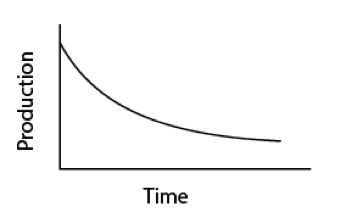
Take a few minutes to watch the following video and learn about the browser-hosted STELLA model interface, before running the model.
Video: Peak Oil Model 1 (2:13)
Peak Oil Model 1
PRESENTER: This is actually the cover of a piece of sheet music that was published in 1864 in New York. This is "The American Petroleum Polka," or charge, or gallop, or waltz, or march. And it has a picture of a beautiful Pennsylvania scene, the oil well spouting its oil. Now, oil was black back then. Oil is still black. But you couldn't have black oil falling on the lady's pink dress, so they made the oil white.
And then bragging, "This oil well threw pure oil a 100 feet high." people understood the value that you get from oil, from petroleum. And they celebrated that.
Now, let’s run the model and see what happens. Follow this link to the Peak Oil Model which should be set up exactly the same as the diagram above. Answer the questions either on the worksheet you downloaded or on a piece of paper to be submitted later to the Module 3 Summative Assessment (Graded) quiz. If you didn't download the worksheet on the main page of this assessment, do it now.
Question
1A. Does the production history agree with our simple calculations (position the cursor on the graph, and it will show you the values at different times)?
- yes
- no
2. Oil Production with Improving Technology
2. Oil Production with Improving TechnologyOil and gas companies have certainly become better at what they do over time. Originally, they drilled near natural oil seeps and hoped for the best, but now, a good team of geoscientists can “see” exactly where the oil/gas is, and engineers can drill with great precision and then “stimulate” the oil/gas-bearing rock formations to squeeze as much oil/gas as possible out of the rocks.
One way to incorporate this into the model is to change the rate of oil/gas production, r, so that it increases as time goes on. To do this, we make a simple equation that says r = 0.0005 x TIME, so then when TIME is 10 years, r will be 0.005 and when TIME is 100 years, r will be 0.05. Other than this change, the model is the same as in experiment 1. The value 0.0005 is called tech rate in the model, and we’ll see what happens if we change it.
Let’s see how this change affects the history of oil/gas production. Click this link to run the model and then answer the following questions on your worksheet or on a sheet of paper to be submitted to a Canvas Assessment later. As you can see, the production of oil peaks in this case. It rises because r is increasing, but as r increases, the Proven Reserves is decreasing and eventually a point is reached where the product of these two numbers (the production) starts to decline.
| Data | Practice | Graded |
|---|---|---|
| Tech Rate | 0.0002 | 0.0004 |
Questions
2A. When does the production reach its maximum (peak) value?
2B. What is the magnitude of the peak in production?
3. Including Price in the Production Flow
3. Including Price in the Production FlowIn addition to technology, economics also plays a role in the production of oil/gas, in the sense that higher prices will motivate greater production. Let’s assume that the as the supply of proven reserves drops, the price will rise. As long as there is a demand for oil and gas, as it becomes more scarce, it will become more valuable. This is a pretty simplistic view of what determines the price of oil and gas — reality is much more complex, which is why prices fluctuate quite a bit over time. But it is hard to escape the basic reality that as a desirable commodity becomes scarce, its value goes up.
To make this change in the model, we need to add something that will calculate the price. This new model looks like this:

As before, production is defined as Proven Reserves x r, and r in this case is defined as price x tech_slope x TIME, so it once again has the increase over time that our previous model had, but it also increases as the price goes up. The tech_slope is just the slope of the increase in technology over time and the default value is 0.0002. Price here is defined as 0.01 + price_slope x (100 – Proven Reserves); price_slope is the slope of price increase relative to change in Proven Reserves, and is originally set to 0.05. At the beginning, Proven Reserves is 100, so this gives a price of 0.01 — very small. But, when Proven Reserves has declined to 50, we get a price of 2.51. This equation is not meant to be anything more than a way to make the price increase as the Proven Reserves get smaller. The value 0.01 at the front end of this equation is just there so that the price is not 0 at the beginning, which would then make r be 0 and no oil would ever get produced.
What we have created here is a system with a feedback mechanism. Here is how it works:

If the production increases, then the proven reserves must decrease; this triggers an increase in price, which in turns triggers an increase in production. Notice that the starting point (production increase) and the ending point (production increase) are the same. In other words, the change at the beginning of the mechanism promotes more of the same — this is what is known as a positive feedback mechanism. Positive feedback mechanisms tend to cause an acceleration of change, sometimes resulting in runaway behavior. In contrast, the are other feedback mechanisms that tend to counteract change, encouraging stability; these are known as negative feedback mechanisms. Note that in this context, positive is not necessarily good, and negative is not necessarily bad.
Take a few minutes to watch the video below to learn more about the positive feedback mechanism the oil production model before running the next model.
Video: Peak Oil Positive Feedback (1:19)
NARRATOR: This simple diagram is meant to represent the positive feedback mechanism that we've put into the model. So if you imagine that we begin with a production increase. That's the initial change. Let's say something happens and we increase production. That is going to cause the proven reserves to decrease, right, because production drains that reservoir. So as that goes down, the commodity becomes more scarce and because of that, the price goes up. So that's another effect here that's triggered by the production increase. And as the price is increased, that will then encourage us to do even more to try to produce more of the oil that's out there. It's an incentive to produce more oil.
So that leads to an increase in production again. So the initial change that began this was the production increase and that has ended up triggering a series of responses in the model that lead to a further increase in price, and so when that happens, this is called a positive feedback mechanism. It's kind of like a cause and effect loop, right. So here's a cause, it makes in effect, it makes an effect, makes another effect that comes back on that cause and enhances it. So that's going to really change the way that this model behaves.
Activity:
This model has two pages of graphs to look at; the first one shows the Proven Reserves, Produced Oil, price, and production, and r (which combines price and tech slope), while the second one shows just the production. The second graph retains the results from previous model runs, allowing you to make comparisons as you make changes to some of the adjustable model parameters. If you want to clear this graph, hit the Restore Graphs button.
| Data | Practice | Graded |
|---|---|---|
| Tech slope | 0.0001 | 0.0002 |
| Price slope | .05 | .07 |
Questions
3A. First, run the model as it is, with the price slope set to 0.05 and the tech slope set to 0.0002. Note the time and magnitude of the peak in production. Then alter the tech slope or price slope as prescribed, using the new values provided. Run the model and compare the peak time and magnitude with the original case (use page 2 of the graph pad). Use “sooner” or “later” and “greater” or “smaller” to describe how your alterations changed the timing and magnitude of the peak in production.
Change in time of peak =
Change in magnitude of peak =
3B. Use the sliders above the graph to try out a range of different values for the price slope and the tech slope. Run the model with these different settings and see if you can make the peak in oil production go away. Is it possible to avoid a peak in production?
- Yes — there are just a few cases in which a peak occurs
- No — it is impossible; the best you can do is a broad, low peak that takes a long time to develop.
4. Production Driven by Demand From a Growing Population
4. Production Driven by Demand From a Growing PopulationFor our next experiment, we’ll try a different assumption about what drives oil/gas production — demand. The demand for oil and gas has risen over time due to an increase in the global population and an increase in the per capita energy consumption. Here is what this modified version of the model looks like:

The image is a diagram titled "Carbon Reservoirs and Fluxes in a Forest Ecosystem." It shows how carbon moves and is stored within a forest environment.
- Design: It’s a flowchart with black text, boxes, and arrows on a white background, illustrating a simplified forest carbon cycle.
- Components:
- Atmosphere: A box at the top labeled "Atmosphere" contains the text "CO₂" (carbon dioxide), representing the air.
- Photosynthesis Arrow: A downward arrow from "Atmosphere" to "Trees," labeled "Photosynthesis," shows trees absorbing carbon dioxide to grow.
- Trees: A box labeled "Trees" includes a small sketch of a tree with a rounded canopy and trunk, symbolizing living vegetation.
- Respiration Arrow: An upward arrow from "Trees" to "Atmosphere," labeled "Respiration," indicates trees releasing carbon dioxide back into the air.
- Litterfall Arrow: A downward arrow from "Trees" to "Soil," labeled "Litterfall," shows fallen leaves and branches adding carbon to the soil.
- Soil: A box labeled "Soil" represents the ground where carbon accumulates from litterfall.
- Decomposition Arrow: An upward arrow from "Soil" to "Atmosphere," labeled "Decomposition," shows carbon dioxide released back into the air as soil matter breaks down
- Layout: The diagram uses straight black arrows to connect the boxes, forming a cycle of carbon flow between the atmosphere, trees, and soil.
- Style: Simple and uncluttered, with text labels placed directly on or next to arrows and boxes for easy understanding.
Here, the population increases according to pop pct, which is the net growth percentage per year derived from historical data and then extrapolated into the future — so it is a graphical function that changes over time. The population starts at the 1800 level of 1 billion; the net growth % drops to 0 in 2100, and at that point, the population will stabilize.
The demand for oil/gas is represented here by per capita demand, which is essentially a percentage of the proven reserves per billion people. The per capita demand is another graphical function of time, patterned after actual history up until 2010 and then extrapolated to 2100 — optimistically assuming that the per capita energy demands will level off at about 2100. Multiplying the population times the per capita demand gives us r, the fraction of the proven reserves produced in a given year, and then r multiplied by the Proven Reserves gives us the production. The fraction r will increase as the population grows and as the per capita demand grows, and if population and per capita demand level off, so will r. Recall from experiment 2 that if r is increasing over time, a peak in production is inevitable.
Because we are using real population values and real values for the per capita demand, it makes sense to use real numbers for the Proven Reserves. At the present time, the best estimates are that there are 1.5 trillion barrels of oil as proven reserves (this number includes natural gas too), and we have consumed about 1.2 trillion barrels from about 1900 to the present. This means that at the beginning of time, our Proven Reserves will be 2.7 trillion barrels.
This model also includes a component called per capita oil that keeps track of how much oil is actually available per person, by taking the production and dividing it by the population. As per capita oil increases, we can use more and more oil for our energy needs, but as it decreases, we will have to either reduce our energy consumption or turn to other sources to meet our energy demands.
Questions
4A. Can you guess what will happen? Remember that r here is just like r in the earlier models, and you’ve seen what happens to the production history when r increases over time. Which of the following represents your approximate prediction?
- Production will increase throughout the model run
- Production will decrease throughout the model run
- Production will peak sometime during the model run
Now run the model by clicking this link, and see what happens. We will consider this as the “control” for the next experiment.
| Data | Practice | Graded |
|---|---|---|
| Initial proven reserves | 2.0 | 3.5 |
(above numbers refer to trillions of barrels of oil)
4B. How will changing the initial size of the Proven Reserves reservoir affect the history of production? Set the initial Proven Reserves to 2.0 for the Practice Assessment (3.5 for the Graded Assessment) and then run the model and see what happens; choose the response below that best represents how your altered model compares with the control. Page 2 of the graph pad will be useful in making this comparison.
- It peaks at the same time, with a larger peak
- It peaks at the same time, with a smaller peak
- It peaks later, with a smaller peak
- It peaks later, with a larger peak
- It peaks earlier, with a larger peak
- It peaks earlier with a smaller peak
- It does not peak at all
4C. If the production peaks and then declines, and the population grows or stays the same, then the oil per capita has to decline because it is the production/population. With your modified model, find the oil per capita in the year 2100 and then find the time earlier in the model history when the oil per capita was about the same as your 2100 value.
Oil per capita in 2100 = _______ (within 0.1 barrels/person)
Previous time in history with same oil per capita = _______ (within 10 years)
As you can see, this model suggests that our future use of oil will be a little like traveling back in time.
5. Adding Unproven Reserves
5. Adding Unproven ReservesFor our last experiment, we’ll see what happens when we add two more reservoirs, Unproven Reserves (the oil and gas that, we think, is likely to be discovered in the future) and Unknown Oil (the oil and gas we don’t know about, but might be there). Discovery adds Unproven Reserves to the Proven Reserves reservoir, and another flow called discovery adds Unknown Oil to the Unproven reservoir. An example from the Arctic Ocean region helps us get a grasp of these unknown reserves. In this frontier region, less than half of the offshore sedimentary basins have been explored, but based on what is known from more serious exploration off the coast of Alaska, the USGS estimates that there might be ~130 billion barrels of oil and gas — so this is a resource that, we think, might exist, but not enough is known about it yet to put it into the unproven reserves category, which applies to oil reserves that we know exist, but we don’t know enough about them to put them into the proven reserves. For perspective, this Arctic Ocean oil might represent 10-15% of all the unknown oil/gas that remains, and it would be enough to last for 4 years at the current rate of global use.
The discovery of these new resources is a function of a rate constant that increases over time, dictated by something called the exploration slope. The discovery flow that leads from Unknown to Unproven Reserves is set to be 1/5 the rate of the other discovery flow, reflecting the fact that it is much harder to discover something we know little about. Both of the discovery flows are controlled by switches (they can be turned on or off) and they begin (if the switch is on) at a time that can be set using the explor start time control knob. Here is what this new model looks like:

The image is a diagram titled "The Global Carbon Cycle with Human Perturbations." It shows how carbon moves through Earth’s systems, with a focus on how human activities affect this cycle. The diagram is a flowchart with black boxes and arrows on a white background, using red text to highlight human impacts.
At the top, a box labeled "Atmosphere" contains "CO₂" (carbon dioxide), representing the air where carbon dioxide collects. Below it, the diagram splits into natural and human-altered components:
- To the left, a box labeled "Terrestrial Biosphere" includes "Plants" and "Soil," showing where carbon is stored naturally. An arrow labeled "Photosynthesis" points from "Atmosphere" to "Plants," indicating plants absorb carbon dioxide to grow. Another arrow, "Respiration," goes back from "Plants" and "Soil" to "Atmosphere," showing carbon dioxide released as plants and soil organisms breathe or decompose.
- To the right, a box labeled "Fossil Fuels" represents underground carbon reserves like coal, oil, and gas. An arrow labeled "Combustion" in red points from "Fossil Fuels" to "Atmosphere," showing carbon dioxide released when humans burn these fuels.
- In the center, a box labeled "Oceans" shows carbon stored in water. An arrow labeled "Dissolution" points from "Atmosphere" to "Oceans," indicating carbon dioxide dissolving into seawater. Another arrow, "Outgassing," goes back from "Oceans" to "Atmosphere," showing some carbon dioxide returning to the air.
A key feature is a red arrow labeled "Deforestation" pointing from "Terrestrial Biosphere" to "Atmosphere," highlighting how cutting down trees releases stored carbon as carbon dioxide. All arrows are straight and black, except for "Combustion" and "Deforestation" in red, emphasizing human impacts. The layout is clear, with text labels on or beside each arrow and box, showing both the natural cycle and how human actions—like burning fossil fuels and deforestation—add extra carbon to the atmosphere.
Question
5A. How will these new sources of oil/gas change the production history? The total amount of produced oil obviously must be greater than in our model from experiment 4, but how about the shape of that production curve? Will there be a peak, as before? If so, what will that peak look like?
- Yes, it will still peak, but the peak will be broader than before
- No, it will not peak — the production will rise and then remain stead
- Yes, it will peak, but the peak will be delayed and it will be bigger
Video: Peak Oil Intro (2:44)
Before launching the model and experimenting with it, take a few minutes and watch the video that explains how to operate the switches that can turn the discovery flows on and off.
NARRATOR: This last model has some new features added to it. And so I want to explain these before you play with this model. It includes two new reservoirs, unproven reserves, and unknown oil here. And these can be tapped into through a process of discovery and eventually flow into the proven reserves, here.
These two discovery flows here are controlled by switches. And I'll show you those switches in a second. You can turn them on or off. And they're also controlled by a timer, here, that controls when we really tap into these other potential sources of oil. Other than that, it's quite similar to the other model.
Here's what it looks like when you interact with the model. You open the model, you'll see this. You can turn on these switches here, there's the unproven switch, and here's the unknown switch. Now, we're set to tap into those two new sources of oil.
And then down here, we control the time when we would start to produce that oil. So let me turn these things off first, the switches. There's one switch turned off. There's another one off.
I'm just going to go ahead and run this model. It's running now from 1800 to the year 2600, and here it shows the production peaking here at about the year 2000, then dropping off. Here's the population leveling off at-- I got it leveling off at 11.7 billion here, in this case almost 12 billion.
Now, watch this, if I turn on this unproven switch here, and run the model, you can see the production curve changes. See that? Gets bumped out. Basically, because of the addition of this oil here produced by discovery.
So then if we put this one on here, turn that on, then we can even make a more gradual decline in this production curve. So we're tapping into these new sources, and it makes that decline from the peak here, much more gradual.
Now, there are lots of things you can change here. You can change how much is in the unproven reserves and how much is in the unknown oil reservoir. You can control the rate at which those new sources are tapped into. You can control the timing of when we really aggressively start this exploration to tap into these new resources.
So this is just a little bit more optimistic model.
Open the model here, and first make sure the switches are in the off position (down), disabling the two discovery flows. Run the model and you should see exactly the same thing you saw in experiment 4B, with the difference that it runs for a longer period of time. If you study the graphs #3 and #7 show comparative plots of the production (in billions of barrels per year) and oil per capita (in barrels). Make sure you watch the video above to get a general sense of what happens when you turn on the switches.
You will be presented with one of the following 4 sets of initial conditions. Your answers to the following 3 questions will depend on which case you are presented.
| Data | Practice | Graded |
|---|---|---|
| Initial unproven reserves | 1.5 | 3.5 |
| Initial unknown reserves | 2.0 | 2.5 |
| Explore start time | 1980 ± 1 | 2000 ± 1 |
Questions
5B-D. Set the model up using the initial values provided. Use the slider bars at the top to set the initial unproven reserves and the initial unknown oil, and use the dial near the lower right to set the explore start time (the time when we begin to develop and produce the unproven reserves and unknown oil. This dial is a bit hard to adjust precisely, but if you are within a year or two of the specified date, it will be fine. Then run the model with both switches off, then run it again with the unproven switch turned on and then one more time with both switches turned on. Evaluate the differences between these three model runs in terms of the production (graph #3) and the oil per capita (#7). There are many ways to evaluate the effects of adding these new sources of oil, but we’ll focus on the size and timing of the production peak, and the oil per capita in the year 2100.
5B. Oil per capita in 2100 with Unproven Reserve switch on (± 0.1)
5C. Oil per capita in 2100 with both switches on (± 0.1)
5D. Peak in production with both switches on compared to control (with no switches on).
- About the same time (within 10 yrs) and size (within 2 billion barrels/yr)
- About the same time (within 10 yrs), but slightly larger (2-5 billion barrels/yr)
- lightly later (10-20 yrs), and slightly larger (2-5 billion barrels/yr)
- Slightly later (10-20 yrs), and much larger (>5 billion barrels/yr)
- uch later (>20 yrs), and much larger (>5 billion barrels/yr)
5F. Can a peak in oil production be avoided? In other words, is it possible to find some combination of model parameters that results in more of a plateau in oil production? To figure this out, try changing the exploration slope (this will control that rate that the discovery flows increase), and the exploration start time. We’ll leave the unproven and unknown reserves at 3.0 because this is already a very optimistic outlook.
- Yes, a peak can be avoided
- No, a peak cannot be avoided, and no plateau greater than 10 yrs is possible
- No, a peak cannot be avoided, but a ~50 yr plateau is possible
6. In your own words, summarize the effects of 1) improving technology (of oil production); 2) the price-production feedback; and 3) growing population on the history of oil production.
Summary
SummaryWe’ve just completed quite a few experiments, so it is a good idea to try to summarize a few important points.
- When we talk about “peak oil”, we’re talking about the rate of oil production — how much oil/gas is brought to market in a given year — not the total amount of oil/gas on Earth (which peaked as soon as we started to pump it out of the ground!).
- Improvements in our ability to extract oil/gas (i.e., improving technology) lead to a distinct peak in oil production.
- If we assume that production is motivated by price, and the price goes up as the oil becomes more scarce, this also leads to a peak in oil production.
- If the demand for oil is related to population, and population increases, this also leads to a peak in oil production. This effect is enhanced if the per capita demand for energy increases, as it has during the last 100 years.
- If we include unproven oil reserves and unknown reserves into the system, we can make the decline in oil production more gradual, but there is still a tendency for it to peak.
- At the end of the day, there is a finite amount of oil and gas available to us. This fact, combined with improvements in technology, an increase in demand for production related to price, increasing population, and increased standard of living, makes a peak in oil production inevitable — we cannot have a sustainable supply of oil and gas to fuel our economy. Facing up to this reality is important because it leads us to be more serious about making plans for a future where our energy needs are met without relying on fossil fuels.
Summary and Final Tasks
Summary and Final TasksModule 3 Summary
The sun sends out energy continuously. Plants have figured out how to store that energy for later use, by combining water and carbon dioxide to make more plants. Almost all the other living things on Earth survive by “burning” these plants to get the stored energy.
Usually, plants are burned soon after they die, but occasionally some plants are buried without oxygen and survive for much longer. Time and the Earth’s heat combine to “cook” these old, buried plants, making fossil fuels. We rely on oil—primarily from “slimy” plants (algae, and similar water plants), coal—primarily from “woody” plants, and gas from both.
Most of the coal is found in the rocks where it formed, but most of the oil and gas we are using had migrated upward through spaces in the rock and then been trapped in geologically special places before reaching the surface. Recently, we have begun “fracking” to get oil and gas still trapped in the rocks where they formed. We are also using bitumen from “tar sands”, the leftovers from where oil seeped all the way to the surface and the more-fluid parts were burned by bacteria or else evaporated. We’re trying to learn how to use “oil shale” containing dead plants that would make oil if they were cooked more. And we’re thinking about the possibility of using natural gas that has formed clathrate ice in cold places beneath the sea floor.
The known reserves of these fossil fuels—the ones we’re sure we can use—will be gone in a few decades at the current rate of use. The total resource—including the fuels we think we’ll discover as we search harder, and we think we’ll learn how to use as we invent new ways—would last a few centuries at the current rate of use, but that might drop to less than a century if population and use per person continue to rise. And, sharp increases in price and other problems are likely to start well before the fossil fuels become really scarce.
Nature will make new fossil fuels, but not nearly fast enough to help us. We are burning our way through a “bank account” of fossil fuels supplied by nature, with no income to replace what we use. And, as we will see in the next lessons, our fossil-fuel burning is releasing carbon dioxide that is accumulating in the air and changing the climate.
Reminder - Complete all of the Module 3 tasks!
You have reached the end of Module 3! Double-check the Module Roadmap to make sure you have completed all of the activities listed there before you begin Module 4.
References and Further Reading
Enrichments
Enrichments azs2More on Oxygen in Water
More on Oxygen in WaterOxygen in Water Enrichment
We oversimplified slightly in the text above. Even after oxygen is used up burning dead plants in mud beneath an ocean or lake, a little more burning may occur as bacteria use other chemicals in place of oxygen. For example, bacteria may use the sulfate in sea water. The reaction can be written this way:
Sulfuric acid + plant → hydrogen sulfide + carbon dioxide + water + energy
In reality, the sulfate (SO4-2) will also be reacting with other things in the ocean, but this isn't too far off. Hydrogen sulfide (H2S) is the source of “rotten egg smell”. It also readily reacts with iron in mud to make iron sulfide minerals, which initially appear black in the mud but which later may recrystallize to beautiful fools-gold pyrite if they have enough time and a bit of heat and other help. You might have seen this if you have visited a salt marsh. The mud in the shallowest parts of salt marshes is often black just below the surface, and releases rotten-egg smell if stirred up, because the marsh is growing lots of plants, the mud has little oxygen, and bacteria are using sulfate to burn the organic matter.
As mud is deposited at the bottom of lakes, the sea floor and elsewhere, it buries older mud with its organic matter. If you dig a hole, the material farther down was deposited longer ago, and has had more time to run out of oxygen and the other chemicals that are used to burn dead plants. One often sees a sequence going down in the mud in which, at the top, oxygen is used to burn organic matter, and then nitrate, manganese oxides, iron oxides, and then sulfate. If organic matter still remains, the next step is for bacteria to produce methane, CH4, which is the main component of natural gas.
Something really interesting may happen next. At the pressures and temperatures we commonly see under water, methane is usually a gas, although at high pressure it can be liquefied for storage or shipping. But, if the pressure is high enough, the temperature low enough, and there is lots of water around, instead of making bubbles, the gas will combine with the water to make a special kind of ice. This ice is often called methane hydrate or methane clathrate. When samples are brought to the surface, are brought to the surface, they actually will burn (see figures below).


There is a lot of clathrate under the sea floor in many places, and more in the Arctic in permafrost. (Yes, we know that we told you that warmer conditions favor burial of plants without burning, but this burial can happen in cold places as well, and freezing may actually help it happen by keeping worms and other creatures from eating dead plants before they are buried in mud. The frozen soils of the Arctic are rich in dead plants, and much methane is produced from them where thawing occurs without much oxygen.)
As mud is buried deeper and deeper by more sediment, the Earth's heat warms it up. At some depth, the ice melts to release bubbles of methane. When this process was first discovered, some scientists were worried that undersea landslides or other accidents might release giant methane belches that would sink ships (if a huge bubble rose right where a ship was, the ship could fall into the bubble), and change the climate, and cause other problems.
Additional research has reduced these worries, although they haven't gone away entirely. It is still just possible that a bubble might endanger a boat in certain special conditions, but we are fairly confident that huge amounts of gas can't come out really rapidly. As the clathrate is buried by more sediment, trapping the Earth's heat, the deepest ice melts to make bubbles. But, making those bubbles requires pushing water out of the way, which requires that the gas have high pressure. Pushing more water away needs higher pressure. At some high enough pressure, the gas will fracture the icy layer above and bubble out gradually, before enough gas can build up to make a climate-changing belch. Also, as clathrate forms, it uses the water but not the salt in seawater, and that salt may build up in water remaining in mud nearby, lowering the melting point so that some water doesn't freeze even if a lot of methane is supplied, allowing gas to move up through unfrozen regions to leak out at the sea floor.
As we will discuss climate change next chapter, methane in the sea floor may be very important for amplifying warming over decades and centuries, as warmer conditions melt the ice and let methane escape to increase the greenhouse warming. But, conduction of heat through the sediments to cause melting is rather slow, so we don't think that giant methane belches will change the climate even faster than that.
Module 4: Global Warming - Physics
Module 4: Global Warming - PhysicsModule 4 Overview
Video: Physics, Not Politics (2:06)
Dr. Alley relates a true story of a confidently mistaken person in high places.
DR. RICHARD ALLEY: I was down in Washington, not that long ago, talking to the staff of an important congressional committee. Which committee? Which party? Doesn’t matter. The bright young lawyer looked at me and said, “I didn’t take science in college. I don’t know science. I don’t like science, but I know that you’re wrong about your science because Global Warming is based on a hockey stick, and it’s broken." The hockey stick she referred to is a history of climate change showing recent rapid warming that’s been confirmed multiple times, and really isn’t broken, nor is it the basis of global warming.
And so my answer to her was, “No, actually global warming is based on physics.” It’s physics that’s been known for more than a century. It’s physics that’s confirmed everyday. And, it’s physics that was really worked out by the Air Force right after World War 2, not for climate, but for things such as sensors on heat seeking missiles. And in some real sense, if you deny the warming influence of the CO2 from our fossil fuels, you’re claiming that the Air Force doesn’t know what kind sensor to put on a heat seeking missile. The discussion we had after that was absolutely fascinating.
Now it’s certainly true that no all aspects of the global warming story are as solid as those physics of radiation in the atmosphere. So let’s go look at the parts that are solid, and see where they start to get speculative or where they start to get arguable.
The science of global warming involves a lot of physics, plus chemistry, biology, climatology, geology, glaciology, ... The science is not that difficult, but the whole story is fairly long. We look at some of this story in Modules 4 and 5.
Not too many years ago, a staff member of an important government committee told Dr. Alley, in approximately these words, “I didn’t study science in college. I don’t know science. I don’t like science. But, I know you’re wrong about your science, because global warming is based on a broken hockey stick.” To which Dr. Alley replied, more or less in these words “No, global warming is based on physics known for over a century, and really refined by the US Air Force after World War II when they were working on issues such as sensors for heat-seeking missiles. If you deny global warming, in some sense you’re denying that the Air Force knows what type of sensor to put on a missile.” The conversation that followed was fascinating.“ (The “hockey stick” that the staff member referred to is the history of temperature over the most recent centuries, based on tree-ring and other records as well as thermometer measurements, and actually has proven to be surprisingly accurate as more data have been collected.)
Public discussion of climate and energy in much of the world, including the US, often involves the question of whether someone or some group “believes in global warming”. Usually, “global warming” is understood to mean that humans are primarily responsible for an ongoing increase in the average temperature of the atmosphere near the Earth’s surface. But, to a scientist working in the field, asking whether they “believe” in global warming from the CO2 from fossil-fuel burning, is a little like asking whether they “believe” that gravity will pull a dropped pencil downward; both are unavoidable consequences of well-understood physics.
You might note that if you dropped your pencil just at the moment a tornado blew the roof off the building, the pencil might go upward; it also might go upward if you dropped it just at the moment that someone turned on a giant and properly aligned electromagnet and the pencil contained enough metal, or if an earthquake suddenly accelerated you just as you were dropping the pencil. We can never be absolutely positive what the future holds.
But, most people accept the tendency for a dropped pencil to fall downward, without asking whether you “believe” in gravity. If they could see in the infrared, they would probably hold similar beliefs about global warming. Within this module, we will explore the Physics of Global Warming.
Goals and Objectives
Goals and ObjectivesGoals
- Recognize the natural and human-driven systems and processes that produce energy and affect the climate
- Explain scientific concepts in language non-scientists can understand
- Use numerical tools and publicly available scientific data to demonstrate important concepts about the Earth, its climate, and resources
Learning Objectives
The global-warming story is huge. In this module, we will look at the physics, and the next module covers the history and the impacts. Don't let it get you down; the basics are not nearly as hard as they might seem at first.
After completing this module, students will be able to:
- Recall that carbon dioxide has a well-understood and physically unavoidable warming influence on Earth’s climate
- Recognize that positive feedbacks amplify changes, and negative feedbacks reduce them
- Recall that multiple independent records from different places using different methods all show that both CO2 and temperature are rising
- Explain that patterns of global warming in the past century can only be reproduced by considering both natural and human influences on climate
- Use a model to show that global climate always finds a steady state, but certain factors may influence how long it takes to get there
- Demonstrate that greenhouse gases are the most significant factor controlling surface temperature
Roadmap
Roadmap- | Task | Location | Due on: |
|---|---|---|---|
| To Read | Materials on the course website (Module 4) | Website | This week |
| To Do | Complete Summative Assessment Quiz 4 | Canvas Canvas | Due Following Tuesday Due Sunday |
Questions?
If you prefer to use email:
If you have any questions, please email your faculty member through your campus CMS (Canvas/Moodle/myShip). We will check daily to respond. If your question is one that is relevant to the entire class, we may respond to the entire class rather than individually.
If you prefer to use the discussion forums:
If you have any questions, please post them to the Help Discussion. We will check that discussion forum daily to respond. While you are there, feel free to post your own responses if you, too, are able to help out a classmate.
The Unavoidable Warmness of Burning
The Unavoidable Warmness of BurningShort version: The Earth adjusts its temperature to send back to space as much energy as is received from the Sun. But, the Sun’s shortwave energy passes easily through the air while some of the Earth’s longwave energy is intercepted by carbon dioxide and other “greenhouse” gases, making the Earth warmer than it otherwise would be, with more warming when more greenhouse gas is added to the air. This warmer air picks up water vapor and melts reflective snow and ice, making the total warming even larger.
Friendlier, but longer version: Think about a factory making cars. Many small parts go in, and a few big cars come out. But, the total amount of stuff going in is very nearly the same as the total amount coming out. If they were very different for very long, the factory would either fill up with parts or run out of them. The factory may need to adjust its rate of making cars to match the rate at which parts arrive, speeding up by hiring more workers when the parts arrive rapidly, and slowing down by sending workers home or out for coffee when parts arrive slowly. Keep reading for the longer version!
Tuning the Temperature
Tuning the TemperatureYou can think of energy in the Earth’s climate in a way that is similar to the materials entering and leaving the car factory. Almost all the energy for the Earth system comes from the Sun. About 30% of this is reflected from clouds and the land surface, and the other 70% is absorbed and heats the Earth. (The reflected fraction is called the “albedo”, so we say that the Earth’s albedo is about 30%. We don’t worry much about the heat coming up from the deep Earth because it is almost 4000 times smaller than the absorbed heat from the sun.)energy
You know that when the sun rises in the morning, the temperature in the air can go up a lot, quickly. If all of the Sun’s energy stayed on Earth, everyone would be dead from overheating in much less than a year.
But, warmer things lose energy to colder things. Suppose you turn on an electric stove. As the temperature of the heating element (the “burner”) rises, it begins to heat the pot of water on top to boil the water for your spaghetti. If there isn’t a pot of water on top, you can see the burner begin to glow, radiating energy.

The burner is “glowing” even before you can see the glow, as you could prove to yourself if you watched it while wearing special glasses that can “see” in the infrared, which is a longer wavelength of energy than visible light. As the burner gets hotter, it radiates more energy. And, while it continues to radiate long wavelengths such as the infrared you can’t see, a hotter burner shifts more of its energy to shorter wavelengths you can see, going to red and then orange and yellow as it warms up.
If you keep giving the burner the same amount of energy, its temperature will increase until the outgoing and incoming energy are equal, and then the temperature will stabilize. If you then supply energy more rapidly, the burner will warm to a new level that radiates the extra energy. Always, the burner tends to that temperature at which incoming and outgoing energy are equal, a balance like the stuff going into and out of the factory. But, electricity comes in, and electromagnetic radiation goes out, much the way car parts go in and cars come out of the factory.
For the Earth, energy from the very hot Sun comes in, mostly in the short wavelengths of light we can see, and we send back infrared radiation at longer wavelengths. But on average, the total amount of energy going out is just about the same as the total coming in. At the present time, this incoming and outgoing energy is not exactly equal — a bit less is leaving, which means that the Earth is warming.
Potholes
PotholesWhen a car drives out of the factory, there may be tiny cracks in the pavement that the tires roll over easily. And, the road may go down into a small valley and up the other side, again causing no trouble for the car tires. But, if there is a pothole of the wrong size in the way, the tire may drop in, bending the rim, blowing the tire and getting the car stuck. Going really slowly might allow the car to ease through the pothole without damage, and going really fast might jump the pothole, but a car at the wrong speed in the wrong place can fall into the pothole and get into trouble.

We are all familiar with such situations, in which interactions happen when the size or energy is “right”, but otherwise there is almost no interaction. This is very common in the air. The shortwave radiation from the sun does interact with clouds, and the very shortwave (ultraviolet) interacts with ozone (which helps protect us from skin cancer caused by the high-energy radiation), but otherwise most of the light from the sun passes easily through the air. However, the infrared radiation going back up from the Earth does interact with certain gases in the air, which are often called greenhouse gases. Radiation tends to be absorbed if it is at or near those wavelengths with the right energy to make a particular molecule wiggle or spin in a particular way.
A molecule that is wiggling or spinning because it absorbed radiation has extra energy—it is hotter than it was. It usually will quit wiggling or spinning by colliding with a neighboring molecule and passing the extra energy along; occasionally, the extra energy will be sent out as radiation instead. Most of the energy absorbed by molecules in the air was going up from the surface, and if they “re-radiate” the energy it goes in a random direction, which has the effect of reducing the radiation going to space and sending some back to Earth. In the more common case of collisions, even a rare greenhouse gas can heat the atmosphere by repeatedly absorbing energy and then colliding with non-greenhouse molecules.
Without greenhouse gases, the Earth's average surface temperature would be well below freezing —about 18°C or -0.4°F.
Want to learn more?
Read over Enrichment titled The Simplest Climate Model to learn more about this.
Greenhouse Gases
Greenhouse GasesThe greenhouse gases now in the air do keep the Earth’s surface warmer than it otherwise would be, and adding more greenhouse gases will cause more warming. There is nothing new, surprising, or honestly controversial in any of this. With a calculation something like the one in The Simplest Climate Model (read more about it in the enrichments), the French scientist Jean Fourier discovered in 1824 that something was keeping the Earth’s surface anomalously warm, and among the hypotheses he considered was that the atmosphere is acting something like glass holding heat in a container (perhaps the origin of the comparison to a greenhouse; see The Discovery of Global Warming). The British physicist John Tyndall showed in 1859 that gases in the air, including water vapor and carbon dioxide, were contributing to the greenhouse effect. And, in 1896, the Swedish physical chemist and Nobel Prize winner Svante Arrhenius did a fairly good job of calculating the global warming from the carbon dioxide released by the human burning of fossil fuels. (Through history, scientists have actually been better at calculating the effects of greenhouse gases than at realizing just how incredibly skillful fossil-fuel companies would become at supplying large quantities.)

The image is a timeline chart depicting the development of climate science and related scientific advancements between the years 1800 and 2000. The timeline is represented by a horizontal orange bar at the bottom, with key events marked above and below it.
Starting from the left, in 1824, Fourier's work on the greenhouse effect is marked. In 1859, Tyndall's research on CO2 and H2O warming is noted. In 1896, Arrhenius is credited with the discovery that human CO2 emissions cause warming. Around 1900, Planck's development of quantum mechanics is highlighted in blue. In 1905, Einstein's theory of special relativity is noted in green. In 1915, Wegener's theory of continental drift is marked in red.
The top left corner of the image contains the text "Climate actually a relatively old, well-established branch of science" in purple.
The science of the greenhouse effect thus is not some new discovery but has a long history compared to such “recent” science as relativity (Albert Einstein, 1905) or quantum mechanics (Max Planck, 1900). The pioneers who explored radiation in climate science were giants of physics, chemistry, and mathematics, who saw the strong interactions between laboratory studies and application to the atmosphere.
Much of the work on the details of the interaction between radiation and gases in the air was done by the US Air Force just after World War II and applied to topics such as sensors on heat-seeking missiles, as told in the introduction to this chapter. A missile uses a sensor to “see” the infrared radiation from a hot engine, but greenhouse gases such as carbon dioxide and water vapor block the view in some wavelengths by absorbing that radiation. Because the gases interact with radiation traveling in any direction, and there is much more energy in those wavelengths going up from the sun-warmed Earth than coming down from military bombers, the warming influence of the greenhouse gases is unavoidable.

Earth: The Operators' Manual
Video: CO2 and the Atmosphere (9:03)
This 9-minute clip will appear three times within modules 4 and 5 this week. To see a short clip on the Air Force's role in understanding the physics of the atmosphere and the warming effect of CO2, watch the first 1 minute and 20 seconds. The material that follows this 1 minute and 20 seconds will be covered later in this module as well as in Module 5.
DR RICHARD ALLEY: What CO2 does was confirmed by basic research that had absolutely nothing to do with climate change. (newsreel announcer)
RADIO ANNOUNCER: A continuance of the upper air program will provide scientific data concerning the physics of the upper atmosphere.
DR RICHARD ALLEY: World War II was over, but the Cold War had begun. The U.S. Air Force needed to understand the atmosphere for communications and to design heat-seeking missiles.
At certain wavelengths carbon dioxide and water vapor block radiation. So the new missiles couldn't see very far if they used a wavelength that CO2 absorbs. Research at the Air Force Geophysics Laboratory in Hanscom, Massachusetts produced an immense database with careful measurements of atmospheric gases. Further research by others applied and extended those discoveries, clearly showing the heat-trapping influence of CO2. The Air Force hadn't set out to study global warming, they just wanted their missiles to work. But physics is physics. The atmosphere doesn't care if you're studying it for warring or warming. Adding CO2 turns up the planet's thermostat.
It works the other way as well. Remove CO2, and things cool down. These are the Southern Alps of New Zealand, and their climate history shows that the physicists really got it right. These deep, thick piles of frozen water are glaciers, slow-moving rivers of ice, sitting on land... But once, when temperatures were warmer, they were liquid water, stored in the sea. We're going to follow this one, the Franz Josef, from summit to ocean to see the real-world impact of changing levels of CO2.
It's beautiful up here on the highest snowfield, but dangers lurk beneath the surface. I've spent a lot of time on the ice. It's standard practice up here to travel in pairs, roped up for safety. The glacier is fed by something like six meters of water a year... maybe 20 meters, 60 feet of snowfall... it's a really seriously high snowfall. The snow and ice spread under their own weight and is headed downhill at something like a kilometer a year. When ice is speeding up a lot as it flows towards the coast, it can crack and open great crevasses that give you a view into the guts of the glacier. Man, this is a big one... Ten... Twenty... Thirty meters more... a hundred feet or more heading down in here, and we can see a whole lot of the structure of the glacier right here.
MAN: So, what we're going to do is just gonna sit on the edge and then walk backward, and I'll lower you.
DR. RICHARD ALLEY: Tell me when. Okay, rolling around, and down we go. Snowfall arrives in layers, each storm putting one down... Summer sun heats the snow and makes it look a little bit different than the winter snow, and so you build up a history. In these layers, there are indications of climate, how much it snowed, what the temperature was. And all of this is being buried by more snow and the weight of that snow squeezes what's beneath it, and turns it to ice. And in doing that, it can trap bubbles. And in those bubbles are samples of old air, a record of the composition of the Earth's atmosphere, including how much CO2 was in it, a record of the temperature on the ice sheets, and how much it snowed. As we'll see, we can open those icy bottles of ancient air, and study the history of Earth's atmosphere.
This landscape also tells the story of the Ice Ages. And the forces that have shaped Earth's climate. Over the last millions of years, the brightness of the sun doesn't seem to have changed much, but the Earth's orbit and the tilt of its axis have shifted in regular patterns over tens and hundreds of thousands of years. The orbit changes shape... varying how close and far the Earth gets as it orbits the sun each year.
Over 41,000 years, the tilt of Earth's axis gets larger and smaller, shifting some of the sunshine from the equator to the poles and back. And our planet has a slight wobble, like a child's top, altering which hemisphere is most directly pointed toward the sun when Earth is closest to it. Over tens of thousands of years, these natural variations shift sunlight around on the planet, and that influences climate. More than 20,000 years ago, decreasing amounts of sunshine in the Arctic allowed great ice sheets to grow across North America and Eurasia, reaching the modern sites of New York and Chicago. Sea level fell as water was locked up on land. Changing currents let the oceans absorb CO2 from the air. That cooled the Southern Hemisphere and unleashed the immense power of glaciers such as the Franz Josef, which advanced down this wide valley, filling it with deep, thick ice. Now we're flying over today's coastline, where giant boulders are leftovers from that last ice age.
A glacier is a great earth moving machine. It's a dump truck that carries rocks that fall on top of it. It's a bulldozer that pushes rocks in front of it. And it outlines itself with those rocks, making a deposit that we call a moraine that tells us where the glacier has been. We're 20 kilometers, 12 miles, from the front of the Franz Josef glacier today, but about 20,000 years ago, the ice was depositing these rocks as it flowed past us and out to sea. The rocks we can still see today confirm where the glacier once was. Now, in a computer-generated time-lapse, condensing thousands of years of Earth's history, we're seeing what happened. Lower CO2, colder temperatures, more snow and ice, and the Franz Josef advanced.
Twenty thousand years ago, 30 percent of today's land area was covered by great ice sheets, which locked up so much water that the global sea level was almost 400 feet lower than today. Then, as Earth's orbit changed, temperatures and CO2 rose, and the glacier melted back. The orbits set the stage, but by themselves, they weren't enough. We need the warming and cooling effects of rising and falling CO2 to explain the changes we know happened.
Today, atmospheric CO2 is increasing still more, temperatures are rising, and glaciers and ice sheets are melting. You can see this clearly on the lake formed by the shrinking Tasman Glacier, across the range from the Franz Josef. This is what the end of an ice age looks like. Glaciers falling apart, new lakes, new land, icebergs coming off the front of the ice. In the early 1980s, we would have been inside New Zealand's Tasman Glacier right here. Now we're passing icebergs in a new lake from a glacier that has mostly fallen apart and ends over six kilometers, four miles away.
One glacier doesn't tell us what the world is doing, but while the Tasman has been retreating, the great majority of glaciers on the planet have gotten smaller. This is the Columbia Glacier in Alaska. It's a type of glacier that makes the effects of warming easy to see. It's been retreating so fast that the Extreme Ice Survey had to reposition their time-lapse cameras to follow its motion. In Iceland, warming air temperatures have made this glacier simply melt away, leaving streams and small lakes behind. Thermometers in the air show warming, thermometers in the air far from cities, show warming.
Put your thermometer in the ground, in the ocean, look down from satellites, they show warming. The evidence is clear. The earth's climate is warming.
Adding More Greenhouse Gases Increases Temperature
Adding More Greenhouse Gases Increases TemperatureMore Greenhouse Gases Increases Temperature
Adding more greenhouse gases does increase the temperature more. Put on more blankets on a cold night, and heat leaves you more slowly, making you feel warmer. But, if you put a really good stopper in the drain of your sink to keep the water in, adding more plugs doesn’t slow down the drainage still more. We thus know situations in which the job is only partly done so that adding more workers or blankets or plugs will do more, but we know other situations in which the job is completely or almost completely done and adding more help doesn’t make a difference.
For carbon dioxide and other greenhouse gases, the job is not done, and adding more does turn up the temperature. This is mostly because the greenhouse gases are very good at absorbing energy of certain wavelengths, but only somewhat good at absorbing slightly different wavelengths. So, while the outgoing radiation in the lower part of the atmosphere is completely blocked for the just-right wavelengths, that outgoing radiation is only partially blocked for the almost-right wavelengths; adding more greenhouse gas increases blockage of the almost-right radiation.
Furthermore, if you go up in the atmosphere, the air gets thinner, and at some height there is so little greenhouse gas that the just-right wavelengths are only partially blocked. Adding more of greenhouse gases such as carbon dioxide increases this height. The temperature at this height adjusts to radiate to space as much energy as is received from the Sun, and, the physics of the atmosphere cause the temperature to increase downward (squeezing air under higher pressure does work on the air that increases its temperature), so raising the height from which radiation escapes warms the surface.
Activate Your Learning
Amplifiers
AmplifiersBecause warmer things begin to radiate more energy very quickly, the Earth’s climate is very strongly stabilized, as noted in The Simplest Climate Model. Other processes may stabilize the Earth system by reducing changes or destabilize by amplifying changes.
Some stabilizers can be very important but tend to be very slow. We saw in the last chapter that warming reduces oxygen in the ocean, which makes the burial of organic matter easier. And, because the organic matter grew from carbon dioxide in the air, burying rather than burning the dead bugs lowers atmospheric carbon dioxide. Thus, if something such as a brighter Sun causes warming, fossil-fuel formation reduces the size of the warming. However, we also saw that fossil-fuel formation is a slow process because most plants are still “burned” by bacteria or living things; fossil-fuel formation can be very important over a few hundred thousand years or longer, but not over a few thousand years.
Some carbon dioxide is also picked up from the air by rain, forming a weak acid that breaks down rocks in a process called “weathering” because the weather is involved. The chemicals released from the rocks are used to make shells, some of which contain carbon dioxide. (A coral reef or a clamshell is calcium carbonate, usually written as CaCO3, but sometimes written as CaO•CO2, showing more clearly that it contains carbon dioxide.) Chemists use Bunsen burners in their labs for good reasons; warming almost always makes chemical reactions go faster. So, if the temperature goes up, chemistry removes carbon dioxide from the atmosphere more rapidly. If something such as a brighter sun raises the Earth’s temperature, this “rock weathering feedback” can remove enough carbon dioxide to cool the climate back close to the starting temperature in approximately ½ million years.

This image is a diagram that illustrates the movement of carbon through various components of Earth's system. The diagram is structured as a flowchart with interconnected boxes and arrows, each representing a reservoir of carbon and the processes that transfer carbon between them.
Key elements include:
- Reservoirs: Boxes labeled with major carbon storage areas such as "Atmosphere" (containing CO₂), "Terrestrial Biosphere" (plants and soil), "Oceans" (surface and deep water), and "Fossil Fuels" (coal, oil, and gas).
- Fluxes: Arrows between these reservoirs indicate carbon movement, labeled with processes like "Photosynthesis" (from atmosphere to terrestrial biosphere), "Respiration" (back to the atmosphere), "Dissolution" (atmosphere to oceans), and "Combustion" (fossil fuels to atmosphere).
- Visual Style: The diagram uses a clean, minimalist design with black text and arrows on a white background, emphasizing clarity and readability.
This image serves as a simplified representation of how carbon cycles through Earth's systems, highlighting both natural and human-influenced processes.

Rock Weathering Thermostat Diagram-more complex. The rock-weathering feedback stabilizes the Earth’s temperature over about ½ million years. The really really simple version and the simple version are shown here and should give you the basic idea.
This image is a diagram that builds on the first image by adding numerical values to represent the amount of carbon stored in various reservoirs and the annual fluxes (movements) between them, measured in gigatons of carbon (GtC) per year.
Key elements include:
- Reservoirs:
- "Atmosphere" is shown with 750 GtC.
- "Terrestrial Biosphere" is divided into "Vegetation" (600 GtC) and "Soil" (1,500 GtC).
- "Oceans" are split into "Surface Ocean" (1,000 GtC) and "Deep Ocean" (38,000 GtC).
- "Fossil Fuels" are indicated with 5,000–10,000 GtC.
- Fluxes: Arrows between reservoirs are labeled with annual carbon transfer amounts:
- "Photosynthesis" moves 120 GtC from the atmosphere to vegetation.
- "Respiration" returns 60 GtC from vegetation and 60 GtC from soil to the atmosphere.
- "Dissolution" transfers 90 GtC from the atmosphere to the surface ocean.
- "Upwelling/Downwelling" shows 100 GtC moving between surface and deep ocean.
- "Combustion" releases 6 GtC from fossil fuels to the atmosphere
- Visual Style: The diagram uses a similar clean, flowchart-like layout as the first image, with black text and arrows on a white background. Numbers are prominently displayed in red next to each reservoir and flux for emphasis.
This image provides a more detailed and quantitative view of the carbon cycle, illustrating both the scale of carbon storage and the rates of carbon exchange across Earth’s systems.

The Earth's climate is a complex system, and like most other complex systems, it is, partially controlled by many feedbacks. Feedbacks can affect many things. If we think about temperature, if a warming or cooling affects other processes that in turn change the temperature, those other processes are called feedbacks. A feedback that works against the initial temperature change to reduce its size is said to be stabilizing or negative; a feedback that increases the size of the initial change is amplifying or positive. The most important stabilizing feedbacks for Earth’s temperature are the almost instantaneous increase in radiation leaving the planet when the temperature rises, and the faster removal of carbon dioxide from warmer air to form shells and fossil fuels over hundreds of thousands of years.
At the in-between times, however, the most important feedbacks are positive. As a result, climate changes over years to millennia can be almost as large as changes over much longer times.
The most important of these positive feedbacks is warmer air picking up more water vapor from the ocean and plants, and carrying that vapor along, thus strengthening the greenhouse effect (or, colder air picking up less water vapor…).
Want to know more?
Read the Enrichment titled Carbon Dioxide is more Important than Water Vapor as a Greenhouse Gas.
The air doesn’t know why it is warm, so anything that warms the air—brighter sun, or more greenhouse gas, or alien ray guns—will increase evaporation from the ocean, amplifying the warming.
Note that this does NOT mean that the warming “runs away” and the Earth burns up, but just that the total warming is made larger by the feedback. Suppose the sun becomes enough brighter to warm the planet by 1 degree, based on the simplest climate model in the Enrichment, which doesn’t include the water-vapor feedback. Including the effects of the extra water vapor would increase warming to almost 2 degrees.
Another important feedback is linked to snow and ice. Most surfaces (forests, grasslands, cities, oceans, even deserts) absorb most of the sunshine that reaches them, but snow and ice reflect most of the sunshine reaching them. Warming melts snow and ice, causing the Earth to absorb more sunshine, which causes more warming. This ice-albedo feedback is not nearly as strong as the water vapor feedback under modern Earth conditions because most of the snow and ice occur in places and at times without a lot of sunshine (mostly in the winter, near the poles, and often under clouds that already are reflecting the sunshine; note that this feedback would be much more important if the temperature were cold enough for the ice to extend near the equator).


But, the water-vapor and ice-albedo feedbacks interact with each other. If the sun becomes brighter or carbon dioxide is increased by fossil-fuel burning, the resulting warming melts snow and ice and picks up more water vapor. Each of these causes more warming. But, the warming from the extra water vapor also melts some snow and ice, and the warming from loss of snow causes more water vapor to be picked up. Under modern Earth conditions, this still doesn’t “run away”, but it amplifies the warming still more. (The warming did “run away” on Venus, evaporating the oceans and causing the surface today to be hot enough to melt the metal lead, and such a fate awaits Earth most of a billion years in the future as the sun slowly brightens, although if we hang around and keep learning, we could “geoengineer” our way out of the problem, perhaps using techniques that will be discussed later in the course.)
The best current estimate is that, including changes in vegetation and clouds as well as snow and water vapor, doubling the concentration of carbon dioxide in the air and letting the climate come into balance will cause a warming of roughly 3°C, with fairly high confidence that the number is not less than 1.5°C or more than 4.5°C (or, a most-likely warming of 5.4°F, with the range of possibilities primarily between 2.7°F to 8.1°F). This number is usually called climate sensitivity and is widely discussed in climate science. Of the roughly 3°C warming from doubled CO2, the direct effect of the carbon dioxide on Earth’s radiation is just over 1°C (roughly 2°F), with the rest coming from the positive feedbacks. The stabilizing effect of warmer bodies radiating more energy is included here. Some additional amplifiers are omitted (melting of seasonal snow and sea ice are included, but not melting of the Greenland and Antarctic ice sheets, for example), so over many centuries or millennia, the warming may be somewhat larger than 3°C. The very slow stabilizers are also omitted, but they do not become important until even further into the future. Despite hopes that the climate sensitivity might be low, the most recent studies have made it less and less likely that sensitivity is as low as 1.5-2°C (2.7-3.6°F), with a value close to 3oC (5.4°F) looking fairly likely.
The Warming from the So-Far-Unavoidable Burning
The Warming from the So-Far-Unavoidable BurningShort version: The Earth is warming, as shown by an interconnected web of evidence. The pattern of this warming, in space and time, matches that expected from the human-caused rise of greenhouse gases together with the other, less-important causes of climate change.
Friendlier, but longer version: We will follow the presentation of the United Nations Intergovernmental Panel on Climate Change (IPCC) here. The IPCC is the world’s effort to assess the available science. Researchers act for the public good, in the public eye, without being paid to do so, to tell policymakers and other people what is scientifically solid, speculative, or just silly by summarizing and assessing the relevant science.
If, for some reason, you don’t like the IPCC, you could check out other authoritative assessments, such as those done by the US National Academy of Sciences or the US Climate Change Science Program, or resources from the British Royal Society and others. But, for the world, the IPCC is an outstanding starting point. Dr. Alley did almost nothing for the Fifth Assessment Report or the IPCC released in 2013, but worked extensively on the Fourth Assessment Report in 2007, and contributed to the Third (2001) and Second (1995) Assessment Reports. The IPCC shared the Nobel Peace Prize after the Fourth Assessment Report.
Video: IPCC SPM1 (1:45)
History of the Most Important Greenhouse Gases (launch image in a new window)

The vertical scales on the left are concentration in the atmosphere, in either parts per billion (ppb) or parts per million (ppm). The vertical scales on the right show “radiative forcing”—you can think of this as how much brighter the sun would need to get to give as much warming as provided by the greenhouse gas. Official IPCC Caption: IPCC Figure SPM.1 Atmospheric concentrations of carbon dioxide, methane and nitrous oxide over the last 10,000 years (large panels) and since 1750 (inset panels). Measurements are shown from ice cores (symbols with different colours for different studies) and atmospheric samples (red lines). The corresponding radiative forcings are shown on the right-hand axes of the large panels.
DR. RICHARD ALLEY: This fascinating figure comes from the IPCC. It shows 10,000 years of history-- 10,000 years ago on your left, up to today in the big panels and then just since 1750 in the little panels in each case. And it shows it for carbon dioxide on the top, for methane in the middle, and for nitrous oxide on the bottom. These are the main greenhouse gases.
They're shown on the left in concentrations. This would be parts per million for CO2 and parts per billion for the methane and the nitrous oxide. And over on the other side, it shows radiative forcing. So this is a measure of how much the sun would have to get brighter to have as much warming affect as the greenhouse gases having. And you'll find that the radiative forcing is biggest for the CO2. That's a one up there-- one watt per square meter versus 240 from the sun-- smaller values for the other two.
These plots show ice core data from many different ice cores measured in different places by different labs and drilled in different places and so on, and then overlapping with the measurements that had been made in the atmosphere by modern instruments. You'll see because there's so much agreement among the different cores and different labs and so much agreement with the instrumental record, these are highly reliable. And what they show with very, very high confidence is that the greenhouse gas forcing, the greenhouse gases are rising. Other information shows that that rises very clearly from us.
Source: Intergovernmental Panel on Climate Change (IPCC), 2007: Summary for Policy Makers. In Climate Change 2007: The Physical Science Basis. Contribution of Working Group 1 to the Fourth Assessment Report of the Intergovernmental Panel on Climate Change [Solomon, S., D. Qin, M. Manning, and H.L. Manning (eds.].
History of Carbon Dioxide
History of Carbon DioxideFirst, let’s start with Figure SPM-1 from the Fourth Assessment of the IPCC, showing the history of carbon dioxide and some other greenhouse gases over the last 10,000 years. Ice-core data from multiple cores and labs cover most of the history shown, and overlap with the recent instrumental record, all with very close agreement. The recent rise is unprecedented in the 10,000 years shown. Based on additional ice-core records not shown, the greenhouse-gas levels are now above anything seen in the last 800,000 years. And, data from other sources indicate that carbon dioxide has not been this high for millions of years. (Note that much further back in history, nature did cause higher CO2 levels, a topic to which we will return later.)

This image is a set of three graphs illustrating the historical concentrations of greenhouse gases and their associated radiative forcing from the year 1000 to 2005. The data is sourced from the IPCC 2007 WGI-AR4 report. Each graph represents a different greenhouse gas: carbon dioxide, methane, and nitrous oxide.
- Top Graph (Carbon Dioxide):
The graph shows carbon dioxide concentration in parts per million (ppm) on the left y-axis, ranging from 250 to 400 ppm. The x-axis represents time from the year 1000 to 2005. From around 1000 to 1800, the concentration remains relatively stable, fluctuating slightly between 250 and 280 ppm, depicted with scattered colored dots (gray, purple, green). After 1800, there is a noticeable upward trend, with the concentration rising sharply to around 380 ppm by 2005, shown with a solid red line. On the right y-axis, radiative forcing is plotted, ranging from 0 to 1 W/m². A vertical bar on the right side shows the radiative forcing in 2005, with a colored gradient (blue to red) indicating a value slightly below 1 W/m².
- Middle Graph (Methane):
The graph displays methane concentration in parts per billion (ppb) on the left y-axis, ranging from 400 to 2000 ppb. The x-axis spans from 1000 to 2005. From 1000 to 1800, methane levels are relatively stable, fluctuating between 400 and 700 ppb, shown with scattered colored dots (gray, purple, yellow, green). After 1800, the concentration increases significantly, reaching around 1750 ppb by 2005, depicted with a solid red line. The right y-axis shows radiative forcing, ranging from 0 to 0.4 W/m². A vertical bar on the right side indicates the radiative forcing in 2005, with a colored gradient (blue to red) showing a value around 0.3 W/m².
- Bottom Graph (Nitrous Oxide):
The graph illustrates nitrous oxide concentration in parts per billion (ppb) on the left y-axis, ranging from 260 to 330 ppb. The x-axis covers the years 1000 to 2005. From 1000 to 1800, nitrous oxide levels remain steady, fluctuating slightly between 260 and 280 ppb, shown with scattered colored dots (gray, purple, green, blue). After 1800, there is a gradual increase, reaching around 320 ppb by 2005, depicted with a solid red line. The right y-axis shows radiative forcing, ranging from 0 to 0.1 W/m². A vertical bar on the right side indicates the radiative forcing in 2005, with a colored gradient (blue to red) showing a value slightly below 0.1 W/m².
- Additional Details:
The x-axis at the bottom of all graphs includes a secondary time scale labeled "Time (before 2005)" ranging from 1000 to 5000 years before 2005. The graphs use a combination of scattered dots in various colors (gray, purple, yellow, green, blue) to represent historical data from different sources, and a solid red line to show the aggregated trend over time. The source of the data, "IPCC 2007 WGI-AR4," is noted in the bottom right corner.
The figure shows “radiative forcing” as well as atmospheric concentration. The Earth absorbs 240 W/m2 from the sun. The extra warming from rising CO2 is somewhat similar, although not identical, to the warming from a brighter sun, so the effect of the CO2 can be discussed in W/m2. CBy January of 2017, atmospheric CO2 was at a concentration of 405 ppm, up from 280 ppm before the industrial revolution, with the extra CO2 giving a radiative forcing of roughly 2 W/m2, equivalent to the sun getting almost 1% brighter. The contributions from methane (from rice paddies, cow guts, and other sources) and nitrous oxide (especially produced by processes in soil stimulated by nitrogen fertilizers and animal waste) are significant but smaller.
The amount of extra CO2 now in the air, and moving into the ocean to make it more acidic, closely matches the CO2 we know has been produced from fossil-fuel burning. The human source is roughly 100 times as large as the natural volcanic source, and volcanoes have not done anything bizarre recently, so cannot be blamed for the recent rise. CO2 is moving into the ocean rather than coming out, so oceans cannot be responsible for the rise.
Furthermore, the atmosphere confirms that humans are responsible, as discussed in the ETOM film clip below and the Enrichment linked below.
Want to learn more?
Read the Enrichment titles Humans are Primarily Responsible for the Rise in CO2..
Earth: The Operators' Manual
Watch the short video below on how we know that the rise in CO2 is primarily from our fossil-fuel burning, filmed at the Rotorua Thermal area of New Zealand.
Video: It's Us (2:41)
DR. RICHARD ALLEY: So physics and chemistry tell us that adding carbon dioxide to the atmosphere warms things up. And Earth's climate history shows us there will be impacts, from melting ice sheets, to rising sea level. But how do we know, with equal certainty, that it's not just more natural variation, that humans are the source of the increasing CO2? When we look at a landscape like this one we know immediately that volcanoes put out all sorts of interesting things. And that includes CO2.
So how do we know that the rise of CO2 in the atmosphere that we see, comes from our burning of fossil fuels, and not from something that the volcanoes have done? Well, the first step in the problem is just bookkeeping. We measure how much CO2 comes out of the volcanoes. We measure how much CO2 comes out of our smokestacks and tail-pipes. The natural source is small. Humans are putting out 50 to a 100 times more CO2 than the natural volcanic source. We can then ask the air whether our bookkeeping is right, and the air says that it is. Volcanoes make CO2 by melting rocks to release the CO2. They don't burn and they don't use oxygen. But burning fossil fuels does use oxygen when it makes CO2. We see that the rise in CO2 goes with a fall of oxygen, which says that the rising CO2 comes from burning something.
We can then ask the carbon in the rising CO2 where it came from. Carbon comes in 3 flavors: the lightweight carbon 12, which is especially common in plants. The medium-weight carbon 13, which is a little more common in the gases coming out of volcanoes. And the heavyweight carbon 14. It's radioactive and decays almost entirely after about 50,000 years, which is why you won't find it in very old things like dinosaur bones or fossil fuels. We see a rise in carbon 12, which comes from plants. We don't see a rise of carbon 13, so the CO2 isn't coming from the volcanoes. And we don't see a rise in carbon 14, so the CO2 can't be coming from recently-living plants. And so the atmosphere says that the rising CO2 comes from burning of plants that have been dead a long time... That is fossil fuels. The CO2 is coming from our fossil fuels. It's us.
So, yes, humans are increasing the greenhouse effect, primarily by producing CO2 by burning fossil fuels, with very little uncertainty.
Natural and Anthropogenic Warming
Natural and Anthropogenic WarmingVideo: SPM2 (2:20)
Natural and Anthropogenic Warming (launch image in a new window)

The red bars show warming influences on the recent climate, and blue bars show cooling. We have raised greenhouse gases a lot, and partially offset their warming effect by adding sun-blocking particles (“aerosols”). Official IPCC Caption: IPCC Figure SPM.2 Global average radiative forcing (RF) estimates and ranges in 2005 for anthropogenic carbon dioxide (CO2 ), methane (CH4 ), nitrous oxide (N2O) and other important agents and mechanisms, together with the typical geographical extent (spatial scale) of the forcing and the assessed level of scientific understanding (LOSU). The net anthropogenic radiative forcing, and its range are also shown. These require summing asymmetric uncertainty estimates from the component terms, and cannot be obtained by simple addition. Additional forcing factors not included here are considered to have a very low LOSU. Volcanic aerosols contribute an additional natural forcing but are not included in this figure due to their episodic nature. The range for linear contrails does not include other possible effects of aviation on cloudiness.
DR. RICHARD ALLEY: This fascinating figure is from the IPCC. There's a lot of information on here. It includes the things that are changing-- radiative forcing-- or changing the climate, how much they're doing so, including the uncertainties, whether they expect the whole globe or just part of it, and the level of scientific understanding.
If we do a lot more research-- the low, it probably will reduce the size of the uncertainties-- because we can learn more. But how much we understand is included in the uncertainty already. And it includes both the things that humans have done and the things the nature has done. And this goes from the year 1750 up to the year 2005.
The Biggie is our C02, together, with the other greenhouse gases that we put up, as well as the ozone that comes from human activities from pollution. So these all have a warming influence and they are pushing very strongly towards warming. Clearly, there's a couple of other little warming influences, especially us putting soot on top of snow. But there's also these cooling influences.
We've put up a lot of particles, aerosols that block the sun, and they make clouds last longer and make clouds more reflective. And together, those have a lot of cooling. And we've cut dark forests and replaced them by more reflective grasslands.
In addition, since 1750 the sun has brightened a little bit. Over the last 30 years or so, it's actually dimmed, but there's a little bit of that. Add all of these together and there's very clearly a warming influence. And the total warming influences is very similar in size to the CO2 that we've put up.
Taken together, we are pushing the world in a lot of different ways. But because of these cooling influences, if you ask how much of the warming has been caused by our greenhouse gases, the answer is more than all of it. Because it is warm despite these cooling influences.
Source: IPCC, 2007: Summary for Policy Makers
Greenhouse gases are not the only things that affect climate. But, climate changes have causes; there are no magical “cycles” that somehow change the climate without letting us know why. (There are cycles that affect climate, but they have causes, such as features of Earth’s orbit, that we understand; they are NOT magical!) So, we can assess what things are affecting the climate.
More than a century ago, the Earth was a little on the cold side in what is sometimes called the “Little Ice Age” because the sun was a bit dim and volcanic eruptions were putting up dust that blocked the sun. The sun brightened early in the 20th century, contributing to warming, as shown by the little red bar extending to the right for natural solar irradiance down near the bottom of the figure. But, over the last 30 years when satellites have given us the best data, the sun seems to have dimmed just a bit. We humans have cut dark forests and replaced them with more-reflective grasslands, cooling the Earth a little, and we have put up a lot of particles to block the sun, with notable cooling influence (you can find blue bars for these, extending to the left, in the figure).
You may meet someone who agrees that the Earth is warming, but argues that much of the change is natural. This is wrong; over the last few decades, warming has occurred despite nature pushing a little toward cooling, and human particles and land-use changes pushing more strongly toward cooling. The most likely answer for how much of the warming has been caused by our greenhouse gases is “More than all of it”, because of warming despite these other cooling influences.
Video: SPM 3 (1:07)
Temperatures, Sea Level and Snow Cover (launch image in a new window)

The Earth’s surface is warming (top), sea level is rising as glaciers melt and ocean water expands from warming (middle), and springtime snow cover is shrinking as temperatures rise. Official IPCC Caption: IPCC Figure SPM.3 Observed changes in (a) global average surface temperature, (b) global average sea level from tide gauge (blue) and satellite (red) data and (c) Northern Hemisphere snow cover for March-April. All changes are relative to corresponding averages for the period 1961–1990. Smoothed curves represent decadal average values, while circles show yearly values. The shaded areas are the uncertainty intervals estimated from a comprehensive analysis of known uncertainties (a and b) and from the time series (c).
DR. RICHARD ALLEY: This figure from the IPCC starts back in 1850 and then runs up to just pass 2000 up here on the right. And it shows indications of warming happening in the climate system. You can see on top here the thermometer record of global average temperature showing not much happening and then recent warming, very clearly.
Sea level, which is given here, rises because ocean water expands as it warms and because warming tends to melt glaciers that are holding water out of the ocean. And so we see a warming influence that shows up in the rising global sea level.
And we also look, if you go to bring time snow cover, you can see that not much was happening. And then you can see it dropping, and that's happening because of warming and the spring is melting the snow. And so these are among many indicators that are showing that yes, the climate system is warming.
Source: IPCC, 2007: Summary for Policy Makers
The temperature is going up. The figure shows a few of the indicators, but many more are known. Consider the next figure, for example.
Video: Surface Temperatures (1:38)
Decadal Land-Surface Average Temperature (launch image in a new window)

The figure shows the estimates of land surface temperature from four sources. The uncertainty in the Berkeley Earth record is also shown. Data before about 1850 are clearly quite uncertain, linked to having few thermometers back then, but more recently, the agreement among the various groups with their different techniques is very good.
DR. RICHARD ALLEY: This figure is from the Berkeley Earth Project. It was run primarily by physicists who did not start out as climate scientists-- with an interesting mix of funding from public sources. But also some of it came from private sources, including those with ties to the fossil fuel industry.
It's looking at the thermometer record of temperature, and just looking at the land. Now if you go back to 1750 up through about 1850, you could see that the uncertainties are really huge. So we're mostly going to focus since 1850.
Many groups have been estimating the temperature, including NASA-- the Goddard Institute for Space Studies, NOAA-- the National Climate Data Center, the British Group, the Hadley Centre, and the Climate Research Unit. And what you can see is those, plus the Berkeley Earth estimates up here on top. And what you'll notice is that the uncertainties in the Berkeley Earth are similar to the differences between the others, which also have their own uncertainties. But you'll see very clearly that there is a strong warming going on.
The different groups have used different techniques. Although, ultimately, they're all using thermometers. Whether they use them all or not this is different for the different ones. But when you have different groups with different funding, different motivations, perhaps, and some working in different places, they all give the same answer. Which is, it's getting warmer. We have very high confidence that it is warming.
Source: Berkeley Earth
The Berkeley Earth project is an interesting attempt by a group, involving a lot of physicists who were not primarily climate scientists through much of their careers, to use private as well as public funding to re-calculate the temperature record from thermometers. The Berkeley work follows efforts by NOAA and by NASA in the US, and by a British group at the Hadley Center and the University of East Anglia, and other efforts by others, to calculate global temperature changes from thermometer records. You can see clearly in the figure that over recent decades when the data are best, the different groups get the same answer despite having different funding sources and different techniques. The temperature is going up.
Furthermore, if you throw away the records from thermometers in and near the cities and just look in the country, you see warming. Thermometers in boreholes in the ground show warming. Thermometers taken aloft by balloons (radiosondes), and thermometers looking down from satellites and analyzed in different ways, show warming. So do thermometers in the ocean.
The temperature-sensitive snow and ice also show warming. You would not go searching for this effect in the coldest places; if you start off at -40 and warm by a couple of degrees, the snow and ice won’t melt yet. But, the effects of warming are seen in loss around the edges, in space and time, of seasonal snow cover, river, and lake ice, seasonally and perennially frozen ground, mountain glaciers and more. The melting of land ice and the expansion of ocean water as it warms are driving the rise in global sea level. And, the great majority of significant changes in where plants and animals live, and when they do things during the year, are in the direction of warming. So, warming is occurring, despite natural and human pushes toward cooling over recent decades.
Want to learn more? Read the Enrichment titled Global Warming Did Not Stop Recently.
We are once again taking a look at the CO2 and the Atmosphere clip. To see a little on the melting of ice, watch 7:22 - 9:04.
Earth: The Operators' Manual
Video: CO2 and the Atmosphere (9:04)
CO2 and the Atmosphere
DR. RICHARD ALLEY: What CO2 does was confirmed by basic research that had absolutely nothing to do with climate change.
NEWSREEL ANNOUNCER: A continuance of the upper air program will provide scientific data concerning the physics of the upper atmosphere.
[music]
ONSCREEN TEXT: Chapter 2 CO2 & The Atmosphere
DR. RICHARD ALLEY: World War II was over, but the Cold War had begun. The U.S. Air Force needed to understand the atmosphere for communications and to design heat-seeking missiles. At certain wavelengths, carbon dioxide and water vapor block radiation. So the new missiles couldn't see very far if they used a wavelength that CO2 absorbs. Research at the Air Force Geophysics Laboratory in Hanscom, Massachusetts produced an immense database with careful measurements of atmospheric gases. Further research by others applied and extended those discoveries, clearly showing the heat-trapping influence of CO2. The Air Force hadn't set out to study global warming, they just wanted their missiles to work. But physics is physics. The atmosphere doesn't care if you're studying it for warring or warming. Adding CO2 turns up the planet's thermostat.
It works the other way as well. Remove CO2 and things cool down. These are the Southern Alps of New Zealand, and their climate history shows that the physicists really got it right. These deep, thick piles of frozen water are glaciers, slow-moving rivers of ice, sitting on land... But once, when temperatures were warmer, they were liquid water, stored in the sea.
We're going to follow this one, the Franz Josef, from the summit to the ocean to see the real-world impact of changing levels of CO2. It's beautiful up here on the highest snowfield, but dangers lurk beneath the surface. I've spent a lot of time on the ice. It's standard practice up here to travel in pairs, roped up for safety.
[music]
The glacier is fed by something like six meters of water a year... maybe 20 meters, 60 feet of snowfall... it's a really seriously high snowfall. The snow and ice spread under their own weight and is headed downhill at something like a kilometer a year. When ice is speeding up a lot as it flows towards the coast, it can crack and open great crevasses that give you a view into the guts of the glacier. Man, this is a big one... Ten... Twenty... Thirty meters more... a hundred feet or more heading down in here, and we can see a whole lot of the structure of the glacier right here.
GUIDE: So, what we're going to do is just gonna sit on the edge and then walk backwards, and I'll lower you.
DR. RICHARD ALLEY: Tell me when. Okay, rolling around, and down we go. Snowfall arrives in layers, each storm putting one down...Summer sun heats the snow, and makes it look a little bit different than the winter snow, and so you build up a history. In these layers there's indications of climate, how much it snowed, what the temperature was. And all of this is being buried by more snow and the weight of that snow squeezes what's beneath it, and turns it to ice. And in doing that, it can trap bubbles. And in those bubbles are samples of old air, a record of the composition of the Earth's atmosphere, including how much CO2 was in it, a record of the temperature on the ice sheets, and how much it snowed. As we'll see, we can open those icy bottles of ancient air, and study the history of Earth's atmosphere.
This landscape also tells the story of the Ice Ages. And the forces that have shaped Earth's climate. Over the last millions of years, the brightness of the sun doesn't seem to have changed much, but the Earth's orbit and the tilt of its axis have shifted in regular patterns over tens and hundreds of thousands of years. The orbit changes shape... varying how close and far the Earth gets as it orbits the sun each year.
Over 41,000 years, the tilt of Earth's axis gets larger and smaller, shifting some of the sunshine from the equator to the poles and back. And our planet has a slight wobble, like a child's top, altering which hemisphere is most directly pointed toward the sun when Earth is closest to it. Over tens of thousands of years, these natural variations shift sunlight around on the planet, and that influences climate. More than 20,000 years ago, decreasing amounts of sunshine in the Arctic allowed great ice sheets to grow across North America and Eurasia, reaching the modern sites of New York and Chicago. Sea level fell as water was locked up on land. Changing currents let the oceans absorb CO2 from the air. That cooled the Southern Hemisphere, and unleashed the immense power of glaciers such as the Franz Josef, which advanced down this wide valley, filling it with deep, thick ice. Now we're flying over today's coastline, where giant boulders are leftovers from that last ice age.
A glacier is a great earth moving machine. It's a dump truck that carries rocks that fall on top of it. It's a bulldozer that pushes rocks in front of it. And it outlines itself with those rocks making a deposit that we call a moraine, that tells us where the glacier has been. We're 20 kilometers, 12 miles, from the front of the Franz Josef glacier today, but about 20,000 years ago, the ice was depositing these rocks as it flowed past us and out to sea. The rocks we can still see today confirm where the glacier once was. Now, in a computer-generated time-lapse condensing thousands of years of Earth's history... we're seeing what happened. Lower CO2, colder temperatures, more snow and ice, and the Franz Josef advanced.
Twenty thousand years ago, 30 percent of today's land area was covered by great ice sheets, which locked up so much water that the global sea level was almost 400 feet lower than today. Then, as Earth's orbit changed, temperatures and CO2 rose, and the glacier melted back. The orbits set the stage, but by themselves they weren't enough. We need the warming and cooling effects of rising and falling CO2 to explain the changes we know happened.
Today, atmospheric CO2 is increasing still more, temperatures are rising, and glaciers and ice sheets are melting. You can see this clearly on the lake formed by the shrinking Tasman Glacier, across the range from the Franz Josef. This is what the end of an ice age looks like. Glaciers falling apart, new lakes, new land, icebergs coming off the front of the ice. In the early 1980s, we would have been inside New Zealand's Tasman Glacier right here. Now we're passing icebergs in a new lake from a glacier that has mostly fallen apart and ends over six kilometers, four miles away.
One glacier doesn't tell us what the world is doing, but while the Tasman has been retreating, the great majority of glaciers on the planet have gotten smaller. This is the Columbia Glacier in Alaska. It's a type of glacier that makes the effects of warming easy to see. It's been retreating so fast that the Extreme Ice Survey had to reposition their time-lapse cameras to follow its motion. In Iceland, warming air temperatures have made this glacier simply melt away, leaving streams and small lakes behind. Thermometers in the air show warming, thermometers in the air far from cities, show warming.
Put your thermometer in the ground, in the ocean, look down from satellites, they show warming. The evidence is clear. The earth's climate is warming.
For recent updates on temperature, see NASA’s Goddard Institute for Space Studies (GISTEMP).
Models Using Natural and Anthropogenic Forcings
Models Using Natural and Anthropogenic ForcingsNature surely has changed the climate in the past, is contributing to climate change now, and will contribute to climate change in the future. In the figure below, models have been used to see what nature has done, compared to what humans have done. In each case, the black line shows the actual history of temperature. The blue bands, which end up below the black line recently on each plot, show the influence of changing sun and volcanoes; a band is plotted, rather than a line, to show the uncertainties in estimating the sun's and volcanic influences and turning them into temperature changes using models. The pink bands, which so nicely match the black lines showing what really happened, were calculated including the effects of natural changes plus the human causes, including both warming and cooling influences.
Video: SPM 4 (2:09)
Models Using Natural and Anthropogenic Forcings (launch image in a new window)

The history of temperature as measured by thermometers (black lines) is simulated accurately by models if they are “told” what nature and humans have done to change the climate (pink bands, which include the uncertainties), and is simulated fairly accurately early in the 20th century if the models are “told” only what nature has done to simulate the climate, but is not simulated at all accurately more recently from natural changes alone. Climate was changing mostly for natural reasons, but now is changing mostly because of humans.
Official IPCC Caption: IPCC Figure SPM.4 Comparison of observed continental- and global-scale changes in surface temperature with results simulated by climate models using natural and anthropogenic forcings. Decadal averages of observations are shown for the period 1906 to 2005 (black line) plotted against the center of the decade and relative to the corresponding average for 1901–1950. Lines are dashed where spatial coverage is less than 50%. Blue shaded bands show the 5–95% range for 19 simulations from five climate models using only the natural forcings due to solar activity and volcanoes. Red shaded bands show the 5–95% range for 58 simulations from 14 climate models using both natural and anthropogenic forcings.
DR. RICHARD ALLEY: This wonderful figure from the IPCC is looking at the fingerprint of climate change. All of the different plots go from just more recently than 1900 up to 2000. That was the time that they could do best for this.
And in each plot, the black line is the history of temperature. This is for the globe, this would the globe's land, the globe's ocean, and then continent by continent up here, like Asia and Europe, and so on. So in each case, the black is what happened.
The blue models have been taken, and they've been told what nature did. What the sun was doing, what the volcanoes were doing. And the models then said this is the climate change that nature has caused.
In the pink, in each case, the model has been told what nature did, and what humans did. And what you will see, if you start down here, for example, with the global land, is that the warming back here is possibly caused by nature. The sun got a little bit brighter, and coincidentally, the volcanoes quit blocking the sun quite as much as they had done earlier. But recently, the dimming of the sun and some big volcanoes have tried to cool it off. Yet, the temperature went up.
And so what you can see in every one of these panels is that you can explain the climate changes that were happening early in the 20th century by natural causes because the human causes were not terribly large. But by the time you get to the later 20th century, if anything, nature tried to cool it off a little bit, yet the temperature went up. And so what we see across the globe, from Australia to North America, is that the fingerprint of climate change is now that of humans, not that of nature. Other fingerprinting exercises give the same answer, which is that we have taken over from nature in controlling climate change.
Activate Your Learning
Note that there are other lines of evidence confirming the relative significance of human influence suggested in the figure above. Suppose for a moment that you decide the satellite data is wrong, and the sun is really getting brighter. (This is not a sensible thing to do, but just suppose…) If this were correct, we know that more energy from the sun will warm the air near the Earth’s surface, but also will warm the air high in the stratosphere. Rising CO2 also warms the air near the surface, but rising CO2 cools the upper stratosphere. (Ultraviolet radiation heats the ozone there, which transfers energy to CO2 in collisions, and the CO2 then radiates the energy to space, so in the presence of much ozone high in the atmosphere where infrared radiation to space is easy, extra CO2 acts as a radiator and causes cooling of the adjacent air.) The observed pattern of changes—warming near the surface but cooling in the upper stratosphere—has the fingerprints of CO2, not the sun or other possible causes of climate change. Other fingerprinting exercises reach the same conclusion.
Taking all of this together, we now have very high scientific confidence that we humans are changing the composition of the atmosphere, primarily through the burning of fossil fuels, and that the rising concentration of important gases is causing warming. Feedbacks in the Earth system modify the initial warming and are acting to amplify the direct effects of our CO2 and increase the warming. The Earth is warming, based on a great range of independent data sets. This warming is occurring despite natural and human-caused cooling influences, and this warming has the pattern in space and time expected from our greenhouse gases plus the other influences on climate. The close agreement between what is happening, and what we expect to happen from our understanding of the climate system, confirms the science. And, because we are fairly confident that much more fossil fuel remains to be burned than we have burned already, the well-confirmed scientific understanding says that coming climate changes will be much bigger than those we have caused so far if we continue on the path we are now following. What that means is coming in the next module.
Summative Assessment
Summative AssessmentReminder!
After completing your Summative Assessment, don't forget to take the Module 4 Quiz. If you didn't answer the Learning Checkpoint questions, take a few minutes to complete them now. They will help your study for the quiz, and you may even see a few of those questions on the quiz!
Climate Modeling Activity
In this activity, we’ll explore some relatively simple aspects of Earth’s climate system, through the use of several STELLA models — you’ve seen some of these in the Module 3 activity. STELLA models are simple computer models that are ideal for learning about the dynamics of systems — how systems change over time. The question of how Earth’s climate system changes over time is of huge importance to all of us, and we’ll make progress towards understanding the dynamics of this system through experimentation with these models. In a sense, you could say that we are playing with these models, and watching how they react to changes; these observations will form the basis of a growing understanding of system dynamics that will then help us understand the dynamics of Earth’s real climate system.
If you pause for just a moment and think about what we are doing in these activities, it is really just an application of the scientific method. We start with a question, develop a hypothesis, devise and carry out an experiment to test the hypothesis or answer the question, and then study the results to see if they provide an answer to our original question. So, we are learning through experimentation. In this Summative Assessment, we will work through a series of four experiments designed to test the influence of various forcings on climate.
Instructions
This assessment is broken into four experiments with questions related to each one. Separate web pages have been provided for each experiment to reduce scrolling. We have also provided the activity as a worksheet that you can download and even print if you prefer. You may find downloading or printing the complete worksheet easier to work with as you prepare your answers to submit them. As before, there is a practice version, and then a graded version — each version has its own set of model values that are provided in the worksheet.
Files to Download
Download the worksheet. Completing the 'Practice' and 'Graded' versions of the exercise, in the following pages or on the attached worksheet, is required before submitting your assignment.
Submitting Your Assessment
Work through the practice version first, then write down your answers for the graded version on the worksheet. Once you have answered all of the questions on the worksheet, go to Module 4 Summative Assessment: Graded. The questions listed in the worksheet will be repeated as an Canvas Assessment. So all you will have to do is read the question and select the answer that you have on your worksheet. You should not need much time to submit your answers, since all of the work should be done prior to launching the assessment quiz.
Grading and Rubric
This assignment is worth a total of 17 points. The grading of the questions and problems is below:
| Item | Possible Points |
|---|---|
| Questions 1-14 | 1 point each |
| Question 15 | 3 points |
Introduction to a Simple Planetary Climate Model
Introduction to a Simple Planetary Climate ModelOur first climate model calculates how much energy is received and emitted (given off) by our planet, and how the average temperature relates to the amount of thermal energy stored. The complete model is shown below, with three different sectors of the model highlighted in color:

This STELLA diagram visually represents the planetary climate model by categorizing key climate-related variables into three main groups: Energy In (yellow area), Temperature (red area), and Energy Out (blue area).
- Energy In (Yellow Area):
- Factors affecting incoming solar energy: Solar Constant, Albedo, Surf Area.
- These variables influence Insolation, which directs energy to Earth Heat.
- Temperature (Red Area):
- Includes Ocean Depth, Water Density, and Heat Capacity, which influence Temperature.
- Temperature interacts with Earth Heat and contributes to heat exchange processes.
- Energy Out (Blue Area):
- Outgoing energy factors include Heat Emitted, LW Int, and LW Slope.
- Earth Heat emits energy, balancing the system.
Arrows show the flow of energy and interactions between these factors. The diagram helps illustrate the components regulating planetary climate.
First, let’s define a few terms that you might not be familiar with.
Insolation —stands for Incoming Solar Radiation, which is a fancy way of saying sunlight or solar energy.
Albedo — the fraction of light reflected from some material; 0 would be a perfectly black object (no reflected light) and 1 would be a perfectly white object (no light absorbed).
Heat capacity — this is the amount of energy (units are Joules) needed to raise 1 kilogram of some material 1°C.
Ocean Depth — this is the depth of the part of the ocean that is involved in climate over short time scales of decades, the part of the ocean exchanges energy with the atmosphere. While the whole ocean has an average depth of ~4000 m, the part we worry about here has a depth of less than 500 m.
LW Int and LW slope — these are parameters used to describe the relationship between the average planetary temperature and the amount of long-wavelength (infrared, or thermal) energy emitted by the planet; more details are provided below.
The Energy In Sector
The Energy In Sector
This STELLA diagram visually represents the planetary climate model by categorizing key climate-related variables into three main groups: Energy In (yellow area), Temperature (red area), and Energy Out (blue area).
- Energy In (Yellow Area):
- Factors affecting incoming solar energy: Solar Constant, Albedo, Surf Area.
- These variables influence Insolation, which directs energy to Earth Heat.
- Temperature (Red Area):
- Includes Ocean Depth, Water Density, and Heat Capacity, which influence Temperature.
- Temperature interacts with Earth Heat and contributes to heat exchange processes.
- Energy Out (Blue Area):
- Outgoing energy factors include Heat Emitted, LW Int, and LW Slope.
- Earth Heat emits energy, balancing the system.
Arrows show the flow of energy and interactions between these factors. The diagram helps illustrate the components regulating planetary climate.
The Energy In sector (yellow in Fig. 1 above) controls the amount of insolation absorbed by the planet. The Solar Constant is not really a constant, but it does tend to stay close to a value of 343 Watts/m2 (think of about six 60 Watt light bulbs shining down on a patch of ground 1 meter on a side — this is what we get from the Sun). This is then multiplied by (1 – albedo) and then the surface area of the Earth giving a result in Watts (which is a measure of energy flow and is equal to Joules per second). In the form of an equation, this is:
S is the Solar Constant (343 W/m2), A is surface area, and α is the albedo (0.3 for Earth as a whole).
This is the equation
The Energy Out Sector
The Energy Out SectorThis STELLA diagram visually represents the planetary climate model by categorizing key climate-related variables into three main groups: Energy In (yellow area), Temperature (red area), and Energy Out (blue area).
- Energy In (Yellow Area):
- Factors affecting incoming solar energy: Solar Constant, Albedo, Surf Area.
- These variables influence Insolation, which directs energy to Earth Heat.
- Temperature (Red Area):
- Includes Ocean Depth, Water Density, and Heat Capacity, which influence Temperature.
- Temperature interacts with Earth Heat and contributes to heat exchange processes.
- Energy Out (Blue Area):
- Outgoing energy factors include Heat Emitted, LW Int, and LW Slope.
- Earth Heat emits energy, balancing the system.
Arrows show the flow of energy and interactions between these factors. The diagram helps illustrate the components regulating planetary climate.
The Energy Out sector (blue above) of the model controls the amount of energy emitted by the Earth in the form of infrared (thermal) radiation, which is a form of electromagnetic radiation with a wavelength longer than visible light, but shorter than microwaves. You saw earlier that this is often described using the Stefan-Boltzmann Law which says that the energy emitted is equal to the surface area times the emissivity times the Stefan-Boltzmann constant times the temperature raised to the fourth power:
A is the whole surface area of the Earth (units are m2), ε is the emissivity (a number between 0 and 1 with no units), σ is the Stefan-Boltzmann constant (units are W/m2 per °K4), and T is the temperature of the Earth (in °K). The problem with this approach is that it ignores the greenhouse effect, which is a very important part of our climate system. We could represent the greenhouse effect by choosing the right value for the emissivity in the Stefan-Boltzman law, but here, we will use a different approach, one in which Eout is based on actual observations. With a satellite above the atmosphere, we can measure the amount of energy emitted in different places on Earth and figure out how it relates to the surface temperature. As it turns out, this is a pretty simple relationship, described by a line:
The part inside the parentheses is just the equation for a line, with an intercept (LWint with units of W/m2) and a slope (LWs with units of W/m2 per °C). This new way of describing Eout is shown as the red line in the figure below:

This graph plots Long-wave Energy Emitted (W/m²) on the y-axis against Temperature (°C) on the x-axis to illustrate how Earth's natural greenhouse effect raises the planet’s temperature.
- The blue curve represents E_out = σT⁴, showing energy emitted without an atmospheric greenhouse effect.
- The green line represents E_out = 0.6147σT⁴, depicting energy emission with Earth's greenhouse effect.
- The red line represents E_out = 210 + 2T, another approximation of outgoing energy.
- A horizontal dashed line at 240 W/m² represents energy absorbed from the Sun (343(1 - albedo)).
- The intersection of the green line with the 240 W/m² level indicates Earth's actual average surface temperature of 15°C.
- Without the greenhouse effect, the temperature would be -18°C, marked on the graph.
- A label notes that Earth’s greenhouse raises the temperature by 33°C.
The key thing here is that the hotter something is, the more energy it gives off, which tends to cool it, and it will continue to cool until the energy it gives off is equal to the energy it receives — this represents a negative feedback mechanism that tends to lead to a steady temperature, where .
The Temperature Sector
The Temperature SectorThis STELLA diagram visually represents the planetary climate model by categorizing key climate-related variables into three main groups: Energy In (yellow area), Temperature (red area), and Energy Out (blue area).
- Energy In (Yellow Area):
- Factors affecting incoming solar energy: Solar Constant, Albedo, Surf Area.
- These variables influence Insolation, which directs energy to Earth Heat.
- Temperature (Red Area):
- Includes Ocean Depth, Water Density, and Heat Capacity, which influence Temperature.
- Temperature interacts with Earth Heat and contributes to heat exchange processes.
- Energy Out (Blue Area):
- Outgoing energy factors include Heat Emitted, LW Int, and LW Slope.
- Earth Heat emits energy, balancing the system.
Arrows show the flow of energy and interactions between these factors. The diagram helps illustrate the components regulating planetary climate.
The Temperature sector (brown in Fig. 1) of the model establishes the temperature of the Earth’s surface based on the amount of thermal energy stored in the Earth’s surface. In order to figure out the temperature of something given the amount of thermal energy contained in that object, we have to divide that thermal energy by the product of the mass of the object times the heat capacity of the object. Here is how it looks in the form of an equation: (see directions for how view images in a larger format)
or
Let’s look at it with just the units, to make sure that things cancel out:
This can be simplified by combining, rearranging, and canceling to give:
Here, E is the thermal energy stored in Earth’s surface [Joules], A is the surface area of the Earth [m2], d is the depth of the oceans involved in short-term climate change [m], ρ is the density of seawater [kg/m3] and Cp is the heat capacity of water [Joules/kg°K]. We assume water to be the main material absorbing, storing, and giving off energy in the climate system since most of Earth’s surface is covered by the oceans. The terms in the denominator of the above fraction will all remain constant during the model’s run through time — they are set at the beginning of the model and can be altered from one run to the next. This means that the only reason the temperature changes is because the energy stored changes.
Other parts of the model
Other parts of the modelThe model has a few other parts to it, including the initial temperature of the Earth, which determines how much thermal energy is stored in the earth at the beginning of the model run. It also includes some other features that allow you to change the solar input and the part of the greenhouse effect due to CO2. We use the standard assumption (which is itself based on some physics calculations) that for each doubling of the CO2 concentration, there is an increase of 4 W/m2 in the greenhouse effect. This is often called the greenhouse forcing due to CO2. In terms of our E out curve shown in Figure 2 above, this shifts the red curve downwards — so less energy is emitted, and thus more is retained by the Earth. Let’s consider how this works — if we start with 200 ppm of CO2 and increase it to 800 ppm, that represents 2 doublings (from 200 to 400 and then from 400 to 800), so we would get 8 W/m2 of greenhouse forcing.
One unit of time in this model is equal to a year, but the program will actually calculate the energy flows and the temperature every 0.1 years.
Now that you have seen how the model is constructed, let’s explore it by doing some experiments. Here is the link to the model.
Experiment 1: Steady State
Experiment 1: Steady StateOne of the most important components of this climate system is the relationship between temperature and the energy emitted by the planet (Fig. 2), which constitutes a negative feedback mechanism. Negative feedback mechanisms are like thermostats that act to control the temperature and maintain a steady state. In this experiment, we see if that expectation is met by our model.
What happens if we start out with an Earth that is not in a steady state so that Ein≠Eout? Use the slider controls at the top to set the initial conditions specified in the assessment.
| Data | Practice | Graded |
|---|---|---|
| Albedo | 0.3 | 0.31 |
| CO2 Mult | 1.0 | 1.0 |
| Solar Mult | 1.0 | 1.0 |
| Initial T | 20°C for #1,2, (10°C for #3) | 5°C for #1,2, (25°C for #3) |
Questions
- What will happen? How will the temperature change over time? Think about how the Ein and Eout will compare at the beginning.
- Eout > Ein — this will cause warming
- Eout > Ein — this will cause cooling
- Eout < Ein — this will cause warming
- Eout < Ein — this will cause cooling
- Eout = Ein — temperature will remain constant
Now, run the model and see what happens. What is the temperature at the end of the model run (to the nearest 0.1 °C)?
Ending Temperature =
- Now change the initial temperature to second value as prescribed above, run the model and see what happens. Compared to the answer to #2, is the ending temperature the same (within 0.1 °C) or different (varies by more than 0.1°C)?
- Same
- Warmer
- Cooler
Steady state for a system is the condition in which the system components are not changing in value over time even though time is running and things are moving through the system. What is the steady state temperature of your system?
Steady State Temperature =
Be sure to reset everything in the model before going to the next problem.
Hit the refresh button on your browser or the rest button on the model.
Experiment 2: A Fluctuating Sun
Experiment 2: A Fluctuating SunThe Solar Constant is not really constant over any length of time. For instance, it was only 70% as bright early in Earth’s history, and it undergoes much more rapid fluctuations (and much smaller) in association with the 11-year sunspot cycle. During a sunspot cycle, the solar constant may vary by as much as 0.3 W/m2. Let’s see what this would do to the temperature of the planet. The model has a small switch called the Solar Cycle Switch that we can use to turn on or off the effects of the solar cycle. Set the model up with the following parameters:
| - | Practice | Graded |
|---|---|---|
| Albedo | 0.30 | 0.30 |
| CO2 Mult | 1.0 | 1.0 |
| Solar Mult | 1.0 | 1.0 |
| Initial T | +15 | +15 |
| Ocean depth | 100 for #5,6, (200 for #7) | 150 for #5,6, (50 for #7) |
Questions
Run the model and see what happens. How much does the planetary temperature change over the solar cycle (the difference between peak and trough — measure this after the third peak)?
Change in temperature in one cycle =
Notice that the temperature peaks after the Solar Input peaks. This time delay is called lag time. What is the lag time here in years?
Lag Time =
- Predict how the model will change if you increase the ocean depth to the second specified depth (table above). How do you think the lag time and the magnitude of temperature will change relative to the first solar cycle model (#5,6)? In other words, make a prediction. It might help to think about what heats up faster — a pot with a little water in it, or the same pot with a lot of water in it?
- Lag time shorter, magnitude smaller
- Lag time shorter, magnitude greater
- Lag time longer, magnitude smaller
- Lag time longer, magnitude greater
Be sure to reset everything in the model before going to the next problem.
Experiment 3: Changing CO2
Experiment 3: Changing CO2Let’s see what happens when we change the concentration of CO2 in the atmosphere.
| Data | Practice | Graded |
|---|---|---|
| Albedo | 0.3 | 0.30 |
| CO2 Mult | 0.5 | 2.0 |
| Solar Mult | 1.0 | 1.0 |
| Initial T | 15°C | 15°C |
| Ocean Depth | 100 | 50 |
First, try to predict what will happen. How much warming or cooling will occur? Will the temperature level off, or rise/fall forever? Then run the model.
Questions
You’ve changed the atmospheric CO2 concentration from its original value of 380 ppm by multiplying it by a specified value (table above). What is the resulting atmospheric CO2 concentration in your model?
New CO2 concentration =
What is the resulting temperature change at the end (50 yrs)? (±0.1 °C)
Change in temperature =
- Notice that the temperature levels off at the end — it finds a new steady state. How long does it take to level off? Let’s find the response time, which is defined as the time required to accomplish 2/3 of the total temperature change. For example, if the temperature change was 1°C and it started at 15°, then we would find the time when the temperature reached 15.67°C — this would be the response time.
Find the response time for this case. (±.5 yrs)
Response Time =
Experiment 4. Causes of Climate Change
Experiment 4. Causes of Climate ChangeThings that can cause the climate to change are sometimes called climate forcings, and we’ve just tinkered with two of these — the Sun, and CO2. It is generally agreed upon that on relatively short timescales like the last 1000 years, there are 4 main forcings — solar variability, volcanic eruptions (whose erupted particles and gases block sunlight), aerosols (tiny particles suspended in the air) from pollution, and greenhouse gases (CO2 is the main one). Solar variability and volcanic eruptions are obviously natural climate forcings, while aerosols and greenhouse gases are anthropogenic, meaning they are related to human activities. The history of these forcings is shown in the figure below.

This graph displays climate forcing (W/m²) on the y-axis over the years 1000 to 2000 on the x-axis. Positive values indicate warming, while negative values indicate cooling.
- The black vertical lines represent volcanic activity, which shows large negative spikes indicating strong cooling events.
- The red line represents solar forcing, which remains relatively stable with slight variations.
- The green line represents greenhouse gas (GHG) forcing, which shows a sharp increase after 1900, indicating significant warming influence.
- The blue line represents aerosol forcing, which has a small negative effect in more recent years.
A legend in the lower right corner labels the different forcing factors:
- Black = Volcanoes
- Red = Solar
- Green = Greenhouse gases (GHG)
- Blue = Aerosols
Volcanoes, by spewing ash and sulfate particles into the atmosphere, block sunlight and thus have a cooling effect. This history is based on the human records of eruptions in recent times and ash deposits preserved in ice cores and sediment cores for older times; it is best during the historical period. Note that although the volcanoes have a strong cooling effect, the history consists of very brief events. The solar variability comes from actual measurements in recent times and further back in time, on the abundance of an isotope of Beryllium, whose production in the atmosphere is a function of solar intensity. The greenhouse gas forcing record is based on actual measurements in recent times and ice core records further in the past (the ice contains tiny bubbles that trap samples of the atmosphere from the time the snow fell). The aerosol record is based entirely on historical observations and is 0 earlier in time, before we began to burn wood and coal on a large scale.
In this experiment, we will add the history of these forcings over the last 1000 years and see how our climate system responds, comparing the model temperature with the best estimates for what the temperature actually was over that time period. Solar variability, volcanic eruptions, and aerosols all change the Ein or Insolation part of the model, while the greenhouse gas forcing change the Eout part of the model. We can turn the forcings on and off by flicking some switches, and thus get a clear sense of what each of them does and which of them is the most important at various points in time.
We can compare the model temperature history with the reconstructed temperature history for this time period, which comes from a combination of thermometer measurements in recent times and temperature proxy data for the earlier part of the history (these are data from tree rings, corals, stalactites, and ice cores, all of which provide an indirect measure of temperature).
First, open the model with the forcings built in, and study the Model Diagram to get a sense of how the forcings are applied to the model. If you run the model with all of the switches in the off position, you will see our familiar steady state model temperature of 15°C over the whole length of time. The model time goes from 0 to 998 years, but in reality, this is meant to be the year 1000 to 1998 (it ends in 1998 because the forcings are from a paper published in 2000).
| Parameter | Practice | Graded |
|---|---|---|
| Ocean Depth | 100 | 300 |
Questions
Use the switches to examine the effect of each of the 4 forcings separately (only 1 switch on at a time), and observe how well the model temperature matches the reconstructed (observed) temperature by looking at graph #1 only. Of the 4 forcings, which gives a better fit to the general (smoothed) shape of the observed temperature? (In other words, don’t pay attention to the detailed, squiggly part of the graph).
Best fit from:
- Solar
- Volcanoes
- Aerosols
- GHG (greenhouse gases) [correct answer for the practice version]
Now, find the forcing that does the best job of matching the detailed ups and downs (ignoring the longer term trends).
Best fit from:
- Solar
- Volcanoes [correct answer for the practice version]
- Aerosols
- GHG (greenhouse gases)
- Now try the combinations of the forcings listed below and choose the one that gives the best fit in a numerical sense over the whole length of the model period (years 1000 to 1998).
- All forcings on
- Volcanoes + GHG
- Solar + volcanoes
- Solar + volcanoes + GHG
- GHG + aerosols + volcanoes [correct answer for the practice version]
- GHG + solar
- Volcanoes + aerosols
- Of all the forcings, which does the best job in terms of matching the strong increase in temperature over the last 100 years? This is the upward-pointing blade of the “hockey stick” pattern. Base your answer on a visual inspection of graph #1.
- Solar
- Aerosols
- Volcanoes
- GHG (greenhouse gases) [correct answer for the practice version]
- Look back at what was said about the scientific method as a way of learning at the beginning of this activity, and then give an example of something new you’ve learned in this activity, and how experimentation played a role in your learning process.
Summary
SummaryAssessment Summary
As before, let’s try to recap some of the main points from this activity.
- Earth’s climate system is an energy balance system in which the energy absorbed from the Sun is equal to the energy emitted (in the form of infrared radiation) by the Earth.
- The simple fact that the energy emitted is directly related to the temperature provides a powerful negative feedback mechanism that drives the system to a steady state (where the energy in is equal to the energy out).
- Although the system has a tendency to find a steady state, changes in the solar input, the albedo, and the greenhouse effect can change the steady state and the system takes a while to adjust and get into the new steady state.
- The influence of CO2 on Earth’s climate is a logarithmic one, meaning that for each doubling, the amount of extra heat retained in our system increases by 4 W/m2 — so changing the concentration from 200 ppm to 400 ppm has more of an effect than changing it from 400 ppm to 600 ppm.
- We hypothesize that over the past 1000 years, there are four main forcings that cause our climate to change — solar variability, volcanic eruptions, aerosols (or pollutants), and greenhouse gases. By applying these forcings to our simple climate model, we can see that combined, they provide a fairly good match with the observed temperature record (supporting our hypothesis). Of these forcings, the greenhouse gases are by far the most important in terms of matching the observed temperatures over the past 100 years. Thus, we conclude that the increase in CO2 over this time period is the primary cause of the warming. None of the other forcings are capable of explaining this warming.
Summary and Final Tasks
Summary and Final TasksSummary
Science does not claim perfect knowledge, but a huge body of successful climate science gives us high scientific confidence that:
- Our fossil-fuel burning, aided by deforestation and cement-making, are raising the CO2 concentration of the atmosphere.
- This has a warming influence.
- This warming influence causes feedbacks in the Earth system, some of which reduce the warming, others that amplify the warming, but over human lifetimes, the amplifiers are more important, causing the warming to be larger than that caused by the effects of the CO2 alone.
- This successful science projects that if we continue burning fossil fuels rapidly, future warming and other changes will be large compared to those experienced so far.
Reminder - Complete all of the Module 4 tasks!
You have reached the end of Module 4! Double-check the Module Roadmap table to make sure you have completed all of the activities listed there before you begin Module 5.
Enrichments
Enrichments azs2The Simplest Climate Model
The Simplest Climate ModelBetter Climate Models and Weather Forecasts End, but Climate Forecasts Continue
The energy from the sun that reaches the top of Earth’s atmosphere is sometimes labeled S, in units such as Watts per square meter (W/m2), and is approximately S=1370 W/m2. Most of the energy leaving the sun misses the Earth and goes streaming off into space, but we intercept a little of it. This total energy reaching the whole Earth is just the Earth’s cross-sectional area multiplied by S, or , where r is the radius of the Earth.
But, because the Earth is a sphere rotating under the Sun, this energy must be spread around the whole surface area of the planet, including the side facing away from the Sun, with a total area of . Hence, the energy available per square meter of Earth’s surface is .
However, recall that some of this energy is reflected back to space without warming the planet. We call the reflected part the albedo, and for the whole Earth it is roughly 30%, or A=0.3. The absorbed energy is 1-A=0.7. The average energy going to warm the planet is then S(1-A)/4.
The Earth radiates energy back to space, and this can be approximated by “black-body” physics. In this approximation, the outgoing radiation increases with the fourth power of the absolute temperature T (which is how many degrees you are above absolute zero), so outgoing radiation is , where the constant σ, which is often called the Stefan-Boltzmann constant, has a particular numerical value = (that is, 5.67 times 10 to the negative eighth power), with temperature in Kelvins (K).(Some people like to write “degrees Kelvin” or “oK”, and the same for “degrees Fahrenheit or oF” or “degrees Celsius or oC”, but it is OK to just use K, F or C.)
Incoming and outgoing energy come into balance, so we have the equation . You can substitute the numbers given just above for S, A, and σ, and then calculate T, the average surface temperature of the Earth. This will give you about 255 K, or -18 C or 0 F, which is well below freezing; the actual average surface temperature is close to 288 K, or 15 C, or 59 F. Our very simple model omitted the greenhouse effect, which keeps the Earth’s average surface temperature above freezing.
Because radiation increases as the fourth power of absolute temperature, the climate is very strongly stabilized. A 1% increase in average temperature causes approximately a 4% increase in radiated power, which means that even a relatively large change in the brightness of the sun, or in other factors affecting the climate, will have a moderately small effect on the temperature. Without this strongly stabilizing effect giving us the climate we have, we might not even be here!
Better Climate Models
Climate models may be the part of the science that most people know the least about. Be very clear-scientists do not tell their computers to produce global warming, and then get excited when global warming comes out of the computer!
The simplest climate model we just discussed shows you a tiny bit of what goes into a real climate model. The starting point is physics. This includes the rules that mass and energy are not created or destroyed but just changed around. The physics also includes interactions between mass and energy-how much energy is needed to evaporate an inch of water per week, for example, or to warm the atmosphere by a degree. Interactions of radiation and greenhouse gases are specified from the fundamental physics worked out by the US Air Force after World War II, and other such studies.
The model also must “know” about the Earth-how much sunshine we get, how big the planet is and how fast it rotates, where the land and oceans are, how much air we have and what it is made of. (Climate models are applied to other planets, and very clearly give different answers because of the differences between the planets.)
All of this information is written down in equations, translated into computer language, and then the computer is turned on. What happens next is remarkable-the computer simulates a climate that looks like the real one. Air rises and rains in the tropics, then sinks and dries over the Sahara and Kalahari. Storms scream out of the west riding the jet stream, and snow grows and shrinks with the seasons across the high-latitude lands.
The model will not be perfect, of course. Suppose you are interested in wind speed. You know from personal experience that you can hide behind a windbreak for relief on a windy day. A forest can serve as a windbreak, giving weaker winds than on a prairie. So, the model must be “told” about the distribution of forests and grasslands (or else must calculate where they grow), and about the “roughness” of the forest and the grass. Scientists have conducted studies on the effects of forests and grasslands on winds, but all studies include some uncertainty. So, the modelers know that the surface roughness in this region must be about this much, but could be a little less or a little more within the range allowed by the data.
The modeler (or more typically, the modeling team) can now “tune” the model. If the winds in the model are a little stronger in some places than in the real world, the modeler may increase the roughness a little, although without going outside the uncertainties. To avoid any biases, different groups in different countries with different funding sources build different models, and tune them in different ways; when all of them agree closely, it is evident that the tuning hasn’t controlled the answer.
Some of the models are used for weather forecasting and for climate studies, and work fine for both. There are differences between weather and climate (see Weather Forecasts End, But Climate Forecasts Continue) - many climate models are simulating changes in vegetation, for example, but if you’re worried about the weather for next week, you don’t really care whether global warming endangers the Amazonian rainforest over the coming decades.
As a general rule, in talking to the public or policymakers, climate modelers rely especially on those results that:
- are exhibited by a range of models from simple to complex run by different scientific groups;
- are understood based on the physics;
- are observed in the history of climate; and
- are confirmed by recent instrumental observations.
Weather Forecasts End, But Climate Forecasts Continue
Weather Forecasts End, But Climate Forecasts ContinueNo one has succeeded in forecasting the weather more than a week or two into the future, and we’re confident that such forecasts are impossible because of “chaos”. But, this difficulty does not interfere with the ability to project climate changes much, much further into the future.
For weather forecasting, you need to start with the current state of the atmosphere. If there is a cold front sweeping eastward across North Dakota in the US, areas just to the east in Minnesota are likely to experience the effects of that cold front soon. However, if the cold front has already passed across Minnesota, a different forecast will be more accurate.
This difficulty arises from the fact that no one can ever perfectly know the current state of the atmosphere everywhere (nor can we calculate perfectly, but let’s focus on the data here). If you give a good forecasting model the best available data, the model will produce a forecast that is demonstrably skillful for the next week or two, but the further you look into the future, the lower the skill, until the model is not able to predict the details of the weather. The model still produces “reasonable” forecasts—for summer in North Dakota, it will produce summertime conditions, not wintertime ones—but there is no skill for forecasting whether a cold front is coming in 26 days, or 27.
Suppose you now take your best data, and “tweak” them within the known uncertainties in the original measurements and the interpolations between the measurement stations. If the temperature in Fargo at noon on June 23, 2012 was 87.1 F, you don’t really know whether that was 87.100 or 87.102 or 87.009, nor do you know the exact temperature in all of the suburbs of Fargo that lack thermometers. So, take the 87.1 and try replacing it with the possible value 87.102, fully consistent with the available data. Make similar tweaks to other stations. Then, run the model again. What happens?
For the first few days, the forecast is almost unaffected. But, as you look further into the future, the forecast becomes more and more different from the original one. If you do this again, with different tweaks to the data (say, 87.009 rather than 87.100), you again will get almost the same forecast for a few days, but further out the forecast will differ from both of the prior ones. Do this a lot of times, and the odds are good that one of the runs will end up being close to what happens in the future, and that the average of the runs will be similar to the average behavior of the weather over a few decades (unless climate is changing rapidly!). But, you won’t know which individual run is the right one. This “sensitivity to initial conditions” is often called “chaos” in public discussions, and it means that weather forecasts can’t be accurate too far into the future. In the same way, you cannot predict the outcome of the roll of dice in a game until the dice have almost stopped moving.
Note that you can predict the average outcome of many rolls of dice, and you can predict the average behavior of weather over many years, which is climate. You may have met someone who argued that failure of a weather forecast casts doubt on climate-change projections, but that is like using one roll of dice to argue that if you keep gambling you’ll beat the casino. People who make that mistake at casinos are usually known as “poor” or “broke”.
Video: Chaos and Phil the Groundhog (PSUrockvideo) (3:50)
Chaos and Phil the Groundhog
PRESENTER: (SINGING) As the Wheel-of-Fortune is spinning, slowing down, you can predict that just before it stops, where it's going to end. Whether a smile or frown, but for more than a few seconds, tops.
But you know before the spin, the million dollar pie, is skinnier than all the rest. You can predict it will be rare as a few weeks go by, confident you'll pass the test.
The game is chaotic, so you cannot know too far in the future just how it will go. But the wheels deterministic, as the averages show through the years.
The weather follows rules that we now know quite well. The physics cannot go away. But too far in the future, and you cannot tell what will happen on a single day.
Because no data can be perfect, we can never know everything exactly, everywhere. Tomorrow's forecast is quite good, but the uncertainties grows 'til we can't tell what will occur then, there
But this chaos doesn't mean anything goes. Brazil's hot rainforest won't get Antarctic snows. The climatic averages show how the wind blows, in your ear.
If they widened the million wedge, the chances would rise, that any spin would hit it square. You still could not predict one, but no surprise, more millions would be spun up there.
If the sun brightens up, or less reflects back out, or there's an increase in greenhouse gas, that turns up the thermostat, there is no doubt. And climate change will come to pass.
And history, physics, data, models show our CO2 warms the surface here below. So, we're eating the climate as our emissions grow through the years.
But climate averages the weather, you still have to spin, and see just where the pointer stops. Sometimes you lose and other times you win. Some lovely days, and yes, some flops.
On February 2nd of another year, the faithful sun will surely rise. But will it bring shadows on a morning clear, or diffuse light under cloudy skies?
Phil, please tell us, what will March 1st bring? Sleet, snow, tornadoes, a warm day in spring? You're just as good for that as the computer thing, and you're cuter.
Phil, please tell us, what will my March 1st bring? Sleep, snow, tornadoes, a warm day in spring? You're just as good for that as the computer thing, and you're cuter.
Carbon Dioxide is more Important than Water Vapor as a Greenhouse Gas
Carbon Dioxide is more Important than Water Vapor as a Greenhouse GasThis may seem strange. If you track what happens to the radiation leaving the Earth's surface, some is absorbed on the way, and some goes straight out to space. Water vapor, carbon dioxide, and clouds dominate the absorption, with all the others (methane, ozone, chlorofluorocarbons, nitrous oxide, etc.) also enough to be important if taken together. (Clouds also have a slightly more important role in blocking the sun, with the net effect of clouds being slight cooling under modern conditions.) Because some radiation is blocked almost entirely by only one gas type, but other wavelengths may interact with both water vapor and carbon dioxide, there is a bit of uncertainty in the bookkeeping of the exact importance of a single type of greenhouse gas. Overall, though, it is fairly accurate to say that water vapor supplies close to half of the total greenhouse effect, clouds and carbon dioxide each a little under a quarter, and all others just under a tenth.
But, the amount of water vapor in the air is equal to the amount of rain that falls on the Earth in just over a week. As water vapor rains out very rapidly, it is replaced by evaporation of more water. Any extra water vapor we put in the air from burning of fossil fuels or irrigating crops just doesn't stay up there very long. And, because the natural source of water vapor is so huge (evaporation from a giant ocean and a lot of plants that together cover almost the entire Earth), the human source is actually tiny in comparison. The only practical way we know of to greatly change water vapor in the air is to change the temperature. A hair dryer has a heater for good reasons, and warming the air will allow it to pick up and carry along more water vapor, whether the warming is caused by carbon dioxide, or a brighter sun, or some sort of heat ray from space aliens, or anything else.
Some research has looked at what would happen if carbon dioxide were removed from the atmosphere. Loss of the carbon dioxide cools the planet, but that condenses some of the water vapor, which cools the planet more, and the Earth turns into an ice-covered snowball. If water vapor is removed, a lot more evaporates quickly before the Earth can freeze.
So, yes, water vapor is blocking more energy than carbon dioxide today. But, carbon dioxide is much more important for changing the climate than is water vapor. Carbon dioxide can be a forcing—add it to the air, and you force the climate to change. Carbon dioxide also can be a feedback—change something else (such as reducing oxygen in the ocean to allow more fossil-fuel formation), and that changes carbon dioxide in the air, which in turn changes the temperature. But, water vapor is almost entirely a feedback because there aren't any natural or human processes other than changing the temperature that can put water vapor up fast enough to make a big difference to climate.
Humans are Primarily Responsible for the Rise in CO2
Humans are Primarily Responsible for the Rise in CO2Bookkeeping by itself shows that humans are responsible. We produce roughly 100 times more CO2 than volcanoes do (maybe only 50 times, maybe closer to 200 times, if you include the uncertainties, but something like 100). Nature was producing its CO2 for a long time, but humans have increased from being a very small source to being much more important than volcanoes.
Furthermore, several tracers in the atmosphere confirm the bookkeeping. These include:
- Dropping oxygen. The level of oxygen in the air is dropping as CO2 rises. You'll still be able to breathe with no trouble, but this shows that the rise in CO2 is caused by fire, which uses oxygen, and not by melting beneath a volcano or CO2coming out of the ocean, which don't use oxygen.
- Falling carbon-13. Plants preferentially use CO2 containing the lighter and faster-diffusing carbon-12 rather than the heavier carbon-13, so CO2 formed by burning living plants or fossil fuels is more enriched in carbon-12 than is CO2emitted by volcanoes or coming from chemicals dissolved in the ocean. The CO2 in the air is becoming more enriched in carbon-12 and less enriched in carbon-13, which shows that the extra CO2 comes from living or dead plants.
- Falling carbon-14. Carbon-14 is made in the atmosphere by cosmic rays, then taken quickly into living plants, but decays radioactively over about 50,000 years. (Half of the carbon-14 decays in just about 5730 years, half of the remainder in the next 5730 years, and by 50,000 years or so almost none remains.) Thus, living plants contain carbon-14, but fossil fuels don't. Carbon-14 is becoming less common in the atmospheric CO2, much more rapidly than can be explained by radioactive decay, showing that the extra CO2 in the air is coming from plants that have been dead a long time.
Taken together, bookkeeping says that the rise in atmospheric CO2 is coming from human burning of fossil fuels. And, the atmosphere says that the rise in CO2 is coming from burning of plants that have been dead a long time. The agreement is beautiful, confirming that we are responsible for what is occurring.
There is a bit more complexity to this, linked to our burning of forests, but also letting some forests grow back and fertilizing others, and linked to us releasing some CO2 while making cement. But overall, the biggest source of CO2 is our fossil fuels, and this will become more and more important in the future if we continue on our present path.
Global Warming Did Not Stop Recently
Global Warming Did Not Stop RecentlyThe main text presented some of the evidence that temperature is rising. But, the climate is influenced by the 11-year sunspot cycle, the occasional sun-blocking influence of particles from big volcanic eruptions, and also by the sloshing of water in the tropical Pacific Ocean associated with El Nino and La Nina-when the hot waters spread along the equator in an El Nino event, some heat moves from the ocean to the air, and when the cold waters of La Nina follow, heat flows back into the ocean. An extra El Nino, or an extra-strong one, in a decade can make global warming look very fast, whereas an extra La Nina can temporarily slow the upward march of temperature from the rising CO2. This sort of sloshing cannot ultimately change the warming of the planet, but can make it appear more variable, and control whether the air warms fast and the ocean much slower, or whether faster warming of the ocean slows the atmospheric warming a bit.
Think for a minute about a neighbor taking a very active dog for a walk. Watch the person, and you can see steady progress down the street. Watch the dog, and you may have to study carefully for a while to even know which way they are going. You may find it useful to think of the year-to-year temperature changes as the dog, and the average behavior as the person. Please click the image below to watch the animation.

Animated gif demonstrating trends.
Frame 1 (Early 1960s to 1970s)
- The graph initially shows data only from the 1960s to late 1970s.
- The red temperature line fluctuates, but appears to decline slightly.
- A black trend line slopes downward, suggesting cooling.
- Text displayed: "Dr. Alley was born in 1957, at the start of cooling?"
Frame 2 (Extending into the 1980s)
- The graph expands, now including temperature data up to the early 1980s.
- The red line still fluctuates, but some warmer years start appearing.
- The black trend line slightly flattens, though cooling is still implied.
- Text changes to: "Oh wait... we forgot some data."
Frame 3 (More 1980s Data Appears)
- Additional data from the mid-to-late 1980s appears.
- The red temperature line rises more visibly.
- The black trend line flattens further, reducing the cooling trend.
- Text now reads: "Oops... forgot some more data."
Frame 4 (1990s Data Added)
- The timeline now extends through the 1990s<.
- The red temperature line shows a noticeable warming trend.
- The black trend line is nearly flat.
- Text changes again to: "Hmmm... looks like it's getting warmer."
Frame 5 (Early 2000s Data Appears)
- Data from the early 2000s appears, reinforcing warming.
- The red temperature line climbs further, surpassing earlier fluctuations.
- The black trend line now slopes slightly upward.
- Text now reads: "Maybe the cooling was just a fluke?"
Frame 6 (Late 2000s Data Added)
- The graph extends into the late 2000s.
- The red temperature line is now clearly trending upward, confirming warming.
- The black trend line now visibly slopes upward.
- Text changes to: "Yeah, definitely a fluke."
Frame 7 (Final Frame - Full Data to 2010)
- The graph completes the dataset, extending into 2010.
- The red temperature line reaches its highest points, solidifying the warming trend.
- The black trend line fully reverses, now clearly showing long-term warming.
- Final text displayed: "Never mind!
Next, take a look at the figures, which highlight events from Dr. Alley’s career. In each case, the jagged red line connects the temperatures from year to year, using data from NASA’s Goddard Institute for Space Studies, and the smoother black line is the best fit to the data over the interval selected. You will see that in each case, Dr. Alley has carefully picked the end points so that the best-fit line slopes downward, indicating a cooling trend. For the last 20 years, Dr. Alley has met important people in Washington, DC who declared that global warming stopped. It is very easy to do so; be quiet during a year with strong warming, and then the next year go back to claiming that global warming stopped.
Over a century ago, the Guinness brewery in Ireland hired an Oxford mathematician, W.S. Gosset, to develop ways to separate actual trends from short-term variability. The techniques were published with a pseudonym (A. Student), presumably to help people without telling competitors how valuable it was for a business to avoid self-delusion. If you apply techniques derived from that research, global warming has not stopped; all time intervals long enough to show a statistically significant trend do show warming.
By 2016, the temperature had risen enough that it barely fit in the chart above, aided by the ongoing human warming and by a strong El Nino event. This strong El Nino was warmer than the previous one, which was warmer than earlier ones, mostly because of human CO2. But, temperature was dropping a bit in late 2016 as the El Nino faded. And, some inaccurate voices were already, again, declaring that global warming had stopped.
Better Climate Models
Better Climate ModelsSome Better Climate Models
Climate models may be the part of the science that most people know the least about. Be very clear — scientists do not tell their computers to produce global warming, and then get excited when global warming comes out of the computer!
The simplest climate model we just discussed shows you a tiny bit of what goes into a real climate model. The starting point is physics. This includes the rules that mass and energy are not created or destroyed, but just changed around. The physics also includes interactions between mass and energy — how much energy is needed to evaporate an inch of water per week, for example, or to warm the atmosphere by a degree. Interactions of radiation and greenhouse gases are specified from the fundamental physics worked out by the US Air Force after World War II, and other such studies.
The model also must “know” about the Earth-how much sunshine we get, how big the planet is and how fast it rotates, where the land and oceans are, how much air we have and what it is made of. (Climate models are applied to other planets, and very clearly give different answers because of the differences between the planets.)
All of this information is written down in equations, translated into computer language, and then the computer is turned on. What happens next is remarkable — the computer simulates a climate that looks like the real one. Air rises and rains in the tropics, then sinks and dries over the Sahara and Kalahari. Storms scream out of the west riding the jet stream, and snow grows and shrinks with the seasons across the high-latitude lands.
The model will not be perfect, of course. Suppose you are interested in wind speed. You know from personal experience that you can hide behind a windbreak for relief on a windy day. A forest can serve as a windbreak, giving weaker winds than on a prairie. So, the model must be “told” about the distribution of forests and grasslands (or else must calculate where they grow), and about the “roughness” of the forest and the grass. Scientists have conducted studies on the effects of forests and grasslands on winds, but all studies include some uncertainty. So, the modelers know that the surface roughness in this region must be about this much, but could be a little less or a little more within the range allowed by the data.
The modeler (or more typically, the modeling team) can now “tune” the model. If the winds in the model are a little stronger in some places than in the real world, the modeler may increase the roughness a little, although without going outside the uncertainties. To avoid any biases, different groups in different countries with different funding sources build different models, and tune them in different ways; when all of them agree closely, it is evident that the tuning hasn’t controlled the answer.
Some of the models are used for weather forecasting and for climate studies, and work fine for both. There are differences between weather and climate (see Weather Forecasts End, But Climate Forecasts Continue) - many climate models are simulating changes in vegetation, for example, but if you’re worried about the weather for next week, you don’t really care whether global warming endangers the Amazonian rainforest over the coming decades.
As a general rule, in talking to the public or policymakers, climate modelers rely especially on those results that:
- are exhibited by a range of models from simple to complex run by different scientific groups;
- are understood based on the physics;
- are observed in the history of climate; and
- are confirmed by recent instrumental observations.
Module 5: Global Warming - History
Module 5: Global Warming - HistoryModule 5 Overview
You just read over a lot of information that is not controversial in the scientific community, but is controversial in some public and political discussions. For a little perspective, watch the short video below that we shot for you in Rocky Mountain National Park. Dr. Alley and others teach a class on Geology of National Parks, and we talk about earthquakes and volcanoes, and how rocks such as these, that were almost melted deep in the Earth, came to be sitting up here in the Rocky Mountain. In class, we note that earthquakes and volcanoes affect us, and they depend on convection currents deep in the Earth’s mantle, something like the currents in a pot of spaghetti cooking on the stove, and such currents help explain the rocks here. And the people say, “Great, let’s get to the earthquakes and volcanoes.”
But, with the same people, suppose we say “Climate affects us, and carbon dioxide from our fossil fuels is turning up the thermostat.” Many of them say, “How do we know that fossil fuels make carbon dioxide? How do we know carbon dioxide is rising? How do we know our fossil fuels are responsible? How do we know carbon dioxide affects climate? How do we know temperatures are rising? How do we know the rising temperatures are from the carbon dioxide? How do we…”
Now, the science of what’s convecting beneath our feet is based on hundreds, thousands of scientists working over decades, collecting and analyzing rocks and seismic records, hypothesizing and testing, arguing and agreeing. The science is not done, but it’s very good.
The science of what’s above us in the climate is actually older. Climate science is more successfully predictive, and better tested. But, because it matters more to money, we argue about climate science more.
Burning fossil fuels doesn’t make the “stuff” in them just go away; it makes carbon dioxide. In the US, we’re putting up about 20 tons per person per year. The warming effect is physics, known for over a century and really refined by the US Air Force after WWII for purposes such as sensors on heat-seeking missiles. There isn’t an alternative, there isn’t another side, there is just the reality that we are raising carbon dioxide, that is raising the planet’s thermostat, and climate affects us. Some people think we scientists are being overly dramatic, others think we’re being too conservative.
What really matters to most people is not radiation interacting with atmospheric gases, but home and food and friends. So, let's look at what climate change might mean to them.
Video: How do we Know? Rocky Mountain National Park (4:41)
Video: How do we know?
DR RICHARD ALLEY: It's beautiful here in Rocky Mountain National Park. I teach a class in the Geology of the National Parks. And we talk about questions like, why are those huge mountains there? And why are they made of rocks that were deep in the earth not that long ago where it was really hot and they were sitting under some volcano? And then we talk about volcanoes, and earthquakes, and things that matter to people. And we talk about these grade convection cells deep in the mantle that drive the drifting continents and the tectonic plates and that are ultimately responsible for the volcanoes and earthquakes that people worry about it.
We talk about the sun heating that mountain and later in the afternoon that heat will cause the air to rise. It will be causing big, poofy white clouds and those clouds may lead to hailstorms, and tornadoes, and things that matter to people. And when we talk about these circulations in the earth or the circulations in the air, most people say, yeah, yeah, yeah, get on to the exciting stuff-- the volcanoes or the tornadoes that we're really interested in.
We also talk about the fact that the sun shines through the air and heats the mountain, but the mountain is radiating longer waves infrared back to space. And because there's CO2 and water vapor in the air, we are warmer than we otherwise would be, because they are blocking some of that heat that the mountain is sending back to space.
That CO2 in the air we are raising because we're burning fossil fuels. And at that point a whole lot of people were very happy with convection currents in the mantle or in the atmosphere start to say, wait a minute, how do we know there's CO2 in the air? How do we know that CO2 is blocking heat? How do we know that humans are raising the CO2? Does that matter to us at all? And we get off on a discussion of technical points of science that people are very happy to accept similar things when it doesn't matter to them as much.
Now the physics of the atmosphere are in many ways easier then the physics of what's underneath our feet. What's under our feet, our understanding of these convection currents in the mountain building is based on work by 100,000 of scientists working over decades proposing new ideas, making predictions that differ from predictions of other ideas and seeing which ones work. Throwing away what doesn't work, keeping what's left as a provisional estimators of the truth, and moving forward in that science.
The physics of the atmosphere is based on work, probably by more scientists working longer. The greenhouse effect of our CO2 has been understood for more than a century, and it's really based on physics. It was refined by the Air Force right after World War II. Now, the Air Force wasn't doing global warming. They were doing things such as heat seeking missiles. You can see the infrared coming from the hot engine of an enemy bomber. And if you have the right sensor on your missile, you can follow that and shoot down the enemy. But if you have the wrong sensor, CO2 blocks that radiation.
There's a little bit of radiation comes down from enemy bombers. There's much more comes up from the sun warmed earth. The CO2 in the air doesn't care what made the radiation, it interacts with it. And so the physics of how greenhouse gases warm the earth, of how our of CO2 warms the earth is really, really solid. And it's been known for a very long time. And that, plus the fact that we in the US are putting up something like 20 tons of CO2 per person, per year is really all you need to know to realize this matters. So let's go and take a look at the really solid physics and what it means.
Goals and Objectives
Goals and ObjectivesGoals
- Recognize the natural and human-driven systems and processes that produce energy and affect the environment
- Explain scientific concepts in language non-scientists can understand
Learning Objectives
The basic physics of global warming are very well understood, but by themselves don’t mean much to most people. More interesting is how the physics leads to things that do matter to people. After completing this module, student will be able to:
- Summarize how the Earth’s history confirms the warming influence of carbon dioxide
- Recognize that past climate changes have greatly affected plants and animals, usually in unpleasant ways
- Recall that future rise in CO2, and therefore surface temperature, is likely to be much worse than what we have experienced in the past 100 years
- Explain how small amounts of climate change are worse for poor people, and larger amounts are bad for everyone
- Assess what you have learned in Unit 1
Roadmap
Roadmap| What to do | Task | Due |
|---|---|---|
| To Read | Materials on the course website (Module 5) | A.S.A.P. |
| To Do | Quiz 5 Unit 1 Self-Assessment | Due Sunday |
Questions?
If you have any questions, please post them to Help Discussion. We will check that discussion forum daily to respond. While you are there, feel free to post your own responses if you, too, are able to help out a classmate.
Who Did Start the Fire?
Who Did Start the Fire?Nature has set fires for a very long time. Lightning is a common cause, but volcanoes, meteorites, or other natural phenomena also can start fires.
Humans also set fires, usually to cook food, to provide heat, or do other things that we want. But, rarely, humans set fires for bad reasons such as to hurt someone or to collect insurance money. This is the crime of arson. Police departments and insurance companies often have arson investigators, who must understand natural fires to be able to tell whether humans or nature were responsible when something burned down.
How does arson relate to climate change? You may know one of the many people who argue that we shouldn’t worry about human-caused climate change because nature has changed climate in the past. Some of these people seem to think that the existence of natural climate change means that we couldn’t be causing the changes going on now or that may come in the future—equivalent to arguing that a fire couldn’t be arson because nature lit fires in the past. Other people seem to think that living things survived past climate changes, so ongoing and future climate changes won’t matter—equivalent to arguing that arson might happen, but it doesn’t matter because it doesn’t really hurt anyone. But while many people make such arguments about climate change, very few people make the same arguments about arson.
Those who study the history of climate, like those who study the history of fires, generally come away with a clear understanding that both nature and humans can cause changes, and that big changes caused by nature or by humans matter a lot to people and other living things. For climate, studying the history of the Earth provides strong evidence that humans can make changes that match or exceed almost anything nature has done, with huge impacts.
Heeding Heated History
Heeding Heated HistoryShort version: Increasingly strong evidence shows that natural changes in carbon dioxide have been the main control on Earth's climate history and that the climate changes have greatly affected living things.
Friendlier but longer version: During the late 1700s and early 1800s, scientists were building the geologic time scale, drawing “lines” to separate history into blocks of time that could be given names. Fossils showed the species that lived at different times, and the lines were usually drawn when many species became extinct before new species evolved to take over the “jobs” left vacant by the extinctions. Those early geologists didn’t know why the species went extinct, but they knew that something big happened.
Since then, an immense amount of effort has gone into learning what happened. In one case about 65 million years ago, a giant meteorite impact killed the dinosaurs and ended the Mesozoic Era, to start the Cenozoic Era. Changing climate was responsible in other cases, and climate changes may prove to have been the main drivers in most of the big extinctions. Climate change was probably very important in how the meteorite killed the dinosaurs, too; for most of them, it didn’t fall on their heads but instead blocked the sun with dust it kicked up, causing great cooling for a few years, among many changes.
We’ll look briefly at three big changes, and then see what they say when viewed with the rest of climate history. Don’t worry about memorizing names and dates we’ve already given or the ones coming unless you’re really into that; just get the sense of the story.
Video: Continental Glaciation (3:27)
(launch image in a new window)

Estimates of the history of CO2 over the last 400 million years (MA), with today on the right. The shaded band is output from a model calculating CO2 from inputs such as volcanic eruptions and outputs such as fossil-fuel formation; the other curves represent estimates of atmospheric CO2 from different techniques applied to sedimentary deposits. The bars hanging down from the top show the extent of ice at low elevation (very high mountains can have ice even in times with warm temperatures at low elevations where most people live, but low-elevation ice requires cooler temperatures in most places); times with no bar had no ice at low elevation.
DR. RICHARD ALLEY: This wonderful plot is from the IPCC and other places. This is a different scale. Today is over here on your right, and the 400 over here is 400 million years-- not 400 years, 400 million years. So this is really deep time.
And what you have plotted on here are two different things. At the top, hanging down in blue is the extent of glaciers at a time. And so there were no ice on the planet, basically at sea level. And then there was a little blip of glaciers, and they went away. And then the glaciers went way down towards the equator-- not all the way by any means-- but they got more than halfway there. And then they melted away into a time with no ice near sea level. And then the glaciers have come back, and we have ice in Antarctica and Greenland today.
So there's the history, and you can think of this as a history is temperature. There was no because it was warm. There was ice because it was cold. There was no ice because it was warm. There was ice because it was cold. OK.
Shown below is the history of CO2. And what you'll notice is when there was no ice, CO2 was high, and this is estimated in various ways. But what you have here is this high CO2 back here in a no ice time. And then when CO2 got low, the ice had grown. And when CO2 went back up to being high, the ice had melted away. And when CO2 got low again, the ice had grown back. And it turns out there's actually a little dip in CO2 right here that goes with this little blip of ice.
And so what we see is a very nice relationship-- high CO2, little or no ice; low CO2, lots of ice. Furthermore, we understand from processes that you can read about in our course and elsewhere, that it is the CO2 causing the changes in ice and not, primarily, the ice causing the changes in the CO2. And this is something you just can't see from this correlation, but we get it from other sources.
Now, try to walk you through a few events in climate history. We're going to start with this one back here, The Great Dying-- a time when volcanic CO2 raises the temperature and seems to have made it so hot near the equator that large creatures couldn't live there. We then will walk you into the Paleocene-Eocene Thermal Maximum-- a time when some formerly living carbon came out of C4 methane or other sources, belched out fairly rapidly and made it warm. And we'll finish up with the Ice Ages. This is a time when features of Earth's orbit have driven temperature changes, but those temperature changes have been amplified and made global by CO2.
Source: From CCSP, 2009: Past Climate Variability and Change in the Arctic and at High Latitudes. A report by the U.S. Climate Change Science Program and Subcommittee on Global Change Research [Alley, R.B., J. Brigham-Grette, G.H. Miller, L. Polyak, and J.W.C. White (coordinating lead authors)]. U.S. Geological Survey, Reston, VA, 257 pp. modified from IPCC (2007)
Activate Your Learning
The Great Dying
The Great DyingAt the end of the Permian Period, which also is the end of the Paleozoic Era about 252 million years ago, approximately 95% of the species known from fossils went extinct. This is the same time, with very little uncertainty, as the greatest volcanic outpouring on Earth in the last 500 million years.
The rise in CO2 from the volcanic eruptions caused warming. (Volcanoes generally cause cooling over short times, such as their role in causing the Little Ice Age of a couple centuries ago, but volcanoes raise temperatures over longer times, such as their role in warming the end of the Permian.
Do you want to learn more?
Read the Enrichment titled Volcanoes Cool and Warm, without Doubletalk.
The volcanic eruptions are estimated to have raised CO2 much more slowly than humans are doing, but the volcanoes didn't run out of CO2 as rapidly as we will run out of fossil fuels, so the event back then lasted longer. Our understanding indicates that the extra warmth from the CO2 accelerated rock weathering, providing extra fertilizer reaching the ocean. This would have helped make extensive “dead zones” as parts of the ocean ran out of oxygen, aided by the lower oxygen level in the water caused by the higher temperature. Sediments from that time contain special “biomarker” molecules made by green sulfur bacteria that photosynthesize with the poisonous-to-us gas hydrogen sulfide, indicating loss of oxygen and rise of hydrogen sulfide in the ocean. New data also suggest the Earth became so hot that the few remaining large creatures could not live in the tropics immediately after the extinction, but only closer to the poles.


We do not expect the warming in our near future to produce anything nearly so bad, but fertilizer runoff from our fields and warming from our CO2 can contribute to oceanic “dead zones”. And, we cannot rule out the possibility that beginning or near the end of this century, we could make the Earth so hot that living unprotected in the tropics becomes difficult or even impossible for us and some other large creatures.
The Paleocene-Eocene Thermal Maximum (PETM)
The Paleocene-Eocene Thermal Maximum (PETM)PETM

In case you find yourself getting confused by the geologic names, or you just want to see whether you remember the names you learned sometime in the past, here is a fantastic image from the United States Geological Survey showing the geological time scale.
The image is a colorful, spiral-shaped diagram illustrating the geologic time scale and the history of life on Earth. The spiral starts at the center and winds outward, representing billions of years of Earth’s history from its formation to the present day.
Overall Structure
- The spiral is three-dimensional, resembling a coiled ribbon, with each loop representing a major era or period in Earth’s history.
- The background is a deep blue, symbolizing oceans or space, while the spiral itself is mostly white and light brown, with blue sections indicating water.
Text and Labels
- Along the spiral, there are labeled sections for different geologic eras and periods, including:
- Precambrian Era (innermost coil)
- Paleozoic Era (includes Cambrian, Ordovician, Silurian, Devonian, Mississippian, Pennsylvanian, Permian)
- Mesozoic Era (Triassic, Jurassic, Cretaceous)
- Cenozoic Era (Tertiary and Quaternary periods, with epochs like Pliocene, Pleistocene, Holocene)
- Numbers like “251 million years ago” and “65 million years ago” mark major transitions.
Visual Elements
- Center of the spiral: Represents early Earth, mostly barren and oceanic.
- Moving outward, the spiral shows:
- Marine life such as trilobites and fish in early periods.
- Plants and forests appearing in later Paleozoic.
- Dinosaurs dominating the Mesozoic era.
- Volcanoes and continental landscapes scattered throughout.
- Mammals and humans near the outermost edge, representing recent history.
- Each era includes illustrations of characteristic life forms and environments:
- Precambrian: Simple organisms, mostly microscopic.
- Paleozoic: Fish, amphibians, early reptiles, lush vegetation.
- Mesozoic: Dinosaurs, flying reptiles, coniferous forests.
- Cenozoic: Mammals, ice age scenes, humans.
Additional Details
- Clouds and volcanic eruptions appear near transitions, symbolizing major events like mass extinctions.
- The outermost edge shows modern landscapes with humans and large mammals.
- The spiral narrows toward the center, emphasizing the vast time span of early Earth compared to recent history.
Video: Paleoclimate Concepts (1:31)
The Paleocene-Eocene Thermal Maximum looks small and short in this view of 65 million years of Earth history but lasted longer than modern humans have existed on Earth, and was a major event for the creatures living on the Earth then. This is Figure 2.8, from Alley, R.B., J.J. Fitzpatrick, J. Brigham-Grette, G.H. Miller, D. Muhs, and L. Polyak, 2009: Paleoclimate concepts. In: Past Climate Variability and Change in the Arctic and at High Latitudes. A report by the U.S. Climate Change Science Program and Subcommittee on Global Change Research. U.S. Geological Survey, Reston, VA, pp. 11-30.
DR. RICHARD ALLEY: This was taken from work by a variety of people, and especially by Jim Zachos. And it was used in a report of the US government, the CCSP, that I helped with a little bit. And so we'll draw you a dinosaur over here.
Poor dinosaur because right here, 65 million years ago, this big meteorite came zinging in, and the poor dinosaur was wiped out. And what we have is time since then, from 65 million years ago on your left, running up to today on your right.
And this is sort of no ice on the planet down here right after the dinosaurs. And then you start to get ice in East Antarctica and then West Antarctica. So over here, it is icy.
And what you can see down here are estimates of temperature. In the no-ice world, it was pretty hot. And then it cooled off, as we went to ice. And this was primarily because of dropping CO2.
And right here, there's this little blip. It was already hot. And then in a reasonably short time of sort of 10,000 years, the temperature went way up. And then over 100,000 or 200,000 years, the temperature came back down.
And that had all sorts of implications for living things. It changed the rain. It changed who lived where.
It drove evolution. It drove a whole bunch of things. And it was caused rather clearly by CO2 being belched out of the Earth's system in various places.
During the Cenozoic, about 55 million years ago, an extinction event wiped out many sea-floor foraminifera, small shelly critters, at the time dividing the Paleocene and Eocene Epochs. Starting with an already-warm world, the temperature went up several degrees in roughly 10,000-20,000 years (with some uncertainty) as CO2 rose and then cooled over the next 100,000-200,000 years as CO2 fell. The Arctic was ice-free during the event. Plants and animals migrated rapidly. Many large animals became “dwarfed” during peak warmth, possibly because high temperatures cause greater trouble for larger animals. (We generate heat over the volume of our bodies and lose heat from the surface, and the ratio of surface area to volume is generally smaller in larger animals, making heat loss harder.) Insect damage to leaves spiked and patterns of rainfall and drought shifted. The ocean became more acidic, and that extra acidity was then neutralized in part by dissolving shells.

The source of the CO2 remains somewhat uncertain but most likely was volcanic eruptions linked to rifting of the North Atlantic cooking organic material including oil in rocks, amplified by the loss of carbon from soils and sea-floor methane clathrates. The event is unique over tens of millions of years in its size and speed, so may have involved a coincidence of some sort, or else more such events would have occurred.
Wherever the CO2 came from in detail, it warmed the climate as much or more than models generally calculate and had very large impacts on living things. And, the effects lasted a long time. For example, although corals did not go extinct, coral reefs disappeared as functioning ecosystems and did not come back for millions of years.
The Ice Ages
The Ice AgesOver the last million years or so, ice has grown and shrunk on the Earth’s surface, with a main spacing of 100,000 years, and lesser wiggles at about 41,000- and 23,000-year spacing. Early geologists identified and named many of the times of large and small ice, and eventually developed tools that allow quite precise estimates of when events occurred.
Earth: The Operators' Manual
If you want to see a short animation of the orbital cycles, and how they affected the Franz Josef Glacier in New Zealand, revisit this clip for the last time (1:20 to 7:22). Dr. Alley had a lot of fun in the helicopter.
Video: CO2 and the Atmosphere (9:03)
DR. RICHARD ALLEY: What CO2 does was confirmed by basic research that had absolutely nothing to do with climate change.
NEWSREEL ANNOUNCER: A continuance of the upper air program will provide scientific data concerning the physics of the upper atmosphere.
DR. RICHARD ALLEY: World War II was over, but the Cold War had begun. The U.S. Air Force needed to understand the atmosphere for communications and to design heat-seeking missiles.
At certain wavelengths, carbon dioxide and water vapor block radiation. So the new missiles couldn't see very far if they used a wavelength that CO2 absorbs. Research at the Air Force Geophysics Laboratory in Hanscom, Massachusetts produced an immense database with careful measurements of atmospheric gases. Further research by others applied and extended those discoveries, clearly showing the heat-trapping influence of CO2. The Air Force hadn't set out to study global warming, they just wanted their missiles to work. But physics is physics. The atmosphere doesn't care if you're studying it for warring or warming. Adding CO2 turns up the planet's thermostat.
[helicopter sounds and music]
It works the other way as well. Remove CO2, and things cool down. These are the Southern Alps of New Zealand, and their climate history shows that the physicists really got it right. These deep, thick piles of frozen water are glaciers, slow-moving rivers of ice, sitting on land... But once, when temperatures were warmer, they were liquid water, stored in the sea. We're going to follow this one, the Franz Josef, from summit to ocean to see the real-world impact of changing levels of CO2.
It's beautiful up here on the highest snowfield, but dangers lurk beneath the surface. I've spent a lot of time on the ice. It's standard practice up here to travel in pairs, roped up for safety. The glacier is fed by something like six meters of water a year... maybe 20 meters, 60 feet of snowfall... it's a really seriously high snowfall. The snow and ice spread under their own weight and is headed downhill at something like a kilometer a year. When ice is speeding up a lot as it flows towards the coast, it can crack and open great crevasses that give you a view into the guts of the glacier. Man, this is a big one... Ten... Twenty... Thirty meters more... a hundred feet or more heading down in here, and we can see a whole lot of the structure of the glacier right here.
MAN: So, what we're going to do is just gonna sit on the edge and then walk backwards, and I'll lower you.
DR. RICHARD ALLEY: Tell me when. Okay, rolling around, and down we go. Snowfall arrives in layers, each storm putting one down... Summer sun heats the snow, and makes it look a little bit different than the winter snow, and so you build up a history. In these layers, there's indications of climate, how much it snowed, what the temperature was. And all of this is being buried by more snow and the weight of that snow squeezes what's beneath it, and turns it to ice. And in doing that, it can trap bubbles. And in those bubbles are samples of old air, a record of the composition of the Earth's atmosphere, including how much CO2 was in it, a record of the temperature on the ice sheets, and how much it snowed.
As we'll see, we can open those icy bottles of ancient air, and study the history of Earth's atmosphere. This landscape also tells the story of the Ice Ages. And the forces that have shaped Earth's climate. Over the last millions of years, the brightness of the sun doesn't seem to have changed much, but the Earth's orbit and the tilt of its axis have shifted in regular patterns over tens and hundreds of thousands of years. The orbit changes shape... varying how close and far the Earth gets as it orbits the sun each year.
Over 41,000 years, the tilt of Earth's axis gets larger and smaller, shifting some of the sunshine from the equator to the poles and back. And our planet has a slight wobble, like a child's top, altering which hemisphere is most directly pointed toward the sun when Earth is closest to it. Over tens of thousands of years, these natural variations shift sunlight around on the planet, and that influences climate. More than 20,000 years ago, decreasing amounts of sunshine in the Arctic allowed great ice sheets to grow across North America and Eurasia, reaching the modern sites of New York and Chicago. Sea level fell as water was locked up on land. Changing currents let the oceans absorb CO2 from the air. That cooled the Southern Hemisphere, and unleashed the immense power of glaciers such as the Franz Josef, which advanced down this wide valley, filling it with deep, thick ice.
[helicopter noises]
DR. RICHARD ALLEY: Now we're flying over today's coastline, where giant boulders are leftovers from that last ice age.
[music]
DR. RICHARD ALLEY: A glacier is a great earth moving machine. It's a dump truck that carries rocks that fall on top of it. It's a bulldozer that pushes rocks in front of it. And it outlines itself with those rocks making a deposit that we call a moraine, that tells us where the glacier has been. We're 20 kilometers, 12 miles, from the front of the Franz Josef glacier today, but about 20,000 years ago, the ice was depositing these rocks as it flowed past us and out to sea. The rocks we can still see today confirm where the glacier once was. Now, in a computer-generated time-lapse condensing thousands of years of Earth's history... we're seeing what happened. Lower CO2, colder temperatures, more snow and ice, and the Franz Josef advanced.
Twenty thousand years ago, 30% of today's land area was covered by great ice sheets, which locked up so much water that the global sea level was almost 400 feet lower than today. Then, as Earth's orbit changed, temperatures and CO2 rose, and the glacier melted back. The orbits set the stage, but by themselves they weren't enough. We need the warming and cooling effects of rising and falling CO2 to explain the changes we know happened.
Today, atmospheric CO2 is increasing still more, temperatures are rising, and glaciers and ice sheets are melting. You can see this clearly on the lake formed by the shrinking Tasman Glacier, across the range from the Franz Josef. This is what the end of an ice age looks like. Glaciers falling apart, new lakes, new land, icebergs coming off the front of the ice. In the early 1980s, we would have been inside New Zealand's Tasman Glacier right here. Now we're passing icebergs in a new lake from a glacier that has mostly fallen apart and ends over six kilometers, four miles away.
One glacier doesn't tell us what the world is doing, but while the Tasman has been retreating, the great majority of glaciers on the planet have gotten smaller. This is the Columbia Glacier in Alaska. It's a type of glacier that makes the effects of warming easy to see. It's been retreating so fast that the Extreme Ice Survey had to reposition their time-lapse cameras to follow its motion. In Iceland, warming air temperatures have made this glacier simply melt away, leaving streams and small lakes behind. Thermometers in the air show warming, thermometers in the air far from cities, show warming.
Put your thermometer in the ground, in the ocean, look down from satellites, they show warming. The evidence is clear. The earth's climate is warming.
Remarkably, astronomers had predicted the measured timings decades before they were observed because they arise from cycles in Earth’s orbit. These cycles have very little effect on the total amount of sunshine reaching the whole Earth, but they move sunshine around on the planet, with large effects (more than 10%) on the sunshine reaching a particular latitude during a particular season.
Even more remarkably, when sunshine has dropped in the far north, especially in summer, the whole world has cooled, including places getting more sunshine. And, when sunshine has risen in the far north, especially in summer, the whole world has warmed, including places getting less sunshine. The explanation is that when northern sunshine dropped, a whole lot of ice grew on the lands of the north (enough to lower sea level about 400 feet), many other things in the Earth system changed, and some of these changes caused some CO2 to move out of the air into the oceans; when ice melted in the far north, those other changes reversed and moved the CO2 from the oceans back into the air. Several processes may have contributed, including northern ice changes shifting winds that shifted ocean currents that controlled how rapidly deep ocean waters came back to the surface, bringing CO2 released by ecosystems living on the sinking organic matter from the surface.
Want to learn more?
Read the Enrichment titled The History of the World.
Ice growth lowered CO2, which cooled the regions getting more sunshine; ice melting raised CO2, which warmed the regions getting more sunshine. The known physics of CO2 explain what happened, and nothing else has succeeded in doing so.
The Big Picture 2
The Big Picture 2Let's return to the figure showing the broad histories of atmospheric CO2 (with estimates from different techniques shown by different lines plus the shaded band at the bottom), and of ice on the planet (glaciers extending farther toward the equator are shown by longer bars hanging down from the top). Clearly, CO2 and ice moved in opposite directions, with rising CO2 occurring with melting ice. The figure has been “smoothed”, and so doesn’t show the details of the shorter-lived events discussed just above.

By themselves, the correlations just discussed between CO2 and temperature do not prove that CO2 caused the warmth. But, straightforward physics shows the warming effect of CO2. And, although warming can raise CO2 over short times, as at the start of the PETM or the ends of the ice ages, over long times warming lowers CO2 by causing faster rock weathering and fossil-fuel formation. Thus, the prolonged high levels of CO2 during warm times were not caused by the hot climate; instead, such high levels were caused by faster volcanism, or thicker soils slowing access of CO2 to react with rocks, or other geological reasons.
The physics, and the lack of other plausible causes despite major efforts to find something, show that the warmth was caused by the CO2. Testing our understanding by “retrodicting” what happened—starting with the causes and simulating the effects of the climate changes—shows that our models work well. If there is a problem, the world has changed a little more in response to CO2 than expected from the models.
More than Just Temperature
More than Just TemperatureThe past confirms much more about our understanding. The major events in Earth’s history were identified first by their influence on living things, including extinctions. A huge amount of additional research was required to learn that changing climate was responsible for many of those events, and perhaps for almost all of them. This long history of climatically caused extinctions supports our scientific expectation that continuing climate change risks extinctions in the future. We also expect that the CO2 we put up will continue to affect the climate for a long time, based on models and understanding that are well-confirmed by the geologic history.
The biggest of the climate changes of the past were much larger than the changes humans have caused so far. But, if we continue to burn the available fossil-fuel resource, we can cause a change that is as more-or-less as large as, and much faster than, the biggest natural events (except for the meteorite that killed the dinosaurs, which caused large changes very very rapidly).
The geologic record highlights another major issue. Science always involves uncertainty. All measurements have some “plus and minus”—Dr. Alley is within an inch of 5’7” and weighs within a few pounds of 145, for example, but he surely is not known to be exactly those measurements. And, when measurements are used to drive models that project climate changes that are used to estimate economic impacts, many sources of uncertainty are involved, and we cannot in any way be exactly certain what the future holds.
In assessing those uncertainties, though, we find evidence of an asymmetry that you probably could have figured out from common sense. In ordinary life, breaking things is almost always easier than building them. If you want to build a new house, you will need a lot of different materials and tools and know-how. But, if you want to tear down a house, you can do it with just a wrecking ball or an exploding stick of dynamite.
When we survey the history of climate, we see something similar. We don’t find evidence of Eden, a time when changing CO2 and climate had turned the whole Earth into paradise. Deserts and ice have grown and shrunk, so some times may have been “nicer” than others, with no guarantee that we now live in the best of all possible worlds. But, hazards existed at all times.
We do find evidence of occasions that were much closer to Hell, with up to 95% of the known species becoming extinct. A species might survive from just a single pregnant female or a few eggs or seeds even if all other individuals are killed, so the extinction times were very bad indeed.
If we continue to rapidly change the atmospheric concentration of CO2, we have a best estimate of likely impacts, which will be discussed further just below and in additional material later in the course. Uncertainties are real, and the future may be somewhat better than expected, or somewhat worse. But, we don’t see any reasonable chance that the changes will be much better than expected—cranking up CO2 is very, very unlikely to make Eden. And, the history of climate suggest the possibility that things will be much worse than expected—cranking up CO2 might break things we really care about.
If you drive somewhere, you face a similar situation. What you expect is very far on the "good" side of what is possible, as shown in this short piece...
Video: Possibilities (5:10)
Commuters, and citizens considering climate, face similar uncertainties—for both groups, the most-likely outcome is well on the optimistic end of the possible outcomes. Things may be a little better, or a little worse, or a lot worse, than what normally happens.
DR. RICHARD ALLEY: So I'm this really lucky person. I get to ride my bicycle when I go places. And that's a great thing. But suppose you have to drive a car. You may run into problems. And you might have very few problems at really low. And you might have bad problems way over here on the right. So this is problems getting worse. And this is how likely-- this is highly likely you're really going to get this. And this is rare down here.
So what we're going to look at is, what does a commuter encounter if you go out in your car in the real world. Well, the most likely thing that happens-- and so we show way up here because it's likely. It's that you get caught in traffic. And you kill some time. And you turn on the radio, and it's just sort of boring. It's not something that you really wanted to listen to. That's really what most of us experience when we have to drive somewhere.
Be perfectly honest. It is possible that you will get to a situation that nobody's in your way. And you turn on the radio, and they're playing the Beach Boys festival. And you're just grooving as you run down the road. It's a wonderful thing, and you're having a ball. It is also possible that you get stuck in lots of traffic. You're sitting there for an hour. You turn on the radio, and they're testing the Emergency Broadcast System. And they're screaming eeeeeek out of the radio. And this is no fun at all.
But recognize that there's a slight possibility that you're sitting there stuck in traffic listening to the Emergency Broadcast System. And a drunk driver comes running over the top of you. And you know, you get-- I'm sorry. You could be seriously damaged, or you could end up dead. And that is indeed possible. It's not very likely, but it's possible.
Well, what do we do about that? We buy cars that have airbags in them, that have crumple zones. We put on our seat belts. If we have kids, we put them in a kid's seat. We take out catastrophic insurance. We pay Mothers Against Drunk Driving to try to reduce drunks. We pay engineers to make the roads safer. We put a fair chunk of our transportation budget into something that we do not expect to happen because it's so devastating if it happens.
Now, when we start talking to Congress, or to what have you, about the cost of global warming, we have a best estimate. What is the most likely thing? And when we take those problems that go with that best estimate, and you put them in an economic model, we are better off if we deal with it than if we pretend it doesn't exist.
Now, be very clear. This is science. It is not revealed truth. It is indeed possible that we will see smaller or slower changes. Absolutely correct, that could happen. It's also possibly we could see larger or faster changes. We simply do not see any way that simply adding CO2 to the air will turn the earth into the greatest place to live that could possibly be imagined. You can't make Eden with just one thing because building paradise would take getting a lot of things right.
So there's no really not much chance that we get wonderful, no problems, great benefits, just from cranking up CO2. But there's a slight chance that we actually make the tropics too hot to live in for unprotected people, that we could have dead zones belching out poison gas, that we could shut down the North Atlantic and dry out the monsoon belts, that we could dump and ice sheet in the ocean and flood the coasts in a hurry.
These are all considered to be very unlikely at this point. But we can't rule them out. And CO2 might, by itself, do that. And so if you look at the picture, yes, it could be a little better. It could be a little worse. It could be a lot worse. But we don't see any way to make it a lot better.
Now, this is an opinion. But the last times that I have sort of talked to high policymakers about this, that I've testified to Congress or what have you, my impression is that we've spent a lot of time having this argument. I present what we know best from the science. And someone says, it could be better. This is our best estimate. It could be better. This is our best estimate, this could be better. Yes, that is not both sides. Be very clear, the best scientific evidence versus don't worry is not showing you both sides. And if we scientists are wrong, it's more likely to be on the bad side than it is on the good side.
The Projection Project
The Projection ProjectShort version: With high confidence, warming from rising carbon dioxide will bring more very hot days and fewer very cold ones, more sea-level rise, stress for endangered species, plant fertilization but heat stress, more-intense peak rains but drying in many times and places, and many other impacts. Small changes will bring winners and losers, but losers will grow to far outnumber winners if we continue on our current path and cause very large changes.
Friendlier but longer version: For the next decade or two, the biggest uncertainties about future climate are linked to things we cannot know—will there be a big volcanic eruption in the next decade, or an extra El Nino or La Nina? The expected warming over a decade or two for any of the choices we are likely to make is more-or-less the same size as the cooling effects of a big volcano or La Nina. For a small number of decades after that, the biggest uncertainties are probably linked to things we don’t fully understand about the climate. Recall that the equilibrium warming from doubled CO2 is estimated to be between 1.5 and 4.5°C. The big difference between the high and low estimates might be reduced by better climate science, although the interactions among feedbacks mean that greatly reducing the uncertainty is quite difficult. But, by late in the century, the uncertainties related to volcanoes or climate sensitivity are smaller than the uncertainties related to what we humans choose to do. And remember, at least the younger students in this class are likely to live longer than that!
Because our choices are so important, climate scientists normally don’t discuss predictions, choosing instead to provide projections: “If people decide to do xxxx, then the climate will do yyyy, with an uncertainty of zzzz.” By replacing the “xxxx” with different things we might do, the science shows policymakers and other people the changes yyyy±zzzz that their decisions would cause.
Video: Past and Future CO2 Atmospheric Concentrations (1:58)
Past and Future CO2 Atmospheric Concentrations
DR RICHARD ALLEY: This is another figure from the IPCC from 2007, their fourth assessment report. The year 1000 is over here. So this is year, and it comes up to the year 2000 and then into the future going that way.
This is how much CO2 was in the air. And so what we're looking at here is a long period of stability. These are ice core data from breaking bubbles in various cores in Antarctica with different levels of impurities, different snowfall, different temperature but the same record.
As we come in here, what we see is that the ice cores and the instrumental record, what's measured in the air today, actually agree just beautifully and that we really, really have raised CO2. And these are various possible futures running off here to the right. And depending on sort of how the economy grows and so on, none of these include a strong effort to reduce CO2. So far, we've been tracking very near the highest of these or above it a little bit, but we haven't gone very far and so it's a little hard to tell which way we're going.
The things to notice are that the rise so far from human CO2 is unequivocal. It's beautifully clear scientifically, but it's not very big compared to what's coming in all the future's envisioned. We see a much larger change in the future than in the past.
And all of these curves are still headed up as they get to the point where students today are getting old but are still not passed away. And our children and our grandchildren very clearly will live off of this. So if we don't do something about our CO2, the changes coming are very, very much bigger than the changes that have happened so far.
The graph just above shows the history of atmospheric CO2 over the last millennium as measured in bubbles from ice cores, including the very close agreement between ice-core and atmospheric data during the decades of overlap, and then shows various possible futures. These future “scenarios” were prepared to bracket likely paths we may follow, and provide enough curves so that one of them may prove to be fairly close. So far, we’re running near the highest of the projections, but close to the others because the different scenarios don’t diverge a lot until further in the future. None of these paths assumes that we take major efforts to reduce greenhouse-gas emissions, which could lower any of them.
Notice that in all of these scenarios the projected changes are much larger than those to date, with CO2 still rising beyond 2100. (The world does NOT end in 2100!) With notable uncertainties, fossil fuels may become rare by the time CO2 reaches the top of the chart around 1000 ppm, or may be common enough to drive CO2 more than twice that high, giving us two or three doublings from the relatively stable level of approximately 280 ppm before the industrial revolution.
We could estimate future temperature by taking the climate sensitivity of around 3°C for doubled CO2 (or between 1.5 and 4.5°C), and the two or three doublings, calculating a warming, and reducing that a bit because the warming lags the CO2 a little and the CO2 will start down before peak warming is reached. We get much more information by taking our best models, run by different groups in different ways, forcing them with the scenarios, and studying the results.
Warming to the Future
Warming to the FutureVideo: Global Surface Warming (2:23)
IPCC Figure SPM 5. Solid lines are multi-model global averages of surface warming (relative to 1980–1999) for the scenarios A2, A1B, and B1, shown as continuations of the 20th-century simulations. Shading denotes the ±1 standard deviation range of individual model annual averages. The orange line is for the experiment where concentrations were held constant at the year 2000 values. The grey bars at right indicate the best estimate (solid line within each bar) and the likely range assessed for the six SRES marker scenarios. The assessment of the best estimate and likely ranges in the grey bars includes the AOGCMs in the left part of the figure, as well as results from a hierarchy of independent models and observational constraints.
DR. RICHARD ALLEY: This is a plot from the IPCC from 2007, their fourth assessment. Down here, this is basically going to more CO2 as we go in the future. And so these different things are scenarios for how much CO2 we face. This is the history of temperature going from 1900 up through 2000 and then the future of temperature as we look into the future.
The warming, to date, is sort of one degree. That's not terribly big. The uncertainty is somewhere between one degree Fahrenheit and one degree Celsius. And so the warming is sort of one degree. If in the year 2000, we had stabilized the composition of the atmosphere, so no more changes happened in the air, we actually would have expected a little more warming, as shown on this orange curve down here because the ocean has to catch up.
Right now, a lot of the heat is going from the air into the ocean. And as the ocean warms, the air will catch up. But not a lot more warming.
These others show various paths in the future, depending on how much CO2 we emit. So far, we're tracking very near or just above the uppermost of these. But we haven't gone very far yet.
Things to notice-- first of all, is it in all futures in which we don't do a lot to reduce CO2, the warming that is coming is very big compared to the warming which has happened? Now, the world does not end in 2100. And you'll notice that all of these curves are still heading up, at least slowly and possibly rapidly, as we go into the future. Some students are going to live off of this graph.
You'll also notice over on the side that the uncertainties, as so often happens in this, are mostly on the bad side. So there's a most likely value. And it could be somewhat less or there's more room on the high side. If it's more, it could be even more. And so what you see is that, if we don't do a lot to head off CO2 emissions, the warming, so far, is very small compared to the warming that comes, with the uncertainties mostly on the bad side.
The figure shows the past warming, which is just under 1°C or roughly 1°F, together with the future warmings for the different scenarios. The lowermost future line assumes that the atmospheric composition had been stabilized in the year 2000, with no further rise of CO2. Warming continues in that scenario because some heat is now going into the ocean, keeping the air cooler than it will be as ocean warming catches up. Note that it is already too late for us to follow that path because we have raised CO2 since 2000. Also, we are committed to some additional warming if we choose to stabilize the atmospheric concentrations at any point in any of the scenarios, again because of the slow warming of the ocean.
In all the other scenarios, if we don’t make major efforts to reduce future CO2 emissions, the future warming is projected to be quite large compared to the past warming, and the temperature is still going up as the next century starts. Also notice the uncertainty bars on the right, showing that warming may be a little less than the most-likely estimate, or a little more, or somewhat more than that.
Warming around the Globe
Warming around the GlobeVideo: Projected Surface Temperature Changes (2:55)
IPCC Figure SPM 6. Projected surface temperature changes for the early and late 21st century relative to the period 1980–1999. The central and right panels show the AOGCM multimodel average projections for the B1 (top), A1B (middle) and A2 (bottom) SRES scenarios averaged over the decades 2020–2029 (center) and 2090–2099 (right). The left panels show corresponding uncertainties as the relative probabilities of estimated global average warming from several different AOGCM and Earth System Model of Intermediate Complexity studies for the same periods. Some studies present results only for a subset of the SRES scenarios, or for various model versions. Therefore, the difference in the number of curves shown in the left-hand panels is due only to differences in the availability of results.
DR. RICHARD ALLEY: This is a moderately complicated plot that comes from the IPCC, and we're going to look at a few things here. This is not much CO2 in the future relative to what's possible. And so you see how much warming might occur for the global average out to 2020 to '29, that decade, and how much warming might occur out at 2090 to 2099 in degrees Celsius, which are listed along the bottom here.
And then these maps correspond here on the right to the warming from 2020 to 2029, the average of that decade, and what you expect late in the century that we're in now for this low emissions. And then here's the same thing for somewhat higher emissions of CO2. More warming. And here's one where we really keep burning like crazy. I'm just going to walk you through that when all of them show about the same thing, but we'll start down there.
First thing to notice is that these are how much warming is possible by late in the century here, and they show probabilities. The highest point is the most likely, and then there's a slight chance of having low values like this or low values like this. What I hope you notice is that the warming could be a little bit less, or it could be a little bit more. Very, very unlikely to be a lot less, but it is possible to be a lot more.
And so there's a lop-sidedness in this. And if the scientists are wrong about what's most likely, then it's more likely that we'll get more warming. More likely more warming than what people have been telling you. OK. That's important first.
Second thing. The average warming here is just over 3 degrees Celsius, which is sort of this color, which is what you'd get out here in the ocean. Most of the world is ocean. The global average is not what happens on land where we live. It's what happens primarily in the ocean.
What you will notice is that all of the colors over here tend to be darker in red colors than what's in the ocean when you go up on land. Almost everyone on the planet gets above average warming because the land warms more than the ocean, and almost everyone lives on the land rather than in the ocean. So when people tell you the global average warming they expect, in some sense, that's very optimistic because it's the low end of what's possible, and it's mostly telling you what's happening where people don't live rather than where people do live.
The figures here show the projected warming, and uncertainties. The maps are the projected warming for the next decade (2020-2029, center) and the last decade in this century (2090-2099, right), for different possible emissions scenarios, with more CO2 emitted as you go down through the maps. The estimates were made with Atmosphere-Ocean General Circulation Models (AOGCMs), the big climate models of the world. And, the maps here are the averages of the projections from all of the models participating in this effort—tests in the past have shown that this average across all the models generally does better than any single model (the “wisdom of the crowd” in models).
Warming is projected to be especially slow in those places where ocean water sinks into the deep ocean, and especially fast in the Arctic. Projected warming is generally larger over land than over the ocean. Because the Earth is mostly ocean, the numbers usually given for “global warming” are closer to ocean than to land values. But, almost everyone lives on land, so the great majority of people are expected to experience above-average warming!
The panels on the left show the uncertainties in the projected warming. Notice for the 2090-2099 projections (the larger warmings, in red), that the most-likely warming tends to be towards the low end of the possible warmings. We have already seen that the most-likely impacts of a specified warming are on the low-damage side of the possible impacts, and now we see that the most-likely warming is on the low side of the possible warmings. Both of these have the same effect: the less you trust climate scientists to get the most-likely estimate correct, the more worried you probably should be about climate change, because the numbers most frequently quoted by scientists are on the optimistic side of the possibilities.
Precipitating a Change
Precipitating a ChangeVideo: Relative Changes in Precipitation (1:21)
IPCC Figure SPM 7. Relative changes in precipitation (in percent) for the period 2090–2099, relative to 1980–1999. Values are multimodel averages based on the SRES A1B scenario for December to February (left) and June to August (right). White areas are where less than 66% of the models agree in the sign of the change, and stippled areas are where more than 90% of the models agree in the sign of the change.
DR. RICHARD ALLEY: This figure is from the IPCC. And it's showing precipitation, rainfall, in the future for a moderate warming scenario. And on the left here is December, January, February. This is winter. And on the right here is maybe of more interest, this is summer.
And so this is showing how much water will come out of the sky. Things will look drier than this in a warmer world because evaporation will go up. In general, what you'll notice-- let's just look at the one on the right here, from summer. And sort of these redder or oranger areas down in here are going to be drier in the summer. And these bluer areas in the middle, then, are going to be wetter in the summers, as up in here at the poles as well.
And so what you generally tend to find is that the wet areas get wetter and the dry areas get drier. But in the modern world, we grow a lot of food in these places that are going to get drier. If you add in the rain will evaporate faster and that when it comes, it will fall really fast and tend to run off more, there's real worries about drought in the future.
This slightly complex figure shows projections of future precipitation. In general, the models project that wet places will get wetter, dry places dryer, and the dry subtropics will expand somewhat into currently wetter regions toward the poles. Evaporation is also expected to go up with warming, and many of the models find summertime drying in places we grow much of our food, so agriculture may be reduced more than you might think from looking at this, as we discuss after a quick look at sea level.
LOTS of other issues come up because climate affects so many things that we care about. A few of the larger issues include sea level rise, more floods and droughts, agriculture impacts, and impacts on people.
Sea Level Rise
Sea Level RiseWarming causes ocean water to expand and melts mountain glaciers. (Despite a few outliers or oddities, the great majority of mountain glaciers are melting.) The big ice sheets of Greenland and Antarctica are also losing mass. With continuing warming, we expect more sea-level rise. The recent rise has been about 3 millimeters per year, or just over an inch per decade, and sea level has risen almost a foot (just under 1/3 m) over the last century or so. We expect sea-level rise to continue and probably accelerate moderately, with at least a slight chance of a large acceleration if the big ice sheets change rapidly. A foot of sea-level rise might not seem like a lot when the biggest hurricanes can have storm surges of 10 or rarely even 20 feet (3 to 6 m). But, the last foot may be the one that goes over the levee or into the subway tunnels, so even a relatively small change in sea level can have large consequences for cities and other human-built structures.
Video: Sea Level Rise (1:17)
Sea Level Rise Regions in the southeast US that would be under water for a sea-level rise of 1 m (3.3 feet, upper left), 2 m (6.6 feet, upper right), 4 m (13.1 feet, lower left) and 8 m (26.2 feet, lower right). Many projections for late in this century include 1 m as a possible rise, and long-term the worst-case scenario is much more than 8 m.
DR. RICHARD ALLEY: This figure comes from the US government from NOAA, National Oceanographic and Atmospheric Administration. And all it does is show regions that will go underwater-- shown by the reddish color, such as here-- for various levels of sea level rise. And this is one meter of sea level rise over here on the left.
And you see certain places that are starting to get a little bit damp. This is two meters of sea level rise, and you see big areas where a whole lot of people live are in trouble, then. And this is four meters of sea level rise. And this one over here is eight meters of sea level rise. And you see really big areas getting wet.
The worst case scenario that we can dream of is actually a good bit bigger than eight meters. Clearly, people could build walls to hold back the sea. The Netherlands has done it. It's been done around New Orleans with dikes, although though sometimes fail. But it gets expensive if you're trying to wall off that much of the coast. So one suspects that if we head towards the worst case somewhere well out in the future, that it could become very expensive or we lose a lot of land.
More Floods and Droughts
More Floods and DroughtsAs noted above, there is a tendency for wet places to get wetter and dry places to get drier, with the subtropical dry zones expanding somewhat. When conditions are right to rain, warmer air holds more water (by roughly 7% per degree C or 4% per degree F), so all else equal, a warmer climate can deliver more rain in a hurry. But, evaporation speeds up with warming, too. All winter, Dr. Alley’s tomato patch is damp or frozen; in the summer, just a week or two after a downpour, he needs to water the plants again. A more summer-like world is likely to have more variability in the water cycle, with more floods and more droughts.
Video: Potential for Drought by the End of this Century (1:01)
Projections of drought by late in the century (2090-2099). To start the video, click on the image above. Although some places are expected to become wetter (check out Siberia), most of the world, especially where the population is not concentrated, is expected to experience increases in drought.
DR. RICHARD ALEY: This figure comes from the US government, from the Environmental Protection Agency, EPA, and it's based on just a fascinating study that was published in 2011 that takes into account the changes in temperature, evaporation. It takes into account changes in the rainfall that are expected if we keep emitting a lot of CO2 when we look out late in the century. What you see is low risk of drought is expected, so something like over here, in places up near the pole, for example, where not a huge number of people live at this time.
But what you'll notice is the high risk of drought in very big areas where actually a whole lot of people live now. And so this is one of those plots that is maybe a little bit worrisome if you look out to the future, and we don't decide to change their behavior. Because there are projections that we make drought more likely in a whole lot of places where a whole lot of people now live.
Source: Environmental Protection Agency
Agricultural Impacts
Agricultural ImpactsPlants need CO2 to grow, and higher CO2 levels will give faster plant growth. But, plants need many other things, too; in experiments with extra CO2 added to natural ecosystems, an initial growth spurt lasts a few years before settling down to only slightly faster growth than before the CO2 addition because the plants need more of those other things to sustain fast growth. If CO2 is added to farm plants that also are supplied those other things, faster growth can continue, but the gain is still not huge.
Working against this fertilization effect of CO2, the projected increase in floods and droughts would make farming more difficult. Farmers have learned to handle the bugs and weeds that now annoy them, but changing climate allows new ones to invade.
Perhaps the biggest concern is heat stress on crops. At present, anomalously hot weather reduces crop growth in many agricultural regions even if the plants have enough water, fertilizer and protection from bugs and weeds. For much of the world, continuing our present path until late in this century is projected to give average summer conditions hotter than the hottest summer up to 2006 (the last data available for an influential study). Record highs are rising with average temperatures, and expected to continue doing so. Thus, unless crop breeders become highly successful at developing heat-resistant varieties, heat stress may become quite damaging if we cause large warming.
Video: Net Photosynthesis (1:19)
Net Photosynthesis Data from laboratories (including the single example shown here) and the field show that above some level, plant growth is greatly reduced by warmer temperatures, and this effect is understood based on how the chemistry of plants behaves. In this figure for corn (maize) from the US Department of Agriculture, “Net photosynthesis” is plant growth, and clearly decreases as temperature increases.
DR. RICHARD ALLEY: This is from the site of the United States Department of Agriculture. Maize, which is what's shown here, is corn. And we eat a lot of corn and a lot of animals eat a lot of corn. Net photosynthesis is good. This is turning sun's energy into something we can eat. And so, up here, is eat and down here is starve. We don't eat if nothing is growing. And this is temperature, going from fairly warm to really hot up here, and in degrees Fahrenheit, there's 100 right there.
And what you'll notice is for this particular one, if you look at the rate of photosynthesis, what grows as it's affected by leaf temperature, when the leaf gets hot, growth slows a lot. This is something that's worrisome. In the modern world, a lot of places where we grow corn and other crops, on the hottest day of summer they don't grow very well because it's actually too hot for them. And we face some possibility that by late in the century, the hottest summer that we've ever seen until recently will be considered cool. And given this trend, that is something that a lot of people worry about.
Note also that the tropics are the big belt around the middle of the Earth, the polar regions are the small caps on the ends, and mountain ranges taper to points at the top, so simply moving poleward or up the mountains to follow cooler conditions involves losing ground. In addition, we now grow mid-latitude crops in soil that was transported by glaciers from higher latitudes or altitudes, so moving poleward in at least some places leaves most of the soil behind. Greenlanders are doing a little farming in special places such as on raised beaches from the ice age, but much of Greenland is too rocky for good farming, as shown below. So if Greenland's ice melts, raising sea level about 7.3 m (24 feet) averaged around the globe, and flooding valuable coastal property, the land revealed beneath the former ice sheet is not likely to be a wonderfully fertile replacement.
Video: South Greenland (1:14)
Glacially eroded bedrock, east Greenland. Greenland farmers are raising a few crops and pastures, as shown here in south Greenland. The weight of the ice-age ice that covered the entire island pushed the land down. As the ice age ended, the ice melted faster than the land bobbed up. The extra water flooded the coast as the ice melted away, depositing ocean sediments, especially along beaches. Then the land rose, and those sediments are exposed just above the sea. Farming is especially concentrated in those areas, as shown here. Notice, though, that almost everything else you see is hard rock that the glaciers polished clean, with little or no soil. The second picture in the video more clearly shows bedrock scratched and polished by the glacier, and not at all good for farming.
DR. RICHARD ALLEY: This is a small farm in Greenland. The ocean is out here where the big O is. And in here there are some grass-- there's some alfalfa that's being grown to feed a few sheep. When the glacier was here-- you know 20,000 years ago-- the weight of the ice had pushed the land down. And when the ice melted, the ocean actually had succeeded in flooding this area for a little while before the land came back up. And it put in a little bit of sediment, which the crops now grow on.
However, all of this stuff up here is just one rock sticking out because the glacier cleaned off all the soil there. And you can't grow anything there, and you'll see why there is there's no crops up there because it's just hard rock. A whole lot of Greenland, the looks that way.
So you know here's a person for scale, you are not going to grow crops on this. The glacier took the soil away. And so in case you hear anyone say, oh, when it gets too hot in the tropics, we'll just move towards the poles, and we'll grow crops where the ice used to be in Greenland-- no.
Overall, the effects of the rising CO2 and the changing climate are expected to be mildly positive for farms for the near term, switching to negative and becoming increasingly worse beyond a few decades. One study found losses for US corn and soybeans of 30% to 82% by late in this century, depending on the scenario used and other factors.
Impacts on People
Impacts on PeopleToo hot or too cold cause problems for people. But, we have largely mastered the art of putting on coats, boots, hats and gloves, whereas personal air conditioning is not well-advanced. Thus, in too-hot places we tend to stay inside air conditioned places or be unhappy, whereas in cold places we go skiing or snowmobiling. As warming reduces the snowy season in some places, fewer automobile accidents and airports closed by blizzards will be beneficial. But, the arrival of unexpected heat can be dangerous—the highly anomalous European heat wave of 2003 is estimated to have killed 70,000 people. Adaptations such as expansion of air-conditioning tend to reduce the health impacts when heat continues.
Still, humans and other animals risk damage or death when conditions are too hot. How hot is too hot depends on humidity (we can take higher temperatures when it is drier), and on exercise level. A recent study found that, averaged across the world’s human population, heat already here reduces the ability for people to work outside in the hottest months by about 10%. If we continue to release CO2 rapidly, this is projected to rise to a 20% reduction in work by 2050, 40% by 2100 and perhaps 60% by the end of the next century. These losses are concentrated in the warmer parts of the world, where they can be very large.
Lots of Other Issues
Lots of Other IssuesClimate affects almost everything somehow, so a great number of other issues can be raised, from huge to tiny. Vines seem to like carbon dioxide, for example, so poison ivy is expected to grow well, and vines may out-compete large trees in tropical rain forests.

More broadly, almost all ecosystems will be perturbed, often in major ways. Rare and endangered species may have difficulty migrating, especially if they are persisting in a park or preserve surrounded by human-controlled landscapes, or if they are migrating up a mountain and eventually having nowhere further to climb. Acidification of the oceans, and loss of oxygen with warming, will affect marine species and those of us who eat them. Loss of wintertime cold doesn’t mean that everyone in the high latitudes is about to get malaria, but one line of defense will go away. Changes in hurricane frequency are still highly uncertain, but the strongest storms seem likely to get stronger, and so much of the damage is done by the strongest storms. Cooling towers for power plants expect enough, and cold enough, water, and may experience troubles. And on, and on.
More Big Picture
More Big PictureVery generally, we are adapted to the climate we have. In the short term, almost any change has associated costs. If two regions with different climates simply swapped their climates, for example, both would have wrong-sized air conditioners and heaters, too many or too few snow plows and swimming pools, less-than-optimal seeds for crops, etc. All of these can be fixed, but not for free.
If changes remain small, there are likely to be winners and losers. Warming may make beach resorts happier, but ski areas less happy. Rare and endangered species, and people trying to live traditional lifestyles, may be pushed to the edge by even small changes. For most people, if you have winter that interferes with travel and other activities, air conditioners so you can work in the summer, and bulldozers to build walls against the rising sea, a little warming is not especially costly; if you lack winter, air conditioners and bulldozers, even a little warming is likely to make your life at least a little harder.
But, if the temperature continues to rise, and the big hotter-than-we-like belt around the equator expands towards the poles, life is projected to get harder for most people in most places.
There are real uncertainties, so things really may end up better than this. But recall that, because breaking is easier than building, we don’t see how raising CO2 greatly and rapidly will create Eden, but we do see at least a slight chance of huge and damaging changes.
Video: Reducing Risks of Climate Change Damage (2:59)
Reducing Risks of Climate Change Damage
DR. RICHARD ALLEY: This is a fascinating figure from the IPCC. This is actually from the 2001 report. So this one goes back a little farther.
This part is CO2. And, actually, it's more CO2 as you move towards the left here. And that gives you more warming.
So this is how much warming you get for various possible futures. So far we're tracking on the high end. But we're really not sure where we'll end up in the long term.
And each of these over here, as we release more CO2, by late in the century, we get more warming. And so you can take the warming that you think we'll find and you can draw a line across. Maybe you think we're going to get three Celsius, because we're on the high end of the emissions. And so you draw the line across there.
Then what you see are various columns over here. So example one here is unique and threatened systems such as species extinction. If you are a rare and endangered species living in a little national park and now you need to migrate and there's cornfields in the way, even a little bit of warming is pretty bad for you.
And so you'll notice, this is going from orange up to red or into a more saturated color very, very quickly. Because even a little bit of warming causes a lot of trouble for unique and threatened systems.
If you're worried about when do we get more floods and more droughts, it doesn't take a lot of warming before you start getting to more floods and more droughts. And we'll be well into that before the end of the century. We're already seeing some of that now.
In some areas, poor people in hot places are already hurting now. Rich people in cold places-- it'll take more warming before they really get into trouble.
And because so much of the Earth's economy is in the rich people in cold places, you don't really worry about them until you get a good bit of warming. And this sort of, we killed the North Atlantic or dump the antarctic ice sheet, it takes a lot of warming until we get there.
And so in terms of the question, how much warming before we get into trouble, that bothers a lot of people, it depends what you're talking about. And for unique and threatened systems, for rare and endangered species, we're already pushing them hard, as well as for poor people in hot places.
The world's economy is not yet suffering hugely. But as the warming increases, it will tend to suffer more.
And the basic picture-- each degree of warming costs more than the previous degree and that the first degree didn't hurt a huge amount, because it's really only hurting the rare things and it's not hurting the economy. At some point, it starts to hurt the economy, too.
Source: IPCC, Intergovernmental Panel on Climate Change, 2001, Figure SYR 6-3.
One way to look at the future is shown in the figure. Different things you might care about are shown by the different columns, and the risks from warming are shown by the increasingly orange-red (saturated) color going up in the columns. Another way to look at the issue is that damages are projected to go up faster than temperature; the first degree of warming is nearly free, but each degree beyond that costs more than the previous one did. The first degree has allowed us to test our models and learn that they are doing well; the next degrees really matter.
Please recognize that these projections do not include major human efforts to reduce emissions of CO2 and other greenhouse gases. And, we are certainly capable of making such reductions, or of adopting other approaches that might reduce the warming while supplying plenty of energy.
So, in the next Unit, we’ll look at some of the options. Then, we’ll return to Economics, Ethics and Policies that might address the paired issues of getting valuable energy for many people while reducing damages from climate change.
Activate Your Learning
Self-Assessment
Self-AssessmentReminder!
After completing your Self-Assessment, don't forget to take the Module 5 Quiz. If you didn't answer the Learning Checkpoint questions, take a few minutes to complete them now. They will help you study for the quiz, and you may even see a few of those questions on the quiz!
Learning Outcomes Survey
We have now come to the end of Unit 1. The purpose of this exercise is to encourage you to think a little bit about what you have learned well, and just as importantly, about what you feel you have not learned so well. Think about the learning objectives presented at the beginning of the Unit, and repeated below. What did you find difficult or challenging about the things you feel you should have learned better than you did? What do you think would have helped you learn these things better?
For each Module in Unit 1, rank the learning outcomes in order of how well you believe you have mastered them. A rank of 1 means you are most confident in your mastery of that objective. Use each rank only once — so if there are four objectives for a given module, you should mark one with a 1, one with a 2, one with a 3, and one with a 4. All items must be ranked. For each Module, indicate what was difficult about the objective you have marked at the lowest confidence level.
Module 1
- Recognize that even really smart people have failed when climate changed in the past.
- Explain how machines and trade have helped other people avoid catastrophe.
- Describe how we have burned through energy sources in the past.
- Show that people can make money and save the world at the same time.
What did you find most challenging about the objective you ranked the lowest?
Module 2
- Recall that using energy doesn’t make it go away, it is just converted into a less useful form.
- Recognize the many units of energy and power.
- Show that the amount of energy used by people around the world is much larger than the 100 watts inside most people converted from food.
- Recall that around 85% of the energy we use is derived from fossil fuels.
- Analyze energy use and production in a country other than the United States.
What did you find most challenging about the objective you ranked the lowest?
Module 3
- Recall that oil, coal and natural gas are produced naturally by well-understood processes.
- Evaluate the effects of technology, economics, and population growth on fossil fuel production using computer models.
- Demonstrate that our current consumption of fossil fuels is not sustainable by exploring future scenarios with computer models.
What did you find most challenging about the objective you ranked the lowest?
Module 4
- Recall that carbon dioxide has a well-understood and physically unavoidable warming influence on Earth’s climate.
- Recognize that positive feedbacks amplify changes, and negative feedbacks reduce them.
- Recall that multiple independent records from different places using different methods all show that both CO2 and temperature are rising.
- Explain that patterns of global warming in the past century can only be reproduced by considering both natural and human influences on climate.
- Use a model to show that global climate always finds a steady state, but certain factors may influence how long it takes to get there.
- Demonstrate that greenhouse gases are the most significant factor controlling surface temperature.
What did you find most challenging about the objective you ranked the lowest?
Module 5
- Summarize how the Earth’s history confirms the warming influence of carbon dioxide.
- Recognize that past climate changes have greatly affected plants and animals, usually in unpleasant ways.
- Recall that future rise in CO2, and therefore surface temperature, is likely to be much worse than what we have experienced in the past 100 years.
- Explain how small amounts of climate change are worse for poor people, and larger amounts are bad for everyone.
- Assess what you have learned in Unit 1.
What did you find most challenging about the objective you ranked the lowest?
Scoring Information and Rubric
The self-assessment is worth a total of 25 points.
| Description | Possible Points |
|---|---|
| All options are ranked | 10 |
| Questions are answered thoughtfully and completely | 15 |
Module Summary
Module SummaryIn Module 4, we discussed the very strong scientific evidence that our burning of fossil fuels is raising atmospheric CO2, with an unavoidable warming influence on the climate. Temperatures are in fact rising, despite the cooling effect of recent slight dimming of the sun, blocking of the sun by particles from our smokestacks, and our actions in cutting dark forests to replace them with grasslands that reflect more sunshine. The success of climate models in explaining what has happened, “retrodicting” history by starting in the past and running toward the present, and the very clear evidence that climate is doing what earlier climate scientists projected, give us high confidence that our scientific understanding is correct. And, considering how much fossil fuel remains in the ground, we have high confidence that if we continue to burn rapidly, the coming changes will be large compared to those that have happened so far.
People typically are most interested in how climate will affect them—global mean surface temperature is rarely as interesting as dinner, and whether or not dinner will be available. Looking at a great range of scholarship, small climate changes tend to cause winners and losers. Generally, poor people in hot places are hurt by a little warming, whereas wealthier people in colder places are not impacted as much and may even benefit slightly. But, as the climate changes become larger, the losers grow to far outnumber winners.
The biggest concern may be that many of our crops are already damaged by excessive heat, but by late in this century if we continue burning fossil fuels rapidly, much of the world’s cropland is likely to see average temperatures hotter than the hottest ever experienced so far. If the climate is favorable, plants grow better with more CO2 in the air, but the damages from higher temperatures are expected to grow to greatly exceed the benefits of this CO2 fertilization, made worse by increasing floods and droughts, and by invasive pests. Other impacts of climate change are also expected to hurt more than help for humans and most other species.
This is real science, so there are real uncertainties. But, this is not reassuring to most people who look carefully. The uncertainties are generally on the “bad” side—things may be a little better or a little worse, but with almost no chance of being a lot better but some chance of being a lot worse. Building almost anything requires getting many things right, but breaking can be done with a big hammer or a stick of dynamite. By analogy, adding CO2 to the air is very unlikely to create paradise, but might greatly damage many things that we care about.
In case you find this scary or depressing, please stay with us. The next Unit of the course covers the amazing resources that are available to us, with the potential to power everyone on the planet almost forever. And in the third Unit, we discuss how the use of this knowledge can make us better off, with a bigger economy, more jobs, greater national security, and a cleaner environment where we treat each other more fairly. Fossil fuels have given us another step on the ladder to a better future, and while they cannot get us to the top, other sources of energy really can.
Reminder - Complete all of the Module 5 tasks!
You have reached the end of Module 5! Double-check the Module Roadmap to make sure you have completed all of the activities listed there before you begin Module 3.
References and further reading
You can find the key results for this, and other modules in the reports of the IPCC, and of the US National Academy of Sciences, and in Dr. Alley’s book Earth: The Operators’ Manual (it isn’t free, though); a quick look by Dr. Alley indicates that most of the Wikipedia pages are pretty good, too. A few of the numbers in Modules 4 and 5 may be harder to find though and those references are given here.
- Estimates of food stress for future summers hotter than any seen up to 2006 are from Battisti, D.S. and R.L. Naylor, 2009, Historical warnings of future food insecurity with unprecedented seasonal heat, Science 323, 240-244.
- Estimated losses of US corn and soybean production with warming are from Schlenker, W. and M.J. Roberts, 2009, Nonlinear temperature effects indicate severe damages to U.S. crop yields under climate change, Proceedings of the National Academy of Sciences of the United States of America 106, 15994-15998.
- The death toll from the 2003 Europe heat wave is estimated in Robine, Jean-Marie; Siu Lan K. Cheung, Sophie Le Roy, Herman Van Oyen, Clare Griffiths, Jean-Pierre Michel, François Richard Herrmann, 2008, Death toll exceeded 70,000 in Europe during the summer of 2003, Comptes Rendus Biologies 331, 171-178.
- The reductions in work outside were estimated by Dunne, J.P., R.J. Stouffer and J.G. John, 2013, Reductions in labour capacity from heat stress under climate warming, Nature Climate Change 3, 563-566.
- IPCC, 2007: Summary for Policymakers. In: Climate Change 2007: The Physical Science Basis. Contribution of Working
Group I to the Fourth Assessment Report of the Intergovernmental Panel on Climate Change [Solomon, S., D. Qin, M. Manning,
Z. Chen, M. Marquis, K.B. Averyt, M.Tignor and H.L. Miller (eds.)]. Cambridge University Press, Cambridge, United Kingdom and New York, NY, USA. Note: Dr. Alley was one of the Drafting Authors for this report. - Schmidt, G.A., R. Ruedy, R.L. Miller, and A.A. Lacis, 2010: The attribution of the present-day total greenhouse effect. J. Geophys. Res., 115, D20106, doi:10.1029/2010JD014287.
- For more from the IPCC, including all of the 2013 report, see IPCC. Especially look at Climate Change 2013: Physical Science Basis and start with Summary for Policymakers (SPM) , focusing in on IPCC, 2013: Summary for Policymakers. In: Climate Change 2013: The Physical Science Basis. Contribution of Working Group I to the Fifth Assessment Report of the Intergovernmental Panel on Climate Change [Stocker, T.F., D. Qin, G.-K. Plattner, M. Tignor, S.K. Allen, J. Boschung, A. Nauels, Y. Xia, V. Bex and P.M. Midgley (eds.)]. Cambridge University Press, Cambridge, United Kingdom and New York, NY. The basic information here was mostly in place in the Fourth Assessment from 2007, and really was fairly well know in the decades before that, but the science continues to get better, and the IPCC has continued to update to give you the latest and greatest.
Enrichments
Enrichments azs2Volcanoes Cool and Warm, without Doubletalk
Volcanoes Cool and Warm, without DoubletalkRight after World War II, when industry powered up in peacetime and started cranking out consumer goods, emissions increased rapidly for both CO2 and particles from smokestacks. If emissions are suddenly ramped up like that, and then held constant, the number of sun-blocking particles in the air increases for a week or so. Then it stabilizes because particles are falling out of the air as rapidly as they are added. But, for a given rate of emission, the CO2 concentration of the air will rise for a few hundred thousand years, until the rate of rock weathering balances the new, raised rate of emission. (Human emissions did not remain constant, but this may help you think about things.) For industry after the war, the particles emitted in the first week had a cooling effect that was much larger than the warming effect of the CO2 emitted during that week. But, as years became decades, the particles fell down, much of the CO2 stayed up, and the warming grew to outweigh the cooling.


Volcanic eruptions have essentially the same story. Over short times, the sun-blocking cooling from particles exceeds the warming of the CO2. The volcanic particles typically get thrown into the stratosphere, above most rainfall, and so stay up a year or two rather than a week or so, but then fall out. So if extra volcanism continues long enough, the particles fall down, the CO2 builds up, and warming results. Exactly how long you have to wait for “short time” to become “long time” depends on the types of volcanoes and many other issues. In general, an increase in volcanic activity (typically involving many volcanoes, or huge volcanic provinces) will cause cooling over times of years to centuries that most economists worry about, but with warming over longer, geologic time.
The Vostok Ice Core
The Vostok Ice CoreTo help you “see” some of the material we just discussed, here are some data from an ice core at a place called Vostok in East Antarctica. It is probably not the coldest place on Earth, but it’s close. There is a Russian base there with good measuring equipment, and it observed the lowest reliably documented natural temperature ever at Earth’s surface: −89.2°C or −128.6°F. Snow accumulates very slowly there, and an ice core contains a long, accurate record of the temperature at Vostok, and of the atmospheric composition because air bubbles trapped in the ice are little samples of the old atmosphere. Several long ice-core records have been collected in Antarctica, with the longest continuous one about 800,000 years, and older ice found in other places but disturbed by ice-flow processes so that a complete, continuous record beyond 800,000 years is not yet available from ice cores. (Other sedimentary records go much further back in time, but don’t trap bubbles of old air, so estimates of older atmospheric concentrations rely on indirect indicators and are slightly less certain.)
The temperature record, from the isotopic composition of the ice, is what happened in the Vostok region, not the whole world. But, if you take records from elsewhere, and smooth them a good bit, they all look similar to Vostok; the whole world cooled and warmed together through the ice-age cycles. And as explained in the next clip, this is primarily because of changes in CO2.
As noted on the previous page, the ice ages were caused by features of Earth’s orbit. The spacing between ice ages actually was predicted decades before it was measured accurately, based on astronomical calculations from the orbits. The prediction and test are explained in the clip just below, and shown in the figure below it. The figure is from a fancy way (called a Fast Fourier Transform, or FFT) to figure out the spacing between wiggles in a curve, such as the climate record—the arrows are the predicted peaks, and you can see that the actual peaks line up beautifully.
The story is wonderfully complicated but can be made fairly simple, again as noted on the previous page. When the summer sun has dropped in the north over thousands of years, ice grew, forming vast ice sheets that have bulldozed across Scandinavia, Boston, New York and Chicago. (Antarctica is already glaciated, and it doesn’t really get cold enough to get ice onto Australia, Africa, or most of South America, so sunshine in the south isn’t so important). The ice sheets were made from water from the ocean, which dropped more than 100 m (about 400 feet). Many other changes occurred as the ice grew, and these shifted some CO2 into the ocean. Then, the whole world cooled, including places getting more sunshine. When sunshine rose in the far north, this reversed. The temperature of the whole world changed together, even though half of the world got less sunshine when the other half got more, and CO2 is the main explanation.
The last figure is then important, showing where CO2 may go this century if we don’t change our energy system.
Video: Data from the Vostok Ice Core (5:45)
Data from the Vostok ice core, in central East Antarctica, from the paper by Petit et al. (1999). Today is on the LEFT, and 400,000 years ago on the RIGHT; ice-core papers are often done this way, but not always, and this is backward from most of the figures in this class. The temperature is for the Vostok site, not for the whole world, but if you blur your eyes a little it is pretty close to being a global record. CO2 mixes rapidly around the globe, and the CO2 record is a good estimate of the global average. Notice that the two curves move together, and that they are not random; there are spikes about 100,000 years apart, and other regular wiggles. Click the video above to watch Dr. Alley explain the figure, and the next three, which also are shown separately just below.
DR. RICHARD ALLEY: I have to apologize to you for this one. We've done something to you that may be a little bit confusing. Today is over here on your left, and this is 400,000 years ago over here on your right. So old is over here on the right and young is over here on the left, and time goes this way.
What's shown here, first of all, is the temperature in Antarctica. That's this blue curve down below here. And what you'll notice is it sort of goes down and up and down and up. This is not temperature on the globe. This is temperature in a place in Antarctica, which is called Vostok. But if you blur your eyes, it is sort of temperature on the globe.
And what you'll notice is that this really, really, really does not look like a random curve. It's sort of warm, cold, warm, cold, warm, cold, warm, cold, warm, cold. And you can see this is going tick, tick, tick, tick, tick, tick, tick. And if you look carefully, you'll see some other faster sort of tick, tick, tick, tick, tick running down below here.
There are techniques that people have worked out for an analysis to tell you what are the wiggles that went into making this curve. If you focus on there, this is what you get. There is a big tick, tick, tick, tick, tick, at about 100,000 years spacing. There's one at 41,000 years and there's a couple at 23 and 19,000 years. And this is a remarkable thing because these are features of Earth's orbit, and they were predicted decades before they were discovered.
Milankovitch and other workers before him said, we know that sunshine on the planet is being varied by these things. And when you climate scientist finally get a good enough record. You will find a peak under each of these arrows, and this one actually is an interaction of these two. So they really predicted that one too. And so when it happened, people actually found that there's really no question that we need to worry about that the ice ages are driven by features of Earth's orbit.
They're not driven by CO2 or the brightness of the sun or continental drift. They're driven by wiggles in Earth's orbit. But these Earth's orbit wiggles have very little effect on the total sun that reaches the planet. All they do primarily is move the sun around. So some places will be getting more sun. Other places will be getting less sun. And what's really strange-- I show you here is sort of midsummer sun at the South Pole and when you see here, when it was very cold, the midsummer sun was actually high at the South Pole.
It turns out that temperatures at the south really do depend on sunshine at the south, but they also follow sunshine in the far north. In fact, the whole world follows sunshine in the far north. When ice was growing in Canada, the whole world got colder, including places that were getting more sun. When ice was melting in Canada the whole world warmed up, including places that got less sun. Now that's weird.
Some places listen to their sun, some places ignored their sun. How did that happen? Well, you'll notice the second curve up here, this is CO2 in the atmosphere. When the ice grew in Canada, a huge number of things changed on planet-- dust to the ocean, ocean circulation, wind the sea level, a bunch of things. And it shifted some CO2 from the air into the ocean.
When the ice melted on Canada, these things changed back, and it shifted CO2 out of the ocean and into the air. If you try to explain why the temperature in Antarctica really wasn't following the sun in Antarctica and the temperature at the equator wasn't following the sun at the equator, if you ignore the CO2, no one has ever explained it successfully. If you include the effects of the CO2, it all makes sense. And so the ice ages are caused by features of Earth's orbit, but they're globalized by CO2, and that helps us to understand that CO2 really does have an effect.
Now suppose we then look at this future, this is the same plot as you saw before except I've squeezed it down to show you the level that we will go to. People taking this course are likely to see us go off of this page. If we don't change our behavior, some of you are likely to live that long. And this was important to this, but we may be going here. Now it is indeed true that as the CO2 gets higher it takes more to make a big difference, but we are making a very big change to the atmosphere in something that we have very, very high confidence will affect the climate.
Source: The figure was modified from the figure in Alley, R. B., 2004, “Abrupt climate changes: Oceans, ice and us,” Oceanography 17, 194–206.


Earth: The Operators' Manual
This three-minute clip visits the US National Ice Core Lab to show a little more about the changes in the CO2and the climate that occurred with the ice ages.
Video: CO2 in the Ice Core Record (3:01)
Ice Core Record
DR. RICHARD ALLEY: This frozen library, the National Ice Core Lab in Denver, Colorado, has ice from all over... kept at minus 35 degrees. The oldest core here goes back some 400,000 years. Here really ancient ice from Greenland in the north, and Antarctica in the south, reveals Earth's climate history. Let's see what cores like this can tell us.
First are those layers I mentioned in the New Zealand snow. They've turned to ice, and we can count them, summer, winter, summer, winter. Like tree-rings, we can date the core. Other cores tell other stories. Look at this... it's the ash of an Icelandic volcano that blew up to Greenland 50,000 years ago. Cores hold other and even more important secrets... look at these bubbles. They formed as the snow turned to ice and trapped old air that's still in there.
Scientists now are working with cores from Antarctica that go back even further. They tell us, with a very high degree of accuracy, how much carbon dioxide was in the air that far back. Researchers break chunks of ice in vacuum chambers and carefully analyze the gases that come off. They're able to measure very precisely levels of carbon dioxide in that ancient air. Looking at the cores, we see a pattern that repeats... 280 parts per million of CO2, then 180, 280, 180, 280. By analyzing the chemistry of the oxygen atoms in the ice, you can also see the pattern of rising and falling temperature over time. Colder during the ice ages, warmer during the interglacial periods. Now put the two lines together... and you can see how closely temperature and carbon dioxide track each other. They're not exactly alike. At times, the orbits caused a little temperature change before the feedback effects of CO2 joined in.
But, just as we saw in New Zealand, we can't explain the large size of the changes in temperature without the effects of CO2. This is the signature of natural variation, the cycle of the ice ages driven by changes in Earth's orbit, with no human involvement. But here's where we are today. In just 250 years, since the Industrial Revolution, we've blown past 380 with no sign of slowing down. It's a level not seen in more than 400,000 years, forty times longer than the oldest human civilization.
The History of the World
The History of the WorldThis is a “minitext” that was originally written by Dr. Richard Alley for Geosciences 320, Geology of Climate Change, at Penn State. It provides a short history of the world’s climate over the last 4.6 billion years. It assumes a little more background knowledge than is expected in the rest of the class, but may be useful.
Deep Time
Deep TimeThis is a “minitext” that was originally written by Dr. Richard Alley for Geosciences 320, Geology of Climate Change, at Penn State. It provides a short history of the world’s climate over the last 4.6 billion years. It assumes a little more background knowledge than is expected in the rest of the class but may be useful.
“Deep time” is sometimes difficult to understand. The planet is 4.6 billion years old. If you substitute distance for time, and let the 100-yard length of a US football field (just under 100 m, and roughly the length of a full-sized soccer pitch) be all of the Earth’s history, start at one goal line and drive toward the other, then:
- Trilobites and other shelly critters show up after you have gone 88 yards, just 12 yards from scoring;
- The end-Permian extinction is reached after 95 yards, just 5 yards from the goal;
- The dinosaurs died out less than 1.5 yards from the goal;
- The warming from the coldest part of the last ice age started about 0.02 inches from the goal;
- Humans have been writing down our history for something like 0.005 inches, the thickness of one or two sheets of paper;
- The average college student, approximately 20 years old, has been alive for roughly 1/300th of the thickness of a sheet of paper.
Studying Earth’s history, and the physics, chemistry, biology, geology, and other “ics” and “istries” and “ologies”, provides many insights to the planet. A few of these include:
Earth shows long-term stability. The physics of radiation provide a powerful protector for the planet. Geologists generally can tell with high confidence whether sediments were deposited in liquid water. Such water-laid sediments dominate the geologic record. Furthermore, there are indications of life through most of geologic time. Together, liquid water and life show that the climate of the planet must have one or more stabilizing feedbacks (as noted below, without such feedbacks, bad things would have happened). One of these stabilizing feedbacks is easy-simple radiative balance. Because the radiation emitted by a black body is proportional to the fourth power of the absolute temperature, a 1% rise in temperature of the planet causes a 4% rise in the energy emitted to space by the planet (or a 1% drop in temperature causes a 4% drop in emitted energy — the Earth is not really a black-body, but close enough that you can work with that for now). This means that the hotter something is, the more energy you must supply to increase its temperature another degree. That is a powerful stabilizer.
But black-body physics does not provide enough stabilization alone — the “faint young sun” paradox shows the importance of the greenhouse effect. Solar physicists are confident that the aging of the sun, as it burns hydrogen to helium, has caused the sun’s energy output to increase smoothly over time, starting from about 70% of the modern solar output at the time when the Earth formed. (Hydrogen fuses to helium, packing almost as much mass into a much smaller space in the center of the sun. This increases the sun’s gravitational pull on its outer layers, pulling the surrounding hydrogen more tightly towards the sun’s center. The fusion that powers the sun and converts hydrogen to helium requires that the hydrogen be packed tightly together, so the rising gravity makes fusion run faster, producing more energy.)
This result from solar physics yields the “faint young sun” paradox — assuming modern albedo and greenhouse effect, most of the Earth’s surface water should have been frozen for most of its history, but the available evidence shows that this did not happen. With an active hydrological cycle (as shown by the sedimentary record), hence clouds, there is no known way to lower the albedo enough to solve this problem, so the early Earth must have had a stronger greenhouse effect. (To offset solar output only 70% as large as today with the same greenhouse effect would require a perfectly black planet, not physically possible.) (The distance of the Earth from the Sun has changed a tiny bit over time, but not enough to really matter; collision with a Mars-sized body, such as the one believed to have blasted out material to form the moon, might have moved the planet a couple of percent of its distance from the sun; the meteorite that killed the dinosaurs would have moved the planet less than an inch.)
Rock-weathering stabilizes, too. Many things may have contributed to the stronger early greenhouse. A wide range of evidence indicates that the early atmosphere lacked abundant oxygen. (For example, pieces of minerals that break down rapidly in the presence of oxygen are found, not broken down, in old sedimentary deposits. The huge banded iron formations that we mine in places such as Minnesota have precipitated from ocean water long ago, but getting a whole lot of iron to the ocean in a dissolved form rather than as chunks of rust requires that the water carrying the iron lacks oxygen or rust would have formed. Also, “red beds” — rusty soils and other rusty sedimentary layers deposited above sea level — have formed commonly in “recent” geologic history but are very rare or entirely absent from the early Earth. And, there are still other indications that the early atmosphere lacked abundant free oxygen.) Carbon dioxide is a greenhouse gas, but per molecule and at concentrations vaguely similar to modern, methane is a more potent greenhouse gas than is carbon dioxide. (Raise the methane concentration a lot, and adding still more methane causes the new molecules to partly duplicate the job of existing molecules, just as for CO2 , so the importance per molecule of methane drops as the abundance rises, just as for CO2 and other greenhouse gases.) In the modern atmosphere, oxygen combines with methane over a decade or so to form carbon dioxide; for the early Earth, there may have been more methane and other reduced greenhouse gases because the oxygen wasn’t there to break them down.
The best-understood stabilizer, and the one most likely to have been important, was discovered by Penn State’s Jim Kasting and coworkers. This is the silicate weathering feedback. Volcanoes release carbon dioxide and volcanic rock, which is mostly silicate with a lot of calcium. Chemical processes (many involving biology, and generally lumped together as “rock weathering”) then recombine the carbon dioxide and rock to make dissolved materials that are washed to the ocean, turned into shell by living things (or deposited inorganically if there are no living things around to do the job, with inorganic deposition requiring somewhat higher concentrations in the water than organic deposition), deposited, then (eventually, over time scales of order 100 million years) taken down subduction zones or squeezed in obduction zones, where heating produces carbon dioxide and volcanic rock. (Metamorphic rock also may be formed, releasing carbon dioxide. For this broad-brush approach, metamorphic and volcanic rock are interchangeable.)
The formula is often oversimplified to:
which shows the volcanic rock and carbon dioxide being changed to shells (calcium carbonate is found in coral reefs, many foraminifera, clams and snails and others; silicon dioxide or silica is found especially in diatom and radiolarian shells and sponge spicules).
The transformation of these shells back to rock and carbon dioxide (draw the arrow the other way) doesn’t much care about the temperature at the surface of the Earth, but the recombination of volcanic rock and carbon dioxide goes faster in a warmer climate (almost all chemistry goes faster when it is warmer, and in this case the chemical kinetics are accelerated further by there being more rainfall on a warmer world because the reactions typically happen in water). Thus, if the temperature at the Earth’s surface increases, chemistry happens faster, removing carbon dioxide from the atmosphere and lowering the temperature back toward the original value. If the temperature falls, the removal of carbon dioxide from the air slows, the release of carbon dioxide from volcanoes continues unaffected, so the concentration of carbon dioxide in the air rises, increasing the greenhouse effect, and the planet warms back toward the original value. The time scale for this to work is something like 0.5 million years (more or less the residence time of carbon in the combined atmosphere-ocean system). This time scale may have changed over geologic history, but probably by no more than a factor of a few, not orders of magnitude.
Notice that the stabilizer of black-body radiation is almost instantaneous. The stabilizer of rock weathering takes hundreds of thousands of years to matter much. In between, we will see that amplifiers are more important.
Snowball Earth
Snowball EarthProbably a few times, especially around 700 million years ago, the Earth seems to have come close to freezing over for a few million years at a time. Deposits of glaciers are found interbedded with marine sediments near the equator. (The Earth’s magnetic field is nearly horizontal near the equator and nearly vertical near the poles. When lava flows cool or sediments settle, the magnetization is aligned with the field and then “frozen in”. Because lava flows and sediment layers tend to be nearly horizontal, the angle between the layering and the magnetization tells the latitude when the rock formed. Near-equatorial sites of deposition for ice-related deposits have been found many times.)
We don’t think that the Earth rolled over on its side, so the planet must have been very cold. One intriguing hypothesis is that the snowball intervals represent rises in oxygen, which oxidized and thus removed chemically-reduced greenhouse gases, thus lowering the greenhouse effect (methane plus oxygen makes carbon dioxide plus water, the water rains out rapidly, and per molecule, the carbon dioxide is less effective as a greenhouse gas than the methane was, so rise of oxygen means fall of greenhouse effect—the greenhouse is still there, but just weaker!). A snowball could develop even with the rock-weathering feedback if the cooling was fast compared to 0.5 million years—a slow stabilizer can’t stop a fast cooling. Indeed, knowing what we do about the faint young sun and the slow rock-weathering feedback, we might even have predicted the occurrence of snowball-Earth events; if we make an analogy to sports, it is likely that the powerful but slow “defense” of the rock-weathering feedback would sometimes “lose” to a “fast-break” offense of climate change.
A snowball planet would have a very high albedo, and a few million years of volcanic carbon dioxide would be required to warm enough over a snowy surface to cause melting. The isotopic composition of carbon deposited during snowball events indicates that the biosphere was greatly reduced during the snowballs. (Today, plants use light carbon preferentially, so shells and the carbonate sedimentary rocks from shells end up with the heavy carbon that is left after the plants get what they want from the in-between carbon coming out of volcanoes. If the biosphere nearly stopped producing more plants, then essentially all of the carbon would be heading for carbonate rocks, probably the inorganic equivalents of shells, and so the rocks would have intermediate carbon isotopes, getting some of the light carbon that normally would go to plants, and this is observed with snowballs.)
Huge layers of odd carbonate deposited on top of the snowball layers seem to be formed from the immense amounts of carbon dioxide released during the snowball intervals. Once the snowball melted from millions of years of volcanic carbon dioxide, the warm temperatures and high carbon dioxide would have caused very rapid, extensive rock weathering, supplying immense quantities of materials to the ocean to make carbonate rocks. Thus, the snowballs show that the rock-weathering feedback works, but slowly. And, the rock-weathering feedback relies on the warming effect of carbon dioxide.
Note also that we don’t see any way that the modern Earth is heading soon for either a snowball or a Venusian runaway greenhouse, although if you look forward hundreds of millions to billions of years, a runaway Venusian greenhouse becomes likely as the sun continues to brighten. (Oddly enough, if you removed all the carbon dioxide from the air today, you probably would get a snowball. Removing the carbon dioxide would cause cooling, which would remove much of the water vapor, causing more cooling. If you removed all the water vapor, the oceans would put more up before the Earth could freeze over. So, while the water vapor contributes more of the greenhouse effect today than does carbon dioxide, the carbon dioxide is arguably the most important greenhouse gas because it controls a lot of the water vapor.) (Note also that the study of snowball-Earth events is very difficult, with only rare records of relatively short-lived but old events. The science is evolving rapidly, and some of what you read just above may be modified fairly quickly.)
Nature Has Changed Carbon Dioxide a Lot
Nature Has Changed Carbon Dioxide a LotNature has changed carbon dioxide a lot, but slowly, and climate has responded rapidly. Younger than the snowballs, over the last half-billion years or so, we have had an atmosphere recognizably similar to the modern one in having oxygen. (You need a lot of oxygen to allow big critters, and there is a rich fossil record of big critters over the last 500 million years. Too much oxygen and everything burns rapidly, but there is a rich fossil record of unburned things.) The rate at which geology recycles shells to make carbon dioxide and sends that carbon dioxide out to make volcanic rocks can change — big belches of hot rock from deep in the mantle can occur, for example (there is carbon dioxide down there, and if a hot-spot plume head hits the surface to feed giant flood basalts, a lot of carbon dioxide can come out), and the collisions between continents that make a lot of metamorphic rocks happen only occasionally. (If North America and Asia continue moving towards each other as rapidly as your fingernails grow, another big collision may occur in a couple-hundred million years!) If there are no big mountains, soil builds up and the carbon dioxide in the air may have trouble getting all the way down to attack rocks and cause weathering. If the mountains are high, much of the soil can wash or slide off, exposing rocks to faster weathering. And, the mere accidents of geology might matter — shales at the surface don’t weather very rapidly, carbonates weather to produce carbonate shells in the ocean with no net change, but weathering of many volcanic rocks can be fast and remove carbon dioxide from the air, so the geologic accidents that control what rocks are at the surface may affect the setting of the rock-weathering “thermostat”.
And, evolution can affect how rapidly carbon is stored to make fossil fuels (which naturally release their carbon back to the atmosphere when erosion brings them to the surface and living things “eat” them.) There is a fascinating hypothesis that the great coal beds of Pennsylvania and many other places, which formed during the “Carboniferous” — the Mississippian and Pennsylvanian Periods — record the evolution of successful plants containing really hard-to-eat woody structures, and that coal formation was rapid but then slowed greatly tens of millions of years later as termites and fungi and other things evolved to break down those woody structures. When fossil fuels are being formed, carbon is being transferred from atmospheric carbon dioxide to oil or coal or natural gas in the ground, and when fossil fuels are being burned, the carbon dioxide is going back into the air. The time scale for lots of evolution to occur, or for lots of rearrangement of continents to occur, is sort of 100 million years, so it is not surprising that changes between high-carbon-dioxide and low-carbon-dioxide times have typically taken about 100 million years. There is no evidence for true cycles (no tick-tick-tick of a clock, such as we see with day-night or summer-winter), but lots of evidence that the changes in carbon dioxide occurred over the time scales one would expect given knowledge of the causes — the world does make sense.
Carbon dioxide has been the main driver of climate change on this hundred-million-year time scale. A statement such as this involves pretty much all of climatology and paleoclimatology. The general path is:
Reconstruct the history of past temperatures, which requires reading the temperature history in sediments, and knowing the time when the sediments were deposited. This can be done with considerable confidence; old crocodile-like critters on Ellesmere Island, very close to the North Pole are a pretty good indication that it wasn’t too cold there then.
Reconstruct the history of past carbon-dioxide concentration in the atmosphere, again requiring ages as well as indicators of the atmospheric composition. Before ice cores (and the oldest ice core is less than 1 million years), the indicators of carbon dioxide in the atmosphere are not as clear as we’d like, but considerable agreement from several lines of evidence allows us to tell in general when carbon dioxide was high or low, and to make some quantitative estimates. (For example, plants “prefer” the lighter carbon-12, which diffuses and reacts more rapidly, so when carbon dioxide is common, plants are especially enriched in carbon-12; when carbon dioxide is rare, plants have to use more of the carbon-13. Special cell-wall molecules in the ocean, and soil carbonates, and remains of some water plants from lakes, are used to learn the carbon-12:carbon-13 ratio and hence the carbon dioxide level. Leaves grow fewer “breathing holes” — stomata — when there is more carbon dioxide in the environment because stomata lose water while gaining carbon dioxide, so when carbon dioxide is high, plants can save water. Rising carbon dioxide shifts the ocean toward greater acidity, and this affects whether the little bit of boron in the ocean is as B(OH)3 or B(OH)4-1. The charged form substitutes more easily into carbonates, so the ratio of boron to calcium in a shell increases as the carbon dioxide drops. In addition, the charged ion of boron preferentially holds the light isotope boron-10 in comparison to the heavy boron-11. The residence time of boron in the ocean is many millions of years. Over shorter times, a drop in carbon dioxide will shift most of the boron in the ocean to the charged form, so its isotopic composition must become heavier as it comes to match the whole-ocean value, and the charged form is included in carbonates. There are other ways to get paleo-carbon-dioxide as well.)
Assess the correlation. The simple answer is that the correlation is not perfect, but is pretty darned good. There is a broad and shallow “skeptic” literature that plays with the estimates and dates to get fairly poor correlations, but the reputable sources (e.g., the IPCC Working Group I Fourth Assessment Report, chapter 6, at IPCC) show a rather tight coupling.
Attribute the correlation. Does the correlation match expectation from physical understanding? And, is there any other plausible explanation for the correlation, such that the correlation is a fluke, or the correlation arises because something else is controlling both temperature and carbon dioxide? This is the hardest one, and is never complete, because there always might be a new explanation that we haven’t thought of. But, we have known for more than a century that more carbon dioxide should make it warmer, based on fundamental physics that just won’t go away. The reconstructed warmings of the past actually are just about the size expected from our understanding of the effects of carbon dioxide (if there is a problem, the world changed a bit more than we might have expected). And no plausible hypothesis has been proposed that explains what happened without including the carbon dioxide. Moving continents around on the planet, opening and closing “gateways” to affect oceanic circulation, changing land albedo with plants, and other possibilities appear to be “fine-tuning” knobs on the climate, all mattering, but not mattering enough to explain the history by themselves or combined but ignoring carbon dioxide. Whether calculated on the back of an envelope or in a full Earth-system model, these non-carbon-dioxide effects do not suffice to explain the changes reconstructed from the features of the rock record, nor do other possible causes correlate well in time with the changes that happened in the climate.
Changes in carbon dioxide and other things can matter a lot to life. The early geologists named time intervals in geologic history, and the rocks deposited during those time intervals. Name changes were chosen at key times. The end of the Mesozoic, for example, is now known to have been caused by a huge meteorite impact that killed the dinosaurs. The end of the Paleozoic killed even more living things, and seems to have been linked to carbon dioxide. The last Period of the Paleozoic Era is the Permian, and the end-Permian extinction was the biggest mass extinction. Some uncertainty remains, but the leading hypothesis now is that a “plume head”, the mushroom-shaped top of a new hot spot bringing heat and mass from deep in the mantle, produced the Siberian traps, a vast basaltic lava-flow province, the biggest known. Carbon dioxide released by this volcanism increased the Earth’s temperature. The new rocks were easily weathered, fertilizing the ocean. Sulfur released by this affected chemistry. The warming from the carbon dioxide reduced the oxygen content of the ocean, and the warming caused the surface waters to “float” more strongly, reducing the ocean circulation taking oxygen to the deep ocean. Large areas became anoxic and euxinic, producing hydrogen sulfide, which is poisonous to many, many things. Certain bacteria, called Chlorobiaceae, or green sulfur bacteria, use hydrogen sulfide instead of water in photosynthesis, and make distinctive organic molecules. These molecules are found in sediments from shallow oceans at the end of the Permian, indicating that poisonous hydrogen sulfide was widespread. (No serious science yet suggests that human carbon dioxide could cause such a disaster, but our actions can contribute to spread of “dead zones” in the ocean that are in some ways analogous. And, note that we are releasing carbon dioxide faster than we believe the volcanoes released it at that time.)
Perhaps without going all the way to poisonous hydrogen sulfide, other times have produced low-oxygen marine environments that allowed deposition of organic-rich material that would have been eaten and burned if oxygen had been higher. The sediments are often black shales, and the “fracking” for natural gas now going on is exploiting the carbon in these deposits. Warm temperatures favor such anoxic events, including the oceanic anoxic events (OAEs) of the saurian sauna of the Cretaceous Period. Note that such deposition tends to lower the carbon dioxide in the air, leading to subsequent cooling. Coal formation also will tend to lower carbon dioxide in the air and favor cooling.
Faster changes in carbon dioxide have occurred, again with higher carbon dioxide causing warming. The best-documented of these is the Paleocene-Eocene Thermal Maximum (PETM). Temperature indicators show warming over a few thousand years, with warmth persisting for 200,000 years or so. Carbon dioxide shows the same history. Isotopic indicators suggest that the carbon dioxide came from volcanic and biological sources. The rapid warming and carbon-dioxide increase came with an acidification of the ocean (carbon dioxide and water make a weak acid), and with a major extinction event for bottom-dwelling types; extinction appears to have been in response to the climate change, with no plausible way that the extinction could have somehow caused the climate change. The most-likely source of the carbon was a large amount of volcanic activity, linked to the “unzipping” of the North Atlantic, especially between Greenland and Europe, with melted rock squirting into sediments loaded with organic material (oil, coal and gas). And, the warming then seems to have released more carbon that was stored in plants, or soils, or sea-bed methane deposits. (At present, plants hold about as much carbon as does the atmosphere, soils somewhat more, and seabed methane more. Anything that caused a notable transfer of carbon from one of those other reservoirs to the atmosphere is in principle capable of explaining the event, including permafrost in Antarctica at the time. Note that the PETM is the biggest and fastest such event over very long times, so a coincidence may have been involved — if causing the PETM was easy, more PETMs would have happened over the vast span of Earth’s history.) The PETM and other abrupt events of the past point to the importance of carbon dioxide in temperature (they were far too fast for continental drift to have mattered, for example), and provide time scales for possible feedbacks in the carbon cycle (not fast enough to control the atmosphere on the time scales of decades to centuries over which human societies operate, but fast enough to matter on those time scales).
Greenhouse to Icehouse
Greenhouse to IcehouseThe planet slid from greenhouse to icehouse over the last hundred million years as carbon dioxide fell. The dinosaurs lived on a high-carbon-dioxide, hot world. We have long known that the poles were ice-free in dinosaur times. Early studies indicated that the equator then was not much hotter than today, but those early studies came with the warning that the main indicator used (isotopic composition of planktonic foraminifera) was subject to alteration after deposition that might have turned an indication of “hot” into an indication of “warm”. Recent studies, using other indicators and using very careful searches for unaltered foraminifera shells, are now indicating “hot” in the tropics during dinosaur times. The work is ongoing, and a full consensus is not in, but tropical temperatures so hot that un-air-conditioned humans would have found it uncomfortable or even fatal to live on much of the planet now seem possible or even likely. Carbon dioxide remains the best explanation of the warmth, although current models, when given best-estimate carbon-dioxide loadings then, tend to simulate worlds a bit cooler than data indicate; whether this indicates shortcomings in data or models is unknown.
The planet saw widespread ice appearing at the poles about 35 million years ago, and generally carbon dioxide dropped and ice spread until recently. Details of that correlation remain unclear, with some central-estimate reconstructions indicating that some climate features are difficult to explain based on carbon-dioxide changes alone, but with the error bars including a carbon-dioxide explanation. (And the overall trend from greenhouse to icehouse is quite clearly a carbon-dioxide story. Furthermore, as more data have been collected, and better data, the mismatches between estimated carbon-dioxide level and estimated temperature have gotten smaller.)
Regionally, large and interesting changes occurred for reasons unrelated to carbon dioxide. The modern “conveyor belt” circulation in the Atlantic, for example, with surface flow directed northward from the Southern Ocean to near Norway, sinking, and return deep, does not seem to have existed more than a few million years ago when a seaway connected the Atlantic and Pacific Oceans across what is now Central America. (Now, the atmospheric transport of water vapor in the Trade Winds across Central America is not balanced by a return flow in the ocean beneath, so the Atlantic is saltier than the Pacific, and the “conveyor” circulation re-establishes the oceanic balance. With an open seaway across Panama, a much more direct route was possible. And, without the conveyor circulation, oceanic currents and coastal climates would have been quite different, although without a large globally averaged temperature change from the different currents.) In the ice-house world of the last few million years, Milankovitch cyclicity has driven ice-age cycling. The Earth’s orbit has many interesting features. These come from a few sources. First off, there are lots of planets out there, and some big ones. And all the planets run around the sun at different speeds. If you think of the solar system as a horse race, we keep passing Jupiter on the inside, and every time we pass, its gravity tugs on us a bit. The sum of all the tugs changes the Earth’s orbit a bit, giving the eccentricity changes described below. In addition, the rotation of the Earth causes the equator to bulge a bit. The planets, the sun and the moon (mostly the sun and moon) tug on this bulge, and that gives us the changes in obliquity and precession, just like a spinning top. As you might guess now, the important orbital features for this discussion are:
Obliquity
Think of an air-hockey table. Put the sun in the middle, nailed down, tie the Earth to it with a string, and hit the Earth. The Earth will zing around the sun. Put a little pin in the top of the Earth to be the North Pole. If you put the pin sticking straight up, you’re not there yet. The pin is inclined 21 degrees to 24 degrees from straight up, depending on when you look, going from 24 degrees to 21 and back over about 41,000 years. The larger the angle, the more the sun can shine on the North Pole (and on the South Pole, when the Earth is on the other side of the sun on the orbit!), and the less sun hitting the equator. This 41,000-year obliquity cycle moves some of the sun’s energy from equator to poles and back.
Eccentricity
The air-hockey orbit in the previous section isn’t right; the orbit is eccentric (non-circular elliptical; think of a NASCAR track, although with a little curve even on the “straightaways”). A non-circular ellipse has two foci; think of two towers in the infield, both halfway between the straightaways, one a bit right and one a bit left when viewed from the main grandstand. The sun will sit at one of those tower positions (and the sun does not jump back and forth between the towers; it stays put). But, this is a weird NASCAR track; come back later, and the shape is changed a bit, going from almost circular to more squashed and back to almost circular over 100,000 years. (There actually is a 400,000-year modulation, so almost circular-slightly squashed-almost circular-more squashed-almost circular really squashed-almost circular-some squashed....) This change in eccentricity changes the total amount of sun reaching the planet a tiny bit; if you were in one of the towers, and the track were really squashed, the cars would spend a lot of time at the end far away from you where you had trouble seeing them, and only a little time at the near end, and if the cars are counting on being warmed by the “sun” from you, the extra time they spend far away reduces the total sun they receive. For the tiny changes in the Earth orbit, this is only a tenth of a percent or so in total sun received.
Precession
You may remember from the description of obliquity that the North Pole is inclined a bit. In addition to this angle changing, the North Pole also wobbles. Imagine putting your feet against a metal stake in the ground, grabbing the stake with your hands, leaning out until your arms are straight, and then having a friend push you in circles around the stake. Imagine a North Pole sticking up out of your head, extending your spine. The metal stake is “straight up”. If you bend your elbow and pull yourself toward the metal stake, your North Pole will point more nearly in the same direction as the metal stake, because you have changed your obliquity. But if you hold your obliquity the same (don’t bend your arm any more), and your friend pushes you around the metal stake, you are precessing.
Now, suppose you were doing this (metal stake, friend and all) on top of a NASCAR racer, with the sun in one of the towers in the infield. Your friend would have to push you really slowly, the drivers would make about 10,000 laps before you got halfway around the metal stake! But notice that you would slowly switch from being on the infield-side of the metal stake when the car was at the end of the track closest to the sun tower (summertime for your North Pole, and wintertime for your South Pole), to being on the outside of the metal stake at that closest approach and on the near side of the metal stake at the farthest distance from the sun tower. This is precession. Notice that if you are close in northern summer, you are far in northern winter, giving a big difference between seasons in the north, but that close in northern summer is close in southern winter, and far in northern winter is close in southern summer, so when the winter-summer difference is large in the north, the winter-summer difference is small in the south, and when the winter-summer difference is small in the north, it is large in the south. Also, your friend is not pushing you with perfect consistency (and, bizarrely enough, the whole track is actually turning slowly, so that the straightaways switch slowly from being mostly north- south to being mostly east-west and on around to north-south again), so that rather than making a full circle of your metal stake every 20,000 laps or so, you typically make a full circle after either 19,000 laps or 23,000 laps. Also notice that, if the orbit/NASCAR track were a perfect circle, the two towers would be exactly in the center, the distance of the car from the tower sun would never change so that this precession would not matter at all. Thus, precession matters a lot when the orbit is very eccentric, and precession matters little when the orbit is nearly round.
As scientists came to understand the Earth’s orbit and spin, calculation of the effects of these orbital features on the distribution of sunshine on the planet became possible. The most complete pre-computer treatment came from Milutin Milankovitch, so these are usually called Milankovitch cycles. Milankovitch predicted that, when ice-age cycles were understood, it would be found that the climate had varied with periods of 19,000 years, 23,000 years, 41,000 years and 100,000 years. Several decades later, when isotopic records of oceanic foraminifera were developed, these very periodicities were discovered — Milankovitch was right! And, because the different cycles affect north and south, and poles and equator, differently, it is possible to tell where the main controls reside.
The leading interpretation now is that poles are more important than equator, and north more important than south. When Canada and Eurasia received little summer sun, ice grew, and the world cooled globally; when the sun increased in the high latitudes of the north, the world warmed and the ice shrank. The changes have been large — roughly 5 C to 6 C globally averaged — and switching from the modern level of about 10% of the land under ice (Greenland and Antarctica, primarily) to about 30% of the modern land area under ice (with glaciers over Erie and the Poconos in Pennsylvania, among many other places — note that when the ice spread, sea level fell, revealing land that is now under ocean, such that the total non-ice-covered land area was about the same then as now).
Oddly enough, northern sun has been more important than southern sun, with cooling in the south during some times when sunshine was increasing there. Many people have tried to explain this odd behavior in many ways, but so far, the only successful explanations involve carbon dioxide. (The high albedo of the expanded ice contributed to the cooling, as did the sun-blocking effect of extra dust, plus shifts from trees to grasslands or tundra with higher albedo, but these together don’t explain the whole signal; the carbon dioxide, and a bit of methane and nitrous oxide change, were important.) Whenever the ice sheets have grown in the north in response to reduced sunshine there, carbon dioxide has dropped, and the carbon dioxide provides a successful explanation of the changes in the south. The path is: changing sunshine to changing things in the Earth system (temperature, ice volume, sea level, dust, etc.) to changing carbon dioxide to more changes in temperature in response, so the carbon dioxide is a positive feedback, not a cause.
The processes by which changing ice volume affects carbon dioxide are rather complex, involve many different pieces of the Earth system, and are a bit beyond our course. One, for example, is that ice-sheet growth in the north increases dust supply to the ocean (the glaciers grind up rocks, change winds, etc., increasing dust delivery, especially in the north where there is a lot of land to make dust), which fertilizes plankton that turn carbon dioxide into plant, the plankton are eaten, the eaters poop, the poop sinks, and so carbon dioxide is moved into the deep ocean and away from the atmosphere, lowering atmospheric carbon dioxide. There exist many other mechanisms — covering 20% of the land with two-mile-thick ice sheets, lowering the sea level by several hundred feet, changing winds and currents, spreading sea ice in the cold, and other things constitute large perturbations to the Earth system, and it responded in a way that amplified those changes. The most important changes probably relate to shifts in southern winds — now, the winds howl around Antarctica, moving water to their left, hence north because of the Coriolis effect on our eastward-rotating Earth, and driving upwelling that brings CO2 back from the deep ocean, but during ice-age times the winds shifted up on South America and so left more CO2 in the deep ocean, lowering the atmospheric level.
The “skeptics” of climate change are fond of pointing out that temperature change probably started slightly before carbon dioxide change, and then concluding that carbon dioxide cannot be responsible for any of the warming. This is faulty logic, but of the sort that seems sensible to people who know nothing about the subject. (Suppose you run up a big debt on your credit card, and then you end up paying lots of interest on the debt until you go bankrupt. By the skeptic logic, you went into debt before you started paying interest, so the interest cannot have contributed further to your debt because the interest payments lag the debt in time. Wrong.)
A lot of very interesting questions are not fully answered with regard to the ice ages. But, the big picture is clear. The ultimate cause is tied to Milankovitch orbital features, which change the total amount of sunshine reaching a place during a season by 10-20% or even more (although with tiny globally averaged effect). Many things happen in response to this cause, and carbon-dioxide response is especially important in the global signal. (Growing ice in Canada doesn’t directly make it much colder in Antarctica, but changing carbon dioxide does.) The changes have been large but slow. The 5 C to 6 C warming (10 F warming) from the last ice age, globally averaged, took over 10,000 years, or less than 0.1 F/century; the warming of the last century, tied especially to human activities, has been ten times faster, and the warming in the next century if we don't change our energy system is expected to be faster yet. Similarly, the carbon-dioxide changes of the ice ages were much, much slower than what humans are now doing. The ice ages provide further evidence of the warming effect of carbon dioxide, they allow us to test our models (which work pretty well), but they don’t provide any alternate explanation of recent temperature changes.
Abrupt Changes Have Punctuated Climate History
Abrupt Changes Have Punctuated Climate HistoryAbrupt changes have punctuated climate history. An abrupt climate change is one that occurs faster than its cause, or comes so rapidly that ecosystems or economies have trouble adapting. Abrupt climate changes can involve sudden onset of droughts, collapse of ice sheets, or other features of the climate. Studies have especially focused on the North Atlantic events that punctuated the last ice-age cycle (and, probably, earlier cycles).
In the modern world, the relatively salty Atlantic waters become dense enough in the winter to sink in the far northern Atlantic, and then flow south, while warmer surface waters flow north in replacement. Because of this, the North Atlantic Ocean does not freeze in the wintertime even at high latitudes, so the surroundings remain relatively warm all winter. While the “frozen tundra” of Lambeau Field in Green Bay becomes almost too cold for even American football at 45 N latitude in a Wisconsin winter, the Manchester United football/soccer team runs around in shorts at 53 N latitude in England through the winter. The differences in climate between England and Wisconsin arise from several processes, but it is a safe bet that if the North Atlantic Ocean froze in the winter, Manchester United would not be playing a wintertime season.
There is widespread agreement across a range of climate models, from the simplest to the most complex, that a sufficiently large freshening of the North Atlantic under modern or lower carbon-dioxide concentrations would allow wintertime freezing, changing the oceanic and atmospheric circulation. Furthermore, many models find that the climate undergoes jumps — a gradual freshening can lead to a sudden onset of freezing, which will persist through many winters and then terminate suddenly (in as little as a single year, to a few decades). (In many models, the onset of wintertime freezing occurs with loss of the conveyor-belt circulation, but the continuing Trade Winds across Panama increase saltiness in the Atlantic until the conveyor-belt turns on again.)
The data agree with the models. In the past, large floods from ice-dammed lakes, or surges of the ice sheet in Canada, or slower melting of Canadian ice, have delivered extra fresh water to the North Atlantic and led to loss of the conveyor-belt circulation, allowing wintertime freezing in the North Atlantic, and bringing widespread climate changes. These include very strong cooling in wintertime around the North Atlantic, slight cooling around most of the Northern Hemisphere, slight warming in the Southern Hemisphere (the conveyor-belt takes sun-warmed water from the South Atlantic to cool in the north-Atlantic winter, so shutting down the flow gives cooling in the north but warming in the south), a southward shift of the tropical circulation pattern, hence strong drying in the places left behind by the intertropical convergence zone (the ITCZ) and strong wetting in the places to which it moves, and general loss of rain in the monsoonal regions of Africa and Asia. Small northern glacier readvance was observed in such events during the termination of the last ice age, but with no ability to return to the ice age (glaciers mostly care about summertime temperatures, but loss of the conveyor primarily cools northern wintertime). Global-average effects of a conveyor shutdown were small-a bit more cooling in the north than warming in the south, with ice-albedo feedbacks important.
There has been much discussion of whether such an event could occur in the future. A shutdown would affect ocean currents, fisheries, etc., no matter when it occurred. If a shutdown waited too long into the future, the carbon-dioxide warming would largely block wintertime freezing, and with it the big amplifier of climate change. Model results generally show that a shutdown is more likely in a colder climate, and is more likely when a big ice sheet sits on Canada, steering winds towards Spain rather than Norway. Most models of the future agree that melting of Greenland’s ice and other processes will weaken but not shut down the conveyor-belt circulation, and the Intergovernmental Panel on Climate Change (IPCC) in 2007 assessed a <10% chance (but not zero) of an abrupt change over the next century. The movie The Day after Tomorrow surely was not accurate. (But, if your heroes are larger than life, maybe your problems must be larger than life to make an entertaining movie.)
The Holocene shows stability when carbon dioxide was not changing. After the last ice age ended (with the warming beginning about 24,000 years ago and most of the warming completed by 11,500 years ago), we entered what is called the Holocene. Temperature- wise, fluctuations have been small, except for one brief blip about 8200 years ago corresponding to the last of the outburst floods from a lake dammed by the dying ice sheet in Canada.
Not much happened to greenhouse-gas concentrations during most of the Holocene. The Holocene temperature record is well-explained through the influence of changing orbits (more midsummer sunshine in the north a few thousand years ago than more recently), volcanic eruptions (a degree or so cooling for a couple of years from a big eruption that loads the stratosphere with sun-blocking particles; a few eruptions close together can make enough cooling to matter) and solar fluctuations (reconstructed from sunspot observations, using the recent correlation between satellite-measured solar output and sunspot numbers, or reconstructed from beryllium-10 or carbon-14 using the relation between sunspots, the solar wind, and the penetration of cosmic rays that form those isotopes). Some evidence points to a role for changes in the conveyor-belt circulation, which may act to amplify the other causes by slowing slightly in colder times. Searches for influences from changes in the Earth’s magnetic field, from cosmic dust or cosmic rays, or other causes have come up empty; the paleoclimatic record continues to point to a sensible, understandable climate system. (Farther back, about 40,000 years ago, the magnetic field dropped to near zero for a millennium or so, cosmic rays streamed in to create a large spike in beryllium-10, but the climate ignored it, which argues against any serious role for cosmic rays or the magnetic field.)
The Last Century - Humanity Takes Over
The Last Century - Humanity Takes OverSince 2007, every report from the UN IPCC has concluded that warming of the climate system is “unequivocal”. Thermometers show warming, including thermometers far from cities (so it is not just an urban-heat-island effect), thermometers in the ground, in oceans, on balloons, and looking down from satellites. Most of the world’s ice is shrinking, including in places getting more snowfall. Most of the changes in where different things live, and when they do things during a year, are moving in the direction expected with warming. Models forced with the known natural causes match changes in the late 1800s and early 1900s, but not since. Adding human forcings gives a very good match to what happened all the way along. This match includes not merely global-mean surface temperature, but also many aspects of the “fingerprint” — regional temperature changes, vertical temperature changes, oceanic temperature changes, etc. Note that the whole forcing must be included; particles from smokestacks do the volcano job of blocking the sun, but don’t stay up very long, whereas greenhouse gases warm the climate and stay up longer. (The cooling after World War II was forced by human-produced aerosols, based on available information. And the idea that scientists were warning about global cooling in the 1970s, so beloved of the “skeptics”, is a misrepresentation. Newsweek ran an article on this, and some interesting science was being done on ice-age cycling, and on cooling by particulates, and the possibility of a “nuclear winter”, but the scientific community was already primarily focused on warming at that time, and never released any consensus documents pointing to cooling. And while Newsweek may be a respected general-information source, it is NOT a respected scientific source.)
Suppose, for a moment, that you believe the sun has caused the recent warming. There is no support for this in the data; almost 30 years worth of satellite data show no trend in solar output, or a very slight drop, while temperatures on Earth were going up. But suppose you believe that the satellite data are wrong, that the sun has been getting brighter, and that the temperature changes on the planet are solar-caused. A clear prediction of this solar model is warming in the stratosphere as well as in the troposphere, as more energy is added to both. But a greenhouse-gas hypothesis points to tropospheric warming coupled to stratospheric cooling, as the greenhouse gases hold the energy closer to the surface and radiate from high elevation. So, what do the data show? Tropospheric warming-and stratospheric cooling. The “fingerprint” is human, not solar.
The future looks warmer, unless we change our behavior. Everywhere and everywhen we look, more carbon dioxide makes it warmer. This is a fundamental result of physics — there is no serious suggestion that this could be wrong, and extraordinarily strong evidence that it is right. The data agree; warmth and high carbon dioxide have gone together, the warmth is explainable through the known effects of carbon dioxide, and the warmth is not explainable if the effects of carbon dioxide are omitted. When carbon dioxide has been fairly constant, small effects from sun, volcanoes, and perhaps other things have been evident, but these have acted more as fine-tuning knobs than as coarse adjustments.
The planet’s climate is stabilized strongly by the black-body radiative feedback over very short times, and by the feedbacks involving rock weathering and carbon dioxide over very long times. Between, the feedbacks are largely amplifying.
The biggest amplifier is linked to water vapor. At higher temperature, the saturation vapor pressure is higher, and the “kinetics” (evaporation if dry air is over water) are faster. Over the ocean (which is most of the planet), relative humidity is more-or-less constant (the wind mixes dry air down from above into the wet air below, so the air holds most but not all of the water for saturation), and warmer places thus have more water vapor. Warming is increasing water vapor. And water vapor is a powerful greenhouse gas. Humans cannot change water vapor very much directly — the residence time is barely over a week, so the water vapor we put up comes down quickly — but by changing the temperature through other greenhouse gases, we can change atmospheric water vapor because there is an immense ocean out there to respond to the warming by putting more water in the air.
The ice-albedo feedback is straightforward. With warming, snow and ice melt, and that increases absorption of sunlight in the Earth system, warming the planet. Vegetative feedbacks also can matter — we may have cooled the planet a bit by replacing dark forests by more-reflective croplands — but vegetative feedbacks can’t be really huge (they are limited to land, and that particular trees-to-crops switch is limited to croplands). Clouds bring the biggest uncertainties, but the main circulation pattern of the Earth is highly stable, hence the upward and downward motions of air fairly well fixed; hence one cannot make immense changes in cloud easily.
Comparing various models indicates that, if we start from a stable climate similar to that of the Holocene, and then double carbon dioxide with no other forcings, and let water vapor, snow, cloud, etc. respond, the planet will average about 3 C warmer. The direct effect of the carbon dioxide is just over 1 C with the rest from feedbacks. The uncertainty is usually given as 1.5 C, although increasingly it appears that the lower end of that (warming from doubled carbon dioxide being less than 2 C) is more likely to be wishful thinking than science. Efforts to match the history of the last century, of the ice-age cycling, and of longer times, generally agree with the models, strongly reject lower values, but typically include a small possibility of a larger or much larger sensitivity (so things could be a little better than the central estimate, a little worse, or much worse). With enough fossil fuels still in the ground that we could quadruple atmospheric carbon dioxide, and perhaps octuple, and with each doubling of atmospheric carbon dioxide having a roughly equivalent effect on temperature, a central estimate of warming in a burn-it-all future may approach 10 C or more than 15 F; if we burn it all, and the climate is really insensitive, we may get only half of that warming, or we may get twice that much. (And, remember that the difference between the ice-age world and the recent one was about 10 F. Note that we won’t get the full equilibrium warming because the ocean takes a while to warm up, but carbon dioxide stays up long enough that we are likely to get most of the equilibrium warming.)
The “so what” part of this takes a lot more discussion, which won’t all fit here. In general, warmer temperatures are likely to bring less winter, more summer, sea-level rise, more droughts and more floods (fewer precipitation events with more water in them), drying in grain belts in summer, potential spread of tropical diseases, loss of ecosystems and species. Initially, there is not likely to be too much economic impact in the cold places where vigorous economies are driving the change, but negative impacts in the warm places where great numbers of people live. Eventually, harm is expected to spread to almost everyone almost everywhere.
Economic analysis of these issues is much cruder than physical-scientific analysis (in part because the uncertainties in the physical science are magnified in the economics). Typically, analyses show that an optimal response (considering only the economy, and not ethical issues) involves at least some investment to reduce greenhouse-gas emissions now. A complete fix is often priced at around 1% of the world economy, after a few decades of serious effort.
Of course, this is science, not revealed truth, and is subject to errors. The distribution of possible outcomes is “interesting” — things could be a little better than sketched here, or a little worse, or a lot worse. North Atlantic shutdowns, hundred-year droughts, ice-sheet collapses, and climate sensitivity of 4 or 5 C rather than 3 C for doubled carbon dioxide are clearly within the range of outcomes consistent with current knowledge, whereas no- change or tiny-change worlds are not.
A Parting Thought
A Parting ThoughtA parting thought (remember that this History-of-the-World Enrichment is from Dr. Alley’s more-advanced class, and some of the policies and other issues are covered later in our class): Humans have almost always succeeded in solving problems by being smart. We have a problem with energy-supply and global-warming issues. Our understanding of the problem is very good — much better than the basis underlying many laws and budgets that are passed by our elected officials. Humans have occasionally failed spectacularly by not solving problems, by not being smart enough. These observations may have implications for wise paths forward.
A few sources:
Broecker, W.S. 2002. The Glacial World According to Wally, Third Revised Edition, Eldigio Press, Lamont-Doherty Earth Observatory of Columbia University, Palisades, NY.
Intergovernmental Panel on Climate Change Reports, IPCC.
National Research Council, US National Academy of Sciences Reports. In particular, see Abrupt Climate Change: Inevitable Surprises, 2002; and Climate Change Science: An Analysis of Some Key Questions, 2001, available online at The National Academies of Science, Engineering, Medicine.
Royer, D.L., R.A. Berner, I.P. Montanez, N.J. Tabor and D.J. Beerling. 2004. CO2 as a primary driver of Phanerozoic climate change. GSA Today, 14(3), 4-10.
Alley, R.B. The Two-Mile Time Machine. Princeton University Press. 2000.
Alley, R.B. The Biggest Control Knob. 2009 Lecture, American Geophysical Union.