"People" in the CSR
"People" in the CSRSignificant Variation in Organizational Emphasis
People aspects and indicators are highly varied in CSRs worldwide, with what is probably the most variation of any of the 3Ps. Some companies have tremendous emphasis on People aspects and address not only concerns internal to the organization, but also the entire supply chain. These organizations also tend to have a very high level of stakeholder engagement, not only as an input for the creation of People aspects and indicators, but many times, as an output of the creation of those aspects and indicators. For example, if an organization annually polled and surveyed the labor union at their manufacturing sites to address an important People aspect for their sustainability program, the very act of collecting that data and engaging union members would be a significant act of stakeholder engagement.
As we will see in our exploration of Nike in our case this week, sometimes the high level of attention to People aspects may also be the result of past negative incidents. Occurrences such as episodes of major PR damage, labor strikes, or NGO investigation tend to nudge organizations to pay more attention to those aspects in the future.
At the other end of the spectrum lie some of the same companies actively chasing "the White Whale of Sustainability" in regard to Planet aspects. Perhaps because of a superficial understanding of sustainability (i.e., "greenwashing") or perhaps because they wish to take a somewhat more passive approach to sustainability, these organizations will have a tendency to do one of two things with People aspects:
- Include a few, somewhat generic aspects and indicators for employees. The scope of these efforts will tend to be as passive as possible, perhaps a short employee survey with no open-ended questions, or maybe a staged employee picture with a single statistic. We can not consider it meaningful stakeholder engagement when the effort itself is superficial, and the only stakeholder group engaged receives paychecks bearing the signature of the CEO of the organization in question.
- Completely ignore People aspects and indicators. Typically, this is a symptom of a "greenwashed" sustainability effort.
People Aspects and Indicators in Sustainability Reporting
In the table below are some expressions of the more common People aspects you'll see in CSRs worldwide. I have also included links to the Global Reporting Initiative G4 Implementation Manual for reference (or if you would like to explore more on a certain aspect!). Please note that the GRI G4 Social section holds quite a few less common aspects not reflected in the table below, so it is worth reading the Social section in its entirety sometime.
Read the linked GRI pages (a page or two each), and pay special attention to the Guidance: Relevance sections, as they frame up the topic nicely.
Review the sample presentations of the indicators. Take some time to consider not only the structure of the presentation, but also the underlying aspects and indicators represented.
- Are they appropriately represented for the organization?
- Are they clearly stated?
- Could they be better stated in a different way?
Again, remember as we become more advanced in our abilities to critically analyze filings, we will begin to see that some indicators and graphs may appear to be beautifully executed, but there may be serious issues underlying the scope and indexing on which the indicator is represented.
People Aspects and Indicators in Corporate Sustainability Reports
Employment
| Aspect of Employment | GRI G4 definition | Example of the indicator as presented in CSR |
|---|---|---|
| New employee hires and turnover by age, gender and region | G4-LA1 Report |
|
| Benefits extended only to full-time employees | G4-LA2 Report |
|
| Return to work and retention rates after parental leave, by gender | G4-LA3 Report |
|


Occupational Health and Safety
| Aspect of Occupational Health and Safety | GRI G4 definition | Example/Presentation of the indicator as presented in CSR |
|---|---|---|
| Percentage of total workforce represented in formal joint management-worker health and safety committees | G4-LA5 Report | All production sites have a mandatory health and safety committee that covers all of the employees working on the site. Within Yara offices there are varying degrees of formal health and safety committees depending on local legislation. 33 of the 44 reporting countries have a health and safety committee in place. 8056 employees are covered by the mandate of the local health and safety committee, which, based on number of permanent employees, equals 82.5%, up from 58% in 2012. |
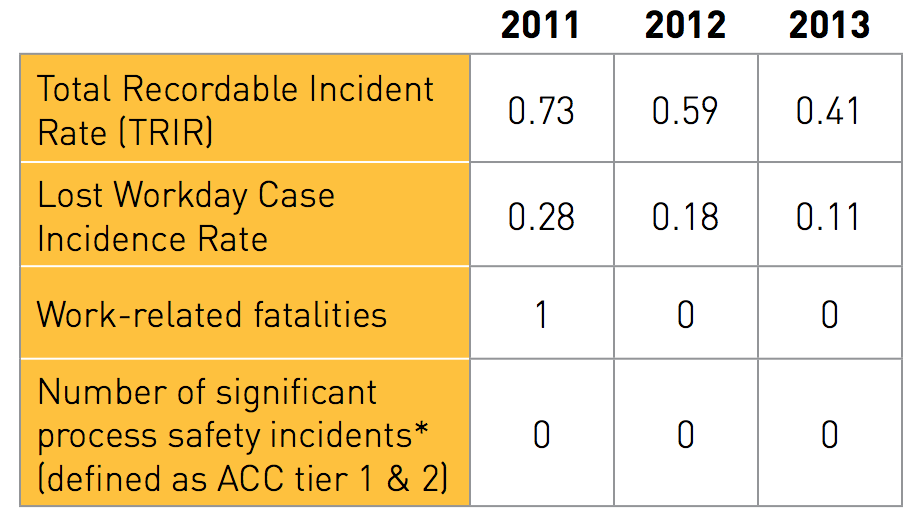
| Type of injury and rates of injury, occupational diseases, lost days, and absenteeism | G4-LA6 Report |
|
Diversity and Equal Opportunity
| Aspect of Diversity and Equal Opportunity | GRI G4 definition | Example/Presentation of the indicator as presented in CSR |
|---|---|---|
| Composition of governance bodies and breakdown of employees per employee category | G4-LA12 Report |  Click on image to view a larger version. Text Version of Ethnicity by Gender Table |
Equal Remuneration for Women and Men
| Aspect of Remuneration for Women and Men | GRI G4 definition | Example/Presentation of the indicator as presented in CSR |
|---|---|---|
| Ratio of basic salary and remuneration of women to men by employee category | G4-LA13 Report |
|

Supplier Assessment for Labor Practices
| Aspect of Supplier Assessment for Labor Practices | GRI G4 definition | Example/Presentation of the indicator as presented in CSR |
|---|---|---|
| Percentage of new suppliers that were screened using labor practices criteria | G4-LA14 Report |
|
| Significant actual and potential negative impacts for labor practices in the supply chain and actions taken | G4-LA15 Report |
|


Labor Practices Grievance Mechanisms
| Aspect of Labor Practices Grievance Mechanisms | GRI G4 definition | Example/Presentation of the indicator as presented in CSR |
|---|---|---|
| Number of grievances about labor practices filed, addressed, and resolved | G4-LA16 Report |
|

Child Labor, Forced or Compulsory Labor, and Assessment
| Aspect Category | Aspect | GRI G4 definition | Example/Presentation of the indicator as presented in CSR |
|---|---|---|---|
| Child Labor | Organizations and suppliers identified as having significant risk for incidents of child labor, and measures taken | G4-HR5 Report |
|
| Forced or Compulsory Labor | Operations and suppliers identified as having significant risk for incidents of forced or compulsory labor, and measures taken | G4-HR6 Report | |
| Assessment | Total number and percentage of operations that have been subject to human rights reviews or impact assessments | G4-HR9 Report |

Supplier Human Rights Assessment
| Aspect of Supplier Human Rights Assessment | GRI G4 definition | Example/Presentation of the indicator as presented in CSR |
|---|---|---|
| Significant actual and potential negative human rights impacts in the supply chain and actions taken | G4-HR11 Report |
|

Local Communities
| Aspect of Local Communities | GRI G4 definition | Example/Presentation of the indicator as presented in CSR |
|---|---|---|
| Percentage of operations with implemented local community engagement, impact assessments, and development programs | G4-SO1 Report |
|

Public Policy
| Aspect of Public Policy | GRI G4 definition | Example/Presentation of the indicator as presented in CSR |
|---|---|---|
| Total value of political contributions by country and recipient/beneficiary | G4-SO6 Report |
|

Compliance
| Aspect of Compliance | GRI G4 definition | Example/Presentation of the indicator as presented in CSR |
|---|---|---|
| Monetary value of significant fines and total number of non-monetary sanctions for non-compliance | G4-SO8 Report |
|
