Air Capture: Putting the Genie Back in the Bottle
Air Capture: Putting the Genie Back in the BottlePrioritize...
After completing this section, you should be able to:
- Define what we mean by "air capture" and understand how capturing carbon dioxide already in the atmosphere differs from carbon capture during emission.
- Understand what scientists mean by natural and artificial trees, and how both could be possible solutions to help remove excess CO2 from the atmosphere.
Read...
Air capture offers a bold approach to addressing carbon dioxide (CO₂) emissions: removing CO₂ directly from the atmosphere after it has already been released. Unlike carbon capture and sequestration (CCS), which targets CO₂ at the source, air capture aims to scrub CO₂ from the ambient atmosphere. While this idea might sound futuristic, its potential is both intriguing and complex.
Nature’s Approach: Reforestation
One natural method for air capture is reforestation—planting more trees to absorb CO₂ through photosynthesis. While this may seem like a straightforward solution, it has limitations.
Wait, why's that? Trees act as temporary carbon sinks, storing CO₂ as they grow, but this storage is not permanent. All that carbon gets (primarily) locked up in the solid parts of the tree: the trunk, branches, and roots. When trees die, their organic matter decomposes, releasing much of the stored carbon back into the atmosphere in the form of CO₂ or methane, depending on decomposition conditions. This means that the carbon captured during the tree's lifespan isn't permanently removed from the carbon cycle, making reforestation an inefficient method for achieving long-term carbon sequestration. Don't get me wrong, planting trees is good from a climate perspective. If we increase the number of trees growing on the Earth's surface, we increase the total carbon pool in trees, but we can't do that infinitely, unfortunately.While reforestation remains a valuable tool for improving biodiversity and providing ecosystem services, it should be seen as one piece of a larger climate solution, not a standalone fix for stabilizing atmospheric CO₂ levels. See the schematic below to get an idea of what I'm talking about.
Furthermore, factors such as deforestation, forest fires, or land-use changes can abruptly release this stored carbon, negating the benefits of the initial planting. Additionally, reforestation in snow-covered extratropical regions could inadvertently contribute to global warming by reducing Earth's reflectivity (albedo) during winter and early spring, as highlighted by climate scientist Ken Caldeira of Stanford University.

A Technological Alternative: Artificial Trees
What if we could "make" trees that vacuum up carbon like real trees but then hold it instead of eventually dying and releasing it back into the atmosphere? Enter the concept of artificial trees. No, not the ones you shove up in your attic after Christmas, but rather a more engineered approach to air capture. These synthetic "super trees" are designed to absorb CO₂ more efficiently than natural trees while avoiding the drawbacks of decomposition and albedo reduction. In fact, they can be constructed with reflective surfaces to enhance Earth's albedo, potentially offsetting warming effects.
Artificial trees use chemical filters to capture CO₂, which is then extracted, compressed, and buried for long-term storage. How does that work? One common method involves calcium oxide (quick lime), which absorbs CO₂ at high temperatures (~400°C) and releases it at even higher temperatures (~1000°C) for sequestration. Concentrated solar heating could power this process, eliminating the need for fossil fuels.
An engineer named Klaus Lackner has proposed an even more efficient system for artificial trees. His design relies on ion exchange resins, which capture and release CO₂ by changing humidity rather than temperature. This approach significantly reduces energy demands compared to traditional methods, making it a promising candidate for large-scale deployment. See below for an example of what one of these artificial trees looks like!
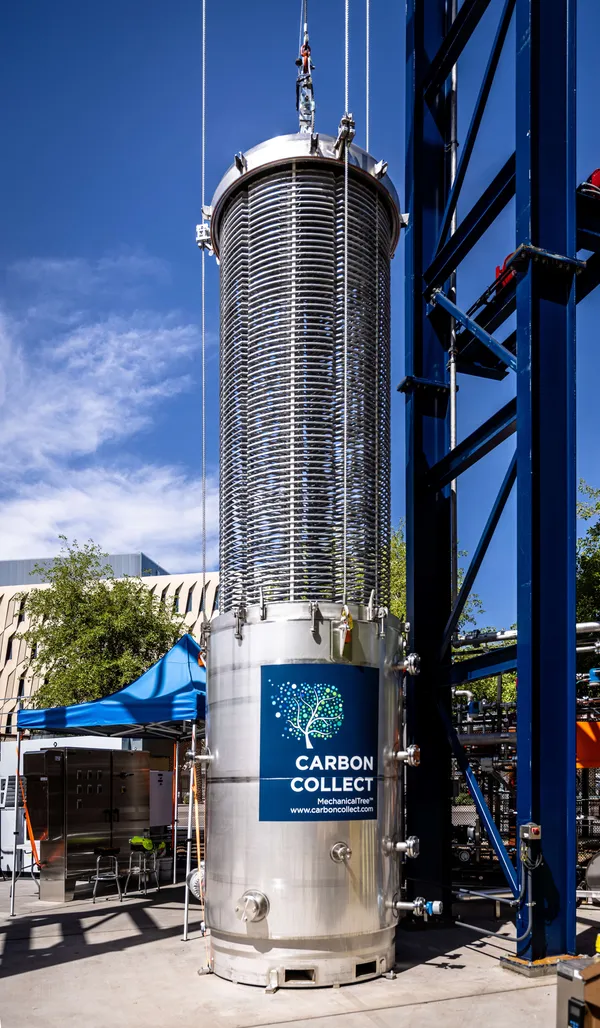
These schemes might seem rather fanciful and far-fetched, but, in fact, they are quite implementable. Air capture has already proven feasible. In 2008, scientists, in a review study, estimated that a basic carbon capture tower could remove up to half of the CO₂ from incoming air. That sounds great, what's the catch?!
The challenge lies in the technology's cost-effectiveness—how expensive it is to remove one "unit" (whatever that may be) of carbon dioxide. Capturing CO₂ from diffuse levels in the atmosphere is far less efficient than capturing it from concentrated sources, as in traditional CCS systems. Consequently, air capture is currently less viable than cheaper alternatives.
That said, air capture may become an essential tool as the cost of emitting carbon rises through carbon pricing or as climate risks escalate. If global CO₂ levels reach dangerous thresholds, air capture could be the only way to stabilize or reduce atmospheric CO₂ concentrations rapidly. Air capture holds unique promise for actively lowering atmospheric CO₂ levels.
Unlike other geoengineering solutions that we'll talk about next, air capture addresses the root problem: rising CO₂ levels. While air capture faces significant technological and economic hurdles, its potential to reverse atmospheric CO₂ accumulation makes it an essential option in our climate mitigation toolbox. As the urgency to stabilize global temperatures grows, air capture could play a pivotal role in achieving a sustainable climate future.