Geoengineering: What's the Big Deal?
Geoengineering: What's the Big Deal?Prioritize...
After completing this section, you should be able to:
- Define "geoengineering."
Read...
Geoengineering refers to the intentional manipulation of the environment on a global scale, aiming to counteract the effects of climate change. The term "geoengineering" combines "geo," meaning Earth, and "engineering," reflecting the deliberate design and manipulation of systems! While humans have already had significant unintended impacts on the climate—through burning fossil fuels, producing sulfate aerosols, and altering land surfaces—these changes don’t qualify as geoengineering because they weren’t deliberate attempts to modify the climate.
At this stage, geoengineering remains a theoretical concept, but it’s increasingly part of discussions around potential climate solutions. The basic idea is straightforward: to actively intervene in the Earth’s systems in ways that offset the warming effects of greenhouse gas emissions. However, the strategies proposed vary widely in scope, feasibility, and risk.
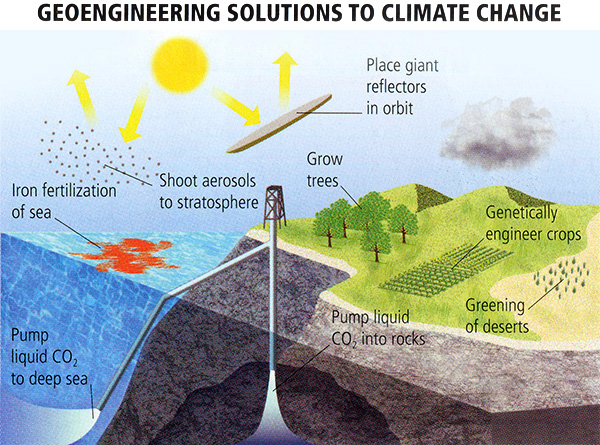
Some geoengineering approaches focus on carbon removal. For instance, carbon capture and sequestration (CCS) involves capturing CO₂ emissions from sources like power plants before they enter the atmosphere, while air capture seeks to remove CO₂ already in the atmosphere—akin to trying to "put the genie back in the bottle." This might include strategies like reforestation or even creating artificial "super trees" designed to extract carbon more efficiently than their natural counterparts. In these cases, the captured carbon would need to be stored securely underground or in the deep ocean, isolated from the atmosphere for long periods. Another proposal involves fertilizing the ocean with iron to stimulate the growth of phytoplankton, which could, in theory, absorb more CO₂ through photosynthesis and sink it into the deep ocean.
Other strategies, known as solar radiation management, aim to cool the planet by reflecting sunlight away from the Earth's surface. One idea is to mimic the cooling effects of large volcanic eruptions by injecting sulfate aerosols into the stratosphere. Another envisions placing massive arrays of reflective mirrors in space to reduce the sunlight reaching Earth. Related proposals focus on increasing the Earth's surface reflectivity, such as by painting rooftops white or modifying land surfaces to reflect more solar radiation.
Each scheme has its own set of potential benefits, risks, and trade-offs. We'll talk about them over the next few pages!