Interception! Carbon Capture and Sequestration
Interception! Carbon Capture and SequestrationPrioritize...
After completing this section, you should be able to:
- Define what "carbon capture and sequestration is" and how it can reduce carbon emissions at energy sources (like a power plant).
- Describe the rocky history of carbon capture and storage (CCS) and explain why it's unlikely to be the only solution to climate change.
Read...
Among the various geoengineering proposals, carbon capture and sequestration (CCS) is often considered the least invasive to the Earth's systems. The idea behind CCS is simple yet ambitious: prevent carbon dioxide (CO₂) produced during fossil fuel combustion from ever reaching the atmosphere. In theory, this could allow energy generation from fossil fuels with near-zero carbon emissions. However, CCS is only economical for large point sources, such as coal-fired power plants or industrial facilities like steel mills, cement factories, and oil refineries.
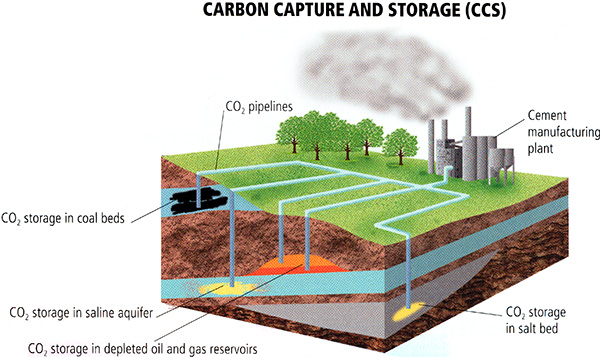
One notable attempt to demonstrate the feasibility of CCS was the FutureGen project, a full-scale "proof of concept" for CCS at a coal-fired power plant in Illinois. Funded by the U.S. Department of Energy in partnership with coal producers, users, and distributors, FutureGen aimed to capture CO₂ from coal combustion, compress and liquefy it, and inject it deep underground for long-term storage. The site chosen, Mount Simon in Illinois, offered an ideal geological setting, with porous rock formations to absorb CO₂ and impermeable caprock to seal it in, all situated well below freshwater aquifers.

The process involved a technique called oxy-combustion, where coal is burned in a mixture of oxygen (O₂) and recycled CO₂ instead of regular air. This results in a relatively pure stream of CO₂ after combustion, which is then scrubbed of residual pollutants, compressed, liquefied, and injected into deep geological formations. Over time, the CO₂ reacts with porous igneous rocks to form stable limestone, mimicking natural geological processes. FutureGen estimated it could bury 1.3 million tons of CO₂ annually—equivalent to 90% of the plant's emissions.
FutureGen was intended not only to reduce emissions but also to generate critical data on the efficiency and long-term viability of CCS. Researchers planned to monitor the injection sites, ensuring that CO₂ remained securely stored. Lessons learned from this experiment could, in theory, guide the deployment of CCS at other locations worldwide.

Why was FutureGen considered a good choice for testing the efficacy of CCS? The geology of the Mount Simon site in Illinois is well suited for CCS, and it is also reasonably representative of geological formations found in many other regions of the world. Whatever was learned from FutureGen could, in principle, be applied to many other potential CCS sites around the U.S. and the world.
Like Mount Simon, geological formations that contain salt water are ideal because of their porosity -- a fancy way of saying there are lots of pockets in which to store things. Moreover, there is impermeable caprock to seal in CO2. The formation is deep, placing it well below the depth of aquifers that are tapped for freshwater supply.
More than anything else, FutureGen was proposed as an experiment. The FutureGen operation would have evaluated potential storage sites before deciding precisely where the liquefied CO2 would have been injected for long-term storage, based on both theoretical modeling and data collection to evaluate detailed geological information about potential storage sites. The effectiveness of the injection system would be evaluated, and there would be continual monitoring of the burial process to ensure that CO2 was indeed being sequestered and remained sequestered. Whatever was learned could, in principle, be applied to any full-scale future deployment of CCS in the U.S. and abroad.
Despite its promise, FutureGen faced significant hurdles. The project was restructured as FutureGen 2.0, but it was eventually suspended in 2015 due to funding issues. Similarly, other CCS projects, like the Kemper County plant in Mississippi, struggled with cost overruns and ultimately abandoned CCS in favor of natural gas combustion. While some CCS efforts continue, such as Texas's Petra Nova project and Iceland's CarbFix program, they remain limited in scope and application.
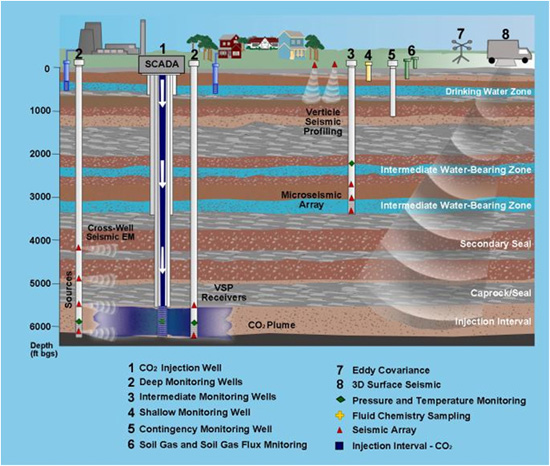
Although CCS appears to offer a pathway to reducing greenhouse gas emissions, its potential is constrained by several factors:
- Residual Emissions: Even with a 90% sequestration rate, CCS-equipped plants still emit some CO₂, meaning they cannot achieve zero emissions.
- Geological Risks: Seismic activity, groundwater flow changes, or other unforeseen events could compromise storage integrity, leading to CO₂ leaks and undermining the economic investment in the CCS infrastructure.
- Economic Viability: Establishing and maintaining CCS sites requires significant upfront costs, which may not compare favorably to other low-carbon energy solutions.
Moreover, the promise of "clean coal" technology remains largely theoretical. Without extensive data from projects like FutureGen, the long-term efficacy of CCS in sequestering carbon remains uncertain. Evaluating whether stored CO₂ remains secure could take decades—time we may not have, given the urgency of reducing emissions to avoid severe climate impacts.
While CCS shows promise, it is unlikely to serve as a magical solution for climate mitigation. The technology could play a role in reducing emissions from hard-to-decarbonize sectors like heavy industry, but relying on it as a primary strategy risks delaying critical transitions to renewable energy and other low-carbon solutions. As we continue to explore potential pathways for addressing climate change, CCS may complement, but cannot replace, more comprehensive efforts to reduce emissions at their source.