Detection and Attribution in Climate Justice
Detection and Attribution in Climate JusticePrioritize...
After completing this section, you should be able to:
- Define "detection" and "attribution" and explain how they are used in climate science.
- Explain what a "counterfactual" experiment means with respect to climate attribution.
Read...
When we're talking about climate justice, it's not just about recognizing the impacts of climate change; it's about understanding the science that helps us pinpoint these impacts and their causes. This is where detection and attribution come into play. Sort of like CSI: Climate Science.
Detection is noticing that something fishy is going on with the climate. It's about identifying changes in the climate system that stand out and can't be chalked up to natural variations. For example, if you see that global temperatures are rising, detection helps us figure out if this change is unusual and significant.
Attribution, on the other hand, is about figuring out what and who is to blame for these changes. It’s like finding the culprit in a mystery novel. Attribution links observed changes to specific causes, like greenhouse gas emissions from human activities. Scientists do this by comparing real-world data with climate models. They look at different scenarios, such as natural factors like volcanic eruptions and human factors like emissions from cars and factories. If the models show that the observed warming only happens when human activities are included, it’s a strong indication that we're the ones driving these changes.
So why are the ideas of detection and attribution important for climate justice? Well, remember earlier when we said we shouldn’t think about climate change as “causing” a particular extreme event (for example, a hurricane), but rather, whether climate change increased the probability of that event occurring or enhanced its impacts. Detection involves asking the question, “Is there something that climate change did here?” and attribution is asking the question, “What percentage of this event’s impact was caused by climate change?” Answering these two questions can prove important for understanding how societal choices regarding emissions, land use changes, etc., are potentially causing harm to parties less responsible for such decisions.
So, how do scientists do this? There is no one answer. They use a variety of methods and tools. These approaches often involve sophisticated climate models, historical climate data, and statistical techniques to isolate the influence of human activities from natural variability. For detection, researchers analyze long-term climate records to identify trends and anomalies that deviate from expected natural patterns. This process requires meticulous examination of temperature records, precipitation patterns, and extreme weather events, ensuring that identified changes are robust and significant.
See an example of detection below.
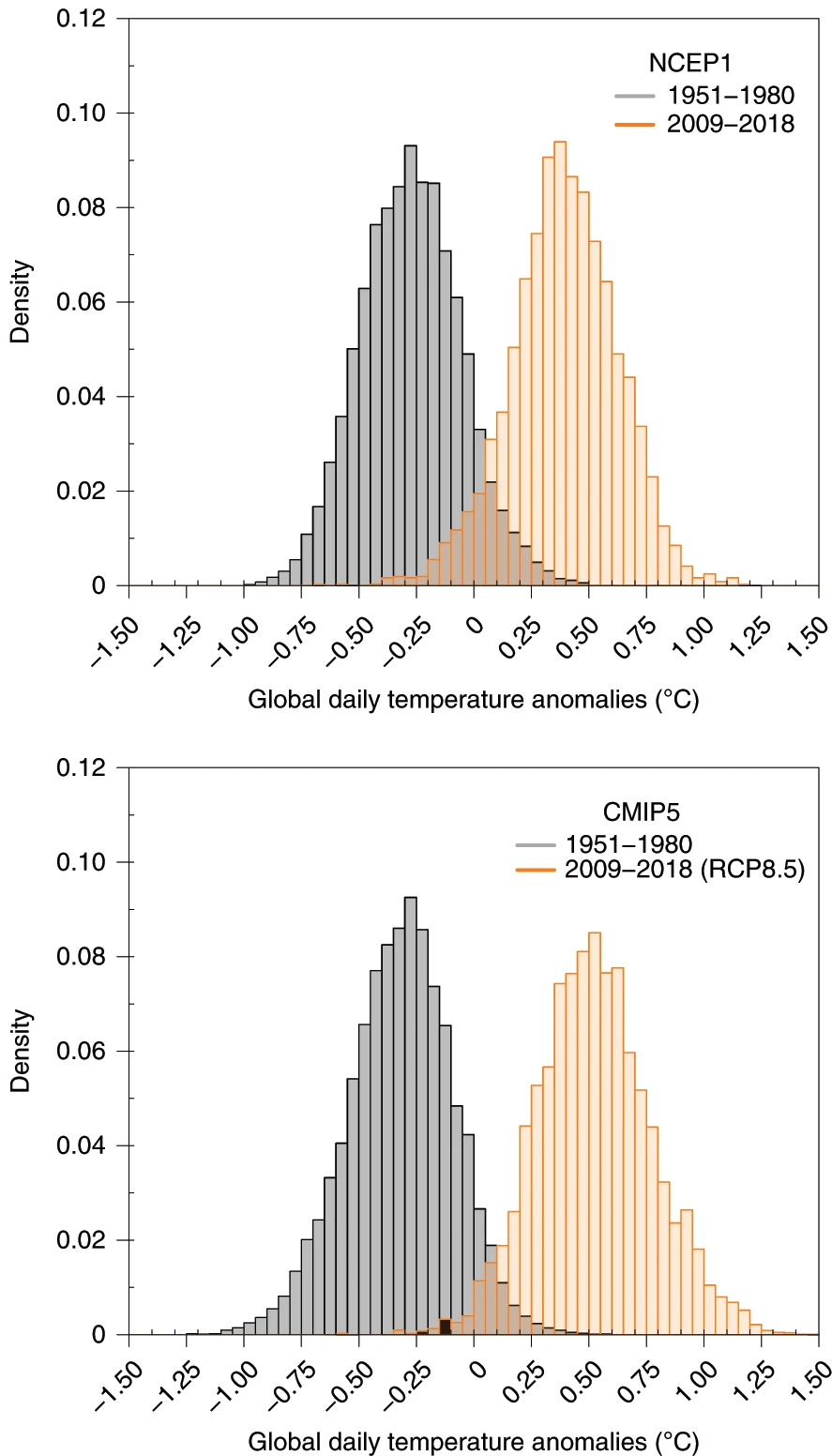
The graphs compare global daily temperature anomalies using data from (top) the NCEP dataset and (bottom) CMIP5 models.
These graphs show how daily temperatures have changed globally over time. The black bars represent temperatures from 1951–1980, while the orange bars show temperatures from 2009–2018. The top panel uses data from the National Center for Environmental Prediction (NCEP), whereas the bottom panel comes from verification of climate model simulations. Notice how the orange bars have shifted to the right compared to the black bars. We’ve seen similar graphs before in this course—these results clearly "detect" climate change, confirming that the most recent period is warmer than the past! Another cool takeaway here is that our models capture the same warming signal seen in observations—a reassuring sign that they’re trustworthy tools for understanding climate trends.
For attribution, scientists use climate models to simulate Earth’s climate under different scenarios. They run these models with and without human influences—like greenhouse gas emissions and land-use changes—to see how the climate would behave in each case. By comparing the results to observed data, researchers can figure out how much human activity has contributed to specific climate events or trends.
Let’s break this down with an example. Hurricane Florence, a major storm from the 2018 Atlantic season, caused prolonged heavy rain and catastrophic flooding in the Carolinas, leading to 54 deaths and $24.23 billion in damages. How much of this flooding was due to climate change? To answer this, scientists used atmospheric models to simulate two versions of Hurricane Florence. One version closely matched the real storm as it happened. The other, called a "counterfactual," used the same meteorological setup but removed the human-induced fingerprint of climate change from the conditions leading up to the storm. To account for variability, they ran hundreds of slightly different simulations (an ensemble) for each version. By comparing the “actual” and “counterfactual” results, they could determine how much of the storm’s impact was influenced by human-driven climate change.
Emphasize!
A counterfactual experiment in climate attribution is a method used to isolate the impact of human activities, like greenhouse gas emissions, on specific weather events or climate trends. It involves running climate model simulations under two scenarios:
- The actual scenario (in red), which includes both natural factors (like volcanic eruptions and solar variations) and human influences (such as emissions and land-use changes).
- The counterfactual scenario (in blue), which removes human influences and only includes natural factors.
By comparing the outcomes of these simulations, scientists can determine how much of an event’s severity, likelihood, or impact can be attributed to human-induced climate change. For example, in studying a heatwave, a counterfactual experiment might reveal that the event was made significantly more intense or frequent due to human activities.
The figure below shows histograms (with solid lines) of the maximum rainfall (i.e., the highest precipitation peak at any weather station over the Carolinas) and the total accumulated precipitation over the region impacted by Florence. The red (“actual”) and the blue (“counterfactual”) histograms come from the ensemble of model simulations, and the vertical black stripe is the single value that was observed by satellite data. To make it easier to see the differences, the researchers fit smooth curves (illustrated by dashed lines) to the results. For both quantities, the blue curve is to the left of the red curve, which means the blue curve is composed of less rainfall. In other words, climate scientists found that when they removed the “fingerprint” of human induced climate change from Hurricane Florence precipitation decreased. Put another way, approximately 5% of Hurricane Florence’s precipitation was due to climate change. This may not seem like a big number, but in many cities around the United States, this can be the difference between levees being breached or not or buildings being flooded and lives being lost.

Additionally, advancements in climate science have improved the precision of these studies, allowing for more accurate (and rapid) attribution of extreme weather events. For instance, after a heatwave, scientists can assess the probability of such an event occurring in a pre-industrial climate versus today’s climate in near real-time. These rapid attribution studies provide timely insights into the role of human activities in intensifying extreme weather, which is essential for public awareness and helps make sure that media outlets are communicating the best possible science to individuals interested in understanding such impacts.
Explore Further...
Curious about how scientists determine whether climate change influenced a recent heatwave, flood, or drought? Visit World Weather Attribution (WWA) to explore real-time analyses of extreme weather events. WWA uses climate models and weather observations to assess how human-driven climate change affects the intensity and likelihood of these events. From heatwaves in Europe to flooding in Africa, their studies provide insights into the role of climate change and highlight the actions needed to prepare for a world of increasing extremes.
