The Disproportionate Impacts of Climate Change
The Disproportionate Impacts of Climate ChangePrioritize...
After completing this section, you should be able to:
- Explain how climate impacts can be "decoupled" from emissions, and give at least one example of how poorer countries may bear the brunt of climate impacts at the expense of richer, highly emitting ones.
- Define Gross Domestic Product (GDP) and explain why it's helpful in understanding "uneven" climate impacts.
Read...
We’ve established that the “Global North” emits more greenhouse gases than the “Global South.” And if you are concerned with restricting global CO2, this inequity in emissions means that the “Global North” must recognize it as such. But emissions are just one side of the coin. The other side—and to be honest, the real injustice—is how climate change disproportionately impacts countries with the least responsibility for causing it.
Things wouldn’t be unfair if impacts were proportional to emissions. If climate change were like a restaurant bill split based on who ordered what—you had an extra drink and ordered the most expensive dessert, so you pay your fair share—that would make sense. But imagine sitting at the table while your friend drinks the priciest bottle of wine (all by themselves!), racks up the biggest tab, and then suggests, “To make it easy, let’s just split the check evenly!” Not ideal, right?

Climate change doesn’t hit everyone equally. Unfortunately, it overwhelmingly tends to magnify existing inequalities and hits those least equipped to handle its effects the hardest. Nations that have contributed the least to global emissions—the ones that historically used fewer resources—are, in many cases, now the most vulnerable to climate disasters. Meanwhile, wealthier, industrialized countries that released the bulk of greenhouse gases have the financial resources to buffer themselves against the worst impacts. This imbalance is one of the defining injustices of our time. Do you believe that poorer countries are getting the short end of the stick? Let’s look at why certain nations bear the brunt of the climate crisis.
Many poorer nations are located in regions particularly vulnerable to climate change—low-lying islands, arid zones, and tropical areas. These places face rising sea levels, more intense droughts, heatwaves, and storms. For example:
- Small island nations like Kiribati and the Maldives are grappling with the existential threat of rising seas. Entire communities are being displaced as their homes are swallowed by the ocean.
- Sub-Saharan Africa is enduring prolonged droughts and extreme heat, devastating agriculture and putting millions at risk of famine.
- South Asia, including heavily populated countries like Bangladesh, faces severe flooding and cyclones, displacing millions and eroding already fragile infrastructure.
Look at the image below—it's a striking example of what I mean. This graphic comes from the IPCC AR6 report we’ve referenced before. It maps the projected number of days different regions around the world will experience extreme heat and humidity by the end of this century. The top row is the “present” day (note that unfortunate IPCC typo… “pressent!”), and the three columns in the bottom two rows represent three climate scenarios we discussed in the last lesson for the middle and end of the 21st century.
As expected, we see an increase in "redder" colors across the map, signaling more days of extreme heat as the climate warms. That part isn’t surprising—as our surface air temperature distribution shifts to higher values, we know we should expect fewer extreme cold events and more extreme hot ones. But look closely at where these increases are most pronounced. It’s not the densely populated areas in the mid-latitudes—countries like the United States, Europe, or most of China. Instead, the ballooning extremes are occurring in regions like northern South America, sub-Saharan Africa, India, and parts of the Pacific. These areas are often less economically developed (and we’ll dive into why that matters in just a moment).

But geography is not the only factor. A nation’s resources make a huge difference. Wealthier nations have infrastructure and systems in place to protect their residents—seawalls, advanced weather forecasting, and disaster relief programs. In contrast, many developing nations lack these safety nets. A heatwave in Europe might mean higher electricity bills for air-conditioning, but in South Asia, it can lead to mass casualties for people without access to cooling or reliable power grids. Flooding in the Netherlands is mitigated by one of the world's most sophisticated systems of dikes and floodgates, preventing widespread devastation. Meanwhile, flooding in Bangladesh regularly displaces millions, as communities lack the infrastructure and resources to protect against rising waters. After a hurricane hits Florida, rebuilding efforts begin almost immediately, thanks to insurance and federal disaster funds. But after a cyclone devastates Mozambique, recovery can take years—or may never fully happen.
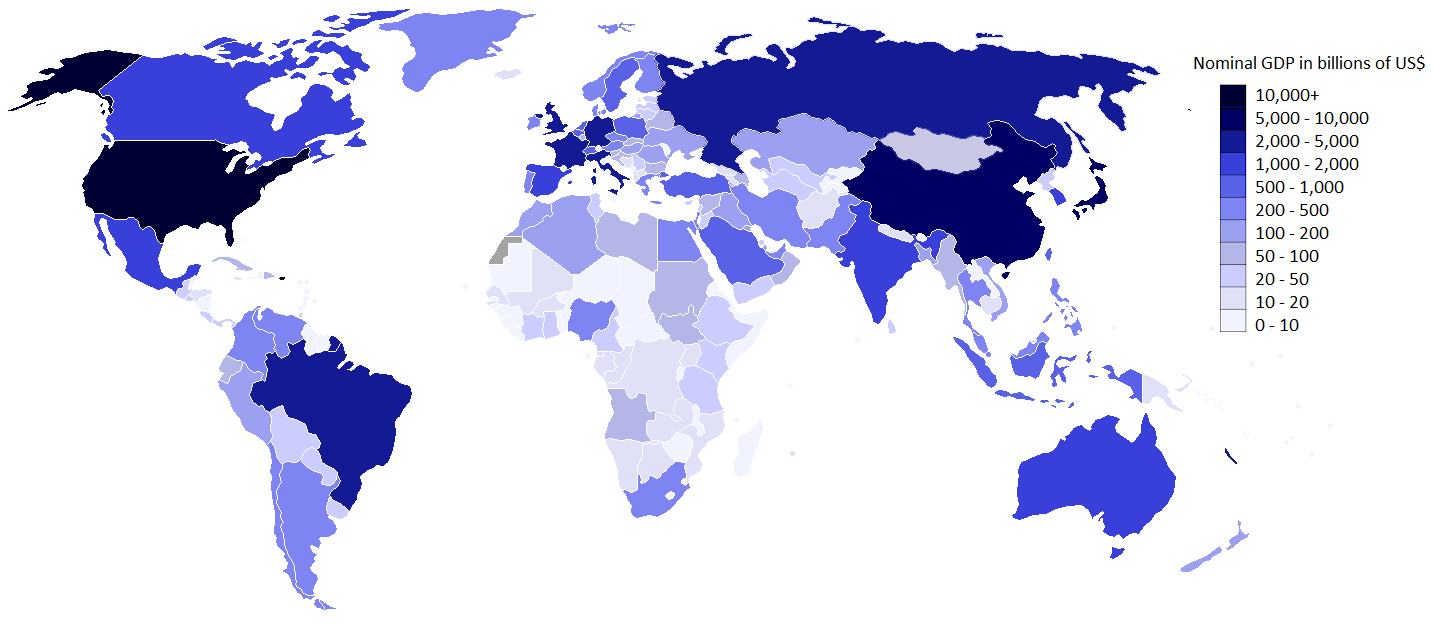
Wait, how can I say that Florida has more resources than Mozambique? Some of you may think, “That’s obvious,” but quantitative ways exist to evaluate it. One way to measure a country’s resources is through something known as Gross Domestic Product (GDP), a metric often used to quantify economic output and wealth. GDP is basically the total amount of money a country makes in a year from everything it produces and sells. You’ve probably heard the term on the news – economists and politicians love to talk about it!
Below is another map (we do love maps!) that shows the world’s nations by GDP. Darker blues to near-black represent wealthier, richer countries, while lighter shades closer to white indicate poorer ones. To put things into perspective, the GDP of the United States is generously about 1,000 times greater than that of Mozambique. It stands to reason that hurricane recovery resources would be much, much better in one country versus the other.
Now, scroll back up and take a moment to notice the inverse relationship between GDP and projected heat waves. The areas with lower GDP (the lighter areas on the map below) often align with regions facing the most dramatic increases in extreme heat (the redder areas on the map above). Sadly, this pattern isn’t unique; many global maps of economic and climate vulnerabilities tell a similar story.

The irony is hard to ignore: wealthier nations built their prosperity on a foundation of carbon emissions. Industrialization fueled the progress we often take for granted: the convenience of same-day delivery, year-round fresh produce, and the ability to fly across the country in hours. All of this was (and is) made possible by burning fossil fuels—and lots of them.
Despite their small carbon footprints, many poorer countries face the steepest costs of climate adaptation. For example, some of the things -- and far from an exhaustive list -- they must consider working on:
- Building seawalls to combat rising seas.
- Developing drought-resistant crops to cope with failing agricultural systems.
- Establishing disaster response systems to protect lives during increasingly frequent extreme weather events.
- Implementing water management systems to address shrinking freshwater supplies caused by prolonged droughts and glacial melt.
- Reforesting degraded lands to stabilize soil, reduce flooding, and sequester carbon, especially in regions like sub-Saharan Africa and Southeast Asia.
- Relocating entire communities from areas rendered uninhabitable by rising seas or desertification, a costly and logistically complex process faced by small island nations and arid regions.
- Investing in resilient healthcare infrastructure to combat the spread of diseases like malaria and dengue, which are becoming more prevalent due to shifting climate patterns.
For many nations in the Global South, these costs are insurmountable. When dealing with high poverty fractions across their populations, spending additional money on climate adaptation is a non-starter. The same countries that have been least responsible for emissions are now being asked to invest in solutions they can barely afford—solutions wealthier nations have long had the resources to develop.