Ice Changes
Ice ChangesPrioritize...
At the completion of this section, you should be able to:
- Describe the effects of warming on sea ice and ice sheets, including the factors contributing to their decline and the role of albedo in the Arctic region’s warming.
- Explain the difference in sea-level impact between melting sea ice and land ice, and discuss how melting ice sheets contribute directly to global sea-level rise.
Read...
If you’ve experienced snowy winters, you know that ice and snow are sensitive to temperature changes. As the world has warmed, ice in the polar regions, particularly in the Arctic, has been on a steady decline. Warmer temperatures now melt ice for longer periods each year, reducing its overall coverage, thickness, and volume. To understand this loss, climate scientists focus on two main types of ice: sea ice and ice sheets.
Sea ice is frozen ocean water that grows in winter as temperatures drop and shrinks in summer as temperatures rise. Satellite data, available since 1979, have given scientists a clear picture of sea ice changes across the Arctic. To track these changes, they measure the minimum extent of sea ice in September, when it reaches its lowest point each year. Since satellites began monitoring, Arctic sea ice in September has decreased by about 13 percent per decade (see the graph below).
Like the stock market’s ups and downs, sea ice coverage can vary from year to year due to natural shifts in the climate system. But the overall trend is clear: a consistent and steady decline. Even with occasional peaks that might look like a “rebound,” the long-term pattern is one of continual loss.

Long-term reconstructions of Arctic sea ice, like the one just shown of Arctic minimum sea ice extent from 1979 to 2023 (credit: Zachary Labe), provide context for the recent, rapid decline. What does this drop in Arctic sea ice mean? Let’s start with a concept from our earlier discussion on energy budgets: ice has a high albedo, meaning it reflects a lot of sunlight. With less ice, the Arctic loses some of that reflectivity, or “albedo.” This allows more sunlight to be absorbed, which leads to even more warming in the region.
But the effects don’t stop there. A warmer Arctic with less sea ice can alter temperature gradients across the Northern Hemisphere. These gradients, or temperature differences between the poles and the equator, are key players in shaping mid-latitude weather systems and circulation patterns. As the Arctic warms and the pole-to-equator gradient weakens, it can disrupt these systems, potentially leading to more erratic and unusual weather patterns.
Shrinking areas of sea ice also mean that the Northwest Passage (the shortcut route from the Atlantic Ocean to the Pacific Ocean through the Arctic) more frequently becomes ice free, and it can become a more viable route for commercial shipping during late summer. While having such an ice-free shortcut can have economic benefits, more open routes for ships also bring about security concerns. This has the attention of the United States Navy, in particular. In 2014, the Navy issued their "Arctic Roadmap" through 2030 (NOTE: not required reading), which outlines how the Navy plans to deal with the consequences of increasing open waters in the Arctic. In case you're wondering, the Antarctic region also has sea ice, but it typically grows and nearly completely disappears each year with the changing seasons.
Moving away from the sea, ice sheets are vast expanses of "glacial" ice found on land, each covering at least 50,000 square kilometers (20,000 square miles). To clarify, "glaciers" are similar but smaller formations of “old” ice on land that do not reach the size of ice sheets. Ice sheets typically grow over time as snow accumulates each year and does not fully melt during the summer. This cycle allows fresh snow to fall on top of the previous year's snow, compressing it. Over hundreds to thousands of years, this process can result in the formation of large ice masses.
Today, there are two major ice sheets on Earth: one in Greenland and another in Antarctica (credit: NSIDC). Together, these ice sheets contain about 99 percent of the world's freshwater ice. During the last ice age, these ice sheets were much more expansive. For instance, the Greenland ice sheet once covered much of North America and Northern Europe, acting as a colossal reservoir of ice and significantly altering the global climate and sea levels.

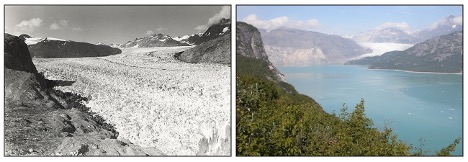
But, as the world warms, the Greenland and Antarctic ice sheets are also melting. Scientists began tracking these ice sheets via satellite in 2002, and you can see an example of the trends in land-ice mass in the side-by-side pictures below of Alaska's Muir Glacier in 1941 (left) and 2004 (right; credit: Zachary Labe). Note that the Greenland ice sheet is melting more rapidly than the Antarctic ice sheet, in large part because the high latitudes of the Northern Hemisphere (where Greenland is located) are warming faster than anywhere else on the planet. As a result, in addition to the Greenland ice sheet, high-latitude glaciers in the Northern Hemisphere are melting, too.
Overall, ice both on land and in the water is melting much faster in the Arctic than in the Antarctic. In the Antarctic, where warming has been less intense, some ice shelves (floating masses of ice attached to a land mass) have even grown slightly. However, when sea ice melts, the impact on sea level is relatively minor because this ice was already floating in the ocean. If I put some ice cubes in a glass and fill the water up to the brim, it won’t overflow even when it melts. This principle also applies to ice shelves.
In contrast, the melting of ice sheets and glaciers, which are situated on land, presents a different scenario. When these large ice masses melt, they contribute directly to rising sea levels because they add new water to the ocean that was previously stored as ice on land. This process is more akin to holding new ice cubes above a full glass and letting the melted water drip down. Eventually, that full glass will overflow. This distinction highlights the more significant role that land ice plays in influencing global sea levels and climate dynamics.