Reconstructing our Climate's History: Sediment and Ice Cores
Reconstructing our Climate's History: Sediment and Ice CoresPrioritize...
When you have finished this page, you should be able to:
- List at least two ways climate scientists reconstruct past climate and describe how they work.
Read...
Characterizing the climate today is (relatively) straightforward. As we’ve discussed, we have a variety of tools at our disposal, including in-situ measurements (like weather stations) and remote sensing (such as satellites) that allow us to observe the Earth system in real time. However, these methods have only been around for about a century for surface measurements and even less time for satellite observations. So, how do we know about climate conditions from hundreds, thousands, or even millions of years ago? You've likely heard of ice ages, which clearly happened long before our modern instruments existed!
The answer lies in what climate scientists call proxy records—natural recording systems that help us reconstruct past climates. These proxies come from sources like ocean and lake sediments, ice cores, and tree rings. Each of these provides clues about what the climate was like in different periods, allowing us to piece together a picture of Earth’s climate history long before we started taking direct measurements.
Ocean/Lake Sediments
Ocean and lake floors contain layers of sediment that can tell us about the climate at the time the sediment formed. Sediment is a mixture of particles, including minerals, organic material, and fragments of rocks, that settles at the bottom of a body of water over time. When you've gone swimming in a lake, you have probably felt the bottom as a bit of a "sandy muck" -- this floor gets compressed over long periods of time and pushed down and forms the sediment we are talking about.
Deep underneath the ocean/lake floor, these sediment layers can contain shells of tiny creatures. The species of creatures are present provide information about the surface water temperature. Some may like water at 50°F, others may prefer 55°F. We can also look at the ratio of different oxygen isotopes within the sediment cores. What is an isotope, you ask? Isotopes are variants of a chemical element with the same number of protons but different numbers of neutrons in their nuclei, giving them different atomic masses. An oxygen atom always has 8 protons in its nucleus, but it can have different numbers of neutrons! For example, oxygen isotope 18O has 8 protons and 10 neutrons (8 + 10 = 18), which makes it heavier than 16O, which has 8 protons and 8 neutrons (8 + 8 = 16). The bigger the number, the "heavier" the isotope.
The fraction of heavy versus light isotopes can tell us something about the temperature of the water at the time the sediment was formed. Think it's magic? Here’s how it works. First, we should remember that the chemical formula for a water molecule formula is H2O, meaning that it contains two hydrogen atoms and one oxygen atom. Water with the lighter 16O isotope, is easier for the atmosphere to evaporate. When the climate is warmer 16O evaporates into the atmosphere eventually falls back as precipitation in the ocean and lakes from which it originated. However, during colder periods, much of this lighter 16O falls as rain or snow that becomes trapped in ice sheets. This "locks" the 16O isotope out of the ocean circulation (since it's "stuck" in the ice), and we find a higher concentration of the heavier 18O isotope in the ocean. When we find higher concentrations more 18O in ocean sediments, it's a sign that -- when that sediment was formed -- the global temperatures were cooler, and ice sheets were more extensive. Pretty neat, huh?
It is quite an operation to retrieve these cores. Have a look at the following video to see scientists in action collecting these important records.
Video: Martin Jakobsson explains how to collect sediment cores from the sea floor (3:23)
Martin Jakobsson explains how to collect sediment cores from the sea floor
[music]
On screen text: How do the scientist collect sediment cores from the bottom?
Martin Jakobsson, Stockholm University: The sediment Cores we collect with different devices depending on what we're after. If we're after the surface, a very undisturbed surface sample, we take what's called a Multicore. That is a slightly different device, where you have very short tubes instead that are more controlled, pushed into the sea floor, and you get maybe 50 centimeters or something in eight different cores. They're so undisturbed that you actually preserve, in the best case scenario, you preserve the surface of the sea floor. If there's something lying on the ocean, for example, a sea star or something, sometimes that one. One can be unlucky, and then it get caught right into the sediment corner, and it actually got hoisted up.
[music]
If we would like to take long sediment records and study long climate series, we try to go for what we call a piston core, which is an old Swedish invention from Borja Kullenberg. And that is simply a pipe. And in the pipe, you have a piston. And that pipe is to the sea floor, you have a trigger arm that release, it falls freely, and then this piston stops at the sea floor. It prevents the whole compression of the sediment so the pipe can go down much easier and take very long records.
So from all that, we can take up to 12 meters. And then we have gravity course, which is very simpler. It's just a barrel or a pipe that you load to the sea floor and then just let it go and take sediments. Inside these pipes, we have what we call a liner. That's a plastic tube that capture the sediments. So, we have a container that is very controlled. So you get very nice sediment records. You see all the layers, they get fairly undisturbed. And that's what we're after for the long term of climate series.
[music]
Ice Cores
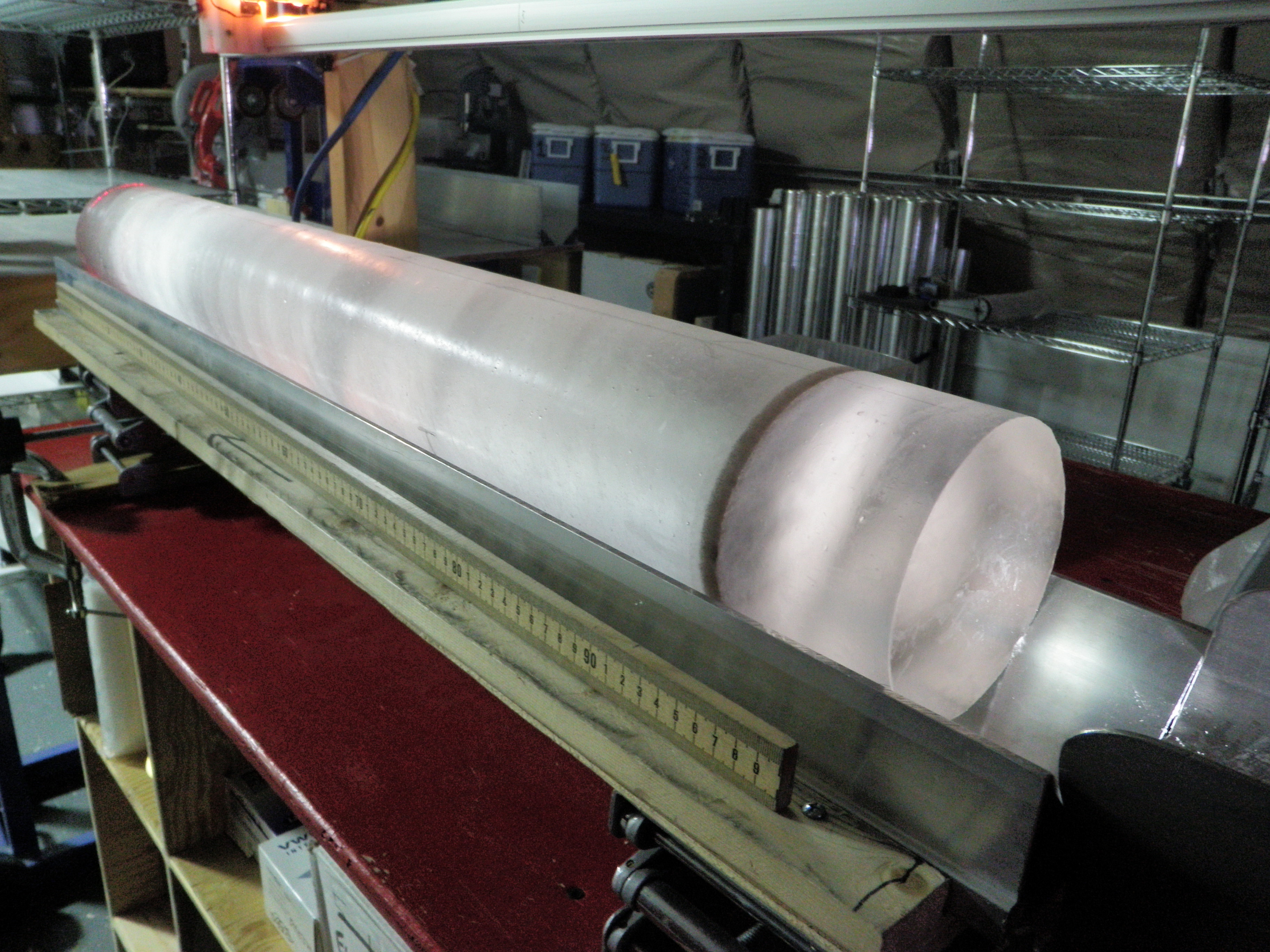
Glaciers grow as snow falls in layers that are slowly compacted into ice. Over time, this creates a deep glacier, like the Greenland Ice Sheet. These ice sheets stay frozen, preserving a long record of the composition of the snow from which scientists can get a variety of different measurements important for understanding the climate. To do so, long cylinders of ice are drilled and collected. From here, trapped air bubbles can be sampled to determine the composition of the atmosphere at the time the ice was formed. This can tell us, for example, what the concentration of carbon dioxide was. Similar to the ocean sediment cores, the air temperature can also be estimated by looking at the molecules that make up the frozen water, in particular, the ratio of oxygen isotopes. Within an ice core, more lighter isotopes indicate colder temperatures. Specific events, like volcanic eruptions can also be seen in these records, which helps determine the age of the ice at different depths in the core.