Phases of the ENSO cycle
Phases of the ENSO cyclePrioritize…
At the completion of this section, you should be able to:
- Describe the ENSO cycle and its phases (El Niño, La Niña, Neutral).
- Define "climate oscillation" and explain the Southern Oscillation and its connection to ENSO phases.
Read...
The El Niño-Southern Oscillation (ENSO) cycle is a natural pattern of climate variability centered in the equatorial Pacific Ocean. It arises from the interaction between the tropical atmosphere (like pressure, wind, and cloud patterns) and the ocean (such as sea surface temperature, coastal upwelling, and ocean currents). This interaction causes periodic shifts in sea surface temperatures (SST), air pressure, and rainfall patterns, which play out over the course of a few years. ENSO is a bit like a slow-moving pendulum—sometimes swinging toward warmer, wetter conditions and other times toward cooler, drier ones, all depending on the balance between the ocean and the atmosphere. Back-and-forth, back-and-forth...

Although ENSO is primarily a tropical phenomenon, its impacts ripple across the globe, disrupting typical weather patterns and triggering extreme events. For this reason, climate forecasters closely monitor ENSO signals to predict long-term climate trends that affect everything from agriculture to energy management.
Phases of the ENSO cycle
In the 1920s, British mathematician Sir Gilbert Walker discovered a large-scale atmospheric pressure pattern in the tropical Pacific, which he named the Southern Oscillation. In climate science, an “oscillation” refers to a recurring pattern of change over time in certain aspects of the climate system, such as temperature, pressure, or precipitation. We've already used the classical pendulum analogy climate scientists love to use, but to give another analogy, think of it as a yo-yo moving up and down – just as the yo-yo moves all the way down to the floor and then all the way back up to your hand, an oscillation in the climate system involves a back-and-forth shift between two states. These shifts can happen on various timescales, from months to decades, and can influence regional or even global climate conditions. In the case of the Southern Oscillation, it represents a seesaw-like fluctuation in atmospheric pressure between the eastern and western tropical Pacific, driving changes in wind patterns, ocean currents, and weather across the globe.
Sir Walker’s research was a game-changer because it showed that atmospheric pressure changes and shifts in sea surface temperatures across the tropical Pacific were actually linked. He explained how, every few years, the usually cool waters off the coast of South America would suddenly warm up, causing all kinds of weather disruptions around the world. This warming, known as El Niño, wasn’t just a local oddity—it was part of a larger, interconnected system. By piecing together these atmospheric and oceanic changes, Walker helped us understand what we now call the ENSO cycle, which plays a huge role in global climate patterns.
ENSO doesn’t follow a strict timetable (not unlike me!), but it generally transitions through its phases every 2 to 8 years. The cycle has three phases: the positive phase (El Niño), the negative phase (La Niña), and the neutral phase when the tropical Pacific shifts back to its climatological state. You've almost certainly heard about these in the news, but what do they actually mean from the perspective of a climate scientist?
- El Niño
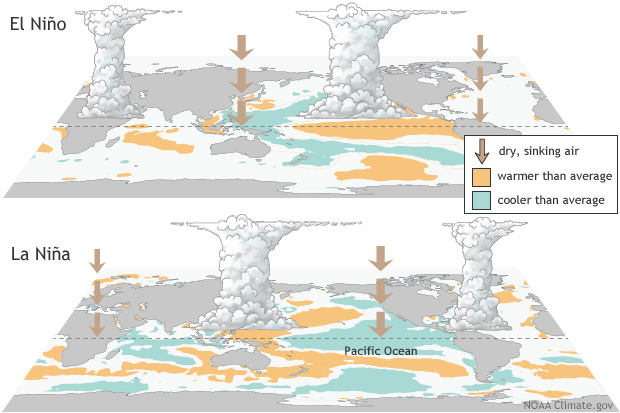
El Niño, which means “The Little Boy” or “Christ Child” in Spanish, was named by Peruvian fishermen in the 1600s when they noticed that every few years around Christmas the water off the coast of South America would be much warmer than usual. This warming disrupted fish populations and fishery yield, causing the fishermen to give it a name associated with the holiday season. During an El Niño event, the central and eastern Pacific Ocean becomes unusually warm. This shift in sea surface temperature influences atmospheric circulation, leading to changes in weather patterns worldwide. For instance, El Niño can bring wetter conditions to the western United States and Peru, while causing droughts in Australia and Southeast Asia.
- El Niña
La Niña, meaning “The Little Girl” in Spanish, is the opposite phase to El Niño. During the peak of La Niña, the central and eastern Pacific Ocean experiences cooler-than-average sea surface temperatures. This cooling can lead to opposite, but equally significant, weather impacts compared to El Niño. La Niña often results in wetter conditions in Australia and Southeast Asia, while causing drier weather in the southwestern United States.
- V Southern Oscillation
The Southern Oscillation is the atmospheric oscillation that accompanies the sea surface temperature anomalies associated with the El Niño and La Niña. The Southern Oscillation is characterized by the surface pressure differences between the Darwin and Tahiti, and thus reflects the strength of the Walker circulation spanning the equatorial Pacific. The Southern Oscillation index is negative during the El Niño (i.e., the Walker Circulation weakens), while positive during the La Niña (i.e., the Walker Circulation strengthens).