Other Greenhouse Gases
Other Greenhouse GasesPrioritize...
After reading this section, you should be able to:
- List the other three greenhouse gas families that are most important for anthropogenic climate change.
- Describe their most common sources in terms of human activities.
Read...
While carbon dioxide tends to grab most of the headlines when we talk about human-driven climate change (and for good reason!), it’s not the only player in the atmosphere affected by our activities.
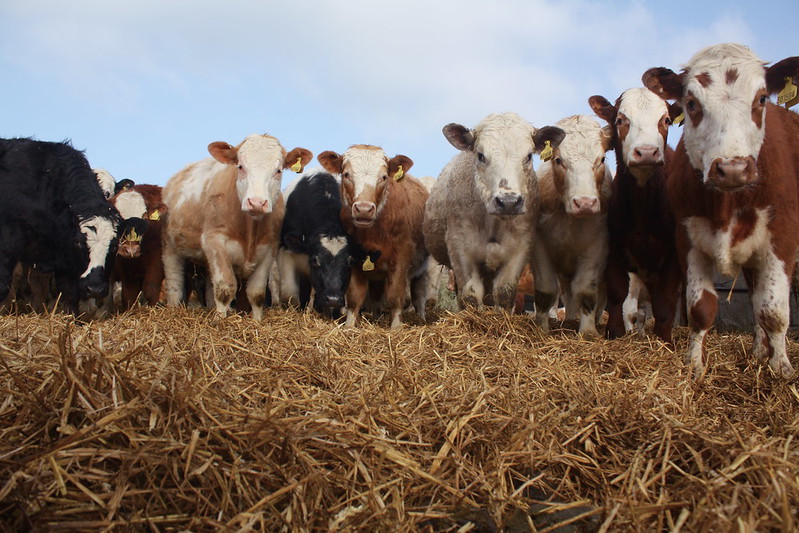
Methane (CH₄) is another potent greenhouse gas, with both natural and human-made sources, and its atmospheric concentration has more than doubled since pre-industrial times. Like carbon dioxide, methane levels began rising around 1800, as human activities became more widespread. Today, about 60% of methane emissions can be traced directly to human activities, with agriculture and waste management being the biggest contributors. For example, livestock like cows, goats, and sheep produce methane during digestion, a process that results in the gas being released into the atmosphere. You may have heard the term “cow farts” thrown around in jokes, but while oversimplified, it’s true that livestock farming contributes significantly to methane emissions.
Other major human sources of methane include landfills, where bacteria break down organic waste and generate methane, and rice paddies, where waterlogged soils become breeding grounds for methane-producing bacteria. Then there’s the oil and gas industry: during drilling and extraction, methane often leaks into the atmosphere—a phenomenon known as “fugitive emissions.” These leaks, along with other industrial activities, make up a notable portion of methane emissions.
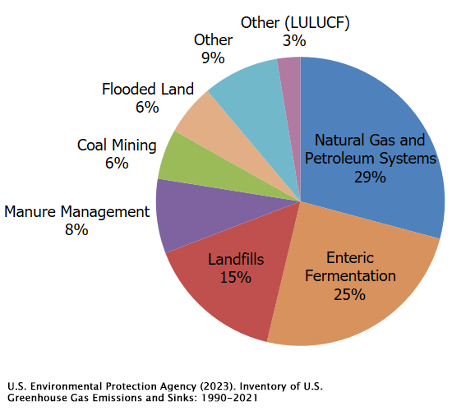
Below is the breakdown of anthropogenic methane emissions in the United States over the 1990-2021 period. Almost 80% of methane comes from gas leaking, agriculture, and landfills.
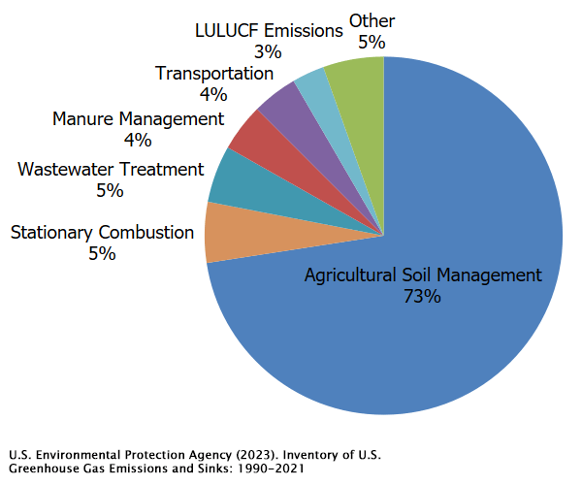
There are two other gases that round out the "core four" greenhouse gases, and nitrous oxide (N₂O) is one of them. You might know it as "laughing gas" from dental procedures, but in the context of climate change, it’s no laughing matter. Since pre-industrial times, the concentration of N₂O in the atmosphere has risen steadily. The main culprit? Nitrogen-based fertilizers.
Nitrogen fertilizers are key to enhancing plant growth and boosting crop yields. However, not all of that nitrogen stays in the soil. Some of it escapes into the atmosphere as nitrous oxide. This makes agricultural practices the primary source of N₂O emissions, as shown in the pie chart below. Beyond agriculture, N₂O is also released from a variety of industrial processes, such as burning solid waste, fossil fuel combustion, and wastewater treatment.
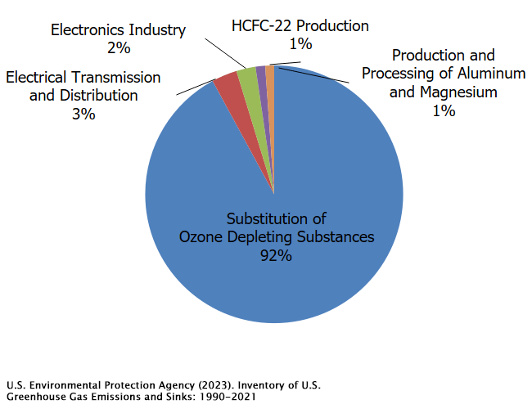
Halogenated gases (HGs) are also significant contributors to anthropogenic greenhouse warming. These gases are mainly used in refrigeration, air conditioning systems, and as propellants in products like spray paint and canned cleaners. What sets them apart is the presence of at least one halogen atom—fluorine, chlorine, bromine, iodine, or astatine—in their molecular structure. HGs are primarily the result of human activities, though there are some natural sources like volcanic eruptions and certain oceanic biological processes. However, the amount emitted naturally is quite small compared to human-made sources. In fact, some halogenated gases are entirely synthetic, with no natural counterparts, created in labs for specific uses.
Once these gases are released into the atmosphere, they become well-mixed globally, meaning their concentrations spread out and stabilize around the world. They persist for a long time in the atmosphere, only being broken down in the upper layers where ultraviolet rich sunlight breaks apart their molecular bonds. Unfortunately, this breakdown process is quite slow, making halogenated gases some of the most long-lasting and stubborn greenhouse gases, contributing to warming for many years after their release.
How are all these gases changing? Well, they look a lot like what we saw earlier with CO2. Below is another timeseries, but this time, instead of just including CO2, we also include CH4 and N2O. (The halogenated gases also follow a similar trend.) They all look remarkably similar -- relatively stable for a long period of time before a sharp uptick coinciding with the industrial revolution. Given what we have learned about the sources of these emissions, this indicates that all three gases have seen recent increases that are linked to human activities – increases that go far above and beyond their environmental backgrounds that come about as a result of natural sources.
