Ingredients of a Climate Model
Ingredients of a Climate ModelPrioritize...
After completing this section, you should be able to:
- List at least three processes that are simulated in Earth system (climate) models.
- Understand that climate models are broken into different components.
Read...
All that said, when people talk about “climate models,” they aren't talking about these "toy" models. Usually, they mean something much more complex than what we can write out on a napkin at the bar! Earth System Models (ESMs) are detailed software programs (they are indeed just a bundle of computer code!) that show how the atmosphere and oceans behave on a global scale. They use complex mathematical equations to represent the movement of air and water, the exchange of heat and moisture, and other critical processes necessary to ensure we can model the climate in a way that matches what we actually observe. They can also be modified to include the carbon cycle, vegetation, and human activities—topics we’ve discussed before. ESMs aim to provide a comprehensive picture of the Earth's climate system by including natural cycles and human influences like greenhouse gas emissions and land-use changes.
While “ESM” is the technical term many scientists use (sometimes, this will also get abbreviated GCM, which stands for "general circulation model," although recently people have also been using the acronym for "global climate model"), we’ll go back to colloquially calling these tools generally “climate models” for the rest of this section.
A quick aside:
It’s worth noting that many of you are probably more familiar with weather models than climate models. At the very least, you’ve likely heard more about them on TV—your local meteorologist might say, “It’s a beautiful day right now, but the models suggest we’re in for a change by the end of the week!” A weather model is actually a specialized type of ESM (Earth System Model). Its purpose is to predict what will happen in the short term, looking just a few days to a week ahead, instead of years or decades into the future.
Climate models, on the other hand, are more complex. They need to simulate processes that are essential for estimating long-term trends in global temperature over the course of a century. For example, predicting whether the global mean temperature will rise by 4 degrees over the next 100 years is crucial, but on a weekly timescale, that’s not relevant. Entire ice shelves won’t melt in a few days—most weather models treat them as constant. But over decades, they’re a factor we can’t ignore. This difference means that weather models tend to be simpler and faster to compute, which is essential since we need updated weather forecasts multiple times each day!
How does a climate model work? While these models are incredibly complex—often the result of tens or even hundreds of scientists working on them full-time—we can break down the basics using the schematic below. This diagram focuses primarily on the atmosphere (appropriate for a METEO course!), but similar structures apply to other components of climate models, like those used to simulate the ocean and land.
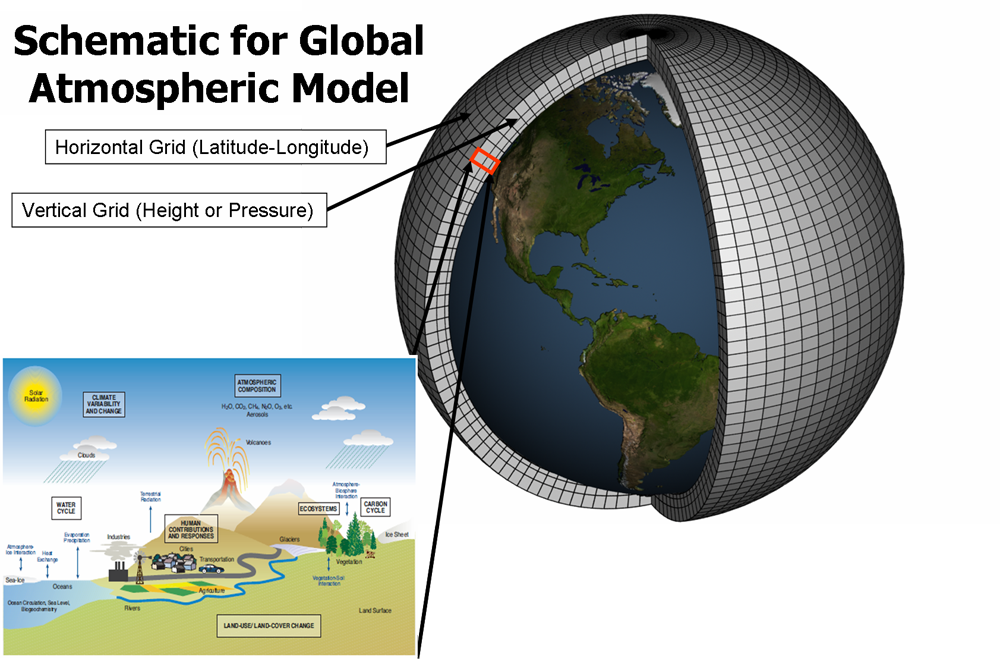
Climate models simulate the Earth’s climate by using mathematical equations to represent physical processes—many of which we’ve explored qualitatively (in other words, without too many equations!) in this course. These equations are solved on a grid covering the entire globe, where each grid cell represents a specific (two-dimensional) surface area or (three-dimensional) volume of air or water. So, State College, PA, may be surface area "grid cell number 421," while Sydney, Australia, may be "grid cell number 1078." Imagine the total collection of grid cells as the model’s “skeleton”—breaking the Earth up this way helps work through the complex, interconnected processes within each small piece, bit by bit until our model captures the whole system.
These climate models account for a range of factors, such as air and water flow, heat exchange, moisture distribution, and energy balance – all sorts of things we have learned about over the past few months! By running these climate models forward in time, they show how these elements interact, evolve, and change. This approach allows scientists not only to understand current climate patterns but also to make projections about future changes. To improve their accuracy, models are continually updated with our most recent understanding of how real-world processes work. A model in use today has been updated over a model from five years ago. And today's model will look archaic (hopefully!) in another decade!
How do these models simulate such a massive system? They’re divided into components—similar to the main parts we discussed at the beginning of this course (remember Lesson 1?). Each major component of the climate system is represented: the atmosphere, the ocean, the land, and ice-covered areas. For instance, the atmosphere component models air behavior, including wind patterns, air temperature changes, and precipitation. The ocean component handles water movement, currents, and heat exchange with the atmosphere. The land surface component tracks soil moisture, vegetation, and how the land absorbs and reflects sunlight. Finally, the cryosphere component models ice-covered areas, such as glaciers, sea ice, and snow, and their interactions with the rest of the climate system.
To illustrate this, take a look at the diagram below from the Department of Energy’s climate model. Each part of the climate system has its own dedicated “sub-model”—the atmosphere, land, ocean, etc.—and each sub-model addresses processes specific to that component. Together, these sub-models work to represent the entire climate system and its complex interactions.

Equations and data are at the heart of climate modeling. The equations rely on core physical laws like the conservation of energy, mass, and momentum, which describe how energy and matter move within the climate system through processes like radiation, convection, and the water cycle. Meanwhile, data are just as critical; they are produced by the real-world measurements necessary to set up and validate the models. These data come from sources like satellite observations, weather stations, and ocean buoys. By combining physical equations with observed data, climate models simulate past, present, and future climate conditions, enabling scientists to make informed predictions and study the possible impacts of climate change.