Lesson 7: Changes in Climate Over the Past 4 Billion Years
Lesson 7: Changes in Climate Over the Past 4 Billion YearsMotivate...

There's an enormous jigsaw puzzle with pieces scattered across eons of Earth’s history. Some pieces tell the story of tropical warmth, others of icy ages, and still others of fiery volcanic eruptions or subtle shifts in the Sun’s energy. Now, I'm going to hand it to you. Before we can talk about how climate may evolve in the future, we need to understand how it has evolved in the distant past. Your task? To dump these pieces all over the table (hopefully, you've cleaned it off!) and reveal how our planet's climate has changed over millennia.
Puzzle analogy aside, we have a big problem: we (meaning all of humanity!) weren’t around to see most of it firsthand, so how do we do it? The answer lies in the clues left behind—proxies, natural records hidden in ocean sediments, ice cores, tree rings, and even pollen. These records are like nature’s time capsules, silently preserving critical information about past climates. But proxies are just the beginning of the story. They tell us “what” happened, but we still need to understand “why.” To do that, we also need to consider larger forces at play: massive ice ages, shifts in Earth's orbit that influence solar radiation, and even volcanic eruptions that cool the planet by blocking sunlight with clouds of ash. Each of these forces adds to the complexity of Earth’s climate puzzle, and as we piece them together, we start to see patterns—patterns that not only tell us about the past but also hint at what’s to come.
In this lesson, you’ll learn how scientists reconstruct the climate’s history using proxies and what this tells us about the climate going back millions (and billions) of years. You'll also find out how Earth’s orbit, sunspots, and volcanic eruptions have shaped the climate. You’ll explore how these factors can work together to trigger events like ice ages or cause dramatic shifts in weather patterns. Understanding the interactions between these forces helps us make sense of today’s climate and gives us the tools to anticipate future changes.
So, let’s dive into Earth’s climatic past and discover the processes that have shaped our planet’s weather and climate for billions of years. Every proxy, every volcanic eruption, every solar cycle is another piece of the puzzle, and together, they reveal a picture of Earth’s ever-changing climate system. Ready to explore the forces that have shaped our world?
Reconstructing our Climate's History: Sediment and Ice Cores
Reconstructing our Climate's History: Sediment and Ice CoresPrioritize...
When you have finished this page, you should be able to:
- List at least two ways climate scientists reconstruct past climate and describe how they work.
Read...
Characterizing the climate today is (relatively) straightforward. As we’ve discussed, we have a variety of tools at our disposal, including in-situ measurements (like weather stations) and remote sensing (such as satellites) that allow us to observe the Earth system in real time. However, these methods have only been around for about a century for surface measurements and even less time for satellite observations. So, how do we know about climate conditions from hundreds, thousands, or even millions of years ago? You've likely heard of ice ages, which clearly happened long before our modern instruments existed!
The answer lies in what climate scientists call proxy records—natural recording systems that help us reconstruct past climates. These proxies come from sources like ocean and lake sediments, ice cores, and tree rings. Each of these provides clues about what the climate was like in different periods, allowing us to piece together a picture of Earth’s climate history long before we started taking direct measurements.
Ocean/Lake Sediments
Ocean and lake floors contain layers of sediment that can tell us about the climate at the time the sediment formed. Sediment is a mixture of particles, including minerals, organic material, and fragments of rocks, that settles at the bottom of a body of water over time. When you've gone swimming in a lake, you have probably felt the bottom as a bit of a "sandy muck" -- this floor gets compressed over long periods of time and pushed down and forms the sediment we are talking about.
Deep underneath the ocean/lake floor, these sediment layers can contain shells of tiny creatures. The species of creatures are present provide information about the surface water temperature. Some may like water at 50°F, others may prefer 55°F. We can also look at the ratio of different oxygen isotopes within the sediment cores. What is an isotope, you ask? Isotopes are variants of a chemical element with the same number of protons but different numbers of neutrons in their nuclei, giving them different atomic masses. An oxygen atom always has 8 protons in its nucleus, but it can have different numbers of neutrons! For example, oxygen isotope 18O has 8 protons and 10 neutrons (8 + 10 = 18), which makes it heavier than 16O, which has 8 protons and 8 neutrons (8 + 8 = 16). The bigger the number, the "heavier" the isotope.
The fraction of heavy versus light isotopes can tell us something about the temperature of the water at the time the sediment was formed. Think it's magic? Here’s how it works. First, we should remember that the chemical formula for a water molecule formula is H2O, meaning that it contains two hydrogen atoms and one oxygen atom. Water with the lighter 16O isotope, is easier for the atmosphere to evaporate. When the climate is warmer 16O evaporates into the atmosphere eventually falls back as precipitation in the ocean and lakes from which it originated. However, during colder periods, much of this lighter 16O falls as rain or snow that becomes trapped in ice sheets. This "locks" the 16O isotope out of the ocean circulation (since it's "stuck" in the ice), and we find a higher concentration of the heavier 18O isotope in the ocean. When we find higher concentrations more 18O in ocean sediments, it's a sign that -- when that sediment was formed -- the global temperatures were cooler, and ice sheets were more extensive. Pretty neat, huh?
It is quite an operation to retrieve these cores. Have a look at the following video to see scientists in action collecting these important records.
Video: Martin Jakobsson explains how to collect sediment cores from the sea floor (3:23)
Martin Jakobsson explains how to collect sediment cores from the sea floor
[music]
On screen text: How do the scientist collect sediment cores from the bottom?
Martin Jakobsson, Stockholm University: The sediment Cores we collect with different devices depending on what we're after. If we're after the surface, a very undisturbed surface sample, we take what's called a Multicore. That is a slightly different device, where you have very short tubes instead that are more controlled, pushed into the sea floor, and you get maybe 50 centimeters or something in eight different cores. They're so undisturbed that you actually preserve, in the best case scenario, you preserve the surface of the sea floor. If there's something lying on the ocean, for example, a sea star or something, sometimes that one. One can be unlucky, and then it get caught right into the sediment corner, and it actually got hoisted up.
[music]
If we would like to take long sediment records and study long climate series, we try to go for what we call a piston core, which is an old Swedish invention from Borja Kullenberg. And that is simply a pipe. And in the pipe, you have a piston. And that pipe is to the sea floor, you have a trigger arm that release, it falls freely, and then this piston stops at the sea floor. It prevents the whole compression of the sediment so the pipe can go down much easier and take very long records.
So from all that, we can take up to 12 meters. And then we have gravity course, which is very simpler. It's just a barrel or a pipe that you load to the sea floor and then just let it go and take sediments. Inside these pipes, we have what we call a liner. That's a plastic tube that capture the sediments. So, we have a container that is very controlled. So you get very nice sediment records. You see all the layers, they get fairly undisturbed. And that's what we're after for the long term of climate series.
[music]
Ice Cores
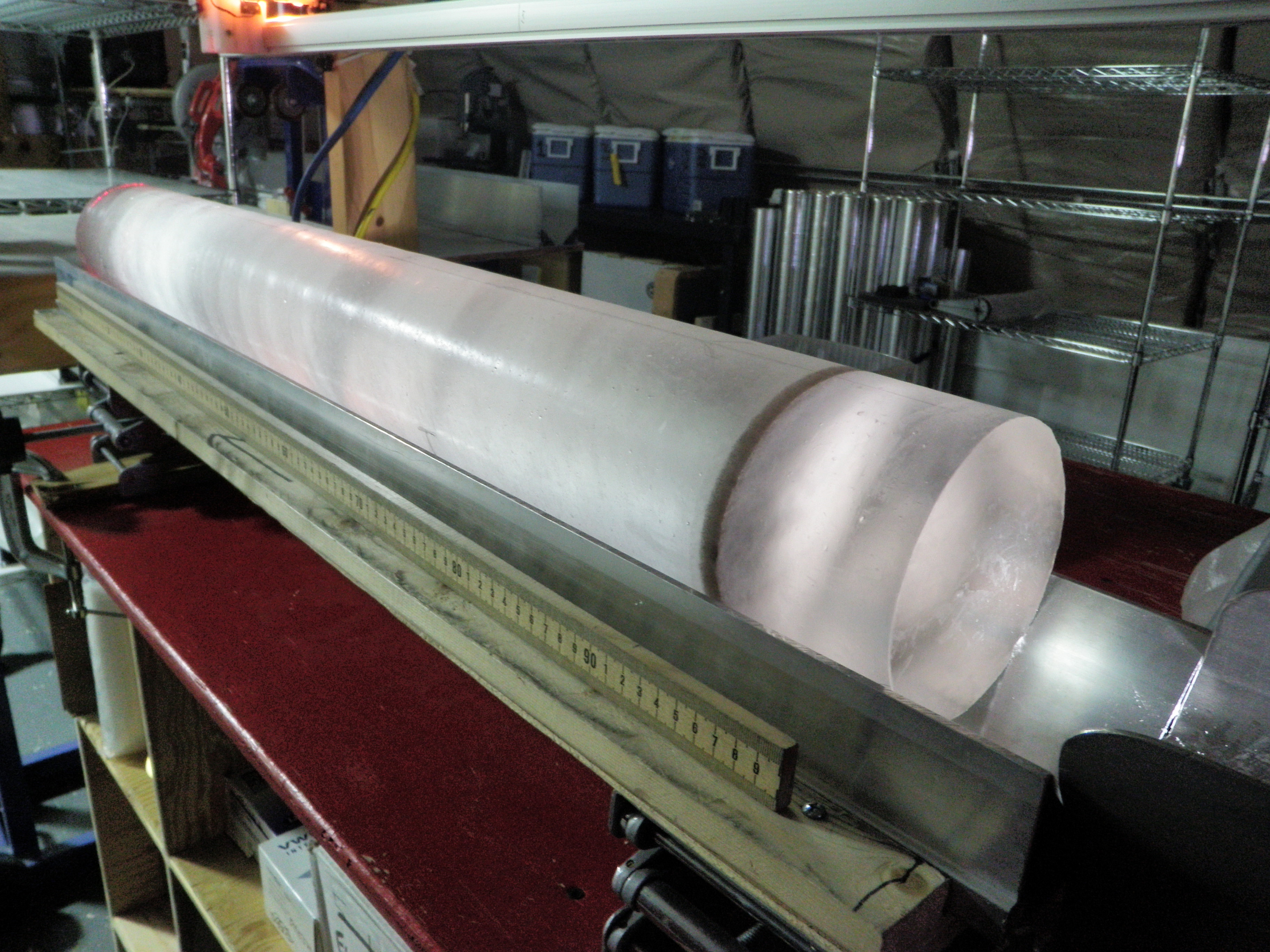
Glaciers grow as snow falls in layers that are slowly compacted into ice. Over time, this creates a deep glacier, like the Greenland Ice Sheet. These ice sheets stay frozen, preserving a long record of the composition of the snow from which scientists can get a variety of different measurements important for understanding the climate. To do so, long cylinders of ice are drilled and collected. From here, trapped air bubbles can be sampled to determine the composition of the atmosphere at the time the ice was formed. This can tell us, for example, what the concentration of carbon dioxide was. Similar to the ocean sediment cores, the air temperature can also be estimated by looking at the molecules that make up the frozen water, in particular, the ratio of oxygen isotopes. Within an ice core, more lighter isotopes indicate colder temperatures. Specific events, like volcanic eruptions can also be seen in these records, which helps determine the age of the ice at different depths in the core.
Quiz Yourself...
Reconstructing our Climate's History: Tree Rings and Pollen Grains
Reconstructing our Climate's History: Tree Rings and Pollen GrainsPrioritize...
When you have finished this page, you should be able to:
- List two other ways climate scientists reconstruct past climate and describe how they work.
Read...
Tree rings
If you've ever looked closely at a tree stump, you’ve likely noticed it grows in a pattern of concentric rings. These rings represent the tree's seasonal growth, with each one marking another year of the tree’s life. By counting these rings, scientists can determine the age of the tree—sort of like reading the chapters of a well-preserved book. But these rings tell more than just the tree’s age; they also provide insights into the climate conditions in which the tree grew. The width, color, and even the density of each ring can reveal if the tree experienced a wet or dry year, a warm growing season, or times of stress due to drought. In this way, trees act like natural climate historians, recording information about past environments.
What’s more, scientists can match tree ring data to modern climate records, allowing them to calibrate the patterns in tree rings with actual weather conditions. This process helps researchers reconstruct detailed climate histories, sometimes going back hundreds or even thousands of years. And the best part? These ancient trees don’t need to be cut down for us to access this information. Using a tool called a tree corer, scientists can carefully extract a small cylinder of wood from the tree without harming it (the tree eventually fills that wood back in). This allows the tree to continue growing while still providing scientists with a rich climate record. Win-win!

The NOAA National Centers for Environmental Information (NCEI) manages the International Tree-Ring Data Bank (ITRDB), a global repository of tree ring data. This database contains growth records from over 4,600 locations across six continents, offering insights into historical climate conditions. In addition to living forests, the data include ring patterns from ancient structures and even rare artifacts like Stradivari violins! Scientists use these records to compare tree growth with local weather data, helping to reconstruct climate patterns for hundreds or even thousands of years. These reconstructions provide critical baselines for understanding natural climate variability and assessing human-induced climate change.
Using tree ring data, researchers have pieced together important events in climate history. For example, reconstructions based on tree rings from the American Southwest reveal a prolonged drought in the late 1200s. See the figure below of rainfall anomalies over a 16-year period estimated from tree rings. In particular, note the 13-year period of continuous drought conditions (red areas denoting below-average rainfall from 1276-1289). This drought likely contributed to the abandonment of the Mesa Verde cliff dwellings by the Ancestral Pueblo people.

Pollen Grains
Pollen grains, produced by plants, are another valuable tool for reconstructing past climates. These tiny grains, which are actually the reproductive cells of plants, are often preserved in sediments found in lakes, bogs, and even ocean floors. Different plant species produce pollen with distinct shapes, a bit like each plant having a fingerprint. This allows scientists to identify which plants were present at a given time. Similar to how ice cores are used, scientists pull a core from a sediment layer and analyze the types of pollen in each part of the core. From this, scientists can infer what the local vegetation was like, which in turn reflects the climate. For example, an abundance of tree pollen might suggest a warm, temperate climate, whereas a higher concentration of grass pollen might indicate cooler, drier conditions. As for tree rings, this method is also non-destructive, meaning samples can be collected without disturbing the environment, and it provides an essential link between climate and the biosphere during periods long before humans walked the Earth.

Quiz Yourself...
Reconstructing our Climate’s History: Old Logs and Written Records
Reconstructing our Climate’s History: Old Logs and Written RecordsPrioritize...
When you have finished this page, you should be able to:
- List one more way scientists can reconstruct past climate without direct observations.
- Explain how these tools for climate reconstruction can be added together to teach us that the climate has varied significantly in the distant past.
Read...
Old Logs and Written Records
I want to touch on one more source of climate data, albeit one that isn't technically a proxy. Before the advent of modern meteorological instruments, early observers meticulously recorded weather conditions in logs, diaries, and other written records. Ship captains, for instance, often noted wind patterns, sea ice, and weather events during their voyages across the world’s oceans. Handwritten records from explorers, farmers, and even monks often contain detailed accounts of temperature, rainfall, and unusual events such as droughts, floods, or frosts. For instance, ship logs from the 18th and 19th centuries have been used to reconstruct historical sea ice extent in the Arctic and Antarctic. Likewise, personal diaries from farmers have revealed details about crop failures and harsh winters, which can indicate broader climate conditions.
While these observations are certainly not as precise as modern measurements many times they are qualitative, talking about "a great heat wave" instead of providing a numeric temperature they can help us piece together patterns of past climate and weather events, especially when combined with other sources of data, such as the ones above. They can also give us a picture albeit a fuzzy one of trends in extreme weather, like what hurricane landfalls may have looked like around the founding of the United States.

Stitching all of these together, we can get a more complete view of how the temperature of the planet has changed over geological time. The figure below shows estimates of the Earth's temperature from 500 million years ago (on the far left) to the present day (on the far right). We have a more detailed understanding of the temperature the closer we get to the present day, so the tick marks for time are change at each vertical break in the figure, starting with every 100 million years (100,000,000 years) in the first section and ending with every thousand years (1,000 years) on the right.

The color and width of tree rings can provide snapshots of past climate conditions.
From this figure, we can see that the Earth’s temperature has changed drastically over the course of geological time. Within this period, many changes occurred: the continents changed positions, volcanic activity ramped up and ramped down, and the atmosphere had different amounts of carbon dioxide. In general, periods that are very warm over the Earth’s history are ones where the carbon dioxide is higher. Over the past 11 thousand years the Earth’s temperature has been relatively constant, allowing humans to thrive. This is the case until very recently, when an increase in carbon dioxide created by people has led to a quick increase in temperature that is projected to continue, as depicted by the red dots representing projected temperatures for 2050 and 2100. Remember, the scale on the bottom is changing with each break. Although the Earth has been as warm as we are projecting it to become, it has never happened this quickly or when humans have been able to thrive.
Quiz Yourself...
Why Earth's Orbit Matters
Why Earth's Orbit MattersPrioritize...
When you have finished this page, you should be able to:
- Define the three main orbital cycles of the Earth: tilt (a.k.a. obliquity), wobble (a.k.a. precession), and ellipticity (a.k.a. eccentricity).
- For each of the three orbital parameters, describe how they impact the amount of solar radiation that hits the Earth.
Read...
Way back in Lesson 3, we talked about how solar radiation from the Sun strikes the Earth differently in different seasons. For Northern Hemisphere summer, the Earth's north pole tilted toward the Sun and vice versa for the winter. This is why we have longer days in summer than in winter. The geometry of Earth's annual orbit around the Sun changes slowly over time. These changes are subtle, but they are persistent over thousands of years and have a profound impact on climate.
Obliquity
The first of these changes involves the tilt angle (or, more technically, the obliquity) of Earth's axis relative to its orbital plane. Today, the Earth's rotational axis is inclined at an angle roughly 23.5 degrees from the vertical to the orbital plane. This is why the tropics are located between 23.5°N and 23.5°S and why the Arctic and Antarctic circles are poleward 66.5°N and 66.5°S (90°-23.5°=66.5°), respectively. This angle of inclination is not fixed over time, however, and it varies between roughly 22.1 degrees and 24.3 degrees. Seasonality only exists because of the tilt; if not for the tilt, neither hemisphere would be preferentially tilted toward the Sun at any time of the year. Therefore, periods, when the tilt angle is greatest, are periods of heightened seasonality, while periods, when the tilt angle is smallest, have reduced seasonality. It takes roughly 41 thousand years (41,000 years) for the tilt angle to go through one full cycle of alternation between minimum and maximum values of the obliquity.
Video: Changes in Obliquity (Tilt) (:01) (No Audio)
Wobble
The second of these orbital variations involves the slow wobble (or, to use the more technical term, the precession) of the Earth's rotational axis. This is analogous to the wobbling of a gyroscope. One full wobble takes roughly 19-23 thousand years (19,000-23,000 years). The precession determines when the Northern and Southern Hemispheres are each tilted toward (summer) or away (winter) from the Sun.
Video: Axial Precession (Wobble) (:04) (No Audio)
The primary importance of this factor is that it determines whether the summer solstice in each hemisphere occurs when Earth is farthest (making summer a little cooler) or closest (making summer a little warmer) to the Sun. This factor only matters, then, because Earth's annual orbit around the Sun is not circular but slightly elliptical – which brings us to our last factor.
Eccentricity
The last of Earth's changing orbital parameters involves the ellipticity (or, to use the more technical term, the eccentricity) of the orbit. Another way to think about this in non-technical terms is the "ovalness" of Earth's path around the Sun. Earth's orbit is not circular but, instead, is slightly elliptical. The degree of ellipticity is measured by the eccentricity, which ranges from roughly zero (an essentially circular orbit) to a maximum of roughly 4% (a slightly elliptical orbit). It takes roughly 100 thousand years (100,000 years) for the eccentricity to go through one full cycle of alternation between low and high eccentricity.
Video: Changes in Eccentricity (Orbit Shape) (:07) (No Audio)
These orbital cycles were first discovered by a mathematician named Milutin Milankovitch. Recreating past and future values of these orbital parameters is straightforward using celestial mechanics (a branch of astronomy that deals with motions of objects in outer space) and Milankovitch did these calculations by hand back in the early 1900’s.
The most important part of these orbital parameters is that they impact where solar radiation hits the Earth. Based on his calculations, Milankovitch theorized that the amount of solar radiation hitting the Northern Hemisphere could swing by 20% depending on the relative phases of these cycles. This has significant impacts on the climate system. In the next section, we will discuss how these can lead to large swings in the Earth’s temperature during glacial-interglacial periods.
Let's review these three important concepts. Think about what they mean -- if you can't define it in your head, click to expand and make sure "you hammer it home!"
- Obliquity (Tilt)
This refers to the angle between Earth's rotational axis and the vertical to its orbital plane around the Sun. Earth's tilt changes slightly over a cycle of about 41,000 years, varying between approximately 22.1° and 24.5°. Changes in obliquity affect the severity of the seasons: a greater tilt means more extreme seasons (hotter summers and colder winters), while a smaller tilt leads to milder seasons.
- Precession (Wobble)
Precession is the slow wobble of Earth's rotational axis, similar to the wobbling of a spinning top. This wobble occurs over a cycle of roughly 19,000 to 23,000 years. Precession alters the timing of when each hemisphere is tilted toward or away from the Sun, affecting the timing of the seasons in relation to Earth's position in its orbit.
- Eccentricity (Ellipticity)
Eccentricity describes the shape of Earth's orbit around the Sun, which changes from being more circular to more elliptical over a cycle of about 100,000 years. When the orbit is more elliptical, the distance between Earth and the Sun varies more throughout the year, influencing the amount of solar energy Earth receives and impacting long-term climate patterns.
Quiz Yourself...
Glaciers? Or No Glaciers?
Glaciers? Or No Glaciers?Prioritize...
When you have finished this page, you should also be able to
- Explain how the orbital cycles discussed in the previous section can lead to large regular swings in the Earth’s temperature between glacial and interglacial periods.
- Define the ice-albedo feedback.
Read...
Glacial-Interglacial Periods
If you had an eagle eye, you might have noticed on the first page of this lesson that the planet's temperature has experienced large regular swings over the past 500,000 years. See the zoomed-in figure below, where the blue and green lines are temperature reconstructions from ice core data in Greenland and northern Russia, respectively. These large swings are called glacial-interglacial cycles. Looking at the time between each peak in temperature, you will see that these cycles occur roughly every 100,000 years. Why do these oscillations occur? Why do they have a regular period of 100,000 years? What explains their “sawtooth-like" shape where the temperature increases rapidly and then decreases slowly? These are all good questions -- let's see if we can answer them!

The previous section of this lesson taught us about three orbital cycles that occur on long timescales (protip: you should pause here and test yourself to see if you can list the three!). The eccentricity of Earth’s orbit, in particular, operates with a period of 100,000 years. This sounds suspiciously like it could be related to the glacial-interglacial cycles! The question is how?
First, let’s think about how these three orbital parameters alter where and when solar radiation hits Earth. In short, we have stronger seasonality when Earth is more tilted, and when precession causes Earth’s Northern Hemisphere to tilt toward the Sun (summer) at a point when it is closer to the Sun. Think about it: when Earth’s axis is tilted more, the poles experience more extreme seasonal differences. If, during this time, Earth is also farther away from the Sun during Northern Hemisphere summer due to precession, summers—while still warmer than winter—become less hot. These impacts are amplified when the eccentricity of the orbit is greater—that is, their role is "turned up" the more oval-shaped Earth's orbit becomes.
When summers are cooler in the Northern Hemisphere due to a combination of these factors, snow and ice are less likely to melt fully. So, what role does ice play in all of this? Excellent question—we need to explore another (very) important feedback in the climate system.
Ice-Albedo Feedback
Let’s dive deeper into the ice-albedo feedback, a process that can amplify the impact of the orbital parameters we’ve just discussed. Remember when we talked about solar radiation earlier in this class? That’s where we first encountered the concept of albedo. To refresh your memory: albedo is a measure of how much sunlight a surface reflects. Snow and ice have a high albedo, meaning they are excellent at reflecting incoming sunlight back into space, which helps keep the surface cool. In contrast, the ocean or land beneath the snow and ice has a much lower albedo, meaning these surfaces absorb more sunlight, which warms the surface.
Now, let’s consider what happens when there’s less ice than usual. In this scenario, more of the low-albedo ocean or land would be exposed, causing more sunlight to be absorbed rather than reflected. More absorption of solar radiation means more "energy in" and a warmer surface. This additional warmth would melt even more snow and ice. As the ice melts, the exposed surface area with low albedo increases, which leads to even more absorption of solar energy. This results in further warming, which melts more ice, and the cycle continues.
Experiment:
In many northern areas of the United States, homeowners who heat their homes with wood often spread dark ash over snow and ice-covered driveways. This not only helps with traction for vehicles but also accelerates the melting process by exposing the underlying darker surface. It's the same concept at play as the ice-albedo feedback! You can try a mini version of this experiment yourself—sprinkle some dark material (like ash from a fireplace or charcoal grill) onto a small patch of snow-covered asphalt and -- once the sun comes out -- observe how much faster it melts compared to the untouched snow!
This process is an example of what we call a positive feedback. Essentially, an initial change (in this case, less ice) triggers a series of events that reinforce and amplify the original change.
The ice-albedo feedback is a powerful mechanism in the climate system. It’s one of the reasons why relatively small changes in Earth's orbital parameters can lead to such dramatic shifts in global temperatures during glacial and interglacial periods. The more ice melts, the more the Earth warms, and vice versa. This feedback loop plays a key role in amplifying the natural variability introduced by the orbital cycles.
Think About It...
Quiz Yourself...
How to Build an Ice Age
How to Build an Ice AgePrioritize...
When you have finished this page, you should also be able to
- Explain how orbital parameters and the ice-albedo feedback can "combine" to create ice ages
Read...
Ready to add another recipe to your book? Let's write "How to make an ice age."
Let's put the two concepts we just learned together. Roughly every 100,000 years, the eccentricity of Earth's orbit reaches a high value, creating the largest possible differences in Earth-Sun distance over the course of the year. During these times, there's a point in the much faster 19,000-23,000 year precession cycle when Earth is tilted toward the Sun at its closest approach. This makes summers exceptionally warm and winters unusually cold. This effect is further amplified when the obliquity (tilt of Earth's axis) is at its maximum. We focus on the Northern Hemisphere because there's more landmass, allowing snow and ice to form further south. Typically, winter temperatures are cold enough to maintain ice, but very warm summers lead to rapid melting of snow and ice.
In the figure below, we can see the three orbital parameters—precession, obliquity, and eccentricity—plotted over time. Notice how these cycles oscillate at different frequencies: precession is the fastest, followed by obliquity, with eccentricity being the slowest. Also shown in this figure is the summer Northern Hemisphere insolation (solar radiation received at 65°N). If you look very closely, you'll see how this insolation pattern is linked to the orbital cycles: broad changes every 100,000 years from eccentricity, with smaller, faster changes from precession and obliquity. Lastly, the ice core temperature record offers a glimpse into Earth's past climate, where you can clearly see the sawtooth pattern of glacial-interglacial cycles, occurring roughly every 100,000 years.
Let's focus on one glacial-interglacial cycle in particular. First, note that in this graph, time progresses to the left, opposite to what we've usually seen -- there's nothing wrong with this, but you need to flip your brain to think "hey, the present day is on the very left of this plot." Starting at point A, we see a period of very cold temperatures—an ice age—followed by a rapid increase in temperature. This warming coincides with an increase in Northern Hemisphere summer insolation at 65°N, along with a rise in eccentricity and high obliquity and precession values. As described earlier, this combination of factors—greater eccentricity amplifying the effects of precession and obliquity—leads to warmer summers that quickly melt ice, triggering a positive feedback loop that pulls Earth out of the ice age.
At point B, both precession and obliquity are in their negative phases, and eccentricity begins to decrease. This reduces solar radiation at 65°N, leading to warmer winters and cooler summers in the Northern Hemisphere. These conditions are perfect for growing ice sheets: warmer winters allow for more snowfall (since warmer air holds more moisture), and cooler summers prevent accumulated snow from melting. Ice begins to build up, reflecting more solar radiation back to space and causing cooling to spread southward. This is how a glacial period slowly takes hold, lasting tens of thousands of years. The sawtooth pattern of Earth's temperature comes from the fact that melting ice happens faster than its accumulation, leading to quicker warming followed by slower cooling.


Let’s return to the full reconstruction of Earth’s climate history that we looked at earlier (I’ve copied it below—trust me, you’ve seen it before!). You might notice something interesting: these ice ages didn’t start showing up until about 700,000 years ago (the wobbles beginning in the fourth panel). Why weren't there more ice ages in the earlier panels? The mechanism we discussed for glacial-interglacial cycles relies on the formation of large ice sheets, and scientists think that the climate just wasn’t cool enough yet to allow for that. While we can’t say for certain, the leading theory is that the planet needed to cross a cooling threshold for large ice sheets to form. This gradual cooling is thought to have been driven by a slow decline in carbon dioxide concentrations over millions of years. In other words, during the time of the dinosaurs, for example, the planet was simply too warm for the ice-albedo feedback to kick in. Eventually, as the Earth continued to cool with age, it reached that critical point, allowing the 100,000-year cycles we see in blue below (and in the figures above) to begin.
The glacial-interglacial cycles we observe, driven by Earth's orbital changes and amplified by feedback loops like ice-albedo, have only become prominent in the last 700,000 years as the planet's temperature gradually dipped, allowing large ice sheets to form and trigger these dramatic climate shifts. Pretty "cool!"
Quiz Yourself...
Solar Variability and Sunspots
Solar Variability and SunspotsPrioritize...
On this page, you will learn:
- Define sunspots and faculae, and explain how sunspots can change how much energy the sun emits in the short-term
- Explain how sunspots relate to solar radiation and their relative importance in forcing the Earth’s climate.
Read...
As we've learned, the sun is our primary source of energy. While it's incredibly consistent to the point where we actually define the amount of energy coming into the climate system as the solar constant there are tiny fluctuations in the amount of energy it releases. One of the most intriguing features related to these variations is sunspots—dark blotches or patches on the Sun’s surface that have been observed by humans for centuries. In fact, sunspots were regularly reported in Chinese literature as far back as the 4th century. In 1609, Galileo, with his newly invented telescope, was able to observe them in greater detail, documenting their presence by counting the number of visible spots. Now I should note that you should never (ever!) stare directly into the sun! However, before we talk about the science behind sunspots and their impact on the climate, here's a way you can observe the sun if you want to go sunspot hunting right now or maybe after you finish this lesson!
Explore Further...
You can easily observe the sun safely by using a simple and inexpensive device called a "pinhole camera." All you need are a few basic materials and some sunshine. Here’s what you’ll need:
- 2 sheets of stiff white paper
- (Optional) a sheet of aluminum foil
- A pin
- A sunny day
First, take one of the sheets of paper and carefully punch a small hole in the center using the pin. The example below makes this a bit easier by cutting a square out of your paper, taping some aluminum foil over that square, then pricking a hole in the foil. In both cases, this is going to be your lens. Head outside and hold the paper up, aiming the hole at the Sun—just be sure not to look directly at the Sun through the hole (or in any other way!). Next, use the second sheet of paper to act as a screen. Move it back and forth until the image of the Sun coming through the hole looks clear. What you’re seeing isn’t just a dot of light—it’s actually a tiny image of the Sun projected through that pinhole!

Now for some fun experiments: try making the hole larger or smaller and see how that changes the image. Or imagine this what if you punched a thousand tiny holes in the paper and placed little lenses in front of each one? You’d get a super-bright, sharp image as all the individual solar images would converge. In fact, optical telescopes work on a similar principle, combining light from countless tiny points into a single focused image.
If you’re feeling creative, you can even upgrade your pinhole camera. Add a stand to hold the paper, use a screen for better projection, or go all out and turn it into an actual camera by adding film. There’s plenty of inspiration out there — perform an internet search for "pinhole camera" for ideas to take it to the next level!
If you are persistent, you'll be able to see sunspots (at least large ones) with the above method! So, what exactly are sunspots?
Sunspots
Sunspots are dark patches on the Sun’s surface that appear cooler and emit less solar radiation than the surrounding areas. Though they may last anywhere from a day to several months, they are constantly changing and shifting. Their size can vary dramatically, ranging from about 100 kilometers to a staggering 10,000 kilometers—larger than the Earth! At any given moment, only about 0.0 to 0.1% of the Sun's visible surface from Earth is covered by sunspots. These spots form due to disturbances in the Sun’s magnetic field, disrupting the normal flow of energy.
In the figure below, we have images of the Sun’s surface taken on two different days—April 29, 2002, and April 29, 2009. The visible light images (which represent what we’d see with our own eyes) show a stark difference in the number of sunspots for the two days. On April 29, 2002, you can spot a large number of sunspots as dark spots scattered across the Sun, while on April 29, 2009, no fewer sunspots are apparent. If you look at the ultraviolet images, you’ll also notice something else—bright regions surrounding the sunspots. These are called faculae. The word "faculae" is borrowed from the Latin for "little torch." While sunspots emit about 15% less solar radiation, the faculae around them are actually more intense, releasing 25% more solar radiation. So, even though sunspots themselves are darker and cooler, the existence of these faculae can actually lead to an overall increase in the amount of solar energy reaching Earth when more sunspots are present!

Total Solar Irradiance (TSI)
The existence of sunspots tweak the amount of energy the Earth recieves from the sun -- what does that mean for us? Thanks to the advent of satellite measurements, we can now directly measure the Sun’s energy output—this is known as the total solar irradiance, or TSI for short. Earth-orbiting satellites are equipped with extremely precise instruments capable of detecting even small changes in TSI. However, these measurements aren’t always perfectly accurate, and the average values of TSI can vary between satellites. To address this, scientists adjust the data, stitching together measurements from multiple satellites to create a continuous and reliable record.
In the figure below, you’ll find TSI measurements from various satellites over the past few decades, alongside the number of sunspots. The two data sets correspond remarkably well—when we see an increase in sunspots, there’s a corresponding rise in solar radiation, and when sunspots are few, the TSI dips. By leveraging this relationship between sunspot numbers and TSI, scientists can actually reconstruct fluctuations in solar radiation going all the way back to the 1600s. This long-term reconstruction works similarly to how scientists reconstruct Earth’s temperature record, as we discussed earlier in this section, giving us deeper insights into how the Sun’s variability affects our climate over centuries.
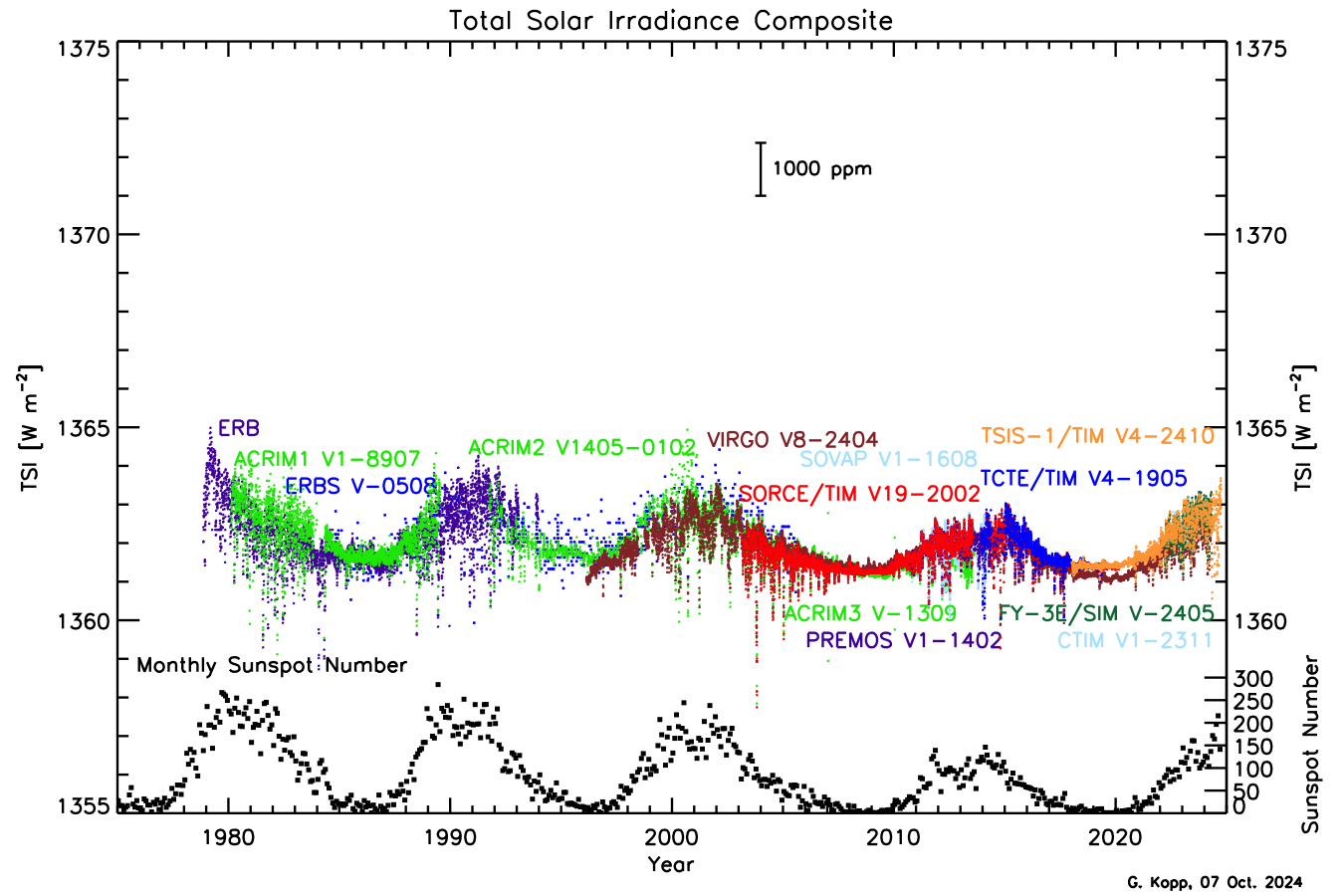
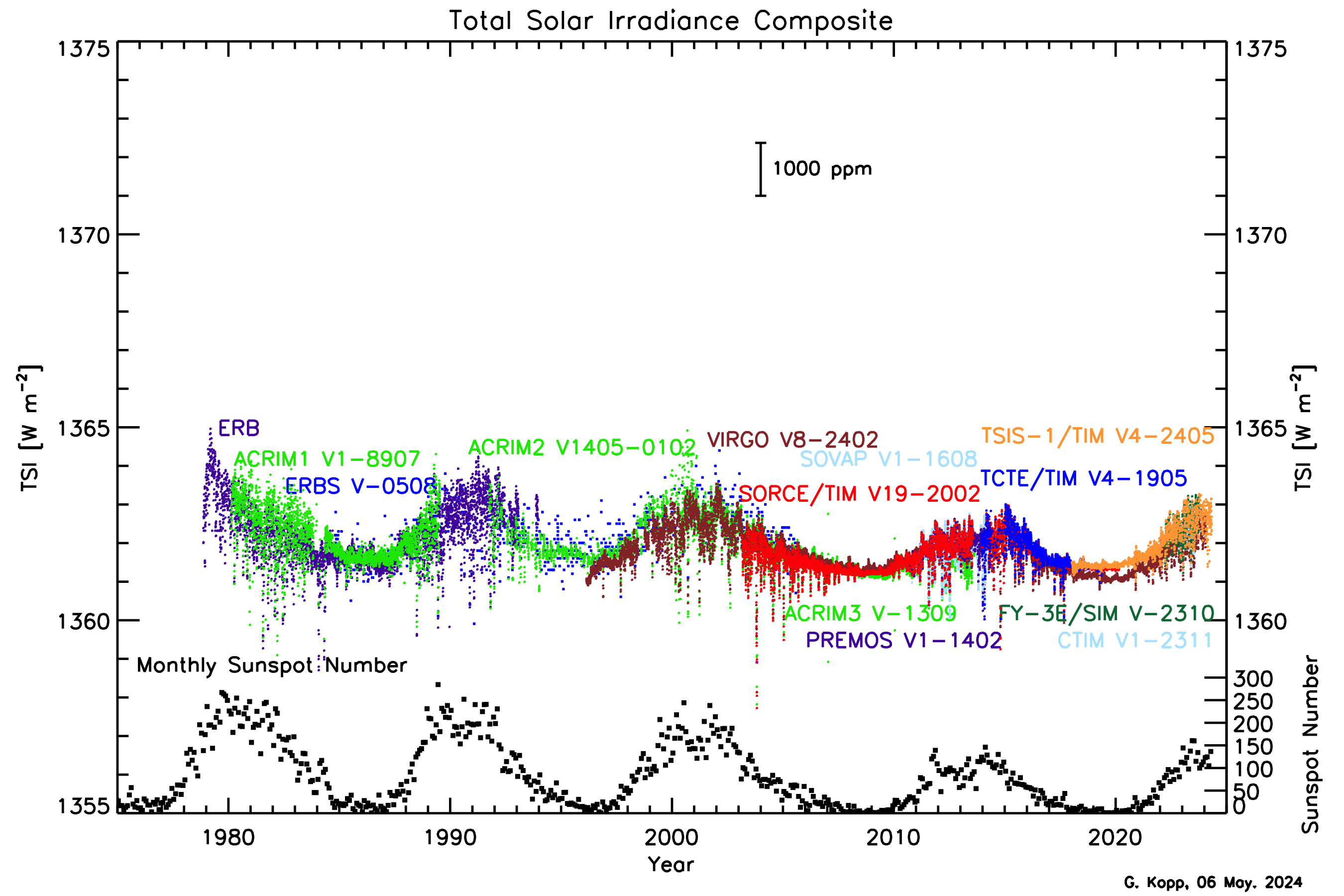
In the figure above, you’ll notice a regular cycle in both TSI and sunspots, which occurs roughly every 11 years. The total amount of radiation the Earth receives from the Sun varies by about 0.1% between the high and low points of these cycles. If we take a longer view looking at sunspot numbers as far back as the 1600s in the figure below - we can see that these cycles have been repeating for a long time. In addition to the 11-year cycles, there are longer term fluctuations that occur over 80-90 years, known as Gleissberg cycles. Sunspot activity tends to be relatively low during certain periods, such as the early 1800s, early 1900s, and early 2000s, with higher activity occurring in between.
One particularly notable feature of the sunspot record is the pronounced absence of sunspots from 1650 to 1715, a period known as the Maunder Minimum. This era, named after British astronomers Edward and Annie Maunder, represents a time when the Sun's activity was unusually low. During this period, global temperatures were also lower, especially in the Northern Hemisphere, contributing to what is often called the "Little Ice Age." This wasn't a true ice age like we previously discussed, but it was a time marked by colder winters and significant climatic shifts in Europe and North America. Although the exact cause of this diminished solar activity remains a mystery, recent research by astronomers from Penn State (led by undergraduate-at-the-time Anna Baum!) has uncovered evidence of a similar phenomenon occurring in another star, offering intriguing clues about these solar mysteries.

Now, I want to stress that while the amount of radiation the Earth receives from the sun does change, this variability plays a relatively minor role in influencing the Earth's temperature. A quick back-of-the-envelope calculation on the effect of fluctuations in TSI (which I won't make you do, but meteorology majors study!) shows that the impact on the planet’s surface temperature is less than 0.1°C. Furthermore, we’ve been in a period of declining fluctuations in solar activity since the 1950s. These variations are also accounted for in climate models, where we can confirm that they play a minor role in driving changes in the Earth's temperature compared to other factors like greenhouse gas concentrations. So, when talking heads say, "climate change is just a bunch of sunspot cycles," they aren't totally wrong, but observed changes in the sun are a drop in the bucket compared to the temperature changes we are currently observing and expect to observe in the future.
Quiz Yourself...
The Faint Young Sun Paradox
The Faint Young Sun ParadoxPrioritize...
After completing this page, you will be able to:
- Define the Faint Young Sun Paradox
- How scientists hypothesize the Earth stayed warm enough to support life despite a weaker young Sun.
Read...
Hopefully, I’ve convinced you that ongoing changes in the Sun’s output are relatively small (at least during human history). But before we move on, I want to point out something strange: scientists have discovered that when Earth first formed about 4.5 billion years ago, the Sun was much fainter than it is today. In fact, astrophysical models tell us that the Sun’s energy output was about 30% lower back then!
Check out the graph below. It shows the time-series of luminosity (i.e., emitted energy), radius, and temperature of the Sun over the past 4.6 billion years of its life—and it projects another 7 or so billion years into the future. The values on the y-axis are all normalized to present-day values, meaning a radius of 1.2 would mean the Sun is 20% larger than it is today. I want to emphasize that the x-axis is in billions of years, so all of human history is constrained to that small point where all three lines cross 1.0. (None of us will be around—barring some serious medical breakthroughs—to experience much beyond that!)

If you’ve taken an astronomy class, you might have learned that the Sun is continually growing larger (as this graph shows!). But for this class, we’re just focused on energy, so pay attention to the luminosity (the red curve). For the first two billion years of Earth’s life (note, Earth formed about 60 million years after the Sun’s birth), the energy the Sun output was less than 80% of what it is today. This means early Earth should have been much colder—so cold, in fact, that it should have been frozen solid. Yet, we know from the proxy records we’ve discussed that liquid water existed on the surface, and life was already starting to take hold. In fact, things were quite warm!
This puzzle is known as the Faint Young Sun Paradox—how did Earth stay warm enough to support life when the Sun wasn’t as bright? Astronomers Carl Sagan (you have probably heard of him, or at least heard of "The Pale Blue Dot") and George Mullen first raised this question in 1972. So, what could have kept Earth warm enough to sustain liquid water and life? Scientists aren’t 100% sure, but the most widely accepted theory involves greenhouse gases.
When Sagan and Mullen first introduced the Faint Young Sun Paradox, they suggested that high concentrations of ammonia gas (NH₃) could have been responsible for keeping Earth warm. We haven’t talked much about ammonia because—well—there isn’t much of it in the atmosphere today! But it is an effective greenhouse gas, meaning it can trap heat in the atmosphere, much like carbon dioxide (CO₂). However, there’s a catch: ammonia is easily destroyed by sunlight. Once exposed to ultraviolet radiation, it breaks down into nitrogen (N₂) and hydrogen (H₂) gases, which don’t trap heat as effectively. Although Sagan later suggested that a photochemical haze might have shielded ammonia from destruction, research eventually showed that this idea wasn’t plausible—the haze itself would have cooled Earth’s surface, counteracting any warming from ammonia. I mention this to highlight that even the most brilliant scientists aren’t always right!
Greenhouse gases to the rescue?
So, if ammonia couldn’t do the job, what could? Most scientists now agree the answer is carbon dioxide. Remember when we first introduced the greenhouse effect? We explained that carbon dioxide is a potent greenhouse gas, and we’ll dive deeper into that next lesson. For now, the key takeaway is simple: more greenhouse gases = a warmer planet! CO₂ levels in Earth’s early atmosphere were likely much higher than they are today.
Scientists have used models to estimate how much CO₂ would have been needed to keep Earth warm enough for liquid water during the Faint Young Sun period. These models suggest CO₂ concentrations could have been up to 1,000 times higher than present-day levels. Trust me, that’s a lot of carbon dioxide! This “supercharged” greenhouse effect would have compensated for the Sun’s dimmer output, allowing Earth to remain warm enough for water—and life—to exist.
The figure below shows this tradeoff over time. In the early part of Earth’s history (on the left side of the graph), solar energy (brown curve) was much lower, but CO₂ concentrations (blue curve) were sky-high. As we move forward in time (left to right), the Sun’s brightness increased while CO₂ levels dropped—without this balance, Earth would have become too hot for life as we know it.

But carbon dioxide wasn’t the only greenhouse gas at play. There’s also evidence that methane (CH₄), another potent greenhouse gas we’ll discuss soon, played a crucial role. Early Earth was home to a variety of microbes—single-celled organisms—that produced methane as a byproduct of their metabolism. These microbes were anaerobic, meaning they didn’t require oxygen to survive. In the oxygen-poor atmosphere of the time, they thrived, and their methane emissions could have significantly contributed to warming the planet.
In the early 2010s, scientists analyzing ancient marine sediments found clues suggesting methane worked alongside CO₂ to keep early Earth warm. By pulling out ocean sediment cores, they discovered certain iron-rich minerals that coexisted during the early part of Earth’s history. This hinted at a balance between CO₂ and hydrogen (H₂) in the atmosphere, with methane playing a key role. Methane is far more effective at trapping heat than CO₂, so even small amounts could have had a big impact on global temperatures.
Why is this important?
The Faint Young Sun Paradox doesn’t just teach us about Earth’s distant past—it also highlights the incredible power of greenhouse gases. Even small changes in CO₂ and methane levels can dramatically impact the planet’s temperature. In other words, the lesson of the Faint Young Sun Paradox is clear: greenhouse gases matter—a lot! In fact, our planet has fundamentally relied on the balance between energy from the Sun and the Earth’s atmosphere to sustain life. If we could snap our fingers and put as much CO₂ into the atmosphere as there was during the early Earth’s history, we’d fry like an egg (well, eggs wouldn’t exist, I suppose…)


William Shakespeare once wrote in The Tempest, “What’s past is prologue.” He used the quote in the context of fate, suggesting that everything leading up to the present shapes what happens next. But we can also apply this to climate: history sets the stage for our present and future. Understanding the role of greenhouse gases in Earth’s climate system, both past and present, is key to anticipating the future of our planet.
Quiz Yourself...
Volcanic Activity
Volcanic ActivityPrioritize...
After reading this page, you should be able to:
- Explain how volcanic eruptions can impact the Earth’s climate.
- Recognize when you see a rapid cooling and a gradual recovery in the Earth’s temperature record, you might suspect a violent volcanic eruption occurred at this time.
Read...
On June 15, 1991, Mount Pinatubo in the Philippines erupted in one of the most powerful volcanic events in recorded human history. In fact, it was the second-largest eruption of that century. Fortunately, there were warning signs before the eruption, and thanks to accurate forecasts from the Philippine Institute of Volcanology and Seismology and the U.S. Geological Survey, evacuation orders were issued in time. This likely saved more than 5,000 lives in the densely populated area around the volcano. When we think of volcanic eruptions, we often picture towering ash clouds, avalanches, and rivers of molten lava. But have you ever considered how such eruptions could affect the Earth's climate?

How Volcanos Impact the Earth's Climate
When a volcano erupts, it releases more than just dramatic ash clouds (see above) and lava flows—it also sends ash, dust, and gases high into the atmosphere. Heavier particles, like ash and fine rock, fall back to Earth relatively quickly, settling on the ground nearby. However, the smallest particles, especially those released in the most violent eruptions, can be injected high into the atmosphere and remain there for months, sometimes even longer. These fine particles, often in the form of aerosols, are carried by global winds, spreading around the Earth.
But that’s not all volcanoes release. Along with ash and dust, they emit a variety of gases, including water vapor, carbon dioxide (CO2), and sulfur dioxide (SO2). While water vapor and carbon dioxide are both well-known greenhouse gases that trap heat and contribute to warming the Earth’s surface, their effect from individual volcanic eruptions is actually quite small compared to human-driven emissions. Early in Earth’s history, when volcanic activity was much more frequent, these gases played a bigger role in shaping the planet’s climate. Today, however, the amount of carbon dioxide released during eruptions is minimal compared to the vast quantities emitted by human activities such as burning fossil fuels -- essentially just a rounding error in the carbon budget we'll talk about in the next lesson.

Sulfur Dioxide (S02)
Sulfur dioxide (SO₂), on the other hand, is particularly important. It plays a crucial role when it comes to volcanic impacts on the climate. When a volcano erupts, vast amounts of SO₂ can be ejected into the stratosphere. This is the atmospheric layer above the troposphere—well beyond where commercial airplanes fly. In the troposphere, rain can wash out particles fairly quickly, but in the stratosphere, where there is much (much) less condensed water, SO₂ can linger for months or even years. Once in the stratosphere, SO₂ reacts with the small amount of water vapor present to form sulfuric acid (H₂SO₄) aerosols. These tiny particles act like mirrors, scattering and reflecting incoming solar radiation away from the Earth’s surface, effectively increasing the planet’s albedo (I wasn't kidding when I said you'll see that word a lot in this class!). This reflection of sunlight causes a cooling effect on the Earth's surface, and after major volcanic eruptions, we can often observe noticeable dips in global temperatures. Scientists measure the amount of sunlight blocked by these aerosols using a metric called aerosol optical depth. This metric, commonly abbreviated AOD, is a gauge of how much sunlight is being scattered by particles in a given "column" of atmosphere.
The most violent eruptions can significantly impact the Earth’s climate, leading to rapid cooling followed by a slow recovery. The figure below shows notable volcanic eruptions over the past 150 years. What I've actually plotted is the stratospheric aerosol optical depth -- high values mean there are more particles in the stratosphere. Note the very strong linkage between when you see spikes in the data and volcanic eruptions, telling us that when we have lots of aerosols in the stratosphere, they were thrown up there by a big volcano.

Since these aerosols can increase planetary albedo, they can reduce sunlight reaching the surface and temporarily cool the planet. Historical temperature records reveal clear drops in global mean temperatures that align with major volcanic events. These cooling periods can last several years as the aerosols slowly dissipate from the atmosphere and the climate gradually returns to its previous state. The strongest volcanos may cool the planet up to 1°C, which is 10x more than the variability from sunspots we learned about! But I should emphasize that these effects are transient -- once all the aerosols "fall out" of the atmosphere, it's like the volcano no longer exists, so they don't do anything to stop or reverse long-term trends. While volcanic cooling is a natural process, it underscores the Earth’s sensitivity to changes in atmospheric composition, even for relatively short periods.
Quiz Yourself...
Summary
SummaryRead...
Summary
What did we learn?
- Climate proxies are natural recorders of past climate, helping scientists reconstruct conditions long before modern instruments existed. Key proxies include:
- Ocean and lake sediments: Layers of sediment provide clues about past water temperatures and ice coverage.
- Ice cores: These trap ancient air bubbles, revealing past greenhouse gas levels and precipitation patterns.
- Tree rings: The width and density of rings reflect yearly climate conditions like temperature and rainfall.
- Pollen grains: Found in sediments, they indicate the types of plants present, which helps infer past climate conditions.
- Proxies tell us that the Earth’s temperature has varied significantly over its 4.5 billion year lifespan.
- Orbital parameters are long-term cycles that influence Earth's climate by changing how much sunlight reaches different parts of the planet:
- Obliquity (tilt): The angle of Earth's axial tilt changes over a 41,000-year cycle, affecting the intensity of seasons. Greater tilt leads to more extreme seasonal differences, while a smaller tilt reduces seasonality.
- Precession (wobble): Earth’s axis wobbles like a spinning top, altering the timing of seasons relative to Earth's position in its orbit. This cycle takes about 19,000 to 23,000 years.
- Eccentricity (orbit shape): Earth’s orbit changes from more circular to slightly elliptical over a 100,000-year cycle, impacting the distance between Earth and the Sun, contributing to glacial-interglacial cycles.
- Ice-Albedo Feedback: A positive feedback loop where ice and snow reflect sunlight, cooling the Earth. As the planet cools, more ice forms, increasing reflectivity and further lowering temperatures. Conversely, when ice melts, less sunlight is reflected, warming the planet and accelerating ice loss. This feedback plays a crucial role in amplifying temperature changes during glacial and interglacial periods.
- Sunspots: Dark, cooler areas on the Sun’s surface that appear in cycles, typically every 11 years. While sunspots emit less energy, the surrounding areas (faculae) emit more, leading to slight variations in the Sun’s total energy output. These cycles can influence short-term climate patterns but have a relatively minor impact on long-term global temperatures compared to greenhouse gases.
- We learned about the Faint Young Sun Paradox. Despite the Sun being about 30% dimmer when Earth first formed, the planet remained warm enough to support liquid water and early life. This paradox is likely explained by much higher concentrations of greenhouse gases like carbon dioxide and methane, which trapped more heat and offset the Sun's weaker output.
- Volcanoes: Large volcanic eruptions release sulfur dioxide into the stratosphere, where it forms reflective aerosols that block sunlight and cool the Earth temporarily. These cooling effects can last for several years, with major eruptions like Mount Pinatubo in 1991 causing global temperatures to drop by up to 1°C. However, volcanic impacts are short-term and don't offset long-term warming trends.
Now that we’ve explored the natural processes that influence Earth's climate over time, it’s important to understand how human activities are accelerating climate change. In the next section, we’ll dive into the science behind anthropogenic climate change and examine how greenhouse gas emissions are driving rapid warming in recent decades.