What is climate and what are the climate system components?
What is climate and what are the climate system components?Prioritize...
By the time you are finished reading this page, you should be able to:
- Define climate and differentiate how climate differs from weather
- List the five key components of the Earth’s climate system.
Read...
You are probably most used to thinking about the weather in your day-to-day lives. Should I bring an umbrella to class today? Is it warm enough for me to wear shorts? Can I gamble on that snowstorm cancelling my exam? The term “climate” may imply something completely different than what you see on the 6 p.m. news every night, but they are intricately related, differing in terms of time scale and predictability.
Climate is the “synthesis of the weather in a particular region.” Put another way, “Climate is what you expect ... weather is what you get!
Essentially, we can consider climate as the average outcome of all the weather at a particular location. Imagine you are playing a game like Monopoly that requires two dice. Any single roll of the dice could be something different – a 2, a 6, a 9. But over many, many rolls, a pattern begins to emerge. 2 and 12 happen, but are very rare. 6s, 7s, and 8s keep coming up time and time again. Any single roll of the dice can be thought of as “weather” -- unpredictability factor in the dice roll -- while the the regularity of dice rolls establishes a predictable pattern that informs how frequently those numbers can come up, just as climate does with weather data over decades.
Explore Further...
Take a minute to visit the Dice Roll simulator and try it for yourself.
The climate system (sometimes referred to as “the Earth system”) reflects an interaction between a number of critical pieces, or components. There are five generally accepted components of the climate system.
Atmosphere—This is perhaps the component that springs to mind when we think of “meteorology.” The atmosphere includes everything above the land surface, including the air we breathe and clouds in the sky. The atmosphere is incredibly thin; if we define the top of it using the Karman Line, it is only 100km thick, compared to the Earth’s radius of 6,371 km!
Hydrosphere – As its prefix “hydro” implies, the hydrosphere includes all of Earth's water bodies—oceans, seas, lakes, rivers, groundwater, and even the moisture in the air. Though it covers about 71% of Earth's surface, the average depth of the ocean is about 3,688 meters, which is extremely small relative to our planet’s radius! The hydrosphere is crucial in regulating the Earth's climate, serving as a massive heat reservoir and participating in essential processes like the water cycle and ocean circulation.
Cryosphere – The cryosphere encompasses all the frozen elements of Earth's system, from polar ice caps and glaciers to sea ice and frozen ground. Despite its apparent vastness, the cryosphere represents a relatively small portion of our planet's surface when contrasted with the vastness of the Earth itself. Yet, its presence has a significant impact on our global climate and environment.
Lithosphere - Delving into Earth's solid foundation, the lithosphere encapsulates the planet's rigid outer shell, encompassing the Earth's crust and the uppermost mantle. While it may seem substantial, it's merely a thin veneer when compared to the Earth's overall size, yet it plays a crucial role in shaping our planet's geological features.
Biosphere - The biosphere comprises all living organisms on Earth, from microorganisms to complex ecosystems. It interacts with the lithosphere, hydrosphere, and atmosphere, forming the foundation of life on our planet. In contrast to the planet's overall size, the biosphere exists as a relatively thin layer on Earth's surface.
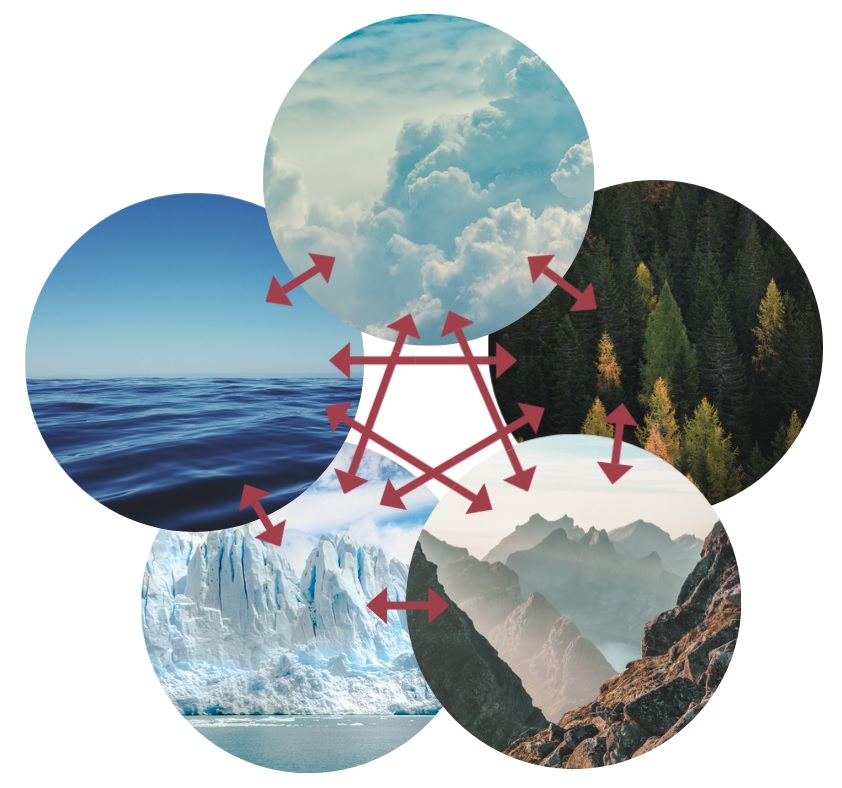
The five climate system components: Starting from the top and going counterclockwise, we have the atmosphere, the ocean, the cryosphere, the lithosphere, and the biosphere. The arrows indicate that all the components are intertwined and continuously interact with one another.
