Module 3: Mountain Building & Volcanism
Module 3: Mountain Building & Volcanism jls164Welcome to Module 3
Welcome to Module 3Introducing Mountain Building & Volcanism (Volcanoes!)
Mountains have always fascinated people, and we are especially fascinated when those mountains erupt, hurling melted rock through the air and endangering our lives. In Module 3, we will explore more about how mountains are built, and about volcanoes. We will start with a little history of humans and volcanoes, mostly for fun—you do not need to memorize how the legend of Atlantis is related to volcanoes, but you may be interested. Then, we will get into the important material, starting with what to do for Module 3 followed by the Module 3 Main Topics.
If you’re lucky to visit Italy, you may be able to stop at Pompeii and Herculaneum. These cities were buried, more-or-less intact, almost 2000 years ago (in the year C.E. 79) by a great eruption of the volcano Vesuvius. Most of the residents escaped when the volcano first became active, but well over 1000 people remained and were killed by the major eruption, mostly by the heat of glowing flows of gas and volcanic ash (called pyroclastic flows), which were roughly 250oC (480oF) at Pompeii. The ash that buried the cities piled up roughly 5 m (16 feet) thick. The Admiral Pliny the Elder was trying to rescue people and died in the eruption. His nephew Pliny the Younger, who was farther away and survived, left the following account:
They tied pillows on top of their heads as protection against the shower of rock. It was daylight now elsewhere in the world, but there the darkness was darker and thicker than any night…(t)hen came a smell of sulfur, announcing the flames, and the flames themselves…he stood up, and immediately collapsed…his breathing was obstructed by the dust-laden air.

Many other volcanic eruptions have affected human history. And, the legend of Atlantis may involve a volcano. Supposedly, Atlantis was an island civilization "outside the Pillars of Hercules" and thus located in the Atlantic Ocean, where it was destroyed by an earthquake or tsunami (giant wave) about 11,000 years ago. The source of this information (according to Wikipedia and many other sources) is an account that Plato wrote in 360 BCE of information reportedly given to Solon two hundred years earlier by priests he visited in Egypt. Now, if someone told you that 200 years ago someone else had received information from yet another person regarding something that happened 9000 years earlier, would you immediately believe it? A lot of people apparently do; a search of Google for "Atlantis Plato" finds about 4.8 million matches, and not all of them are academic discussions.
A better question might be whether there really are islands that disappear below the sea. The answer is yes; many do. Some slide slowly downhill, at about the same rate as your fingernails grow, and disappear first beneath the waves and finally beneath the continents. Others suddenly explode, scattering themselves across the world. The Atlantis story actually may come from one such explosive volcanic eruption in the 1600s B.C.E. that destroyed most of an island at what is now Santorini in the Mediterranean Sea, and pushed a giant wave (tsunami) perhaps 300 feet (100 m), or more, high across the coast of Crete, probably contributing to the eventual demise of the Minoan civilization there.
Before we go any further, take a look at the following short video introduction by Dr. Anandakrishnan...
Video: Master of the Lamp (3:02)
Transcript: Master of the Lamp
Sridhar Anandakrishnan, Geophysicist and Glaciologist: Hey, groovy cats. Welcome to my pad. This is the GEOSC 10 '70s show, in which we're going to talk about vinyl, bell-bottoms, platform boots, and most importantly, lava lamps. What? You mean you don't have a lava lamp? Run down to Uncle Eli's right now and get one. I'll wait. So what do lava lamps and GEOSC 10 have to do with each other? Well, they're a wonderful analog for this whole first section of GEOSC 10. The first section, if you remember from looking at the syllabus, is building mountains. And the short story for building mountains is heat from within the Earth. We're going to talk about tearing down mountains later on, but right now we're talking about building mountains, and the heat within the Earth is what drives that whole process. And a lava lamp is a beautiful example of that. Let's take a look at it. What we have here is a glass tube with some water in it, and then these globules of a slightly different material, and at the bottom we just have a light bulb that produces heat and heats up the bottom of this glass bowl. All right, I'm going to take this apart here, and just take a look on the inside. I don't know if this is going to be too bright for you, but we have a light bulb underneath here, and its only purpose is to produce heat and to light up this glass bulb a little bit. These green globules in here get heated up at the bottom, and as they get heated up, they get less dense. This is fundamentally what's happening inside the Earth. Rocks get heated up at depth because there's a lot of heat trapped inside the Earth. As they get heated up, they get less dense, and just like these lava lamp globules, they rise up like this one's doing right now, up to the surface of the Earth. When they get to the surface they cool off, and then just like this one, they sink back down into the Earth and the whole process goes on and on again. This inside the Earth we would call a convection cell. In a lava lamp, we call it cool.
Learning Objectives
- Explain how the creation of sea floor at spreading ridges is balanced by the destruction of the seafloor at subduction zones.
- Explain the different types of volcanoes that form at spreading ridges, subduction zones, and hot spots.
- Identify the different types of hazards caused by volcanoes and the increasing but imperfect ability to predict eruptions.
What to do for Module 3?
You will have one week to complete Module 3. See the course calendar in Canvas for specific due dates.
- Take the RockOn #3 Quiz
- Take the StudentsSpeak #3 Survey
- Submit Exercise #1
- Begin working on Exercise #2
Questions?
If you have any questions, send an email via Canvas, to ALL the Teachers and TAs. To do this, add each teacher individually in the “To” line of your email. By adding all the teachers, the TAs will be included. Failure to email ALL the teachers may result in a delayed or missed response. For detailed directions on how to do this, see How to send an email in GEOSC 10 in the Important Information module.

This course is offered as part of the Repository of Open and Affordable Materials at Penn State. You are welcome to use and reuse materials that appear on this site (other than those copyrighted by others) subject to the licensing agreement linked to the bottom of this and every page. Students registered for this Penn State course gain access to assignments and instructor feedback and earn academic credit. Information about registering for this course is available from the Office of the University Registrar.
Main Topics: Module 3
Main Topics: Module 3Overview of the main topics you will encounter in Module 3
Many students find that they need a bit more effort to master the new material in this module than in Module 2 and when those students put in the effort, they reported that they enjoyed it and learned a lot!
Subduction
- We saw that the sea floor is made at spreading ridges such as the one through the Gulf of California that almost reaches Death Valley.
- The sea floor is basalt—just what you’d get if you melted a little bit of mantle rock, and let the melt rise and then freeze.
- Although the sea floor is generally less dense than the mantle, very old, cold sea floor can be dense enough to sink into the hot mantle.
- As new sea floor is made at spreading ridges, Earth does not get bigger and bigger like a balloon being inflated, so the old sea floor must be lost somewhere.
- The sea floor is lost where it sinks back into the mantle at Subduction Zones. All sorts of things happen there:
- Moving rocks stick, then slip, giving earthquakes;
- As the rocks go down, they are squeezed until the arrangement of atoms in the minerals changes to one that takes up less space; sometimes this rearrangement affects a lot of rock at once, giving an “implosion” earthquake (the deepest quakes may be of this type);
- Mud and rocks and even parts of islands are scraped off the downgoing slab, piling up, something like groceries at the end of a check-out conveyor belt (that’s what makes up Olympic National Park);
- Some mud and rock are carried down a bit and then squeezed back out, something like squeezing a watermelon seed between your fingers until it squirts out (you may find some of this squeezed-back-out material at Olympic, too);
- Some mud and water and rock are carried even farther down, where the water lowers the melting point of the rocks (just as adding water to flour speeds cooking in the oven);
- A little melted rock is generated from this subducted water and rock, and the melt rises and feeds volcanoes (such as Crater Lake and Mt. St. Helens) that form lines or arcs near continent edges or offshore;
- This melt is richer in silica and poorer in iron than the basalt it comes from, and forms a rock called andesite (the name was chosen because the volcanoes in the Andes were formed this way), often with granite forming under the volcanoes from melt that did not erupt.
A Bit of Review
- The Earth includes a colder, harder upper part called the lithosphere, which includes the crust at the top and the upper mantle beneath, and which floats on the deeper, softer part of the mantle called the asthenosphere; convection occurs in the asthenosphere;
- The lithosphere is broken into a few big plates and many little ones; most “action” is at plate edges;
- Plates pull apart at spreading ridges, splitting continents to make space for volcanic activity that makes basaltic sea floor;
- Plates come together at subduction zones, where the cold sea floor is dense enough to sink into a hot mantle, where scraped-off materials pile up to make edges of continents (Olympic National Park, etc.), and where water and sediment taken down lower the melting point of rock, feeding silica-rich (andesitic) volcanoes;
- Plates also may slide past each other, moving horizontally at transform faults, such as the San Andreas;
- Earthquakes are generated by stick-slip behavior where some rocks move past other rocks; earthquakes also may occur deep in subduction zones where minerals being taken down rearrange suddenly into denser forms.
Introducing Volcanoes
- Towers of rising rock from very deep in the Earth (often from the core-mantle boundary) feed “hot spots;”
- Plates drift over the tops of these hot spots, and hot spots occasionally punch through, making lines of volcanoes, which often are oceanic islands (seamounts);
- Hotspots are from the mantle, and their basaltic composition is very similar to sea floor;
- If we could look down into the mantle, when a new hotspot is first rising and before its top reaches the surface, it looks like a mushroom; when it reaches the surface, the head feeds huge (state-sized) lava flows called flood basalts, and after the flood basalts form, the stem continues to flow to make lines of volcanoes ;
- Hawaii is the classic example of a line of hot-spot volcanoes (its flood basalt has already gone down a subduction zone);
- Yellowstone also is a hot spot; the head of the Yellowstone hot spot covered eastern Washington and Oregon with basalt, but the recent eruptions at Yellowstone have come from lava that was modified coming through the crust so that more silica is erupted than for Hawaii.
Volcano Characteristics
- In melted rock, silicon and oxygen make SiO4 tetrahedra that try to polymerize (stick together in chains, sheets, etc.) to make lumps;
- The lumpiness can be reduced by making the melted rock hotter or adding iron, both of which help basalt flow easily and not explode;
- This helps Hawaii be a much-wider-than-it-is–high shield volcano, because the flows spread out easily;
- The lumpiness of melted rock can be reduced by adding volatiles (water, CO2 , etc.), but when these escape near the surface, the lava gets lumpy again and won’t flow easily and may plug the system; more volatiles may get trapped beneath the plug and then explode;
- This helps build steep stratovolcanoes, composed of alternating layers of steep (“lumpy”) flows and pyroclastics (blown-up bits from explosions).
Volcanic Hazards
- Volcanoes are hazardous in many ways, including:
- Pyroclastic flows, deadly hot, fast-moving rock-gas mixes;
- And pyroclastics, big rocks that can fall on your head if you are close to an eruption, or smaller ones that can plug up jet engines on a passing plane;
- Also, poison gases, that can kill many people very quickly;
- And landslides and mudflows, that can bury whole cities;
- Tsunamis, giant waves that can devastate coasts;
- Climate change, especially short-term cooling from particles blocking the sun and frosting crops, but over geologic history, there have been terrible extinctions from too much heat from long-term volcanic carbon dioxide (the recent changes in carbon dioxide in the air are from humans, not volcanoes, as we will see later);
- These hazards are especially dangerous from subduction-zone volcanoes; the flows on Hawaii mostly block roads and burn houses, and usually, you could run away from one and stay safe.
Predicting Volcanoes
- It is fairly easy for geologists to figure out where volcanic eruptions are likely;
- Often, but not always, it is possible to figure out that an eruption will happen in the next days or hours;
- Predictions are valuable and have saved many lives, but are imperfect and probably will remain so far into the future;
- And people get mad if you tell them to leave and then nothing happens;
- The United States Geological Survey especially handles predictions in the USA; they are highly valuable and greatly under-appreciated;
- Lots of people continue to build and live where dangers await.
Crater Lake
Crater Lake
Right: R. B. Alley © Penn State is licensed under CC BY-NC-SA 4.0
We will start with a little information on a truly wonderful National Park that you may wish to visit someday, and then move into important information on volcanic arcs and the “Ring of Fire”. Crater Lake, at 1932 feet (about 600 m) deep, is the deepest and probably the cleanest lake in the United States, and surely among the most beautiful. Crater Lake sits in a great volcanic crater or caldera, 5 miles (8 km) across, formed when Mt. Mazama experienced a cataclysmic eruption about 6600 years ago. That massive eruption laid down ash that is 200-300 feet thick (almost 100 m) on the flanks of the volcano; the ash forms a layer that has been preserved and is recognizable in the sediments in surrounding lakes, including in Yellowstone Lake almost 600 miles (1000 km) away, and a little of the ash has been found in Greenland ice cores.
The peak of the volcano had risen more than a mile above its mile-high base on the highlands of southwestern Oregon, but the great eruption removed about 4000 feet (1200 m) from the mountain’s height. About 16 cubic miles (40 cubic km) of rock were blown away. Glaciers had flowed down from the mountain peak; today, the glacial valleys can be followed upward until they disappear at the caldera rim. Although 50 feet (15 m) of snow falls in a typical year now, melting in the summer is more than sufficient to remove all this snow, so no glaciers exist. A tongue-in-cheek Christmas celebration on Aug. 25 substitutes for the snowbound December event.
After the great eruption, lava flows began building Wizard Island. If the water were removed from the lake, you could see that Wizard Island is roughly 0.5 mile (0.8 km) high. No permanent streams feed into the lake; the great rainfall and snowfall in the crater are balanced by evaporation, and by seepage through the rocks and eventually out the sides of the volcano as springs. With no streams supplying sediment, the lake is exceptionally clear and clean. Aquatic moss receives enough sunlight to grow 425 feet (130 m) below the water's surface. When trout were stocked in the lake, freshwater shrimp were stocked first because otherwise, biologists feared that the trout would have nothing to eat.
Take a Tour of Crater Lake National Park
Want to see more?
Visit the Crater Lake National Park website. While you are not required to review this, you may find it interesting and possibly even helpful in preparing for the quiz!
The Ring of Fire
The Ring of FireWe will discuss much more about volcanoes soon. For now, note that Crater Lake sits atop one of a string of volcanic peaks: Lassen Volcanic National Park and Mt. Rainier National Park preserve other peaks in the Cascades range. Mt. St. Helens, Glacier Peak, and several others are protected federally. These peaks line up in a row, called a volcanic arc, parallel to the coast. A similar arc sits along much of Central America and forms the Andes of South America. And similar arcs also occur as island chains—the Aleutians, Japan, and others. In fact, the Pacific Ocean is almost entirely encircled by such volcanic arcs, forming the “Ring of Fire”.
Video: Ring of Fire (5:37)
Transcript: Ring of Fire.
Dr. Richard Alley: We saw in the last unit that there are spreading ridges out in the ocean that are making seafloor that moves away from them. And it might have bothered you at that time - the Earth is not being blown up, inflated like a giant balloon. So if we're making sea floor all the time, where does it go? And the answer is it goes back into the Earth to replace what is coming out at subduction zones.
And this is a diagram of a subduction zone that we have swiped from the United States Geological Survey. It has a number of details, maybe more than we need, but the down-going slab, the friction that it makes, tends to drag down the sea floor and make low spots that we call trenches. Those are often filled with very deep water -- the deepest spots in the world ocean. But sometimes they get filled with sediment and you see the accretionary wedge there. That's the scraped-off stuff. And sometimes this scraped-off stuff can make a little Coastal mountain range. We'll see that at the Olympic and the coast ranges of California. You also end up in such systems that the downgoing slab, it takes down some water, the water lowers the melting point of the deep rocks, and that allows magma to rise and then to feed volcanoes. So you have these volcanic arcs running along, parallel to the trenches. And you also find in such systems, that there's a lot of sticking and slipping and sticking and slipping that makes earthquakes as you go down. So these are features that you see in subduction zones.
Now, where do you find subduction zones? A lot of them are lined up around the Pacific Ocean in what we call the "Ring of Fire". And so you can see a diagram of the Ring of Fire here. These blue things are the trenches, including the deepest water in the world ocean, at the Challenger Deep. There is another trench over here, it just happens to be full of sediment so you don't need to worry about this, and later we'll sing about the Ring of Fire. So there's, there's the Ring of Fire for you.
Now we'll take a better look at this, a little more detail and more data. There's a lot of things in this figure. First of all, if you come over here on the right towards the Caribbean, you'll see this big red band. And there are several of such big red bands on this. These are the subduction zones that are close to the U.S. Holdings. So that's near Puerto Rico and the Virgin Islands and they're part of the U.S. and so these are near U.S. land and these are just a special concern of the United States Geological Survey which made this map. If we then look at other things on this map, there is some more red on here, and that's little tiny red dots. And you'll see a whole bunch of little tiny red dots for example, just below what I drew there at the top. All of those little red dots are volcanoes and you see volcanoes in the Aleutians where I was. You see them out in the Cascades, you see them in Central Mexico, you see them in Central America, you see them down the Andes. There's a whole lot of places around here that you can see volcanoes popping up. Also on this plot you can see earthquakes. So the black dots, such as the ones just inland from where I'm drawing down in the lower right there next to South America, those are all earthquakes. So this plot is showing you where the earthquakes are and where the volcanoes are, which ones are in the U.S. The very light red line out in the middle, these are the spreading ridges and then later we'll come back and we'll look at Hawaii and the hot spot chains. But so now you can get a pretty good view of what many of the features are that we have to worry about when we talk about the Ring of Fire.
We're gonna do one more view of things here. This is a figure that was generated by Gavin Hayes, who is a graduate of Penn State, and works for the United States Geological Survey. And what's shown here is not just the Pacific Ring of Fire, which is sort of over around this, right, so that's in the Pacific. Now you see all of the subduction zones on the planet. And the funny sort of coloring here, the yellow, the zeros, mean that the downgoing slab, the downgoing sea floor, has just started down. It's right at the sea floor. And you'll see it, say, over where I'm drawing now, it starts down under South America there. The deeper one, 600 kilometers, that's 400 miles almost, and it goes down and gets deep most of the way under South America towards the Atlantic. You can similarly see other places that the slabs are going down from shallow to deep and this one you'll also see the subduction zone that's continuing to Vesuvius and Aetna and the pushing up the Alps there. So we're going to look at subduction zones here.
Sitting offshore of the Ring of Fire, is a ring of trenches, which include the greatest depths of the ocean. The trenches parallel the volcanic arcs. Some trenches, which sit near continents, are nearly filled with sediments dumped off the continents, but other trenches are almost free of sediment and so have very deep water, to almost 7 miles (11 km) deep. (Figuring out depths is often complicated by sediment. The surface of Death Valley sits more than two miles lower than the adjacent peaks of the Sierra Nevada. But below the salt flats of Death Valley there are sediments as much as three miles thick, materials that were eroded off the tops of the peaks, so the valley has dropped by much more than three miles relative to the peaks.)
The trenches and volcanoes that ring the Pacific are a few of the many clues that tell us about subduction zones, and help solve a problem that might have been bothering you from Module 2. If sea floor is made at spreading ridges and then moves away, where does it go? The earth is not getting bigger. (Well, meteorites are adding a tiny, tiny, tiny bit, but not nearly enough to account for sea-floor spreading.) So, the sea floor must be disappearing somewhere, going back into the Earth.
Indeed, almost all the sea floor is younger than 160 million years old, but the continents contain rocks as old as almost 4 billion years, showing that the sea floor is being consumed before it gets very old. (Remember, before the class ends, we’ll discuss how geologists date rocks.) (And remember that when a geologist dates a rock, it involves physics or chemistry but not dinner or a movie.)

Credit right: Swanson, Don A., USGS Volcano Hazards Program, Public Domain
More clues to what happens at subduction zones
The sea floor is made of basalt. This is just the kind of rock that would be made if you melted a little bit of the deep, convecting rocks of the Earth’s mantle, and let that melt float up to the surface and “freeze” (cool until it solidifies). If you take basalt, plus a little ocean sediment and some ocean water, and heat them enough to cause a little melting, and then let that melt come to the surface and freeze, you obtain a rock called andesite with a little more silica and a little less iron and magnesium than basalt, lighter in color and lower in density than basalt. Interestingly, the dominant rock in the walls of Crater Lake, and in the other Cascades and Ring-of-Fire volcanoes, is andesite (named after the Andes, which are part of the Ring of Fire), giving you a clue to how these peaks were formed. (Some of the melted rock freezes below ground, making granite or similar rocks.)
If the sea floor were plunging under the continents and melting to make andesite, you might expect that occasionally the downgoing rocks would get stuck and then break free, making earthquakes. Indeed, a three-dimensional map of earthquakes shows that shallow ones occur near the trenches, and the quakes are progressively deeper inland beneath the volcanic arcs, along the descending slab of old sea floor. The great 1964 Alaska earthquake was such an earthquake, which happened where rocks of the Pacific Ocean floor plunged to the north under coastal Alaska and the Aleutian chain. The more southerly of the earthquakes there occur at shallow depths, with the earthquakes getting deeper to the north, occurring along the downgoing rocks. The disastrous 2011 Tohoku earthquake in Japan was of the same type.
Earthquakes make waves that travel through the Earth, at speeds that depend on the characteristics of the rocks, including their temperature. Careful analysis of the speed of the waves, which can be learned from the time it takes for a wave to get from an earthquake to a listening device (a seismometer), shows the higher speeds of the cold slabs going down into the hotter mantle. As these initially-cold downgoing slabs of rock are heated, with their water and sediment, a little melted rock (magma) is produced. (Interestingly, wet rocks melt at a lower temperature than dry rocks, just as adding a little water to flour and yeast speeds cooking of bread in the oven.) When the melt rises to the surface and cools, andesite forms, such as is seen around Crater Lake, in the Andes, or in the Aleutian volcanoes.
So, the sea floor is made at the spreading ridges. It is hot and low-density initially, but cools and contracts as it gets older and loses heat to the colder ocean water. When the sea floor becomes cold and dense enough, it can sink back into the mantle, and we call the place where it sinks a “subduction zone”. The sinking sea-floor slab drags along a little sediment and water. The slab warms because of friction with the surrounding rocks and heat flowing from those surrounding rocks into the colder slab. This causes the sediment and a little of the sinking slab to melt, and the melt rises to feed the volcanic arcs. Old sea floor is going down around much of the Pacific Ocean, and in a few other places such as beneath the Caribbean, and beneath portions of the Alps. Wherever this happens, andesitic volcanic arcs form as shown in the video and figure below. The subduction beneath the Alps created the volcanoes Vesuvius that buried Pompeii, and Santorini that may have destroyed Minoan civilization.
Video: Subduction Zones (2:46)
Transcript: Subduction Zone
Dr. Richard Alley: So let's do a little review on what subduction zones are and what they mean for us. Recall that in the deep earth, there is hot, soft rock which is undergoing convection and that some of that convection leads to mid-ocean ridges. The hot soft rock comes up and it makes ridges and the ridges make seafloor and the sea floor moves away from those ridges. The Earth is not inflating like a balloon so if you're making seafloor somewhere it has to be disappearing somewhere else and that goes down at subduction zones. Subduction zones cause a number of features. If they are not filled with sediment, they drag down the rocks where they start down and they make deep trenches and the deepest water in the world oceans happens to be at such trenches. Very often though, there is sediment being eroded from the neighboring land or volcanic ark and so the sediment comes down in rivers and it fills up the trenches as it happens in the west coast of the U.S. off of Washington and Oregon. When that sentiment is dragged down the subduction zone and any sediment from out under the ocean, a lot of it is scraped off and it may make a pile that you would see as the coast ranges or the Olympic out in the western U.S. A little of that sediment is dragged down along the subduction zone together with a little of water and the water and the sediment lower the melting point down there and that allows the rocks to melt, which makes magma, which rises and that eventually feeds to Mount St Helens and Crater Lakes and other Crater Lake and other volcanoes that line up in an arc along there. You also end up with a lot of earthquakes in the system, so this can get stuck and then break, and stuck, and then break. There is a possibility too, as the Rock is taken way down, that it changes into other forms, other minerals, and then occasionally that may cause a sort of implosion that shakes the ground when it happens and makes a really big, really deep earthquake. And so you see, a whole lot of different things can happen at subduction zones. We see volcanic hazards, landsides from steep slopes, we see giant waves made by earthquakes that we call tsunamis. So subduction zones are really, really important.
The following diagram shows the same process as described in the video above. Take a look and see if you would be able to describe it to a friend.

Olympic National Park
Olympic National Park
Take a Tour of Olympic National Park
The Olympic Peninsula juts out into the Pacific Ocean, separated from Seattle by Puget Sound. Moisture-laden winds off the Pacific dump more rain and snow on the Olympic than anywhere else in the lower-48 United States. Great old-growth forest trees—Sitka spruce, Douglas fir, etc.—tower up to 300 feet (almost 100 m) above the forest floor, where butterflies flit past crystalline streams and cascading waterfalls. Along the coast, sea lions bask on offshore stacks, while urchins and starfish populate tidal pools. On the “high peaks,” numerous glaciers form and flow downhill. More snow accumulates than melts on the peaks. On most mountains, you have to go much higher to find summertime snow, but the huge winter snowfall on the Olympic allows the peaks to be snow-clad year-round despite rising less than 8000 feet (about 2500 m) above sea level. (Those glaciers are shrinking because of human-caused climate warming, as we will discuss later in the semester.)
Olympic National Park is a bit unusual in that it was established as much for biological reasons as for geological—to protect the Roosevelt elk that live on the peninsula. (The elk, named after Theodore Roosevelt, were critical in obtaining national monument status, which was signed by President Theodore Roosevelt. Later, the upgrade to national park status was signed by President F.D. Roosevelt. The Roosevelt elk is the largest of the elk subspecies in the country. Some consideration was given to naming the park Elk National Park before Olympic was chosen.)
The geologic story of the Olympic is somewhat shorter and less dramatic than for most of the national parks. The rocks of the Olympic are almost all young—less than 40 million years. (Again, please bear with us—we will justify these numbers before the course ends!) Before that, the coastline must have been farther to the east, perhaps in North Cascades National Park, and before that even farther east.
Want to see more?
Visit the Olympic National Park website. While you are not required to review this, you may find it interesting and possibly even helpful in preparing for the quiz!
The Olympic Grocery
The Olympic Grocery
You’re standing at the grocery-store checkout. You put a bag of potato chips on the conveyor, and off they go, followed by a case of Pepsi, three loaves of bread, a watermelon, a box of Ho-Hos, and a sack of potatoes. Then, you realize that there is no bagger working and that everything is piled up at the end, in a BIG mess. That mess is a good model for the Olympic Peninsula and the whole coast from there up to Alaska.
The rocks of the Olympic Peninsula are a mixture of sea-floor basalts and the sorts of sediments that accumulate today off the coast and fill the trench there. Rivers draining the peninsula and other parts of the west coast carry great loads of sediment down to the ocean. Much of that sediment piles onto the sea floor that is slowly moving beneath the continent, a conveyor belt that drags some of the water-saturated sediment down to melt and then erupt from volcanoes. But, most of those sediments are “scraped off” on the way down, just as at the grocery store. The Olympic Peninsula is the offscrapings. Most of the rocks have been bent and twisted from the attempt to shove them under the continent (think of the potato chips after the milk jug hits them!). Some of the Olympic rocks have been heated a good bit—the conveyor belt took them part way down, but then they were squeezed back out.
And here's another fun way to understand subduction zones.
Video: Olympic Subduction Zone (0:40)
Transcript: Subduction Zone.
Dr. Richard Alley: You may think that this looks like an ordinary sandwich cookie but in fact, this is a subduction zone demonstrator. Here is the Pacific Seafloor and on top of it is sediment, wind-blown dust and dead shells, and other things sitting on top of the basaltic sea floor and it's going down the subduction zone under the state of Washington and Oregon, and as it does some of the sediment is scraped off and is making a pile and that pile is the coast ranges and the Olympic Peninsula.
Our emerging picture of plate tectonics is that the earth is heated inside, softening the deep rocks of the asthenosphere enough that they can move in great, slow convection currents that transfer heat from deep in the earth to near the surface. Heat is conducted through the upper rocks, or is erupted through them by volcanoes, and eventually is lost to space. But, the upper rocks in most places are cold enough that they tend to break rather than flow—they are brittle. These brittle rocks form the lithosphere, which includes the crust and the uppermost mantle. The rocks of the crust in continents are rich in silica (often like andesite or granite in composition), making them light in color and low in density so that they float on the deeper rocks and are rafted around on them by the moving convection currents. The sea floor rocks in the crust are between the continents and the mantle in composition and typically are basalt. The sea-floor rocks are usually intermediate between continents and mantle in density as well, but if the sea-floor rocks are cold enough, they will be slightly denser than the hot mantle. Then, the sea-floor lithosphere consisting of the sea-floor crust plus a little attached mantle will sink into the asthenosphere of the deeper mantle.
Geologic Plates
The lithosphere is broken into a few big rafts, called plates—eight big ones plus some smaller ones, depending a little on how you define “big” and “small”—that float around on the convection cells below. Plate boundaries include spreading ridges where the plates move apart (remember Death Valley and the mid-ocean ridges), and subduction zones where the plates come together and one side sinks under the other. You might imagine that if plates can come together or pull apart, they must be able to slide past each other as well, which is what happens at the San Andreas Fault in California (we met it when we were discussing earthquakes); such slide-past boundaries are often called transform boundaries or transform faults (see the figure below). You might worry that sometime, two continents would run together; we’ll meet that soon when we visit the Great Smoky Mountains.

The lithosphere and asthenosphere are solids, but a little melted rock may occur in places in the asthenosphere, and some of this may leak out where plates are pulled apart, feeding basaltic volcanoes. And, the water taken down subduction zones can stimulate a little melting, feeding andesitic volcanoes that line up in arcs above the downgoing slabs of the subduction zones; examples of these volcanic arcs include the Cascades, Aleutians and Andes. Continents are a collection of scum formed from freezing of material that melted in the mantle and then moved upward and froze; continents are too low in density to sink back into the mantle. Continents grow as the conveyor belt from the mid-ocean ridge to the subduction zone brings in sediments and islands and what-not, or when andesitic volcanoes erupt on continents, or when andesitic volcanoes form an arc in the ocean that then collides with a continent (sometimes the site of subduction moves, and the volcanoes find themselves on the conveyor belt, or they hit a different continent). Because much of the sediment comes from the continents themselves, the growth of continents is not fast—material eroded from the continents falls on the conveyor and is added back at Olympic or erupted back at Crater Lake.
Mt. St. Helens
Mt. St. HelensMt. St. Helens & Volcanic Hazards; More to Worry About

(right) Mount St. Helens by Mike Doukas, USGS (Public Domain).
Take a Tour of Mount St. Helens
The great eruption of Mt. St. Helens in May of 1980 is ancient history for most of you, from before you were born. That is often the way with geological disasters—they are far enough apart that we forget... and the reminder is often unpleasant.
The eruption blasted out at over 300 miles per hour and over 600ºF, followed by even hotter blasts at more than 1300ºF. Deaths included 57 people, nearly 7000 large animals (deer, elk, bear), countless smaller creatures, and enough trees to supply lumber for 300,000 homes. Most eruptions build volcanoes, but a few really dramatic ones blow the top off - this one lowered the peak by more than 1300 feet.
Mt. St. Helens, in southwestern Washington, was in some ways the queen of the Cascades Range. Beautifully symmetric, and snow-capped, it had been called the Fujiyama of the Pacific Northwest. Scores of people flocked to St. Helens’ flanks to hike, camp, ski, and generally enjoy the environment. But, all that changed in 1980.
(It may seem weird to you that we are about to focus on an event from before most of you were born, from 1980, when larger volcanic eruptions have happened more recently. But, St. Helens is the largest eruption that has occurred in the lower-48 states of the USA since before the country was formed, is the easiest eruption site to get to and observe, and really is awesome. Professor Alley’s elder daughter, Janet, was a ranger there one summer and recommends that you include Ape Cave if you visit. Our goal here is to help you see just how immense the eruption's effects really were—and, we strongly recommend that you visit if you can.)
Mt. St. Helens has also been the most active of the Cascades volcanoes over the most recent centuries. In early 1980, the volcano clearly was “waking up”. Earthquakes shook it almost continuously, including special “harmonic tremors”, similar to those sometimes caused by fluid flow in pipes, which showed that liquid rock was moving up from below. Small eruptions occurred, and hot springs and fumaroles (steam or gas vents) became increasingly active. The north side of the mountain was bulging, blowing up like a balloon as the magma moved into it. Scientists were scrambling to study the volcano and predict its course. They recommended evacuation for safety, and most people (but not all, including some scientists) were moved out of the way. Penn State professor Barry Voight warned that the huge bulge on the north side of the volcano would fail, unleashing a giant landslide and a devastating eruption.

On the morning of May 18, 1980, Professor Voight’s prediction came frighteningly, awesomely true. The bulge failed. A large earthquake either caused, or was caused by, the failure of the north side of the mountain in a giant landslide. Like pulling the cap off a hot, well-shaken soda bottle, the liquid beneath flashed into a froth, driving an eruption 12 miles (20 km) high. A shock wave knocked over full-grown trees in an area of 20 x 10 miles (32 x 16 km). The landslide eventually poured more than 100 million cubic yards of rock material down the Toutle and Cowlitz Rivers, raising the floor of the North Fork of the Toutle as much as 600 feet (200 m), and sweeping roads and houses downstream, with the debris reaching and clogging the shipping channels of the Columbia River. The Toutle floor now sat higher than the smaller streams that fed it, and lakes began to form; only quick work by the Army Corps of Engineers prevented those lakes from overtopping the mud that was damming them, then cutting quickly down through the mud and releasing further floods. (We will revisit the dangers of such mud-dammed lakes in Module 5.)
In total, the Corps of Engineers spent $250 million removing mud dams, clearing shipping channels, and doing other critical work. 57 people were killed in the blast and landslide; some were buried under hundreds of feet of steaming mud and their bodies were never recovered.
President Jimmy Carter scowled at the disaster from a helicopter. Disaster planners pontificated. And in the shadows of the other Cascades volcanoes, people continued building houses in regions of known volcanic hazard.
The Mt. St. Helens Volcanic Memorial today has little in common with conditions pre-1980. The center of the volcano was lowered more than 1/2 mile (nearly 1 km) during the eruption, with the missing rock spread over the surrounding countryside, forming a visible layer as far as 900 miles (1500 km) away. (Professor Alley and his wife Cindy were driving in Alberta, Canada during the summer of 1980, on a great, seven-week, see-the-national-parks-in-a-Chevette-with-a-tent honeymoon when a secondary eruption of Mt. St. Helens put enough ash in the air to halt traffic because of reduced visibility, hundreds of miles from the volcano.) Many of the trees knocked over by the blast still lie there—hundred-foot-long toothpicks pointing in the direction of the searing winds of the blast. Among these dead trees, however, salmonberry, fireweed, and young firs are pushing skyward, elk are grazing, and coyotes are searching for rodents. In some places, salvage-logging of the downed trees was allowed. In some of those places, erosion accelerated, large gullies developed, and the return of vegetation was slowed. In the crater of the volcano, a new lava dome has formed. (Go back and see the slideshow for photos of some of these details.)
Optional Viewing
Below, you'll see two time-lapse images of Mount St. Helens, taken many years after the great eruption and showing how the volcano continued to evolve. Watch them if you're interested. The first one shows it squeezing slowly upwards like toothpaste from a very hot tube, and amazingly, a glacier sits behind it, fed by the great snowfall and the avalanches down into the crater, and partially protected from melting by the debris that falls into it with the avalanches. The second one shows changes in the lava dome and Crater Glacier. The heat of the volcano does melt some of the glacier’s ice from below, but not fast enough to balance the supply of snow from above.
Video: Time-lapse images of Mount St. Helens dome growth 2004-2008 (No Audio) (1:27)
Video: Time series of dome & glacier growth at Mount St. Helens, WA (No Audio) (00:20)
Want to see more?
Visit the Mount St. Helens National Volcanic Monument website. While you are not required to review this, you may find it interesting and possibly even helpful in preparing for the quiz!
Hot Spot Volcanoes
Hot Spot VolcanoesVolcanoes occur where melted rock rises to the Earth’s surface. Almost all volcanoes are associated with one of three settings—pull-apart margins (spreading ridges), push-together subduction zones, and hot spots. We’ve already met the volcanoes that produce sea floor at spreading ridges, where low-silica basalt has erupted, and we have seen large, explosive volcanoes (called “stratovolcanoes”) such as Mt. St. Helens, made of higher-silica andesite at subduction zones. Next, we will look at wide, flat, basaltic shield volcanoes at hot spots. (Smaller volcanoes called cinder cones can form with stratovolcanoes or shield volcanoes, or in some other places; you can learn a little more about them in the Enrichment.) The short video below shows the shield volcano Mauna Kea in Hawaii, the stratovolcano Mt. Rainier, and the cinder cone Sunset Crater in Sunset Crater Volcano National Monument. We traced them for you, and put all the tracings on the same figure, to show you how different the shapes are.
Video: Volcano Shapes (2:47)
Transcript: Volcano Shapes.
Dr. Richard Alley: We're going to look at various types of volcanoes and we're going to start with their shapes which are sort of telling us a lot about what's going on. So this is Mount Rainier. It is a strata volcano. It is steep, it is big, it is looming above Tacoma in this picture, in the state of Washington just south of Seattle. And if we trace it with this blue line then you can sort of see what the outline looks like. Now it turns out that Mount Rainier used to be even taller and steeper. The top slid off to make a massive Landslide about 5700 years ago. So here you see both the modern and the before that landslide. Next we'll look at Mauna Kea. This is Hawaii. It is a shield volcano, not so steep. It is even bigger. Mount Rainier rises about two miles above its base. Mauna Kea Hawaii starts at the sea floor and rises more than six miles above its base. But you can see rather clearly, it is not so steep up here at the top. So if we resize them so they fit in the same figure now you can see the comparison between Mount Rainier in blue and Mauna Kea in the redder one, much lower there. And if we put the top back on Mount Rainier you can now see that the comparison is very striking. These are the two most important types we're going to worry about. Just for fun, we'll add one more here. If we go back to Mauna Kea, there are little Cinder Cones up on the side of it that are pointed out with the green arrows. There are cinder cones at Mount Rainier, there are cinder cones at other places, such as Sunset Crater in Arizona. They are made of loose pieces, little bits of melted rock went through the air, they froze, they fell down, and they made a pile. If you try to walk up the side, it tends to roll out from under your feet and it's hard to walk up. And if we outline that with this green one here, we can put them all on the same picture here now and the cinder cone is sort of in between, with the shield volcano very flat and the stratovolcano very steep, especially if we put the top back on Mount Rainier. So, there are some volcano shapes and the shapes are telling us about processes about what goes on to make those volcanoes.
Hot Spots
Video: Hot Spots (3:36)
Transcript: Hot Spots
Dr. Richard Alley: I'm gonna go do hot spots now. This is a cutaway view of the earth and there is heat being generated way down in the core from radioactivity and other things that are going on. But the core is so dense that it can't rise by itself. So the heat comes up and it warms the base of the mantle, and when that gets hot enough, that starts to rise, and it will be coming up, and at some point, when it's coming up it might look something like this. Sort of having a mushroom head that we can see there. And that is headed up towards the surface. Later, if we come look at it, you'll have the heat down here. The thing will be rising up there, and the head will have made it up to the top and there'll be immense outpourings of basaltic lava going over the surface, in what we call a flood basalt. But eventually, that flood basalt will be carried away by the drifting plates and you will be left with something that looks more like this. It's coming up from below. It comes up here, and you have heat there that is trying to leak through. Now let's go to a different diagram that shows that. And we can do this. And so here is, coming up from below, the hot spot. It's trying to break through the lithosphere up here, and it does so in particular places, such as Hawaii, there at Mauna Loa and Kilauea. And, you might have two or three places that are active once, but eventually, as a Pacific Plate moves over, these will be carried away, and a new one will break through, and then a new one will be broken through as that comes along. And this has been going on for a very long time. This one out here is, for example, Kauai, it was sort of five million years ago, this was back here being active. And so this has been going on, and it's all a fascinating thing, and if you back up now, what do we see? The previous picture that you were looking at was right down here. That's Hawaii, and this is way out in the Pacific, and what we're going to do now is zoom in just a little bit on this so that you can see it more clearly. And so here we will go. And so the previous picture was down there in the corner in Hawaii. The flood basalt that came from the start of the Hawaiian hot spot is already gone. It has gone down the subduction zone and been turned into volcanoes or other things up here in the Aleutian Arc. This is sort of 81 million years since this was down here at the active hot spot. This corner here is about 43 million years old. So this has been going on for a long time. The fact that the angle changes is probably because the direction that the plate is moving changed, about 43 million years ago. Although it's possible there is a little bit of motion of the hot spot as well. And so there you see a hot spot.
The drifting tectonic plates of the lithosphere are thin—roughly 100 miles (160 km), although with notable variation—compared to the 4000 miles (6000 km) radius of the Earth. Hot spots come from deeper, with the big ones from about halfway down near the base of the mantle just above where it meets the outer core. There, a rising tower of hot rock sometimes forms and then lasts for quite a while, powered by heat coming from the core. (To see something that looks vaguely like the formation of such a hot spot, go back and view the “lava lamp” film of Dr. Anandakrishnan in the introductory material to this module.)
As the lithosphere drifts overhead, the hot spot may “punch through” to make a volcano. Then as the lithosphere carries that volcano away, the hot spot punches through a new place to make a new volcano, a little like a quilter shoving a needle through at discrete places, although a quilter never sticks a needle through two holes at the same time, whereas the hot spot may be wide enough to feed two or more volcanoes at the same time. Hot spots bring melt from the mantle, and so normally make basaltic volcanoes that are only a little different from sea-floor basalt at spreading ridges. However, where a hot spot pokes through a continent rather than through the sea floor, silica from the continental rocks may mix with the melt to increase its silica content, as at Yellowstone.

When a new hot spot first rises from below, the top must push through the mantle and crust, and the resistance of the stuff in the way of the rising column causes its top to spread out like the head of a thunderhead rain cloud, or of a mushroom cloud from an atomic bomb, or of a blob in a lava lamp, and for the same reasons. When that wide head reaches the surface, it can produce immense lava flows that spread across state-sized areas and bury them hundreds of feet deep. Much of central and eastern Washington and Oregon is buried by the “flood basalts” from the head of the Yellowstone hotspot. After the head of the mushroom cloud has made a flood basalt, the “stem” may continue for millions of years or more, supplying melt to the surface. At Yellowstone, the continent has moved across the hot spot, which has fed a string of volcanoes including those at Craters of the Moon National Monument in Idaho. The hot spot now fuels Yellowstone (which is why it is called the Yellowstone hot spot…a lot of this stuff isn’t that difficult!). The flood basalts from the Hawaiian hot spot have been subducted beneath the Aleutians, but the string of hot-spot volcanoes that have not yet been subducted can be traced from the Aleutians south all the way to the volcanically active big island of Hawaii. A new volcano, Loihi Seamount, is growing undersea just off Hawaii as the big island slowly drifts away, and Loihi will someday (not in our lifetimes!) be the new, volcanically active “big island” while the volcanoes of the current big island die and the island slowly erodes away. The upward flow of the hot spot raises the crust above it, and volcanoes slide slowly down from this raised area as the drifting plate carries them away, which along with erosion causes them to disappear beneath the sea surface.

The flood basalts from the Hawaiian hot spot have been subducted beneath the Aleutians, but the string of hot-spot volcanoes that have not yet been subducted can be traced from the Aleutians south all the way to the volcanically active big island of Hawaii. A new volcano, Loihi Seamount, is growing undersea just off Hawaii as the big island slowly drifts away, and Loihi will someday (not in our lifetimes!) be the new, volcanically active “big island” while the volcanoes of the current big island die and the island slowly erodes away. The upward flow of hot rock that feeds the hot spot also raises the crust above it, and andanoes slide slowly down from this raised area as the drifting plate carries them away, which along with erosion causes them to disappear beneath the sea surface.
What controls the type of volcano?
We have now seen that melted rock can leak up from below to feed volcanoes at spreading ridges, at hot spots, and above subduction zones. But, very different volcanoes develop in these different settings: sea floor forms from spreading ridges; flood basalts and then wide, not-very-steep Hawaii-shaped volcanoes form from hot spots; and, steep Mt. St. Helens-type volcanoes form above subduction zones. The type of volcano that develops at a place depends on a host of factors, including the temperature, composition, and rate of supply of the melt, how long the melt is supplied, and several others. We will focus on two of these here, which are probably the most important: composition of the melt (primarily how much silica versus other chemicals) and volatile content (mostly how much water, although carbon dioxide, hydrogen sulfide, and other compounds that are gases under conditions at the Earth’s surface may be present and classified with volatiles).
Composition of the melt
Silicon and oxygen are the two commonest elements in the crust of the Earth and get together in melt to form the material we call silica. Left to itself, each silicon atom will be surrounded by four oxygen atoms, which form a tetrahedron (a little pyramid). But, give them a little time, and the tetrahedra will start sticking together, or polymerizing, into chains and sheets and bigger clumps, with some oxygens being shared between more than one tetrahedron. If these lumps get big enough, we call them minerals, and the melt has solidified.
When the lumps are present but not too big, the melt is like lumpy oatmeal—it doesn’t flow very well. There are three ways to get rid of the lumps: make the melt really hot, which makes the tetrahedra vibrate so rapidly that they pull away from other tetrahedra and so stop polymerization; fill the melt with iron, magnesium, and other elements that interfere with the tetrahedra polymerizing; or, fill the melt with volatiles that interfere with the tetrahedra polymerizing. When polymerization is low, the melt flows easily. Lava comes out of the volcano quietly, without making big explosions, and flows easily and far from the mouth of the volcano. In extreme cases, flows may be nearly horizontal and cover much of a state, as in the flood basalts. If the melt spreads almost as easily as flood basalts, the lava will have very slight slopes of only a few degrees, forming shield volcanoes (they look like a warrior’s shield lying on its side) such as in Hawaii. Hawaiian lavas and flood basalts flow easily because they are hot and are high in iron and magnesium.
Volatile content
When water and other volatiles remove the lumps, a different situation develops. This is because the volatiles will stay in the melt only if the pressure on them is high. Just as a bottling company can force CO2 into the water of a soft drink under high pressure, but the CO2 escapes as the pressure falls when you open the bottle or can, the water and CO2 and other volatiles stay in the melt under high pressure down in the Earth but escape as the pressure drops as the melt gets close to the surface.
Silica-rich melts usually form with many volatiles. Remember that in subduction zones, wet sediment dragged down the trench releases water (and carbon dioxide and other volatiles) that promote melting. When the melt (called magma when it is in the Earth and lava when it reaches the surface) nears the surface, the lower pressure allows the volatiles to bubble off and escape into hot springs, geysers, etc. (Note that most of the fluids that come out of such hot springs are rainwater that has circulated down into the earth, but some of the fluids may be “juvenile” waters from the magma below.) Silica-rich, relatively cool lava that has lost its volatiles flows only with great difficulty. It may emerge from the volcano and flow a short distance as a very thick, slow-moving, steep flow. It may not even flow, but simply form a dome directly over the volcanic vent. The videos you saw on the last page for Mt. St. Helens show such a “plug dome” forming in the crater left by the great 1980 eruption. And, such “thick” lava may “plug the system” when it solidifies, preventing the escape of more lava and volatiles coming from below. Then the stage may be set for a big explosion.
The next melt that rises in the volcano cannot follow the same path, because the hardened lava above prevents escape. The gases are trapped, and pressure builds up. The volcano is like a hot pop bottle being shaken by little earthquakes. If the top is removed, either by a “bottle opener” (such as the landslide that released the explosion at Mt. St. Helens, or a crack opened by an earthquake) or just because the pressure becomes great enough to blow the top off, the sudden release allows the soda or the magma to come foaming out. A good champagne may fountain to many times the bottle’s height, and blast the cork across the room. A powerful volcano may blast ash higher than jet flight paths. The melt really does get foamy, and that foam hardens into little glass shards. The ash layer deposited by Mt. St. Helens, which stopped drivers hundreds of miles away, was mostly composed of such little glass shards, although torn-up bits of the former volcano were also included. The picture below shows volcanic ash that is composed of lots of broken bubble walls.

The andesitic volcanoes of the Ring of Fire are typically stratovolcanoes, formed of alternating layers of thick lava flows and of pyroclastics—the things thrown through the air by the volcano. The steepness comes from the flows, which cannot go too far from the vent. Some of the andesitic volcanoes, including the rebuilding of Mt. St. Helens, include plug-dome elements, the oozing lava staying right above the vent.
So, the major volcanoes for our purposes are the quiet, basaltic shield volcanoes of hot spots, the quiet basaltic rift volcanoes of spreading ridges, and the steep, scenic, explosive, andesitic volcanoes of the Ring of Fire. Other types exist, notably, cinder cones thrown up by typically minor eruptions tossing pyroclastics short distances (see the Enrichment on cinder cones). Also, hot spots or rifts trying to poke through continental rather than oceanic crust may pick up silica and water, and then produce explosive silica-rich volcanoes. But if you understand shields and stratovolcanoes, you will be well on your way toward understanding volcanism.
Enrichment: Cinder Cone Volcanoes
Enrichment: Cinder Cone Volcanoes
Many volcanic eruptions produce small cinder cones. These may form on the flanks of a shield volcano (such as are shown in the picture of Mauna Kea), or a stratovolcano, or in other volcanic settings such as where a spreading ridge comes above sea level. Cinder cones form when a small opening reaches the surface above magma containing gas. If you have ever been really close to a recently poured carbonated beverage, you know that the bubbles rise and then break, throwing droplets of the drink that can make your face wet. Similarly, bubbles rise and break in the melted rock, throwing droplets that freeze in midair, and then fall as loose pieces that pile up around the opening. Walking up a cinder cone can be difficult because the loose pieces roll easily underfoot.
Cinder cones are not as important as other volcanoes in making large mountains that last a long time, but many people have seen a cinder cone, and sometimes they can be dramatic. Back in 1943, a new cinder cone suddenly began growing in a cornfield west of Mexico City. The volcano Parícutin grew to be more than 1300 feet (400 m) high, buried two towns, and killed three people, but eventually quit erupting and became a great tourist attraction.
Watch some short vintage videos discussing cinder cones.
Video: Cinder Cone Volcanoes: Sunset National Park #1 (1:14)
An explanation of cinder cone volcano formation by CAUSE student Sam A.
Transcript: Sunset National Park #1.
CAUSE Student: Right now we're at-- this is called Lenox Crater, and it's a volcano. It's a cinder cone volcano. If you looked around behind us, right at the center there's a big crater, hence the name. And all the stuff that we're sitting on right here is cinders, basalt rock that was ejected from the volcano. And as it was ejected, it was thrown up and out, kind of like this. And--
Kind of like what?
[LAUGHTER]
CAUSE Student: Kind of like that. And it just over the years built up and built this-- what did it say, it's 400 feet high or something like that? Yeah. Not too bad.
Video: Cinder Cone Volcanoes: Sunset National Park #2 (2:09)
Another, slightly "dramatized" explanation of cinder cone volcano formation by CAUSE students Stephanie S. and Ryan G.
Transcript: Sunset National Park #2.
Ryan, CAUSE Student: That was hard. Why?
Stephanie, CAUSE Student: Well, Ryan you just walked up a really steep side of a volcano.
Ryan: What volcano?
Stephanie: This volcano.
Ryan: That's a volcano?
Stephanie: Yeah. Right over there's the center of the volcano. And we're sitting on top of cinders that were thrown out of the volcano.
Ryan: What's a cinder?
Stephanie:These are cinders.
Ryan: What are they?
Stephanie: OK, imagine this is the bottom of the volcano. Stuff's thrown out of the center of the volcano. And it starts to build up around the side. So eventually, when enough stuffs thrown out, you get a steep-sided volcano. It's just layer, upon layer, upon layer, upon layer, upon layer of stuff that's ejected out of the volcano, falling down on top of each other.
Ryan: How far does cinder travel?
Stephanie: Well, we're sitting about a quarter mile from the center of the volcano, so these cinders traveled about a quarter mile. They can go further than that, a mile.
Ryan: So if this is cinder, it's so small. I mean, are they all this small?
Stephanie: Yeah. Well, some are real small, some are a little small. Some are big, and some are the size of Volkswagens.
Ryan: Oh. But Stef, I still don't get it. I mean, where else are we going to see this in the real world?
Stephanie: Have you ever made spaghetti?
Ryan: Yeah.
Stephanie: All right. Well, think of a pot of spaghetti sauce. You've got the heat cranked up real high, and the sauce starts boiling. You get bubbles and then, next thing you know, you've got butter and spaghetti sauce. You've got spatters of sauce all over your kitchen stove.
Ryan: And that's exactly what's going on over here?
Stephanie: Yeah. Why don't we go to take a look?
Ryan: OK.
Stephanie: Go down in the crater.
Ryan: Hey!
Video: Cinder Cone Volcanoes: Sunset National Park #3 (1:07)
A third explanation of cinder cone volcano formation, by Dr. Alley himself.
Transcript: Sunset National Park #3
Dr. Richard Alley: We're looking at Sunset Crater, a volcano that erupted almost 1,000 years ago. It's primarily a cinder cone, so when it was erupting it was sort of spitting out little pieces like a pot of spaghetti sauce bubbling and throwing things.
Those little pieces-- we can actually see similar pieces from either that one or a different eruption here. And we've been walking on them, and they're not terribly pleasant for walking on, but you can build a pile out of stuff like this. There's probably lava flows helping to hold that one up.
A little more oxidized late in the eruption, and so you get that pretty red around the top that gives the Sunset Crater name.
Volcanic Hazards
Volcanic Hazards
People who live near volcanoes have many good reasons to be worried about safety. Volcanoes can do much damage. The volcanic-triggered landslide that buried Armero, Colombia, in 1985, and the eruption of Mt. Pelée on the island of Martinique in the Caribbean in 1902, each killed about 30,000 people. Other volcanic disasters have brought the human death toll to perhaps 200,000 over the last few centuries. Compared to war, disease, or even automobile accidents, this is not a terribly high toll; however, the 200,000 people directly involved almost certainly would have appreciated enough warning to get out of harm’s way. One of the goals of modern geology is to predict volcanic hazards and to save lives and property by doing so. There are many hazards to worry about. These include:
Pyroclastic flows
Often, a volcano will produce a dense mixture of ash and hot gases (up to 1500 °F or 800 °C, and including poisons such as hydrogen sulfide). This potentially deadly mix is either forced away from the volcano (the lateral blast released by the landslide on Mt. St. Helens) or forced upward to then collapse and flow under gravity, at speeds up to hundreds of miles (hundreds of km) per hour. The deaths on Martinique were caused by such a “glowing cloud” (nuée ardente in French, where the only survivor in the whole city of St.-Pierre was a lone man locked in a heavily built prison.) See some amazing pictures in the slideshow below.
Pyroclastics
If the heat and gases don’t get you, the rocks might. People have been killed by rocks up to car-sized or bigger, called bombs, that were thrown from volcanoes. Having a car-sized rock fall on your head from a great height is not recommended. Even fine-grained ash deposits may bury and kill nearby crops. Jet aircraft are endangered by flying into ash at high speeds. From 1980-1995, ash caused an estimated $200 million in damage to the 80 aircraft that flew into eruption clouds, mostly over the Pacific. Of those, seven lost engine power and came close to crashing. Improved monitoring of eruption clouds, to provide warnings and steer the airplanes into safer air, has greatly reduced damage since then. However, to avoid crashes from the 2010 eruption of Eyjafjallajökull in Iceland, literally millions of passengers were stranded in Europe and elsewhere as flights were suspended for weeks.
Poisonous gases
Sometimes, a volcano will smother or poison victims. Pompeii and Herculaneum, the cities entombed by the eruption of Vesuvius in the year 79, have proven to be archaeological treasures, but certainly would be considered tragedies by the many people killed there and by their relatives. The people were killed before they were buried, and poisonous gases as well as great heat may have contributed to the deaths. Lake Nyos in Cameroon rests in a volcanic crater. Volcanic CO2 feeds into the bottom of the lake, but the lake typically remains stratified and does not mix. The CO2 thus builds up in the deep waters. In 1986, the lake overturned, perhaps because a landslide from the crater wall temporarily mixed the water at one end. The escaping CO2 made a great fountain like a giant erupting champagne bottle, filled the crater with CO2, and then flowed down outside the crater, killing about 1700 people through some combination of suffocation and poisoning. The lake is now being vented through large pipes, but an earthquake might break the walls and release a huge flood, and that would release much CO2 that has not been vented, and that might kill people. (Note that while CO2 can be toxic locally, in lower quantities it is not toxic, and a little is necessary for plants to grow. The flux of CO2 from all the volcanoes in the world is about 1% of the flux from human fossil-fuel burning, and there has been no significant change in that natural volcanic flux recently, so the volcanoes are not driving recent global warming.)
Landslides and mudflows
These are often less dramatic, but more dangerous cumulatively, than the explosive events. Most of the andesitic volcanoes are steep, and many are capped by very large glaciers. Mt. Rainier, for example, has 25 times as much glacier ice as Mt. St. Helens had, ready to melt and trigger mudflows after even a minor eruption. The tragedy at Armero arose from a minor eruption that triggered a big landslide. It is worth noting that Armero was built on a known, older debris-flow deposit.
Tsunamis
A large undersea eruption may move a lot of water. This water movement may form into a tsunami, a long, low wave that moves very rapidly. When a tsunami nears a shore, the water “piles up” into a short, steep wave that may be 100 feet or more high. Such waves, which can also be caused by landslides or earthquakes, may affect coasts hundreds of miles (or kilometers) from the source. The largest eruption of historical times, that of Krakatau in Indonesia in 1883, killed thousands of people on neighboring islands in this way. The great Tohoku earthquake of 2011 in Japan caused a tsunami that was over 130 feet high (40 m) at its worst, which it came ashore where people lived. We’ll look more at tsunamis in Module 4.

Climate change

A large volcanic eruption puts a lot of sulfur gases into the stratosphere, together with ash and other materials. The sulfur eventually forms sulfuric-acid droplets, which typically remain aloft for one to a few years before falling out across much or all of the planet. While they are aloft, the sulfuric-acid droplets block some of the sunlight, cooling the planet a little. This can produce killing frosts during normal growing seasons, leading to widespread starvation in sensitive regions. The Tambora eruption of 1815 is associated with the starvation “year without a summer” of 1816. Ice cores from Greenland, Antarctica and elsewhere record volcanic fallout (the ash and sulfuric acid are preserved in the ice) and the temperature (from certain indicators including the isotopic composition of the ice), and show that big eruptions typically are accompanied by a cooling of a good chunk of a degree for a year or two, with more cooling in some places and seasons, and less in others. This isn’t a huge change, but when one killing frost can cause starvation, it may be too much. If many volcanic eruptions occurred in a short period, it might produce major climate changes; however, volcanism doesn’t seem to get organized—there is no way for a volcano in Alaska to tell a volcano in Indonesia that it is time to erupt. (Volcanoes also release carbon dioxide, which tends to warm the climate, as we will see later in the course. However, not a lot of carbon dioxide comes out in one volcanic eruption. If all the world’s volcanoes started erupting a lot faster, maybe twice as fast as normal, enough carbon dioxide would be released in “only” a few hundred thousand years to start warming the world notably. Over really short time scales of years to centuries, more volcanism would cause more cool years, because the sun-blocking effect would be much bigger than the warming-from-carbon-dioxide effect. If you greatly increased the rate at which volcanoes erupt, you would get cooling first and then warming later.)
Optional Viewing
For the first video, add optional text: Hawaiian volcanoes are usually not as dangerous as the explosive eruptions of Cascade volcanoes such as Mt. St. Helens. But that does not mean that Hawaiian volcanoes are safe! Here, a USGS film shows a lava flow slowly destroying a subdivision.
Video: Kīlauea Volcano — Pāhoehoe Flows on Kaupili Street (1:24)
Aerial view of fissure 8 of Kilauea Volcano on May 6, 2018, in Leilani Estates. After vigorously erupting for much of the day, activity on the fissure diminished around 4:00 pm. A lava flow from the fissure advanced about 1 km (0.6 mi) to the northeast. Again, this sort of eruption is normally slow enough that people can get out of the way, but it can still be dangerous.
Video: Kīlauea Volcano — Fissure 8 Video Compilation (1:03)
Transcript: Video: Kīlauea Volcano — Fissure 8 Video Compilation (1:03)
TOGGLER_CONTENT
Predicting Eruptions
Predicting EruptionsSo, we can help a lot of people if we can do a better job of predicting when and where volcanoes will cause hazards. Various things can be done. For problems such as climate change, the best we can do is to know that every few years or decades some region is likely to experience difficulties with crop production because of eruptions. The solutions are either to maintain a little excess food to feed those endangered people or to ignore them and figure that some will starve to death. (Many other climate changes, including droughts, give us the same choice. Despite the apparent silliness—either we stockpile food and figure out how to distribute it to the needy, or we let people starve to death—it is surprising how often starving to death is the outcome.)
For tsunamis, an operational warning system now exists for many of the world’s coasts, but much more could be done. One way to avoid volcanic hazards is to stay out of harm’s way. Geologists can map regions where large pyroclastic chunks have fallen, or where landslides have occurred, with great confidence. Using carbon dating of logs caught in debris flows, or tree-ring dating of trees growing on landslides (just hang on; we will explain how ages are learned), scientists can determine the recurrence interval—how often do such disasters happen? Today, whole housing subdivisions are being built around Mt. Rainier National Park in the growing Seattle-Tacoma region which has a danger of destruction by landslide many, many times higher than their danger of destruction by household fires. More than 200,000 people work, and more than 100,000 people live, on debris-flow deposits less than 10,000 years old, with more people coming. (The largest of those flows, the Osceola Mudflow from about 5,700 years ago, came from the top of the mountain, and lowered its peak about 1,600 feet (500 m); Mt. Rainier is now 14,417 feet (4,394 m) in elevation, but the peak once was about 16,000 feet (4,900 m) high.) The homeowners living in danger around a volcano will all carry house-fire insurance, but few if any are insured against the volcano.

(Much argument is attached to sending disaster aid for predictable events even if they are not very common. Should those who wish to live in beautiful but risky areas carry insurance to pay for their gambles? Increasingly, planners are saying “yes,” and much effort is being devoted to quantifying the hazards so that insurance rates can be set wisely. This applies to such things as hurricanes along coasts, earthquakes along faults, and floods along rivers. Geologists have an important role to play in learning hazards and thus setting rates.)
With sufficient care, volcanic eruptions can be predicted with some confidence. Volcanoes usually give off many signals before an eruption: the ground swells as magma moves up; the moving magma and the swelling ground create earthquakes and especially the distinctive harmonic tremors of fluid flowing in a pipe; small eruptions occur; gaseous emissions increase as the magma nears the surface and then cease if the system becomes plugged and builds up pressure for an explosion. A monitoring program of seismographs to detect earthquakes, repeat surveying of laser reflectors set on the mountain together with monitoring using satellites to watch for deformation patterns, gas sampling, and perhaps photographic or other sensors to watch for landslides, can track a volcano’s behavior and allow timely warning. Monitoring of ground shape from space can even see the changes in volcanoes as magma moves under them. The eruption of Mt. St. Helens was predicted well enough to save hundreds of people including the residents of a YMCA camp. The eruption of Mt. Pinatubo in the Philippines in 1991, which heavily damaged the U.S. military bases there, was predicted accurately, allowing timely evacuation and saving tens or hundreds of thousands of lives of residents and military personnel.
The burden of predicting eruptions is very high, though. Imagine telling an Air Force general to abandon his or her assigned duty post, spend perhaps millions of dollars to move tens of thousands of people, and then having nothing happen—the general, and all of those people, would be very unhappy. Imagine instead deciding to wait another day to be sure, and having all of those people (possibly including you) killed. As important as this is, predicting disasters is not for the faint of heart.
The Mt. St. Helen eruption was a small one compared to many others. Each of the major eruptions of Yellowstone moved about 1000 times more material than Mt. St. Helens did, and Yellowstone’s eruptions were not the largest known. Small eruptions are more common than large ones. But, eruptions ten times as big as Mt. St. Helens are perhaps five times as rare, but not ten times as rare. This means that, as for earthquakes, most of the “work” done by volcanoes is achieved by the few big ones, not the many little ones.
Hawaii Volcanoes
Hawaii VolcanoesTake a Tour of Hawaii Volcanoes National Park
These pictures were taken many years ago when Dr. Alley visited Hawaii. Lava is not always flowing in Hawaii, and the site of greatest activity has moved since then.
The hot spot of Hawaii erupts runny lava to the surface, giving some very interesting features, such as the lava tubes you will see forming in the first vintage video, and formed in the second one. The hike out to the flowing lava was, in the spring of 2007, over three miles across rough, often broken, and glassy lava that solidified from glowing hot flows over the last couple of decades. Whales were spouting offshore when Dr. Alley and his family made the trip. Tag along, and see what they saw way back when.
Video: Hawaii: Night Lava (1:02)
Transcript: Hawaii: Night Lava video.
Dr. Richard Alley: Hawaii Volcanoes National Park below the east rift Kilauea, this is the lava headed for the sea. It is 2,000 degrees Fahrenheit or so. This is the innards of the Earth turning inside out, building new land that we're sitting on right now. And this is way cool because it's so hot. You just can't imagine what this is like.
Below us, it is fountaining into the sea and jetting up great bursts of steam. New land being born, this is geology in action, this is the real thing. The breeze blowing over us is a little bit sulfurous, it's a little bit warm-- we're going to get out of here fairly quickly. But we're having a lot of fun, I wish you could be here with us. This is an amazing, amazing sight.
Video: Hawaii: Lava Tube (0:50)
Transcript: Hawaii: Lava Tube video.
Dr. Richard Alley: We're in the rainforest on the side of Kilauea, and behind me is a lava tube. A great lava flow came through here in the past, the top freezes first, the sides freeze, the inside-- glowing hot lava-- comes flowing out, and it drains. And you go inside and there'll be stalactites that were little drips that were falling off the ceiling when they froze. And this is the way a lot of the lava gets to the coast. It's that the top will freeze and the insides will go squirting on out to the sea. And so it's a really interesting place, a very different kind of cave.
Lava was erupting in the Southwest Rift of Kilauea not that long ago. Sometimes, the lava erupts with a little force, throwing pieces that freeze to glass in the air and rain down. Other times, the lava flows even more quietly along the surface. Here, you can see evidence of both.
Video: Hawaii: Southwest Rift (1:07)
Transcript: Hawaii: Southwest Rift video.
Dr. Richard Alley: The Southwest Rift of Kilauea on Hawaii. There's a vast and fascinating volcanic history sitting here. Layers of rock that were made of pieces that were tossed through the air. Glass that froze in the air as it was thrown as molten little bits from the volcano, and then other sorts of layers.
Then there's been a great cracking here, probably an inflation from underneath as melted rock is moving underneath that sort of bubbles things up and breaks it. Then an eruption happened at some point, and there was actually sort of a waterfall of melted rock, and it was flowing into the crack. And we can see behind me all these places where this stuff has flown down into the crack. Just a wonderful record of the excitement of the geology of this place.
Sometimes, the lava erupts with a little force, throwing pieces that freeze to glass in the air and rain down. Other times, the lava flows even more quietly along the surface. Here, you can see evidence of both.
Want to see more?
The following optional vintage videos, and a vtrip are here for your enjoyment (and education, but you won't be quizzed on them.) Volcanoes are just too interesting to leave so quickly, so here are some more looks at these important, and dangerous, pieces of our planet. First, visit Hawaii again, and see some strange things. On the next page, we'll head over to Sunset Crater Volcano National Monument, Arizona, with the CAUSE class. Have fun, and keep your feet cool!
Hawaii: Tree Mold (1:12)
Transcript: Hawaii: Tree Mold video.
Dr. Richard Alley: I am in one of the stranger positions in one of the stranger places you'll ever see. The camera is looking right down on me, and I am sort of lying over the ground. And behind my head is a tree mold in Hawaii Volcanoes National Park. There used to be a giant Ohia tree here. A lava flow came in around it, the lava chilled where it hit that tree and was boiling the water away from the bark. Eventually, the tree rotted out, but it left its shell of lava sitting here behind me, and you can see sort of the shape of the bark sitting here in the tree.
Then a new tree has grown and is putting its roots down in the hole where the old one was. But this is the mold that was left from a tree that was hit by a lava flow. And it's really something you can see. There's places in the park where there are footprints that you can see, where people walked in the lava, and here's the mark of a tree.
Hawaiian lava flows engulf whatever is in their way, including trees. What happens when hot lava hits a cold, wet tree? Find out here, your chance to look down on Dr. Alley.
Hawaii: Boiling Cauldrons (1:27)
Transcript: Hawaii: Boiling Cauldrons video.
Dr. Richard Alley: Kilauea, Hawaii Volcanoes National Park. Deep beneath us a boiling cauldron of melted rock that wells up from possibly the core mantel boundary on the giant hot spot that is Hawaii. Next to us, the great crater here, fills with magma, with lava, that comes boiling up from below. And then it rifts out, it breaks, and you get cracks in the ground, and the lava flows out, and it is now flowing into the sea and building new pieces of the island just below us down at the coast.
Around me here, you can see swirling-- the fogs, the mists, the steam, the hot sulfurous gases that come off of this volcano. Where the rain from above soaks down through the cracks, it hits a hot rock, it flashes to steam, and it comes boiling out. This is a place where geology lives, where geology is living right now. And it's an amazing place to try to breathe in this.
Kilauea Volcano is a wonderful place to visit. Stay in the lodge on the rim, and you'll wake up to the view shown here behind Dr. Alley.
Enrichment Tour: Hawaii Volcanoes National Park
A Rocking Review
A Rocking ReviewRing of Fire
Did you catch all of that? Review the chapter with another Johnny Cash tune not sung by Johnny Cash, "Ring of Fire.", Mt. St. Helens by the subduction zone—it really is a burning thing!
Transcript: "Ring of Fire" parody
DR. RICHARD B. ALLEY: Hi. I'm not Johnny Cash. But I have been in a ring of fire.
[MUSIC- JOHNNY CASH, "RING OF FIRE]
(SINGING) Subduction is a burning thing. It feeds a fiery ring. Cold, dense ocean floor will soon retire down through the mantle for a ring of fire.
Subduction scrapes off mud 'round a burning ring of fire. Takes water down, drives the volcanoes higher. Makes light andesite from a ring of fire. A ring of fire. Basalt is born calm and dark at a spreading ridge or Hawaii's hot-spot park. Dangerous stratovolcanoes fountain higher when fed by subduction and a ring of fire. Subduction scrapes off mud 'round a burning ring of fire. Takes water down, drives the volcanoes higher. Makes light andesite and a ring of fire. A ring of fire.
Great earthquakes from the moving load, stick, slip, and plates just might implode.
Eruptions, landslides-- we require Tsunami warnings from the Ring of Fire.
Subduction scrapes off mud 'round a burning ring of fire. Takes water down, drives the volcanoes higher. Makes light andesite from the Ring of Fire. The Ring of Fire. St. Helen's blew high, others blow higher. Go in awe and fear to the Ring of Fire. The Ring of Fire. The Ring of Fire.
Enrichment Videos
The Biggest Eruption in the Whole USA
The eruption from Mt. St. Helens in 1980 was not especially big—each of the main Yellowstone eruptions moved about 1000 times more material, for example. But, the Mt. St. Helens eruption killed more people (57; before that only 2 deaths in the US were blamed on volcanic eruptions, with none since), and did more property damage (almost $1 billion), than any other eruption in the United States since the country was formed. Novarupta, in Alaska in 1912, blasted more material than the Mt. St. Helens eruption, but was so far from most people that no one died and damages were small; also, Alaska, at that time, was a territory of the US but not yet a state.
The 1980 Mt. St. Helens eruption probably involved the largest landslide ever observed by humans, in the US or anywhere else, at least since we started writing down what we saw. So, by many measures, in 1980, Mt. St. Helens gave us "The Biggest Eruption in the Whole USA." Here's a Rock-Video parody to show you what happened. If an eruption this big happened from Mt. Rainier, which is close to many more people, the damages would be far, far greater. And, Rainier might just do it some day...
Transcript: The Biggest Eruption
Dr. Richard B. Alley: (SINGING): Good morning, Mountain. Hello, crater. Lava dome raising its head. Cracks in their showing the molten rock glowing so hot it's orange and red. Behind the new dome, there's a glacier, fed by the massive snowfall. Fire and ice may make you think twice, either can make you feel small.
May on the mountain, 1980, the magma was coming full bore. The poison gas rising, the earthquake surprising, the north slope was bulging out more. Scientists worried, authorities hurried to save everyone if they could. Those few felt the power, but in the last hour, those few feared that everyone would.
The forces of nature dwarf us here as they shape the mighty land. But as we wonder, as we fear, we can understand. But there once was a time when we could not imagine just what it would mean to say, "We saw the biggest eruption in the whole USA."
Morning the 18th came the earthquake, the north slope went sliding to ground, uncorking the bottle that went off full-throttle. "This is it!" the most memorable sound. Almost as fast as sound came fury. 700 degrees in the blast. The forest was leveled, the landscape was beveled, 57 had breathed in their last.
Now we and the mountain live together. We both have a place on this sphere. It gives us new land, and the scenery grand, new soil for the trees and the deer. But bigger ones happened before cameras. Yellowstone was 1,000 times more. And Crater Lake's blast, not that far in the past, sent ash up to Greenland and o'er.
The forces of nature dwarf us here as they shape the mighty land. But as we wonder, as we fear, we can understand. And that helps us prepare for a bigger one coming. But until then we can say, "We saw the biggest eruption in the whole USA!"
St. Helen's will reach you, St. Helen's will teach you, and stay with you when you say, "I saw the biggest eruption in the whole USA!"
Good morning, Mountain.
Module 3 Wrap Up
Module 3 Wrap UpReview Module Requirements
You have reached the end of Module 3! Double-check the list of requirements on the Welcome to Module 3 page and the Course Calendar to be sure you have completed all the activities required for this module.
Comments or Questions?
If you have any questions, send an email via Canvas, to ALL the Teachers and TAs. To do this, add each teacher individually in the “To” line of your email. By adding all the teachers, the TAs will be included. Failure to email ALL the teachers may result in a delayed or missed response. For detailed directions on how to do this, see How to send an email in GEOSC 10 in the Important Information module.
Exercise #2 Images
Exercise #2 ImagesBlacktop: Questions 1 & 2
First, examine blacktop pictures 1-6. All six are “blacktop”, not concrete or brick or something else, and you may assume that all of them were similar when new, blacktop is blacktop, and any differences you see have been caused by events since the blacktop was laid down. The pictures are in approximate order of the year in which the blacktop was installed, with the road (1) built most recently, the bike trail (2) older, the road (3 and 4) built before the bike trail, and the nearly-abandoned road (5) and the nearly-abandoned driveway (6) built before 3 and 4, probably with the driveway oldest. The roads 1, 3 and 4 are roads, so they are driven on a lot more than the driveway or the bike trail, but they’re not the main street through town.
We’re going to make a few educated guesses about ways that geology works, based on what we see in these pictures, what we know about roads versus bike trails or driveways, and what we know about the world.
Blacktop #1: Cracks in blacktop, Puddintown Road. The cracks are especially common where the wheels drive. |
Blacktop #2: Crack in blacktop, bike trail. There are no trees nearby, no heavy loads have been driving on this, and there are very few other cracks nearby. |
Blacktop #3: Crack in blacktop, edge of Big Hollow road. Cracks in the road are most commonly at the edge, or under the wheel tracks. |
Blacktop #4: Crack in blacktop, Big Hollow Road. The road is slanted here, and the broken-up part may be sliding downhill a little. Notice that the cracks are damp and plants are growing in some cracks. The township has patched this, at least twice, but is still losing. |
Blacktop #5: A small section of road off Houserville Road, no longer regularly used, but rather old for blacktop. Notice that to the upper right and left the blacktop is almost completely gone. Some cracks are damp here, too, with plants growing in some. |
Blacktop #6: Abandoned blacktop driveway in Houserville. This is a little hard to even recognize as a driveway. |


Gravestones: Questions 3 & 4
Now, take a look at the gravestone pictures presented here. We will call all of the stones granite, marble or sandstone (some of the marble ones are limestone or dolomite, and some of the granite are granodiorite, but we’ll keep it simple because the marble and limestone and dolomite are similar to each other, as are the granite and granodiorite). These are in the same cemetery. We know enough about stone-carving history that all of the stones would have had similarly clear and deep dates initially. We chose good-looking stones to show you, and for which we could get clear pictures of the date without showing names or anything that anyone might not want us to use in a geology class. If you walked around the cemetery, you would find even older granite stones that have clear dates, and not-quite-so-old marble stones that are already hard to read, with sandstone in-between. Thus, you may accurately assume that the first five pictures show a new and an old granite gravestone, a new and an old marble gravestone, and an old sandstone gravestone (there were no new sandstone gravestones, and very new few marble gravestones; almost all are granite now).
Gravestone #1: Granite, 2010. The grass stuck to the stone was thrown there by the lawn mower; ignore the grass (you’ll see some in other pictures, and should ignore it there, too), and notice that the carving is clear and sharp. |
Gravestone #2: Granite, 1914. Notice that the carving is still clear and sharp. Letters are often about 1/8 inch (3 mm) deep. |
Gravestone #3: Marble, 2002. Notice that the carving is clear and sharp. |
Gravestone #4: Marble, 1856? (the “18” on the left and “6” on the right are evident; not positive about the “5”. Notice that the carving is almost totally gone. |
Gravestone #5: Sandstone, 1843. The clarity of the numbers is somewhere between the granite and the marble. But, check the next picture. |
Gravestone picture #6: Sandstone, 1843. This is the same stone as in gravestone picture #5. The stone is splitting, something like sheets of paper on a tablet. The marble and granite did not show such splitting. |
Gravestone #7: This is an old granite stone. Notice that a chip is missing from the corner. |
Gravestone #8: This is an old marble stone (1860, we believe, although hard to read the last digit). Notice that a chip is missing from the corner. |
Gravestone #9: This is lichen growing on an old granite stone. Simply looking at this stone won’t tell you what the lichen is doing, but we independently know that lichens tend to take rocks apart chemically to get useful nutrients to use in growing. If we carefully removed the lichen, we would find that the rock beneath has lost some chemicals and gained others, as compared to the rock that isn’t under the lichen (we didn’t want to upset anyone by scraping away at the gravestone, so we ask you to take our word on this one). If you go back and look, there are lichens of other types on all of the old stones. But, some of the numbers have been worn away without lichens, so other mechanisms must be active. | --- |


Chemicals: Question 5
Next, look at pictures Chemical 1, 2 and 3, and read the text. We noted in the previous question that evidence (which we haven’t actually shown you) demonstrates that lichens promote chemical alteration of rocks. But, the marble gravestone, in particular, seems to have worn away in places where there aren’t lichens, and there aren’t piles of little pieces of marble at the bottom of the stone. This might suggest that other chemical processes are dissolving the rocks in rainfall, and especially the marble. The picture Chemical 1 shows and describes things that are related to concrete, which is in some ways chemically similar to marble. The pictures Chemical 2 and 3 show other evidence of chemical changes going on.
 | Chemical #1: This rather strange picture shows a crack in the roof of a drainage tunnel under Fox Hollow Road just north of Penn State’s Beaver Stadium. Rainwater picks up carbon dioxide from the air, and possibly acid rain from coal-fired electric plants, making a weak acid. When the weak acid hits limestone, or marble, or cement, it dissolves some of the rock chemically. This is how caves form, and other changes happen. If the water then evaporates or loses some carbon dioxide back to the air, a cave formation can be deposited. The picture shows a “cave formation” growing along a crack in the roof of the tunnel. Thus, chemical processes can dissolve rock, and can also deposit rock. The chemical composition of the cave formation is the same as clam shells and many other shells (calcium carbonate), which may suggest what eventually happens to these chemicals if they stay in the water rather than being left behind as cave formations. |
 | Chemical #2: The blacktop on the bike path has small stones in it. This one contains a piece of iron pyrite, the gray pebble surrounded by the dark ring of rust near the center of the picture. Iron pyrite produces acid mine drainage from some old strip mines and some other places because it contains sulfur (which eventually becomes sulfuric acid) as well as iron (which here is becoming rust). The top of the iron-pyrite-bearing pebble is lower than the tops of the materials around it. |
 | Chemical #3: This is a “concretion,” a big ball that formed in a layer of shale, and now sits outside of the Deike Building on Penn State’s University Park campus. This contains some pyrite, and the rusting of that pyrite is contributing to the break-up of the concretion. Many rocks contain a little pyrite, and nature deals with it, but too much of it can cause environmental problems. |
Corners: Question 6
You saw back in gravestone pictures 7 and 8 that the gravestones typically lost chunks from corners rather than from the middle regions of faces. Pictures Corner #1 and Corner #2 show similar things, with chips missing from the corner of a curb, and from the edge of a road. Now look at the following images and read the text and then head back to Exercise 2 in Canvas to answer question #6.
Corner #1: This is a curb in front of the Penn Stater. Notice that the corner has been chipped in several places (the light-colored places). |
Corner #2: This is the edge of Pastureview Road on the University Park Campus. You can see in the center where chunks of blacktop have broken off of the pavement (which is on your left). |
Gravestone #7: This is an old granite stone. Notice that a chip is missing from the corner. |
Gravestone #8: This is an old marble stone (1860, we believe, although hard to read the last digit). Notice that a chip is missing from the corner. |


Slides: Question 7
Now, peruse the pictures labeled Slide 1 through 6, because they talk about things sliding or rolling downhill, not because they are “slides”. Chipmunks and groundhogs have loosened rock and soil that has slid downhill in the first three. The wall shown in the next two is holding back material that seems to have been pushing by itself—there is no sign of a groundhog or a backhoe pushing the wall out, just a fairly steep slope with plants growing on it, creeping or sliding downhill. The sixth picture was taken in a place where observation shows that kids like to climb the slope above the bike trail, which may help move the rocks downhill.
Slide #1: This is a chipmunk hole in the cemetery. Notice that the rocks and dirt that the chipmunk dug up are almost all to the lower right of the hole, which is the downhill side. |
Slide #2: This is a groundhog hole, with a lot of loose dirt downhill below the hole (the brown stuff). You can see a blacktop road at the very bottom. The next picture is of the bottom of the dirt that the groundhog dug up and threw downhill. |
Slide #3: The dirt from the groundhog hole in the previous picture is burying grass here; the big pieces have slid to the bottom. |
Slide #4: This old, lichen-covered wall is along the same hill that the groundhog was digging in. To guide your eye, we’ve drawn a line along the bottom of the wall. Notice the bulge. You may notice that the stones look less regular in the bulge, and that there are a few that are light-colored (end of the yellow arrow) because they lack lichens. The next picture is taken looking along the yellow arrow. |
Slide #5: We’re looking at the bulge from the other side now, with the irregular, light-colored rocks visible. The wall was pushed out, and eventually failed, and someone has reconstructed the wall, rolling some of the rocks over in the process, so that their non-lichen-colored sides are on top. |
Slide #6: The big orange “P” is a pillar of a freeway bridge over a bike trail. The pink line guides your eye along the edge of the loose rocks, which have been rolling out onto the bike trail on either side of the pillar but not so much right where the pillar is. Notice that the rocks cover a very steep slope. In the lower left, there are loose rocks under the plants (hard to see, but they’re there). Notice that there the rocks aren’t rolling out into the bike path. |


Wash: Question 8
Wash #1: A side bike path comes in from the left at the bottom of the picture to meet the main bike path. Cyclists cutting the corner short (notice the tracks in the mud just to the left of the arrow) are helping keep the grass from covering the dirt just there. You can see that there is a “plume” of dirt that has washed away from this bare place as shown by the arrow, and heads downhill away from us, angling across the bike trail towards Slab Cabin Run, which is just out of the picture on the far right. |
Wash #2: The pile of dirt is used for maintenance of the nearby baseball diamond at Spring Creek Park. Kids play on the pile, birds take dust baths on it when people aren’t around, and it is otherwise disturbed. When rain falls, the water runs towards the camera, around the parking bumper and out into the grass to the left. Notice the trail of dirt that the water has washed with it. |
Wash #3: Rainwater running toward the camera along the side of the road has washed gravel from the shoulder into the grass on the right, and on towards the camera across the driveway in the foreground. The Township pays people to add gravel occasionally, to prevent a major dropoff developing that could cause cars to wreck if a wheel dropped off the edge. |
Wash #4: In the Penn State agricultural lands north of the Penn Stater, boards have been placed across steeply sloping gravel roads to trap the loose rocks washed by rainwater. The hill slopes towards the camera. Rocks have piled up against the “dam” on the far side as high as the top of the board, clean water flows over and has eroded a little on the near side, creating the drop off we see, as shown by the arrows. These “dams” work, but they are far from perfect. |


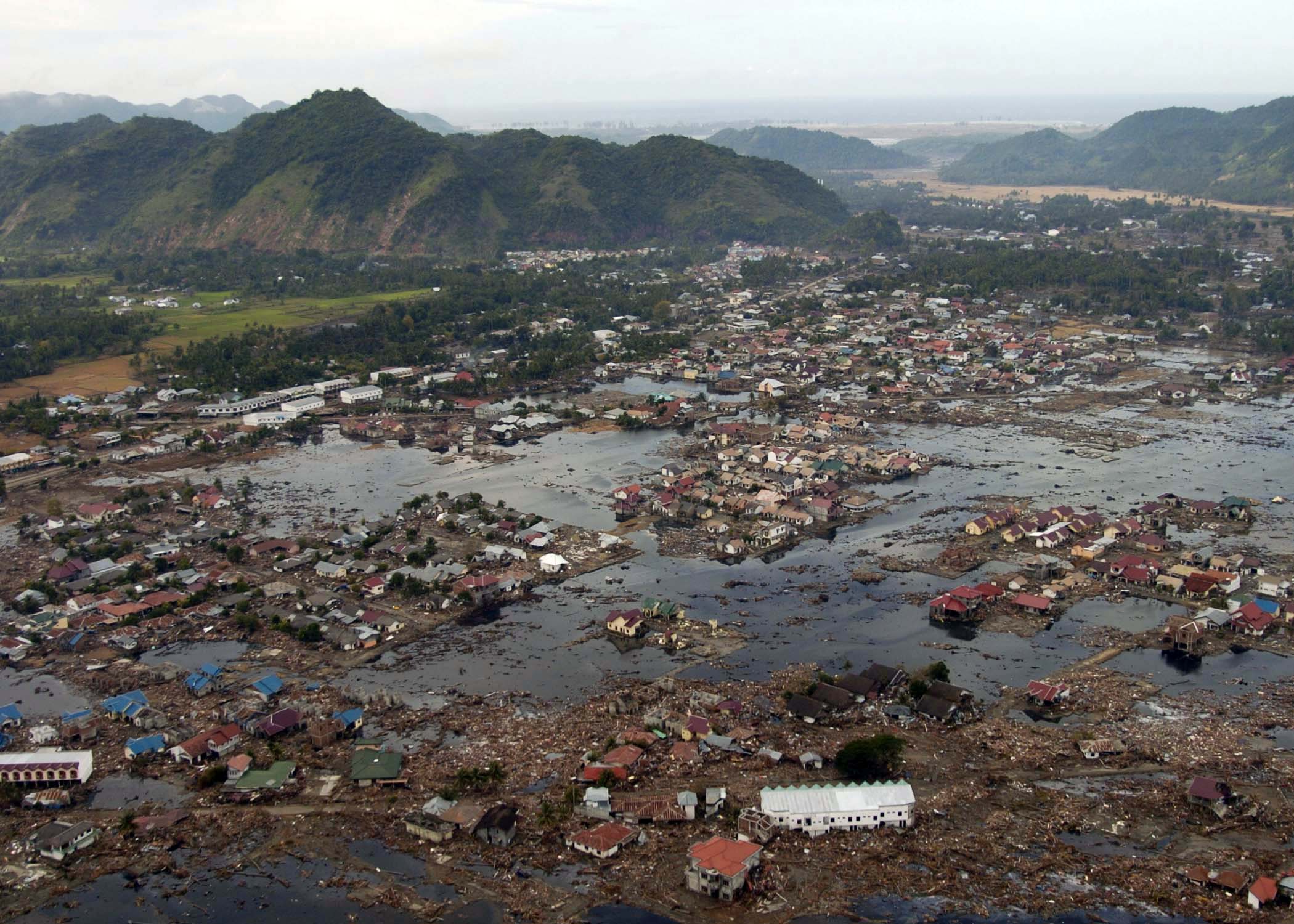
Trees: Question 9
 | Tree #1: Cracks in sidewalk and curb around an elm tree on Burrowes at University Park. |
 | Tree #2: Cracks in sidewalk and curb around an elm tree on Burrowes at University Park. |
 | Tree #3: Cracks in bike path below Sunset Park, State College. |
Walls: Question 10
This office wall image will be used to answer question ten.
