Module 11.2: Food Access and Food Insecurity
Module 11.2: Food Access and Food InsecurityIn this module, we will introduce the concepts surrounding the global challenge of food access and insecurity and the vulnerability of agri-food systems and particular populations to market and climate shocks. The concepts used in this unit build on the ideas of shocks and perturbations, resilience, adaptive capacity, and vulnerability of agri-food systems that were covered in unit 11.1. The unit, therefore, illustrates an urgent aspect of the analysis of the agri-food system as a coupled natural-human system.
Introduction to Food Access, Food Security, and Food-Insecure Conditions
Introduction to Food Access, Food Security, and Food-Insecure ConditionsFood access is a variable condition of human consumers, and it affects all of us each and every day. If you have ever traveled through an isolated area of the country or the world and encountered difficulty in encountering food that is customary or nutritious to eat, or within reach of your travel budget, you have an inkling of what it means to have issues with food access. For those with little capacity for food self-provisioning from farms or gardens, food access is determined by factors influencing the spatial accessibility, affordability, and quality of food sellers. The consistent dependability of adequate food access helps to enable food security whereby a person’s dietary needs and food preferences are met at levels needed to main a healthy and active life. Famines are conditions of extreme food shortage defined by specific characteristics (see below). Food-insecure conditions, such as acute and chronic hunger, are important conditions that affect many people both in the United States and in other countries.
Global Overview of Food Insecurity: Food Deficit Map and Required Readings
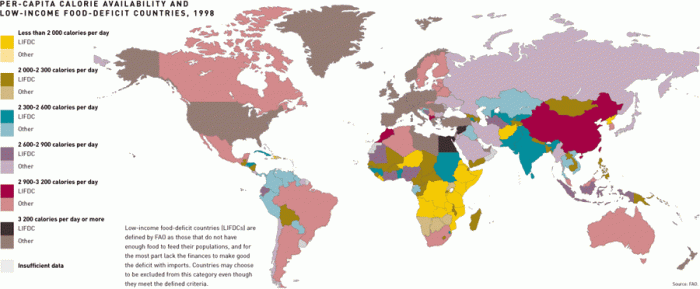
Global Overview of Food Insecurity: Food Deficit Map and Required ReadingsA global overview of food insecurity can be obtained by mapping the average daily calorie supply per person for each country (see Figure 11.2.1). Mapped values are shown as ranging from less than 2,000 calories per person (e.g., in Ethiopia and Tanzania) to the range of 2,000-2,500 calories per person, which covers several countries in Africa as well as India and other countries in Asia in addition to Latin America and the Caribbean. Calories are a reasonable way to begin to understand large-scale patterns related to the lack of food access around the world. Nevertheless just looking at calories hides other aspects of human nutrition, such as the need for a diverse diet that satisfies human requirements for vitamins, minerals, and dietary fiber, which were described in module 3.
Required Readings
The following brief readings are good ways to appreciate the analyses and debates surrounding food insecurity and the challenges of "feeding the world", especially in the emerging scenario of climate change impacts on food production. They form part of the required reading for this module and will help you to better understand the materials and the summative assessment.
- Bittman, Mark. "Don't Ask How to Feed the 9 Billion" NYT, Nov 12, 2014. (Note: The link is available only for users with Penn State accounts.)
- Deering, K. 2014. Stepping up to the challenge – Six issues facing global climate change and food security, CCAFS (Climate Change and Food Security Program)-UN (United Nations), 2014. Read the page headings on each challenge and the brief description of the response below.
Food Shortages, Chronic Malnutrition, and Famine: Coupled Human-Natural Systems Aspects
Food Shortages, Chronic Malnutrition, and Famine: Coupled Human-Natural Systems AspectsFood Crises and Interacting Elements of the Natural and Human Systems
This section employs the framework of Coupled Natural-Human Systems (CHNS) in order to illustrate the interacting elements of natural and human systems that can combine to produce severe food shortages, chronic malnutrition, and famine food systems around the world. These CHNS concepts build on the diagrams and concepts in modules 10 and 11.1. You will also apply these concepts in the summative assessment on the next page.
As you read this brief description consult figure 11.2.2 below. It depicts that interacting conditions within the human and natural systems, combined with driving forces and feedbacks, are at the core of many cases of severe food shortages, chronic malnutrition, and famine in agri-food systems.
The best place to begin interpreting Figure 11.2.2 is by focusing on the driving forces emanating out of both the human and natural systems. Human system drivers often involve political and military instability and/or market failures and volatility (such as prices). Most cases of famine, as well as many instances of severe food shortages and chronic malnutrition, involve these human drivers. In addition, human drivers not only drive vulnerability in natural systems but may act first and foremost on human systems, reducing the adaptive capacity of consumers and producers, for example by reducing the purchasing power of poor populations during price spikes.
Figure 11.2.2 also shows that drivers emanate from the natural system. Climate change and variation, such as drought and flooding, often contribute to cases of famine, as well as severe food shortages and chronic malnutrition.
These drivers, however, are only PART of the causal linkages of severe food shortages, chronic malnutrition, and famine. Similarly important are the conditions of poor resilience (potentially arising as result of weak social infrastructure), low levels of adaptive capacity and poverty. Poverty is tragically involved as a cause of nearly all cases of severe food shortages, chronic malnutrition, and famine. For Mark Bittman, the author of the required reading on the previous page, the link between poverty and failures of food systems, rather than a failure of any other human or natural factors such as food production, food distribution, or overpopulation, is the central thesis he advances in his short opinion piece. You may want to glance again at this reading in order to remind yourself of why poverty is so deeply implicated in the failures of agri-food systems.
Weak or inadequate resilience (R) and adaptive capacity (AC), along with vulnerability (V), are also symptomatic of natural systems prone to severe food shortages, chronic malnutrition, and famine. For example, cropping and livestock systems unable to tolerate extreme conditions illustrate a low level of adaptive capacity (AC) that can contribute significantly to the failure of agri-food systems.

Summative Assessment: Anatomy of a Somali Famine (2010 - 2012)
Summative Assessment: Anatomy of a Somali Famine (2010 - 2012)Instructions
Download the worksheet and follow the detailed instructions provided.
Files to Download
See worksheet on next page.
Anatomy of a Famine: multifactorial failures of adaptive capacity to climate and social shocks.
This worksheet relies heavily on the data resources presented by the Food Security and Nutrition Analysis Unit – Somalia and the Famine Early Warning System Network (FEWS Net).
This worksheet uses maps, tables, and graphs to guide you in analyzing a tragic famine in Somalia between 2010 and 2012 as a case of adaptive capacity and vulnerability (see Module 9.2 for the definition of a famine). As many as 260,000 people died in this famine, half of them children under five years old (optional: see Somalia famine 'killed 260,000 people', May 2, 2013). You should read carefully through the case study presented in the worksheet (download above) and answer the question in each section, e.g. “Question A1” and the two summary questions at the end.
Submitting Your Assignment
You do not need to submit your worksheet; it will instead act as a guide for you to complete the summative assessment quiz.