Module 11.1: Resilience, Adaptive Capacity, and Vulnerability (RACV): Agrobiodiversity and Seed Systems
Module 11.1: Resilience, Adaptive Capacity, and Vulnerability (RACV): Agrobiodiversity and Seed SystemsIn this module, we consider resilience, adaptive capacity, and vulnerability (RACV) of food systems through the lens of agrobiodiversity and seed systems. We will build on the awareness of human-natural system interactions that was explored in module 10.2. In this module, we examine the way that shocks and perturbations affect human systems and the ways in which human systems have found to cope with these shocks that produce resilience within food systems. You will learn about agrobiodiversity at a crop and varietal level as an important case of adaptive capacity that provides resilience to shocks for food systems within different types of food systems (e.g. smallholder, globalized). You will apply this learning to examining RACV in a case study from the southwestern United States.
Perturbations and Shocks in Agri-Food Systems
Perturbations and Shocks in Agri-Food SystemsPerturbations and shocks are common in food systems and involve both the “natural system” components and the “human system” components in these systems. Throughout modules 11.1 and 11.2, we will use the word shocks and perturbations fairly interchangeably to refer to these negative events that challenge food systems and their proper function, although the word "shock" denotes a perturbation that is more sudden and potentially disastrous. Perturbations and shocks in “natural” components include dramatic changes in climate factors such as rainfall, as well as changes brought on by biological components such as disease and pest outbreaks that affect plants and livestock. Similarly, perturbations can occur within the “human system” components of a system. For instance, food prices are rarely entirely constant and farmers and consumers are said to face "price shocks" in the purchasing of food.


Extreme conditions can result in major perturbations and shocks in agri-food systems. Major climate variation, such as severe or prolonged drought, is a common example with regard to major changes emanating from the natural system (see figure 11.1.1). Gary Paul Nabhan, the author of the required reading in this module, uses the example of the extreme "Dust Bowl" drought in the United States in the 1930s. Since it is already a region that receives little rainfall, the agri-food systems in the U.S. Southwest were considerably threatened by this drought. Extreme conditions endangering food-growing and availability can also arise in human systems. Examples include political and military instability as well as market failures and volatility (such as the sharp increase in prices).
The human-environment dynamics of major perturbations and shocks in agri-food systems are shown in figure 11.1.3. This figure uses the already familiar approach of Coupled Natural-Human Systems (CNHS) introduced in Module 1 and applied in module 10 and throughout the course. Here we apply it to interactions of the natural and human systems that result in reduced production and accessibility of food. The human response to perturbations and shocks can be understood by applying the CNHS framework to agri-food systems. Within this diagram, we also want to emphasize that because of the coupling and interactions within and among these systems, the human and natural systems are never just passive recipients of a shock. Both subsystems have mechanisms for responding that can either ameliorate or worsen the "crisis" effects of perturbation. These system properties and responses to shocks are considered through the concepts of resilience, adaptive capacity, and vulnerability (RACV), defined on the next page. In the next module (11.2) we will use the RACV and human-natural systems framework to understand shocks and system responses that result in famine and severe malnutrition.

Defining Resilience, Adaptive Capacity, and Vulnerability
Defining Resilience, Adaptive Capacity, and VulnerabilityIntroductory Video and Knowledge Check
Please watch the brief video about resilience and adaptive capacity. The presenter, Terry Chapin of the University of Alaska- Fairbanks, is an ecosystem ecologist who is used to thinking about the stresses that whole systems like ecosystems and food systems confront. Note that he uses the term 'resources' as roughly equivalent to the components of natural systems that support coupled human-natural food systems presented on the previous page. After the video in the knowledge check activity below, we'll ask you to identify the types of resources (i.e. components of natural systems) we've presented as vital to food systems in this course. You should, therefore, think about how the example he presents of Alaskan Native American communities and peoples can extend to many other elements of the food system.
Resilience: The importance of adaptive capacity (2:10)
Transcript: Resilience: The importance of adaptive capacity (2:10)
Many resource users all over the world have dealt naturally with variations in resource supply, and as a result they have a tremendous capability of getting access to resources. It's when other things begin to constrain their ability to deal naturally with their resources, then there the problems develop. So for example, when they become less dependent on resources and more dependent on a steady supply of food from the store, then they lose their flexibility to deal with natural resources. Or alternatively, when they move from a society that's migratory, to a society that's fixed in place by infrastructure, then they lose their capability to adjust. So I think one of the things that is most important for resource users, is to provide mechanisms by which they can use their natural ability to adapt to the environment, to be able to take advantage of fluctuations in resource supply. So in Alaska for example, one of the things, it used to be that people would move from place to place when there were changes in season. Or between years, if there was a wildfire, they would move to a place that still had the sorts of animals they used to harvest. And now that they're fixed in place by airports, and schools, and churches, and stores, and permanent housing, they no longer have this flexibility. So if we can provide other mechanisms to provide this flexibility, then they have a tremendous amount of creativity to be able to adapt and find ways to make use of resources. And they're proud of their ability to adapt and cope. So I think I'm optimistic about their ability to deal with climate change, as long as we can provide the other mechanisms of flexibility and empower them with the ability to make the choices that they wish to choose.
Knowledge Check Activity
Based on your learning in the course so far:
Question 1 - Short Answer
Try to quickly think of two important resources for food production like the ones described in this video. For each of the three, think of threats that confront these resources in their role of affecting food production.
ANSWER:
- Example 1
Resource: water
Threat: drought, climate change, decreased soil water holding capacity, depletion of aquifers (don't need to have all these, just examples) - Example 2
Resource: Soils and soil nutrients
Threat: soil erosion, too little manure, fertilizer, organic matter, and other soil inputs being returned to soils, urbanization, and loss of agricultural land base - Example 3
Resource: Crop production
Threat: pests, diseases, and weeds
Question 2 - Short Answer
Can you guess some examples of "adaptive capacity" by human systems within food systems we've seen so far?
Policies to regulate water use and water pollution, breeding of resistant crops, measures to maintain soil health, creation of irrigation systems, crop insurance
Definitions of Resilience, Adaptive Capacity, and Vulnerability
Resilience, adaptive capacity, and vulnerability (RACV) are three concepts used to explain how human and natural systems respond to perturbations and shocks. We can use these concepts to understand the responses of agri-food systems to such factors as drought or the occurrence of market shocks or political crises. Here are some definitions of the RACV concepts, understood within a Coupled Natural-Human System Framework.
Resilience
Resilience is a system property which denotes the degree of shock or change that can be tolerated while the system maintains its structure, basic functioning, and organization. Talking about resilience usually implies thinking about the resilience “OF what TO what”. That is, we need to understand the resilience of a system (what system or process?; e.g. crop production; food distribution; farming or culinary knowledge) TO a threat or shock (what kind?; e.g. drought, war, plant disease). A recent report from a United Kingdom scientific commission states that resilience is “the capacity to absorb, utilize or even benefit from perturbations, shocks and stresses” which includes the idea that resilient systems, provided they are sufficiently robust, can even benefit from perturbations.

Adaptive Capacity
Adaptive capacities are the social and technical skills and strategies of individuals and groups that are directed towards responding to environmental and socioeconomic changes. In the context of food systems, adaptive capacity is usually exhibited or deployed to maintain livelihoods, food production, or food access. In the context of climate change, it is important to distinguish between adaptive capacity vs. mitigation: Adaptive capacity is deployed to adapt to perturbations in growing or living conditions or shocks brought on by climate change. Mitigation involves actively reducing the threat of climate change, rather than adapting to its effects: for example reducing emissions, reducing meat consumption among high-meat consuming populations, or geoengineering of the atmosphere to reduce CO2 concentrations.
Adaptive capacity is the second important property that refers to the responsiveness of agri-food systems when faced with extreme conditions. Human systems might, for example, have the capacity to switch to alternative land use within the agri-food systems. In these cases, people would be able to adapt to change since they have the capacity to shift their use of land and other resources. Adaptive capacity in the case of natural systems is exemplified by drought-tolerant crops (figure 11.1.5). Such crops may have more developed root systems or biological adaptations for conserving moisture.

Vulnerability
Vulnerability is the exposure and difficulty of individuals, families, communities, and countries in coping with shocks, risk, and other contingencies. This can be thought of as the opposite of adaptive capacity, with a continuum of mixed adaptation/vulnerability in between the two extremes of adaptive capacity and vulnerability. Farmers and consumers in extremely poor and isolated circumstances (whether in urban or remote areas) can be considered highly vulnerable because they lack their own ability to adapt to threats, and may be cut off or marginalized from external resources (family, government assistance etc.) that allows them to adapt to changes.
Now we can apply the concepts of resilience, adaptive capacity, and vulnerability to agriculture and food, using a Coupled Natural-Human System (CNHS) framework (Figure 11.1.6).
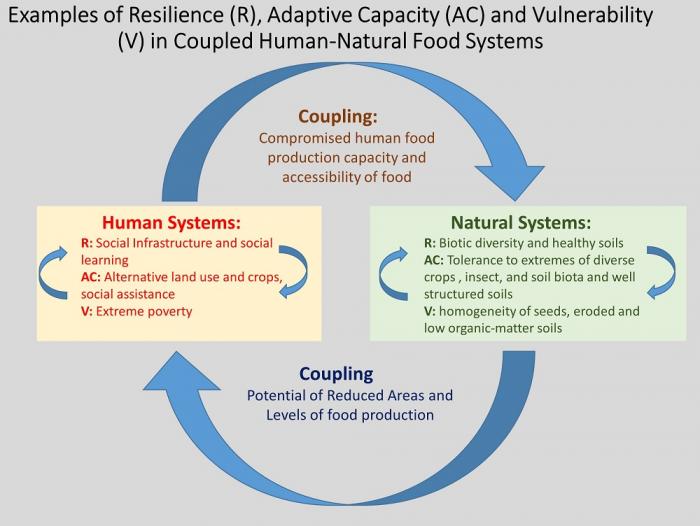
Text description of Figure 11.1.6.
Examples of Resilience (R), Adaptive Capacity (AC), and Vulnerability (V) in Human systems and natural systems
Human Systems:
R: Social infrastructure and social learning
AC: Alternative land use and crops, social assistance
V: Extreme poverty
Natural Systems:
R: Biotic diversity and healthy soils
AC: Tolerance to extremes of diverse crops, insect, and soil biota and well structured soils
V: homogeneity of seeds, eroded and low organic-matter soils
As shown in Figure 11.1.6, resilience can be found in both the natural and human subsystems of food systems. You may recognize that many of the examples of natural system adaptive capacity refer to the "best practices" that we have advocated for water, soils, crops, and pest management in sections II and III of this course. These would include examples such as reducing the water footprint of food production, managing soils in a system framework for greater "soil health", and managing pests with ecological practices that seek to avoid pest and weed resistance to our management approaches (Modules 4, 5, 7, and 8 respectively). These approaches are not only important in increasing productivity under average conditions, but also help a food production system to adapt to shocks and perturbations.
Meanwhile, the human component of coupled human-natural food systems also is a vital part of resilience and adaptive capacity. Resilience is higher where there are higher levels of social infrastructure that enable people to share learning and resources in response to shocks and perturbations, such as extreme drought. Social infrastructure, shown in Fig. 11.1.6, includes mutual assistance within families and communities or among regions in a country, coordinated by governments to assist in the case of shocks that affect food production. Social learning is vitally important since it’s one of the main ways that people would learning new techniques based on the conditions prevailing in their area. For example, farmers could use social learning to acquire the skills and knowledge to lessen water use, and thereby lessen the degree of agricultural production decline and reduced food access. Biological diversity is a major example of higher resilience functioning in the natural components of coupled agri-food systems. Food production systems with more biological diversity---a property referred to as agrobiodiversity and covered on the next pages---typically have the capacity for greater levels of resilience. This greater level of resilience may result from a mixture of crops and varieties combining vulnerable and resistant type of crop, for any given stress, so that even if some crops fail, others will do well. Different crops and land uses may also produce positive or facilitating interactions in which one crop type or wild plant species, for example, provides benefits to another (e.g. nitrogen fixation and better soils or screening from an important pest; see module 6 on crops and the previous section on systems approaches for management for additional examples).
Resilience vs. Adaptive Capacity: What's the Difference?
On the surface, resilience and adaptive capacity in systems may seem very similar, and it is true that as defined here they are very aligned. One way to remember the difference is that resilience is a broader system property that may have to do with the interplay of human and natural systems, or one or the other of these subsystems. We can say that a region's food system is quite resilient to drought (a more general statement) if we think for a number of reasons that its food supply would be able to continue mostly without issues during a drought. Adaptive capacity meanwhile is more narrowly focused on the specific skills and mechanisms that are deployed by human systems to contribute to resilience. In other words, we might identify that the system or component thereof is resilient (like the region mentioned above), and then identify sources or mechanisms of resilience in terms of particular knowledge, practices, land uses, or biological properties that are functioning in a food production system, referring to these as adaptive capacity. We turn next to agrobiodiversity as an example of adaptive capacity that can contribute to food system resilience (can you see the difference between the two words in this last sentence?).
Agrobiodiversity: Biological Diversity and Associated Human Capacity in Agri-food Systems
Agrobiodiversity: Biological Diversity and Associated Human Capacity in Agri-food SystemsOne major way of increasing the resilience and adaptive capacity of agri-food systems in response to perturbations and shocks is to be certain they contain components with high levels of agrobiodiversity.
Here is a standard definition of agrobiodiversity:
Agricultural biodiversity…includes the cornucopia of crop seeds and livestock breeds that have been largely domesticated by indigenous stewards to meet their nutritional and cultural needs, as well as the many wild species that interact with them in food-producing habitats. Such domesticated resources cannot be divorced from their caretakers. These caretakers have also cultivated traditional knowledge about how to grow and process foods.. (which) is the legacy of countless generations of farming, herding and gardening cultures.
This definition is taken from Gary Nabhan’s book Where Our Food Comes From and is based on work of the United Nation’s Food and Agriculture Organization (FAO)

There are two important points to note about this definition:
- First, and most importantly, the biological diversity of agri-food systems includes vital coupling to the human system, most directly the people who are growers and their skills, knowledge, and other factors. These growers are “caretakers” in Nabhan’s definition; see Fig. 11.1.7 for potato varieties and a representative "caretaker" - a local farmer with working knowledge of these varieties. Agrobiodiversity exists squarely at the intersection of human and natural systems conceptualized in this course.
- Second, it encompasses both our cultivated species of plants and animals, which are crops and livestock chosen and evolved for production, as well as their still living wild relatives and the biodiversity of the ecosystems associated with this production (both the agroecosystem itself and the surrounding uncultivated ecosystem). Agrobiodiversity production in the natural system must be sufficient to offer positive feedbacks into the human system in order to offer the incentive for continued production.
The above-mentioned points in the definition of agrobiodiversity are illustrated in figure 9.6, which depicts agrobiodiversity as a Coupled Human-Natural System (CNHS).

The growers of agrobiodiversity range widely around the world. They include the people of traditional and indigenous cultures who often live in more remote locations. Many of these people live in mountainous regions and hill lands of the tropics and sub-tropics. Their use of agrobiodiversity in agri-food systems is reflected in certain global centers of diversity, as shown in the map that we presented in Module 2 regarding the sites of crop domestication in the early history of food systems. Such centers are sometimes called “Vavilov Centers” in recognition of the pioneering contribution of the scientist Nikolay Vavilov in the 1920s.

Increasingly it’s recognized that significant agrobiodiversity also occurs outside the Vavilov Centers. For example, many urban and peri-urban dwellers grow small fields and gardens as part of local, small-scale agri-food systems. Producers of diversified production for local markets in North America and Europe are still another important group of agrobiodiversity-growers.
The extent of agrobiodiversity, in terms of crops and livestock, may vary from only a few types in a field or farm to many dozens. Agri-food systems with only a few types are quite important since they can confer significant resilience to perturbations and stressors. For example, cultivation of only a few types of barley, wheat, or maize (“corn” in the U.S.) among neighboring farms and communities can offer a much higher degree of resilience than the monoculture of a single type.

Equally important is the case of the megadiverse agri-food systems. In the potato fields of the Andes Mountains of western South America, for example, a farmer may grow as many as 20-30 major types of potatoes in a single field. (Figure 11.1.11). Here, in tha global “Vavilov Center” of the Andes mountains, high levels of agrobiodiversity are integral to the agri-food system as a result of factors in the human system (skills, knowledge, labor-time, cultural and culinary preferences) and the natural system (highly varied climate and soil conditions characteristic of tropical mountains).

Activate Your Learning: Agrobiodiversity and Resilience
Assigned Reading:
Please read the brief "introduction to the reading" below and then the following pages from Gary Nabhan's book "Where Our Food Comes From":
Nabhan, G.P. "Rediscovering America and Surviving the Dust Bowl: The U. S. Southwest ", p. 129-138, part of Chapter 9, Where Our Food Comes From: Retracing Nikolay Vavilov's Quest to End Famine. Washington: Island Press.
Introduction to the reading: The reading describes part of a much longer account of travels by Vavilov (for whom the Vavilov centers of agrobiodiversity are named, see the previous page in the book, and module 2.1 in this course) from 1929 to 1934 in North America. During this trip, the Russian crop researcher met with U.S. researchers as well as "keepers" of U.S. native agrobiodiversity. This chapter describes Vavilov's trip to the Hopi Indians in 1930, in which he and the U.S. scientists were able to observe firsthand the seed systems and their resilience to the drought that was currently going on in the United States. The author of the book, Gary Nabhan, relates this account of the visit and then compares it to similar visits he made to the Hopi in the more recent past. This compiled history of seed systems and their relation to both human and natural system changes in the U.S. Southwest is a sort of case study, from which the assessment worksheet will ask you to draw conclusions.
Download Worksheet
Activate Your Learning
This exercise requires you to fill in some of the blanks in the worksheet based on the reading.
Two of the shocks that the Hopi food system has been exposed to have already been filled in on the worksheet, the main one being periodic drought. Within the human system box, fill in some of the agricultural methods (ways of growing food) described by Nabhan that represent adaptive capacity to drought shocks.
Click for answer.Deep planting of crops to capture moisture, spring-fed terraces, stream-side fields to capture flood moisture.In the natural system box, fill in how agrobiodiversity and their seed systems also represented adaptive capacity of the Hopi against drought.
Click for answer.Diverse crops adapted to local conditions, local seed saving so that seeds were not lost, tree crops and edible wild plant gathering to supplement diet.During the more recent drought, Nabhan states that an additional climatic factor related to climate change tended to worsen the effects of drought. What was this? Place it in the additional shock box at the lower edge of the diagram.
Click for answer.Hotter summer temperatures due to climate change.A shock that emerged from the human system was the pumping of groundwater for coal mining and coal slurry transport in the region. What was the vulnerability to drought in the local natural system that this water extraction created? Fill it in in the “vulnerabilities” box in the natural system part of the diagram.
Click for answer.Pumping of groundwater for coal mining dries out springs and reduces the availability of spring water for irrigated terraces.In the last part of the chapter, Nabhan notes first a social/cultural vulnerability that has emerged in recent times. What is this social vulnerability? Note it in the vulnerability space of the Human System rectangle.
Click for answer.Shift toward salaried work in cities by young people within the community.Nabhan also notes a new social adaptive capacity that has arisen to challenge this vulnerability. What is this newest change that gives Nabhan hope about the fate of Hopi seed and agricultural systems?
Click for answer.Hopi organizations that seek to revitalize farming traditions and the Hopi food system.Of the three shocks now documented in the diagram, to which one would the Hopi knowledge system and adaptive capacity been most exposed to over recent centuries? Answer in one sentence.
Click for answer.Likely, drought would have been a recurrent shock with which Hopi knowledge systems and adaptive capacity would have been familiar.Compare the level of success the Hopi food system had in adapting to the older, better-known shock you chose in (7), in comparison to the other two shocks, at least during the last thirty years. (3-4 sentences, this may make the page run over to the next).
Click for answer.It was more challenging to adapt to these later shocks – their effects may have been unfamiliar based on long experience, and also they tend to affect not just production but the very means of existing adaptive capacity, for example limiting the effectiveness of known farming strategies (e.g. spring-fed terraces) or the entire knowledge system from which the Hopi drew their adaptive capacity. (some version of the above is acceptable as an answer: explain that it is more challenging and some reference to why that was so)