9.2 Mechanisms of Heat Transfer
9.2 Mechanisms of Heat TransferHeat transfer is the movement of thermal energy from a hotter system to a colder system. This process is driven by temperature differences and is classified into three different mechanisms: conduction, convection and radiation.
Conduction
Conduction is the transfer of heat through direct contact between particles in a solid object. Heat moves from the warmer area to the cooler area through particle collisions.
In solids, atoms and molecules cannot move freely like they do in liquids or gases. Instead, they vibrate in place. When an atom or molecule gains energy, it vibrates more vigorously and transfers that energy to neighboring atoms through physical contact.
Example: In the image below, heat travels from the end of a metal rod in a candle flame to the cooler end. The vibrations pass from one molecule to the next, but the molecules themselves do not move from their positions.
Convection
Convection is the transfer of heat through the movement of fluids (liquids or gases).
In residential heating, convection occurs when warm air rises and cold air sinks. When you open a door, warm indoor air escapes outside while cold air enters through cracks around windows and doors. Inside a room, cold air near the floor absorbs heat from the heater, becomes less dense, and rises. Meanwhile, heavier cold air sinks to take its place, creating a circulation pattern that gradually warms the entire room.
In the image below, heat (energy) is conducted from the end of the rod in the candle flame further down to the cooler end of the rod as the vibrations of one molecule are passed to the next; however, there is no movement of energetic atoms or molecules.
Radiation
Radiation is the transfer of heat through electromagnetic waves. Unlike conduction and convection, radiation does not require any material medium—it can travel through empty space.
Example: In the image below, sunlight travels through the vacuum of space to reach Earth, even though there are no gases, solids, or liquids to carry the energy.
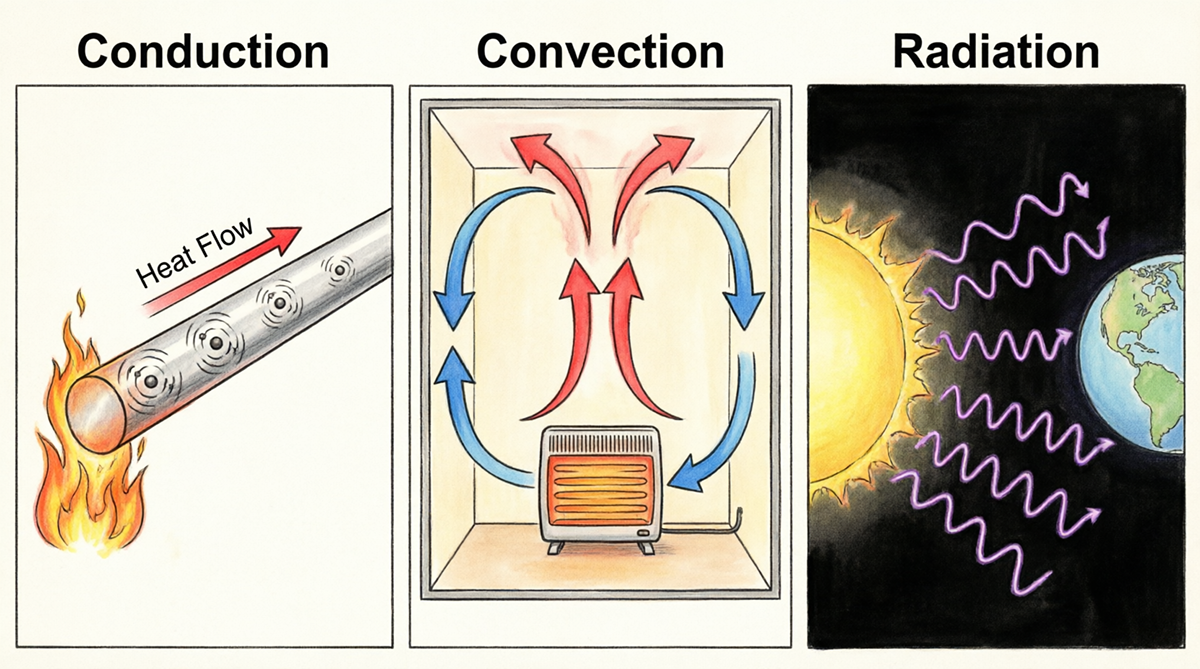
Text description of the Conduction, Convection, and Radiation image.
The image illustrates three methods of heat transfer: conduction, convection, and radiation, each represented within its own panel. The conduction panel on the left depicts a metal rod with visible heat flow represented by concentric circles and an arrow pointing from a flame on the left side of the rod. The middle panel shows convection within a box featuring a heater at the bottom. Arrows indicate a circular flow of red (warm) air rising and blue (cool) air descending. The right panel depicts radiation with the sun on the left emitting wavy lines towards Earth on the right, representing heat transfer through space.
The image below shows how heat can be lost in your home. Where do you think the majority of your energy losses occur?

Text description of the Heat Loss Examples image.
The image depicts a cutaway view of a two-story house, illustrating air flow patterns through various rooms. The house is divided into sections displaying different parts, including the bathroom, living area, and basement.
On the upper level, the bathroom is on the left, featuring a mirror above a sink, next to a toilet and a visible ventilation pipe. In the living area, there is a window and a door leading to a hallway, behind which is a chimney. The right section houses a laundry room with a washer and dryer, while a staircase leads to the basement.
The basement, situated below the main floor, contains a furnace and water heater. Arrows in various colors indicate air movement: red arrows show warm air rising, blue arrows show cool air descending, and purple arrows illustrate drafts or ventilation.
The structure has a gabled roof, and the exterior walls have visible masonry. The surrounding land includes a lawn.