Lesson 10: Home Cooling and Windows
Lesson 10: Home Cooling and WindowsThe links below provide an outline of the material for this lesson. Be sure to carefully read through the entire lesson before returning to Canvas to submit your assignments.
10.1 Lesson 10 Introduction
10.1 Lesson 10 IntroductionWelcome to Lesson 10
Welcome to Lesson 10. In our last module, we explored how home heating systems and insulation work together to retain thermal energy and keep your living space comfortable during colder months. Now, we’re shifting our focus to the opposite seasonal challenge: how to effectively cool your home while managing energy use, indoor comfort, and utility costs.
As we dive into cooling strategies, we’ll also examine a critical but often overlooked factor: humidity. You’ve probably noticed that an 85°F day with high humidity feels far more oppressive than a 90°F day with dry air. This isn’t just in your head it’s thermodynamics. We’ll explore how water vapor in the air carries latent heat, interferes with your body’s natural evaporative cooling process, and forces air conditioning systems to work significantly harder to maintain comfort. Understanding this relationship will help you choose smarter cooling strategies, size equipment correctly, and avoid common energy waste.
Next, we’ll turn our attention to one of the most influential components of your building envelope: windows. While windows bring in valuable daylight and connect us to the outdoors, they can also be major pathways for unwanted summer heat gain. We’ll break down exactly how window orientation, glazing type, shading, and performance metrics like Solar Heat Gain Coefficient (SHGC) and U-factor directly impact your cooling load. You’ll learn how strategic window selection, placement, and retrofits can significantly reduce energy demand, lower your electricity bills, and improve year-round comfort.
Lesson 10 Objectives
Upon completing this lesson, you should be able to:
- Explain how natural and mechanical air-cooling systems affect building energy use
- Describe how an air conditioner works
- Describe different types of air conditioning systems
- Calculate the monetary savings when the efficiency of an air conditioner is improved
- Describe how high humidity affects both human thermoregulation and HVAC system performance
- Explain the relationship between humidity and temperature
- Identify key window performance metrics (U-factor, SHGC, VT, air leakage) and their impact on cooling demand
10.2 Humidity
10.2 HumidityWhy Humidity Matters
Humidity is one of the main reasons hot weather can feel uncomfortable. Sometimes it is not just the air temperature that makes us feel hot, but also the amount of water vapor in the air.
Our bodies cool themselves by sweating. When sweat evaporates from the skin, it removes heat from the body. However, when the air already contains a lot of moisture, sweat does not evaporate as easily. This makes it harder for the body to cool down, so we feel warmer and more uncomfortable.
Humidity also matters in buildings because it affects both comfort and energy use. If indoor air is too humid, people may lower the thermostat to feel cooler, which increases energy use. Managing humidity can therefore help improve comfort while also reducing cooling costs.
Air Composition and Pressure
Air is a mixture of several gases, including nitrogen, oxygen, and water vapor.
- The total air pressure exerted by a volume of air in a given container on that container is the sum of the individual (partial) pressures of these gases.
- The vapor pressure is the individual or partial pressure of the water vapor.
Warm air can hold more water vapor than cool air. This is why humidity changes with temperature. As air warms up, its moisture-holding capacity increases. As air cools down, it can hold less water vapor, and some of that moisture may condense into liquid water.
The Psychrometric Chart
A psychrometric chart is a tool used to show the properties of air at different temperatures and moisture levels. It helps us understand how temperature and humidity work together.
The chart shows that as air temperature increases, the amount of moisture the air can hold also increases. This is an important idea in heating, ventilation, and air conditioning (HVAC), because comfort depends on both temperature and moisture content.
A psychrometric chart (shown below) graphically represents the moisture content of air at various temperatures. The chart demonstrates that as air temperature increases, the amount of moisture that dry air can hold also increases.
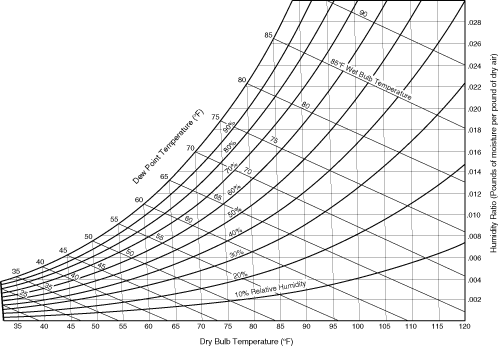
Text description of the Psychometric Chart image.
The image is a psychrometric chart, which is a graphical representation of the physical and thermal properties of moist air. The chart is structured with a grid of curved and straight lines.
- The horizontal axis represents Dry Bulb Temperature in degrees Fahrenheit, ranging from approximately 30°F to 120°F.
- The left vertical axis is labeled Humidity Ratio, measured in pounds of water vapor per pound of dry air, with values ranging from about 0.002 to 0.028.
- Curved lines represent constant Relative Humidity (RH) percentages, labeled at intervals like 10%, 20%, up to 100%.
- Several sets of diagonal lines run across the chart:
- Lines of constant Wet Bulb Temperature appear, measured in degrees Fahrenheit.
- Lines of constant Dew Point Temperature, also in degrees Fahrenheit, angle slightly less steep than the Wet Bulb lines.
Measuring Moisture in Air
Absolute Humidity is the actual amount of moisture that is contained in air. It is represented in the formula below:
Relative humidity (RH), is the ratio of the amount of moisture in the air to the maximum amount of moisture the air can hold at a given temperature, expressed as a percentage It is represented in the formula below:

Text description of the Relative Humidity image.
The image depicts a black chalkboard with a mathematical equation for calculating relative humidity written in white chalk. The equation reads: "Relative Humidity = (Amount of Water Vapor (lb)) / (Max. Amount of Water Vapor Air can hold) x 100." The terms "at a given temperature" and "at that temp." are indicated in smaller font beneath the numerator and denominator respectively. The color and texture suggest a vintage blackboard surface.
Example 1
Calculate the relative humidity of air when the air contains 0.002 lb of moisture per pound of dry air, while the maximum moisture air can hold at that temperature is 0.005 lb per lb of dry air.
Key Temperature Concepts
- Dry bulb temperature: The dry-bulb temperature is the regular air temperature measured by a thermometer. It is called “dry-bulb” because the thermometer bulb is dry. This is the temperature we usually see in weather reports.
Dew point Temperature: The dew point is the temperature at which air becomes fully saturated with water vapor. If air cools to its dew point, water vapor begins to condense into liquid water. This is how dew forms on grass or how moisture can form on a cold surface. A higher dew point means there is more moisture in the air. When the dew point is high, the air often feels muggy and uncomfortable.
Water vapor can store and transfer heat energy differently than dry air. Because of this, moist air often feels warmer and heavier than dry air at the same temperature. High humidity can make summer weather feel much hotter, while lower humidity usually feels more comfortable.
Saturation and Condensation
Saturation occurs when air contains the maximum amount of water vapor possible at a given temperature and pressure. At saturation:
- Relative humidity = 100%
- Air cannot hold additional moisture in vapor form
Condensation occurs when:
- Relative humidity reaches 100%, or
- Air is cooled below its dew point temperature, or
- Moist air contacts a surface cooler than the dew point temperature
Important: The coldest surface in a room is typically where condensation will occur first (called the "first condensing surface"). For air at a given absolute humidity, the colder the surface, the higher the relative humidity at that surface.
Temperature and Moisture Relationships
- As air warms: Water molecules move faster and remain in the gas phase; air can hold more moisture
- As air cools: Water molecules slow down and are more likely to condense onto surfaces
- At dew point: Air is saturated (100% RH); any further cooling causes condensation
Relative Humidity Isn't What You Think it Is (3:25)
Transcript: Relative Humidity Isn't What You Think it Is (3:25)
This episode is brought to you by the Music for Scientists album, now available on all streaming services. Click the link in the description to start listening.
[♪ INTRO]
If you’ve ever paid close attention to the humidity levels on your phone’s weather app, you might have noticed that they seem to make no sense. Like, in the summer, your app can say there’s 75% humidity, and you’ll be sticky and sweaty. But during winter, 75% might mean that your skin is super dry. So, what’s going on here?
Well, it turns out that the most common definition of humidity is… kind of inconvenient. But there is a better way to think about it. It all comes down to the fact that your phone, and most weather channels, specifically report relative humidity.
This number is measured in percentages, and it’s the amount of moisture in the air compared to how much water the air can hold. And the key is, how much water the air can hold depends a lot on temperature. See, for water vapor to come out of the air, it has to go from a gas to a liquid — usually, by condensing onto something like dust, or your window glass. And for something to go from a gas to a liquid, it has to lose energy. In other words, the molecules have to physically slow down.
Well, when the air is warm, the water molecules in it contain a lot of energy. They’re moving more than water molecules in cooler air. That means they’re less likely to condense out of the atmosphere — and they end up hanging out in the air and making things feel all sticky.
Humidity and temperature. So, temperature plays a big role in relative humidity. And it’s why this stat usually isn’t that useful in planning your day. If it’s -10 degrees Celsius, the air can’t hold onto as much moisture — so 75% humidity isn’t actually that humid. But if it’s 20 degrees, 75% humidity suddenly means there’s a lot more water in the air to make things feel all muggy.
If you want a number for humidity that isn’t quite so relative… try the dew point temperature. This is the temperature at which water droplets or dew form on things like grass. In other words, it’s the temperature at which the air is completely saturated with moisture. And the closer the dew point temperature is to the temperature outside, the stickier and more unpleasant it will be.
For reference, people react differently to dew points, but most folks are comfortable with a dew point of 10 degrees Celsius. And things get pretty humid and unpleasant around 15 or 21 degrees. So, it’s still a new scale to learn… but it’s also consistent no matter how cold it is outside.
Science inspiration. Now, the big question is, if the dew point temperature is a great way to tell you how the outside world feels, why don’t weather apps and weather channels use it? It’s mostly a matter of history. Instruments that measure relative humidity predate the ones that measure dew points. Like, one of the first mechanical hygrometers, a device that measures humidity, appeared in 1783. And since these devices were widely available to the public and gave reliable measurements of relative humidity, the term, unfortunately, stuck around.
...you know what else is available to the public and gives reliable science inspiration? Music for Scientists, a tribute album to science inspired by the beauty of science. It was written and recorded by Patrick Olsen, and if you want to check it out, I’d recommend starting off with the song “Aristarchus in the Rain” — which isn’t about humidity, but is about a scientist trying to make sense of this messy and cloudy world. If you want to check it out, look for “Music for Scientists” on all major music streaming services, or click the link below.
[♪ OUTRO]
 Saturation is the maximum amount of water vapor in the air at an existing temperature and pressure. Air is said to be saturated at 100 percent relative humidity when it contains the maximum amount of moisture possible at that specific temperature.
Dew point is the temperature when air reaches 100% relative humidity.
10.3 Air Conditioning
10.3 Air ConditioningNow that we understand how humidity affects comfort and how windows influence heat gain, we turn our attention to the systems designed to manage both: air conditioning.
Air conditioning is about more than just lowering temperature. A well-designed system simultaneously:
- Cools the air (removes sensible heat)
- Dehumidifies the air (removes latent heat)
- Filters and circulates air for indoor air quality
- Maintains relative humidity in the comfort zone (~40–60%)
Why Cooling Also Means Dehumidifying
When warm, humid indoor air passes over the cold evaporator coil inside an air conditioner, two things happen simultaneously:
- Sensible cooling: The air temperature drops as heat energy transfers to the refrigerant.
- Latent cooling: As the air cools, its capacity to hold moisture decreases. When the air reaches its dew point, water vapor condenses on the coil and drains away.
Real-World Observation

The Comfort Zone: Targeting ~50% Relative Humidity
Temperature: 72–78°F (22–26°C)
Relative Humidity: 40–60% (ideally ~50%)
| Humidity Level | Comfort Impact | Energy Impact |
|---|---|---|
| < 30% RH | Dry skin, irritated respiratory passages | May require humidification (adds energy) |
| 40–60% RH | Optimal comfort, effective evaporative cooling | Efficient AC operation |
| > 60% RH | "Sticky" feeling, reduced sweat evaporation, mold risk | AC works harder; may need dedicated dehumidifier |
Why 50%? At this level, your body's natural cooling mechanism—sweat evaporation—works efficiently. Higher humidity slows evaporation, making you feel warmer even at the same temperature. This is why a humid 82°F day can feel like 90°F.
10.4 How Air Conditioners Work
10.4 How Air Conditioners WorkContrary to what is generally assumed, outside air is not cooled inside the air conditioner and then supplied inside. Only heat energy is moved or pumped by the air conditioner from a low temperature environment (inside the building) to a high temperature environment (outside the building).
What Air Conditioning Actually Does (and Doesn't Do)
An air conditioner DOES:
- Transfer heat energy from indoors to outdoors
- Remove moisture (water vapor) from indoor air
- Filter and recirculate indoor air
- Maintain setpoint temperature and humidity
An air conditioner does NOT:
- "Create cold" (cold is simply the absence of heat)
- Bring in large amounts of outdoor air (unless designed for ventilation)
- Remove indoor air and replace it with outdoor air (that's ventilation, not cooling)
How Air Conditioning Works (4:38)
Transcript: How Air Conditioning Works (4:38)
If you’re feeling the summer heat, you might be tempted to switch on the machine that makes all the problems go away: your air conditioner. And the source of that sweet relief? Well, of course it’s chemistry.
Air conditioners pull off the seemingly magical feat of making the air inside a home, car, or shopping mall deliciously chilly. Air conditioning -- and refrigeration, which is the same thing just in a slightly smaller box -- rely on the laws of physical chemistry.
And p-chem tells us that as a liquid evaporates into a gas, it absorbs heat. The molecules in a liquid are held together by weak intermolecular interactions. Not quite chemical bonds, just enough passing attraction to keep them from flying apart. Some of the molecules absorb enough heat energy -- in other words, they get moving fast enough -- to overcome these intermolecular attractions, ESCAAAAPE and take gaseous form.
That’s the reason you feel chilly getting out of the shower, and why we sweat to stay cool. The water has to absorb heat to evaporate. And it carries that heat away from you.
An air conditioner’s basic job, then, is to use a fluid called a refrigerant that constantly changes from a liquid to a gas and back to a liquid again to move heat from one place (your sweaty bedroom) to another (outside, where it’s already hot and miserable anyway, so who cares.)
Here’s a admittedly very schematic-ified version of how most a/c units work. The liquid refrigerant flows through a series of coils exposed to the air in your home. The refrigerant has a low boiling point, so the heat from the interior air is enough to make it turn into a gas. Which means there’s now more heat in the refrigerant, and less in the air. A fan blows that colder air into your room. Or straight into your face, we’re not judging.
So now your A/C has to do two things: dump the heat absorbed by the refrigerant outside, and two, it has to condense the refrigerant back into a liquid so it can be used again. And to do those things it uses a compressor to ramp up the pressure on the gaseous refrigerant -- so much that it can condense into a liquid again, even though it’s at the warmer outside temperature.
As it condenses, the refrigerant loses heat to the air around it, which another fan blows outside, where it’s already all sticky anyway. Which is a neat trick, boiling something at a low temperature and then condensing it at a high one.
Nothing in thermodynamics is free, and the compressor needs energy to do the work of compressing the refrigerant. Which may explain your power bills in July.
After the refrigerant condenses, the air conditioner backs off the pressure with an expansion valve, so that the refrigerant can boil at the lower temperature again. Which it does, in a loop, over and over until your home reaches the temperature you set the thermostat to, or your housemates complain and switch it off.
While the refrigerant could be practically any substance, there are some chemicals that do the job better than others, and these refrigerants have a checkered history. A refrigerant needs to have a pretty low boiling point, and one that can be adjusted to where you want it by changing the pressure on it. It should also be pretty good at conducting heat, be able to absorb a lot of heat as it boils. AND THEN it needs to be cheap, widely available, and as non-flammable and non-toxic as possible. That kinda narrows your choices of chemical.
Scientists thought they’d found the perfect refrigerant with Freon, the trade name of a group of chemicals called chlorofluorocarbons. But CFCs are actual murder to the ozone layer. They’ve been largely replaced with hydrofluorocarbons, or HFCs. HFCs don’t damage the ozone layer, which is good! But they have a different problem...they’re greenhouse gases.
So the search is on to phase out HFCs too. Some alternatives? Simple hydrocarbons like these have been approved in the USA. Hydrofluoroolefins like this one are less rough on the climate than HFCs, but also more expensive. The most surprising potential replacement is CO2. CO2 totally works as a refrigerant, and even though it is the literal poster child for greenhouse gases, it’s also way less potent than HFCs.
Whatever we use in the future, it doesn’t seem likely that we’ll give up on AC altogether. Not in a scorching summer like this one. Pass the popsicles, wouldja?
Thanks for watching, and if you want to help us keep making great videos like this one, ...
How the Refrigeration Cycle Moves Heat
At the heart of every air conditioner is a closed-loop refrigeration cycle. Here's a simplified breakdown of the four main components and what they do:
1. Evaporator Coil (Indoor Unit)
- Cold, low-pressure liquid refrigerant enters the coil
- Warm indoor air blows over the coil
- Refrigerant absorbs heat from the air and evaporates into a gas
- Moisture in the air condenses on the cold coil and drains away
- Cooled, dehumidified air is circulated back into the room
2. Compressor (Outdoor Unit)
- Low-pressure refrigerant gas is compressed
- Compression increases both pressure and temperature of the refrigerant
- The refrigerant leaves as a hot, high-pressure gas
3. Condenser Coil (Outdoor Unit)
- Hot refrigerant gas flows through the condenser coil
- A fan blows outdoor air over the coil
- Heat transfers from refrigerant to outdoor air
- Refrigerant condenses back into a high-pressure liquid
4. Expansion Device (Metering Device)
- High-pressure liquid refrigerant passes through a small orifice
- Pressure drops dramatically, causing the refrigerant to cool
- Cold, low-pressure liquid returns to the evaporator to repeat the cycle

Text description of the Refrigeration image.
The image is a diagram of an air conditioning system illustrating the refrigeration cycle. The system consists of several key components connected by arrows indicating the flow of refrigerant. At the top, the "Compressor" is depicted, with red arrows labeled "Hot Refrigerant" pointing towards the "Condenser" on the right. "Cool Refrigerant" is shown flowing from the Compressor towards the "Evaporator" on the left via blue arrows. The Evaporator and Condenser both have labeled boxes detailing their functions: "Heat Xfer to Refrigerant" for the Evaporator and "Heat Xfer to Air" for the Condenser. Between the Evaporator and Condenser are two fans labeled "FAN," indicating "Ambient Air" flows past them. The "Expansion Valve," located at the bottom, shows refrigerant flow changing from "Warm" to "Cold." Drops of water with a blue arrow indicate "Condensation Drains to Outside."
10.5 Types of Air Conditioners
10.5 Types of Air ConditionersThe basic types of air conditioners are room air conditioners, split-system central air conditioners, and packaged central air conditioners. We will discuss them more in depth below.
Room Air Conditioners
Room air conditioners cool rooms rather than the entire home. If they provide cooling only where they're needed, room air conditioners are less expensive to operate than central units, even though their efficiency is generally lower than that of central air conditioners.
Room air conditioners generally range from 5,500 to 14,000 BTU per hour. The size needed depends on the size of the room, local climate and shading.

Central Air Conditioners
Central air conditioners circulate cool air through a system of supply and return ducts. Supply ducts and registers (i.e., openings in the walls, floors, or ceilings covered by grills) carry cooled air from the air conditioner to the home. This cooled air becomes warmer as it circulates through the home; then it flows back to the central air conditioner through return ducts and registers.

Split System
In a split-system central air conditioner the main components include:
- an outdoor metal cabinet that contains the condenser and compressor;
- an indoor cabinet that contains the evaporator;
- in many split-system air conditioners, the indoor cabinet also contains a furnace or the indoor part of a heat pump. The air conditioner's evaporator coil is installed in the cabinet or main supply duct of this furnace or heat pump.

If your home already has a furnace but no air conditioner, a split-system is the most economical central air conditioner to install.

Packaged Units
The packaged central air conditioner is usually located outdoors and consists of one cabinet that contains the evaporator, condenser, and compressor. The cabinet is usually placed on a roof or on a concrete slab next to the house's foundation. The packaged air conditioner is connected to the indoor air supply and return ducts through the home's exterior wall or roof.
Since these air conditioners often include electric heating coils or a natural gas furnace, this combination of air conditioner and central heater eliminates the need for a separate furnace indoors. This type of air conditioner is used to cool and heat homes as well as small commercial buildings.

10.6 Air Conditioner Efficiency
10.6 Air Conditioner EfficiencyAir conditioners are rated by the number of British Thermal Units (BTU) of heat they can remove per hour. Another common rating term for air conditioning size is the "ton," which is 12,000 BTU per hour.
Each air conditioner has an energy-efficiency rating that lists how many BTUs per hour are removed or “pulled out” for each watt of power it draws.
- The efficiency rating for room conditioners is the Energy Efficiency Ratio, or EER.
- The efficiency rating for central air conditioners, is the Seasonal Energy Efficiency Ratio, or SEER.
These ratings are posted on an Energy Guide Label, which must be conspicuously attached to all new air conditioners. Energy Star-labeled appliances mean that they have high EER and SEER ratings.

Room Air Conditioners—EER
Energy Efficient Ratio (EER) measures how efficiently a room air conditioner will operate at a specific outdoor temperature. The higher the EER, the more efficient the system.
The EER can be calculated using this equation:
Remember that the EER energy-efficiency rating lists how many BTUs per hour are removed or “pulled out” for each watt of power it draws. Room air conditioners generally range from 5,500 BTU per hour to 14,000 BTU per hour.
New standards from the US Department of Energy (DOE) went into effect on January 1, 2023 which requires new AC units to have a minimum energy efficiency. Additionally, homeowners may be eligible for tax credits when purchasing highly efficient air conditioner upgrades.
Central Air Conditioners—SEER
Seasonal Energy Efficiency Ratio (SEER) measures how efficiently a central air conditioner will operate at a specific outdoor temperature. The higher the SEER, the more efficient the system.
The SEER can be calculated using this equation:
Again, the SEER energy-efficiency rating lists how many BTUs per hour are removed or “pulled out” for each watt of power it draws.
National minimum standards for central air conditioners require a SEER of 9.7 and 10.0, for single-package and split-systems, respectively. But you do not need to settle for the minimum standard—there is a wide selection of units with SEERs reaching nearly 17.
Before 1979, the SEERs of central air conditioners ranged from 4.5 to 8.0. Replacing a 1970s-era central air conditioner with a SEER of 6 with a new unit having a SEER of 12 will cut your air conditioning costs in half. Today's best air conditioners use 30% to 50% less energy to produce the same amount of cooling as air conditioners made in the mid 1970s. Even if your air conditioner is only 10 years old, you may save 20 to 40 percent of your cooling energy costs by replacing it with a newer, more efficient model.

In general, new air conditioners with higher EERs or SEERs have higher price tags. However, the higher initial cost of an energy-efficient model will be recovered several times during its lifespan. Some utility companies encourage the purchase of a more efficient air conditioner by offering incentives. Buy the most efficient air conditioner you can afford, especially if you use (or think you will use) an air conditioner frequently and/or if your electricity rates are high.
Example 1
Calculate the power consumption of 5000 BTUs/h room air conditioner with an Energy Efficiency Ratio (EER) of 8.
Solution: We know that
Given that the AC pulls out 5,000 BTUs per hour and its EER = 8, we have
Therefore, its wattage =
Example 2
Air Conditioner Efficiency. An old room air conditioner with an EER 6 was replaced by a new air conditioner with an EER of 10.0. The power consumption with the old air conditioner was 1000 W. Calculate the power consumption of the new air conditioner.
We have an old air conditioner with an EER of 6. EER is basically Energy Efficiency Ratio which is given by number of Btus the air conditioner is pulling out per hour divided by watts of power consumed.
And in this problem we are given the EER as 6 and we need to calculate the number of Btus it is capable of pulling out. We also know that it is consuming a thousand watts of power. So we need to calculate these Btus per hour that it is pulling out. So we can calculate the x, unknown, by multiplying thousand by 6 and we get six thousand Btus per hour.
The room size is not changing but we are just replacing the old air conditioner with the new one. The new EER is 10, the new air conditioner EER is 10 and it is still pulling 6000 Btus per hour out and the new one, how many watts of power does it consume?
To calculate the power, we have 6,000 Btu/hour load and we know the EER, which is 10, so dividing by this we get the power which is 600 watts.
What we are doing here is, by replacing the old air conditioner which used to consume 1,000 watts with this new air conditioner which has an EER of 10, we are reducing the power consumption to 600 watts.
Example 3
An old room air conditioner with an EER 6 was replaced by a new air conditioner with an EER of 13.0. The room requires 0.75 tons of air conditioning. Calculate the difference in power consumption between the old and new air conditioners.
The old AC unit has an EER of 6. And this was replaced by one with an EER of 13. The room basically is required to pull out 0.75 or three quarters of a ton. You should remember that each ton, one ton of refrigeration or air conditioning is equal to, basically pulling out 12,000 Btus every hour. So it is pulling out ¾ of a ton, which happens to be 0.75 times 12,000 Btus per hour. That is 9,000 Btus per hour.
So to pull out 9,000 Btus per hour with an air conditioner of EER equal to 6. So we are pulling out 9,000 Btus/hr and what is the wattage? Or watts? And wattage is equal to now, 9,000 divided by 6. This is 1,500 watts.
Ok. Now if we were to replace this with an EER of 13. Now it still has to pull out 9,000 Btus/hr and what would be the wattage? So watts equal to 9,000 Btus/hr divided by 13, that would be 900 watts.
So by replacing this air conditioner, which used to consume 1,500 watts, by an energy efficient air conditioner with an EER of 12, we are able to bring down the power consumption to 692 watts. So that is a savings of over 53% right there.
Example 4
What is the annual cost for operating a 3 ton central air conditioner with an SEER of 10? Assume that the AC operates 2,000 hours in a year and the cost of electricity is 19.2 cents per kWh.
Solution:
Recall that 1 ton = 12,000 BTUs/h. Therefore, the cooling load is 3 × 12,000 BTUs/h = 36,000 BTUs/h
Recall also that 1,000 W = 1 kW. Therefore, power consumption = 3.6 kW.
Energy = Power × Time of Usage
= 3.6 kW × 2,000 h/year = 7,200 kWh/year.
Annual Cost = Units of energy × price per unit
Example 5
Suppose you are comparing two air conditioners, both of which are expected to last for 10 years. The least efficient air conditioner draws 775 W of power. The most efficient one uses 600 Watts. Assuming that the air conditioner operates 2,400 hours annually and that the local energy costs 0.128 per kWh, how much money and energy can you save with the energy-efficient model?
| Category | Air conditioner 1 | Air conditioner 2 |
|---|---|---|
| Life | 10 years | 10 years |
| Power | 775 Watt | 600 Watt |
| Time | 2,400 hours | 2,400 hours |
Air Conditioner #1
Air Conditioner #2
| Time | Air conditioner 1 | Air conditioner 2 |
|---|---|---|
| In 10 years... | ||
| 10 year cost | $2380.80 | $1848.32 |
Electricity price is estimated at $0.128/kWh. Over the ten years you will pay $2,380.80 in electricity to run AC #1, while you would only pay $1,848.32 for AC #2. This assumes electricity prices stay the same for those ten years. You would save $532.48 over 10 years by purchasing unit #2.
10.7 Air Conditioner Sizing
10.7 Air Conditioner SizingImportant Factors in Sizing Air Conditioners
Selecting the right-size air conditioning system is one of the most critical decisions for home comfort, energy efficiency, and equipment longevity. With rising energy costs, extreme heat events, and advanced variable-speed technology, proper sizing is essential.
The Consequences of Improper Sizing
Oversized System Problems:
- Comfort: Short cycling prevents proper dehumidification → cold but clammy air
- Energy Use: Frequent start/stop cycles waste energy; higher peak demand
- Equipment Life: Compressor wear from frequent cycling reduces lifespan by 30–50%
- Indoor Air Quality: Insufficient runtime to filter air or remove moisture
- Cost Impact: Higher upfront cost + higher operating cost
Undersized System Problems:
- Comfort: Runs continuously but can't maintain setpoint during peak heat
- Energy Use: Extended runtime increases total energy consumption
- Equipment Life: Continuous operation accelerates component fatigue
- Indoor Air Quality: May promote mold growth if humidity remains high
- Cost Impact: Lower upfront cost but higher operating cost + potential replacement needs
A system that is too large will cool the room or home quickly but will not provide the comfort that is needed, because the cool air reaches the thermostat quickly and the thermostat sends a signal to shut the system before the relative humidity is reduced to a comfortable level. As the cold air is distributed in the room, the thermostat realizes that the temperature is not at the set point and then turns on the air conditioner. This quick cycling of the unit (start and stop) reduces the lifespan of the equipment and increases the energy consumption. A larger air conditioner also consumes more energy.
A system that is small will have to work all the time and is not energy efficient. So the right size is very important for energy efficiency.
A good starting point for sizing an Air Conditioning system is to look at the cooling needs based upon the size of the space needed for cooling. A rough estimate of is listed in the table below.
| Area To Be Cooled (square feet) | Capacity Needed (BTUs per hour) | AC size in Tons |
|---|---|---|
| under 600 | 12,000 | 1 |
| 600-1000 | 18,000 | 1.5 |
| 1,000- 1,500 | 24,000 | 2 |
| 1,500-2,000 | 30,000 | 2.5 |
| 2,000-2,500 | 36,000 | 3 |
| 2,500-3,300 | 42,000 | 3.5 |
Adjustment Factors: When to Modify Capacity
Heavy shading (mature trees, permanent overhangs): Reduce capacity by 5–10%. Less solar gain through windows and walls.
Extreme sun exposure (west-facing, no shading, dark roof): Increase capacity by 5–10%. Higher radiant and conductive heat gain.
High occupancy (>2 people regularly in room): Add 400–600 BTU/h per additional person. Accounts for sensible + latent heat from occupants.
Kitchen installation: Add 2,000–4,000 BTU/h. Cooking appliances generate significant heat.
High ceilings (>9 ft): Increase capacity by 10–15% per additional 2 ft. Greater air volume to condition.
Open floor plan: May require zoning or multiple units. Airflow distribution challenges affect effective capacity.
Variable-speed system selected: May allow slight downsizing (5–10%). Modulating compressors handle part-load conditions more efficiently.
10.8 Natural Cooling
10.8 Natural CoolingWhat Is Passive (Natural) Cooling?
Passive cooling uses non-mechanical, design-based strategies to maintain comfortable indoor temperatures without relying on energy-intensive air conditioning. These time-tested principles, enhanced by modern materials and building science, can:
- Reduce cooling energy use by 30–50% in typical homes
- Eliminate AC needs entirely in mild climates with proper design
- Extend the lifespan of mechanical systems by reducing runtime
- Improve indoor air quality and thermal comfort
- Provide cooling during power outages (critical for climate resilience)
The Four Pillars of Modern Passive Cooling
Effective passive cooling follows a hierarchical approach: prevent heat gain first, then remove any heat that does enter. Here are the four core strategies:
1. Reflect Heat Away
Prevent solar radiation from reaching your building envelope
Modern Techniques:
- Cool roofs: Reflective roofing materials (white or light-colored) with Solar Reflectance Index (SRI) ≥ 82 can reduce roof surface temperature by 50–60°F compared to conventional dark roofs
- Radiant barriers: Aluminum foil-based materials installed in attics reflect up to 97% of radiant heat, reducing cooling loads by 5–10%
- Exterior wall finishes: Light-colored stucco, reflective paint, or insulated metal panels minimize heat absorption
- Smart windows: Electrochromic (dynamic) glass that automatically tints in response to sunlight intensity
2026 Impact: The U.S. Department of Energy's "Cool Roofs Initiative" encourages adoption through rebates and updated building codes in 15+ states.
Instructions: Place your cursor over the numbers of the image below to learn more about reflecting heat away.
Reflecting Heat Away
Reflecting Heat Away
The following are passive methods for reflecting unwanted heat energy away from your home.
- The roof, made out of traditional roofing materials, allows about 1/3 of unwanted heat that builds up in the home. Unlike most light-colored surfaces, even white asphalt and fiberglass absorb 70 percent of the solar radiation. One solution is to apply a reflective coating to your existing roof. Two standard roofing coatings are marketed primarily for mobile homes and recreational vehicles. Both are waterproof and have reflective properties.
- Wall color is not as important as roof color, but it does affect heat gain somewhat. White exterior walls absorb less heat than dark walls. And light, bright walls increase the longevity of siding, particularly on the east, west, and south sides of the house.
- Windows permit about 40 percent of the unwanted heat that builds up in the home. Reflective window coatings are plastic sheets treated with dyes or thin layers of metal. Besides keeping your house cooler, these reflective coatings cut glare and reduce fading of furniture, draperies, and carpeting. Two main types of coatings include sun-control films and combination films.
- Sun control films are best for windows in warmer climates because they can reflect as much as 80 percent of the incoming sunlight. Many of these films are tinted, however, and tend to reduce light transmission as much as they reduce heat, thereby darkening the room.
- Combination films are best for climates that have both hot and cold seasons. They allow some light into a room but they also let some heat in and prevent interior heat from escaping.
2. Block Heat
Stop heat from penetrating your building envelope
Modern Techniques:
- High-performance windows: Triple-pane glazing with low-e coatings and argon fill (U-factor ≤ 0.20, SHGC ≤ 0.25 for hot climates)
- Exterior shading devices:
- Automated awnings with sun-tracking sensors
- Fixed overhangs designed using 3D solar modeling for optimal seasonal performance
- Exterior shutters (operable or fixed)
- Pergolas with deciduous vines (shade in summer, sunlight in winter)
- Landscaping:
- Strategic tree placement: Deciduous trees on south and west sides can reduce cooling costs by 15–25%
- Green walls/living facades: Vegetated exterior walls reduce surface temperatures by 20–30°F
- Ground cover: Grass and plants absorb less heat than concrete or asphalt
- Insulation upgrades:
- Continuous exterior insulation to eliminate thermal bridging
- Attic insulation to R-49 to R-60 (climate-dependent)
- Advanced framing techniques to maximize insulation coverage
2026 Standard: The 2024 IECC (International Energy Conservation Code) requires enhanced shading and window performance in Climate Zones 1–3 (hot/humid and hot-dry regions).
3. Remove Built-Up Heat
Ventilate and flush heat from your home using natural air movement
Modern Techniques:
- Cross-ventilation: Strategic window and door placement to create pressure differentials that drive airflow
- Stack ventilation: Using warm air's natural rise to draw cool air in from below and exhaust hot air through high openings or solar chimneys
- Night flushing: Opening windows at night to cool thermal mass (concrete, tile, masonry), then closing during the day
- Whole-house fans: Modern, energy-efficient models (15–40 watts) that exhaust hot air and draw in cool evening air, reducing cooling costs by 50–90% when used properly
- Attic ventilation: Ridge vents, soffit vents, and solar-powered attic fans to prevent heat buildup
- Earth tubes/ground-coupled ventilation: Underground ducts that pre-cool incoming air using stable ground temperatures (typically 50–60°F year-round)
- Smart ventilation controls: Automated window openers and dampers that respond to indoor/outdoor temperature and humidity sensors
2026 Innovation: AI-powered building management systems can optimize natural ventilation schedules based on weather forecasts, occupancy patterns, and indoor air quality sensors.
4. Reduce or Eliminate Internal Heat Sources
Minimize heat generated inside your home
Modern Techniques:
- LED lighting: Produces 75% less heat than incandescent bulbs while using 90% less energy
- Energy Star appliances: Modern refrigerators, dishwashers, and washing machines generate significantly less waste heat
- Induction cooktops: 85–90% efficient vs. 40–55% for gas; produce less ambient heat
- Smart power management:
- Schedule heat-generating activities (laundry, cooking, dishwashing) for early morning or evening
- Use smart plugs to eliminate phantom loads from electronics in standby mode
- Efficient electronics: Modern computers, TVs, and chargers generate far less heat than legacy devices
- Hot water system optimization: Insulate pipes, use on-demand/tankless water heaters, and locate water heaters outside conditioned space when possible
- Plug load management: Unplug devices not in use; use power strips to eliminate standby power (accounts for 5–10% of residential energy use)
2026 Context: The average U.S. home has 20–25 connected devices, making internal heat gain from electronics a significant cooling load factor.
Energy Savings by Naturally Cooling Your Home
Instructions: Place your cursor over the numbers of the image below to learn more about using insulation and shading to block heat.
Blocking the Heat
Blocking the Heat
The following are passive methods for blocking unwanted heat energy from your home.
- Low ground cover such as grass, small plants, and bushes can also be very effective in cooling. A grass-covered lawn is usually 10 degrees F (6 degrees C) cooler than bare ground in the summer. If you are in an arid or semiarid climate, consider native ground covers that require little water.
- Deciduous trees that lose their leaves in the fall help cut cooling energy costs the most. When selectively placed around a house, they provide excellent protection from the summer sun and permit winter sunlight to reach and warm your house. The height, growth rate, branch spread, and shape are all factors to consider in choosing a tree. Vines are a quick way to provide shading and cooling. Grown on trellises, vines can shade windows or the whole side of a house.
- Solar screens resemble standard window screens except they keep direct sunlight from entering the window, cut glare, and block light without blocking the view or eliminating air flow. They also provide privacy by restricting the view of the interior from outside your house. Solar screens come in a variety of colors and screening materials to compliment any home. Although do-it-yourself kits are available, these screens will not last as long as professionally built screens.
- The attic is a good place to start insulating because it is a major source of heat gain. Adequately insulating the attic protects the upper floors of a house. Recommended attic insulation levels depend on where you live and the type of heating system you use. For most climates, you want a minimum of R-30. In climates with extremely cold winters, you may want as much as R-49.
- Weatherization measures such as insulating, weather-stripping, and caulking help seal and protect your house against the summer heat, in addition to keeping out the winter cold. Although unintentional infiltration of outside air is not a major contributor to inside temperature, it is still a good idea to keep it out. Outside air can infiltrate your home around poorly sealed doors, windows, electrical outlets, and trough openings in foundations and exterior walls.
- Draperies and curtains made of tightly woven, light-colored, opaque fabrics reflect more of the sun's rays then they let through. The tighter the curtain is against the wall around the window, the better it will prevent heat gain. Two layers of draperies improve the effectiveness of the draperies' insulation when it is either hot or cold outside.
- Landscaping is a natural and beautiful way to shade your home and block the sun. A well-placed tree, bush or vine can deliver effective shade and add to the aesthetic value of your property. When designing the landscaping, use of plants that are native to the local area survive with minimal care.
- Shutters are movable wooden or metal coverings that, when closed, keep sunlight out. Shutters are either solid or slatted with fixed or adjustable slats. Besides reducing heat gain, they can provide privacy and security. Some shutters help insulate windows when it is cold outside.
- Awnings are very effective because they block direct sunlight. They are usually made of fabric or metal and are attached above the window and extend down and out. A properly installed awning can reduce heat gain up to 65 percent on southern windows and 77 percent on eastern windows. A light-colored awning does double duty by also reflecting sunlight.
- Wall insulation is not as important for cooling as attic insulation because outdoor temperatures are not as hot as attic temperatures. Also, floor insulation has little or no effect on cooling.
- Venetian blinds, although not as effective as draperies, can be adjusted to let in some light and air while reflecting the sun's heat. Some newer blinds are coated with reflective finishes. To be effective, the reflective surfaces must face the outdoors.
- Besides providing shade, trees and vines create a cool microclimate that dramatically reduces the temperature (by as much as 9 degrees F [5 degrees C]) in the surrounding area. During photosynthesis, large amounts of water vapor escape through the leaves, cooling the passing air. And the generally dark and coarse leaves absorb solar radiation.
10.9 Windows and Heat Loss
10.9 Windows and Heat LossWhy Windows Matter for Energy Efficiency
Windows typically occupy 15–20% of a home's exterior wall area, yet they have a disproportionate impact on energy use and comfort. While windows provide essential benefits—natural daylight, ventilation, views, and architectural appeal—they also represent the weakest thermal link in most building envelopes.
The Energy Challenge
- In winter: Windows lose more heat per square foot than any other surface in the home
- In summer: Sunlight entering through windows significantly increases cooling loads
- Overall impact: Approximately 30% of a home's heating energy loss occurs through windows
Understanding the Thermal Gap: Walls vs. Windows
To illustrate why windows matter so much, compare typical thermal performance values:
| Building Component | Typical R-Value | Thermal Performance |
|---|---|---|
| Well-insulated wall | R-13 to R-19 | Good resistance to heat flow |
| Single-pane glass (⅛") | ~R-1 (not R-0.03*) | Very poor resistance to heat flow |
| Double-pane window (standard) | R-2 to R-3 | Moderate improvement |
| High-performance window | R-4 to R-9 | Approaches wall-level performance |
*Note: The R-value of 0.03 cited in some sources refers to thermal conductance per inch of glass material itself—not the whole window assembly. For practical purposes, single-pane glass performs at approximately R-1.
What This Means in Practice
Imagine a home with:
- Walls insulated to R-19
- Single-pane windows at ~R-1
The Path Forward: Improving Window Performance
While no window can completely eliminate heat transfer, significant improvements are possible through:
- Multi-pane glazing (double or triple glass layers)
- Low-emissivity (low-e) coatings to reduce radiant heat loss
- Gas fills (argon, krypton) to suppress convection between panes
- Warm-edge spacers to reduce edge-of-glass heat loss
- Proper installation to minimize air leakage around the frame
In the following sections, we'll explore these technologies in detail and show how they work together to reduce energy loss, improve comfort, and lower utility bills.
10.10 Understanding Window Performance Labels
10.10 Understanding Window Performance LabelsIntroduction to NFRC Ratings
The National Fenestration Rating Council (NFRC) label provides objective, third-party ratings that allow reliable comparisons between products. Fenestration refers to the arrangement and proportion and design of windows and doors in a building. to the arrangement Each label includes:
- Manufacturer name
- Product description
- Source for additional information
- Energy performance ratings for key characteristics
Standardized Testing: NFRC rates all products using two standard sizes to ensure fair comparisons. The label displays ratings for up to five performance factors: U-Factor, Solar Heat Gain Coefficient (SHGC), Visible Transmittance (VT), Air Leakage (AL), and Condensation Resistance (CR).

Text description of the National Fenestration Rating Council's window label.
The image is a certification label for energy performance ratings of a window product named "World's Best Window Co. Series '2000' Casement." The top section features an ENERGY STAR map of the United States, with certified regions highlighted in blue. The ENERGY STAR logo is present, along with the caption "ENERGY STAR Certified in Highlighted Regions," written in both English and Spanish. Below the map in a blue bar, the text "energystar.gov/windows" is listed alongside the word "Certified" in English and Spanish.
The middle section includes a logo for the National Fenestration Rating Council (NFRC), indicating certification. Below the NFRC logo, details about the window product are presented, including its frame material, glazing, and model number.
In the bottom section, the energy performance ratings are displayed. It lists values for U-Factor, Solar Heat Gain Coefficient, Visible Transmittance, and Air Leakage. Condensation Resistance is also mentioned.
[Transcribed Text]
ENERGY STAR Certified in Highlighted Regions
Certificado por ENERGY STAR en las regiones resaltadas
energystar.gov/windows Certified / Certificado
National Fenestration Rating Council NFRC CERTIFIED
World's Best Window Co.
Series "2000" Casement
Vinyl Clad Wood Frame
Double Glazing-Argon Fill - Low E
XYZ-X-1-00001-00001
ENERGY PERFORMANCE RATINGS
U-Factor (U.S. / I-P) 0.22
Solar Heat Gain Coefficient 0.23
ADDITIONAL PERFORMANCE RATINGS
Visible Transmittance 0.51
Air Leakage (U.S. / I-P) ≤0.3
Condensation Resistance 51
Manufacturer stipulates that these ratings conform to applicable NFRC procedures for determining whole product performance. NFRC ratings are determined for a fixed set of environmental conditions and specific product size. NFRC does not recommend any product, nor does it warrant the suitability of any product for any use. Consult manufacturer's literature for other product performance information.
www.nfrc.org
U-Factor: Measuring Heat Loss
What It Measures
U-Factor (or U-Value) measures how well a window prevents heat from escaping. It indicates the rate of heat transfer through the window assembly.
Understanding the Scale
- Range: 0.20 to 1.20 (typical residential windows)
- Lower is better: A lower U-Factor means less heat loss and better insulation
- Testing conditions: Based on 0°F (-18°C) outdoor temperature and 70°F (21°C) indoor temperature
U-Factor vs. R-Value
U-Factor and R-Value are inversely related:
- U-Factor = thermal conductance (heat flow through a material)
- R-Value = thermal resistance (heat flow resistance of a material)
U-values are the reciprocals of R-values (h °F ft 2/Btu).
Thus, the U-value is the inverse of the R-value or:
Some manufacturers rate thermal performance using R-Value. For example, an R-factor of 4.0
is the same as a U-Factor of 0.25.
| Window Assembly | U-Factor | R-Value |
|---|---|---|
| Single Glazed | 0.91–1.11 | 1.1–0.9 |
| Double Glazed | 0.43–0.57 | 2.3–1.7 |
| Triple Glazed | 0.15–0.33 | 6.7–3.3 |
Solar Heat Gain Coefficient (SHGC): Blocking Solar Heat
What It Measures
Solar Heat Gain Coefficient (SHGC) measures how well a window blocks heat from sunlight. Specifically, it represents the fraction of incident solar radiation admitted through a window—both directly transmitted and absorbed then released inward as heat.
Understanding the Scale
- Range: 0 to 1
- Lower is better for cooling: A lower SHGC means less solar heat transmission
- Higher may be better for heating: In cold climates, higher SHGC can provide passive solar heating
Visible Transmittance (VT): Maximizing Daylight
What It Measures
Visible Transmittance (VT) measures how much visible light passes through a window. It's an optical property that indicates the amount of daylight transmitted into a space.
Understanding the Scale
- Range: 0 to 1
- Higher is better for daylight: A higher VT means more natural light enters the room
- Typical range: 0.20 to 0.80 for most windows
Balancing VT and SHGC
While you want high VT for daylighting, you also want to control heat gain (SHGC).
Light-to-Solar Gain Ratio (LSG) indicates how efficiently a window transmits daylight while blocking heat gain. It's calculated as:
Understanding the Ratio
- Higher LSG = Better performance: More light with less heat
- LSG > 1.0: Window transmits more light than heat (ideal for hot climates)
- LSG < 1.0: Window transmits more heat than light
Test Yourself
Calculate the R-value and LSG
For each of the following examples, calculate the R-value and LSG. (Round your answers up to two decimal places.) After you enter your answers in the boxes below, check your work by clicking on the “check” buttons below.
—
—
Calculating R-Value and LSG
Based on the following energy performance ratings, calculate the R-Value and LSGR for each.
- Window #1
- U-Factor: 0.30
- Solar Heat Gain Coefficient: 0.36
- Visible Transmittance: 0.59
- Air Leakage: 0.2
- Window #2
- U-Factor: 0.35
- Solar Heat Gain Coefficient: 0.30
- Visible Transmittance: 0.46
- Air Leakage: 0.2
- Window #3
- U-Factor: 0.32
- Solar Heat Gain Coefficient: 0.45
- Visible Transmittance: 0.58
- Air Leakage: 0.3
Answers:
- Window #1
- R-Value = 3.33
- LSG = 1.64
- Window #2
- R-Value = 2.86
- LSG = 1.53
- Window #3
- R-Value = 3.13
- LSG = 1.29
Air Leakage (AL): Preventing Infiltration
What It Measures
Air Leakage (AL) rating indicates the rate of air infiltration through cracks in the window assembly. It's expressed as:
AL = cubic feet of air per minute per square foot of window area (cfm/ft²)
Understanding the Scale
- Lower is better: Less air infiltration means better energy efficiency
- Typical range: 0.1 to 0.3 cfm/ft² for high-performance windows
- Industry standard: ≤0.3 cfm/ft² meets most energy code requirements
Why It Matters
Air leakage causes:
- Heat loss/gain through convection
- Increased energy bills from conditioned air escaping
- Comfort issues from drafts
- Moisture problems from humid air infiltration
Condensation Resistance (CR): Preventing Moisture Buildup
What It Measures
Condensation Resistance (CR) measures a window's ability to resist condensation formation on the interior surface.
Understanding the Scale
- Range: 0 to 100
- Higher is better: A higher CR rating indicates better resistance to condensation
- Typical range: 20 to 80 for residential windows
10.11 Window Glazing and Layered Assemblies
10.11 Window Glazing and Layered AssembliesRecent advances in window technology have transformed glazing from a simple opening into a dynamic building component that actively manages energy flow. Modern low-emissivity ("low-e") coatings, spectrally selective films, and multi-layer assemblies now enable windows to:
- Control solar heat gain and loss
- Maximize useful daylight while reducing glare
- Minimize fabric fading from UV exposure
- Provide enhanced privacy and security
- Improve resilience in high-hazard zones (wind, seismic)
These technologies are now standard in both new construction and window replacement projects. Understanding how they work helps you select the right glazing for your climate, orientation, and energy goals.
Types of Glazing
Modern window glazing falls into three categories:
- Chemically or physically altered glass
- Coated glass or films
- Multiple-layered assemblies with or without either of the first two items.
Chemically or Physically Altered Glass
What it is: Glass with altered chemical composition to absorb specific wavelengths of sunlight.
How it works: Tints absorb solar energy before it passes completely through the window, reducing the amount of heat that reaches the interior.
Performance:
- Reduces solar heat gain by 25–55% during cooling season
- Available in various colors (bronze, gray, green, blue)
- Can be applied to both glass and plastic laminate
Limitation: Absorbed heat can still transfer indoors via radiation and convection from the warm glass surface.
Coated Glass and Films
What they do: These advanced coatings transmit visible light while reflecting infrared (heat) radiation.
Key benefits:
- High visible light transmission (VT) for daylighting
- Low solar heat gain coefficient (SHGC) to reduce cooling loads
- Blocks most ultraviolet (UV) radiation to protect furnishings
- Often appears with a subtle blue or green tint
Optimal placement: In multi-pane windows, spectrally selective coatings perform best on the outermost pane to reject heat before it enters the assembly.
Low-Emissivity (Low-e) Coatings
What they are: Ultra-thin, virtually invisible metallic or metal-oxide layers (just a few molecules thick) applied to glass surfaces to reduce radiant heat transfer.
How they work: Low-e coatings reflect long-wave infrared radiation (heat) while allowing short-wave solar radiation (light) to pass through. This keeps heat where you want it—inside during winter, outside during summer.
Performance impact:
- Reduces infrared heat transfer by 5–10 times compared to uncoated glass
- Roughly equivalent to adding an extra pane of glass—without the weight or cost
- Slightly reduces visible light transmission (typically 5–15%)
Multiple Layered Assemblies
One of the most effective ways to improve window energy performance is to use multiple layers of glazing separated by sealed spaces. This approach—combined with advanced gas fills—dramatically reduces heat transfer compared to single-pane glass, improving comfort and lowering energy costs year-round.
Gas Fills
When the space between window panes is filled with a less conductive, more viscous gas, three important things happen:
- Convection currents are minimized: Dense gases move more slowly, reducing heat transfer via air circulation within the sealed space
- Conduction through the gas is reduced: Inert gases have lower thermal conductivity than air
- Overall heat transfer decreases: The combined effect lowers the window's U-factor (improves R-value)

Common Insulating Gases
Argon
- Cost: Inexpensive; widely available
- Performance: Improves thermal performance by ~10–15% compared to air
- Properties: Nontoxic, nonreactive, clear, and odorless
- Best for: Standard double- and triple-pane windows in most climates
Krypton
- Cost: More expensive than argon (typically 3–5× higher)
- Performance: Superior insulation; improves thermal performance by ~20–30% compared to air
- Properties: Same inert characteristics as argon, but denser molecule provides better resistance to heat flow
- Best for: Narrow-spaced panes (e.g., triple-pane windows) or high-performance applications where maximum efficiency is prioritized
Argon-Krypton Blends
- A practical compromise that balances performance and cost
- Often used in mid-tier high-performance windows
Xenon (Specialized Applications)
- Provides exceptional thermal performance (~R-20 per inch of gas space)
- Very expensive; typically reserved for specialized or premium architectural applications
Layers of Glass: Single, Double, Triple, and Beyond
Understanding Pane Configurations
Window glazing can be configured as single-pane, double-pane, triple-pane, or multi-pane assemblies. Each additional pane and sealed space increases the window's resistance to heat flow.
Single-Pane Glass
- Typical R-value: ~R-1
- Performance: Provides minimal insulation; accounts for significant heat loss in winter and heat gain in summer
- Best for: Historic preservation (with storm panels), mild climates, or non-conditioned spaces
Double-Pane Windows
- Typical R-value: R-2 to R-4 (depending on coatings, gas fill, and spacing)
- Performance: Significant improvement over single-pane; standard for most residential construction
- Construction: Two glass layers separated by a sealed air or gas-filled space (typically ½–⅝ inch)
Triple-Pane Windows
- Typical R-value: R-5 to R-8+ (with low-e coatings and gas fills)
- Performance: Superior insulation; ideal for cold climates or high-performance building standards
- Considerations: Heavier weight requires reinforced framing; higher upfront cost offset by long-term energy savings
Multi-Pane & Advanced Assemblies
- Four or more layers used in specialized "super windows"
- Can achieve R-values up to R-9 or higher when combined with low-e coatings, gas fills, and warm-edge spacers
- Typically found in net-zero energy homes, passive house construction, or extreme climate applications
The Importance of Spacer Width
The width of the air or gas space between panes significantly affects performance:
- Optimal spacing: ½ inch to ⅝ inch (12–16 mm) maximizes R-value
- Too narrow (< ½ inch): Increased conduction through the gas reduces insulating value
- Too wide (> ⅝ inch): Convection currents develop within the space, increasing heat transfer
10.12 Frame and Spacer Materials for Windows
10.12 Frame and Spacer Materials for WindowsFrame and Spacer Materials
Window frames are available in a variety of materials including aluminum, wood, vinyl, and fiberglass. Frames may be primarily composed of one material, or they may be a combination of different materials such as wood clad with vinyl or aluminum-clad wood. Each frame material has its advantages and disadvantages, as shown in the table below.
| Material | Advantages | Disadvantages | How to Improve |
|---|---|---|---|
| Aluminum | Ideal for strength and customized window design | Conduct heat and therefore lose heat faster and are prone to moisture condensation. | Anodizing or coating will prevent corrosion and electro-galvanic deterioration of aluminum frames; thermal resistance can be improved by placing continuous insulating plastic strips between the interior and exterior frame. |
| Wood | Have higher R-values, are not affected by temperature extremes, and do not generally promote moisture condensation. | Require considerable maintenance in the form of periodic painting or staining. If not properly protected, wood frames can swell, which leads to rot, warping, and sticking. | |
| Vinyl (typically polyvinyl chloride (PVC) | Available in a wide range of styles and shapes, have moderate to high R-values, are easily customized, are competitively priced, and require very low maintenance. | Do not possess the inherent strength of metal or wood. | Larger-sized windows are often strengthened with aluminum or steel reinforcing bars. |
| Fiberglass | Some of the highest R-values; excellent for insulating; will not warp, shrink, swell, rot, or corrode. | Relatively new and are not yet widely available. Unprotected fiberglass does not hold up to the weather and therefore is always painted. |
Spacers are used to separate multiple panes of glass within the windows. Although metal (usually aluminum) spacers are commonly installed to separate glass in multi-pane windows, they conduct heat.
During cold weather, the thermal resistance around the edge of a window is lower than that in the center; thus, heat can escape, and condensation can occur along the edges.

Problems with Spacers
The following have been done to alleviate the problems associated with spacers:
- One manufacturer has developed a multi-pane window using a 1/8-inch-wide (0.32 centimeters-wide) PVC foam separator placed along the edges of the frame. Like other multi-pane windows, these use metal spacers for support, but because the foam separator is secured on top of the spacer between the panes, heat loss and condensation are reduced.
- Several window manufacturers now sandwich foam separators, nylon spacers, and insulation materials such as polystyrene and rockwool between the glasses inside their windows.
- A new type of spacer product called warm-edge technology has evolved in the industry to overcome the thermal inefficiency of conventional aluminum spacers. Warm-edge refers to the type of spacer material used to separate the panes of glass (or glazing) in an insulated window unit. If the material conducts less heat or cold than a conventional aluminum spacer at the edge of the glass, it is said to be "warm-edge." Most of these newer spacers are less conductive and outperform pure aluminum. But still they all contain some kind of metal. And metal is highly conductive.
- Available in the market is a NO-metal Super Spacer, which uses no metal and is made up of 100 percent polymer structural foam. Therefore, it is believed to improve the R-Value of the whole window and reduce moisture condensation problems.
Selecting Main Parameters of Windows
General guidelines for selecting the main parameters of windows based on the climate are provided in the table below.
| - | Colder climate | Moderate Climate | Warm Climate |
|---|---|---|---|
| U-Factor | Less than 0.33 | 0.33 | 0.33 |
| Visual Transmittance | 50 percent | >50 percent | >60 percent |
| SHGC | 0.4-0.55 | >0.55 | <0.4 |
| UV-Protection | >75 percent | 75 percent | 75 percent |
| Edge Spacers | Super Spacers | Warm edge spacers | Warm edge spacers |
| Frame | Non-conductive | Non-conductive | Non-conductive |
| Air leakage | <0.3 cfm/sq.ft | <0.3 cfm/sq.ft | <0.3 cfm/sq.ft |
Improvement in Window Performance
The image below shows the improvement in window performance (R-value) with advanced window glazing. It can be seen from the figure that the super windows are losing less heat and are even making progress to gain heat instead of losing heat because of solar heat gains.

10.13 Saving Energy while Staying Cool
10.13 Saving Energy while Staying Cool- Ceiling Fans:
- Using a ceiling fan allows you to raise the thermostat setting by about 4°F without reducing comfort. In moderate climates, ceiling fans can sometimes replace air conditioning altogether.
- Set Your Thermostat Wisely:
- Set your programmable thermostat as high as comfortable in the summer and raise the setpoint when you’re away from home.
- The Department of Energy (DOE) and ENERGY STAR recommend finding a comfortable indoor temperature during the day and increasing it by 7°F when no one is home. Start with an indoor temperature between 75-78°F during the day.
- Choose a programmable thermostat that is appropriate for your HVAC system and household needs.
- Maintain Your Air Conditioner:
- Clean or replace air conditioner filters once a month or as recommended by your HVAC contractor.
- Efficient Use of Exhaust Fans:
- Turn off kitchen, bath, and other exhaust fans within 20 minutes after use. When replacing these fans, consider high-efficiency, low-noise ENERGY STAR models that can exhaust 50-80 cubic feet per minute (CFM) of air.
- Weatherize Your Home:
- Minimize uncontrolled air leakage and slow heat transfer by weatherizing your home. Look for financial resources for home energy efficiency upgrades through local utility programs and federal tax incentives. Check out the ENERGY STAR rebate finder for more information.
- Manage Window Coverings:
- During summer, keep window coverings closed during the day to block the sun’s heat.
- Choose Energy-Efficient Products:
- When buying new cooling equipment, select energy-efficient products like heat pumps. Your contractor should provide energy fact sheets for different models to help you compare energy usage. Look for the ENERGY STAR label when purchasing new products.
- Consider Heat Pump Systems:
When upgrading HVAC equipment, consider using heat pump systems for their energy efficiency and effectiveness.
10.14 Conclusion
10.14 ConclusionIn this lesson, you explored the interconnected roles of humidity, air conditioning, and window performance in creating a comfortable, energy-efficient home. Here’s a quick synthesis of what you’ve learned:
Humidity & Comfort: You discovered that how hot or cool we feel isn’t just about temperature—it’s heavily influenced by moisture in the air. High humidity reduces your body’s ability to cool itself through sweat evaporation and increases the latent load on your HVAC system. Effective cooling requires managing both temperature and humidity.
Air Conditioning & Efficiency Ratings: We examined different AC system types and how to evaluate their performance using EER (Energy Efficiency Ratio) and SEER (Seasonal Energy Efficiency Ratio). These metrics help you compare equipment, estimate operating costs, and choose systems that deliver the right balance of capacity, efficiency, and dehumidification for your climate.
Windows as Energy Pathways: Despite covering only 15–20% of your exterior walls, windows are often the largest source of unwanted heat gain in summer and heat loss in winter. You learned how to read the NFRC label, interpret key metrics like U-factor, SHGC, VT, and Air Leakage, and apply modern glazing technologies—low-e coatings, inert gas fills, spectrally selective tints, and multi-pane assemblies—to dramatically reduce thermal bridging.
The Big Picture: Windows + AC + Humidity Work Together
The most important takeaway from this lesson is that windows and air conditioning don’t operate in isolation. High-performance windows reduce the cooling and dehumidification load before it reaches your HVAC system. When you pair efficient glazing with a properly sized, high-EER/SEER air conditioner, you get:
- Lower energy bills
- Better humidity control
- Improved indoor comfort
- Extended equipment lifespan
- Reduced peak demand on the electrical grid