4.2 Energy Conversion Devices
4.2 Energy Conversion DevicesIn the first lesson, we saw that energy can be transformed from one form to another, and during this conversion, all the energy that we put into a device comes out. However, all the energy that we put in may not come out in a useful form.
For example, we put electrical energy into a bulb and the bulb produces light (which is the desired form of output from a bulb), but we also get heat from the bulb (undesired form of energy from an electric bulb).

Text description of the Electrical energy conversion to light and heat image.
The image shows a chalkboard with a diagram illustrating the transformation of electrical energy. On the left side, the words "Electrical Energy" are written in yellow chalk. An arrow points right to a simple outline of a light bulb in the center, suggesting the conversion process. Two arrows extend from the light bulb to the right, each labeled; the upper arrow points to the word "Light," and the lower arrow points to "Heat."
Therefore, energy flow into and out of any energy conversion device can be summarized in the diagram below:
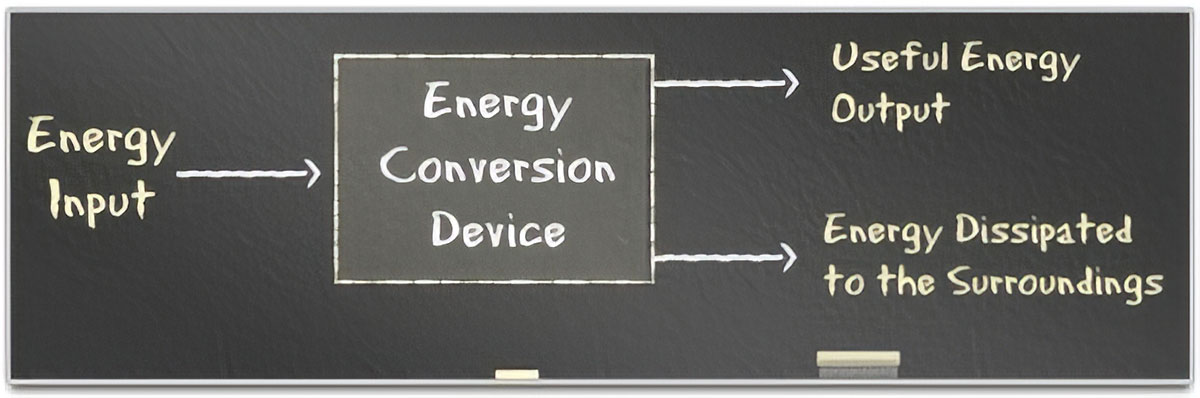
Text description of the Energy Flow Diagram for an Energy Conversion Device image.
The image is a diagram on a dark gray background resembling a chalkboard. The left side of the image shows the words "Energy Input" with an arrow that points towards a large rectangular box labeled "Energy Conversion Device." From the right side of the box, two arrows extend; one labeled "Useful Energy Output," and the other labeled "Energy Dissipated to the Surroundings."
When all forms of energy coming out of an energy conversion device are added up, it will be equal to the energy that is put into a device. Energy output must be equal to the input. This means that energy can not be destroyed or created. It can only change its form.
In the case of an electric bulb, the electrical energy is converted to light and heat.
The amount of electrical energy put into a bulb = the amount of light energy (desirable form) plus the heat energy that comes out of the bulb (undesirable form).
Self Check
Instructions: Identify the useful energy output(s) and undesirable energy output(s) in the energy conversion devices below. Enter your answers in the fields provided, and click the "Check" button to check your work.
Activity description: Energy Conversion Self Check
Self Check: Energy Conversion Devices
For each of the following examples, determine the types of useful energy and undesired energy for the given energy converter.
Example 1: Lawnmower with a chemical energy input. (Hint: How do you know when your neighbor is mowing the lawn?)
Example 2: Car with a chemical energy input. (Hint: Think about mufflers, tires, and generator.)
Example 3: Television with an electrical energy input. (Hint: Have you ever felt the back of your TV after it has been on for a few hours?)
Example 4: Desktop computer with an electrical energy input. (Hint: What’s in your tower and why?)
Answers:
Example 1: The useful energy for a lawnmower is mechanical, while the undesired energy is thermal (heat) and radiation (noise).
Example 2: The useful energy for a car is mechanical, while the undesired energy is thermal or heat (tail pipe).
Example 3: The useful energy for a TV is radiation (light and sound) and the undesirable energy is heat (from circuits).
Example 4: The useful energy for a computer is radiation (light and sound) and the undesirable energy is heat (circuits – electrons moving through system) and mechanical (fan for cooling).