Lesson 4: Energy Efficiency
Lesson 4: Energy EfficiencyThe links below provide an outline of the material for this lesson. Be sure to carefully read through the entire lesson before returning to Canvas to submit your assignments.
4.1 Lesson 4 Introduction
4.1 Lesson 4 IntroductionWelcome to Lesson 4!
Every day, we rely on devices that convert energy from one form to another: your phone transforms electrical energy into light and sound, a car engine turns chemical energy from gasoline into motion, and a power plant converts heat from fuel or fission into the electricity that powers your dorm. But here's a critical question: how much of the original energy actually does the work we want? The answer lies in the concept of energy efficiency—a measure of how well a system converts input energy into useful output. In this lesson, we'll explore why no conversion is perfect, especially when thermal energy (the random motion of molecules) is involved, and how fundamental laws of physics set hard limits on what engineers can achieve.
In this lessons, we will look at the operating principle of a heat engine. A heat engine is a device that converts heat to work. Particularly, automobiles are all heat engines, and they are notoriously inefficient. We will see examples and calculations of why these automobiles are notoriously inefficient and learn how to calculate the theoretical maximum efficiency of any heat engine using the Carnot efficiency. For these calculations, we must make sure our temperatures are in the Kelvin, an absolute temperature scale.
We can also calculate the efficiency of a whole process from the step efficiencies. For example, if it involves 2 or 3 steps like in a relay race. You know you have 3 or 4 players taking the baton and one lap by each of the athletes. So, what is the overall or team efficiency if we know the efficiency of each of those steps or the efficiency of each of those players? This multiplicative effect explains why small improvements at each stage can lead to big gains in total performance—and why understanding these principles is essential for designing sustainable, high-performance technology. By the end of this lesson, you'll be able to analyze energy systems critically and appreciate why efficiency isn't just a number—it's a bridge between physics and the future of energy.
Lesson 4: Learning Objectives
Upon completing this lesson, you should be able to:
- define and calculate efficiency of an energy conversion device;
- explain why energy conversion devices cannot achieve 100% efficiency
- convert temperatures between Celsius and Kelvin;
- explain operating principles of a heat engine; and
- calculate overall efficiency from step efficiencies.
See the calendar in Canvas for due dates/times.
Questions?
If you have any questions, please post them to the General Course Questions forum in located in the Discussions tab in Canvas. I will check that discussion forum daily to respond. While you are visiting the discussion board, feel free to post your own responses to questions posted by others - this way, you might help a classmate!
4.2 Energy Conversion Devices
4.2 Energy Conversion DevicesIn the first lesson, we saw that energy can be transformed from one form to another, and during this conversion, all the energy that we put into a device comes out. However, all the energy that we put in may not come out in a useful form.
For example, we put electrical energy into a bulb and the bulb produces light (which is the desired form of output from a bulb), but we also get heat from the bulb (undesired form of energy from an electric bulb).

Text description of the Electrical energy conversion to light and heat image.
The image shows a chalkboard with a diagram illustrating the transformation of electrical energy. On the left side, the words "Electrical Energy" are written in yellow chalk. An arrow points right to a simple outline of a light bulb in the center, suggesting the conversion process. Two arrows extend from the light bulb to the right, each labeled; the upper arrow points to the word "Light," and the lower arrow points to "Heat."
Therefore, energy flow into and out of any energy conversion device can be summarized in the diagram below:
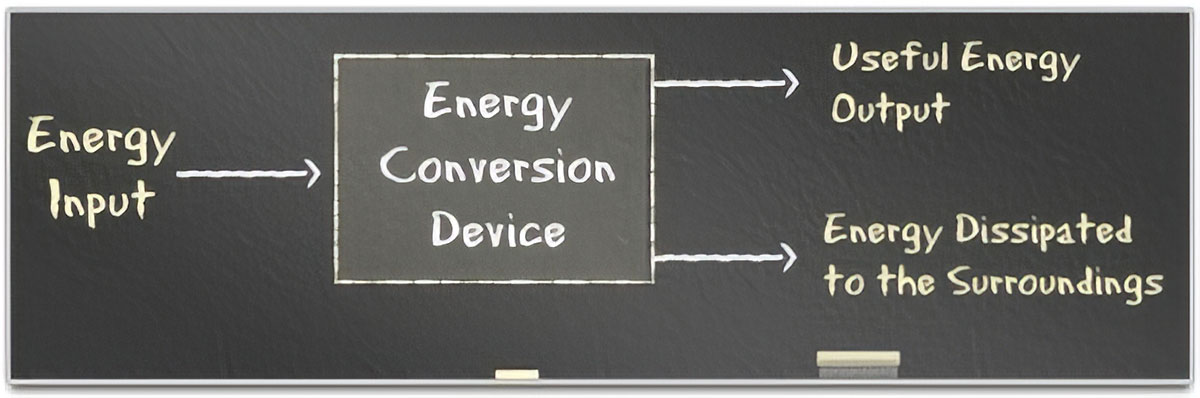
Text description of the Energy Flow Diagram for an Energy Conversion Device image.
The image is a diagram on a dark gray background resembling a chalkboard. The left side of the image shows the words "Energy Input" with an arrow that points towards a large rectangular box labeled "Energy Conversion Device." From the right side of the box, two arrows extend; one labeled "Useful Energy Output," and the other labeled "Energy Dissipated to the Surroundings."
When all forms of energy coming out of an energy conversion device are added up, it will be equal to the energy that is put into a device. Energy output must be equal to the input. This means that energy can not be destroyed or created. It can only change its form.
In the case of an electric bulb, the electrical energy is converted to light and heat.
The amount of electrical energy put into a bulb = the amount of light energy (desirable form) plus the heat energy that comes out of the bulb (undesirable form).
Self Check
Instructions: Identify the useful energy output(s) and undesirable energy output(s) in the energy conversion devices below. Enter your answers in the fields provided, and click the "Check" button to check your work.
Activity description: Energy Conversion Self Check
Self Check: Energy Conversion Devices
For each of the following examples, determine the types of useful energy and undesired energy for the given energy converter.
Example 1: Lawnmower with a chemical energy input. (Hint: How do you know when your neighbor is mowing the lawn?)
Example 2: Car with a chemical energy input. (Hint: Think about mufflers, tires, and generator.)
Example 3: Television with an electrical energy input. (Hint: Have you ever felt the back of your TV after it has been on for a few hours?)
Example 4: Desktop computer with an electrical energy input. (Hint: What’s in your tower and why?)
Answers:
Example 1: The useful energy for a lawnmower is mechanical, while the undesired energy is thermal (heat) and radiation (noise).
Example 2: The useful energy for a car is mechanical, while the undesired energy is thermal or heat (tail pipe).
Example 3: The useful energy for a TV is radiation (light and sound) and the undesirable energy is heat (from circuits).
Example 4: The useful energy for a computer is radiation (light and sound) and the undesirable energy is heat (circuits – electrons moving through system) and mechanical (fan for cooling).
4.3 Efficiency of Energy Conversion Devices
4.3 Efficiency of Energy Conversion DevicesEfficiency is the useful output of energy. We can mathematically define energy efficiency as the ratio of useful energy output to total energy output. This will give us a value between 0-1. To get this as a percentage, you should multiply by 100%. To calculate efficiency, the following formula can be used:
This simple yet powerful equation allows us to express efficiency as a percentage, where 100% would represent a theoretically perfect device with no energy losses—a condition that, as we will explore, is impossible to achieve in practice due to the fundamental laws of thermodynamics.
NOTE: You can never have energy efficiency over 100%. If you get a value above 1 by using the formula above, make sure you have the USEFUL energy value on the top and TOTAL energy output on the bottom of the equation.
Example 1
An electric motor consumes 100 watts (a joule per second (J/s)) of power to obtain 90 watts of mechanical power. Determine its efficiency.
Solution:
Input to the electric motor is in the form of electrical energy, and the output is mechanical energy.
Using the efficiency equation:
Or efficiency is 90%.
Caution!
This is a simple example because both variables are measured in Watts. If the two variables were measured differently, you would need to convert them to equivalent forms before performing the calculation.
Test Yourself #1
An electric motor consumes 91 watts (a joule per second (J/s)) of power to obtain 83 watts of mechanical power. Determine its efficiency.
- Click to see the solution to Test Yourself #1
Solution:
Useful Energy = 83 Watts
Total Energy = 91 Watts
Efficiency = useful / total
= 83/91
= 0.912
= 91.2%
What if the units are not the same? You need to have the same units in order to determine efficiency.
Example 2
The United States' power plants consumed 39.5 quadrillion Btus of energy and produced 3.675 trillion kWh of electricity. What is the average efficiency of the power plants in the U.S.?
Solution:
Total Energy input = 39.5 x 10¹⁵ Btus and the Useful energy output is 3.675 x 10¹² kWh. Recall that both units have to be the same. So we need to convert kWh into Btus. Given that 1 kWh = 3412 Btus:
Step 1
Given:
Therefore:
Step 2
Use the formula for efficiency.
Test Yourself #2
The United States power plants consumed 35 quadrillion Btus of energy and produced 3 trillion kWh of electricity. What is the average efficiency of the power plants in the U.S.?
- Click to see the solution for Test Yourself #2
Solution:
The units don’t match, so you need to convert to the same units and we know that 1 kWh = 3,412 Btus.
Useful Energy Output = 3 trillion kWh
= 3 x 1012 kWh x 3,412 Btus / 1 kWh
= 10,236 x 1012 BtusTotal Energy Input = 35 quadrillion Btus
Efficiency = Useful Energy Output / Total Energy Input
= (10,236 x 1012) / (35 x 1015)
= 0.2925
= 29.25%
Energy Efficiencies
Energy efficiencies are not 100%, and sometimes they are pretty low. The table below shows typical efficiencies of some of the devices that are used in day to day life:
| Device | Efficiency |
|---|---|
| Electric Motor | 90 % |
| Home Gas Furnace | 95 % |
| Home Oil Furnace | 80 % |
| Home Coal Stove | 75 % |
| Steam Boiler in a Power Plant | 90 % |
| Overall Power Plant | 36 % |
| Automobile Engine (ICE) | 25 % |
| Electric Bulb: Incandescent | less than 10 % |
| Electric Bulb: Fluorescent | 60 % |
| Electric Bulb: LED | 90 % |
From our discussion on national and global energy usage patterns in Lesson 3, we have seen that:
- about 41% of the US energy is used in power generation;
- about 38% of the US energy is used for transportation.
Yet the energy efficiency of a power plant is about 35%, and the efficiency of automobiles is about 25%. Thus, over 62% of the total primary energy in the U.S. is used in relatively inefficient conversion processes.
Why are power plant and automobile design engineers allowing this? Can they do better?
There are some natural limitations when converting energy from heat to work.
4.4 Measuring Thermal Energy
4.4 Measuring Thermal EnergyThermal energy is energy associated with random motion of molecules. It is indicated by temperature, which is the measure of the relative warmth or coolness of an object.
A temperature scale is determined by choosing two reference temperatures and dividing the temperature difference between these two points into a certain number of degrees.
The two reference temperatures used for most common scales are the melting point of ice and the boiling point of water.
- On the Celsius temperature scale, or centigrade scale, the melting point is taken as 0°C and the boiling point as 100°C, with the difference between them being equal to 100 degrees.
- On the Fahrenheit temperature scale, the melting point is taken as 32°F and the boiling point as 212°F, with the difference between them being equal to 180 degrees.
It is important to realize, however, that the temperature of a substance is not a measure of its heat content, but rather, the average kinetic energy of its molecules resulting from their motions.
Try This!
Below is a 6-ounce cup with hot water and a 12-ounce cup with hot water at the same temperature.
- Do they have the same heat content?
- Do they have the same amount of energy?
Instructions: Click the play button to see what is happening in the two cups. Think about your answer to the two questions, and then click the video description link below the video to check your answer. (Note: The animation has no audio.)
Video Description: Measuring Thermal Activity
Measuring Thermal Energy
A six ounce cup and a twelve ounce cup are both filled with 85 degree water.
Conclusion: They do NOT have the same heat content or the same amount of energy. Since water in the two cups is at the same temperature, the average kinetic energy of the molecules in the cups is the same; however, the 12 ounce cup has twice as many molecules when compared with the 6 ounce cup and thus has the greater total motion or heat energy.
4.5 Kelvin Scale
4.5 Kelvin ScaleWhen water molecules freeze at 0°C, the molecules still have some energy compared to ice at -50°C. In both cases, the molecules are not moving, so there is no heat energy.
So what is the temperature at which all the molecules have absolutely zero energy? A temperature scale can be defined theoretically, for which zero degree corresponds to zero average kinetic energy. Such a point is called absolute zero, and such a scale is known as an absolute temperature scale. At absolute zero, the molecules do not have any energy.
The Kelvin temperature scale is an absolute scale having degrees the same size as those of the Celsius temperature scale. Therefore, all the temperature measurements related to energy measurements must be made on Kelvin scale.
4.6 Heat Engines
4.6 Heat EnginesAny device that converts thermal energy into mechanical energy—like a car engine, a jet turbine, or a coal-fired power plant—is called a heat engine. These machines work by taking in high-temperature heat (usually from burning fuel or nuclear reactions), using part of that energy to do useful work—such as turning wheels or generating electricity—and releasing the remaining energy as lower-temperature waste heat, often into the air or a nearby body of water. This "exhaust" isn't a flaw in engineering; it's a fundamental requirement of how nature works. Because heat naturally flows from hot to cold, a heat engine can only extract work while that flow is happening—and it can never capture all the energy in the process.

Text description of the Energy Conversions in an Automobile image.
The image is a blackboard with a diagram illustrating a process flow. Three rectangles are aligned horizontally across the board. The first rectangle on the left contains the text "Chemical Energy," the middle rectangle has the text "Thermal Energy," and the rectangle on the right displays "Mechanical Energy." Arrows connect the rectangles, showing a flow from left to right, indicating a progression from chemical to thermal to mechanical energy.
This limitation is described by the Second Law of Thermodynamics, which tells us that no heat engine can be 100% efficient. Efficiency is defined as the ratio of useful work output to the total heat energy input, and it's fundamentally limited by the temperatures of the heat source and the environment. In fact, the maximum possible efficiency (called the Carnot efficiency) depends directly on the absolute temperatures—measured in Kelvin—of the hot and cold reservoirs: the bigger the temperature difference, the more work you can extract. For example, a car engine operating between ~1500 K (combustion) and ~300 K (outside air) has a theoretical maximum efficiency around 80%, but real-world factors like friction and incomplete combustion bring actual efficiency down to just 20–30%. Power plants, which can operate at more controlled high temperatures, often reach 35–60% efficiency.
Understanding heat engines helps explain why energy conservation matters and why engineers constantly seek better materials and designs. Waste heat isn't just "lost"—it affects fuel economy, emissions, and even local ecosystems when warm water is discharged from power plants. By studying these systems, you'll see how core scientific principles—like absolute temperature, energy conservation, and entropy—directly shape the technology that powers our world. As you move forward in physics or engineering, you'll learn to analyze these cycles quantitatively, but for now, remember this key idea: heat engines don't create energy; they redirect it, and nature always takes a share.

Text description of the Heat Engine image.
The image depicts a schematic diagram of a heat engine. It consists of a gradient background transitioning from red, labeled "High T" at the top to yellow, labeled "Low T" at the bottom, representing temperature change. The top of the diagram is labeled "Heat" with a black arrow pointing downwards towards a yellow rectangular box labeled “HEAT ENGINE.” From this box, there is a black arrow pointing right to a label “Work.” Below the "Heat Engine" box is a gray arrow pointing downwards towards the bottom of the diagram labeled "(Waste) Heat." The arrows and labels illustrate the flow and conversion of heat energy within the engine.
4.7 The Carnot Efficiency
4.7 The Carnot EfficiencyA general expression for the efficiency of a heat engine can be written as:
We know that all the energy that is put into the engine has to come out either as work or waste heat. So work is equal to Heat at High temperature minus Heat rejected at Low temperature. Therefore, this expression becomes:
Where, QHot = Heat input at high temperature and QCold= Heat rejected at low temperature. The symbol (Greek letter eta) is often used for efficiency this expression can be rewritten as:
The above equation is multiplied by 100 to express the efficiency as percent.
French Engineer Sadi Carnot showed that the ratio of QHighT to QLowT must be the same as the ratio of temperatures of high temperature heat and the rejected low temperature heat. So this equation, also called Carnot Efficiency, can be simplified as:
Note: Unlike the earlier equations, the positions of Tcold and Thot are reversed.
The Carnot Efficiency is the theoretical maximum efficiency one can get when the heat engine is operating between two temperatures:
- The temperature at which the high temperature reservoir operates ( THot ).
- The temperature at which the low temperature reservoir operates ( TCold ).
In the case of an automobile, the two temperatures are:
- The temperature of the combustion gases inside the engine ( THot ).
- The temperature at which the gases are exhausted from the engine ( TCold ).
Below is a table showing two temperature scales. The scale labeled "HOT," shows the range of temperatures for the combustion of gases in a car engine. The scale labeled "COLD," shows the range of temperatures at which gases are exhausted from the car engine.

Instructions: Look carefully at the efficiency numbers in the body of the table. How do the Hot and Cold temperatures' effect on the efficiency.
| Hot Columns Cold Rows | Hot 500°C | Hot 600°C | Hot 700°C | Hot 800°C | Hot 900°C | Hot 1,000°C | Hot 1,500°C | Hot 2,000°C |
|---|---|---|---|---|---|---|---|---|
| Cold 150°C | 45 | 52 | 57 | 61 | 64 | 67 | 76 | 81 |
| Cold 125°C | 49 | 54 | 59 | 63 | 66 | 69 | 78 | 82 |
| Cold 100°C | 52 | 57 | 62 | 65 | 68 | 71 | 79 | 84 |
| Cold 75°C | 55 | 60 | 64 | 68 | 70 | 73 | 80 | 85 |
| Cold 50°C | 58 | 63 | 67 | 70 | 72 | 75 | 82 | 86 |
| Cold 25°C | 61 | 66 | 69 | 72 | 75 | 77 | 83 | 87 |
Answer the following questions based on the information in the Car Engine Efficiency table above.
Example
For a coal-fired utility boiler, the temperature of high pressure steam (Thot)would be about 540°C and Tcold, the cooling tower water temperature, would be about 20°C. Calculate the Carnot efficiency of the power plant:
Solution:
Carnot efficiency depends on high temperature and low temperatures between which the heat engine operates. We are given both temperatures. However, the temperatures need to be converted to Kelvin:
Practice
A solar thermal power plant uses concentrated sunlight to heat a working fluid. The high-temperature reservoir reaches 450°C, while the cooling system maintains the low-temperature reservoir at 90°C. Calculate the Carnot efficiency of this power plant. .
Step 1
Convert the high and low temperatures from Celsius to Kelvin:
Step 2
Determine the efficiency using the Carnot efficiency formula:
From the Carnot Efficiency formula, it can be inferred that a maximum of 49.8% of the fuel energy can go to generation. To make the Carnot efficiency as high as possible, either Thot should be increased or Tcold (temperature of heat rejection) should be decreased.
4.8 Examples of Heat Engines
4.8 Examples of Heat EnginesLet’s look at an example of how temperature differences are used to generate power. Power plants convert chemical energy into electrical power. Here is a video overviewing the operation of a geothermal energy system, a classic thermal power generation plant.
Transcript: Energy 101: Geothermal Energy (3:48)
You may have relaxed in a natural hot springs pool.
Or seen the Old Faithful geyser blasting hot water into the air in yellowstone national park. But have you ever thought of where all that heat comes from?
Well, it comes from deep beneath the surface of the earth -- and it's called geothermal energy...
And we can use it to generate clean, renewable electricity. Ok, here's how geothermal works.
Heat from the Earth's crust warms water that has seeped into underground reservoirs. When water becomes hot enough, it can break through the earth's surface as steam or hot water. This usually happens where the earth's crust or 'plates' meet and shift.
In the past, taking advantage of geothermal energy was limited to areas where hot water flowed near the surface. But, as geothermal technologies advance, we can leverage even more of these natural renewable energy sources. Engineers have developed a few different ways to produce power from geothermal wells drilled into the ground.
Have a look at this. It's a dry steam geothermal power plant and it's the most common type of geothermal technology used today... Underground steam flows directly to a turbine to drive a generator that produces electricity. Pretty straightforward.
Another geothermal technology is called a flash steam power plant. A pump pushes hot fluid into a tank at the surface, where it cools. As it cools, the fluid quickly turns into vapor-- or "flash" vaporizes. The vapor then drives a turbine -- and powers a generator.
A binary cycle plant works differently.
It uses two types of fluid. Hot fluid from underground heats a second fluid, called a heat transfer fluid, in a giant heat exchanger. The second fluid has a much lower boiling point than the first fluid, and so it 'flashes' into vapor at a lower temperature. When the second fluid flashes... It spins a turbine that drives a generator.
The environmental benefits of this clean, round-the-clock renewable energy source are substantial: low emissions, small physical footprint, and minimal environmental impact. The few byproducts that can come up are often re-injected underground.
Geothermal energy can also help recycle wastewater. In California, wastewater from the city of Santa Rosa is injected into the ground to generate more geothermal energy.
Some plants do produce solid waste, but that solid waste may contain minerals that we can remove and sell... Which lowers the cost of this energy source.
The U.S. Geological Survey estimates that untapped geothermal resources in the United States, if developed, could supply the equivalent of 10% of today's energy needs. In fact, electricity generated by geothermal energy already provides about 60% of the power along the northern California coast...
From the Golden Gate Bridge to the Oregon state line.
Geothermal energy...helping to push America toward energy independence, and a clean, renewable way to meet our growing energy demands...
Below are two temperature scales. The scale labeled "HOT," shows the range of temperatures for the combustion of gases in a power plant. The scale, "COLD," shows the range of temperatures at which gases are exhausted from the power plant.

Text description of the Power Plant diagram.
The diagram is labeled "Power Plant." Below the label are two horizontal lines representing temperature scales, labeled "HOT" and "COLD." The "HOT" scale is at the top in dark red, starting at 350°C and marked at 400, 500, 600, 700, 800, 900, and ending at 1000. The "COLD" scale is in blue below, marked at 100°C, 200°C, and 300°C.
Look carefully at the efficiency numbers in the body of the table. How do the Hot and Cold temperatures' effect on the efficiency.
| Hot Columns Cold Rows | Hot 350°C | Hot 400°C | Hot 500°C | Hot 600°C | Hot 700°C | Hot 800°C | Hot 900°C | Hot 1,000°C |
|---|---|---|---|---|---|---|---|---|
| Cold 300°C | 8 | 15 | 26 | 34 | 41 | 47 | 51 | 55 |
| Cold 250°C | 16 | 22 | 32 | 40 | 46 | 51 | 55 | 59 |
| Cold 200°C | 24 | 30 | 39 | 46 | 51 | 56 | 60 | 63 |
| Cold 150°C | 32 | 37 | 45 | 52 | 57 | 61 | 64 | 67 |
| Cold 100°C | 40 | 45 | 52 | 57 | 62 | 65 | 68 | 71 |
4.9 Overall Efficiency
4.9 Overall EfficiencyCalculating Overall Efficiency
Using the energy efficiency concept, we can calculate the component and overall efficiency:
Here the electrical energy is given in Wh and Chemical Energy in Btus. So Wh can be converted to Btus knowing that there are 3.412 Wh in a Btu.
This overall efficiency can also be expressed in steps as follows:
Applying this method to the above power plant example:
It can be seen that the overall efficiency of a system is equal to the product of efficiencies of the individual subsystems or processes. What is the implication of this?
Steps of Overall Efficiency
Previously, we examined the efficiency of individual components, such as an automobile engine or a power plant. However, to understand true energy utilization, we must consider the entire chain of energy transformations. This chain ranges from extracting raw resources to the final use of energy, such as light from a bulb or sound from a stereo.
The process involves five key steps:
- Production: Mining the coal.
- Transportation: Moving coal to the power plant.
- Generation: Converting coal into electricity.
- Transmission: Sending electricity through power lines.
- End Use: Converting electricity into light or sound.
Tracking the Energy Flow To calculate the cumulative efficiency, let us trace the energy flow starting with 100 units of energy stored in the ground (measured in BTUs).
- Mining (95% Efficiency): Extracting coal requires energy to operate equipment. For every 100 units in the ground, only 95 units reach the surface.
- Transportation: Trucks consume fuel to move the coal. By the time the coal reaches the power plant, the energy value drops from 95 units to approximately 90 units.
- Electricity Generation (33% Efficiency): Power plants are roughly 33% efficient. When 90 units of coal energy enter the plant, only 30 units emerge as electricity.
- Transmission: High-voltage lines transport electricity to the user. While there are minor losses here, we will estimate that approximately 30 units reach the home.
- End Use (5% Efficiency): Traditional light bulbs are notoriously inefficient, operating at about 5% efficiency. Of the 30 units entering the bulb, only 1.5 units are converted into actual light.
Conclusion We started with 100 units of energy in the ground and ended with 1.5 units of light. Therefore, the overall efficiency is 1.5% (1.5 divided by 100).
This reveals a critical reality: to obtain 1.5 units of useful light, we extract 100 units from natural resources. Along the way, approximately 98.5 units of energy are lost as waste heat or friction during the various conversion processes.
Efficiency of a Light Bulb
If the efficiency of each step is known, we can calculate the overall efficiency of production of light from coal in the ground. The table below illustrates the calculation of overall efficiency of a light bulb.
| Step | Step Efficiency | Cumulative Efficiency or Overall Efficiency |
|---|---|---|
| Extraction of Coal | 96% | 96% |
| Transportation | 98% | 94% = (0.96 x 0.98) * 100 |
| Electricity Generation | 35% | 33% = (0.94 x 0.35) * 100 |
| Transmission of Electricity | 95% | 31% = (0.33 x 0.95) * 100 |
| Lighting: Incandescent Bulb | 5% | 1.6 % = (0.31 x 0.05) * 100 |
| Lighting: Fluorescent Bulb | 60% | 18 % = (0.31 x 0.60) * 100 |
Efficiency of an Automobile
A similar analysis on automobile efficiency is shown in the Figure below.

Text description of the Overall Automobile Efficiency image.
The image illustrates a flowchart titled "Overall Automobile Efficiency," depicting various stages in the lifecycle of automobile energy usage. The flowchart consists of six main stages, each represented by a distinct black and white icon.
- Production: An oil rig pumping oil, symbolizing the extraction phase.
- Transportation: A pipeline with flowing arrows indicates the movement of crude oil.
- Refining: A factory with smokestacks emits plumes of smoke, representing the refining process.
- Distribution: A fuel pump is shown, highlighting the distribution stage of refined fuel.
- Engine: Icons suggest acceleration and deceleration with associated mechanics, detailing the engine's efficiency.
- Transmission: Diagrams with arrows demonstrate the power transmission process in the automobile.
Each stage is connected with bold black arrows, illustrating the flow of energy from one phase to the next.
The table below shows that only about 10% of the energy in the crude oil in the ground is in fact turned into mechanical energy moving people.
| Step | Step Efficiency | Cumulative Efficiency or Overall Efficiency |
|---|---|---|
| Extraction of Crude | 96% | 96% |
| Refining | 87% | 84% |
| Transportation | 97% | 81% |
| Engine | 25% | 20% |
| Transmission | 50% | 10% |
4.10 Conculsions
4.10 ConculsionsIn this lesson, you explored one of the most fundamental—and humbling—principles in energy science: no energy conversion is perfect. Every device that transforms energy, from your smartphone to a power plant, loses some portion of its input to waste heat, friction, or other irreversibilities. Here's a synthesis of the core concepts you've mastered:
Heat Engines and the Limits of Efficiency
- Heat engines (like automobile engines, power plants, and even your body) convert thermal energy into mechanical work—but they must reject waste heat to a colder reservoir. This isn't an engineering flaw; it's a consequence of the Second Law of Thermodynamics.
- Carnot efficiency defines the theoretical maximum efficiency for any heat engine operating between two temperatures
Where:
Kelvin is non-negotiable: Because Carnot efficiency depends on a ratio of temperatures, you must use the absolute Kelvin scale (K = °C + 273.15). Using Celsius yields dramatically incorrect (and impossible) results.
Cascading Efficiency: The Power of Multiplication
- Real-world energy pathways involve multiple sequential steps (e.g., fuel extraction → generation → transmission → end use).
- Losses compound: A system with five 90%-efficient steps has an overall efficiency of only 0.95 = 59%. This explains why small improvements at the least efficient step (e.g., replacing incandescent bulbs with LEDs) can yield outsized system-wide gains.
Test Yourself
The questions below are your chance to test and practice your understanding of the content covered in this lesson. In other words, you should be able to answer the following questions if you know the material that was just covered! If you have problems with any of the items, feel free to post your question on the unit message board so your classmates, and/or your instructor, can help you out!
- A heat engine has Carnot efficiency of 30%. Useful output from the engine is 1,000J. How much heat is wasted?
- How can we improve the Carnot efficiency of a heat engine by changing the hot and cold reservoir temperatures?
- Most of the energy conversion devices that we use in our day-to-day life can be classified as Heat Engines. Give two examples.