Lesson 9: Home Cooling
Lesson 9: Home CoolingThe links below provide an outline of the material for this lesson. Be sure to carefully read through the entire lesson before returning to Canvas to submit your assignments.
Introduction
IntroductionWelcome to Lesson 9!
Lesson 9 Objectives
Upon completing this lesson, you should be able to:
- explain the relationship between humidity and temperature;
- describe how an air conditioner works;
- describe different types of air conditioning systems;
- calculate the monetary savings when the efficiency of an air conditioner is improved.
Questions?
If you have any questions, please post them to the General Course Questions forum in located in the Discussions tab in Canvas. I will check that discussion forum daily to respond. While you are visiting the discussion board, feel free to post your own responses to questions posted by others - this way, you might help a classmate!
Humidity
HumidityAir is a mixture of several gases, including nitrogen, oxygen, and water vapor.
- The total air pressure exerted by a volume of air in a given container on that container is the sum of the individual (partial) pressures of these gases.
- The vapor pressure is the individual or partial pressure of the water vapor.
The warmer the air is, the more moisture it can hold. So its moisture holding capacity changes with temperature.
A Psychometric chart (pictured below) represents the moisture content of air at various temperatures. This chart shows that as the air temperature increases, the amount of moisture that can be held in dry air also increases.
- Dry bulb temperature: Temperature with no moisture in the air; known as “absolute air.”
- Dew point Temperature: Complete saturation – the maximum amount of water vapor that air can hold. Note that water vapor can carry more heat than air.
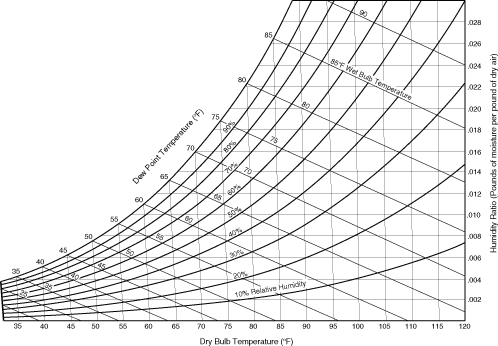
As we know, varying amounts of moisture (in the gaseous or vapor form) exist in the air. Absolute Humidity is the actual amount of moisture that is contained in air. It is represented in the formula below:
Relative humidity, in contrast, is the ratio of the amount of moisture in the air to the maximum amount of moisture the air can hold at a given temperature. It is represented in the formula below:

Example 1
Calculate the relative humidity of air when the air contains 0.002 lb of moisture per pound of dry air, while the maximum moisture air can hold at that temperature is 0.005 lb per lb of dry air.
Air is said to be saturated when the amount of water vapor in the air is the maximum possible at an existing temperature and pressure.
- Air is said to be saturated at 100 percent relative humidity when it contains the maximum amount of moisture possible at that specific temperature.
- Air holding half the maximum amount of moisture at a given temperature has a relative humidity of 50 percent.
When relative humidity reaches 100 percent or is saturated, moisture will condense, meaning the water vapor changes to liquid vapor.
Thus, the saturation level of air is related to the air's temperature. As air temperature increases (or becomes warmer), more water remains in a gas phase. As temperature decreases (or becomes colder), the water molecules slow down, and it is more likely that they will condense onto nearby surfaces.
Dew Point is the temperature at which air reaches 100 percent relative humidity. If the air is cooled below dew point, moisture in the air condenses.
Moisture will condense on a surface whose temperature is below the dew point temperature of the air next to it. For air at a given absolute humidity, the colder the surface, the higher the relative humidity next to that surface. So the coldest surface in a room is the place where condensation will probably occur first (called the first condensing surface).

Saturation is the maximum amount of water vapor in the air at an existing temperature and pressure. Air is said to be saturated at 100 percent relative humidity when it contains the maximum amount of moisture possible at that specific temperature.
Dew point is the temperature when air reaches 100% relative humidity.
Humidity and Condensation
Humidity and Condensation
A basement with a window leading outside at ground level contains normal, cool air. When the window is opened on a summer day, warm, moisture-rich air enters the basement and mixes with the cool air. This causes a buildup of moisture on the walls and floor, as well as the rest of the basement surfaces.
Questions:
1) Which air has the most amount of moisture?
- Warm outside air
- Cool inside air
- Combined inside and outside air
2) After the warm outside air mixes with the cool inside air, what happens?
- Saturation
- Condensation
- Convection
3) In the animation, which of the following is the first condensing surface?
- Walls and floor
- Ground
- Window
4) The temperature of the first condensing surface is:
- At the dew point
- Below the dew point
- Above the dew point
Answers:
- Warm outside air
- Condensation
- Walls and floor
- Below the dew point
Air Conditioning
Air ConditioningNow we will look at how air conditioning systems work. With air conditioning, the adjustment of humidity is important because we always try to cool warm air inside the room.
When the temperature of the air decreases, the maximum amount of water the air can hold also decreases. So the relative humidity always increases. This is more conspicuous when the room air is humid or already saturated. When the saturated air is cooled in an air conditioner, it precipitates or condenses. Water can be seen dripping outside from an AC.
Humidity is generally maintained at about 50 percent. Too low or high humidity is very uncomfortable.
Air conditioning (A/C) involves cooling/heating and cleaning of air, plus controlling its moisture level or humidity to provide maximum indoor comfort.
- An air conditioner transfers heat energy from the inside of a room, or multiple rooms in a building, to the outside.
- The air conditioner does NOT transfer air from the inside of a room, or multiple rooms in a building, to the outside.
More specifically, refrigerant in the system absorbs the excess heat from the inside and is pumped through a closed system of piping to an outside coil. A fan blows outside air over the hot coil, transferring heat from the refrigerant to the outdoor air. Because the heat is removed from the indoor air, the indoor area is cooled.

How Air Conditioners Work
How Air Conditioners WorkContrary to what is generally assumed, outside air is not cooled inside the air conditioner and then supplied inside. Only heat energy is moved or pumped by the air conditioner from a low temperature environment (inside the building) to a high temperature environment (outside the building).
Instructions: Place your cursor over the image below to learn how an air conditioner works.
How an Air Conditioner Works
How an Air Conditioner Works
- The compressor in your outdoor unit compresses the refrigerant (or "Freon") by transferring the part of the electrical energy it consumes into a high-temperature, high-pressure gas.
- As that gas flows through the outdoor coil, it loses heat to the surroundings (because the refrigerant is at a higher temperature than the outside temperature).
- The cooled gas condenses from a liquid into a high temperature, high pressure liquid.
- This liquid refrigerant travels through copper tubing into the evaporator coil.
- In the evaporator coil, the refrigerant expands. Its sudden expansion turns the refrigerant into a low temperature, low pressure gas.
- This cool gas then absorbs heat from the air in the room, which is blown over the evaporator coil.
- The cooled air is distributed back through your room or multiple rooms.
- Meanwhile, the heat absorbed by the refrigerant is carried back outside through copper tubing and released into the outside air. So only the heat is transferred to the outside, not the air.
Instructions: Press the play button to observe an animated version of how an air conditioner works.
An Animated Version of How an Air Conditioner Works
How an Air Conditioner Works
As described in the text above, the animation shows you the process.
The compressor in your outdoor unit compresses the refrigerant (or "Freon") by transferring the part of the electrical energy it consumes into a high-temperature, high-pressure gas. As that gas flows through the outdoor coil, it loses heat to the surroundings (because the refrigerant is at a higher temperature than the outside temperature).
The cooled gas condenses from a liquid into a high temperature, high pressure liquid. This liquid refrigerant travels through copper tubing into the evaporator coil. In the evaporator coil, the refrigerant expands. Its sudden expansion turns the refrigerant into a low temperature, low pressure gas.
This cool gas then absorbs heat from the air in the room, which is blown over the evaporator coil. The cooled air is distributed back through your room or multiple rooms. Meanwhile, the heat absorbed by the refrigerant is carried back outside through copper tubing and released into the outside air. So only the heat is transferred to the outside, not the air.
Types of Air Conditioners
Types of Air ConditionersOperating Principle
The basic types of air conditioners are room air conditioners, split-system central air conditioners, and packaged central air conditioners.
Room Air Conditioners
Room air conditioners cool rooms rather than the entire home. If they provide cooling only where they're needed, room air conditioners are less expensive to operate than central units, even though their efficiency is generally lower than that of central air conditioners.
Smaller room air conditioners (i.e., those drawing less than 7.5 amps of electricity) can be plugged into any 15- or 20-amp, 115-volt household circuit that is not shared with any other major appliances. Larger room air conditioners (i.e., those drawing more than 7.5 amps) need their own dedicated 115-volt circuit. The largest models require a dedicated 230-volt circuit.

Central Air Conditioners
Central air conditioners circulate cool air through a system of supply and return ducts. Supply ducts and registers (i.e., openings in the walls, floors, or ceilings covered by grills) carry cooled air from the air conditioner to the home. This cooled air becomes warmer as it circulates through the home; then it flows back to the central air conditioner through return ducts and registers.
A central air conditioner is either a split-system unit or a packaged unit.
Split System
In a split-system central air conditioner the main components include:
- an outdoor metal cabinet that contains the condenser and compressor;
- an indoor cabinet that contains the evaporator;
- in many split-system air conditioners, the indoor cabinet also contains a furnace or the indoor part of a heat pump. The air conditioner's evaporator coil is installed in the cabinet or main supply duct of this furnace or heat pump.
If your home already has a furnace but no air conditioner, a split-system is the most economical central air conditioner to install.

Packaged Units
The packaged central air conditioner is usually located outdoors and consists of one cabinet that contains the evaporator, condenser, and compressor. The cabinet is usually placed on a roof or on a concrete slab next to the house's foundation. The packaged air conditioner is connected to the indoor air supply and return ducts through the home's exterior wall or roof.
Since these air conditioners often include electric heating coils or a natural gas furnace, this combination of air conditioner and central heater eliminates the need for a separate furnace indoors. This type of air conditioner is used to cool and heat homes as well as small commercial buildings.

Air Conditioner Efficiency
Air Conditioner EfficiencyAir conditioners are rated by the number of British Thermal Units (BTU) of heat they can remove per hour. Another common rating term for air conditioning size is the "ton," which is 12,000 BTU per hour.
Each air conditioner has an energy-efficiency rating that lists how many BTUs per hour are removed or “pulled out” for each watt of power it draws.
- The efficiency rating for room conditioners is the Energy Efficiency Ratio, or EER.
- The efficiency rating for central air conditioners, is the Seasonal Energy Efficiency Ratio, or SEER.
These ratings are posted on an Energy Guide Label, which must be conspicuously attached to all new air conditioners. Energy Star-labeled appliances mean that they have high EER and SEER ratings.

Room Air Conditioners—EER
Energy Efficient Ratio (EER) measures how efficiently a room air conditioner will operate at a specific outdoor temperature. The higher the EER, the more efficient the system.
The EER can be calculated using this equation:
Remember that the EER energy-efficiency rating lists how many BTUs per hour are removed or “pulled out” for each watt of power it draws. Room air conditioners generally range from 5,500 BTU per hour to 14,000 BTU per hour.
National appliance standards require room air conditioners built after January 1, 1990, to have an EER of 8.0 or greater. A room air conditioner with an EER of at least 9.0 is recommended for milder climates, whereas in hotter climates an EER over 10 is preferred.
The Association of Home Appliance Manufacturers reports that the average EER of room air conditioners rose 47 percent from 1972 to 1991. If a 1970s-vintage room air conditioner with an EER of 5 is replaced with a new one with an EER of 10, air conditioning energy costs will be cut by 50 percent.
Central Air Conditioners—SEER
Seasonal Energy Efficiency Ratio (SEER) measures how efficiently a central air conditioner will operate at a specific outdoor temperature. The higher the SEER, the more efficient the system.
The SEER can be calculated using this equation:
Again, the SEER energy-efficiency rating lists how many BTUs per hour are removed or “pulled out” for each watt of power it draws.
National minimum standards for central air conditioners require a SEER of 9.7 and 10.0, for single-package and split-systems, respectively. But you do not need to settle for the minimum standard—there is a wide selection of units with SEERs reaching nearly 17.
Before 1979, the SEERs of central air conditioners ranged from 4.5 to 8.0. Replacing a 1970s-era central air conditioner with a SEER of 6 with a new unit having a SEER of 12 will cut your air conditioning costs in half. Today's best air conditioners use 30% to 50% less energy to produce the same amount of cooling as air conditioners made in the mid 1970s. Even if your air conditioner is only 10 years old, you may save 20 to 40 percent of your cooling energy costs by replacing it with a newer, more efficient model.

In general, new air conditioners with higher EERs or SEERs have higher price tags. However, the higher initial cost of an energy-efficient model will be recovered several times during its lifespan. Some utility companies encourage the purchase of a more efficient air conditioner by offering incentives. Buy the most efficient air conditioner you can afford, especially if you use (or think you will use) an air conditioner frequently and/or if your electricity rates are high.
Example 1
Calculate the power consumption of 5000 BTUs/h room air conditioner with an Energy Efficiency Ratio (EER) of 8.
Solution: We know that
Given that the AC pulls out 5,000 BTUs per hour and its EER = 8, we have
Therefore, its wattage =
Example 2
Air Conditioner Efficiency
An old room air conditioner with an EER 6 was replaced by a new air conditioner with an EER of 10.0. The power consumption with the old air conditioner was 1000 W. Calculate the power consumption of the new air conditioner.
We have an old air conditioner with an EER of 6. EER is basically Energy Efficiency Ratio which is given by number of Btus the air conditioner is pulling out per hour divided by watts of power consumed.
And in this problem we are given the EER as 6 and we need to calculate the number of Btus it is capable of pulling out. We also know that it is consuming a thousand watts of power. So we need to calculate these Btus per hour that it is pulling out. So we can calculate the x, unknown, by multiplying thousand by 6 and we get six thousand Btus per hour.
The room size is not changing but we are just replacing the old air conditioner with the new one. The new EER is 10, the new air conditioner EER is 10 and it is still pulling 6000 Btus per hour out and the new one, how many watts of power does it consume?
To calculate the power, we have 6000 Btu/hour load and we know the EER, which is 10, so dividing by this we get the power which is 600 watts.
What we are doing here is, by replacing the old air conditioner which used to consume 1000 watts with this new air conditioner which has an EER of 10, we are reducing the power consumption to 600 watts.
Example 3
An old room air conditioner with an EER 6 was replaced by a new air conditioner with an EER of 10.0. The room requires 0.75 tons of air conditioning. Calculate the difference in power consumption between the old and new air conditioner.
Ok. An air conditioner, an old one, has an EER of 6. And this was replaced by an EER of 10 air conditioner. The room basically is required to pull out 0.75 or three quarters of a ton. You should remember that each ton, one ton of refrigeration or air conditioning is equal to, basically pulling out 12,000 Btus every hour. So it is pulling out ¾ of a ton, which happens to be 0.75 times 12,000 Btus per hour. That is 9000 Btus per hour.
So to pull out 9,000 Btus per hour with an air conditioner of EER equal to 6. So we are pulling out 9,000 Btus/hr and what is the wattage? Or watts? And wattage is equal to now, 9,000 divided by 6. That happens to be 1500 watts.
Ok. Now if we were to replace this with an EER of 10 (air conditioner with 10). Now it still has to pull out 9000 Btus/hr and what would be the wattage? So watts equal to 9000 Btus/hr divided by 10, that would be 900 watts.
So by replacing this air conditioner, which used to consume 1500 watts, by an energy efficient air conditioner with an EER of 10, we are able to bring down the power consumption to 900 watts. So that is a savings of 40% right there.
Example 4
What is the annual cost for operating a 3 ton central air conditioner with an SEER of 10? Assume that the AC operates 2,000 hours in a year and the cost of electricity is 9.2 cents per kWh.
Solution:
Recall that 1 ton =12,000 BTUs/h. Therefore, the cooling load is 3 x 12,000 BTUs/h = 36,000 BTUs/h
Recall also that 1,000 W = 1 kW. Therefore, power consumption = 3.6 kW.
Energy = Power x Time of Usage
= 3.6 kW x 2,000 h/year = 7,200 kWh/year.
Annual Cost = Units of energy x price per unit
Example 5
Suppose you are comparing two air conditioners, both of which last for 10 years. The least efficient air conditioner draws 775 W of power. The most efficient one uses 700 Watts. Assuming that the air conditioner operates 2,400 hours annually and that the local energy costs 0.08 per kWh, how much money and energy can you save with the energy-efficient model? How much money are you willing to pay extra for the energy-efficient model?
Ok. Here we are trying to compare two air conditioners, both of which are going to last ten years. One consumes less power and the other one high power. They both operate for 2,400 hours annually, so we have the power, and we have the time of usage data. So we need to calculate how much energy each of these will consume.
So life of one, our first air conditioner is 10 years and the second one is 10 years. Power is 775, the least efficient one, watts, and the other one is 700 watts. We have the time of usage. Time of usage is given as 2,400 hours and this one is also 2,400 hours.
| Category | Air conditioner 1 | Air conditioner 2 |
|---|---|---|
| Life | 10 years | 10 years |
| Power | 775 watt | 700 watt |
| Time | 2,400 hours | 2,400 hours |
So the energy consumed is given by power multiplied by time of usage. So in this case it would be 775 watts multiplied by 2,400 hours and that will be 1,860,000 watt hours.
And for this air conditioner it would be 700 watts times 2,400 hours. That will be 1,680,000 watt hours.
So we need to convert this into kilowatt hours because we buy by kilowatt hours. So dividing this by a thousand and dividing here by a thousand, we get kilowatt hours. So this air conditioner will consume 1860 kilowatt hours per year. This air conditioner will consume 1680 kilowatt hours per year.
| Air conditioner 1 | Air conditioner 2 |
|---|---|
So in 10 years, the energy consumption is 18,600 kWh. This is simply multiplying yearly consumption by 10 years. And for the efficient one it would be 1680 kwh times 10 years which would be 16,800 kwh.
| Time | Air conditioner 1 | Air conditioner 2 |
|---|---|---|
| In 10 years... |
We know the price of each of these. You know, each of the kilowatt hours. That is, it is sold at the rate of 0.08 dollars per kilowatt hour. So when you multiply that by 0.08 both sides, the cost to operate this one would be \$1,488 dollars and this one would be \$1,344 dollars. So the difference is, \$144 which means the least efficient one basically cost \$144 more and the best one would be, even if the best one is priced \$144 more, it would work out to be the same amount in the long run over 10 years. But we would be helping the environment by not burning the difference between these two kilowatt hours. You know, a couple of thousand kilowatt hours over 10 years. That would be a help for the environment.
Example 6
If the owner bought an air conditioner with an SEER of 15, which costs $500 more, instead of the model in the previous Illustration (7-3), what is the pay back period?
The power consumption of this new model is
Air Conditioner Sizing
Air Conditioner SizingImportant Factors in Sizing Air Conditioners
An air conditioner's efficiency, performance, durability, and initial cost depends on matching its size to the following factors:
- How large is your home and how many windows does it have?
- How much shade is on your home's windows, walls, and roof?
- How much insulation is in your home's ceiling and walls?
- How much air leaks into your home from the outside?
- How much heat do the occupants and appliances in your home generate?
A system that is too large will cool the room or home quickly but will not provide the comfort that is needed, because the cool air reaches the thermostat quickly and the thermostat sends a signal to shut the system before the relative humidity is reduced to a comfortable level. As the cold air is distributed in the room, the thermostat realizes that the temperature is not at the set point and then turns on the air conditioner. This quick cycling of the unit (start and stop) reduces the lifespan of the equipment and increases the energy consumption. A larger air conditioner also consumes more energy.
A system that is small will have to work all the time and is not energy efficient. So the right size is very important for energy efficiency.
To determine the size air conditioner needed, follow three steps:
Step 1: Determine the square footage of the area to be cooled, by multiplying a rectangular or square room’s length by its width.
Step 2: Determine the correct cooling capacity - measured in British thermal units (BTUs) per hour - using the square footage and the chart below:
| Area To Be Cooled (square feet) | Capacity Needed (BTUs per hour) |
|---|---|
| 100 to 150 | 5,000 |
| 150 to 250 | 6,000 |
| 250 to 300 | 7,000 |
| 300 to 350 | 8,000 |
| 350 to 400 | 9,000 |
| 400 to 450 | 10,000 |
| 450 to 550 | 12,000 |
| 550 to 700 | 14,000 |
| 700 to 1,000 | 18,000 |
| 1,000 to 1,200 | 21,000 |
| 1,200 to 1,400 | 23,000 |
| 1,400 to 1,500 | 24,000 |
| 1,500 to 2,000 | 30,000 |
| 2,000 to 2,500 | 34,000 |
Step 3: Make any adjustments for the following circumstances:
- If the room is heavily shaded, reduce capacity by 10 percent.
- If the room is very sunny, increase capacity by 10 percent.
- If more than two people regularly occupy the room, add 600 BTUs for each additional person.
- If the unit is used in a kitchen, increase capacity by 4,000 BTUs.
- Consider where you install the unit. If you are mounting an air conditioner near the corner of a room, look for a unit that can send the airflow in the right direction.
Natural Cooling
Natural CoolingEnergy Savings by Naturally Cooling Your Home
Keeping cool indoors when it is hot outdoors is a problem. The sun beating down on the homes causes indoor temperatures to rise to uncomfortable levels. Air conditioning provides some relief. But the initial costs of installing an air conditioner and the electricity costs to run it can be high. In addition, conventional air conditioners use refrigerants made of chlorine compounds, suspected contributors to the depletion of the ozone layer and global warming. But there are alternatives to air conditioning.
An alternative way to maintain a cool house or reduce air-conditioning use is natural (or passive) cooling. Passive cooling uses non-mechanical methods to maintain a comfortable indoor temperature.
Specific methods to prevent heat gain include:
- reflecting heat (i.e., sunlight) away from your house;
- blocking the heat;
- removing built-up heat
- reducing or eliminating heat-generating sources in your home.
Reflecting Heat Away
Dull, dark-colored home exteriors absorb 70 to 90 percent of the radiant energy from the sun that strikes the home's surfaces. Some of this absorbed energy is then transferred into a home by way of conduction, resulting in heat gain. In contrast, light-colored surfaces effectively reflect most of the heat away from a home.
Instructions: Place your cursor over the numbers of the image below to learn more about reflecting heat away.
Reflecting Heat Away
Reflecting Heat Away
The following are passive methods for reflecting unwanted heat energy away from your home.
- The roof, made out of traditional roofing materials, allows about 1/3 of unwanted heat that builds up in the home. Unlike most light-colored surfaces, even white asphalt and fiberglass absorb 70 percent of the solar radiation. One solution is to apply a reflective coating to your existing roof. Two standard roofing coatings are marketed primarily for mobile homes and recreational vehicles. Both are waterproof and have reflective properties.
- Wall color is not as important as roof color, but it does affect heat gain somewhat. White exterior walls absorb less heat than dark walls. And light, bright walls increase the longevity of siding, particularly on the east, west, and south sides of the house.
- Windows permit about 40 percent of the unwanted heat that builds up in the home. Reflective window coatings are plastic sheets treated with dyes or thin layers of metal. Besides keeping your house cooler, these reflective coatings cut glare and reduce fading of furniture, draperies, and carpeting. Two main types of coatings include sun-control films and combination films.
- Sun control films are best for windows in warmer climates because they can reflect as much as 80 percent of the incoming sunlight. Many of these films are tinted, however, and tend to reduce light transmission as much as they reduce heat, thereby darkening the room.
- Combination films are best for climates that have both hot and cold seasons. They allow some light into a room but they also let some heat in and prevent interior heat from escaping.
Blocking the Heat
Two excellent methods to block heat are insulation and shading.
Insulation helps keep your home comfortable and saves money on mechanical cooling systems such as air conditioners and electric fans.
- Shading devices block the sun's rays, absorb or reflect the solar heat, and reduce indoor temperatures by as much as 20° F. Shading can be provided by trees and other vegetation or exterior or interior shades.
- Exterior shades are generally more effective than interior shades at controlling heat gain because they block sunlight before it enters windows. Exterior shading devices include awnings, louvers, shutters, rolling shutters and shades, and solar screens.
- When deciding which devices to use and where to use them, consider whether you are willing to open and close them daily or just put them up for the hottest season. You also want to know how they will affect ventilation.
Instructions: Place your cursor over the numbers of the image below to learn more about using insulation and shading to block heat.
Blocking the Heat
Blocking the Heat
The following are passive methods for blocking unwanted heat energy from your home.
- Low ground cover such as grass, small plants, and bushes can also be very effective in cooling. A grass-covered lawn is usually 10 degrees F (6 degrees C) cooler than bare ground in the summer. If you are in an arid or semiarid climate, consider native ground covers that require little water.
- Deciduous trees that lose their leaves in the fall help cut cooling energy costs the most. When selectively placed around a house, they provide excellent protection from the summer sun and permit winter sunlight to reach and warm your house. The height, growth rate, branch spread, and shape are all factors to consider in choosing a tree. Vines are a quick way to provide shading and cooling. Grown on trellises, vines can shade windows or the whole side of a house.
- Solar screens resemble standard window screens except they keep direct sunlight from entering the window, cut glare, and block light without blocking the view or eliminating air flow. They also provide privacy by restricting the view of the interior from outside your house. Solar screens come in a variety of colors and screening materials to compliment any home. Although do-it-yourself kits are available, these screens will not last as long as professionally built screens.
- The attic is a good place to start insulating because it is a major source of heat gain. Adequately insulating the attic protects the upper floors of a house. Recommended attic insulation levels depend on where you live and the type of heating system you use. For most climates, you want a minimum of R-30. In climates with extremely cold winters, you may want as much as R-49.
- Weatherization measures such as insulating, weather-stripping, and caulking help seal and protect your house against the summer heat, in addition to keeping out the winter cold. Although unintentional infiltration of outside air is not a major contributor to inside temperature, it is still a good idea to keep it out. Outside air can infiltrate your home around poorly sealed doors, windows, electrical outlets, and trough openings in foundations and exterior walls.
- Draperies and curtains made of tightly woven, light-colored, opaque fabrics reflect more of the sun's rays then they let through. The tighter the curtain is against the wall around the window, the better it will prevent heat gain. Two layers of draperies improve the effectiveness of the draperies' insulation when it is either hot or cold outside.
- Landscaping is a natural and beautiful way to shade your home and block the sun. A well-placed tree, bush or vine can deliver effective shade and add to the aesthetic value of your property. When designing the landscaping, use of plants that are native to the local area survive with minimal care.
- Shutters are movable wooden or metal coverings that, when closed, keep sunlight out. Shutters are either solid or slatted with fixed or adjustable slats. Besides reducing heat gain, they can provide privacy and security. Some shutters help insulate windows when it is cold outside.
- Awnings are very effective because they block direct sunlight. They are usually made of fabric or metal and are attached above the window and extend down and out. A properly installed awning can reduce heat gain up to 65 percent on southern windows and 77 percent on eastern windows. A light-colored awning does double duty by also reflecting sunlight.
- Wall insulation is not as important for cooling as attic insulation because outdoor temperatures are not as hot as attic temperatures. Also, floor insulation has little or no effect on cooling.
- Venetian blinds, although not as effective as draperies, can be adjusted to let in some light and air while reflecting the sun's heat. Some newer blinds are coated with reflective finishes. To be effective, the reflective surfaces must face the outdoors.
- Besides providing shade, trees and vines create a cool microclimate that dramatically reduces the temperature (by as much as 9 degrees F [5 degrees C]) in the surrounding area. During photosynthesis, large amounts of water vapor escape through the leaves, cooling the passing air. And the generally dark and coarse leaves absorb solar radiation.
Removing Built-Up Heat
Nothing feels better on a hot day than a cool breeze. Encouraging cool air to enter your house forces warm air out, keeping your house comfortably cool. However, this strategy only works when the inside temperature is higher than the outside temperature.
Natural ventilation maintains indoor temperatures close to outdoor temperatures and helps remove heat from your home. But only ventilate during the coolest parts of the day or night, and seal off your house from the hot sun and air during the hottest parts of the day.
The climate you live in determines the best ventilation strategy.
| Climate | Strategy |
|---|---|
| Cool nights and very hot days | Let night air cool the house. A well-insulated house will gain only 1° F (0.6° C) per hour if the outside temperature is 85° to 90° F (29° to 32° C). By the time the interior heats up, the outside air should be cooler and can be allowed indoors. |
| Daytime breezes | Open windows on the side from where the breeze is coming and on the opposite side of the house. Keep interior doors open to encourage whole-house ventilation. If your location lacks consistent breezes, create them by opening windows at the lowest and highest points in your house. This natural "thermosiphoning," or "chimney," effect can be taken a step further by adding a clerestory or a vented skylight. |
| Hot and humid where temperature swings between day and night are small | Ventilate when humidity is not excessive. Ventilating your attic greatly reduces the amount of accumulated heat, which eventually works its way into the main part of your house. Ventilated attics are about 30° F (16° C) cooler than unventilated attics. Properly sized and placed louvers and roof vents help prevent moisture buildup and overheating in your attic. |
Reducing Heat-Generating Sources
Often-overlooked sources of interior heat gain are lights and household appliances, such as ovens, dishwashers, and dryers.
| Heat generating light or appliance | Reducing Heat |
|---|---|
| Incandescent Lamps | Use only when necessary and take advantage of daylight to illuminate house. Also consider switching to fluorescent lamps, which use 75% less energy than incandescent lamps and emit 90% less heat for the same amount of light. |
| Kitchen Appliances | Use in the morning or late evening when extra heat can be tolerated. Consider cooking on an outside grill or using the microwave oven, which does not generate as much heat and uses less energy than a gas or electric range. |
| Laundry Appliances | Seal off laundry room and water heater from rest of room. Purchase new energy-efficient appliances that generate less heat and use less energy. Look for the Energy Guide label indicating the annual estimated cost for operating the appliance or a standardized efficiency ratio, and use this information to select the most efficient model for your needs. |
See Resources document for more information on energy-efficient lighting and appliances.
Saving Energy
Saving EnergyUsing any or all of the strategies just discussed will help keep you cool. Even if you use air conditioning, many of these strategies, particularly reflecting heat and shading, will help reduce the energy costs of running an air conditioner.
However, adopting all of these strategies may not be enough. Sometimes you need to supplement natural cooling with mechanical devices. Fans and evaporative coolers can supplement your cooling strategies and cost less to install and run than air conditioners.
Ceiling fans make you feel cooler. Their effect is equivalent to lowering the air temperature by about 4° F (2° C). Evaporative coolers use about one-fourth the energy of conventional air conditioners, but are effective only in dry climates.
Environmental Protection
Environmental ProtectionIf your home has Central Air Conditioning:
- Set your thermostat at 78ºF or higher. Each degree setting below 78 ºF will increase your energy consumption by approximately 8 percent.
- Use bath and kitchen fans sparingly when the air conditioner is operating.
- Inspect and clean both the indoor and outdoor coils. The indoor coil in your air conditioner acts as a magnet for dust because it is constantly wetted during the cooling season. Dirt build-up on the indoor coil is the single most common cause of poor efficiency. The outdoor coil must also be checked periodically for dirt build-up, and cleaned if necessary.
- Check the refrigerant charge. The circulating fluid in your air conditioner is a special refrigerant gas that is put in when the system is installed. If the system is overcharged or undercharged with refrigerant, it will not work properly. You may need a service contractor to check the fluid and adjust it appropriately.
- Reduce the cooling load by using cost-effective conservation measures. For example, effectively shade east and west windows. When possible, delay heat-generating activities, such as dishwashing, until the evening on hot days.
- Keep the house closed tight during the day over most of the cooling season. Don't let in unwanted heat and humidity. If practical, ventilate at night either naturally or with fans.
- Don’t use a dehumidifier: Try not to use a dehumidifier at the same time your air conditioner is operating. The dehumidifier will increase the cooling load and force the air conditioner to work harder.
If your home has Room Air Conditioning:
- Keep the unit leveled when installing, so that the inside drainage system and other mechanisms operate efficiently. If possible, install the unit in a shaded spot on your home's north or east side. Direct sunshine on the unit's outdoor heat exchanger decreases efficiency by as much as 10 percent. You can plant trees and shrubs to shade the air conditioner, but do not block the airflow.
- Don't place lamps or televisions near your air-conditioner's thermostat. The thermostat senses heat from these appliances, which can cause the air conditioner to run longer than necessary.
- Set your air conditioner's thermostat as high as is comfortably possible in the summer. The less difference between the indoor and outdoor temperatures, the lower your overall cooling bill will be. And don't set your thermostat at a colder setting than normal when you turn on your air conditioner. It will not cool your home any faster and could result in excessive cooling and, therefore, unnecessary expense.
- Set the fan speed on high, except on very humid days. When humidity is high, set the fan speed on low for more comfort. The low speed on humid days will cool your home better and will remove more moisture from the air because of slower air movement through the cooling equipment. Consider using an interior fan in conjunction with your window air conditioner to spread the cooled air more effectively through your home without greatly increasing electricity use.
- Ensure proper maintenance of your air conditioner to save energy. Be sure to do the following:
- At the start of each cooling season, inspect the seal between the air conditioner and the window frame to ensure it makes contact with the unit's metal case. Moisture can damage this seal, allowing cool air to escape from your house.
- Check your unit's air filter once a month, and clean or replace filters as necessary. Keeping the filter clean can lower your air conditioner's energy consumption by 5 percent to 15 percent.
- Occasionally check the unit's drain channels. Clogged drain channels prevent a unit from reducing humidity, and the resulting excess moisture may discolor walls or carpet.
Review and Extra Resources
Review and Extra ResourcesReview Sheet Lesson 9 – Home Cooling
- Humidity
- Relative Humidity- simple calculation of RH
- What happens to relative humidity when the temperature of air changes
- Air Conditioner
- Operating principle of Air Conditioner
- Components of air conditioners – What happens at each component?
- Types of air conditioners, which ones are more efficient?
- Terms used to measure efficiency (EER and SEER) and their meaning
- Factors affecting the size of a room air conditioner
- Energy Savings
- Natural Cooling
- Payback period calculation using EER
- Tips for efficient AC operation and saving money
Test Yourself
The questions below are your chance to test and practice your understanding of the content covered in this lesson. In other words, you should be able to answer the following questions if you know the material that was just covered! If you have problems with any of the items, feel free to post your question on the unit message board so your classmates, and/or your instructor, can help you out!
Short Answer Questions
- Define Relative Humidity.
- Explain with a sketch, the four main components of an air conditioner and their function.
- List the two main types of central air conditioner systems, and explain the difference between the two types.
- What are the main factors to be considered in sizing a room air conditioner?
- What are natural (passive) ways in which you can reduce your cooling costs?
- Define EER and SEER.
Problems for Practice
- A contractor says the home requires a 5 ton air conditioning system. How many BTUS does this system pull out each hour?
- John Jankomsky has an air conditioner that is rated at 10,000 BTUs/h with an EER of 10. What is the power consumption of the air conditioner?
- Your old high school pal, Mike Errington, wants to upgrade an old 1976 vintage room air conditioner that is believed to operate at an EER of 5.5. He is considering a room air conditioner with an EER of 11. He wants to know by what percentage his electricity consumption would reduce. Can you help him with the data given, or not?
- Suppose you are comparing two air conditioners, both of which last for 10 years. The least efficient air conditioner draws 775 W of power. The most efficient one uses 700 Watts. Assuming that the air conditioner operates 2,000 hours annually and that the local energy cost is 0.09 per kWh, can you save any money and energy with the energy efficient model? If so, how much? If the energy efficient model costs $50 more than the least energy efficient model, would you buy the more energy efficient model? Justify your answer quantitatively.
Extra Resources
For more information on topics discussed in Lesson 9, see these selected references:
- How Stuff Works
- Comfort, Air Quality, and Efficiency by Design, Manual RS, Air Conditioning Contractors of America (ACCA), 1999. 80 pp.
- Cooling and Heating Load Calculation Principles, American Society of Heating, Refrigerating, and Air-Conditioning Engineers, Inc. (ASHRAE), 1998. 248 pp.
- Bob Villa
- Cooling Your Home Naturally, US Department of Energy report, CH10093-2221-FS 186, 1994, 8 pp.
- Energy Efficient Air Conditioning, US Department of Energy report, CH10099-379-FS 206, 1999, 8 pp.
- Cooling Your Home with Fans and Ventilation, US Department of Energy report, DOE/GO-10200101278-379-PS 228, 2001, 8 pp.
- Energy Star
Lesson 9 Deliverable
Lesson 9 DeliverableDeliverable 1
You must complete a short quiz that covers the reading material in lesson 9. The Lesson 9 Quiz, can be found in the Lesson 9: Home Cooling module in Canvas. Please refer to the Calendar in Canvas for specific timeframes and due dates.