Lesson 4: Energy and the Environment
Lesson 4: Energy and the EnvironmentThe links below provide an outline of the material for this lesson. Be sure to carefully read through the entire lesson before returning to Canvas to submit your assignments.
Introduction
IntroductionWelcome to Lesson 4!
Lesson 4 deals particularly with Energy and the Environment. As mentioned before in the unit overview, this lesson is divided into 3 parts. Part A is basically looking at the products that are formed when we burn fossil fuels and the environmental effects of these fossil fuels products. In part B we are going to look at global effects of using fossil fuels and how they are changing the environment. We will also look, some other climate issues like acid rain, ozone layer destruction up above in the stratosphere. Go through part A, part B, and part C; together there will be one quiz for this lesson.
Lesson 4 Objectives
Upon completion of this lesson, you will be able to:
- demonstrate a familiarity with fossil fuel composition;
- describe basic combustion chemistry;
- explain the quantitative implications of fossil fuel combustion;
- state the health and environmental effects of products of combustion; and
- describe the effects of primary and secondary pollutants.
See the Calendar tab in Canvas for due dates/times.
Questions?
If you have any questions, please post them to the General Course Questions forum in located in the Discussions tab in Canvas. I will check that discussion forum daily to respond. While you are visiting the discussion board, feel free to post your own responses to questions posted by others - this way, you might help a classmate!
Lesson 4a: Fossil Fuels and Products of Combustion
Lesson 4a: Fossil Fuels and Products of Combustion jls164Introduction to Fossil Fuels and Products of Combustion
Introduction to Fossil Fuels and Products of CombustionIn the first lesson on the world and the U.S. energy supply, we clearly established that the dependence on fossil fuels is still high (still at about 80 percent of the total energy in 2021).
In this section, we are going to look at what the fossil fuels are and the consequences when these fossil fuels are burnt.
As you may recall from an earlier lesson, these fuels, which we primarily depend on, were formed over millions of years by compression of organic material (plant and animal sources) prevented from decay and buried in the ground. They include:
- Coal
- Natural Gas
- Petroleum Oil
Fossil Fuel Elements
Fossil Fuel ElementsFossil fuels are hydrocarbons comprised primarily of the following elements: carbon and hydrogen and some sulfur, nitrogen, oxygen, and mineral matter. Mineral matter turns into ash when burnt.
The composition and the amounts of these elements change for different fossil fuels (coal, petroleum, and natural gas), but the elements are the same. For example, there is more hydrogen in liquid fuels than in coal per unit mass.

Image description: Fossil Fuel Composition
Natural gas is composed of carbon, hydrogen, nitrogen, sulfur, and oxygen.
Petroleum is composed of carbon, hydrogen, nitrogen, sulfur, oxygen, and minerals.
Coal is composed of carbon, hydrogen, nitrogen, sulfur, oxygen, and minerals.
Combustion is rapid oxidation of the fossil fuel’s elements resulting in the generation of heat. When these elements oxidize (or combine with oxygen), products of combustion are formed.
Instructions: Click on the purple hot spot shown above the piece of coal below to determine what products are formed from each during combustion.
Products of Combustion
Products of CombustionSome of the fuel (hydrocarbon) may not completely burn during combustion and therefore is released into the atmosphere along with the products. The products that are formed during combustion of fossil fuels are shown in the image below:

Image description: Products of Combustion
Fossil fuels consisting mainly of carbon, hydrogen, nitrogen, sulfur, and oxygen produce the following products during combustion:
The primary pollutants are Carbon Monoxide (CO), Carbon Dioxide (CO2), Sulfur (SO2), Nitrogen Dioxide (NOx), Nitric Oxide (N2O), Volatile organic compounds (VOCs), and Hydrocarbons (HCs).
The particulate matter produced are Course particles less than 10 microns (PM10), Fine particles less than 2 microns (PM2.5), and Ammonia (NH3).
We will now look at six products of combustion:
- Carbon Dioxide
- Carbon Monoxide
- Sulfur Dioxide
- Nitrogen Oxides
- Lead
- Particulate Matter
Carbon Dioxide (CO2)
Carbon dioxide is one of the maor products of combustion with fossil fuels since carbon accounts for 60–90 percent of the mass of fuels that we burn.
China has emerged as the largest single emitter of energy-related CO2 emissions, surpassing the U.S. in carbon dioxide emissions back in 2010. Now, China emits more than 10 million metric tons while the U.S. hovers around 5 million metric tons. The chart below shows the trend in carbon dioxide emissions since 1980. For Asia and Oceania, and particularly for China and India, emissions can be seen to have increased significantly in the past two decades.
Interactive chart: CO2 Emissions over time.
Click the Table, Map, and Chart tabs to see how CO2 emissions have changed over time and around the world:
Use the following link to downlaod the data (csv file) for the CO2 Emissions over time graphic.

In 2019, 29 % of CO2 emissions were from transportation, 25 % were from electricity production, 23 % were from industry processes the remaining quarter are from commercial, residential and agricultural applications.
Carbon Monoxide (CO)
If a carbon-based fuel and its products are not completely oxidized (i.e. not burned completely), carbon monoxide will be formed. Carbon monoxide, or CO, is a colorless, odorless gas. The figure below shows the contribution of various sources to the emissions of CO:
Carbon Monoxide is a component of motor vehicle exhaust, which contributes about 55 percent of all CO emissions nationwide. Other non-road engines and vehicles (such as construction equipment and boats) contribute about 22 percent of all CO emissions nationwide. Higher levels of CO generally occur in areas with heavy traffic congestion. In cities, 85 to 95 percent of all CO emissions may come from motor vehicle exhaust.
Other sources of CO emissions include industrial processes (such as metals processing and chemical manufacturing), residential wood burning, as well as natural sources such as forest fires. Woodstoves, gas stoves, cigarette smoke, and unvented gas and kerosene space heaters are sources of CO indoors.
The highest levels of CO in the outside air typically occur during the colder months of the year, when inversion conditions are more frequent. An inversion is an atmospheric condition that occurs when the air pollutants are trapped near the ground beneath a layer of warm air.
Sulfur Dioxide (SO2)
Sulfur dioxide, or SO2, belongs to the family of sulfur oxide gases (SOx). These gases dissolve easily in water. Sulfur is prevalent in all raw materials, including crude oil, coal, and ores that contain common metals, such as aluminum, copper, zinc, lead, and iron.
SOx gases are formed when fuel containing sulfur, such as coal and oil, is burned, and when gasoline is extracted from oil, or metals are extracted from ore. SO2 dissolves in water vapor to form acid and interacts with other gases and particles in the air to form sulfates and other products that can be harmful to people and their environment.
Nitrogen Oxides (NOx)
Nitrogen oxides, or NOx, is the generic term for a group of highly reactive gases, all of which contain nitrogen and oxygen in varying amounts. Many of the nitrogen oxides are colorless and odorless.
Nitrogen oxides form when fuel is burned at high temperatures, as in a combustion process. The primary sources of NOx are motor vehicles, electric utilities, and other industrial, commercial, and residential sources that burn fuels as shown in the figure below.
Although many of the nitrogen oxides are colorless and odorless, one common pollutant, nitrogen dioxide (NO2) along with particles in the air can often be seen as a reddish-brown layer over many urban areas.

Lead (Pb)
The major sources of lead emissions have historically been motor vehicles (such as cars and trucks) and industrial sources.
Due to the phase-out of leaded gasoline, metals processing is the major source of lead emissions to the air today. The highest levels of lead in air are generally found near lead smelters (devices that process lead ores). Other stationary sources are waste incinerators, utilities, and lead-acid battery manufacturers.

A man is pictured in a protective suit as he removes lead-based paint from the US Capitol Dome.

Lead is used in the manufacturing of many items, including glass, rubber, paint, batteries, insecticides, plumbing, and protective shielding for X-rays.
Particulate Matter (PM)
Particulate matter (PM) is the general term used to describe a mixture of solid particles and liquid droplets found in the air. Some particles are large enough to be seen as dust or dirt. Others are so small they can be detected only with an electron microscope.
Different sizes of Particles include:
- PM 2.5 describes the “fine” particles that are less than or equal to 2.5 µm (micro meter) in diameter.
- “Coarse fraction” particles are greater than 2.5 µm, but less than or equal to 10 µm in diameter.
- PM 10 refers to all particles less than or equal to 10 µm in diameter (about one-seventh the diameter of a human hair). PM can be emitted directly or formed in the atmosphere.
Different Sources of Particles include:
- "Primary" particles are formed from combustion sources and are emitted directly into the atmosphere. Examples of primary particles are dust from roads or black carbon (soot).
- "Secondary" particles are formed in the atmosphere from primary gaseous emissions. Examples of secondary particles are sulfates formed from SO2 emissions from power plants and industrial facilities; nitrates formed from NOx emissions from power plants, automobiles, and other combustion sources; and carbon formed from organic gas emissions from automobiles and industrial facilities.
The chemical composition of PM depends on location, time of year, and weather. Generally, primary particles make up coarse PM and secondary particles make up most of fine PM.
Health and Environmental Effects of Primary Pollutants
Health and Environmental Effects of Primary PollutantsThe pollutants that are emitted directly from a combustion process – or the products of combustion - are called “primary pollutants.” We just described these products earlier in the lesson, now we will look at their impact on the environment and human health.
Carbon Dioxide (CO2)
Carbon dioxide (CO2) is not a pollutant in the sense that would directly harm our health, but it is a proven greenhouse gas. It has an ability to absorb infrared radiation that is escaping from the surface of the earth, causing the atmosphere to warm up. Excessive emission of CO2 along with other greenhouse gases are linked to climate change, which is reaching a critical point.
Carbon Monoxide (CO)
As we learned earlier, Carbon monoxide, or CO, is a colorless, odorless and tasteless gas that is formed when carbon in fuel is not burned completely.
At much higher levels of exposure not commonly found in ambient air, CO can be poisonous, and even healthy individuals can be affected. Exposure to elevated levels of CO may result in:
- visual impairment;
- reduced work capacity;
- reduced manual dexterity;
- poor learning ability;
- difficulty in performing complex tasks.
The health threat from levels of CO sometimes found in the ambient air is most serious for those who suffer from cardiovascular disease such as angina pectoris.
In the human body, Hemoglobin (an iron compound) in the blood carries the oxygen (O20) from the lungs to various tissues and transports back carbon dioxide (CO2) to the lungs. Hemoglobin has 240 times more affinity toward CO than it does for oxygen. Therefore, when the hemoglobin reacts with CO, it reduces the hemoglobin that is available for the transport of O2. This in turn reduces oxygen supply to the body's organs and tissues.
Sulfur Dioxide (SO2)
High concentrations of SO2 can result in the following health problems:
Short-term exposure
- Adults and children with asthma who are active outdoors will experience temporary breathing impairment.
- Individuals with asthma may experience breathing difficulties with moderate activity and may exhibit symptoms such as wheezing, chest tightness, or shortness of breath.
Long-term exposure (along with high levels of PM)
- Aggravation of existing cardiovascular disease
- Respiratory illness
- Alterations in the lungs’ defenses
The subgroups of the population that may be affected under these conditions include individuals with heart or lung disease, as well as the elderly and children.
The body's reaction to regular and acidic air
Instructions: Click on the types of air and observe what happens for each. (Note: The animation has no audio.)
Video description: Body's Reaction to Acidic Air (0:48)
As a person breathes, regular air enters the lungs through open passageways, filters through the lungs and exits the body through the same open passage as carbon dioxide. However, when the air is acidic, it causes the airways to restrict, and the body must now use twice the energy to evacuate the same amount of carbon dioxide.
Together, SO2 and NOx (discussed on the next page) are the major precursors to acidic deposition (acid rain), which is associated with the acidification of soils, lakes, and streams and accelerated corrosion of buildings and monuments. We will talk more about this in the next section. SO2 also is a major precursor to PM 2.5, which is a significant health concern, and a main contributor to poor visibility.
Health and Environmental Effects of Primary Pollutants, page 2
Health and Environmental Effects of Primary Pollutants, page 2Nitrogen Oxides (NOx)
Nitric oxide (NO) and nitrogen dioxide (NO2) together are represented by NOx. Most of the emissions from combustion devices (approximately 90%) are in the form of NO.
NOx react in the air to form ground-level ozone and fine particulates, which are associated with adverse health effects.
- Short-term exposures (e.g., less than 3 hours) to low levels of NO2 may lead to changes in airway responsiveness and lung function in individuals with preexisting respiratory illnesses. These exposures may also increase respiratory illnesses in children.
- Long-term exposures to NO2 may lead to increased susceptibility to respiratory infection and may cause irreversible alterations in lung structure.
NOx contributes to a wide range of environmental effects directly and when combined with other precursors in acid rain and ozone.
- Increased nitrogen inputs to terrestrial and wetland systems can lead to changes in plant species composition and diversity.
- Direct nitrogen inputs to aquatic ecosystems such as those found in estuarine and coastal waters (e.g., Chesapeake Bay) can lead to eutrophication (a condition that promotes excessive algae growth, which can lead to a severe depletion of dissolved oxygen and increased levels of toxins harmful to aquatic life).
- Nitrogen, alone or in acid rain, also can acidify soils and surface waters.
Acid rain can ruin a fishing trip!
Acidification of soils causes the loss of essential plant nutrients and increased levels of soluble aluminum that are toxic to plants. Acidification of surface waters creates conditions of low pH and levels of aluminum that are toxic to fish and other aquatic organisms. NOx also contributes to visibility impairment.
Particulate Matter (PM)
Particles smaller than or equal to 10 µm (micro meter or millionth of a meter) in diameter can get into the lungs and can cause numerous health problems. Inhalation of these tiny particles has been linked with illness and death from heart and lung disease. Various health problems have been associated with long-term (e.g., multi-year) exposures to these particles. Shorter-term daily and potentially even shorter term peak (e.g., 1-hour) exposures to these particles can also be associated with health problems.
Particles can aggravate respiratory conditions, such as asthma and bronchitis, and have been associated with cardiac arrhythmias (heartbeat irregularities) and heart attacks. People with heart or lung disease, the elderly, and children are at highest risk from exposure to particles.
Particles of concern can include both fine and coarse-fraction particles, although fine particles have been more clearly linked to the most serious health effects.
- Particles larger than 2 micro meters (µm) do not penetrate beyond the nasal cavity or trachea.
- Particles smaller than 0.1 µm tend to deposit in tracheobronchia tree and are removed when exhaling.
- Particles between 0.1 and 2.0 µm penetrate deep into the lungs and settle in respiratory bronchioles or alveolar sacs
In addition to health problems, PM is the major cause of reduced visibility in many parts of the United States by scattering and absorbing some of the light emitted or reflected by the body reducing the contrast. Airborne particles can also impact vegetation and ecosystems, and can cause damage to paints and building materials.
How particulate matter is breathed into the human body
Instructions: See what happens when the name of each size of particulate matter is clicked on. (Note: The animation has no audio.)
Video description: Particulate Matter (0:50)
How particulate matter is breathed into the human body is dependent on the size of the matter.
Particles smaller than .1 micrometers tend to deposit in the tracheobronchial tree and are removed when exhaling. Particles between .01 and 2 micrometers penetrate deep into the lungs and settle in respiratory bronchioles or alveolar sacs. These particles stay in the lungs. Particles larger than 2 micrometers do not penetrate beyond the nasal cavity or trachea. They exit the body during a cough or sneeze.
Lead
Exposure to lead occurs mainly through inhalation of air and ingestion of lead in food, water, soil, or dust. It accumulates in the blood, bones, and soft tissues and can adversely affect the kidneys, liver, nervous system, and other organs.
- Excessive exposure to lead may cause neurological impairments such as seizures, mental retardation, and behavioral disorders.
- Even at low doses, lead exposure is associated with damage to the nervous systems of fetuses and young children, resulting in learning deficits and lowered IQ.
- Recent studies indicated that lead may be a factor in high blood pressure and subsequent heart disease.
- Lead can also be deposited on the leaves of plants, presenting a hazard to grazing animals and to humans through ingestion.
Instructions: Click the "play" button to see the impact of using unleaded rather than leaded gasoline. (Note: The animation has no audio.)
Video description: Gas Pump Activity (0:23)
In the mid-1970s, the use of leaded gasoline caused the amount of lead particles in the air to reach 200 million tons. The use of unleaded gasoline has reduced that amount to 4 million tons of lead particles in the air today.
Secondary Pollutants
Secondary PollutantsThe pollutants that are emitted directly from a combustion process are called “primary pollutants.” When emitted into the atmosphere, these primary pollutants combine with other reactants and form “secondary” pollutants.
An example of a secondary pollutant would be ozone. When hydrocarbons are emitted, and they react with NOx in presence of sunlight, they form ozone. Health and environmental effects of secondary pollutants are discussed in the next section: Global and Regional Effects of Pollutants.
Ozone is a form of oxygen and also a poisonous gas. However, when in the earth's atmosphere, ozone acts as a protective shield against ultraviolet radiation in space.
Lesson 4b: Global and Regional Effects of Secondary Pollutants
Lesson 4b: Global and Regional Effects of Secondary Pollutants jls164Introduction to Global and Regional Effects of Secondary Pollutants
Introduction to Global and Regional Effects of Secondary PollutantsThe Earth is continuously receiving energy from the sun. Energy also leaves the Earth at night (of course in the form of invisible infrared energy!). Otherwise, the Earth would be continuously warming up. This delicate balance between the energy coming in and leaving due to natural greenhouse effect is what keeps the planet warm enough for us to live on.
It is very obvious that if more energy comes in than the energy that leaves, the planet will become warm. Similarly, if the energy that leaves is more than the energy that comes in, the planet will become cool. The atmospheric temperature fluctuates over centuries due to certain natural causes. However, our "recent" (on a geological timescale) use of fuels that have been trapped underground are quickly changing the environment outside of these natural norms.
Go to the next screen to view an animation of the greenhouse effect.
Greenhouse Effect
Greenhouse EffectIn the first lesson, we saw that energy can be transformed from one form to another, and during this conversion, all the energy that we put into a device comes out. However, all the energy that we put in may not come out in the desired form. Please watch the following presentation:
Video description: The Greenhouse Effect (2:30)
What is the greenhouse effect?
Earth is a comfortable place for living things. It’s just the right temperatures for plants and animals – including humans – to thrive.
Why is Earth so special? Well, one reason is: the greenhouse effect! A greenhouse is a building with glass walls and a glass roof. The clear glass allows sunlight to shine into the greenhouse, while also trapping the Sun’s heat inside. This is how a greenhouse keeps plants warm, even at night and in the winter.
The greenhouse effect keeps Earth warm in pretty much the same way. Earth isn’t surrounded by glass, but it is surrounded by a jacket of gases called the atmosphere. In the daytime, the Sun shines through the atmosphere warming Earth’s surface. After the Sun goes down, Earth’s surface cools. This releases heat back into the air. But, some of that heat is trapped by the gases in the atmosphere. These heat-trapping gases are called greenhouse gases. Carbon dioxide, water vapor and methane are all examples of greenhouse gases.
Earth needs a balance of greenhouse gases to maintain just the right temperature for living things. But, some human activities are changing Earth’s natural greenhouse effect. For example, burning fossil fuels – like coal and oil – releases more carbon dioxide into our atmosphere. These extra greenhouse gases can cause the atmosphere to trap more and more heat, leading to a warmer Earth.
NASA satellites are constantly measuring the gases in our atmosphere from space. They have observed increases in the amount of carbon dioxide and other greenhouse gases. The information from NASA satellites can help scientists figure out where greenhouse gases are coming from and how they are ending up in our atmosphere. This information will help us better understand the impact that greenhouse gases have on our climate. And help us better understand this very special greenhouse that we call home.
Find out more about our Earth at NASA Climate Kids!
As can be seen from the Figure below, the amount of CO2 currently in the atmosphere is dramatically higher than previous levels even if we go back 800,000 years!

The onset of this dramatic rise corresponds to the industrial revolution and humanities increased use of CO2 producing fuels.
Greenhouse Gases
Greenhouse GasesOur relationships with the greenhouse effect and greenhouse gases are complicated. A little bit is a good thing, and it plays a big role in what keeps us comfortable. However, too many greenhouse gases will heat up our planet and dramatically change climates throughout the world. It's also worth mentioning that CO2 is not the only greenhouse gas being produced by human activity.
The concentration of greenhouse gases in the atmosphere has been changing over the past 150 years. Since pre-industrial times, atmospheric concentrations of the gases have increased:
- CO2 has climbed over 31 percent.
- CH4 has climbed over 151 percent.
- N2O has climbed 17 percent.
Scientists have confirmed that this is primarily due to human activities, which include burning coal, oil, and gas, and cutting down forests.

Check this out!
Hold your mouse over the pie chart to see what percentage each gas accounts for in the total greenhouse emissions in the United States, and look at the table below for information about the sources of the gasses.
Data table for the greenhouse gases pie chart
| Greenhouse Gas | Percent of Total Greenhouse Gases |
|---|---|
| Carbon Dioxide (C02) - Energy Related | 82% |
| Carbon Dioxide (C02) - Other | 2% |
| Methane (CH4) | 9% |
| Nitrous Oxide (N2O) | 5% |
| Other Gases (CFC-12, HCFC-22, CF4, SF6) | 2% |
The following list shows the greenhouse gasses and the source of emission:
- Carbon dioxide (CO2): Energy related CO2: 82% and Other CO2: 2%.
Produced by combustion of solid waste, fossil fuels, and wood and wood products. - Methane (CH4): 9%.
Source is the production and transport of coal, natural gas, and oil. Methane emissions also result from the decomposition of organic wastes in municipal solid waste landfills, and the raising of livestock. - Nitrous Oxide (N2O): 5%.
Produced by agricultural and industrial activities, as well as during combustion of solid waste and fossil fuels. - Other gases (SO2, CFC-12, HCFC-22, Perfluoromethane [CF4], and Sulfur Hexaflouride [SF6]): 2%.
Produced by industrial processes.
As you can see, energy related CO2 and CH4 accounts for 90 percent of the total greenhouse gas emissions in the United States. This highlights the impact of energy use on the environment.
Atmospheric lifetime is the period of time during which a gas changes and is either transformed or removed from the atmosphere.
GWP is an index defined as the cumulative radiative forcing (infrared radiation absorption) between the present and some chosen time horizon caused by a unit mass of gas emitted now, expressed relative to a reference gas such as CO2, as is used here. GWP is an attempt to provide a simple measure of the relative radiative effects of different greenhouse gases. In terms of GWP, methane is a much stronger greenhouse gas (~30x more potent) compared to CO2.
How Has CO2 Concentration Changed?
As you can see from the graph below, CO2 values have risen dramatically in a very short amount of time. These changes correspond to our increased reliance on fossil fuels which took off in the 1900s.
Try This!
Instructions: In the graph below, observe how CO2 concentration in the atmosphere has changed over the past 50 years. Based on your observations, answer the questions that follow.
| Year | Parts per million (ppm) |
|---|---|
| 1960 | 310 |
| 1970 | 320 |
| 1980 | 340 |
| 1990 | 360 |
| 2000 | 380 |
| 2010 | 390 |
| 2020 | 420 |
Data from the graph above was obtained from ice core samples of trapped air. More specifically, ice in the Polar Regions traps air from that particular time period, and then new ice is deposited over the previously deposited ice, trapping more air from the past. Thus, the analysis of ice core samples provides the composition of past air, which can be used to determine the past temperatures.
The increase in the greenhouse gases between 1950 and 2020 is believed to have caused an increase in the global temperature. The mean increase in the global temperature over the past one century is about 1 degree Celsius. However, this is the global average, which does not distinguish between ocean surface and land surface temperatures. The ocean surface increased by about 0.77 degree C whereas land temperatures increased by a staggering 1.43 degree C compared to pre-1900 temperatures. In other words, land areas are heating up about twice as fast!
Instructions: Review the graph below, showing the Annual mean for the Global surface temperature between years 1960 and 2020. The annual mean will show the detailed fluctuations.


Since 1880, about when the industrial age first started, the average increase in global temperature has been 1 degree Celsius.Not only has there been an increase in temperatures with the increase of greenhouse gasses, there has also been an increase in CO2 emissions from fossil fuels – this has been apparent over the last 150 years (since about 1850).
If we overlay the temperature plot with CO2 emissions, you can see a strong correlation between the rise in temperature and increased CO2 production.

So what will happen in the next few decades? Well, it is hard to say because it depends on what we do in the future. Do we continue to replace fossil fuels with renewables, or do we hold onto our existing practices a bit longer? Experts have tried to predict what will happen to global temperatures based on what we currently know about our climate. A key variable is how much additional CO2 we emit over the next few decades.

These assumptions are used within climate models to predict possible temperature changes into the year 2100.

Though a few degrees doesn't seem like much, this is only the average temperature across the whole planet. In practice, many regions on land will have temperature increases far beyond a few degrees. As such, many predict an increase in the frequency and magnitude of heat waves, forest fires and other nature disasters. These factors are pushing societies to weigh the consequences of cheap fuels with their environmental impacts.
What is Known for Certain
What is Known for CertainHuman activities change the earth's atmosphere.
Scientists know for certain that human activities are changing the composition of Earth's atmosphere. Increasing levels of greenhouse gases in the atmosphere, like carbon dioxide (CO2), have been well documented since pre-industrial times. There is no doubt this atmospheric buildup of carbon dioxide and other greenhouse gases is largely the result of human activities.
It's well accepted by scientists that greenhouse gases trap heat in the Earth's atmosphere and tend to warm the planet. By increasing the levels of greenhouse gases in the atmosphere, human activities are strengthening Earth's natural greenhouse effect. The key greenhouse gases emitted by human activities remain in the atmosphere for periods ranging from decades to centuries.
A warming trend of about 1oC has been recorded since the late 19th century. Warming has occurred in both the northern and southern hemispheres, and over the oceans. Confirmation of twentieth-century global warming is further substantiated by melting glaciers, decreased snow cover in the Northern Hemisphere, and even warming below ground.
What is Likely but Uncertain, Impact of Global Warming
What is Likely but Uncertain, Impact of Global WarmingImpact of Global Warming on such things as health, water resources, polar regions, coastal zones, and forests is likely, but it is uncertain to what extent.
Health
The most direct effect of climate change would be the impacts of the hotter temperatures, themselves. Extremely hot temperatures increase the number of people who die on a given day for many reasons:
- People with heart problems are vulnerable because one's cardiovascular system must work harder to keep the body cool during hot weather.
- Heat exhaustion and some respiratory problems increase.
- Higher air temperatures also increase the concentration of ozone at ground level.
- Diseases that are spread by mosquitoes and other insects could become more prevalent if warmer temperatures enabled those insects to become established farther north; such "vector-borne" diseases include malaria, dengue fever, yellow fever, and encephalitis.
Water Resources
Changing climate is expected to increase both evaporation and precipitation in most areas of the United States. In those areas where evaporation increases more than precipitation, soil will become drier, lake levels will drop, and rivers will carry less water. Lower river flows and lower lake levels could impair navigation, hydroelectric power generation, and water quality, and reduce the supplies of water available for agricultural, residential, and industrial uses. Some areas may experience increased flooding during winter and spring, as well as lower supplies during summer.
Polar Regions
Climate models indicate that global warming will be felt most acutely at high latitudes, especially in the Arctic, where reductions in sea ice and snow cover are expected to lead to the greatest relative temperature increases. Ice and snow cool the climate by reflecting solar energy back to space, so a reduction in their extent would lead to greater warming in the region.
Coastal Zones
Sea level is rising more rapidly along the U.S. coast than worldwide. Studies by EPA and others have estimated that along the Gulf and Atlantic coasts, a one-foot (30 cm) rise in sea level is likely by 2050.
In the next century, a two-foot rise is most likely, but a four-foot rise is possible. Rising sea level inundates wetlands and other low-lying lands, erodes beaches, intensifies flooding, and increases the salinity of rivers, bays, and groundwater tables. Low-lying countries like the Maldives located in the Indian Ocean and Bangladesh may be severely affected. The world may see global warming refugees from these impacts.
Forests
The projected 2°C (3.6°F) warming could shift the ideal range for many North American forest species by about 300 km (200 mi.) to the north.
- If the climate changes slowly enough, warmer temperatures may enable the trees to colonize north into areas that are currently too cold, at about the same rate as southern areas became too hot and dry for the species to survive. If the Earth warms 2°C (3.6°F) in 100 years, however, the species would have to migrate about 2 miles every year.
- Poor soils may also limit the rate at which tree species can spread north.
- Several other impacts associated with changing climate further complicate the picture:
- On the positive side, CO2 has a beneficial fertilization effect on plants, and also enables plants to use water more efficiently. These effects might enable some species to resist the adverse effects of warmer temperatures or drier soils.
- On the negative side, forest fires are likely to become more frequent and severe if soils become drier.
What is Uncertain
What is UncertainThe long-term effects of global warming
Scientists have identified that our health, agriculture, water resources, forests, wildlife, and coastal areas are vulnerable to the changes that global warming may bring. But projecting what the exact impacts will be over the twenty-first century remains very difficult. This is especially true when one asks how a local region will be affected.
Scientists are more confident about their projections for large-scale areas (e.g., global temperature and precipitation change, average sea level rise) and less confident about the ones for small-scale areas (e.g., local temperature and precipitation changes, altered weather patterns, soil moisture changes). This is largely because the computer models used to forecast global climate change are still ill-equipped to simulate how things may change at smaller scales.
Some of the largest uncertainties are associated with events that pose the greatest risk to human societies. IPCC cautions, "Complex systems, such as the climate system, can respond in non-linear ways and produce surprises." There is the possibility that a warmer world could lead to more frequent and intense storms, including hurricanes. Preliminary evidence suggests that, once hurricanes do form, they will be stronger if the oceans are warmer due to global warming. Stil, the net result appears to be a more complex environment that is less hospitable compared to what we are accustomed.
IPCC stands for The Intergovernmental Panel on Climate change. Its role is to assess scientific, technical and socio-economic information to determine the risk of human-induced climate change and the options available for adapting to these changes.
Solutions for Global Warming
Solutions for Global WarmingToday, there is no single action that will reverse the course of climate change. The main question is whether we want to wait and adapt to a new environment, or whether we want to start to do something now?
There is certainty that human activities are rapidly adding greenhouse gases to the atmosphere, and that these gases warm our planet. This is the basis for concern about global warming.
The fundamental scientific uncertainties are these: How much more warming will occur? How fast will this warming occur? And what are the potential adverse effects? These uncertainties will be with us for some time, but many suspect that point of no return is well past us. If we don't change our habits soon, we will be stuck with a warmer world until we find a way to reduce the concentration of greenhouse gases in our atmosphere.
Global warming poses real risks, and those risks increase as we continue to change the composition of the atmosphere. Ultimately, this is why we have to use our best judgment—guided by the current state of science—to determine what the most appropriate response to global warming should be.
What difference can I make?
When faced with this question, individuals should recognize that, collectively, they can make a difference. In some cases, it only takes a little change in lifestyle and behavior to make some big changes in greenhouse gas reductions. For other types of actions, the changes are more significant.
When that action is multiplied by the 300 million people in the U.S. or the 7 billion people worldwide, the savings are significant. The actions include being energy efficient in the house, in the yard, in the car, and in the store.
Everyone's contribution counts, so why not do your share?
Energy Efficiency Means Doing the Same (or More) with less Energy. When individual action is multiplied by the 300 million people in the U.S., or the 6 billion people worldwide, the savings can be significant.
How Can I Save the Environment?
Instructions: You can help save the environment by making changes from the top to the bottom of your home. Click on the hot spots below to see how you can make a difference:
Review
To review, these are the things you can do in your home – from top to bottom - to protect from the environment:
- Purchase "Green Power" - electricity that is generated from renewable sources such as solar, wind, geothermal, or biomass - for your home's electricity, if available from your utility company. Although the cost may be slightly higher, you'll know that you are buying power from an environmentally friendly energy source.
- Insulate your home – you’ll learn more about this in Home Activity Three.
- Use low-flow faucets in your showers and sinks.
- Replace toilets with water-saving lavatories.
- Purchase home products—appliances, new home computers, copiers, fax machines, that display the ENERGY STAR® label - You can reduce your energy consumption by up to 30 percent and lower your utility bills! Remember, the average house is responsible for more air pollution and carbon dioxide emissions than is the average car.
- When your lights burn out, replace them with energy-efficient compact fluorescent lights.
- Lower the temperature on your hot water tank to 120 degrees.
- Tune up your furnace.
- Insulate your water heater and all water pipes to reduce heat loss.
When you remodel, build, or buy a new home, incorporate all of these energy efficiency measures—and others.
Each of us, in the U.S., contributes about 22 tons of carbon dioxide emissions per year, whereas the world average per capita is about 6 tons.
The good news is that there are many ways you and your family can help reduce carbon dioxide pollution and improve the environment for you and your children.
Lesson 4c: Acid Rain and the Ozone
Lesson 4c: Acid Rain and the Ozone jls164Introduction to Acid Rain and the Ozone
Introduction to Acid Rain and the OzoneAcid rain is a serious environmental problem around the world, particularly affecting Asia, Europe, and large parts of the U.S. and Canada. The acidic pollutants such as SO2 and NOx are emitted into the environment by combustion of fossil fuels.
Most of the sulfur in any fuel combines with oxygen and forms SO2 in the combustion chamber. This SO2 when emitted into the atmosphere slowly oxidizes to SO3. SO3 is readily soluble in water in the clouds and forms H2SO4 (sulfuric acid).
Most of the NOx that is emitted is in the form of NO. This NO is oxidized in the atmosphere to NO2. NO2 is soluble in water and forms HNO3 (nitric acid).
Acid Deposition
Acid DepositionSunlight increases the rate of most of the SO2 and NO reactions. The result is a mild solution of sulfuric acid and nitric acid. "Acid rain" is a broad term used to describe several ways that acids fall out of the atmosphere. A more precise term is acid deposition, which has two parts: wet and dry.
- Wet deposition - refers to acidic rain, fog, and snow. As this acidic water flows over and through the ground, it affects a variety of plants and animals. The strength of the effects depend on many factors, including:
- the acidity of the water;
- the chemistry and buffering capacity of the soils involved;
- the types of fish, trees, and other living things that rely on the water.
- Dry deposition - refers to acidic gases and particles. About half of the acidity in the atmosphere falls back to earth through dry deposition.
- Acidic particles and gases are blown by the wind onto buildings, cars, homes, and trees.
- Dry deposited gases and particles can also be washed from trees and other surfaces by rainstorms. When that happens, the runoff water adds those acids to the acid rain, making the combination more acidic than the falling rain alone.
Process of Acid Deposition
Prevailing winds blow the compounds that cause both wet and dry acid deposition across state and national borders, and sometimes over hundreds of miles. Please watch the 1:22 presentation below to learn more about the process of acid deposition.
Video Transcript: Acid Deposition (1:22)
In this diagram, we are seeing how the acid deposition occurs. When the sources emit pollutants such as SO2, NOx, mercury, and volatile organic compounds, primarily SO2 and NOx, which are acidic gases, are deposited in two ways. One is dry deposition, the other one is wet deposition. The SO2 and NOx when they deposit back either gaseous pollutants or as particulates, it's called dry deposition. When these pollutants dissolve in water, cloud water, and then deposit, it's called wet precipitation. Or that is what we call acid rain. The dry, gaseous pollutants or particulate matter can sometimes get dissolved in water and come down again as wet precipitation. Receptors are the species that receive this acid rain and get affected. These receptors can be materials that we care about, or aquatic life, human beings, or lakes and streams.
pH Scale
pH ScaleAcid rain is measured using a pH scale.
pH is a measure of hydrogen ion concentration, which is measured as a negative logarithm. In other words, acids produce hydrogen ions and alkalis produce hydroxyl ions, so pH is the power of a solution to yield hydrogen ions [H+].
The pH scale ranges from 0 to 14 and indicates how acidic or basic a substance is.
- A pH of 7 is neutral.
- A pH less than 7 is acidic.
- A pH greater than 7 is basic.
The lower a substance's pH, the more acidic it is. Each whole pH value below 7 (the neutral point) is ten times more acidic than the next higher value.
- For example, a pH of 4 is ten times more acidic than a pH of 5 and 100 times (10 times 10) more acidic than a pH of 6.
The higher a substance’s pH, the more basic or alkaline it is.
- Each whole pH value above 7 is ten times more alkaline (another way to say basic) than the next lower whole value.
- For example, a pH of 10 is ten times more alkaline than a pH of 9.

Effects of Acid Rain
Effects of Acid RainOverview
Pure water has a pH of 7.0. Normal rain is slightly acidic because carbon dioxide dissolves into it, so it has a pH of about 5.5. As of the year 2000, the most acidic rain falling in the US has a pH of about 4.3.
Below is a video demonstration that replicates the effect of acid rain on plant life. In this video, beans are placed in: a) water, b) slightly acidic water and c) acidic water, and their growth is observed over a period of three days. Please watch the following 5:35 video:
Video description: Effects of Acid Rain (5:34)
We are learning about the environmental effects of acid rain. Acid rain is basically the compounds that form acid are mixing with the water in the clouds and coming down acidic rain. As it can be created at home using various day-to-day ingredients, one of them is vinegar, or you could use, also, lemon juice, that has a lot of acid. So what we are going to do in this demonstration today is to see the effect of acid rain on spouting off moon beans. These are a special kind of beans. And you can use, actually, most of the types of beans which have hard shell on the outside. So we are using here three different bowls here. Each of these bowls is filled with 20 beans, 20 seeds of these moon beans. And we are going to pour plain water in this one, and slightly acidic water in this bowl, and highly acidic water in this bowl, and see every day-- tomorrow, day after, and a day after that-- how this acid changes the spouting off these beans.
So let's actually prepare this and add plain water to the first one. This is plain water, just water from the faucet. I'm going to add enough water so that these beans are all immersed in the water. Now the slightly acidic water I'm preparing by adding vinegar that I have here. And now this is a bottle of vinegar. And I'm going to add two spoons of vinegar to this. So this water in this cup is slightly acidic. I'm going to mix this and use this water. This is slightly acidic water. And I'm going to pour slightly acidic water in here. There are 20 beans in this cup, in this bowl, also. And I'm going to prepare highly acidic water here with the same vinegar. I'm going to add five spoons-- one, two, three, four, five. This is a little bit stronger than the other acid that we prepared. Now I'm going to add this highly acidic water to this bowl to the same level. And as the water evaporates, whatever type of water-- as the water evaporates, we need to refill with the same kind of water-- plain water in this bowl, slightly acidic water in this bowl. And highly acidic water in this bowl-- and observe the results.
And what I want you to now hypothesize is which one would have the significant effects. Which one would have the significant effect? Or which one of these bowls will have more sprouting than the other? And when you look at day one, day two, day three, I need you to count the number of seeds that are sprouting. And you can prepare a plot. Let's say on day one, the plain water ones sprouted six out of 20, which means 30% have sprouted. Slightly acidic ones, four out of 20. So that's 25%. Highly acidic one, six out of 20. That's, again, 30%. So you can plot that as a function of time and see at the end of four or five days how many of these seeds sprout. Let's watch for three days. OK. We are on day three today. And you can see on day one itself we had all 20 out of 20 sprouted in this plain water. And slightly acidic water, we didn't have any sprouts. Even today, we don't have any sign of sprouting in highly acidic water. That is the impact that you can see of the acidity on sprouting of seeds.
Now you can imagine what it would be like for the entire planet if it is covered with acidic rain. And what would be the impact on agriculture? What would be the impact on food supply chain to the humanity? So that is what we learned from this exercise.
Negative Consequences
Acid rain results in many negative consequences. Place your mouse over the image below to see the effects of acid deposition.
Effects of Acid Rain on Forests and Aquatic Life
Effects of Acid Rain on Forests and Aquatic LifeEffects of Acid Rain on Forests
Acid rain does not usually kill trees directly. Instead, it is more likely to weaken trees by:
- damaging their leaves
- limiting the nutrients available to them
- exposing them to toxic substances slowly released from the soil
Quite often, injury or death of trees is a result of these effects of acid rain in combination with one or more additional threats. Click on the hot spots in the image below to see the effects of acid rain on the forest:
Effects of Acid Rain on Aquatic Life
Acid rain causes acidification of lakes and streams and contributes to damage of trees at high elevations (for example, red spruce trees above 2,000 feet) and many sensitive forest soils. Several regions in the U.S. were identified as containing many of the surface waters sensitive to acidification. They include the:
- Adirondacks and Catskill Mountains in New York State;
- Mid-Appalachian Highlands along the east coast;
- Upper Midwest;
- Mountainous areas of the Western United States.

Some types of plants and animals can handle acidic waters. Others, however, are acid-sensitive and will be lost as the pH declines. View the image of the fish, shellfish, and insects below to see what pH levels they can tolerate:
Bass - Acid tolerance of up to pH 5.5
Perch - Acid tolerance of up to pH 4.5
Frogs - Acid tolerance of up to pH 4.0
Salamander - Acid tolerance of up to pH 5.0
Clams - Acid tolerance of up to pH 6.0
Crayfish - Acid tolerance of up to pH 5.5
Snails - Acid tolerance of up to pH 6.0
Mayfly - Acid tolerance of up to pH 5.5
Effects of Acid Rain on Materials, Visibility and Human Health
Effects of Acid Rain on Materials, Visibility and Human HealthEffects of Acid Rain on Materials
Acid rain and the dry deposition of acidic particles contribute to the corrosion of metals (such as bronze) and the deterioration of paint and stone (such as marble and limestone). These effects seriously reduce the value to society of buildings, bridges, cultural objects (such as statues, monuments, and tombstones), and cars.

Effects of Acid Rain on Visibility
Sulfates and nitrates that form in the atmosphere from sulfur dioxide (SO2) and nitrogen oxides (NOx) emissions contribute to visibility impairment, meaning we can't see as far or as clearly through the air.
Eastern United States
Sulfate particles account for 50 to 70 percent of the visibility reduction in the eastern part of the United States, affecting our enjoyment of national parks, such as the Shenandoah and the Great Smoky Mountains.
Through the Acid Rain Program, SO2 reductions will be completed to improve visual range at national parks located in the eastern United States. Based on a study of the value national park visitors place on visibility, these reductions are expected to be worth over a billion dollars annually by the year 2010.

Western United States
In the western part of the United States, nitrates and carbon also play roles, but sulfates have been implicated as an important source of visibility impairment in many of the Colorado River Plateau national parks, including the Grand Canyon, Canyonlands, and Bryce Canyon.

Effects of Acid Rain on Human Health
Acid rain looks, feels, and tastes just like clean rain. The harm to people from acid rain is not direct. Walking in acid rain, or even swimming in an acid lake, is no more dangerous than walking or swimming in clean water. However, the pollutants that cause acid rain also damage human health.
- Effects of Sulfur Dioxide (SO2): These gases interact in the atmosphere to form fine sulfate and nitrate particles that can be transported long distances by winds and inhaled deep into people's lungs. Fine particles can also penetrate indoors. Many scientific studies have identified a relationship between elevated levels of fine particles and increased illness and premature death from heart and lung disorders, such as asthma and bronchitis.
- Effects of Nitrogen Oxide (NOx): Decrease in nitrogen oxide emissions are also expected to have a beneficial impact on human health by reducing the nitrogen oxides available to react with volatile organic compounds and form ozone. Ozone impacts on human health include a number of morbidity and mortality risks associated with lung inflammation, including asthma and emphysema.
Protecting the Environment
Protecting the EnvironmentYou can do the following to protect the environment:
- Turn off lights, computers, and other appliances when you're not using them.
- Use energy efficient appliances: lighting, air conditioners, heaters, refrigerators, washing machines, etc.
- Only use electric appliances when you need them.
- Keep your thermostat at 68°F in the winter and 72°F in the summer. You can turn it even lower in the winter and higher in the summer when you are away from home.
- Insulate your home as best you can.
- Carpool, use public transportation, or better yet, walk or bicycle whenever possible.
- Buy vehicles with low NOx emissions, and maintain all vehicles well.
Introduction to Ozone
Introduction to OzoneOzone (O3) is a triatomic oxygen molecule gas that occurs both in the Earth’s upper atmosphere and at ground level. Ozone can be good or bad, depending on where it is found: It is a bluish gas that is harmful to breathe. Therefore, it is bad at the ground level.

Ozone in Earth's Atmosphere.
Good ozone occurs naturally in the Earth's Stratosphere (upper atmosphere) 10 to 30 miles above the Earth's surface-where it shields us from the sun's harmful ultraviolet rays called UVB band. 90% of the Earth's ozone is in the stratosphere and is referred to as Ozone Layer.
Bad ozone occurs in the Earth's lower atmosphere, near ground level, when pollutants emitted by cars, power plants, industrial boilers, chemical plants, and other sources react chemically in the presence of sunlight. Ozone pollution is a concern during the summer months, when the weather conditions needed to form ground level ozone (lots of sun and hot temperatures) naturally occur.
The Ozone Cycle
The Ozone CycleThe presentation below shows the process of ozone depletion. Ozone depletion is caused by chlorofluorocarbons (CFCs) and other ozone-depleting substances. Please watch the following 1:16 video.
In this picture we are seeing how the ozone layer is destroyed and the effects of that destruction. Certain compounds such as chlorofluorocarbons, CFC’s, are released into the atmosphere by human activities and these CFC’s particularly, they are very, very unreactive at the atmospherical ground level and they go all the way up to the stratosphere and then the CFC’s dissociate or give up the chlorine. Each chlorine atom is capable of destroying or basically turning ozone into oxygen and which again doesn’t have the same capability as ozone does in shielding us from the UV radiation. And once that ozone layer or the number of ozone molecules in that layer goes down, more and more UV rays can pass through the atmosphere and reach the surface and can cause more skin cancer and cataracts in older people.
Production and Destruction of Ozone
Ozone is constantly produced and destroyed in a natural cycle, as shown in the figure below. However, the overall amount of ozone is essentially stable. This balance can be thought of as a stream's depth at a particular location. Although individual water molecules are moving past the observer, the total depth remains constant. Similarly, while ozone production and destruction are balanced, ozone levels remain stable. This was the situation until the past several decades. Please watch the following 1:32 video about ozone destruction.
Here we are looking at the ozone science. How the ozone is produced and how the ozone is destroyed. In the first step, the oxygen molecules are photolyzed or converted by the UV rays that are coming from the sun into two oxygen atoms; nascent oxygen atoms. Oxygen atoms are very, very reactive, and they react with another oxygen molecule and form ozone, O3. Ozone and oxygen atoms are continually being interconverted as rays break the ozone and turns into nascent oxygen and oxygen molecules. And the oxygen atom again reacts with the oxygen molecules, forms ozone. Our activities, which are producing the CFC’s and liberating into the atmosphere, they are going, and these chlorine atoms are destroying the ozone molecules in addition to the natural process of formation and destruction. That is what is causing the reduction in the concentration of ozone in the stratosphere and when the concentration goes down below certain levels, like 220 Dobson units, we call that ozone hole. Ozone hole does not mean that there is a big hole up there, but what it means is that the concentration is below a certain level.
Large increases in stratospheric chlorine and bromine, however, have upset the balance of the Ozone. In effect, they have added a siphon downstream, removing ozone faster than natural ozone creation reactions can keep up. Therefore, ozone levels fall.
Since ozone filters out harmful UVB radiation, less ozone means higher UVB levels at the surface. The more the ozone is depleted, the larger will be the increase in incoming UVB radiation. UVB has been linked to:
- skin cancer;
- cataracts;
- damage to materials like plastics;
- harm to certain crops and marine organisms.
Although some UVB reaches the surface even without ozone depletion, its harmful effects will increase as a result of this problem.
Ozone-Depleting Substance(s) (ODS) are:
- CFCs;
- HCFCs (used in the energy related to refrigeration and air conditioning in homes, commercial buildings, and cars, and manufacture of foam products);
- Halons (used in fire extinguishers);
- Methyl bromide, carbon tetrachloride;
- Methyl chloroform (used as solvents in chemical industries).
The Ozone Hole
The Ozone HoleRecent studies by NASA and others have indicated that about 40 percent of the ozone in the Antarctica has been destroyed and that about 7 percent of ozone is destroyed from the Arctic Circle. The destruction of ozone is also called “Ozone Hole."
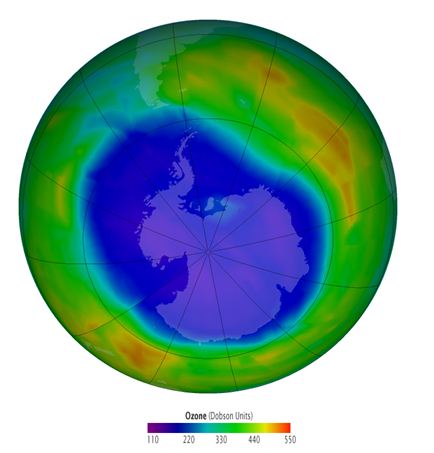
Ozone hole does not mean that there is no ozone in the region. The ozone hole is defined as the area having less than 220 dobson units (DU) of ozone (concentration) in the overhead column (i.e., between the ground and space).
The image below shows the reduction in ozone concentration over Antarctica. This hole in the Antarctica is unfortunately allowing more Australians to be exposed to UV radiation. However, if this kind of ozone destruction ever takes place in the Arctic zone, more humans (in the Northern Hemisphere) would be exposed to higher levels of UVB radiation.
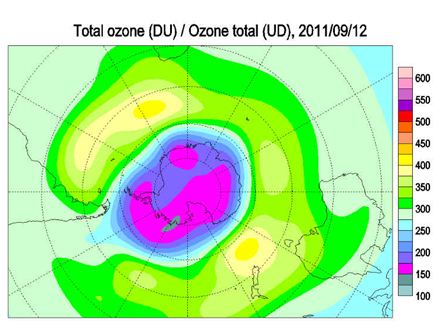
A Dobson Unit is the measure of the amount or thickness of ozone in the atmosphere. It is based on a measurement taken directly above a specific point on the Earth's surface. One Dobson unit refers to a layer of ozone that would be 0.001 cm thick under conditions of standard temperature (0 degree C) and pressure (the average pressure at the surface of the Earth). The Dobson unit was named after G.M.B. Dobson, who was a researcher at Oxford University in the 1920s. He built the first instrument (now called the Dobson meter) to measure total ozone from the ground.
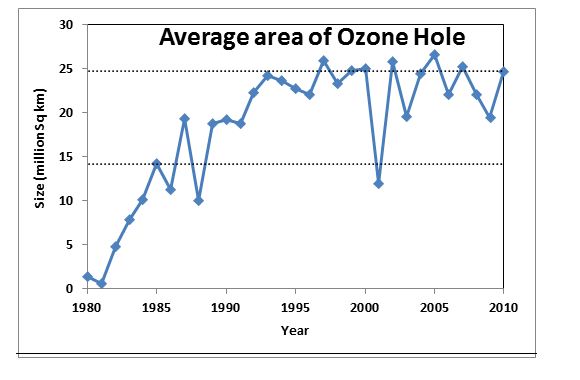
The size of the Southern Hemisphere ozone hole as a function of the year is shown in the figure below. The graph compares the size of the hole over a twenty-year period, from 1980 to 2010. It can be seen that the size increased each year. Each year, in the spring, the ozone hole is at its largest.
Effects of Ozone Depletion on skin
Effects of Ozone Depletion on skinEffects of ozone depletion can result in 1) increased cases of skin cancer, 2) skin damage, 3) cataracts and other eye damage, and 4) immune suppression.
Skin Cancer
The incidence of skin cancer in the United States has reached epidemic proportions. One in five Americans will develop skin cancer in their lifetime, and one American dies every hour from this devastating disease.
Medical research is helping us understand the causes and effects of skin cancer. Many health and education groups are working to reduce the incidence of this disease, of which 1.3 million cases have been predicted for 2000 alone, according to The American Cancer Society. The figure below shows the sources of ozone depleting substances.
Melanoma
Melanoma, the most serious form of skin cancer, is also one of the fastest growing types of cancer in the United States. Many dermatologists believe there may be a link between childhood sunburns and melanoma later in life. Melanoma cases in this country have more than doubled in the past 2 decades, and the rise is expected to continue.
Nonmelanoma Skin Cancers
Nonmelanoma skin cancers are less deadly than melanomas. Nevertheless, left untreated, they can spread, causing disfigurement and more serious health problems. More than 1.2 million Americans will develop nonmelanoma skin cancer in 2000 while more than 1,900 will die from the disease. There are two primary types of nonmelanoma skin cancers.
- Basal Cell Carcinomas are the most common type of skin cancer tumors. They usually appear as small, fleshy bumps or nodules on the head and neck, but can occur on other skin areas. Basal cell carcinoma grows slowly, and rarely spreads to other parts of the body. It can, however, penetrate to the bone and cause considerable damage.
- Squamous Cell Carcinomas are tumors that may appear as nodules or as red, scaly patches. This cancer can develop into large masses, and unlike basal cell carcinoma, it can spread to other parts of the body.
These two cancers have a cure rate as high as 95 percent if detected and treated early. The key is to watch for signs and seek medical treatment.
Other Skin Damage
Other UV-related skin disorders include actinic keratoses and premature aging of the skin.
- Actinic keratoses are skin growths that occur on body areas exposed to the sun. The face, hands, forearms, and the "V" of the neck are especially susceptible to this type of lesion. Although premalignant, actinic keratoses are a risk factor for squamous cell carcinoma. Look for raised, reddish, rough-textured growths and seek prompt medical attention if you discover them.
- Chronic exposure to the sun also causes premature aging, which over time can make the skin become thick, wrinkled, and leathery. Since it occurs gradually, often manifesting itself many years after the majority of a person's sun exposure, premature aging is often regarded as an unavoidable, normal part of growing older. With proper protection from UV radiation, however, most premature aging of the skin can be avoided.
Protect yourself against sunburn. Minimize sun exposure during midday hours (10 am to 4 pm). Wear sunglasses, a hat with a wide brim, and protective clothing with a tight weave. Use a broad spectrum sunscreen with a sun protection factor (SPF) of at least 15. To be safer, 30 is better.
Effects of Ozone Depletion on eyes and immune system
Effects of Ozone Depletion on eyes and immune systemCataracts and Other Eye Damage
Cataracts are a form of eye damage in which a loss of transparency in the lens of the eye clouds vision. If left untreated, cataracts can lead to blindness. Research has shown that UV radiation increases the likelihood of certain cataracts. Although curable with modern eye surgery, cataracts diminish the eyesight of millions of Americans and cost billions of dollars in medical care each year.
Instructions: Place your mouse over the image below to see the effect cataracts can have on vision. (Note: This video has no audio.)
Other kinds of eye damage include pterygium (i.e., tissue growth that can block vision), skin cancer around the eyes, and degeneration of the macula (i.e., the part of the retina where visual perception is most acute). All of these problems can be lessened with proper eye protection from UV radiation.
Immune Suppression
Scientists have found that overexposure to UV radiation may suppress proper functioning of the body's immune system and the skin's natural defenses. All people, regardless of skin color, might be vulnerable to effects including impaired response to immunizations, increased sensitivity to sunlight, and reactions to certain medications.
Protecting the Environment- Ozone Depletion
Protecting the Environment- Ozone DepletionYour “Power” in Protecting the Environment from Ozone Depletion
- Make sure that technicians working on your car air conditioner, home air conditioner, or refrigerator are certified by an EPA-approved program to recover the refrigerant (this is required by law).
- Have your car and home air conditioner units and refrigerator checked for leaks. When possible, repair leaky air conditioning units before refilling them.
- Contact local authorities to properly dispose of refrigeration or air conditioning equipment.
International Action in Protecting the Environment from Ozone Depletion
In 1987, the Montreal Protocol, an international environmental agreement, established requirements that began the worldwide phase out of ozone-depleting CFCs (chlorofluorocarbons). These requirements were later modified, leading to the phase out in 1996 of CFC production in all developed nations.
Ground Level Ozone and Photochemical Smog
Ground Level Ozone and Photochemical SmogOzone is a secondary pollutant that forms from the primary pollutants such as Volatile Organic Compounds (Hydrocarbons) and nitrogen oxides (NOx) in the presence of sunlight. Its formation is mainly from the automobile emissions.

Below is a demonstration on how ozone forms at the ground level (note ground level ozone is also known as “bad” ozone). Please watch the following 5:29 video:
This demonstration is basically looking at how ozone forms or how photochemical smog forms at the ground level because of the pollutants that we emit. Ozone emission or ozone formation depends on two ingredients, nitrogen oxides that are emitted by pollutants that are going out to the tail pipe of a car and in a power plant with a stack. Nitrogen oxides react with volatile organic compounds. Volatile organic compounds are also emitted by the tailpipe of the cars and some of them are coming from petroleum refineries and petroleum industries. VOCs + NOx = Ozone.
These volatile organic compounds react to form ozone only in the presence of sunlight. That is the critical thing, only in presence of sunlight. So, to see this demonstration, we need sunlight. Obviously, we don’t have the sunlight here, but I can create sunlight or the wave lengths that are important to create the same effects. That is the reason I am using a UV lamp. You see this lamp here? This blue light is producing the UV light that is required to create ozone. And this ozone again reacts with volatile organic compounds to produce photochemical smog.
So first of all I am trying to create here ozone. The way I am creating ozone is not with Nitrogen oxides and volatile organic compounds, but turning the oxygen that is there in the beaker into ozone by using this UV light. So let me close this and in about three or four minutes, the oxygen that is there inside will turn into ozone. So we have one ingredient. The second ingredient that is required is Nitrogen oxides or volatile organic compounds to produce smog. Once ozone is formed, I can introduce one of those ingredients, and we can see the smog. Ok, I guess we have probably enough ozone in there. Now we need to add Nitrogen oxides and volatile organic compounds to form the photochemical smog that we are seeing or that we should be seeing. Ozone + VOCs + NOx = Photochemical Smog.
Since I don’t have my car with me or the tail pipe, I need to somehow produce hydro-carbons in this room. So what I am doing is hydro carbons and Nitrogen oxide, cause even is nitrogen oxides are not there, we can form photochemical smog if we have hydro carbons. The composition will be slightly different. So now I am taking my orange, this is the orange, and you know the beautiful smell that you normally smell with an orange is because of linolenic acid. Linolenic acid is the orange smell that you get. And I’m just taking a small peel of this orange, this is the source of hydrocarbons, and I am trying to put it in here - nothing big deal. And this ozone that is there inside will slowly react with this hydrocarbon that are produced, that are emitted from this orange peel and produce the photochemical smog.
Do you see anything going on here? Are you able to still see through the beaker? Is the atmosphere clear in the beaker, or is it becoming hazy? Let me turn this little bit around, and you may be able to see now, I don’t know. Can you see anything coming out of this? That is the photochemical smog, actually. Let me open this and show you. That is the smog that you see and when the smog or when this smoke kind of smog is in the beaker or in the atmosphere, you can not see through and since this has ozone in it, it is not good for our health. When you live in cities filled with this kind of smog, you generally experience breathing problems and other health problems. Your eyes start to water when you drive home from work late in the afternoon, or your nose starts to run because your body tries to get rid of, get rid of these pollutants. So that is photochemical smog and if we keep this orange peel like this we probably can generate enough smog for about 24 hours to 36 hours like this, with this little orange peel. Now you can see what we are doing to the atmosphere by emitting roughly 10, 12, 13 million tons of nitrogen oxides into the atmosphere and several million tons of volatile organic compounds into the atmosphere.
As previously mentioned, the formation of ozone is mainly from automobile emission. A typical profile of pollutants in the air of major cities is well repeatable and is shown in the figure below. Note how the formation changes over the course of a day:
- Early in the morning - During peak traffic hours, NO and Hydrocarbons are emitted along with CO.
- Mid-morning - NO is slowly oxidized to NO2.
- Mid-afternoon - In the presence of sunlight, NOx react with VOCs to form ozone.
Ozone, by itself, is damaging to health and also to the environment. Ozone triggers a variety of health problems even at very low levels and may cause permanent lung damage after long-term exposure. Ozone also leads to the formation of smog or haze, causing additional problems such as a decrease in visibility as well as damage to plants and ecosystems.

Basic Chemistry and Sources
Basic Chemistry and SourcesAs we have learned, volatile Organic Compounds (Hydrocarbons) combine with nitrogen oxides (NOx) in the presence of sunlight to form ozone.
In turn, sunlight and hot weather cause ground-level ozone to form in harmful concentrations in the air. As a result, it is known as a summertime air pollutant.
Many urban areas tend to have high levels of "bad" ozone, but even rural areas are also subject to increased ozone levels because wind carries ozone and pollutants that form it hundreds of miles away from their original sources.
View the graph below to compare the major sources of NOx and VOC that help to form ozone.

Major sources of NO and VOC's.
| Source | Amount of NOx | Amount of VOC |
|---|---|---|
| Industrial | 18% | 50% |
| Utilities | 24% | 0% |
| Motor Vehicles | 55% | 45% |
| Consumer Solvents | 0% | 5% |
| Other | 5% | 0% |
Health and Environmental Impact
Health and Environmental ImpactSeveral groups of people are particularly sensitive to ozone—especially when they are active outdoors—because physical activity causes people to breathe faster and more deeply. In general, as concentrations of ground-level ozone increase, more and more people experience health effects, the effects become more serious, and more people are admitted to the hospital for respiratory problems. When ozone levels are very high, everyone should be concerned about ozone exposure.

Below is a listing of Health Effects of Ground Level Ozone
- Ozone can irritate your respiratory system, causing you to start coughing, feel an irritation in your throat and/or experience an uncomfortable sensation in your chest.
- Ozone can reduce lung function and make it more difficult for you to breathe as deeply and vigorously as you normally would. When this happens, you may notice that breathing starts to feel uncomfortable. If you are exercising or working outdoors, you may notice that you are taking more rapid and shallow breaths than normal.
- Ozone can aggravate asthma. When ozone levels are high, more people with asthma have attacks that require a doctor's attention or the use of additional medication. One reason this happens is that ozone makes people more sensitive to allergens, which are the most common triggers for asthma attacks. Also, asthmatics are more severely affected by the reduced lung function and irritation that ozone causes in the respiratory system.
- Ozone can inflame and damage cells that line your lungs. Within a few days, the damaged cells are replaced, and the old cells are shed—much in the way your skin peels after a sunburn.
- Ozone may aggravate chronic lung diseases such as emphysema and bronchitis and reduce the immune system's ability to fight off bacterial infections in the respiratory system.
- Ozone may cause permanent lung damage. Repeated short-term ozone damage to children's developing lungs may lead to reduced lung function in adulthood. In adults, ozone exposure may accelerate the natural decline in lung function that occurs as part of the normal aging process.
Protecting the Environment
Protecting the EnvironmentClick on the hotspots in the image below to find out what you can do to protect the environment.
Review and Extra Resources
Review and Extra ResourcesReview
Review Sheet Lesson 4 – Energy and the Environment
- Fossil fuels
- Natural gas, Petroleum, Coal
- Fossil fuel composition (Carbon, Hydrogen, Nitrogen, Sulfur, Minerals)
- Products of Combustion
- Primary pollutants
- Carbon Dioxide (majority), Carbon Monoxide, Sulfur Dioxide, Nitrogen Oxides, Lead
- Secondary Pollutants
- Difference between primary and secondary
- Particulate matter
- Primary particles
- Secondary particles
- Primary pollutants
- Health and environmental effects of
- CO2, CO, SO2, NOx, Lead
- PM
- Very Small (smaller than 0.1 μm)
- Intermediate (between 0.1 μm and 2 μm) Most dangerous
- Coarse size (larger than 2 μm)
- Global and Regional effects of Secondary Pollutants
- Greenhouse effect - What is it?
- Greenhouse gases and GWP
- CO2, H2O, CH4, N2O, Other gases [CFC-12, HCFC-22,Perfluoromethane (CF4), Sulfur hexafluoride (SF6)]
- CO2 and temperature fluctuations (pre-industrial and current concentrations and temperature changes)
- Global warming:
- What is it?
- Difference between greenhouse effect and Global warming
- Factors affecting Global climate change
- Potential consequences on global temperature, change in sea levels, polar icecaps, precipitation levels, etc.
- What is known for certain?
- What is likely but uncertain?
- What is uncertain?
- Solutions for global warming
- Acid Rain and Ozone
- Acid Deposition, Basic chemistry of formation, gases responsible for acid deposition
- Wet deposition
- Dry Deposition
- pH scale (ranges from 0 to 14)
- pH of 7 is neutral
- pH less than 7 is acidic
- pH greater than 7 is basic
- Effects of acid rain on human health, vegetation, aquatic life, visibility, and materials
- Ozone
- Good Ozone (stratospheric ozone) vs. Bad Ozone (ground level ozone)
- Ozone Hole (Dobson units)
- Effects of Ozone depletion – basic chemistry
- Ground level Ozone and Photochemical smog formation- Basic chemistry
- Health and Environmental effects
- Your power in protecting the environment
- Acid Deposition, Basic chemistry of formation, gases responsible for acid deposition
Test Yourself
The questions below are your chance to test and practice your understanding of the content covered in this lesson. In other words, you should be able to answer the following questions if you know the material that was just covered! If you have problems with any of the items, feel free to post your question on the unit message board so your classmates, and/or your instructor, can help you out!
- What is the difference between primary and secondary pollutants?
- How can scientists extrapolate historical climate changes by analyzing ice cores?
- What is the greenhouse effect? Explain the difference between greenhouse effect and global warming? Which gases contribute to the greenhouse effect?
- Explain how ozone is formed at the ground level with the help of the basic reactions. Which end users of energy are responsible for the emissions of the compounds involved?
- Explain how the stratospheric ozone layer is being destroyed. Which sector is responsible for the emission of the gases that are responsible for this?
- What is acid rain? How is it formed? What are the effects of acid rain?
- List five steps that you, as an individual, can take to reduce potential global warming, and explain how each of these steps will reduce the emissions.
- List 5 ways in which you, as an individual, can reduce gaseous emissions that contribute to acid rain.
- State the arguments that scientists are making who say that global warming is not due to burning of fossil fuels.
- What are the effects of ground level ozone?
- Briefly describe the methods by which information is gathered and used to show that the planet is warming up.
Lesson 4 Deliverables
Lesson 4 DeliverablesDeliverable 1
You must complete a short quiz that covers the reading material in lesson 4. The Lesson 4 Quiz, can be found in the Lesson 4: Energy and the Environment module in Canvas. Please refer to the Calendar in Canvas for specific time frames and due dates.