Module 8: Cities in Peril: Dealing With Water Scarcity
Module 8: Cities in Peril: Dealing With Water ScarcityOverview
In this module, which extends over two weeks, we will explore issues related to water use and scarcity. Major population centers and their burgeoning water needs, particularly those cities located in arid or semiarid regions with sparse local water supplies—Las Vegas, NV, and Los Angeles, CA come to mind as glaring examples. In both of these cases, the main source of water is surface water from distant sources, and we must examine the provisions and history of the Colorado River Compact to understand how water is allocated in the southwestern U.S. Later in this module, we will see how climate change can affect the Colorado River resource. New York City, on the other hand, is located in a region replete with surface and groundwater resources; but the NYC story is of interest because of the incredible planning and engineering that has gone into—and continues— assuring a steady water supply.
But cities are not the main consumers of water, as we have learned. We must also consider the impact of agriculture on water resources; in the U.S. this is, perhaps, best exemplified by the impacts on the huge multistate Ogallala Aquifer system of the Midwest, which has experienced considerable overdraft, primarily as the result of water withdrawals for crop irrigation. This will also serve as one of our water supply foci in this module.
We will also briefly examine how water is regulated. We have, of course, already covered (Module 7) regulation of drinking water quality, but it is equally important to understand who controls water allocations and how. Water resource allocations are much more complicated, with regional variations in water law and the additional impacts of regional and international compacts. Yes, there have been water "wars" (disputes) related to these laws/doctrines/principles, but we will not cover those here to any extent.
In this module our approach will differ from previous modules in that we will provide some background information on the major topics, including key illustrations, but will ask you to carefully read chapters in "The Big Thirst" (our "textbook", remember that?) and a few other articles, and to compose several short essays in answer to questions in the module.
Module 8.1: Cities in Peril: Dealing with Water Scarcity – History and Current Approaches
Module 8.1: Cities in Peril: Dealing with Water Scarcity – History and Current ApproachesIn this first part of Module 8, we will focus on current strategies for addressing water scarcity. In part, these strategies have arisen within the confines of water laws that have shaped the history of water access and allocation, especially in the American West. After a primer on this legacy that defines the "water allocation landscape", you will learn about the wide-ranging portfolio of approaches utilized by Los Angeles and Las Vegas - cities at the vanguard of creative and modern water management - to hedge against water shortage.
Goals and Objectives
Goals and ObjectivesGoals
- Describe the two-way relationship between water resources and human society
- Explain the distribution and dynamics of water at the surface and in the subsurface of the Earth
- Identify strategies and best practices to decrease water stress and increase water quality
- Thoughtfully evaluate information and policy statements regarding the current and future predicted state of water resources
Learning Objectives
In completing this module, you will:
- Compare land use in areas with contrasting access to fresh water
- Calculate the water needed to support a given population and compare with available resources
- Analyze water supply (scarcity) problems and solutions in the Western US
- Evaluate the policy of annexing water rights from both scientific and ethical perspectives
- Assess the sustainability of water banking as a solution to water scarcity in the event of sustained drought
- Assess the long-term effectiveness and scientific basis of the Colorado River Compact
Surface Water Allocation and Management
Surface Water Allocation and ManagementIn the U.S. there are some differences regionally in how surface water allocations are handled. In large part, these differences arose historically and have been modified and given legal standing.
Riparian Doctrine
Riparian DoctrineThis doctrine has its roots in the Code Napoleon (1804) and English Common Law and has been applied primarily in states east of the Mississippi River. The basic provisions in the early 1800s were that:
- so-called "Riparian water rights" extend to the center of a non-navigable water course;
- navigable water courses belong in the public domain and cannot be obstructed (although it appears that access from privately owned stream banks could be denied);
- mills or milldams could be developed by landowners with stream bank holdings and could be transferred upon sale of property;
- beyond use for millraces, excess water could not be removed and water returned must be equivalent to that removed in quantity and quality; and
- riparian landowners must be compensated for illegal capture of water by others. This last stipulation was interpreted by the U.S. Supreme Court (in 1827) in a way that gave riparian landowners (those with properties bordering a stream) the right to make "reasonable" use of water in a stream. However, they cannot claim ownership of the water, nor can they divert or dam a stream to the detriment of other riparian landowners.
All states (31 states) east of the Mississippi River have water allocation laws based on the Riparian Doctrine. Any waterway that can be used for navigation in its normal condition is considered navigable. If it is only used for intrastate commerce or transport, it is under control of that state. If used for interstate or foreign commerce or transport, it is under the control of the Federal government. There is no "water ownership" under the present Riparian Doctrine and principles of Reasonable Use and Correlative Rights are applied. Riparian landowners can use any quantity of water as long as it does not interfere with the rights of other landowners. They must also, therefore, share the total flow of stream water with other riparian landowners; for example, during a drought, restrictions on water extraction can be enacted to allow all owners (users) a reasonable share of the reduced flow in proportion to their ownership of stream bank property. During floods, riparian landowners can take exceptional action to protect their property, regardless of consequences for other landowners. In addition, the Riparian Doctrine is being altered in some states to allow permits to allocate water based on rates of use and other factors that can be changed by the state at any time. Courts or state water agency officials settle disputes over alleged injurious water use. The Riparian Doctrine works because water resources east of the Mississippi River are not, in general, limiting and irrigation for agriculture is not necessary.
Doctrine of Prior Appropriation
Doctrine of Prior AppropriationThis water law principle developed somewhat gradually in the western U.S. Many western streams had intermittent flows that were not amenable to the specifications of the Riparian Doctrine. Initially, the sparse settlement, general lack of competition for water resources, and seasonality of flow of western rivers allowed landowners to modify river channels to impound water for their use—first-come, first-served. Certainly, the Federal government did not anticipate widespread settlement of the West because it was so arid. By the early to mid-1800s, the influx of Mormon settlers in Utah required some solution to relatively sparse water resources in the face of increased agricultural activity. In response to the need and their religious principles, they established a water allocation system that favored shared use of that resource with a principle that favored beneficial use. However, the beneficial use philosophy was later replaced by that of the "Prior Appropriation Doctrine."
The Prior Appropriation Doctrine grew out of the California gold rush, and the need for gold miners to establish some system of mining claims and water use because of the limited water resources available. This is where the "first come, first served" aspect of water rights arose. California, which became a state in 1850, therefore adopted the Doctrine of Prior Appropriation that allowed diversion of water from a watercourse for use on non-riparian lands. In other words, if irrigation of crops or washing of mine tailings was required on lands with no direct stream access, these uses were permitted, with a priority (time of claim) basis. This doctrine established water rights, based on priority use, that could be sold or transferred as long as they did not interfere with another prior appropriation (" first in time, first in right" as long as this appropriation was properly filed). This doctrine prohibited "junior" (later claimants) users from using water if the resource was so limiting as to reduce that available to "senior" claimants below their allocation. Presently, the "California Doctrine" allows the application of both the Riparian Doctrine and the Doctrine of Prior Appropriation to operate (the so-called California Doctrine), depending on the availability of water resources (e.g., more water-rich northern California vs. arid southern California). Other states had somewhat different histories, but still made use of modified versions of the Doctrine of Prior Appropriation. Colorado, in particular, established the doctrine with respect to agricultural use for non-riparian lands. An interesting aspect of the Prior Appropriation Doctrine is the "use it or lose it" aspect. Once a claim is made, the water use must meet the stipulations of the claim annually, or, potentially, lose that claim. New claims relating to the expansion of irrigation, for example, are treated as "junior" claims that may or may not be honored, depending on the surface-water flow rate and other more senior claims.
Colorado, Alaska, Arizona, Idaho, Montana, Nevada, New Mexico, Utah, and Wyoming presently apply the strict Doctrine of Prior Appropriation as established in Colorado. California, Kansas, Nebraska, North Dakota, Oklahoma, Oregon, South Dakota, Texas, and Washington use the California Doctrine, whereas Hawaii applies its own version of priority depending on the water use.
Cities in Peril: LA
Cities in Peril: LAThe Giant Straws of Los Angeles
To see Los Angeles, with its lush landscaping and common swimming pools, one would never believe it to be water limited. Los Angeles is a sprawling agglomeration of towns and neighborhoods spread over nearly 470 sq. miles (1220 sq. km) of semiarid hills and valleys (precipitation is about 15 in--38 cm-- annually). One river, the Los Angeles River, runs through the city to the sea, but this watercourse flows only intermittently and--mainly for flood control--has now been straightened and confined to a concrete channel. The City of Los Angeles now has nearly 3.9 million people living within its borders, a far cry from the estimated 1600 people that lived there in 1850 when (a smaller footprint) LA was first incorporated (Fig 1). By 1900, LA's population had grown to over 100,000, and the local water supply was deemed inadequate. Thus began LA's quest for additional water resources. The subsequent history of water acquisition, especially that of Owen's Valley water and the LA aqueduct (see L.A. Aqueduct Centennial 2013 for pics) engineered by William Mulholland, makes very interesting reading ("Cadillac Desert" by Marc Reisner, p. 54-107). Controversy still surrounds this acquisition. Table 1 shows the major aqueducts that now supply water to LA. If you aren't familiar with the term, an aqueduct is an artificial channel for conveying water, typically in the form of a bridge across a valley or other gap.

| Aqueduct | Year Complete | Year Construction | Length | $ Cost | Delivery |
|---|---|---|---|---|---|
| Owens Valley and LA Aq | 1913 | 5 | 223 mi | 23mill | 485 cfs |
| Second LA Aq. | 1970 | 5 | 137 mi | 89mill | 290 cfs |
| Colorado River Aq. | 1941 | 10 | 242 mi | 220mill | 1600 cfs |
| California Aq. and West Br* | 1973 | 1960 appop | 701 mi | 5200mill | 4400 cfs |
*California State Water Project: note that the length and cost is for the entire system, not just LA, and the cfs for the West Branch is not what LA alone receives. Source: California State Water Project At a Glance

The second LA Aqueduct was built to take advantage of additional water taken from the Mono Lake drainage through an 11-mile tunnel drilled under the Mono Craters to connect to the Owens Valley system. Today, about 70% of LA's water comes from the Eastern Sierra. The two LA aqueducts supply nearly 430 million gallons per day (about 100 gpd per person in the City of Los Angeles today!). Groundwater wells in the San Fernando Valley and other local groundwater basins supply 15% of water needs, and purchases from the Metropolitan Water District (Colorado River Water and California State Water Project) supply the remaining 15%. Variation in use of each of these sources year by year (Figure 2) is a function of water supply available at the source resulting from drought, competing uses, and other factors. For example, the period between 1987 and 2004 required the purchase of considerably more water from MWD sources (at greater expense) because of severe drought/low snowpack in the eastern Sierra Nevada during that period.
Water Use Trends in LA
Water Use Trends in LA
The trend in total water use for the City of Los Angeles (Figs. 3 and 4) is interesting because, although the population has increased significantly since 1970, average demand has remained relatively constant between 600 and 700 million acre-ft per year and has even decreased to around 500 million acre-feet in the past few years. This is a testimony to the effects of conservation and reuse because of source limitations (competing uses, drought) and rising costs. Economic downturns may also play a role. Certainly, one way to conserve water in LA is through limiting outdoor water use (car washing, landscaping/lawns). It is estimated that watering landscaping for individual homes is about 38% of total water use. Perhaps, like Las Vegas, LA should further encourage xeriscaping and graywater use for irrigating lawns and golf courses, but more on solutions in Module 8, Part 2 next week.

Cities In Peril: Las Vegas
Cities In Peril: Las VegasThe Survival of Las Vegas


It’s hard to think about Las Vegas without images of stereotypical excess: gambling, bachelor(ette) parties, luxurious hotels, swimming pools, golf in the desert, posh fountains, celebrities, major music, and entertainment acts, and famous restaurateurs. On the one hand, it may seem incongruous that Las Vegas and the surrounding Clark County, which receive only 4 inches of rain per year on average and lie within one of the driest regions on Earth (Figure 5) (as discussed in Module 1), are also home to one of the fastest-growing populations in the U.S. (Figure 6; See also the interactive link in the caption below). On the other hand, it may be surprising that Las Vegas is among the most water-conscious cities in the nation, and as discussed below, despite rapid economic and population growth over the past two to three decades the city has managed to live within the limits of its relatively meager allocation of water from the Colorado River, the main water source for the region (see Colorado River Compact).


A Familiar History of Water and Population Growth
A Familiar History of Water and Population GrowthIn the mid-1800s, early settlers named the area "Las Vegas", Spanish for "the meadows", because the Valley, fed by the Las Vegas Springs, was lush, grassy, and green. The springs yielded approximately 5,000 acre-feet of water per year. As you may recall, this is about the amount of water needed today to support 5,000 families of four, or a population totaling around 20,000. With a plentiful natural water supply, Las Vegas became a key stop and hub for the railroads: first the San Pedro, LA, & Salt Lake City Railroad, and later the Union Pacific.
In the early 1900s, private wells drilled into the valley-fill confined aquifer became commonplace to augment the spring flows, as residents tried to turn the valley into productive farmland. Many of the wells were artesian but were left uncapped (Figure 7). By 1912, the 1000 residents of Las Vegas withdrew about 22,000 acre-feet of water per year from the springs and aquifer. By 1930, a combination of several dry years and increasing demand led to overdraft conditions. In the meantime, the Colorado River Compact of 1922 allocated a small amount of Colorado River water to Southern Nevada (see Sidebar: CO River Compact). However, Las Vegas continued to rely principally on groundwater, and aside from some industrial uses, the Colorado allotment went largely unused until the 1940s. (Note that Hoover Dam, the primary infrastructure that allows surface water storage and withdrawal for Clark County, was not completed until 1936.)

With a steadily growing population and water demand, withdrawals greatly exceeded natural recharge and overdraft of the aquifer worsened. In an effort to reduce groundwater extraction, the Las Vegas Valley Water District was created in 1947, in part to begin using the Colorado River allotment. Despite these efforts, by 1960 the valley’s population had swelled to over 110,000, and almost 50,000 acre-feet of water were extracted from the aquifer annually. The natural springs dried up in 1962, and sustained overdraft led the potentiometric surface to drop by a few feet per year on average. The pattern continued through 1971 until the Southern Nevada Water System began delivery of Colorado River water from Lake Mead for municipal supply – 24 years after the water district was created.
With a plentiful supply (300,000 acre-feet per year) of Colorado River Water ready for delivery and distribution, population growth accelerated, reaching almost 700,000 by 1990 (Figure 8), and about 2 million by 2012. Coincident with the shift to water supply from Lake Mead in 1971, dependence on groundwater gradually started to decline (Figure9). As discussed in more detail below, managed (induced) recharge of the groundwater system using surplus Colorado River water was begun on a small scale in the late 1980s; this “banking” of water in wet years or times of surplus is viewed as one strategy to cope with water shortages.


Current Water Use and Sources
Current Water Use and SourcesCurrently, about 90 percent of Southern Nevada’s water comes from Lake Mead (the Colorado River) (Figure 9); the rest comes from groundwater. Because of the very limited natural recharge to the aquifer system, and the fact that no other surface water is available, Las Vegas depends almost exclusively on the Colorado River to sustain its population and economy. The city is essentially at the mercy of the Colorado River. When the Colorado River Compact was signed in 1922, the allotment of 300,000 acre-feet per year was viewed as generous for the sparsely populated state. However, as may sound like a familiar story, with a rapidly growing economy, combined with good weather and apparently plentiful water, population growth rapidly exceeded most projections (see Figure 5).
Of the water delivered by the Southern Nevada Water Authority, it may be surprising to note that most (almost 60%) goes to residential use (Figure 10). Of this, a large fraction is used consumptively for watering lawns. As discussed in detail in The Big Thirst, incentive programs for removal of turf from parks, common areas, and residences is one strategy to reduce water use. Golf courses and resorts, which are often the stereotypical poster children for water “waste” in Las Vegas, use about 14% combined.
The pie chart shown in Figure 10 provides the first blueprint for conservation efforts and potential re-use, by identifying the key water uses in the district. Moreover, there is also a recognition that not all water uses are “equal”: some require clean water (i.e. residential uses, many industrial uses, medical), whereas others do not (golf courses, parks). As a result, reclaimed and partly treated water may be used for many needs. In Las Vegas, water re-use – essentially getting two uses of the same water - is one part of a diverse strategy to maximize the limited allocation of Colorado River water (additional detail on treatment facilities and pricing for reclaimed water are described on the water district’s website.

Figure 10. Municipal water uses in Southern Nevada as of 2022.
Dealing With Water Scarcity: A Diversified Portfolio
Dealing With Water Scarcity: A Diversified PortfolioDue to a decades-long drought in the Colorado River system (see Sidebar: CO River Compact), the water level in Lake Mead has dropped by almost 170 feet since 2000 (Figure11). This corresponds to a decrease from ~25 million acre-feet of stored water to around 10 million acre-feet. If the lake water level drops to 1075 feet (as of June 2022, it is 1043 feet!), a federal shortage would be declared, triggering a reduction in Nevada and Arizona's allocations. In June of 2022, the U.S. Bureau of Reclamation decarded an emergency request for Colorado River states to reduce use by 2-4 million acre-feet within 18 months.To make matters worse, the two intakes in Lake Mead that withdraw water for Las Vegas cannot function if the lake level drops below 1050 feet (intake #1) or 1000 feet (intake #2). With the possibility of continued dry conditions, and because of their near sole dependence on Colorado River water, Las Vegas has developed a multi-pronged strategy to hedge against uncertainty due to future climate change coupled with likely increased demand due to growth and development in Clark County.

Conservation
ConservationAs you have read about in The Big Thirst: Dolphins in the Desert, Las Vegas has been aggressive in water conservation efforts. Part of these efforts focuses on simple reductions in household water use through education, regulation (i.e. watering restrictions), and incentivized removal of water-intensive landscaping. The city has also implemented GPS technology and pressure and acoustic sensors to monitor leaks in their pipelines to limit leaks and thus maintain high efficiency. As a result of these efforts, per capita, water use in Las Vegas has decreased substantially over the past 20 years or so, from over 340 gallons per day to less than 200 gallons (a 40% reduction!) (Figure 12). The SNWA has set a conservation target of 105 gallons per day fro 2035. As a result, Southern Nevada's total annual water use dropped by almost 90000 acre-feet (30 billion gallons) from 2002 to 2012, even as its population grew by 400,000.
Additionally, as noted above, Las Vegas treats wastewater for re-use, especially for applications that (a) don’t require high-quality water, like watering golf courses and parks; and (b) are consumptive. Re-use, incentivized by lower pricing, effectively allows the same water to be used twice, thus making the modest allotment of Colorado River water go further. Indeed, although Southern Nevada’s gross withdrawals from Lake Mead are almost 600,000 acre-feet per year (Figure 9), this is offset by the return of treated water to the Lake such that net withdrawals (consumptive use) remain at the 300,000 acre-feet limit.

New Sources: Tapping Groundwater
New Sources: Tapping GroundwaterDespite a history of overdraft in Las Vegas itself, Southern Nevada has recently turned its eyes back to the underground as an additional water source – but this time in sparsely populated valleys to the North and Northeast of Clark County (Figure13). The rationale for the SNWA’s “Groundwater Development Project” is that groundwater recharge is partly a function of the area over which infiltration occurs, so distributed withdrawals of groundwater from several large valleys fill aquifers outside of Las Vegas may be more sustainable than focused withdrawals from only the local aquifer system. Additionally, the targeted aquifers are in sparsely populated areas, with relatively small water demand.
Nonetheless, as you might imagine, there has been strong opposition to the plan from both environmental groups and ranchers and residents of these valleys, especially when considering past examples of the annexation of water rights for large cities (e.g., Los Angeles and the Owens Valley) and the negative outcomes for the local communities.

Water Banking
Water BankingAs another hedge against water shortage and climate change, the Southern Nevada Water Authority has entered into a series of “Water Banking” agreements with other the Lower Basin Colorado River states, Arizona and California. In these agreements, Nevada pays the other Colorado River water rights holders to store unused water in times of surplus by injecting it into aquifers. Nevada then receives credits for the stored water; if the water is needed, Nevada uses the credits to draw the equivalent water from Lake Mead, and in exchange, the “banker” withdraws the same amount from the aquifer. Although pumping is energy-intensive, groundwater banking does not require the construction of large reservoirs, and the water is not subject to large evaporative losses.
In its water banking agreement with Arizona, the SNWA paid \$100 M initially and began making yearly \$23 M payments in 2009 that will continue indefinitely. The agreement allows the SNWA to withdraw up to 40,000 acre-feet per year. In 2004, SNWA also began a water banking agreement with the Southern California Metropolitan Water District (the water district that serves L.A.) in which some of Nevada’s surplus Colorado River water is stored in an aquifer in Southern California. The agreement allows the SNWA to withdraw up to 30,000 acre-feet per year, provided that they give 6 months notice. Since 1987, Southern Nevada has also been banking its own surplus water – when available - in the valley’s aquifer for later use if needed. In Nevada, about 333,000 acre-feet have been stored through 2022, and in Arizona’s aquifer, the SNWA has stored 614,000 acre-feet of the Colorado River’s water through 2023.
The Third Straw
The Third StrawIn 2005, faced with the specter of prolonged drought and projected Lake Mead water level declines, the SNWA board of directors approved construction of the so-called “Third Straw”, a new $812 M intake from Lake Mead that would allow Southern Nevada to physically extract water from the lake at water levels as low as 1000 feet above sea level (Figure 14). Construction of the intake involves boring a 23-foot diameter tunnel through 3 miles of rock, with much of its length beneath one of the Earth’s largest man-made reservoirs!
The new intake will intersect the lake at 860 feet above sea level but will share a pumping station with intake #2, so will only be able to operate at water levels of 1000 feet (the same as for intake #2). The primary purpose of the third straw is to maintain overall system capacity if Lake Mead falls below the 1050 ft water level limit for operation of intake #1. It also will access the deepest parts of Lake Mead, where water quality is highest. The initial plan for the third intake included a separate pumping facility but was removed to cut costs. It is always possible that the $200 million pumping station and pipelines could be added in the future, though if the Lake Mead water level were to drop much below 1000 feet, there would be much bigger problems throughout the lower Colorado River basin.

Figure 14 shows the elevation of Lake Mead on the y-axis versus the year on the x-axis including different water conservation projects. The important take home from this figure is that as we near 2022 we see that water levels drop. But as different conservation projects (in green, pink, purple, etc.) grow, the rate at which water levels drop decreases. In the time series, the thick dashed line represents the hypothetical elevation of Lake Mead due without conservation projects, while the solid black line represents the actual water level. Although water level is still dropping as of 2022, conservation efforts play a large role in stabilizing Lake Mead water levels.
The Colorado River Compact
The Colorado River CompactThe Colorado River flows almost 1500 km from its headwaters in Wyoming, Colorado, Utah, and New Mexico, through Nevada, Arizona, and California, before crossing the border to Mexico and flowing to the Gulf of California. It is the lifeblood of the American Southwest, serving almost 30 million people and enabling cities, industry, and irrigation-based agriculture to thrive in one of the direst climates on Earth (see Figure 1 in Module 8.2). The river also provides hydroelectric power that spurred much of the 20th-century development of the Southwestern U.S.
In 1922, these seven western states and the federal government negotiated an agreement, the Colorado River Compact (Figure 15) to allocate water rights on the river. First and foremost the compact partitioned water between Utah, New Mexico, Wyoming, and Colorado (the Upper Basin States) where most of its discharge originates as snowmelt); and Arizona, Nevada, and California (the Lower Basin States), where population growth and water demand were increasing rapidly (Figure 16).
The compact was borne in part out of the Upper Basin States’ unease that water projects and use of the river (e.g., by construction of the planned Hoover Dam) by the Lower Basin States at the time would, if interpreted through the lens of the doctrine of prior appropriations, impact their future claims to water from the river. The compact specifies that the Upper and Lower Basin would each have the rights to 7.5 million acre-feet of water per year. To accomplish this while recognizing that not all years would be the same, the delivery of 7.5 million acre-feet per year to the Lower Basin is evaluated based on a ten-year running average (i.e. the Upper Basin must deliver 75,000,000 acre-feet for any span of ten consecutive years). In fact, the primary purpose of Glen Canyon Dam, unlike Hoover Dam, which generates hydroelectric power and serves as the distributary dam for the Lower Basin States, is to serve as a large “capacitor” in the river system to help ensure that this agreement can be met. Later amendments to the agreement included the 1928 Boulder Canyon Project Act, the 1944 Mexican Water Treaty, and the 1948 Upper Basin Compact. In combination, these amendments spelled out the allocation of water between the individual states, and also allocated 1.5 million acre-feet for Mexico (Table 1).
Of course, the specification of an absolute amount of water to each of the states and Mexico has raised a few serious problems that remain contentious. First, the river is over-allocated. The 1920’s – coincidentally the time that the Compact was negotiated was an anomalously wet period with annual flows as high as ~20 million acre-feet (Figures17-18). In contrast, the long-term mean discharge of the river is about 15 million acre-feet, yet 16.5 million are allocated. Furthermore, the river flow is highly variable and based on historical data and tree ring reconstructions, it seems that decades-long dry periods with flows less than 13-14 million acre-feet may be common. Second, climate projections indicate that the region will become drier in the long-term, and some have suggested that we have already entered an era of steadily declining river flows along the Colorado. Fourth, improved understanding and renewed interest in the environmental impact of decades of dramatically reduced flow have spurred new pressures to allocate some discharge for the natural system. Finally, demand is likely to increase as populations in the region continue to grow, further stressing the already over-allocated river (Figure 18).


Colorado River Allocations (Million Acre-Feet per year, ten-year running average)
| Colorado | 3.9 |
|---|---|
| Utah | 1.7 |
| Wyoming | 1.0 |
| New Mexico | 0.85 |
| Nevada | .30 |
|---|---|
| Arizona | 2.85 |
| California | 4.4 |
| Mexico | 1.5 |
|---|---|
| Total | 16.5 |
Total of Colorado River Allocations(in Million Acre-Feet per year) = 16.5


Summary and Final Tasks
Summary and Final TasksSummary
In the first part of Module 8, you’ve learned about the water appropriation laws that have shaped access to water in much of the U.S. As you’ve seen, cities, especially in the arid American West, now must operate within the limits of these water appropriations, regardless of population or economic growth they have accommodated in recent decades. The tension between finite water allocation (i.e. from the CO River) and continued growth has motivated a diverse portfolio of strategies in place to cope with water scarcity and potential shortage. You are now well versed in these approaches, and should be able to describe them, and discuss the costs and benefits of each. In the second part of Module 8 (Module 8.2), we will build upon this knowledge and introduce another risk factor for water supply - that of climate change.
Reminder - Complete all of the Module 8.1 tasks!
You have reached the end of Module 8.1! Double-check the to-do list on the Module 8.1 Roadmap to make sure you have completed all of the activities listed there before you begin Module 8.2.
References
Fishman, C. (2011). The big thirst: The secret life and turbulent future of water. Free Press.
Southern Nevada Water Authority. (2024). 2024–2029 joint water conservation plan.
Module 8.2: Cities in Peril: Future Climate Change, Population Growth, and Water Issues
Module 8.2: Cities in Peril: Future Climate Change, Population Growth, and Water IssuesIntroduction
As has been discussed throughout this course, the relationship between humans and water resources has a long and complicated history. Water has played a central role in how and where human civilizations have developed. Proximity to high quality, reliable water sources provides a firm foundation for a thriving society. Societies that have established near unreliable or unpredictable water sources that may dry up during droughts and/or flood unexpectedly and uncontrollably) have struggled and occasionally suffered catastrophic losses. In other cases, societies have suffered more chronic problems with water quality. Advances in engineering have greatly improved accessibility and reliability of water resources, to an extent that is difficult to overstate. In some cases, however, a combination of highly effective engineering and risky (or ill-informed) decision-making has created some sketchy and unsustainable situations, as discussed in the first half of this module. What does the future hold? How, when and where might the legacy of our past decisions cause us severe problems in the future? What new problems might we anticipate as a result of climate change and population growth? Will technology save us? Or will more ecosystem-focused planning provide a more resilient water future for humans? How much of Earth’s water should humans feel entitled to? How much should be left for nature? These are some of the questions we’ll address in part 2 of this module.
Goals and Objectives
Goals and ObjectivesGoals
- Describe the two-way relationship between water resources and human society
- Thoughtfully evaluate information and policy statements regarding the current and future predicted state of water resources
- Communicate scientific information in terms that can be understood by the general public
- Predict how human interaction with water on Earth is expected to change over the next 50 years
- Interpret graphical representations of scientific data
Learning Objectives
In completing this module, you will:
- Argue one of the many viewpoints on climate change.
- Identify the causes of global warming and climate change over the past ~250 years, including anthropogenic and natural influences.
- Assess whether mathematical models are a sound basis for making policy decisions.
- Evaluate the implications of climate change on future water resources for specific locations in the US.
- Devise a water plan for Phoenix, AZ, projecting forward from 1915
Water Use, Water Stress, and Population Growth
Water Use, Water Stress, and Population GrowthModule 1 discussed the who, how and where of water use throughout the US and the world. In the US and most industrialized countries, the dominant water uses are industry and agriculture. Domestic and municipal water use typically comprises only 15-30% of water use. In developing countries, per capita, water use tends to be lower in general, with a smaller proportion dedicated to industrial use and a larger proportion dedicated to domestic uses (see Module 1, Figures 8 and 9).
It is also useful to remember that we don’t actually see most of the water needed to sustain our daily activities. In the US, average per capita ‘direct’ use of water (domestic or municipal, for watering your yard, taking a shower, flushing the toilet, etc.) is 156 gallons per day, but the per capita ‘indirect’ use of water (including water used for energy production, manufacturing, food production, etc.) is 1230 gallons per day. So we really only ever see about 12% of the water that is used to sustain our quality of life. This ‘invisibility’ (as Charles Fishman refers to it in “The Big Thirst”) of our dependency on clean, reliable water is one of the challenges in planning for the future. Often we’re not even aware of what we stand to lose!
Population growth was also discussed in Module 1. The population is expected to grow by nearly a third of what it is today, to around 9.7 billion by 2050.For an engaging look at population increase in real-time, see the US Census Bureau Population Clock. It is all the more concerning that some of the most rapid population growth in the world (India and Africa) is expected to occur in places that are already experiencing water stress. Add to this the legacies of past policies and infrastructure as well as future projections of climate change and it seems that we have a lot of work and planning to do!
Climate Change
Climate ChangeWhat do and don’t we know about climate change?
Global warming and climate change: Both of these phrases have been used, often interchangeably, to discuss what is currently happening to our climate system. The term ‘global warming’ was coined by a Columbia University geochemist and climatologist by the name of Wallace ‘Wally’ Broecker in a 1975 Science article entitled “Climatic Change: Are we on the brink of a pronounced global warming?” Global warming, in the strict definition, refers to the observation that Earth’s average surface temperature is rising due to increased levels of greenhouse gases. The term ‘climate change’ includes global warming, but also considers the myriad other changes to Earth’s climate system that are caused by rising temperatures, including changes in precipitation and evaporation, movement of air currents (be they frontal systems or convective systems, hurricanes or a polar vortex), etc..
There is virtually no disagreement among climate scientists that both global warming and climate change are happening and is primarily due to human emissions of greenhouse gases. Broad agreement on these points among the science community is not because scientists tend to be an agreeable group. To the contrary, scientists are typically quite quick to disagree with one another and discuss their disagreements ad nauseam, in great detail and based on all available evidence, from empirical observations or theoretical physics and chemistry. Scientists also have large incentives to prove one another wrong. If, for example, a scientist was able to provide compelling evidence that increased greenhouse gases are not causing a systematic change in Earth’s climate system (or that evolution is not the driver of biodiversity, or that the Earth is not 4.6 billion years old), he or she would be famous as the likes of Galileo, Darwin or Einstein (all of whom toppled earlier scientific understanding), their work would be well funded (we would consequently have a lot of new questions that would need to be answered!), their book would be a best-seller, they would probably pick up a Nobel Prize and most notably, they would be interviewed by all of the most reputable talk show hosts. But no scientist has made such a compelling case. To the contrary, the case for significant climate change is compelling in both the empirical observations as well as the theoretical predictions. Those who proffer the opinion that climate change is not happening or is a hoax presumably do so out of sheer ignorance and/or because they have a financial incentive to believe (or to have others believe) that to be the case.
Distinct from the question of whether or not climate change is occurring, many questions remain regarding the effects of climate change on societies and economies. Certainly, there are positive effects. Warmer temperatures and increased carbon dioxide levels mean increased plant and crop productivity. Some places are expected to receive increased amounts of precipitation, potentially relieving water stress (though perhaps also increasing flood risk). Other places will most certainly not be so lucky and generally speaking, the risks and expected losses associated with climate change are expected to far outweigh the benefits. A comprehensive review of climate science and climate change is not possible within the scope of this course, but we will review a few of the key points as they relate to water, science, and society. We refer students to the most recent reports from the Intergovernmental Panel on Climate Change for more detailed and updated information.
Who Does Climate Science?
Who Does Climate Science?Just about anyone could do climate science. Agencies, particularly in the US and Europe, have made an immense amount of weather and climate data available and with a modest amount of training and software anyone could perform rudimentary analyses of temperature or precipitation trends (e.g., see ncdc.noaa.gov or weather.gov or prism.oregonstate.edu). Of course, such analyses don’t answer all the questions. Tens of thousands of highly trained, independent scientists around the world collect and analyze climate data and develop models of global or regional climate change, which are typically tested using historical data and projected into the future. To provide a forum for discussion and debate that could be synthesized to represent our best understanding of climate change, the United Nations Environment Program (UNEP) and the World Meteorological Organization (WMO) established the Intergovernmental Panel on Climate Change (IPCC) in 1988. Thousands of scientists contribute data, analyses, and model results to the IPCC and provide critical peer review of any climate-related research, all on a volunteer basis. Six major assessment reports have been generated by IPCC, with the most recent report released in 2023.
What is Causing Global Warming?
What is Causing Global Warming?While it is not our intent in this module to explore this question in detail, it is worth pointing out that many human activities clearly affect the climate system. Most notably, emissions of greenhouse gases, especially carbon dioxide and methane, are causing more heat to be trapped within Earth’s atmosphere. This effect, called the greenhouse effect, has been well understood since it was discovered by Svante Arrhenius in 1896. Figure 1 below, taken from the 2023 IPCC Working Group 1 Technical Summary shows the relative amount of heating or cooling of the climate system that can be attributed to the various factors that have changed between 1750 and 2019. The anthropogenic modifications to the climate system, enumerated in panel (a) of the figure, show the breakdown of radiative forcing. Anthropogenic forcing greatly outweighs the changes due to natural changes in solar irradiance. Panel (b) shows the effect each emitted component has on global surface temperature. The IPCC is quite careful to note the level of confidence associated with any given piece of knowledge, seen here with the black error bars of 5-95%. They are also transparent and are quick to point out when new understanding has significantly changed estimates or predictions, as has happened with our understanding of stratospheric water vapor, which was thought to be a significant contributor to warming in the Fourth IPCC Assessment Report (AR4, released in 2007), but has been found to be less significant.

What Are the Implications of Global Warming for Precipitation and Water Availability?
What Are the Implications of Global Warming for Precipitation and Water Availability?So what does all this human-induced warming mean for the water cycle and water availability? Thinking back to module 2, you learned that warmer air can hold more water (i.e., warmer air has a higher saturation vapor pressure). Therefore it is reasonable to expect higher amounts of water vapor in the air. This is supported by observations that show a 3.5% increase in water vapor in the past 40 years as the climate has warmed about 0.5°C, with relative humidity remaining approximately constant.
Changes in precipitation are harder to measure (or predict) compared with changes in atmospheric water vapor content because of the immense temporal and spatial variability of precipitation. Nevertheless, patterns of precipitation change can readily be observed from historical records (Figure 2), with many areas seeing increases greater than 25 mm/year per decade (i.e., going from 300 mm/yr to 325 mm/yr over the course of a decade) and other places (particularly Africa and Southeast Asia) seeing decreases in precipitation at rates greater than 10 to 25 mm/year per decade. With increasing temperatures, it naturally follows that a greater proportion of precipitation would fall as rain, rather than snow, which has also been documented by the IPCC.

Historical Precipitation Records and Climate Models
Historical Precipitation Records and Climate ModelsWhat can the historical precipitation records and climate models tell us about the future?
But what can the historical precipitation records and climate models tell us about the future? Simulating future changes in precipitation patterns is one of the most difficult elements of climate modeling because precipitation and evaporation (there are feedbacks between the two so you have to model both) are driven by complex, non-linear processes. So climate models do not attempt to predict detailed representations of precipitation for any given location and climate models are generally not capable of predicting changes in precipitation intensity or frequency of extreme events, other than the likely sign (+ or -) of expected change. Nevertheless, all global climate models attempt to capture general trends in precipitation and considerable agreement exists among all the many competing models. In the broadest perspective, the IPCC makes the following important projections:
“Changes in the global water cycle in response to the warming over the 21st century will not be uniform. The contrast in precipitation between wet and dry regions and between wet and dry seasons will increase, although there may be regional exceptions.”
“Extreme precipitation events over most of the mid-latitude land masses and over wet tropical regions will very likely become more intense and more frequent by the end of this century, as global mean surface temperature increases (see Table SPM.1).”
“Globally, it is likely that the area encompassed by monsoon systems will increase over the 21st century. While monsoon winds are likely to weaken, monsoon precipitation is likely to intensify due to the increase in atmospheric moisture. Monsoon onset dates are likely to become earlier or not to change much. Monsoon retreat dates will likely be delayed, resulting in lengthening of the monsoon season in many regions.”
“There is high confidence that the El Niño-Southern Oscillation (ENSO) will remain the dominant mode of inter-annual variability in the tropical Pacific, with global effects in the 21st century. Due to the increase in moisture availability, ENSO related precipitation variability on regional scales will likely intensify. Natural variations of the amplitude and spatial pattern of ENSO are large and thus confidence in any specific projected change in ENSO and related regional phenomena for the 21st century remains low.”
Figure 3 shows the average temperature and precipitation results of many different competing models for two different scenarios, comparing observations in 1995-2014 to the projected time period 2081-2100. The figures are aggregates of a number of competing climate models from CMIP6. The two scenarios, called ‘Shared Socio-economic Pathways’ (SSPs) 2.6 and 8.5 are the two end-members of greenhouse gas emissions, with SSP 2.6 assuming that greenhouse gas emissions peak in 2010-2020 time period and decrease aggressively thereafter and RCP 8.5 assuming that greenhouse gas emissions increase throughout the 21st century. Notice that the warming (top plots) is not uniform throughout the world. The higher latitudes, especially in the northern hemisphere are expected to heat up considerably more than the temperate or tropical latitudes. We often hear numbers of the global average increase in temperature (estimated 1-2°C or 2-3.5°F by 2050), but this average value does not represent what is expected to happen at high latitudes. A 3-4°C (5-7°F) increase in the arctic, as indicated by SSP 2.6, represents a dramatic transformation of this ecosystem. A 8-10°C (18-21°F) increase in the arctic, as indicated by SSP 8.5, would represent a complete transformation of this ecosystem. What do you think would be the potential benefits and damages caused by such a transformation?
Changes in precipitation are also not expected to be uniform. In general, increases or decreases in precipitation are expected to be more drastic in the high greenhouse gas emission scenario (SSP 8.5) with some areas receiving 30-40% changes relative to 1995-2014. What ecosystem, economic or social changes might you expect to see as a result of a 30-40% increase or decrease in precipitation in the arctic? In Spain? In South Africa? In Chile?
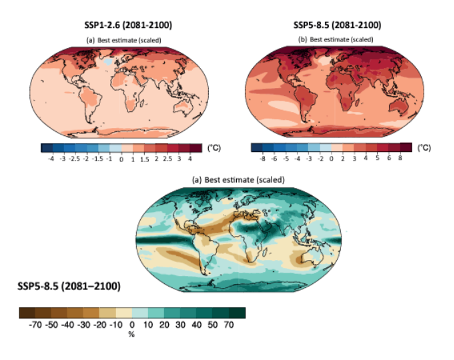
Figure 3. (IPCC chapter 4 figures 4.41 and 4.42) Maps of CMIP6 multi-model mean results for scenario SSP1-2.6 and SSP5-8.5 for temperature and SSP5-8.5 for precipitation. Changes shown from 2081-2100 relative to 1995-2014 averages. IPCC.
Projected Changes
Projected ChangesFigure 4 illustrates projected changes in other parts of the hydrological cycle during the time period 2081-2100 relative to 1986-2005 according to the high greenhouse gas emissions scenario (RCP 8.5). Note that the number of competing climate models represented for each panel of the figure is indicated by a number in the top right (range: 32-39 different models are averaged for each prediction). Future projections of water runoff or soil moisture are dependent on precipitation, which, as discussed earlier, is itself subject to substantial uncertainties. Nevertheless, it is worth considering what the variety of competing climate models have to say. For example, note the general (if slight) decrease in relative humidity over most land masses and a slight increase in relative humidity over the oceans (middle panel, left column). The middle panel in the right column shows changes in the difference between evaporation and precipitation with blue colors indicating a relatively wetter future (more precipitation relative to evaporation) and red colors indicating a relatively drier future (more evaporation than precipitation). The bottom panel in the left column predicts changes in surface water runoff. Note the significant declines in runoff throughout the southwestern US and southern Europe/northern Africa and parts of South America. This same trend is amplified in predictions of soil moisture, which is a primary control on plant growth (bottom panel, right column).
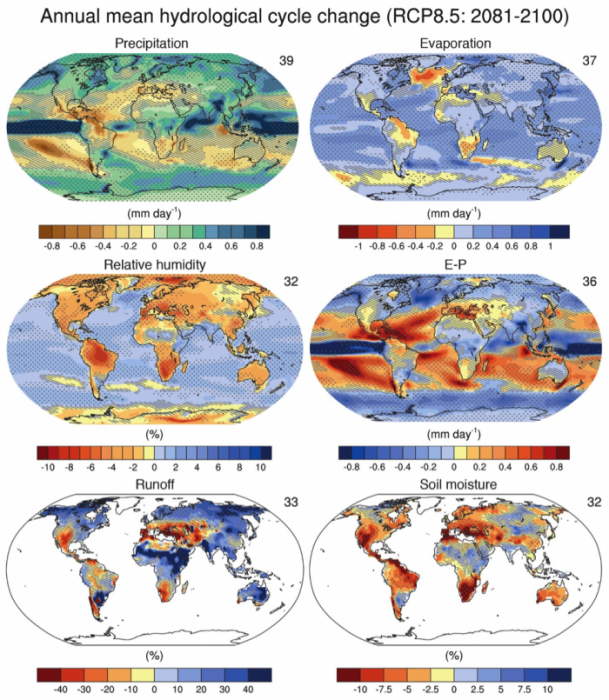
Figure 4. (IPCC TFE.1, Figure 3) Annual mean changes in precipitation (P), evaporation (E), relative humidity, E – P, runoff and soil moisture for 2081–2100 relative to 1986–2005 under the Representative Concentration Pathway RCP8.5 (see Box TS.6). The number of Coupled Model Intercomparison Project Phase 5 (CMIP5) models to calculate the multi-model mean is indicated in the upper right corner of each panel. Hatching indicates regions where the multi-model mean change is less than one standard deviation of internal variability. Stippling indicates regions where the multi-model mean change is greater than two standard deviations of internal variability and where 90% of models agree on the sign of change (see Box 12.1).
All Water Problems Are Local
All Water Problems Are LocalIt is useful to know how climate change is likely to impact the water cycle at the global scale and IPCC reports represent our best understanding of those impacts over the next few decades to a century. But as we have discussed elsewhere, all water problems are local. In very few situations is it even feasible, let alone prudent, to transfer water long distances. Every place has its own set of challenges, institutional and infrastructure legacies, financial or other resource constraints, and concepts of social acceptability.
Generally speaking, places currently experiencing water stress or expecting to experience water stress in the foreseeable future have only a few basic options: a) have fewer people, b) force/incentivize people to use less water, c) increase storage and/or minimize losses within the system, d) reuse water, or e) get water from elsewhere. The capacity to cope with water stress (short or long-term) generally increases with wealth, though in wealthier countries more infrastructure is potentially at risk. As major population centers have already begun to struggle with water shortages it has become clear that massive investments in water technology and security infrastructure can allow wealthy nations to offset higher levels of water stress without remedying their underlying causes. Less wealthy nations, on the other hand, remain vulnerable and have fewer options in water development.
Salt Lake City
Salt Lake CitySalt Lake City: A case study in water development history and planning for the future
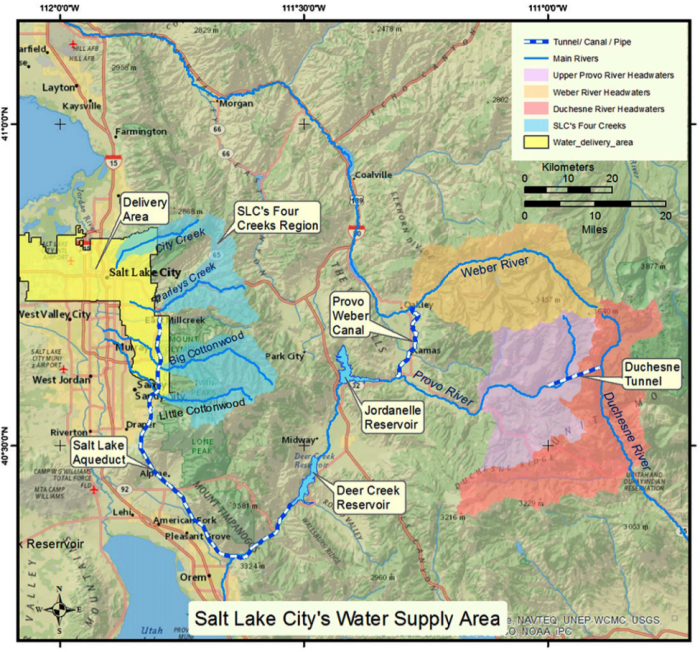
Salt Lake City (SLC) provides an interesting case study in terms of the history and future of water resource development. The first permanent settlers of Salt Lake Valley arrived in 1847 and immediately began diverting water from City Creek (northernmost of the four watersheds highlighted in blue in Figure 5). It is estimated that the early settlers hand-dug 1000 miles of ditches in the first few decades to distribute the water to agricultural fields, Salt Lake City and nearby settlements. By 1879 the population of Salt Lake County had grown to nearly 32,000 and the city authorized construction of the Jordan and Salt Lake City Canal, which was completed in 1882 with a capacity of 150 cubic feet per second, expected to provide enough water for 100,000 residents. The canal is still in use today. Several major dams were constructed as early as 1892 to 1907. Following a major water shortage in 1924, Mayor John Bowman proclaimed that ‘a city can never be greater than its water supply’ and initiated an ambitious water development program to supply reliable water for more than 400,000 residents. Several other large dams were constructed from the 1940s to as late as the 1990s to keep ahead of the rapidly growing population, but options for additional water storage via new reservoirs are now very limited.
Today Salt Lake City’s water supply is derived from several mountainous watersheds to the east of the city, in the Wasatch Front and western Uinta Mountains (Figure 5). About 50-60% of the water is derived from the four creeks just to the east of SLC (highlighted in blue), with the remaining portion delivered from the Weber, Provo, and Duchesne rivers via inter-basin transfers (tunnels, canals, and aqueducts shown as blue and white dashed lines in Figure 5) and extracted from groundwater. Around 70-80% of Salt Lake City’s water supply originates as snowmelt. Thus, the storage of water as snowpack, the timing of snowmelt, and water storage capacity within the system are all critical to ensuring reliable water supply.
Public utilities water use has remained relatively steady at 80,000 acre-feet of water per year since 1980. To put that number in perspective, imagine a tank of water an acre at its base and 80,000 feet (15 miles) tall, or the equivalent of a tank the size of Central Park in New York City flooded 100 feet deep. The fact that total public water use has remained steady over the past three decades is an impressive feat considering the population of Salt Lake County has nearly doubled from 620,000 in 1980 to nearly 1.1 million in 2014. Much of the Greater SLC area is populated by members of the Mormon religion, which has traditionally emphasized large families. More recently the size of families has decreased, but the population as a whole continues to grow.
Despite a growing population, total water use has started to decline in the past decade despite the fact that this time period includes three of the hottest summers on record, due to effective public education and water conservation campaigns (Figure 6).

Climate Change Further Complicates the Water Situation
Climate Change Further Complicates the Water SituationClimate change further complicates Salt Lake City’s water situation. Peak supply from the four creeks typically occurs in early June and is expected to shift earlier in the year, to mid-May, in the coming decades. However, peak water demand typically does not occur until late July or early August. Hence the need for significant amounts of water storage. Temperature increases over the past few decades have already resulted in more winter precipitation falling as rain, rather than snow, thus reducing snowpack. The increased proportion of precipitation falling as rain, combined with an earlier snowmelt threaten the system’s ability to maintain adequate water supply through late summer. The total amount of water runoff is also expected to decrease as the climate warms. Every degree Fahrenheit of warming in the Salt Lake City region could mean a 1.8 to 6.5% drop in the annual flow of rivers that provide the city’s water supply. The semi-arid region is also known to experience frequent and sometimes prolonged drought. With a growing disparity in the timing and potentially the volume of water supply/demand, clearly, some changes are needed. Options currently being considered are further reductions in demand, additional water storage within the system, or extraction of groundwater.
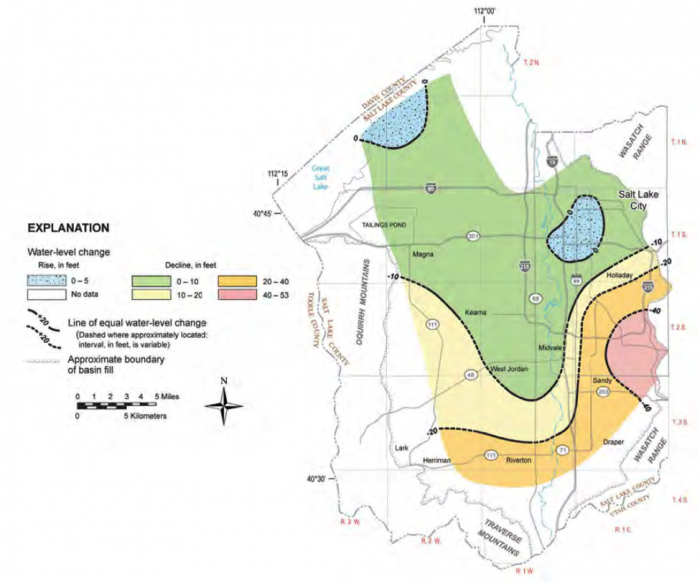
Unfortunately, groundwater reserves are not in great shape. The shallow, unconfined aquifer underlying much of the valley is contaminated from uranium mine leachate, chloride, sulfate, iron, uranium, volatile organic compounds, and pesticides. Recent water quality testing from the shallow, unconfined aquifer found all samples to be below acceptable standards for drinking water. There is a deeper, confined aquifer that is in much better shape, with more than 80% of water meeting or exceeding water quality standards. However, excessive pumping of this aquifer has drawn down the water level by as much as 30-50 feet in places, from 2000-2022.
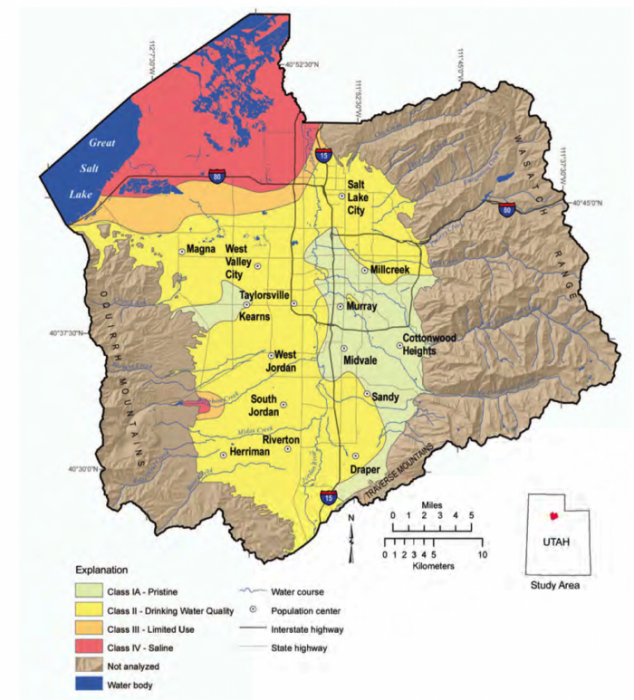
With the Great Salt Lake immediately adjacent to the city it might seem like desalination might be an option. Desalination, also called desalinization, is the process of removal of salt and other minerals to produce fresh water for consumption or irrigation. This is most commonly achieved by boiling water in a process called vacuum distillation or a process called reverse osmosis in which water is forced through a permeable membrane that strips out the salts. Either approach requires a considerable amount of energy and is therefore typically more expensive than most any other alternative. Considering that the Great Salt Lake is 3-8 times more saline than the ocean, this solution is currently not economically feasible to do on a large scale, though some desalination is currently done to treat partially saline groundwater.
People are, of course, not the only organisms that require access to clean and reliable freshwater. More than 75% of the wetlands in the state of Utah are found in Salt Lake Valley, which contains a wide variety of plant species, play an important role in regulating water quality, and provide habitat for a variety of birds, amphibians, and other animals. In addition, several threatened and endangered fish and bird species are dependent on the perennial flowing streams and rivers in the area. Water-stressed trees within the urban forest of the Greater SLC area have become more susceptible to disease. Lower precipitation in the mountains has increased the number and severity of wildfires.
Led by Mayor Ralph Becker, Salt Lake City has taken a proactive stance to adapt water resource management practices and mitigate the effects of climate change. Mitigation involves reducing the magnitude of the problem itself, whereas adaptation involves limiting one’s vulnerability to expected impacts. As part of the Water Conservation Master Plan, the city is attacking the problem from multiple angles. As a preventative measure, the city is purchasing and protecting large tracts of land in the watersheds that provide drinking water. SLC is also incorporating future climate scenarios into city and water development planning efforts, which is quite progressive for a state whose legislature passed a resolution in 2010 proclaiming that climate change was essentially a hoax.
The city is also attempting to bolster local resilience and reduce dependency on external sources of food, recently having passed several ordinances that promote local food production and community gardens. Also, the city is developing a water re-use program to provide water for city parks, golf courses, and the urban forest.
Recognizing that energy demand is a large and growing water use sector, the city is providing incentives for individuals and businesses to minimize the use of all forms of energy and invest in energy-efficient upgrades. Incentives are also in place for the use of solar energy (photovoltaic cells) and solar hot water heaters. The city has promoted net-zero building approaches (meaning that the amount of energy used by the building on an annual basis is roughly equal to the amount of renewable energy created on-site). And they have been willing to put their money where their mouth is…SLC’s Public Safety Building, completed in July 2013, is the first public safety building in the nation to be designed as a net-zero building and one of the first to meet the US Green Building Council’s LEED Platinum certification criteria. Climate change scenarios are being considered in many aspects of infrastructure planning, including building roads and sewers to handle higher runoff volumes and warmer temperatures. In recognition of the progressive direction, he has taken Salt Lake City Mayor Becker was appointed to President Obama’s climate adaptation task force in November 2013.