Reef Coasts
Reef Coasts- What is the global distribution of coasts lined with coral reefs?
- Why are reefs globally distributed in this fashion?
- What are the different types of reef systems we see on a regional scale of kilometers or more?
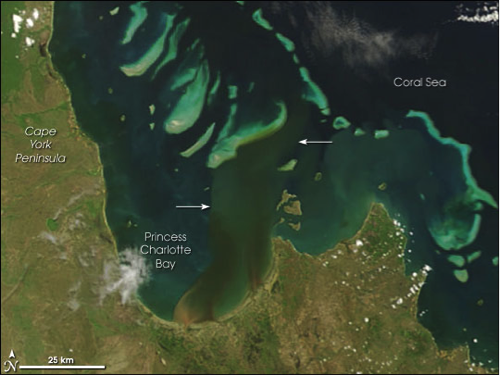
Historically, the exact definition of a reef has been a bit controversial, and different definitions would be provided if you were to ask a geologist or a biologist. For the purpose of this discussion, a reef can be considered any organic framework that is wave resistant and modifies the environment around it because of organic growth. Keep in mind that this definition offers no information about the type of organism creating the reef. Corals, shellfish such as oysters, and even some types of worms can create reefs, although the scale of reefs created by oysters and certain types of worms is much different than the scale of reefs that can be created by corals. The Great Barrier Reef of northeastern Australia extends for nearly, 2300 km and is the only organic structure that is visible from space, whereas oyster reefs are typically only several 10s of meters in length. Fundamentally, reefs rise above the substrate that they are sitting upon and thus modify or alter the speed and direction of currents and waves.

Global Distribution of Coral Reefs
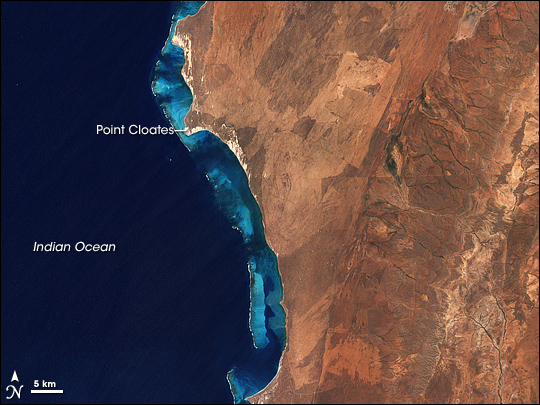
Global Distribution of Coral ReefsThe vast majority of large reefs created by corals in shallow, sunlit waters (< 50 m water depth) are located within a tropical zone located between 30º N and 30º S latitude with a preferred temperature range of approximately 22º to 29º C. Corals also grow best in areas with little suspended sediment in the water, so large coral reefs systems are not common to locations where there is a large input of sediment to the coastal zone by river systems. Although there are cold, deep water types of coral present in the ocean basins, they do not create large nearshore reef structures that affect adjacent coasts.


In total, there are three main types of shallow water coral reef structures: 1) barrier reefs, 2) fringing reefs, and 3) coral atolls. These three types are differentiated on the basis of proximity to land, the overall scale of the reef structure, and the shape of the reef.
- Barrier reefs are typically large-scale, linear features that extend parallel to a shore, with a lagoon between the reef and the mainland.
- Fringing reefs are directly attached to the shore, with no well-developed lagoon between the reef structure and the mainland.
- Coral atolls are circular reefs that often start out as fringing reefs attached to a volcanic island. As the volcanic islands subside, the reef grows upward and a lagoon develops behind the reef and inside the submerging island. Eventually, the island can subside below the water level, and a ringlike coral reef structure remains.


Recommended Readings and Video: For more information on coral and coral reefs, check out these links:
- Coral Reef, Wikipedia
- Corals and Coral Reefs, Smithsonian Natural Museum of Natural History
- Atoll, Wikipedia
- Formation of coral islands, 38-second video
Learning Check Point
Learning Check PointTake a few minutes to think about what you just learned, then answer the questions below.