Coastal Wetlands and Maritime Forests
Coastal Wetlands and Maritime Forests- What is a coastal marsh?
- What are mangroves and what role do they play in capturing sediment and anchoring substrate?
- How can the presence of extensive marsh platforms and mangrove forests help to reduce inland storm surges and flooding?
Coastal wetlands and maritime forests are unique communities of vegetation that can exist along coastal zones. They are directly affected by coastal conditions including changes in water level due to tides, coastal river influx, freshwater, saltwater, wave activity, wind and salt spray, and storm surges. Inasmuch as they are communities uniquely synced to the conditions of their environment, even subtle changes in one condition can cause widespread deleterious changes to the plants themselves.
Coastal Wetlands
Coastal WetlandsThe term coastal wetlands defines an area of land that is permanently or seasonally inundated with fresh, brackish, or saline water and contains a range of plant species that are uniquely adapted to the degree of inundation, the type of water that is present, as well as the soil conditions.
In some cases, coastal wetlands can extend across extremely large areas, as is the case for southern Louisiana along the north-central Gulf of Mexico. The importance of coastal wetlands is well known in southern Louisiana because there, like many other places, the coastal wetlands provide important habitat for a wide range of organisms. They also protect inland communities from the large storm surges that tropical cyclones can produce, by creating friction against an incoming storm surge, resulting in a reduction of the magnitude and extent of inland flooding during tropical cyclones. The greater the width of intact wetlands, the less likely it is that more inland areas will experience the full force of a tropical cyclone. Southern Louisiana has been, however, experiencing drastic loss of wetland at rates that for the last several decades have been equivalent to the loss of a U.S. football field every approximately 30 minutes.

Coastal Wetland Examples
Coastal wetland is used broadly here to identify areas where wetland plants inhabit the coastal zone, in either freshwater or saltwater environments of the coastal zone. For this reason, along the continental U.S. coastal zones, it includes vegetated environments such as salt marshes, fresh marshes, bottomland hardwood swamps, and mangrove swamps. In the United States, coastal wetlands extend across nearly 40 million acres and constitute approximately 38% of the total wetlands in the conterminous U.S.
- Marsh: A marsh is a type of wetland that consists of herbaceous plants (plants with leaves and stems). Typically, there is a period of annual dieback or at least a resting period from growth, and the system can be either salt or freshwater in nature.
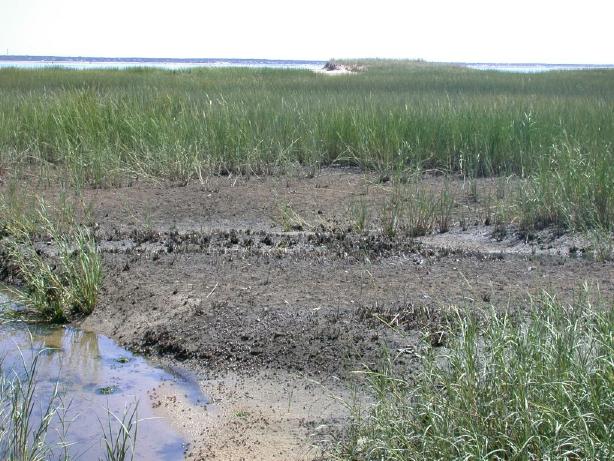
- Salt Marsh: True salt marsh is strongly affected by the tides of a given area on a daily basis because they are located within the intertidal window of elevation. Along the coast of the U.S., all salt marsh experiences a severe to slight dieback during the winter, but begins growing strongly the following year with the return of warmer temperatures. Typical salt marsh structure includes tidal creeks through the marsh platform and localized ponds that may hold some water even during very low tides.
- Fresh Water Marsh: On a global basis, the distribution of coastal-zone freshwater marsh is most closely tied to river systems that enter into coastal zones. The steady influx of freshwater into coastal rivers provides an opportunity for fresh-water vegetation to dominate and prevents the incursion of flora that requires some level of salinity. The Florida Everglades of Florida in the U.S. represent some of the largest, and perhaps the largest, freshwater marsh in the world.
- Swamp: Forested wetlands with little circulation to nearly stagnant conditions are characteristic of swamps. Freshwater, brackish, and saline water are all possible environmental conditions in a swamp.
- Bottomland Hardwood swamps: In the coastal zone, bottomland hardwood forests are closely linked to the availability of freshwater. As a result, most extensive bottomland hardwood swamps are in low-lying river flood plains. Occasional flooding of these environments provides sediment to help anchor the vegetation and nutrients that are critical to growth. Excessive flooding or the introduction of saline waters can have serious effects on the health of such systems.
- Mangrove Swamps and Forests: Mangrove swamps are distributed through tropical and subtropical regions. There are numerous species of mangroves, but they all represent a plant that is halophytic or salt-loving and is associated with other trees and plants that grow within brackish to saline tidal waters. They may consist of a very complicated maze of woody roots and limbs. Depending upon the species of mangrove, very complicated interwoven root structures can develop and provide a significant buffer against erosion and inland progressing waves and storm surges during high-energy events. Across the U.S., they are restricted to low-latitude environments because of the species' intolerance for cold temperatures. Three different species exist from south Florida along to the Texas Gulf Coast, and, in fact, one of the largest mangrove swamps in the world is on Florida's southwest coast where Red Mangrove form structurally resilient coastal environments because of their interlocking woody growth patterns.
Maritime Forests
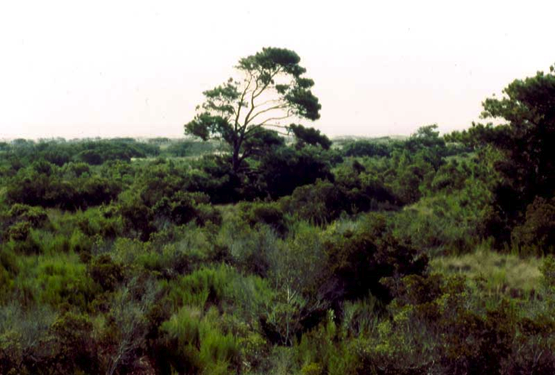
Maritime ForestsMaritime forests are coastally located areas of woods that develop on elevations and topography that is higher than that of coastal wetlands. They primarily rely upon shallow freshwater and cannot tolerate long exposure to salty water; even salt spray can be detrimental to some species of trees that establish maritime forests habitats. Such systems are discontinuously distributed along the U.S. Atlantic coast, but can be found elsewhere as well. In most cases, the soil composition promoting the growth of these forests is sand, either derived from sedimentary units deposited in the past or more recent deposits, such as beach ridges.
Coastal Wetlands and Maritime Forests Summary
Coastal Wetlands and Maritime Forests SummaryCoastal wetland and maritime forests represent unique provinces of vegetation that are uniquely adapted to the harsh conditions of the coastal zone. They provide a range of different habitats for coastal animals and simultaneously provide an important coastal barrier to more inland-located environments, as well as people and infrastructure. There is, however, much concern for the future of our modern coastal vegetation as the different provinces of coastal vegetation face continued exposure to pollution and excess nutrient inputs, changes in the elevation of sea level, and repeat large-scale storm impacts.

For more information on coastal vegetation, check out these links:
- Very good overview of salt marshes
- Nice YouTube video about freshwater marshes
- Information on freshwater marshes
- More information on maritime forest
Learning Check Point
Learning Check PointPlease take a few minutes to think about what you just learned and then answer the questions below.