Solar Energy
Solar EnergyThe sun is far and away the largest potential source of energy to power things on our planet. Humans have been using the sun as an energy source for thousands of years – just think about agriculture and how that would work without sunlight – but the industry of using solar energy to create electricity is in its relative infancy. Growth is fast – in percentage terms, solar is the fastest-growing energy source on the planet. And the cost of solar power, one of its most formidable barriers, is coming down quickly as well. In this module, we’ll take a look at some of the most common technologies used to convert solar energy to electricity.

Solar Photovoltaics
Solar PhotovoltaicsWhen most people think of “solar power,” they think about one of two things – vast arrays of solar collectors laid out in hot deserts (the left-hand panel below) or smaller arrays on rooftops or highways (the right-hand panel below). This is perhaps the most ubiquitous method of converting solar energy into electricity, but it is not the only method. These arrays of solar collectors are known as “solar photovoltaic” installations or Solar PV for short.

Solar PV installations consist of individual collectors called cells, which are packaged together in bundled modules. An individual cell does not generate enough electricity to power much of anything, which is why they must be bundled together. A single module might be enough to provide electricity for a single parking meter or roadside telephone. A number of modules can be further bundled together to form an array (see below). Multiple arrays might be needed to provide electricity for a building or a house.


There are many different kinds of solar PV cells in existence (and even more being developed in research laboratories), but they all work in more or less the same way. Unlike virtually any other type of power plant (be it coal, natural gas or wind), there is no turbine in a Solar PV cell. In fact, there are basically no moving parts at all. .
Solar PV cells harvest solar energy through a phenomenon called the photovoltaic effect, discovered in 1839 by the French physicist Bequerel. Photons of solar energy interact with electrons to “excite” them, causing them to move through conductors, thus producing an electric current. The first solar PV module was made at Bell Labs in the 1950s, but was too expensive to be more than a curiosity; in the 1960’s NASA started to use PV modules in spacecraft and by the 1970s, people started to explore their use in a wider range of terrestrial applications.
This following video explains a bit more about how Solar PV cells work and describes the different Solar PV technologies in use today. One of the potentially most important evolutions in Solar PV technology is the use of semiconducting materials other than silicon in Solar PV cells. These materials are of interest because they could, in concept, allow more of the sun’s energy to be captured on a single array. But they face barriers in the form of high costs and, in some cases, questions about the availability of raw materials.
Video: Photovoltics, a Diverse Technology (4:26)
A Diverse Technology
[music]
NARRATOR: 30 years ago, the first solar cells were made of silicon. And today, silicon makes up more than 3/4 of the rapidly growing worldwide photovoltaic market. But photovoltaic, or PV cells, are also made with other semiconductor materials. Why so many types of solar cells? This diversity is due to innovation. PV materials are improving. Manufacturing costs are dropping. And PV applications are expanding. Balancing these three factors can meet demands for clean, green power, while creating more American jobs.
Innovation means improving photovoltaic materials. Every PV material absorbs sunlight differently, depending on bandgap, which is a unique electronic property of the material. Some cells absorb sunlight within the first micron of material. Others need 100 times more material to absorb the same amount of energy from the sun.
The sun's energy arrives as a combined spectrum of different wavelengths. Each color carries a different amount of energy. This makes solar cell design more complex.
If the energy of the absorbed photon matches the PV material's bandgap, then an electron-hole pair is created. If the photon has more energy, it still creates only one electron-hole pair, but the additional energy is lost as heat. If the photon has less energy than the bandgap, it is not absorbed.
Low bandgap materials absorb most of the solar spectrum, creating many electron-hole pairs, producing a high current. However, PV cells with low bandgap materials have a low voltage. High bandgap materials absorb only higher energy photons, creating fewer electron-hole pairs, producing a lower current with a higher voltage.
A solar cell's efficiency is the percentage of the solar energy, shining on the cell, that is converted into electrical energy. One way to increase efficiency is to use multiple layers, to capture power from multiple wavelengths of light. Understanding the properties of each PV material, allows scientists to improve designs that maximize the power of the cell.
Innovation in PV also means lowering the cost of manufacturing. Crystalline silicon cells have high efficiency because they used very pure single-crystalline silicon, which is expensive to manufacture. Multicrystalline silicon cells have lower efficiency, but they can be cheaper to manufacture, because they use lower quality silicon, less energy, and simpler manufacturing equipment.
Thin-film solar cells can be made for material such as-- cadmium telluride, copper indium diselenide, or amorphous silicon. These materials absorb light more readily than crystalline silicon, so they can be used in very thin layers that are less expensive to produce. Thin-film solar cells are generally less efficient than crystalline silicon cells, but they can be cheaper to manufacture because they use less semiconductor materials, which are grown on glass or flexible foil.
Finally, innovation means meeting different applications best suited by different types of solar cells. Today, PV devices produce power to meet the needs of utilities, businesses, homes, and consumer products.
Large-scale installations can use a range of highly reliable PV technologies. Solar-powered satellites are more sensitive to power per pound. These high-efficiency solar devices can accept higher material and manufacturing costs to get more electricity from less material. Flexible thin-film devices are being installed in innovative ways, including incorporation into structures with complex shapes.
Photovoltaics are here now. And the diversity of PV devices is advancing as scientists improve PV materials and develop new manufacturing methods. More solar applications are emerging, as these innovations make PV more affordable.
Most modern Solar PV technologies are relatively inefficient compared to other forms of electricity generation. Remember here that “efficiency” refers to how much of the fuel that is injected into an electricity generation system is actually converted into useful electricity, versus being rejected as waste heat or otherwise escaping from the generation system. While modern coal-fired and gas-fired power plants can have efficiencies as high as 60% (or sometimes even higher), most Solar PV cells convert sunlight to electricity with an efficiency of 20% or less (see below), though this number has been rising over time.

This chart from NREL (National Renewable Energy Laboratory) tracks the best research efficiencies of various solar cell technologies over time. Below is a detailed breakdown of each dataset, categorized by solar cell type, along with trends and notable efficiency milestones.
Multijunction Cells (Purple)
- Description: High-efficiency solar cells made from multiple semiconductor materials that capture different parts of the solar spectrum.
- Types:
- Three-junction (concentrator)
- Three-junction (non-concentrator)
- Two-junction (concentrator)
- Trends:
- Rapid efficiency gains from the 1980s onward.
- 1995: First exceeded 30% efficiency.
- 2005–2015: Surpassed 40% efficiency, reaching 45.5% in 2015 (record efficiency).
- Key contributors: Spectrolab, Fraunhofer ISE, Boeing-Spectrolab, NREL.
Single-Junction GaAs Cells (Pink)
- Description: Made from Gallium Arsenide (GaAs), known for high efficiency.
- Types:
- Concentrator
- Thin-film crystal
- Trends:
- 1980s: Early developments showed steady progress.
- 1995–2005: Efficiency surpassed 25%.
- 2010–2015: Efficiency reached 29–30%.
- Key contributors: NREL, Radboud, Alta Devices.
Crystalline Silicon (Blue)
- Description: The most widely used commercial solar cell technology.
- Types:
- Single crystal (Monocrystalline)
- Multicrystalline (Polycrystalline)
- Thin-film Silicon
- Silicon Heterojunction (HIT)
- Trends:
- 1980s: Efficiency ranged from 10% to 15%.
- 1990s: Research pushed efficiency beyond 20%.
- 2015: Efficiency peaked at about 26.6%.
- Key contributors: SunPower, Panasonic, UNSW, Fraunhofer ISE.
Thin-Film Technologies (Green)
- Description: Low-cost, lightweight solar cells using non-silicon materials.
- Types:
- Cu(In,Ga)Se₂ (CIGS)
- CdTe (Cadmium Telluride)
- Amorphous Si:H (stabilized)
- Nano-, Micro-, Poly-Si
- Multijunction Polycrystalline
- Trends:
- 1975–1990: Slow improvements, with efficiencies around 5–10%.
- 2000s: Notable breakthroughs, pushing CdTe and CIGS beyond 15% efficiency.
- 2015: Best CIGS efficiency reached 22.3%; CdTe around 21.5%.
- Key contributors: First Solar, NREL, ZSW, Solar Frontier, GE.
Emerging PV Technologies (Red)
- Description: Next-generation solar technologies still in early development.
- Types:
- Organic solar cells
- Organic-inorganic perovskites
- Quantum dot solar cells
- Trends:
- 2000s: Initial efficiencies below 5%.
- 2010s: Perovskite solar cells saw rapid efficiency increases, reaching over 20% by 2015.
- Key contributors: Oxford PV, UCLA, EPFL, University of Valencia.
Overall Observations
- Multijunction Cells remain the most efficient, exceeding 45%.
- Crystalline Silicon dominates commercial markets, reaching 26.6%.
- Thin-Film and Emerging PV show promise for future cost-effective solutions.
- Perovskites and Quantum Dots could revolutionize the field if efficiency gains continue.
Whether the efficiency of Solar PV cells is all that important is a matter of some debate. On the one hand, higher-efficiency cells would require less land or space to produce a given amount of electricity. Land use (or the number of rooftops) can be a significant limiting factor in the deployment of Solar PV. On the other hand, fuel from the sun is free and there is no scarcity of sunlight, so whether Solar PV cells can achieve 30% efficiency versus 20% efficiency may not be such a big deal, and may not be worth the extra economic cost to produce such high-efficiency cells.
Concentrating Solar Power
Concentrating Solar PowerIf you have ever left a cold drink out in the sun during the summertime (or if you have children, if you have ever left water in the kiddie pool out in the sun for a long time), you would notice that the formerly cold water gets warm – maybe even hot. If it happens to be summertime where you are living right now, try it! Whether you realize it or not, this little science experiment is the basis for a second way of harnessing the sun’s energy to produce electricity, called “concentrated solar power” or CSP. (This technology is also sometimes called “solar thermal.”)


The following video explains how CSP works. The basic idea is that a collection of mirrors reflects the sun’s light (and heat) onto a large vessel of water or some other fluid in a metal container. With enough mirrors reflecting all of that sunlight, the fluid in the metal container will get hot enough to turn water into steam. The steam is then used to power a turbine just like in almost any other power plant technology
 Earth: The Operators' Manual
To get started, please watch the video below. This particular video will discuss the history of the idea of concentrated solar power.
Video: Lightbulbs in the Desert (Powering the Planet) (5:55)
Lightbulbs in the Desert
NARRATOR: Planet Earth is awash in renewable energy. The oceans store heat and offer wave and tidal power. Plants harvest sunlight and store its energy. The Sun warms the atmosphere and sets air in motion, and we're getting better at tapping wind power. But the biggest and most promising energy source is the nearby star that lights our days and warms our world. Sunlight reaching the Earth's surface offers about 120,000 terawatts. If the Sun's energy were spread around the world, it would average around 240 watts per square meter. Richard Alley brings that huge number down to earth.
DR. RICHARD ALLEY: If I walk out into this little patch of this great desert, and I hold out my arms about like this-- And then another of me does the same thing-- And each of me is holding two 60 watt incandescent light bulbs, or 10 compact fluorescents, that's 240 watts per square meter that I'm marking out here. That's a lot of energy. And averaged across the globe, day and night, summer and winter, that's how much sunlight is available to power the planet. Let's see what it takes to turn that vast potential into energy we can use. It doesn't take a genius to know that a mirror reflects the Sun, but it does take an inventor and engineer to make the next step. Use the mirror to focus the Sun's rays on a tank filled with liquid to make steam, to drive a turbine, to make electricity, and you have concentrated solar power. That's not a new idea, but one that a little-known American inventor, Frank Shuman, pursued around 1910.
NARRATOR: In his Philadelphia workshop, Shuman invented safety glass for skylights and automobiles. He also came up with designs that could concentrate sunlight on metal tubes, heat liquid, and drive a steam turbine. But in Pennsylvania, back then, it was all about coal. Shuman had difficulty finding local backers. So in 1912, he set off for Egypt. His prototype solar farm used parabolic troughs to concentrate sunlight and boil water. The steam ran a 75 horsepower engine that pumped water from the Nile to irrigate cotton fields. The idea was right, but ahead of its time. Hobbled by both a lack of government support and adequate private capital, the experiment ended with the outbreak of World War One. These parabolic troughs look very similar to Shumans' designs, though they didn't come online until a century later.
This is Solnova 3, at one of the world's first commercial solar power plants. Just as in Shuman's experimental station, the troughs concentrate solar radiation on a pipe that contains a heat-bearing fluid. When completed there'll be three almost identical plants, each with an output of 50 megawatts, large enough to support about 26,000 households. While the Sun powers the Solucar platform, it was the Spanish government that helped develop solar power. The central government set a specific target of 500 megawatts of concentrated solar power and committed to price supports for 25 years. That, in turn, unleashed inventors and industry to prototype plants like this one. The technology works, though changing government policies and the budget crisis have impacted the industry. But, Abengoa, the company building Solucar, is a part of a consortium planning the world's largest solar power project. Formed by a group of European and North African companies and the DESERTEC Foundation, this consortium has energy ambitions that are revolutionary for both Europe and the Middle East.
Unlike some of its neighbors, Morocco has little oil or other fossil fuels. But it does have sun, sand, and empty spaces. The Moroccan government has encouraged the use of distributed solar power by small businesses and individuals. Already, out on the edge of the Sahara, you can see photovoltaic panels on top of tents. But the Desertec vision goes beyond this by including concentrated solar power plants, photovoltaic installations, and wind turbines, linked with low-loss, high-efficiency transmission cables back to Europe. The Desertec project estimates that solar power from the Sahara could provide more than 80% of North Africa's needs, and 15% of Europe's electricity, by 2050. In a single generation, Morocco's young and growing population could go from energy poverty to energy independence. The energy created by this proven technology could generate both electricity and income for some of the world's poorest nations. And updated versions of Shuman's century-old designs and a smart grid could go a very long way toward meeting our species' need for energy. Collecting just 10% of the Sun's energy from a 600-mile-square of low-latitude desert would supply roughly twice today's human consumption of energy.
Recently, more advanced CSP systems have begun to replace the water or synthetic oil with molten salt, as the fluid that is heated molten salt can remain as a liquid from 290 to 550°C. Once it is heated in the tower at the center of the array of mirrors, the hot liquid salt is stored in a highly insulated tank and when there is a demand for electricity, it is sent to a heat exchanger where it turns water into steam, driving the turbine to generate electricity. When the molten salt passes through the heat exchanger, it gives up heat, so it cools off. It is then recirculated to the tower at the center of the mirrors, where the concentrated sunlight heats it back up. These systems have enough liquid salt so that it can act as a thermal battery, storing the solar energy for more than a week before it cools off to the point where it cannot make steam. These kinds of power plants are expensive at the moment, but the technology is still quite new and so we expect prices to drop quickly, as they have for other renewable energy technologies. In fact, a CSP system in Spain using molten salt is now capable of producing energy on demand, 24 hrs a day rather than being limited to times of peak sunlight. The ability to schedule power production versus having to take the electricity when it comes is of great value to the folks that operate electricity systems. Nevertheless, there are still a few obstacles for CSP:
- CSP is difficult to make work on a small scale. A lot of land, usually in sunny deserts, is typically needed. So CSP does not scale up and down to large and small installations like Solar PV can.
- CSP is currently quite expensive — roughly twice as much per unit of energy as Solar PV. However, this is a very new technology and prices are expected to go down in the future.
Solar Energy Potential and Utilization
Solar Energy Potential and UtilizationIn addition to being free as a source of energy (it does cost money to harness it and turn it into electricity), energy from the sun is practically limitless. The surface of the Earth receives solar energy at an average of 343 W/m2. If we multiply this times the surface area of the Earth, about 5x10¹⁴ m2, we get 1715x1014 W. But, 30% of this is reflected, and only 30% of the Earth is above sea level, so the usable solar energy we receive on the land surface is about 360x1014 W. We need to reduce this further because not all of the land surface is suited to installation of solar PV panels — we don't want to cut down forests, and ice-covered areas are not suitable, so we reduce the area by about one half. Over the course of a year, this amount of solar energy adds up to 66x1022 Joules. In 2018, we used about 600x1018 Joules of energy, which is just a shade less than 0.1% of the harvestable solar energy we receive on the land. This means that even if we got all of our energy from the Sun, we would not make a dent in the total! The potential is vast — 10,000 times what we need!
Let’s consider what it would mean for us to get all of our energy from Solar PV — how much of the Earth’s surface would we need to cover with panels? The black dots (radii of 100 km) in the figure below represent areas that could generate enough energy from sunlight to completely power the planet for an entire year. Practically, there are barriers to running the planet entirely on sunlight (everything would need to be electrified, we would need very large quantities of battery energy storage, and so forth), but the dots are useful as a demonstration of just how vast the energy production potential from solar is.

The image is a world map showing annual mean solar potential in watts per square meter (W/m²). A color scale at the bottom ranges from purple (lowest, 0–50 W/m²) to red (highest, 300–350 W/m²).
- High solar potential (orange/red) is near the equator, including Central Africa, the Middle East, northern Australia, and parts of South America.
- Moderate potential (yellow/green) covers much of South America, Southern Africa, India, and Southeast Asia.
- Low potential (blue/purple) is in polar regions, northern North America, Northern Europe, and Russia.
Black dots mark specific locations, possibly solar projects, in areas like the southwestern U.S., South America, Africa, the Middle East, India, and Australia.
The map notes a total solar potential of 18 TWe in the bottom right corner and credits Matthias Loster, 2006.
Optional Resource
If you are interested in a more detailed view of solar energy resources in your area, a company called Vaisala 3Tier produces maps that you can download for your own personal (non-commercial) use.
One of the important differences between Solar PV and CSP is that CSP requires more intense sunlight, and as such, it is not a viable option in many places. In contrast, Solar PV works just about everywhere — it is more versatile. Another important difference is in scale — CSP is really suited to utility-scale power plants, whereas Solar PV works at both the utility-scale and the very small scale.
The map below shows the PV potential for the world. The variability in the map is mainly a function of cloudiness and latitude. Many of the big, utility-scale solar PV plants are located in the red areas, but there is a surprising amount of Solar PV energy being harvested in places like Germany and Japan, both of which are fairly cloudy. But, even in a fairly cloudy place like Pennsylvania, you can see from the map that we could expect about 1460 kWh per year from a 1 kW PV array. From this, you can calculate how many square meters of PV panels you’d need to provide the electricity for a house that uses the typical 10,800 kWh per year. If you divide 10,800 kWh by 1460, you see that you’d need about 7kW of solar panels, which would fit on a typical house roof. The main point here is that Solar PV is a viable energy source in most parts of the world where people are living. In contrast to Solar PV, energy from CSP is only viable in places where the daily totals in the map above are higher than 6 kWh/day. Nevertheless, there are many regions where CSP viability and human population coincide, so it too can be an important energy resource in the future.

Activate Your Learning
The Changing Economics of Solar Energy
The Changing Economics of Solar EnergyThe generation of solar energy – primarily through Solar PV – is a story of exponential growth. Since 2000, the global Solar PV industry has grown by around 25% per year on average, so installed capacity has been doubling every 2.7 years (see below). Even so, solar represents a very small sliver of total global power generation — for now.

The nice thing about exponential growth is that it is easy to project it into the future. Over the time period shown in the graph above, solar energy generation has grown by 25% per year; if we continue that into the future, we find that before long, we would have enough solar energy to make up a substantial portion of the global energy needs by 2030 (see figure below). By the year 2040, this growth would rise to 1360 EJ, more than twice the global energy consumption of the present. Of course, that makes no sense — we would not produce more energy than we need, and this reminds us of an important fact, which is that exponential growth cannot continue forever.

The image is a line graph titled "Global Solar Energy Generation Projection," depicting projected solar energy generation from 1985 to 2030. The x-axis represents the year, ranging from 1985 to 2030, and the y-axis represents the energy generated per year in exajoules (EJ), ranging from 0 to 120. The graph starts with a nearly flat blue line from 1985 to around 2015, indicating little to no growth in solar energy production. After 2015, the line turns orange and begins to curve sharply upward, showing a significant increase, projecting exponential growth in solar energy generation up to 2030. A text box within the graph notes "Projection into the future assuming 25% per year growth."
One reason to trust this projected future growth is that the price of solar energy has fallen dramatically over time as can be seen in the graph below. In fact, if the generation of solar PV energy has been growing exponentially, the price has been dropping exponentially.

This bar chart illustrates the decline in the cost of silicon photovoltaic (PV) cells from 1977 to 2015, measured in US dollars per watt ($/Watt).
Key Observations:
1977:
-
- The price of silicon PV cells was $76.00 per watt, the highest recorded in the dataset.
- Marked by a tall blue bar at the far left.
1980s:
-
- Significant price reduction as PV technology improved.
- By 1985, the price dropped to around $10 per watt.
- The bars become progressively shorter, showing a steep decline.
1990s:
-
- The price stabilized around $5–10 per watt.
- The bars maintain similar heights, indicating slower reductions.
2000s:
-
- Continued gradual decline, reaching around $2 per watt by mid-2000s.
- More efficient manufacturing and increased adoption contributed to lower costs.
2015:
-
- The price reached $0.30 per watt, as indicated by a highlighted blue label at the bottom right.
- This marks a 99.6% reduction from 1977 prices.
Additional Details:
- A text box in the center of the graph reads:
“Price history of silicon PV cells in US$ per watt” - Data Source: Bloomberg New Energy Finance & pv.energytrend.com
- The trend follows Swanson’s Law, which states that solar PV prices drop by 20% for every doubling of cumulative shipped volume.
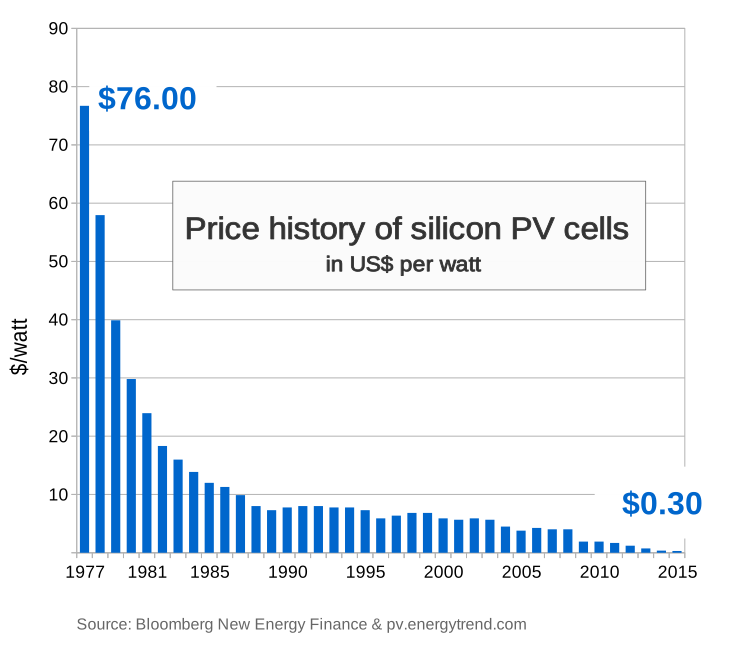

The price decrease is following a pattern that has been given a name: Swanson’s Law, which states that the price drops by about 20% for each doubling in the number of PV cells produced. This law suggests that the prices of solar PV energy will continue to decline in the future.
This brings us to an important question — how does the cost of solar energy compare to other sources of energy? Energy economists have come up with a good way of comparing these costs by adding up all of the costs related to producing energy at some utility-scale power plant (a big wind farm, a big solar PV array, a CSP plant, a nuclear plant, a gas or coal-burning power plant). This is called the levelized cost of energy, and you get it by taking the sum of construction costs, operation and maintenance costs, and fuel costs over the lifetime of a plant and then dividing that by the sum of all the energy produced by the plant over its lifetime. This cost provides us with a way of comparing the energy from different sources. Since the boom in natural gas production due to fracking, natural gas has been the lowest cost form of energy (which is why coal is being used less and less), but energy from solar and wind have been decreasing rapidly, as can be seen in the following graph. When a renewable electrical energy resource such as solar or wind becomes equal in cost to the cheapest fossil fuel source of electricity, we say that the renewable resource has reached "grid parity". Once grid parity is achieved, the renewable resource makes sense from a purely economic standpoint, and as it drops below the grid parity point, it is the smartest electrical energy resource.

This line graph displays the levelized cost of energy (LCOE) for solar, wind, and natural gas from 2008 to 2018 in 2018 dollars per megawatt-hour (MWh). The LCOE represents the total cost of generating electricity from each source, considering installation, maintenance, and fuel costs.
Key Observations:
Solar Energy (Red Line)
-
- In 2008, the LCOE for solar was about $180 per MWh, the highest of the three energy sources.
- The cost declined rapidly over the years, reaching approximately $40 per MWh by 2016.
- By 2018, solar became the cheapest energy source at under $30 per MWh.
- The decline reflects advances in solar panel technology, manufacturing efficiency, and increased adoption.
Wind Energy (Green Line)
-
- The cost of wind energy fluctuated between $60–80 per MWh from 2008 to 2010.
- After 2010, wind costs began to decline, reaching a low of about $20 per MWh in 2018.
- The drop can be attributed to larger and more efficient wind turbines, better grid integration, and falling installation costs.
Natural Gas (Blue Line)
-
- The LCOE for natural gas remained relatively stable, fluctuating between $40-60 per MWh over the period.
- Natural gas was cheaper than solar for most of the timeline but was surpassed by both solar and wind by 2018.
- The stability of natural gas prices is due to fuel costs, infrastructure maintenance, and policy factors.
Overall Trends:
- Solar energy saw the most dramatic cost reduction, making it one of the cheapest electricity sources by 2018.
- Wind energy also experienced a significant drop, becoming the least expensive energy source by 2018.
- Natural gas remained relatively stable, but was no longer the most cost-effective option by the end of the period.
Part of the reason that solar and wind have expanded in recent years has to do with government policies — a number of countries have instituted subsidy and incentive programs that offset a large portion of the construction/installation costs of solar and wind technologies or devise rules that otherwise give advantages to electricity generation from renewables. Subsidies enacted in various countries have included feed-in tariffs (which guarantee an above-market sales price for solar power); rebates (which directly offset capital and installation costs); and favorable tax treatment (which is like an indirect feed-in tariff). Germany has one of the world’s largest Solar PV markets not because it has the best solar resource on earth but because it has been willing to support a generous feed-in tariff on solar power. (For many years the tariff was over 30 cents per kilowatt-hour, or more than five times the average power price in the United States; in recent years the tariff has been reduced.) These government policies have effectively stimulated the growth of these renewable energy resources, which has, in turn, resulted in lower prices.